
This post contains affiliate links. If you buy through one we may earn a commission at no extra cost to you. As an Amazon Associate I earn from qualifying purchases.
Quick answer
An indoor dog playpen needs panel height that clears your dog’s standing reach by several inches, a floor surface that matches carpet or hardwood, and a double-action latch your dog cannot nose open. Get those three details right and nearly any brand on the market will hold a dog safely for short, supervised stretches.
Key takeaways
- Panel height under 24 inches lets many medium dogs clear it, according to buyer guidance from Chewy’s playpen roundup.
- The FXW Rollick 8-panel pen runs 24 inches tall and ships in a configurable set, making it a flexible option for an indoor dog playpen in a shared living space.
- The IRIS USA 4-Panel Dog Playpen is a compact white enclosure built for smaller dogs and apartment rooms.
- The Amazon Basics Octagonal Metal Playpen uses 8 panels at 30 inches for a small-dog footprint with a single door.
- Child-safety standards like ASTM F1004-19 apply to gates for children, not dog pens, so don’t assume certification crossover between the two product categories.
- Forbes’ coverage of dog pens recommends short supervised sessions before leaving a dog alone in any enclosure.
- Freestanding pens can tip if a dog leans or jumps against one side, so anchoring to a wall or solid surface matters more than most buyers expect.
- An indoor dog playpen is not a crate substitute for every dog: confirmed climbers and heavy chewers need different containment entirely.
Affiliate disclosure
This article includes Amazon affiliate links. Price bands are approximate and checked November 2026; they are not live Amazon prices. We earn a commission on qualifying purchases at no extra cost to you.

What is an indoor dog playpen
An indoor dog playpen is a freestanding panel enclosure that gives a dog room to move, rest, and play inside the house without full access to a room. It trades the escape resistance of a crate for open floor space, and it encloses on all sides instead of blocking a single doorway like a baby gate does.
Most pens arrive as connected panels, usually 4 to 8 of them, made from wire metal, molded plastic, or a plastic-metal hybrid. Panels link with pins or hinge clips to form a square, rectangle, or octagon shape. Some fold flat for storage or travel, which matters if weekend plans include an RV trip or a stay at a relative’s house.
For someone managing a senior dog’s mobility or a puppy’s chewing phase, an indoor dog playpen does one job: it holds the dog in a safe spot while you cook dinner, work from the kitchen table, or step into the shower for ten minutes. A reasonable sizing rule is that a puppy playpen should offer enough floor area for a bed, a water bowl, and a few steps of movement, with panels tall enough that the puppy cannot climb or jump free as it grows into an adult dog. Chewy’s buying guidance specifically flags that taller panels matter more once a puppy gets confident with jumping, usually somewhere between four and seven months old.
This guide covers enclosed panel pens only. A doorway-only barrier is a separate product category, and nighttime crying in a crate is a different problem answered elsewhere, not here. If you’re still deciding between a crate and a pen for a new puppy, the commands guide for new puppies covers some of the groundwork training that makes either option easier to manage.
Panels, floors and latch design
The three things that actually decide whether an indoor dog playpen holds a dog are panel rigidity, floor contact, and latch type, not the total panel count printed on the box. A pen with eight thin panels and a cheap hook latch will fail faster than a four-panel pen with heavy-gauge wire and a spring-loaded lock.
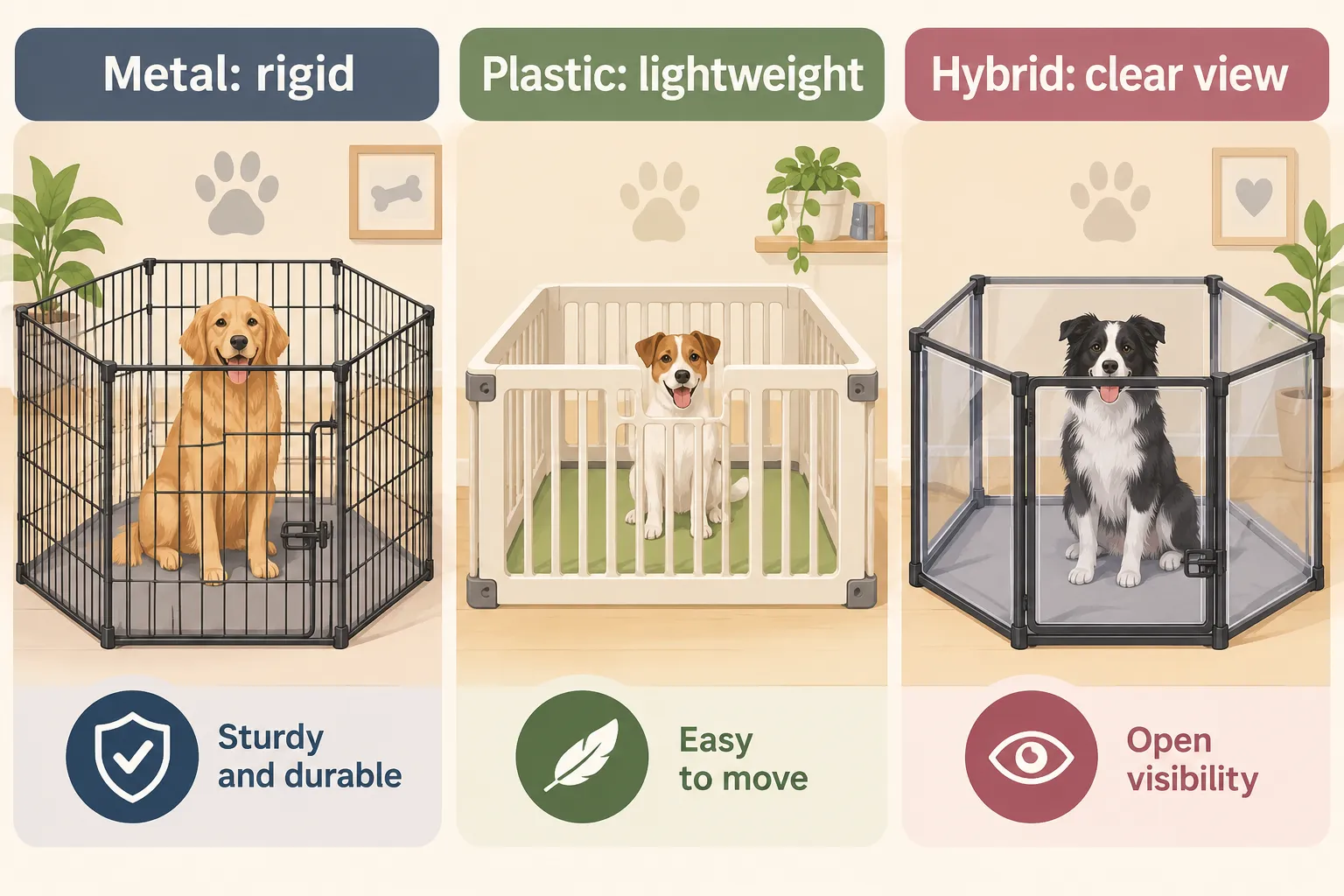
Panels. Wire metal panels resist bending and hold their shape under a dog leaning against them repeatedly. Plastic panels are lighter and quieter when a dog bumps them, but they can bow outward if a large dog pushes on the same spot over weeks. Hybrid panels, like the acrylic-and-metal combination seen on some FXW models, aim for a clear view through the pen plus a rigid metal frame underneath the acrylic sheeting.
Floors. A playpen floor option, usually a tray or a washable mat insert, matters most for house-training puppies and for protecting hardwood or laminate from scratches and accidents. Without a floor panel, the existing flooring in the room has to absorb every spill and every set of nails scrabbling for grip. Safety guidance on playpen setup recommends a level, stable surface and checking that panel spacing stays narrow enough that paws and heads cannot slip through the gaps.
Latches. A loose hook-and-eye latch is the weak point in most budget pens. A double-action latch, meaning a spring-loaded bolt plus a secondary lock that a dog’s nose cannot trip on the first or second try, is the stronger design by current safety standards. The door should sit flush against the frame and close fully, not rest at an angle where a nose or paw can wedge it open over time.
Decision rule: if your dog leans its full body weight on fences during walks or paws at doors at home, skip wire panels under 20 inches and skip single-hook latches entirely. Those two habits predict escape attempts more reliably than breed or age alone.
What size indoor dog playpen do I need for my dog
The right size for an indoor dog playpen depends on your dog’s weight, shoulder height, and how much it likes to jump, not just the number of panels in the box. As a rough floor-space estimate, plan for at least 4 square feet per 20 pounds of dog, enough room for a bed, a water bowl, and a few steps without the dog feeling boxed in.
For panel height, add 6 inches above your dog’s shoulder height if the dog is a calm, non-jumping type. Add 12 to 14 inches above shoulder height if the dog jumps at fences, counters, or doors already. A 15-inch shoulder-height dog that doesn’t jump is usually fine behind a 24-inch panel. The same dog that regularly jumps onto furniture needs something closer to 30 inches, which is where the Amazon Basics Octagonal Metal Playpen’s panel height becomes relevant.
Common mistake: buying based on panel count alone. An 8-panel pen folded into a tight square gives the same cramped area as a 4-panel pen stretched wide. Measure the actual footprint in square feet, not the panel number printed on the packaging.
How long can a dog stay in a playpen safely
A healthy adult dog can typically stay in an indoor dog playpen for 3 to 4 hours at a stretch during the day, provided it has water, has already relieved itself, and isn’t showing signs of distress. Puppies need shorter stretches, often capped around 1 to 2 hours depending on bladder control at their age.
The American Kennel Club’s guidance on playpens recommends staying nearby during early use to confirm the pen is locked and holding as expected, rather than leaving a dog alone in a new enclosure on day one. Overnight use in a pen is more debated than daytime use; many trainers prefer a crate overnight because it offers a smaller, den-like space that can support better sleep, while a pen suits daytime containment when the owner is home but occupied.
Edge case: a dog recovering from surgery or managing a mobility issue may need longer stretches in a pen under veterinary guidance, but that’s a different use case than routine daytime containment and should be planned with a vet, not guessed at.
Best indoor dog playpen for large dogs
Large dogs need taller panels, heavier-gauge wire, and a wider footprint than the compact models built for small breeds. For a dog over 50 pounds, look for panels at least 34 to 36 inches tall, a metal gauge thick enough to resist bending under a full-body lean, and a locking mechanism rated for sustained pressure rather than occasional nudging.
None of the three models compared in this guide are ideal for a large or giant breed on their own; the FXW Rollick at 24 inches and the Amazon Basics Octagonal at 30 inches both suit small-to-medium dogs better than large ones. For large-breed households, check the manufacturer’s weight rating directly rather than assuming a taller-looking pen automatically handles more weight. A dog that can rest its front paws on a 30-inch panel and still have headroom above it is a dog that can likely climb out eventually, which is the exact failure mode large-breed owners report most often.
Indoor playpen vs crate for dogs: which is better
A crate offers stronger escape resistance and a smaller, calming space; an indoor dog playpen offers more room to move, stretch, and play. Neither one replaces the other completely, and many households end up using both for different situations.
- Choose a crate if your dog needs to travel, needs a secure overnight space, or is actively working through separation anxiety with a trainer.
- Choose an indoor dog playpen if your dog needs daytime containment with room to stand, turn around, and reach a water bowl without feeling confined.
- Use both if you have a puppy: crate for sleep and car travel, pen for supervised daytime stretches in the kitchen or living room.
Common mistake: treating a playpen as a full substitute for crate training. A dog that never learns to settle in a crate may struggle later with vet stays, boarding, or travel, situations where a playpen typically isn’t an option.
Why is my dog escaping the playpen
Dogs escape indoor dog playpens for three main reasons: the panels are too short for their jump height, the latch is weak enough to nose open, or the pen isn’t anchored and shifts enough to create a gap. Figuring out which of the three applies determines the fix.
- Jumping over: if the dog clears the top panel cleanly, the fix is height, not a stronger latch. Move to a taller pen or add a top cover panel if the brand offers one.
- Pushing through a gap: if connectors aren’t fully seated, a paw or snout can wedge a gap open. Check every connection point before each use, a step flagged repeatedly in safety guidance for pen assembly.
- Working the latch: if the dog paws or noses the latch open specifically, a single hook latch needs replacing with a double-action lock.
- Tipping the whole pen: if the dog pushes the entire structure over rather than climbing it, anchoring to a wall or using corner straps solves the problem.
Edge case: if your dog already escaped a similar pen once, assume it will try the same move again. Dogs repeat successful escapes, so a latch that failed once needs replacing outright, not just re-closing and hoping.
Top 5 features that decide the purchase
The five features worth checking before buying any this indoor playpen are panel height, latch type, floor grip, footprint area, and panel material. Get these right and brand name matters far less than most reviews suggest.
- Panel height. The FXW Rollick Dog Playpen offers 24-inch panels, a reasonable middle ground for dogs under medium-large size that aren’t determined climbers.
- Latch type. Look for a secondary lock, not a single swing hook, especially if a dog has pulled a latch open before.
- Floor grip. The IRIS USA 4-Panel pen’s compact footprint makes it easier to anchor on carpet with grip pads, since smaller pens flex less under pressure than wide ones.
- Footprint area. The Amazon Basics Octagonal Metal Playpen’s 8-panel, 30-inch configuration gives small dogs more turning room than a 4-panel square of similar panel count.
- Panel material. Metal resists bending under pressure; plastic is lighter for carrying between rooms but can warp with a heavy leaner over time.
Doggy Rank IQ Tool
Playpen Escape Risk Checker

Panel count is the wrong number. Height, latch and anchoring are what keep a dog in.
Cheapest indoor dog playpens under 100 dollars
Several this indoor playpen models stay under the $100 mark without sacrificing basic safety features, as long as the shopper checks latch quality and panel gauge rather than buying on price alone. The IRIS USA 4-Panel Dog Playpen, priced around $40 to $60, is the clearest budget pick in this lineup and suits small or senior dogs in a condo or apartment setting.

The Amazon Basics Octagonal Metal Playpen, priced around $50 to $75, adds four more panels and six more inches of height than the IRIS model while staying under $100, which makes it a reasonable middle option for a small dog that jumps more than average. The FXW Rollick runs slightly higher, often $90 to $120 depending on configuration, but still lands near the budget end for an 8-panel metal set with acrylic viewing panels.
Common mistake: choosing the cheapest option without checking the latch type, since a weak latch on an otherwise sturdy pen undermines the entire purchase. Pet Tracker Lab’s playpen comparisons note that latch quality varies more between budget models than panel material does, so it’s worth reading the specific latch description before adding to cart.
How to train a puppy to use a playpen
Puppies learn to accept an this indoor playpen fastest through short, positive sessions rather than being placed inside for long stretches on day one. Start with the pen set up in a room the puppy already spends time in, door open, treats scattered inside, and let the puppy wander in and out on its own for the first day or two.
- Place the pen in a familiar room and toss a few treats or a favorite toy inside, door left open.
- Once the puppy goes in voluntarily, close the door for 2 to 3 minutes while staying in the room.
- Gradually extend time to 15 to 20 minutes over several days, staying nearby but not hovering.
- Add short absences from the room, starting with a minute or two, before building toward longer unsupervised stretches.
- Keep the same bed, water bowl, and a chew toy inside each session so the pen feels familiar rather than punitive.
Forbes’ pet behavior coverage recommends several short supervised sessions before leaving any dog alone in a pen, a step that applies just as much to puppies as adult dogs new to confinement. If your puppy is also working on basic obedience, pairing playpen training with the groundwork in the essential commands guide tends to speed up both processes, since a puppy that already responds to a release cue settles into a pen routine faster.
Best portable foldable dog playpen for apartments
Apartment living usually calls for a pen that folds flat for storage, sets up without tools, and doesn’t dominate a small room’s floor plan. The IRIS USA 4-Panel Dog Playpen fits this brief well: its 4-panel build is lighter to carry between rooms than an 8-panel set, and its compact footprint suits a corner of a studio or one-bedroom apartment without blocking walkways.
For renters who also want RV or travel flexibility, the FXW Rollick’s 8-panel configuration folds down for transport and can be reconfigured into a smaller shape when floor space is tight, making it a reasonable dual-purpose pick for someone who splits time between an apartment and a vehicle. CNN Underscored’s review of dog pens notes that foldability and tool-free assembly are among the features apartment dwellers prioritize most, often ranking them above raw size.
Indoor dog playpen for destructive chewers
A heavy chewer needs metal panels, not plastic ones, and ideally a pen without exposed plastic trim a dog can work loose with repeated chewing. Chewed plastic edges can splinter and create a choking or ingestion risk, while metal panels hold up far better against teeth over months of daily use.
If a dog chews at the base of panels specifically, adding a floor tray that extends slightly beyond the panel line can reduce direct access to the bottom edge. For dogs that chew through anything left inside the pen, limit toys to rated chew-resistant options and skip soft bedding until the chewing phase settles, since destroyed bedding is both a mess and a potential blockage hazard if swallowed. A pen alone doesn’t solve a serious chewing problem; pairing containment with the grooming and care routines covered in the beginner’s grooming guide can help address redirected chewing tied to boredom or excess energy.
Can you use a playpen instead of a dog crate
A playpen can replace a crate for daytime containment in many households, but it’s a weaker substitute for travel, overnight confinement, or situations requiring strong escape resistance. The two products solve different problems: a crate is built for security in a small space, while an this indoor playpen is built for room to move inside a larger enclosed area.
Dogs that need car travel confinement, airline travel, or boarding stays generally still need a crate, since most of those settings require a hard-sided, fully enclosed unit rather than an open-top pen. For daytime use at home while an owner works nearby or runs errands close by, a playpen is often the more comfortable option for the dog, offering standing and turning room a crate can’t match.
Do indoor playpens work for adult dogs
Yes, this indoor playpens work well for adult dogs, particularly for recovery periods after surgery, for managing introductions between a new dog and existing pets, or for containing an adult dog during home repairs or visitors. The sizing rules are the same as for puppies: match panel height to standing reach, not just shoulder height, and check latch strength against how determined the individual dog is.

Adult dogs that never used a pen as puppies may need the same gradual introduction process described earlier, since unfamiliar enclosed spaces can trigger mild stress in a dog that’s never been confined before. Short sessions with treats and a familiar bed inside the pen usually build comfort within a few days for most adult dogs.
How to stop my dog from jumping out of the playpen
Stopping a dog from jumping out of an this indoor playpen usually means increasing panel height first and addressing the underlying jumping habit second. If a dog already clears the current panel height cleanly, no training trick fixes that gap; a taller pen or a covered top panel is the direct solution.
- Measure the dog’s standing reach (back legs on ground, front paws raised) rather than just shoulder height, since that reach is closer to actual jump capability.
- Add 12 to 14 inches above that reach measurement when shopping for a replacement pen.
- Consider a covered pen with a mesh or wire top panel for dogs under about 25 pounds, since many small-breed covered pens exist at reasonable prices.
- For dogs over 30 pounds that jump consistently, a crate may be the more realistic containment tool rather than any open-top pen on the market.
Decision rule: if a dog jumps out twice within the same week despite a height upgrade, treat that dog as a crate candidate rather than continuing to shop for taller pens.
What should I put inside a dog playpen
A functional this indoor playpen setup includes a bed or mat, a secured water bowl, one or two safe chew toys, and a floor covering appropriate to the dog’s house-training stage. Puppies still working on house-training benefit from a washable pad covering part of the floor, separate from the sleeping area, so accidents don’t soak into bedding.
- Bed or mat: something washable and sized to the pen, not oversized enough to block movement.
- Water bowl: a non-tip or clip-on style prevents spills that create slip hazards on hard flooring.
- Chew toys: one or two rated for the dog’s size and chew strength, rotated periodically to reduce boredom.
- Floor covering: a grip mat on hardwood or tile, a washable pad for puppies still training, and nothing on carpet beyond a cleanup mat if accidents are a concern.
Avoid overcrowding the pen with toys and blankets, since excess material makes it harder to spot accidents quickly and gives some dogs more material to shred out of boredom.
Who should fit which indoor dog playpen
The best this indoor playpen depends on a dog’s size, climbing tendency, and the household’s flooring, more than on brand reputation alone.
- Choose the IRIS USA 4-Panel Dog Playpen rel=”sponsored nofollow” if you have a small or senior dog, limited floor space, and want the budget pick for a quiet corner of a condo or apartment.
- Choose the FXW Rollick Dog Playpen rel=”sponsored nofollow” if you split time between home and RV travel, or want a larger footprint with 8 configurable panels.
- Choose the Amazon Basics Octagonal Metal Playpen rel=”sponsored nofollow” if your dog is a known jumper but still small to medium, since 30 inches of height buys extra margin.
For large or giant-breed dogs, check the dimensions against your dog’s standing reach, not just the stated height. A dog that rests its front paws on a 30-inch panel and still has headroom above it is a dog likely to climb out eventually with enough practice.
Things to watch out for
A few failures show up repeatedly with any this indoor playpen, and most trace back to setup, not the product itself.
- Sliding on hardwood or tile. A pen with no rubber feet or anchoring will walk across a smooth floor as a dog leans on it. A rubber-backed mat or interlocking foam tiles under the pen reduces this, a fix echoed in Forbes’ coverage of dog pen reviews.
- Latch popping under repeated pressure. A single hook latch wears loose over months of a dog nosing it. Check the latch monthly, not just at initial setup.
- Gaps at panel joints. Connectors that aren’t fully seated leave a gap wide enough for a paw or snout. Check every connection before use, especially after moving the pen between rooms.
- No floor insert on carpet. Carpet traps odor and stains without a washable mat underneath, which matters most during house-training.
- Freestanding pens that tip. Gates and pens can be knocked over easily if not against a wall or anchored, a real risk with an enthusiastic jumper or a dog that paces the perimeter.
Who should skip this
An this indoor playpen is not the right tool for every situation, and it’s worth saying so plainly rather than overselling the product category.
- Skip it if your dog is a confirmed climber or jumper over 30 inches. No panel height in this lineup fully stops a determined athletic dog; a crate or a covered pen with a top panel suits that dog better.
- Skip the IRIS USA 4-Panel pen if you have a large dog. Its compact build suits small dogs, not dogs over roughly 40 pounds leaning on panels daily.
- Skip any wire pen on slick tile without anchoring. The pen will shift, and a shifting enclosure undermines the entire point of containment.
- Skip long unsupervised stretches in any pen for a new puppy. Staying nearby during early use confirms the pen is locked and holding as expected.
- Skip a plastic pen for a heavy chewer. Chewed plastic edges can splinter; metal panels hold up better against teeth over time.
Interactive element
Escape-Risk Checker
function cgCheck(){ var h=parseInt(document.getElementById(‘cgh’).value)||0; var j=document.getElementById(‘cgj’).value; var f=document.getElementById(‘cgf’).value; var minHeight = j===’yes’? h+14: h+6; var latch = j===’yes’? ‘double-action lock required’: ‘standard secondary latch okay’; var anchor = f===’hardwood’? ‘yes, use a grip mat or straps’: ‘optional, mat still helps with mess’; document.getElementById(‘cgResult’).innerHTML = ‘Minimum panel height: ‘+minHeight+’ inchesLatch type: ‘+latch+’
Anchoring needed: ‘+anchor; }
| Model | Panels | Height | Price band | Best for |
|---|---|---|---|---|
| FXW Rollick Dog Playpen | 8 panels | 24 inches | around $90 to $120 | medium dogs, indoor/RV use |
| IRIS USA 4-Panel Dog Playpen | 4 panels | around 24 inches | around $40 to $60 | small dogs, apartments |
| Amazon Basics Octagonal Metal Playpen | 8 panels | 30 inches | around $50 to $75 | small-to-medium jumpers |
FAQ
Q: What is the best this indoor playpen for a puppy? A pen with floor coverage, panels at least a few inches taller than the puppy’s expected adult shoulder height, and a latch the puppy can’t nose open works best for most households. The IRIS USA 4-Panel Dog Playpen suits small-breed puppies in apartments specifically.
Q: How tall should a playpen be so a dog cannot jump out? Panel height should exceed the dog’s standing reach by several inches, not just its shoulder height. Jumpers and climbers generally need 30 inches or more, the range seen on the Amazon Basics Octagonal pen.
Q: Do this indoor playpens slide on hardwood floors? Yes, unanchored pens can shift when a dog leans on them. A rubber-backed mat or foam tiles under the pen reduces sliding, a fix recommended in Forbes’ review of dog pens.
Q: Can a large dog use an indoor playpen? A large dog can use a taller, sturdier metal pen rated for its weight, but compact models like the IRIS USA 4-Panel pen are built for smaller dogs and may flex under a large dog’s weight over time.
Q: How many panels do I need for an this indoor playpen? Panel count matters less than total footprint. An 8-panel pen arranged into a tight shape can offer the same space as a 4-panel pen stretched wider, so measure square footage rather than counting panels.
Q: Is a soft-sided playpen a good option indoors? Soft-sided pens suit calm, non-chewing dogs in controlled indoor settings, according to Chewy’s roundup of soft-sided playpens, but they offer less structure than wire or hybrid panels for dogs that push or chew.
Q: Can I leave my dog in a playpen overnight? Overnight use is possible for some adult dogs but most trainers prefer a crate overnight for better sleep structure, reserving the pen for supervised daytime stretches instead.
Q: What’s the difference between a playpen and an exercise pen? The terms are largely interchangeable in the pet product market; both describe a freestanding panel enclosure, sometimes marketed as “ex-pen” for outdoor-rated versions and “playpen” for indoor-focused models.