
This post contains affiliate links. If you buy through one we may earn a commission at no extra cost to you. As an Amazon Associate I earn from qualifying purchases.
Best dog stroller: Quick answer
The best dog stroller for most owners is the one that matches three numbers: your dog’s body length and width while lying flat, your trunk’s interior space once the frame is folded, and the terrain you actually walk on. A stroller with a high weight rating can still be the wrong pick if the cabin is too narrow for your dog to stretch out, so measure before you shop rather than sorting listings by capacity alone.
Key Takeaways
- The Pet Gear AT3 No-Zip is a frequently recommended overall pick for dogs up to 75 pounds, but it measures a roomy 35 x 28.5 x 42 inches unfolded, more outdoor hauler than compact travel stroller according to Forbes.
- The WonderFold Bella AutoFold folds to 25.2 x 19.7 x 14.6 inches with a one-hand fold and a stated 66-pound carrier capacity, priced around $199.99 on Target as of November 6, 2026.
- A stroller rated for 45 pounds can still be too narrow for a 45-pound dog to lie flat, because weight capacity and interior cabin space are measured separately, a point the American Kennel Club raises when comparing models.
- Measure your dog’s length from nose to tail base and shoulder width while lying down before comparing against any stroller’s interior dimensions, not just the weight label.
- Mesh ventilation on at least two sides plus a top panel matters more in warm climates than most buyers expect; a single small window can trap heat even in shade.
- No universal airline rule governs dog stroller folded size; airlines regulate the detachable pet carrier, not the stroller frame, so check your airline directly before flying.
- Entry-level folding strollers in the $40 to $90 band, including BestPet and MoNiBloom, suit short walks and errands better than daily multi-mile outings.
- Consumer Reports and Wirecutter both note that fold mechanism quality, not fabric, is the most common long-term complaint in pet stroller reviews.

Affiliate disclosure
This article contains affiliate links to Amazon. If you buy through one of them, this site may earn a small commission at no extra cost to you. Products are chosen based on fit, construction, and documented specifications, not commission size.
Best dog stroller
The best dog stroller for most owners balances three measurements: your dog’s actual body length and width lying flat, your trunk’s interior space once the frame is folded, and the terrain you’ll actually push it over. Get those three numbers before you look at a single listing.
Here’s where most searches go sideways. People type “best dog stroller” and land on whatever has the highest weight capacity number in the title. Weight capacity tells you what the frame can support. It tells you nothing about whether a 28-pound French Bulldog with a long torso can lie flat without curling into a comma shape for the whole walk.
Dog strollers exist for a specific set of situations: a senior dog with joint pain who still wants to be outside, a small breed recovering from surgery, a multi-dog household where one dog walks and one rides, or an owner managing a dog that cannot handle sidewalk distances anymore. They are not a replacement for walking a healthy dog. If your dog can walk, let it walk, since regular movement also supports the kind of enrichment and training that keeps a dog mentally engaged. The stroller comes out when walking stops being the right option for part of the outing.
Three practical categories cover almost every buyer: compact folding strollers for small dogs under 30 pounds, mid-size three-wheel strollers for medium dogs up to around 50 pounds, and heavy-duty all-terrain frames for larger dogs or multi-dog setups. Check current availability for the best-fit model in your dog’s actual size range before comparing features further down this guide. This article stays focused on the stroller itself. For food, training, or breed questions that come up once the stroller is home, the related guides linked throughout cover those separately.
Doggy Rank IQ Tool
Dog Stroller Fit Calculator

Enter the dog and your trunk. You get the cabin size, folded limit and wheel type for where you go.
Cabin Size and Folded Fit
A stroller’s cabin size and its folded size are two different measurements, and the gap between them is where most buyers get surprised at the car. A roomy interior often requires a tall frame, and a tall frame does not always collapse into something that slides easily into a sedan trunk.
The WonderFold Bella AutoFold is a useful example of how this trade-off plays out. It opens to 34.6 inches long by 19.7 inches wide by 39 inches high, giving a medium dog enough room to turn around, but it folds down to a comparatively compact 25.2 x 19.7 x 14.6 inches with a one-hand mechanism and a self-standing folded position. That’s a meaningfully smaller footprint than many three-wheel joggers once collapsed, and it’s part of why this model shows up repeatedly in travel-focused buying guides.
Compare that against the Pet Gear AT3 No-Zip, a frequently cited overall pick for 2026 according to Forbes. It’s built for dogs up to 75 pounds and earns praise for stability and maneuvering, but its unfolded dimensions run 35 x 28.5 x 42 inches, closer to a jogging stroller than a compact travel unit. Neither stroller is wrong. They solve different problems: the Bella solves trunk space, the AT3 solves large-dog stability on uneven ground.
Choose the cabin-size route if you have a small to mid-size dog and limited trunk or closet space. Choose the larger frame if you have a bigger dog and the vehicle to carry it. No source in this guide documents a formal airline-approved cabin dimension standard for stroller frames specifically; airlines regulate the detachable pet carrier portion, so confirm with your airline directly rather than trusting a listing’s “airline approved” label, a caution also raised by NBC Select.

What’s the difference between a dog stroller and a pet carrier
A dog stroller is a wheeled frame meant to carry a dog over distance on the ground, while a pet carrier is a bag or box designed to be lifted, worn, or placed under an airline seat. The two overlap when a stroller has a removable carrier insert, but they are not interchangeable products.
A carrier alone works for a quick vet visit, a short flight, or carrying a small dog through a crowded store. A stroller works for longer outings where you need your hands free and your dog needs to lie down or sit up comfortably for thirty minutes or more. Some models, like the Zoosky 3 in 1, blur the line by offering a carrier that detaches from the stroller frame, which is useful if you need to carry your dog the last stretch into a building where wheels aren’t practical. If your dog only needs occasional lifting and short trips, a carrier is cheaper and easier to store than a full best dog stroller setup.
How much should you spend on a good dog stroller
Expect to spend somewhere between $40 and $220 depending on size, fold mechanism, and build quality, with most reliable mid-range options landing between $70 and $120. Spending more usually buys a better fold, lighter frame material, and sturdier wheels rather than a bigger weight rating.
- $40 to $60: basic folding frames like the BestPet model, fine for small dogs and short errands.
- $50 to $80: step-up options like the MoNiBloom Pet Stroller, with mesh sides and a compact fold for dogs and cats up to 33 pounds.
- $70 to $110: multi-function builds like the Zoosky 3 in 1, which adds a detachable carrier.
- $190 to $220: premium one-hand-fold frames like the WonderFold Bella AutoFold, built for owners who fold and unfold daily and need the smallest possible stored footprint.
- $250 and up: heavy-duty all-terrain frames in AT3 territory, built for larger dogs and rougher ground rather than portability.
A decision rule that holds up in practice: if you’re not sure your dog will tolerate a stroller at all, start at the $40 to $60 tier. If your dog already rides calmly in a car carrier or wagon, it’s reasonable to invest in a $150-plus model right away.
Best dog stroller for small breeds
The best dog stroller for small breeds under 30 pounds is a compact folding frame with a low entry lip and mesh on at least two sides, since small dogs overheat faster in an enclosed cabin than people expect. The MoNiBloom Pet Stroller covers dogs and cats up to 33 pounds and keeps ventilation on multiple panels, which makes it a common pick for Chihuahuas, Pomeranians, and small terrier mixes doing neighborhood loops.
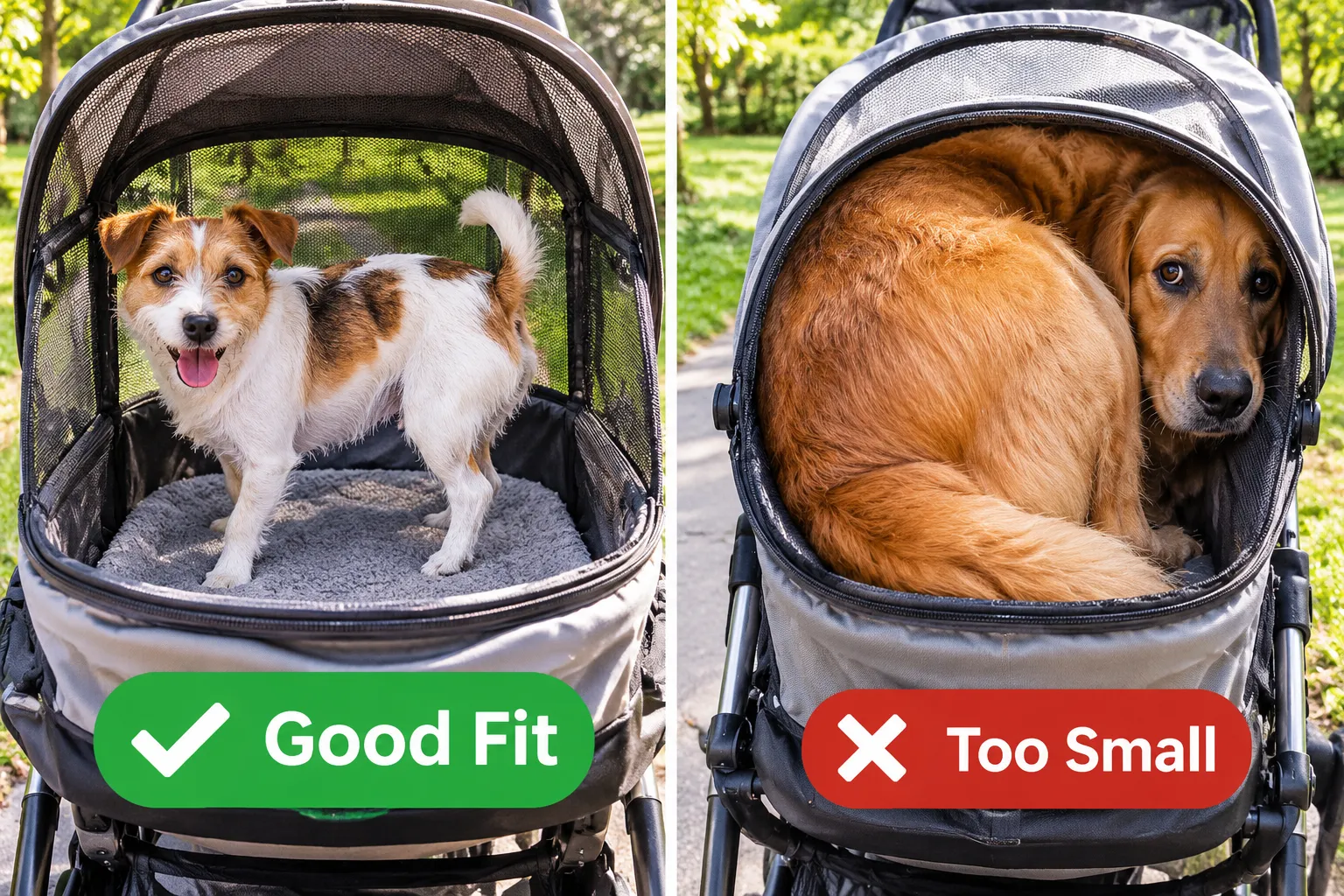
Small-breed owners should still check interior length against the dog’s actual nose-to-tail measurement, not just weight. A 9-pound Yorkie with a long back can still feel cramped in a cabin sized for a stockier 15-pound dog of the same weight class. The American Kennel Club recommends choosing a stroller that lets the dog stand, turn, and lie down without touching all four walls.
Best dog stroller for large dogs
The best dog stroller for large dogs, generally 50 pounds and up, is a wider, taller all-terrain frame rather than anything marketed as compact or travel-friendly. The Pet Gear AT3 No-Zip is built for dogs up to 75 pounds and uses a sturdier frame than smaller folding models, but it stays bulky even collapsed at roughly 35 x 28.5 x 42 inches unfolded.
Large-dog owners should also check their own strength and the stroller’s wheel size. A heavier dog shifting weight mid-ride puts more stress on a cheap wheel axle, which is why budget frames rarely rate above 40 to 50 pounds. If you’re shopping for a giant breed specifically, it helps to first understand what qualifies as a giant breed, since most strollers on the market, regardless of their printed capacity, are undersized for dogs over 80 pounds.
Dog stroller for hiking and trails
A dog stroller built for hiking or trail walking needs a locking front wheel, larger diameter tires, and a suspension system, not the small free-swivel caster wheels found on sidewalk strollers. A locked, straight-tracking wheel resists catching on roots and loose gravel in a way that a swivel wheel cannot.
Three-wheel jogging-style frames, including the AT3, tend to perform better here than compact four-wheel folding models. If your routine includes dirt paths, uneven sidewalks, or light trail walking more than twice a week, prioritize wheel type and ground clearance over folded size. A stroller that folds small but tips over on a curb cut isn’t saving you anything.
Do i really need a dog stroller
Most healthy dogs do not need a stroller, and buying one for a dog that can comfortably walk its usual distance skips a real benefit: the exercise and mental stimulation that walking provides. A stroller earns its place when walking is no longer the right option for part or all of an outing.
Good reasons to buy one: a senior dog with arthritis who tires after a block but still wants to be outside, a dog recovering from surgery who can’t bear weight yet, a small dog alongside a larger walking dog on the same outing, or a dog with a heart or respiratory condition that limits exertion. Buying a stroller purely for convenience, so you don’t have to stop and let your dog sniff, is a weaker reason and tends to result in a stroller that sits unused in a closet within a few months, something Dogster and other pet outlets flag as a common regret among first-time buyers.
Best dog stroller that folds up small for travel
The best dog stroller that folds up small for travel is one where the folded dimensions are listed with the handle and canopy included, since some listings quote a smaller number by leaving those parts out. The WonderFold Bella AutoFold folds to 25.2 x 19.7 x 14.6 inches, which fits in most sedan trunks and many car closets, making it one of the smaller folded footprints among models reviewed by outlets like Good Housekeeping.
Before buying for a flight specifically, confirm two separate things: whether the airline allows a stroller in checked luggage or as a gate-checked item, and whether the detachable carrier portion meets that airline’s in-cabin pet carrier size limits. These are two different rules, and no stroller manufacturer can guarantee airline approval for the frame itself, a distinction also made by NBC Select.
Can senior or arthritic dogs use strollers
Yes, strollers are one of the more common tools recommended for senior and arthritic dogs who still want time outside but can’t manage their old walking distance. A stroller lets a dog experience fresh air, new smells, and a change of scenery without forcing joints through a painful walk.
For arthritic dogs, prioritize a low entry lip or a removable carrier insert, since stepping up over a tall stroller edge can be as hard on sore joints as walking. The Zoosky 3 in 1’s detachable carrier design works well here because you can lift the dog in and out at ground level rather than requiring a step-up. Padding thickness and a flat (not curved) floor also matter more for senior dogs than cabin size alone.
Lightweight dog stroller options
Lightweight dog stroller options matter most for owners who lift the frame in and out of a car trunk or up stairs regularly, since a few extra pounds of frame weight becomes noticeable after repeated handling. The WonderFold Bella AutoFold frame weighs about 17.6 pounds, which is light for a model rated to carry up to 66 pounds of dog.
Budget folding models like the BestPet tend to be lighter still, often under 15 pounds, because they use thinner aluminum tubing and smaller wheels. The trade-off is durability: a lighter frame generally means a shorter lifespan under daily use on rough pavement. If you mainly use the stroller a few times a month for short outings, the lighter, cheaper frame is the more sensible pick.
Why won’t my dog get in the stroller
Dogs commonly refuse a stroller the first few times because the fabric moves under their feet, the cabin feels enclosed, or they’ve never been introduced to it slowly. This is a training and conditioning issue more than a product defect in most cases.
Steps that work for most dogs:
- Let the stroller sit open and stationary in a familiar room for a few days so the dog can sniff it on its own terms.
- Place treats inside the cabin and let the dog step in and out freely without being pushed or lifted.
- Practice short, stationary sessions of the dog sitting inside with the stroller not moving, rewarding calm behavior.
- Add gentle, slow movement once the dog is relaxed sitting still, starting indoors or in a quiet driveway.
- Build up to real walks gradually, keeping early rides short.
If a dog still resists after consistent short sessions over a week or two, check for a physical issue first, since sudden reluctance can also signal pain. The AKC notes that rushing the introduction is the most common reason owners conclude, incorrectly, that their dog “just doesn’t like” the stroller.
Dog stroller alternatives
A dog stroller is not the only way to move a dog that can’t walk its full route. A soft structured carrier works for small dogs under about 15 pounds who only need to be carried for short stretches. A dog wagon, essentially a pull-behind cart, suits owners moving multiple dogs or gear at once and skips the push-handle design entirely. A sling or front-carry harness suits very small dogs and short distances where a wheeled option is overkill. For dogs that can walk part of the way, a simple harness and a shorter route may solve the problem without buying equipment at all, and a reliable harness fit matters more than people think for dogs with long backs or short legs.
What size stroller do i need for my dog
The right stroller size comes from two measurements taken while your dog lies flat on its side: nose-to-tail-base length and shoulder-to-shoulder width. Add roughly 4 to 6 inches of slack to each number, then compare the result against the stroller’s stated interior cabin dimensions, never its weight capacity alone.
This is the single most common mistake buyers make. A stroller rated for 45 pounds can still be too narrow for a 45-pound dog to lie flat, because weight capacity and interior cabin space are measured and advertised separately by manufacturers. If you’re between two sizes on a listing, size up on cabin dimensions rather than relying on the breed’s “typical” size, since individual dogs within a breed can vary by several inches in length.
Best rated dog strollers on amazon
Among frequently reviewed options on Amazon, the BestPet folding stroller, the MoNiBloom Pet Stroller, and the Zoosky 3 in 1 show up consistently in the $40 to $110 range for small and medium dogs. Pricing and specific models shift over time, so it’s worth checking current listings rather than relying on a fixed ranking.
- BestPet: lightweight folding frame with a lower entry lip, suited to small dogs and short errands, priced around $40 to $60.
- MoNiBloom Pet Stroller: mesh sides and a compact fold for dogs and cats up to 33 pounds, priced around $50 to $80.
- Zoosky 3 in 1: detachable carrier design for owners who need to lift a dog out at ground level, priced around $70 to $110.
How to clean and maintain a dog stroller
Cleaning a dog stroller regularly prevents the two most common failure points: a sticking fold latch and a torn or stained fabric liner. Most fabric liners on folding models are removable and machine washable on a gentle cycle, which keeps hair and odor from building up in the padding.
Maintenance checklist:
- Wipe wheel axles monthly to clear sand, salt, and grit, since buildup there is the leading cause of a stiff or sticking fold.
- Check zippers on any carrier insert for fraying threads before they jam mid-walk.
- Inspect mesh panels for small tears that can widen with repeated stretching.
- Dry the fabric fully before folding and storing to prevent mildew, especially after a wet-weather walk.
- Tighten any loose bolts on the frame every few months, since vibration from regular wheeling loosens hardware over time.
Top 5 Features That Decide the Purchase
Five features separate a stroller that earns its closet space from one that gets listed on Facebook Marketplace within a month.
- Interior cabin length versus dog length. The BestPet folding stroller works for compact breeds because its cabin matches a shorter body, but a long-bodied dog needs the actual nose-to-tail measurement checked against the listing, not the weight rating.
- Folding mechanism simplicity. A one-hand fold like the WonderFold Bella’s matters daily, not just at purchase. A fold that requires two hands and a knee against the frame gets used less over time.
- Wheel type for terrain. Swivel front wheels handle tight sidewalk turns; a locking straight-track front wheel matters for gravel trails or jogging.
- Ventilation coverage. Mesh on two sides plus a top panel keeps the cabin breathable. A single small window can trap heat even in shade.
- Entry lip height. The Zoosky 3 in 1 has a removable carrier, which helps dogs who cannot step up over a tall lip, a detail that matters more for senior and recovering dogs than any spec sheet number.
Comparison table: cabin dimensions, entry lip, and folded size for the best dog stroller picks
| Model | Price band | Best for | Key spec |
|---|---|---|---|
| BestPet | around $40 to $60 | Small dogs, short errands | Lightweight folding frame, lower entry lip |
| MoNiBloom Pet Stroller | around $50 to $80 | Small/medium dogs and cats up to 33 lbs | Mesh sides, compact fold |
| Zoosky 3 in 1 | around $70 to $110 | Owners who need a removable carrier | 3-in-1 design, detachable carrier |
| WonderFold Bella AutoFold | around $190 to $210 | Trunk-space-limited owners | One-hand fold, 66 lb capacity, 17.6 lb frame |
Which pick fits which dog and owner?
Match the stroller to the dog’s actual size and your routine, not to the biggest capacity number on the page.
A 10-pound Chihuahua or Pomeranian owner doing short neighborhood loops does fine with the MoNiBloom, which covers dogs and cats up to 33 pounds and keeps mesh ventilation on multiple sides. A 20 to 30 pound dog recovering from surgery benefits from the Zoosky 3 in 1’s removable carrier, since it avoids forcing a sore dog to climb over a stroller lip. Owners with a larger senior dog, 50 pounds and up, should look toward AT3-style territory rather than any compact frame, since cabin space there is built for bigger bodies. The budget pick for owners testing whether a stroller even gets used is the BestPet, priced around $40 to $60, light enough to try without a major commitment.
Things to Watch Out For
Folding mechanisms are the number one complaint across stroller reviews, not fabric quality or wheel durability, a pattern confirmed by both Consumer Reports and The Spruce Pets.
- A folding latch that sticks after a few uses of salt, sand, or grit in the hinge.
- A stroller advertised with a high weight capacity but a cabin too narrow for that weight class to lie flat.
- Carrier zippers that jam when a dog shifts weight mid-ride.
- Wheels that work fine on sidewalk but bind up on gravel or grass.
- Folded dimensions listed without the handle or canopy included, making the real trunk footprint larger than advertised.
Who Should Skip This
A dog stroller is not the right purchase for every household, and skipping it is sometimes the better call.
- Healthy dogs that can comfortably walk their usual distance don’t need a stroller; regular walking supports enrichment and the human-dog bond better than being wheeled past the same smells.
- Owners without trunk or closet space for even a folded frame should consider a soft carrier instead.
- Large or giant breed owners, see our giant breed size guide, will find most strollers undersized regardless of weight rating.
- Dogs with severe anxiety around enclosed spaces may do worse in a stroller cabin than on a slow, supported walk.
FAQ
Q: What is the best dog stroller for a large dog? The Pet Gear AT3 No-Zip handles dogs up to 75 pounds and is built with a sturdier frame than compact travel strollers, though it measures 35 x 28.5 x 42 inches unfolded, so check your storage space first.
Q: How do you measure a dog for a stroller? Measure nose to tail base for length and shoulder width while the dog lies down, then compare both numbers against the stroller’s interior cabin dimensions, not just its weight rating.
Q: Do dog strollers fold small enough for a car trunk? Some do. The WonderFold Bella AutoFold folds to 25.2 x 19.7 x 14.6 inches, which fits most trunks, while larger all-terrain frames like the AT3 stay bulkier even folded.
Q: Are dog strollers worth it for senior dogs? Yes, for dogs whose joints or stamina limit walking distance but who still benefit from outdoor time, sights, and smells; a stroller lets that continue without forcing a painful walk.
Q: Can two small dogs share one stroller? Only in models rated and sized for double occupancy; check interior width carefully, since two dogs need enough shoulder room each to lie without climbing on one another.
Q: What dog stroller works on gravel trails? Look for a locking front wheel rather than a free-swivel one, since locked tracking performs better on uneven gravel or trail surfaces.
Q: Are jogging dog strollers different? Jogging strollers typically use larger wheels and a straighter, lockable front wheel for stability at speed, compared to the smaller swivel wheels on everyday sidewalk strollers.
Q: How much weight can a dog stroller hold? It varies by model: the WonderFold Bella is rated for 66 pounds, MoNiBloom covers up to 33 pounds, and the Pet Gear AT3 goes up to 75 pounds, but weight rating alone does not guarantee enough cabin length for a long-bodied dog to lie flat.
Q: How do I know if my dog is too big for a stroller? If your dog cannot lie flat with legs extended and turn around inside the cabin, the stroller is too small regardless of what the weight label says; measure cabin length and width against your dog’s body before buying.
Q: Can I use a dog stroller instead of a carrier on a flight? No, most airlines require a separate approved pet carrier for in-cabin travel and treat the stroller frame as checked or gate-checked equipment; confirm size rules with your airline before booking.