
This post contains affiliate links. If you buy through one we may earn a commission at no extra cost to you. As an Amazon Associate I earn from qualifying purchases.
Quick Answer
Dog stairs for bed only work when the top step lands within an inch of your mattress height, including any topper. Measure floor to mattress top first, then match that number to a product’s total rise rather than its step count, since a “4-step” unit can still leave a six-inch gap that forces your dog to jump anyway.
Key Takeaways
- A 2026 sizing approach recommends roughly 4.75 to 5.25 inches per step for small dogs and about 7 inches per step for medium or large dogs, based on comparative stair reviews from The Spruce Pets.
- For an 18 inch bed, that works out to about 4 small-dog steps or 3 medium/large-dog steps; at 30 inches, closer to 6 or 5 steps.
- Veterinary guidance from VCA Animal Hospitals notes that an unguarded edge or unstable base is a real fall risk for dogs with limited mobility.
- Senior-dog guidance favors tread depths of 9 to 12 inches so a paw lands flat instead of balancing on an edge.
- Dogs with arthritis or degenerative joint disease often do better with a ramp than with stairs, according to VCA’s osteoarthritis guidance and the AKC’s stairs versus ramps comparison.
- Sudden refusal to climb, yelping, or limping calls for a vet visit, not just a taller product; this matches the flare-up signs described by VCA’s arthritis symptom guide.
- Love’s cabin Dog Stairs for High Bed holds up to 200 lbs across 3 foldable steps, a relevant option for multi-dog or larger households.
Affiliate disclosure line
This article contains affiliate links to Amazon. If you purchase through one of these links, this site may earn a commission at no additional cost to you. Product selection and this article’s conclusions are not influenced by commission size.
Dog stairs for bed
Dog stairs for bed solve one specific problem: a dog that wants to sleep beside its owner but can’t safely make the jump anymore, or never could. They work by breaking a single tall leap into several shorter, manageable climbs instead of asking a dog’s joints to absorb the full landing force in one motion.
The mistake most owners make isn’t picking a bad product. It’s buying by step count instead of height. A “4-step” unit sounds reasonable until the top step sits well below the actual mattress, and the dog still has to leap the last stretch, the exact motion the stairs were supposed to replace. This is the single most common complaint in product reviews for dog stairs, and it’s almost always a measurement error, not a product defect.
Dog stairs for bed come in a few common builds: foam-covered foldable units, rigid wood or plastic staircases, and stair-ramp hybrids with a shallower incline. Related products in the same search category include dog steps for high beds, pet stairs for large dogs, and foldable dog stairs for bed that tuck away for storage. All of them solve the same access problem in different ways, and the right one depends mostly on bed height, dog size, and how much floor space you have to spare.
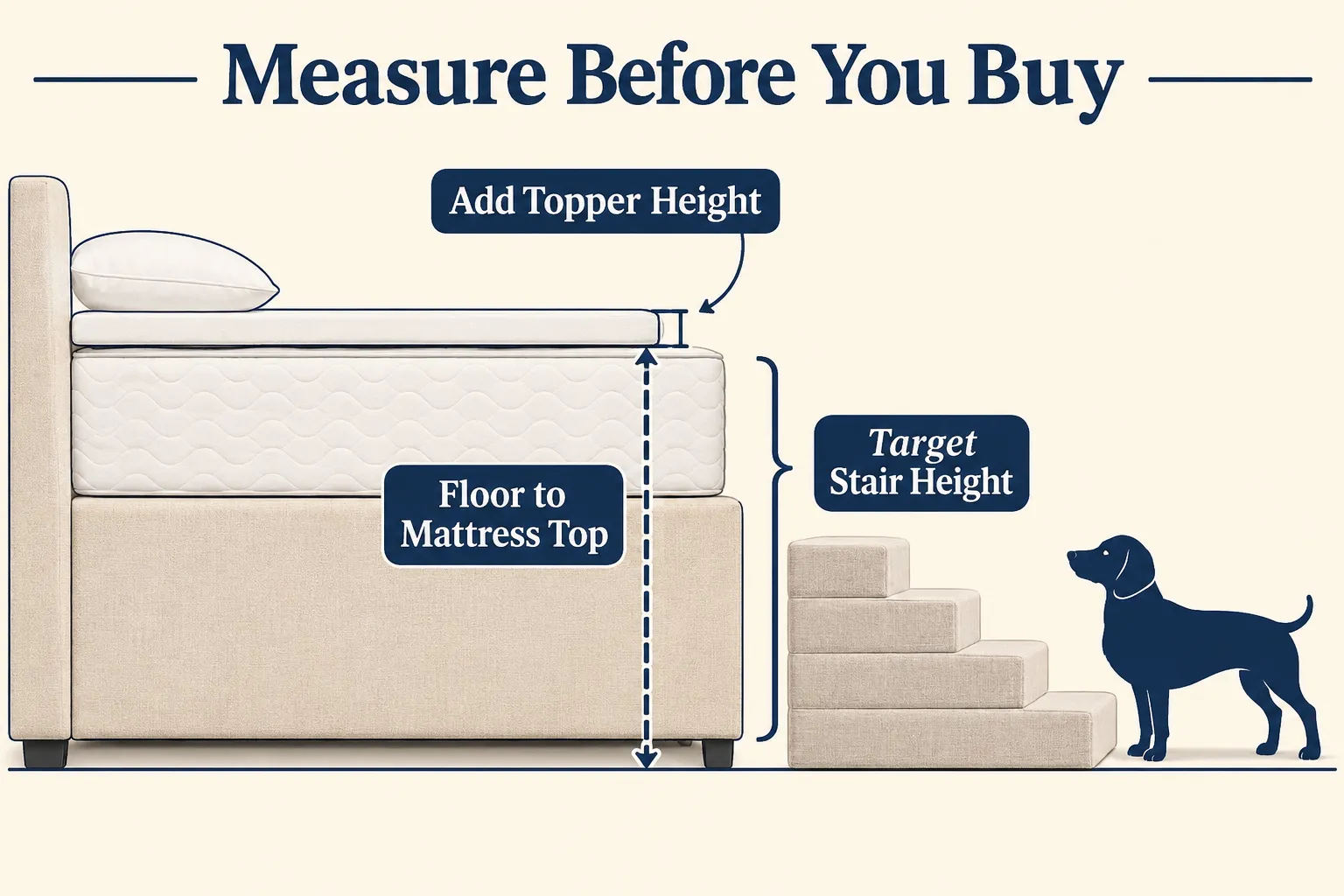
Before comparing products, measure your actual bed. Floor to the top of the mattress, including any topper or pillow-top, because that extra few inches changes which model fits. Yes, including the topper. It counts, and skipping this step is the reason so many buyers end up returning their first stair purchase.
Doggy Rank IQ Tool
Dog Stairs Bed Height Matcher

Owners buy by step count and the dog still jumps the last 6 inches. Measure the bed first.
What size dog stairs do I need for my bed?
The size you need depends on total mattress height and dog size, not the number of steps printed on the box. Measure floor to mattress top including any topper, then match that number against riser height per step for your dog’s size category.
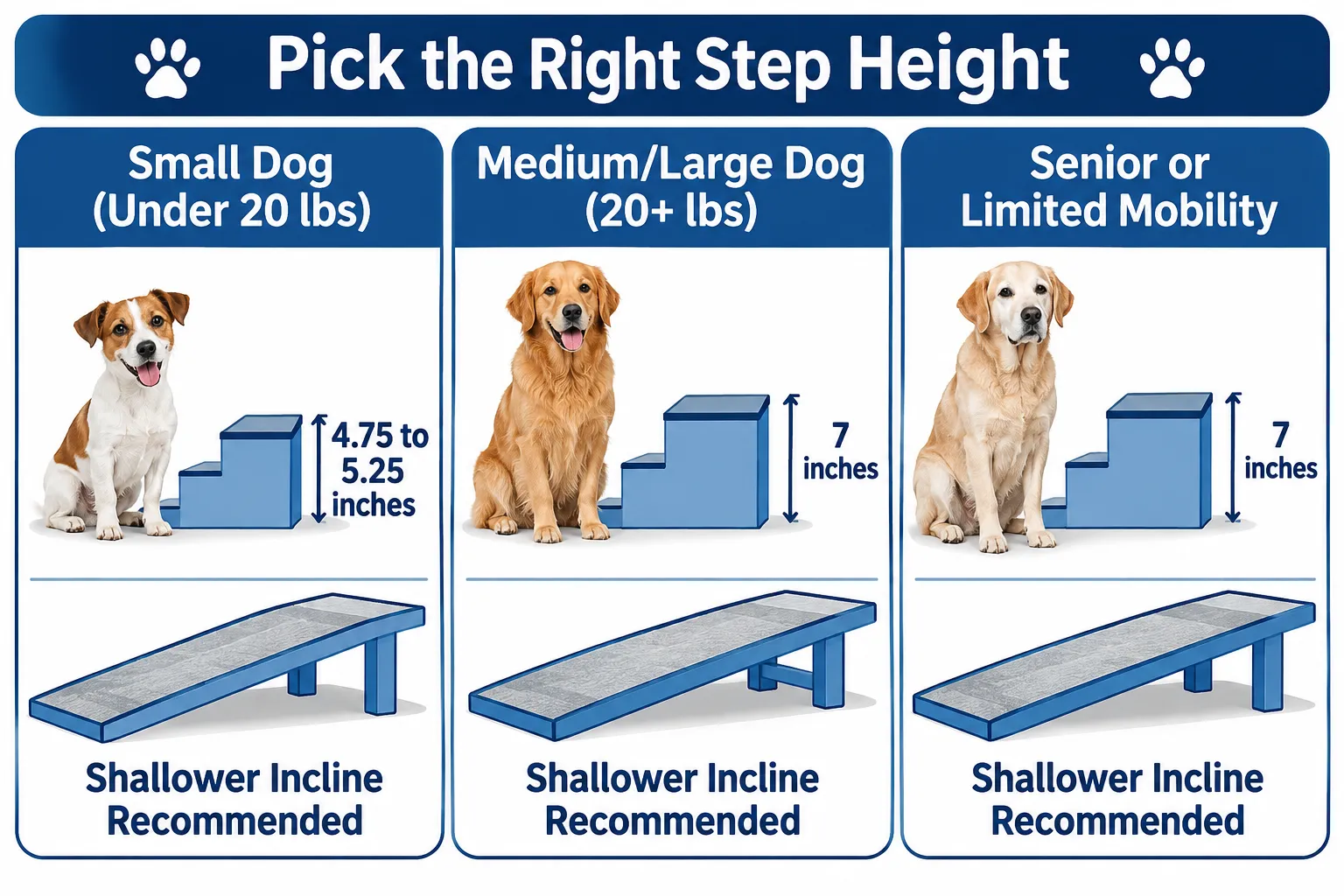
As a working guide: small dogs do best with roughly 4.75 to 5.25 inches of rise per step, while medium and large dogs can usually manage closer to 7 inches per step without strain. Applying that math:
- 18 inch bed: about 4 small-dog steps or 3 medium/large-dog steps
- 22 inch bed: about 5 small-dog steps or 4 medium/large-dog steps
- 26 inch bed: about 6 small-dog steps or 4 medium/large-dog steps
- 30 inch bed: about 6 small-dog steps or 5 medium/large-dog steps
A second check worth running: your dog’s paw-to-elbow height is a rough ceiling for a comfortable single riser. Go much above that and the dog starts hesitating or hopping instead of climbing normally, which defeats the point of buying dog stairs for bed in the first place.
Choose a taller, shallower-rise unit if your bed exceeds 24 inches and your dog is a senior or has any joint stiffness. Choose a compact 3-step unit if your bed sits under 20 inches and your dog is young and mobile with no joint concerns.
How much do dog bed stairs cost?
Most dog stairs for bed fall in the $40 to $60 range for a standard foam or rigid 3 to 5 step model, based on current Amazon and Chewy listings. Premium wood builds or larger weight-rated units can run higher, while basic 2-step foam units for small dogs sometimes dip below $35.
Price tends to track three things: weight capacity, material, and total height coverage. A compact foam unit rated for small dogs and an 18 inch bed will usually sit at the lower end of that band. A taller unit rated for beds up to 25 inches, with a reinforced frame and a 100+ lb capacity, pushes toward the upper end. Chewy’s current roundup of steps and ramps is a useful place to scan live pricing across brands before committing to one model.
Shipping costs and bundle deals (stairs plus a matching dog bed, for example) can shift the effective price up or down, so compare the per-unit cost rather than the bundle price if you’re only shopping for stairs.
Pick the Right Step Height
The right step height is the one where the top tread sits level with, or within an inch of, your mattress surface, not just “close enough” by step count. A stair unit advertised by step number tells you nothing until you know the total rise it covers.
Start with the floor-to-mattress measurement, topper included. Then match it against the sizing table above. A riser that’s too tall per step defeats the whole point of dog stairs for bed, and a narrow base is more likely to tip under a bigger dog, a concern echoed in product safety notes from The Spruce Pets’ stair review roundup.
If your dog is an older Labrador or similar structurally heavier breed, a shallower rise matters even more because the extra body weight increases the force on each landing. For context on breed-specific build differences, see the largest mastiff breeds ranked by height and weight.
Decision rule: choose a taller, shallower-rise unit if your bed exceeds 24 inches and your dog is a senior. Choose a compact 3-step unit if your bed sits under 20 inches and your dog is young and mobile. Common mistake: buying a 4-step unit because it “sounds like enough” without ever measuring the mattress top.
Best dog stairs for high beds
For beds over 24 inches, the best dog stairs for bed are units specifically built with 5 or more steps and a wider, more stable base, since taller stair towers are more prone to wobble than short ones. A ramp alternative is also worth considering above 30 inches, where the stair angle starts getting steep regardless of step count.
Look for these traits in a high-bed stair unit:
- A footprint that’s at least as wide as it is tall, or close to it, for tip resistance
- Side rails or raised edges on the top two steps
- A non-slip base material, not just non-slip tread covers
- A stated weight capacity that comfortably exceeds your dog’s actual weight, not just matches it
The Dog Stairs Ramp for High Beds Up to 25″ is built for this range specifically, with a deeper platform suited to larger dogs and a total rise that avoids the “jump the last stretch” problem common with shorter units.
Are dog ramps better than stairs for getting on beds?
Ramps are generally better than stairs for dogs with arthritis, hip dysplasia, or spinal issues, because a continuous incline spreads joint load across a longer surface instead of asking the dog to repeatedly flex and extend joints at each step. For healthy, mobile dogs, stairs are usually fine and take up less floor space.
The AKC’s comparison of stairs and ramps points out that ramps also suit dogs who are anxious about height changes or who have poor depth perception, since there’s no edge to misjudge. Stairs, on the other hand, are often easier to store in a small bedroom and tend to cost less for a given height range.
Decision rule: choose a ramp if your dog has diagnosed joint disease, is recovering from surgery, or is a senior showing stiffness getting up. Choose dog stairs for bed if your dog is otherwise mobile and you’re mainly solving a height-gap problem rather than a joint-health problem.
How do I train my dog to use bed stairs?
Training a dog to use bed stairs usually takes a few days of short, treat-based sessions rather than one long attempt. Most dogs catch on faster if you build the climb in stages instead of expecting them to use all the steps at once on day one.
A practical sequence:
- Place a treat on the first step and let the dog step up to get it, with all four paws still mostly on the floor if possible.
- Once that’s easy, place a treat on the second step and encourage the climb, praising as soon as the paws land.
- Repeat up through the remaining steps over several short sessions, not all in one sitting.
- Once the dog reaches the top step on its own, reward generously there so the top becomes the most rewarding spot.
- Practice getting down the same way, since descending is often more intimidating for dogs than climbing up.
If your dog is young or still learning basic household commands, pairing this with other foundational work like the five essential commands every puppy should learn can make the whole process smoother, since a dog that already responds to “up” or “wait” picks up stair training faster.
Do dog stairs help with arthritis and joint pain?
Dog stairs for bed can help dogs with mild joint stiffness by reducing the force of a single hard jump, but they are not a universal fix for arthritis. For dogs with diagnosed degenerative joint disease, a ramp is usually the better option because it avoids the repeated bending motion that stairs require at each step.
VCA’s guidance on degenerative joint disease notes that repeated impact and flexion can aggravate existing joint inflammation, which is part of why many veterinary sources recommend ramps over stairs once arthritis is confirmed. If you’re unsure which category your dog falls into, watch for these flare-up signs described in VCA’s arthritis symptom resource: stiffness after rest, reluctance to jump, slower stair handling, or visible limping after exercise. Any of these are reasons to ask a vet before buying stairs at all.
What’s the weight limit on dog bed stairs?
Weight limits on dog stairs for bed typically range from around 50 lbs on small, lightweight foam units up to 200 lbs on heavier-duty foldable models like the Love’s cabin Dog Stairs for High Bed. Always check the manufacturer’s stated capacity rather than estimating based on the unit’s size, since a bulky-looking foam stair can still have a modest weight rating if its internal frame is thin.
For multi-dog households, add up the heaviest dog’s weight plus a safety margin, since dogs sometimes climb stairs together or brush past each other mid-climb. A unit rated for exactly your dog’s current weight leaves no room for the extra few pounds dogs tend to gain over a year or two.
My dog won’t use the stairs. What should I do?
A dog refusing to use stairs is usually reacting to height, instability, or surface texture rather than being stubborn. Start by checking whether the top step actually reaches mattress height, since a gap at the top is the single most common reason dogs refuse or hesitate.
Other things to check before assuming it’s a training issue:
- Does the unit wobble or shift when touched? Dogs notice instability before humans do, and a shaky stair will get rejected fast.
- Is the surface slick or slippery underfoot? A fabric cover with no texture can feel unstable even if the frame itself is solid.
- Is the first step too tall relative to the dog’s leg length? If the very first step is already a stretch, the dog may refuse before even attempting the rest.
- Has there been a sudden change in behavior, like yelping, limping, or general reluctance to climb anything, not just these stairs? That’s a signal to check with a vet rather than keep troubleshooting the product, consistent with guidance from VCA’s arthritis flare-up resource.
If the stairs themselves check out physically, go back to the treat-based training sequence above and slow it down, spending more sessions on the first two steps before moving further up.
Wooden versus foam dog bed stairs: which is better?
Wooden dog stairs tend to offer more stability and a higher weight capacity, while foam dog stairs for bed are lighter, quieter, and easier to fold for storage. Neither material is universally better, the right choice depends on your dog’s size and how often you need to move or store the unit.

Wood or rigid plastic builds make sense when:
- Your dog weighs more than 60 lbs and you want extra confidence in the frame
- You don’t need to fold or move the unit often
- You prefer a surface that’s easy to wipe down after muddy paws
Foam builds make sense when:
- Your dog is under 40 lbs
- You want to fold the unit away during the day or move it between rooms
- You want a quieter surface for nighttime use, since foam muffles paw sounds better than hard wood or plastic
Top 5 Features That Decide the Purchase
These five specifications decide whether a product earns its spot by your bed, more than brand name or step count.
- Riser height per step, tied directly to total mattress height. The EHEYCIGA Dog Stairs for Bed 18″ H fits lower platform beds precisely because its total rise matches that 18 inch range.
- Tread depth, ideally 9 to 12 inches for medium and large dogs so the whole paw lands flat. The Dog Stairs Ramp for High Beds Up to 25″ uses a deeper platform suited to bigger dogs.
- Base grip and stability, since a sliding base is a fall risk flagged directly by VCA’s guidance on mobility-compromised dogs. Rubberized feet matter more than the material of the steps themselves.
- Usable width, which determines whether a dog can turn around comfortably or has to back down. The Love’s cabin Dog Stairs for High Bed uses a wider foam-covered platform rated to 200 lbs, which suits multi-dog homes.
- Weight capacity and foldability, relevant for owners who need to store the unit or move it between rooms often.
Comparison table: Mattress height and stair size worksheet
| Product | Height fit | Steps | Weight limit | Price band |
|---|---|---|---|---|
| EHEYCIGA Dog Stairs for Bed 18″ H | Beds up to ~18 in | 4 steps | Moderate | Around $40 to $60 |
| Love’s cabin Dog Stairs for High Bed | Beds up to ~24 in | 3 steps, foldable | Up to 200 lbs | Around $40 to $60 |
| Dog Stairs Ramp for High Beds Up to 25″ | Beds up to 25 in | 5 steps | Higher capacity | Around $40 to $60 |
Are there alternatives to dog stairs to help my dog on the bed?
Yes, ramps, pet lifts, and repositioning furniture are all workable alternatives to dog stairs for bed, and each suits a different situation. A ramp is the main alternative for dogs with joint issues, while a lower bed frame or a dog bed placed directly on the floor solves the problem without any climbing device at all.
- Ramps: best for arthritic, senior, or post-surgery dogs, per guidance from The Spruce Pets’ ramp review.
- Lowering the bed frame: removes the need for any device, useful if you’re furnishing a new place anyway.
- A floor-level dog bed near the human bed: works for dogs who are fine sleeping nearby rather than on the mattress itself.
- Lift assistance (sling or harness): used short-term after surgery or during recovery, under a vet’s direction rather than as a permanent fix.
Can senior dogs use bed stairs safely?
Senior dogs can use bed stairs safely if the riser height is shallow, the tread depth is generous, and the dog has no diagnosed joint disease that would favor a ramp instead. Without those conditions, stairs can become a hazard rather than a help.
Safety checklist for senior dogs specifically:
- Riser height close to 4.5 to 6 inches per step rather than a full 7 inches
- Tread depth of at least 9 to 12 inches so the paw lands flat
- Side rails or a raised lip on the upper steps
- A wide, grippy base that doesn’t shift when weight is placed unevenly
- Regular monitoring for hesitation, slower climbing, or reluctance, any of which should prompt a vet check rather than continued use of the same product
Where to buy dog bed stairs online
Amazon and Chewy are the two most common places to buy dog stairs for bed, both offering filtering by weight capacity, height range, and material. Chewy’s own buying guide, Best Dog Steps & Ramps 2026, is a useful second opinion to cross-check specs before ordering from any retailer.
When buying online, check three things before adding to cart: the stated total height (not just step count), the weight capacity relative to your dog’s actual current weight, and recent buyer photos showing the product next to a real bed, which often reveal sizing issues that marketing photos don’t.
Do small dogs need special bed stairs?
Small dogs generally need a shorter riser per step, around 4.75 to 5.25 inches rather than the 7 inch rise comfortable for medium and large dogs, along with a narrower overall tread width proportional to their smaller paws. A standard large-dog stair unit can actually be harder for a small dog to use than no stairs at all, since the gaps between steps may be too tall to manage safely.

Look for units explicitly marketed for small or toy breeds, which typically have tighter step spacing and a lower first step close to the floor. The EHEYCIGA This stairs bed 18″ H works well here for lower beds specifically because its total height and step spacing are built around smaller dog proportions.
Is my dog too heavy for dog bed stairs?
Your dog is too heavy for a given set of stairs if its weight meets or exceeds the manufacturer’s stated capacity, or if the base visibly flexes or shifts when the dog climbs. Most standard foam units top out around 50 to 100 lbs, while reinforced models like the Love’s cabin Dog Stairs for High Bed are rated up to 200 lbs.
If your dog is near or above a product’s stated limit, move up to a higher-capacity model rather than assuming “close enough” is safe. A base that’s structurally underrated for a dog’s weight is one of the more common causes of tipping accidents, a risk specifically called out in product safety notes from The Spruce Pets’ stair testing coverage.
Which pick fits which dog and owner?
The right this stairs bed choice depends on bed height, dog size, and mobility, more than brand preference.
- Lower platform beds, small to medium dogs: the EHEYCIGA This stairs bed 18″ H fits an 18 inch bed without requiring the dog to stretch up for a final jump.
- Multi-dog households or heavier dogs needing a budget pick: the Love’s cabin Dog Stairs for High Bed covers up to 200 lbs across its foam-padded steps, folds for storage, and works for couches too.
- Taller platform beds up to 25 inches: the Dog Stairs Ramp for High Beds Up to 25″ adds an extra step and a gentler overall climb.
Owners furnishing a first home for a new dog often check best dogs for first time owners and best dog breeds for apartment living while sorting out bedroom furniture logistics, and stairs fit naturally into that setup phase.
Things to Watch Out For
The single biggest mistake is buying this stairs bed by step count without measuring the mattress. A “5-step” stair unit can still land six inches short of a pillow-top bed, which means the dog jumps the remainder anyway, the exact habit the stairs were meant to stop.
- Narrow bases that rock when a larger dog shifts weight mid-climb.
- Smooth fabric covers with no grip, which become slick once a wet paw touches them.
- Treads shallower than 9 inches for medium or large dogs, forcing the paw to hang off the edge.
- No side rails on taller units, since a dog can fall sideways off an unguarded step, a risk VCA specifically calls out in its mobility-compromised dog guidance.
- Sudden refusal to climb. That’s a signal to check with a vet, not just swap products.
Who Should Skip This
This stairs bed aren’t the right answer for every dog or every bed.
- Dogs with arthritis, hip dysplasia, or spinal issues: veterinary-oriented guidance favors ramps here, since a continuous incline distributes joint load more evenly than repeated step flexion, per VCA’s osteoarthritis guidance and the AKC’s stairs versus ramps comparison.
- Very low beds under 12 inches: the dog can likely just step up; stairs add clutter without solving a real problem.
- Tiny apartments with no floor space: a foldable unit helps, but if there’s genuinely nowhere to store even a folded stair, a ramp that slides under the bed frame may fit better.
- Dogs recovering from surgery: follow a vet’s specific exercise and mobility plan, which may include restrictions beyond stair use, in line with VCA’s exercise restriction guidance, rather than defaulting to any store-bought stair unit.
FAQ
Q: How tall should dog stairs be for my bed? Measure floor to the top of the mattress, including any topper, and choose a unit whose total height matches that number within an inch or two, rather than relying on step count alone.
Q: Are dog stairs or a ramp better for an older dog? Ramps are generally preferred for dogs with arthritis or spinal issues because they reduce repeated joint flexion compared to multiple raise steps, according to veterinary sources including VCA Animal Hospitals.
Q: What dog stairs work for a high bed over 30 inches? Look for a 5 to 6 step unit specifically rated for that height range, such as the Dog Stairs Ramp for High Beds Up to 25″ paired with an added riser, or a ramp alternative for beds taller than most stair units cover.
Q: Are foam dog stairs sturdy enough for a large dog? Some are, if the base has a rigid internal frame and a wide footprint, but check the stated weight capacity before buying; narrow foam units are more prone to tipping under larger dogs.
Q: How do you train a dog to use bed stairs? Place treats on the first step, then the second, building up gradually until the dog climbs the full set on its own, rewarding at the top each time, and practicing the descent separately since it’s often harder for dogs than climbing up.
Q: Do dog stairs work for small dogs with short legs? Yes, and small dogs generally need a shorter riser per step, around 4.75 to 5.25 inches, rather than the taller 7 inch rise used for medium and large dogs.
Q: Can dog stairs fold away for storage? Many foam and some rigid models fold flat; the Love’s cabin Dog Stairs for High Bed is built specifically with foldable storage in mind.
Q: What dog steps hold 100 pounds? Several units marketed for large dogs list capacities at or above 100 lbs; the Love’s cabin model is rated up to 200 lbs across its steps, which covers most single large dogs comfortably.
Q: Do this stairs bed actually reduce injury risk? They can reduce the impact of a single hard jump for otherwise healthy dogs, but they are not a substitute for veterinary care if a dog already shows signs of joint pain or mobility decline.
Q: Is it normal for a dog to need a few days to get used to stairs? Yes, most dogs take a few short training sessions over several days before climbing confidently on their own, especially if the stairs are taller than anything they’ve used before.
Next step
Measure your mattress height including the topper, run it through the bed height matcher above, and check current availability for the EHEYCIGA This stairs bed 18″ H or a taller model if your bed runs higher. For broader training questions once the stairs are in place, see five essential commands every puppy should learn.