
This post contains affiliate links. If you buy through one we may earn a commission at no extra cost to you. As an Amazon Associate I earn from qualifying purchases.
Best dog crate pad: Quick Answer
The best dog crate pad is sized to the crate’s actual interior floor pan, not the crate’s marketed size, uses reinforced seams if the dog chews or paws at fabric, and either washes whole in a machine or has a removable cover that comes off cleanly. Expect to spend between $20 and $50 for a standard washable pad, or $75 and up for a chew-resistant model built for a dog who has already destroyed soft bedding.
Best dog crate pad: Punchline
The best dog crate pad fits the floor pan exactly, including the inch-wide lip most owners forget to measure.
Key Takeaways
- Nonslip backing, reinforced seams, and sealed waterproof barriers are the three features that separate a crate pad that lasts from one that falls apart within weeks.
- Standard crate pads typically run $20 to $50, while chew-resistant pads from brands built for destructive dogs start closer to $75.
- A practical fit benchmark is less than 1 inch of play on each side of the pad once it’s laid inside the crate.
- Some puppies shred or soil soft bedding before they’re fully house-trained, according to the American Kennel Club’s crate-training guidance, which is a reason to hold off on plush pads early on.
- A removable cover is convenient to wash but doesn’t protect the foam core the way a whole-pad washable design does.
- Large and senior dogs often benefit from thicker, orthopedic-style padding, but only if it still fits the crate without crowding standing or turning room, a balance the AKC’s senior dog accessibility guidance also touches on for home setups generally.
- Waterproof backing and high dryer heat often don’t mix. Check the care label before assuming a pad can go in the dryer on anything but low.
Best dog crate pad: Affiliate disclosure
This article contains affiliate links to Amazon. We earn a commission on qualifying purchases at no extra cost to you. Picks are chosen for fit, construction, and wash care, not commission size.
Best dog crate pad
The best dog crate pad is sized to the crate’s interior floor pan, not the exterior crate dimension, built with a fabric and seam strength that match how your specific dog behaves in the crate, and designed to come clean in a normal wash routine without falling apart after a few cycles.
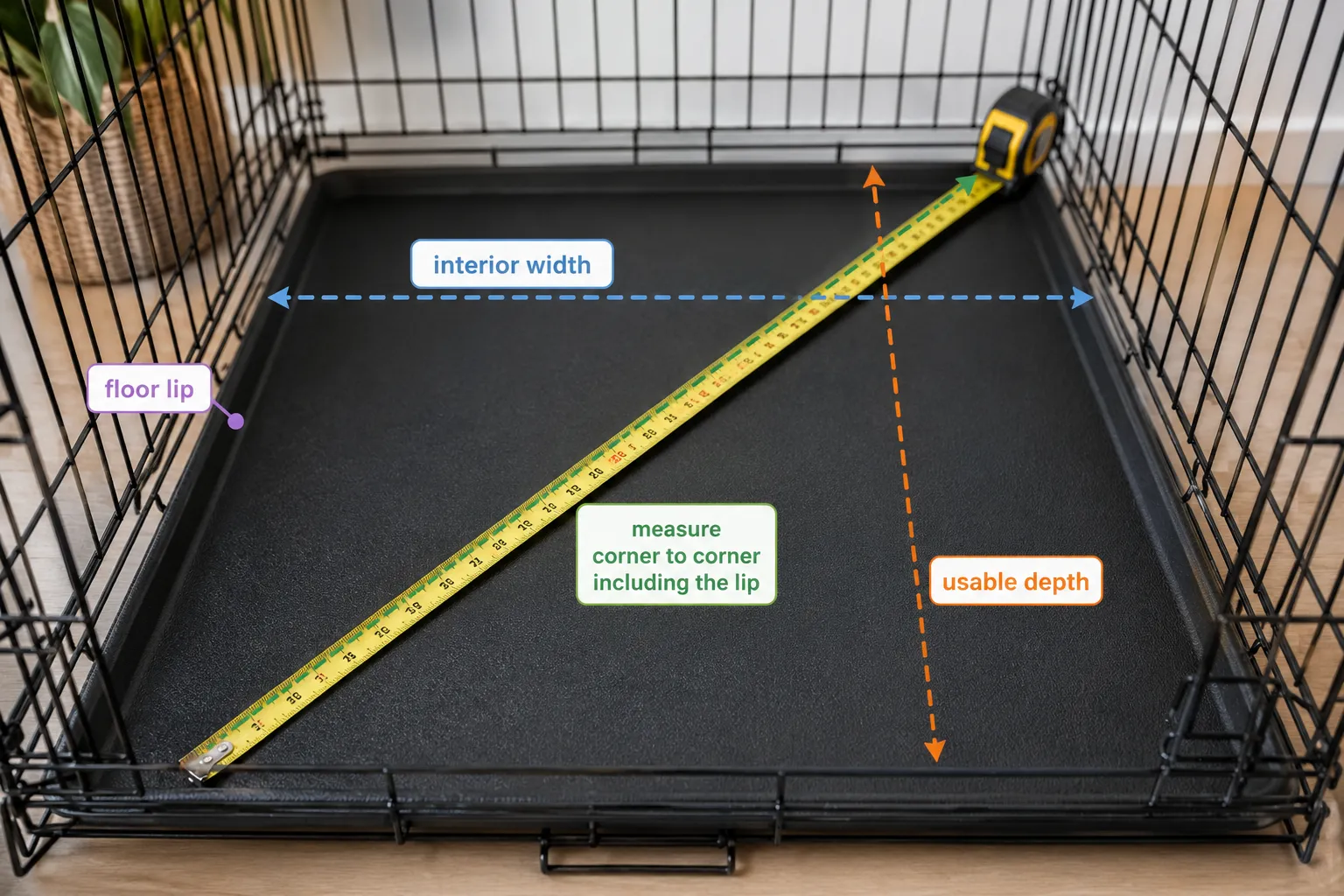
Most buying mistakes happen before the pad ever ships. Owners check the crate’s labeled size, something like “36 inch crate,” and buy a pad to match that number. But the floor pan inside most wire crates is smaller than the outer frame, and many pans have a raised lip around the edge that eats another half inch to a full inch on each side. That’s the gap between a pad that looks right in a product photo and one that bunches up every time the dog turns around inside the crate.
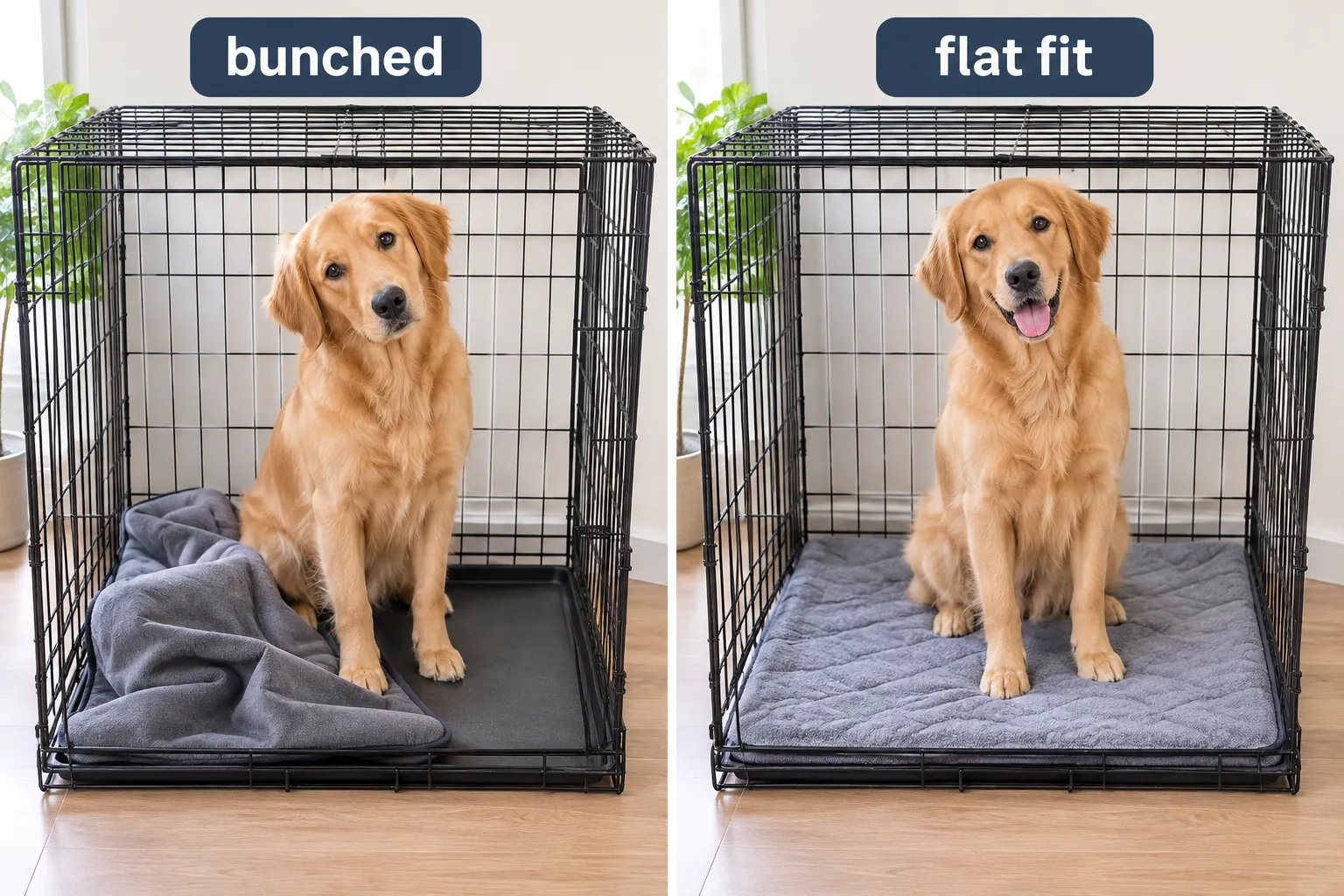
A pad that’s an inch too big pushes up at the corners, folds under the dog’s weight, and ends up as a lump by the crate door within a day or two. A pad that’s too small leaves bare metal or plastic showing along the edges, which isn’t comfortable for a senior dog with thin hips or sore joints, or for any dog that likes to stretch out fully.
Wash care is the second deciding factor, and it matters just as much as fit. A pad that takes two days to air dry means a dog sleeps on a bare crate floor in the meantime, or an owner ends up buying a second pad just to rotate between washes. Reinforced seams and sealed waterproof barriers are what keep a pad holding its shape through repeated laundry cycles instead of fraying at the corners after a month of daily use.
For broader training context around crate routines, the guide on puppy crying in crate at night covers the settling-in period separately from pad selection, since bedding choice and crying at night are two different problems that often get lumped together.
Doggy Rank IQ Tool
Crate Size to Mat Calculator

Pick the crate size or enter the inside measurements. You get the mat size and the fabric for your dog's habits.

Best dog crate pad: Floor Fit, Seams and Wash Care
Floor fit, seam strength, and wash care are the three things that actually determine whether a crate pad earns its keep, and they’re connected: a loose fit stresses seams over time, and worn seams eventually ruin wash care by letting fluid or filling leak through.
Floor fit. Measure the crate’s interior floor corner to corner, and note any raised lip around the edge. The AKC’s crate sizing guidance recommends sizing a crate so the dog can stand, turn around, and lie down comfortably, and that same logic extends to the pad itself: it needs to lie flat without folding at the edges. A practical rule of thumb is less than 1 inch of play per side once the pad is placed inside. If your crate is labeled 36 inches but the floor pan actually measures 34.5 by 22.5 inches, buy for the pan, not the label on the box.
Seams. A seam that opens exposes filling, creates a chew hazard, and lets urine soak into the foam core where no amount of washing fully removes the smell afterward. Reinforced or bar-tacked corners matter more on pads that see daily machine washing, since repeated agitation is what finds a weak stitch first, usually at a corner or along a zipper line.
Wash care. A removable cover is easy to wash but leaves the foam exposed to accidents underneath it. A whole-pad washable design solves that problem, but only if the manufacturer explicitly states the entire pad can go in the machine, not just the cover. High heat can delaminate waterproof backing on pads that aren’t rated for the dryer, so checking the label before assuming anything is worth the extra thirty seconds.
Decision rule: if your dog is a puppy, a senior with incontinence, or prone to accidents, choose a whole-pad washable design over a removable-cover-only design, even if the cover version looks nicer in photos. Comfort that can’t be fully cleaned isn’t comfort for long.
Best dog crate pad: Top 5 Features That Decide the Purchase
These five features decide whether a crate pad earns repeat purchases or ends up in the trash after one wash cycle, and they apply whether you’re shopping for a puppy’s first crate setup or replacing a worn-out pad for an older dog.
- Accurate floor dimensions. The Exsnugy Washable Dog Bed Mat in its 36×23 size is built close to a standard medium wire crate’s floor pan, which cuts down the bunching problem that comes from guessing based on the crate’s label.
- Reinforced or sealed seams. This is the first thing to check on a listing’s product photos or description before anything else, since a weak seam undermines every other feature a pad might have.
- Nonslip backing. Keeps the pad from sliding when a dog circles before lying down, a common complaint with lightweight pads that have a smooth or slick underside.
- Whole-pad or removable-cover washability. The Bedsure Washable Dog Beds Large uses a sherpa surface over a washable base, which suits dogs who aren’t destructive and don’t need heavy-duty fabric.
- Fabric weight matched to chewing habit. The KSIIA Washable Dog Bed Medium plush surface is comfortable for a calm senior dog but isn’t built for a dog that chews bedding regularly.
Comparison table: best dog crate pad picks by price and size
| Model | Price band | Size | Best for |
|---|---|---|---|
| KSIIA Washable Dog Bed Medium | around $20 to $35 | 35 x 23 in | calm medium dogs, indoor comfort |
| Bedsure Washable Dog Beds Large | around $30 to $50 | 36 x 27 in | large or senior dogs needing cushion |
| Exsnugy Washable Dog Bed Mat | around $20 to $30 | 36 x 23 in | budget pick, standard medium crates |
Best dog crate pad: Which pick fits which dog and owner?
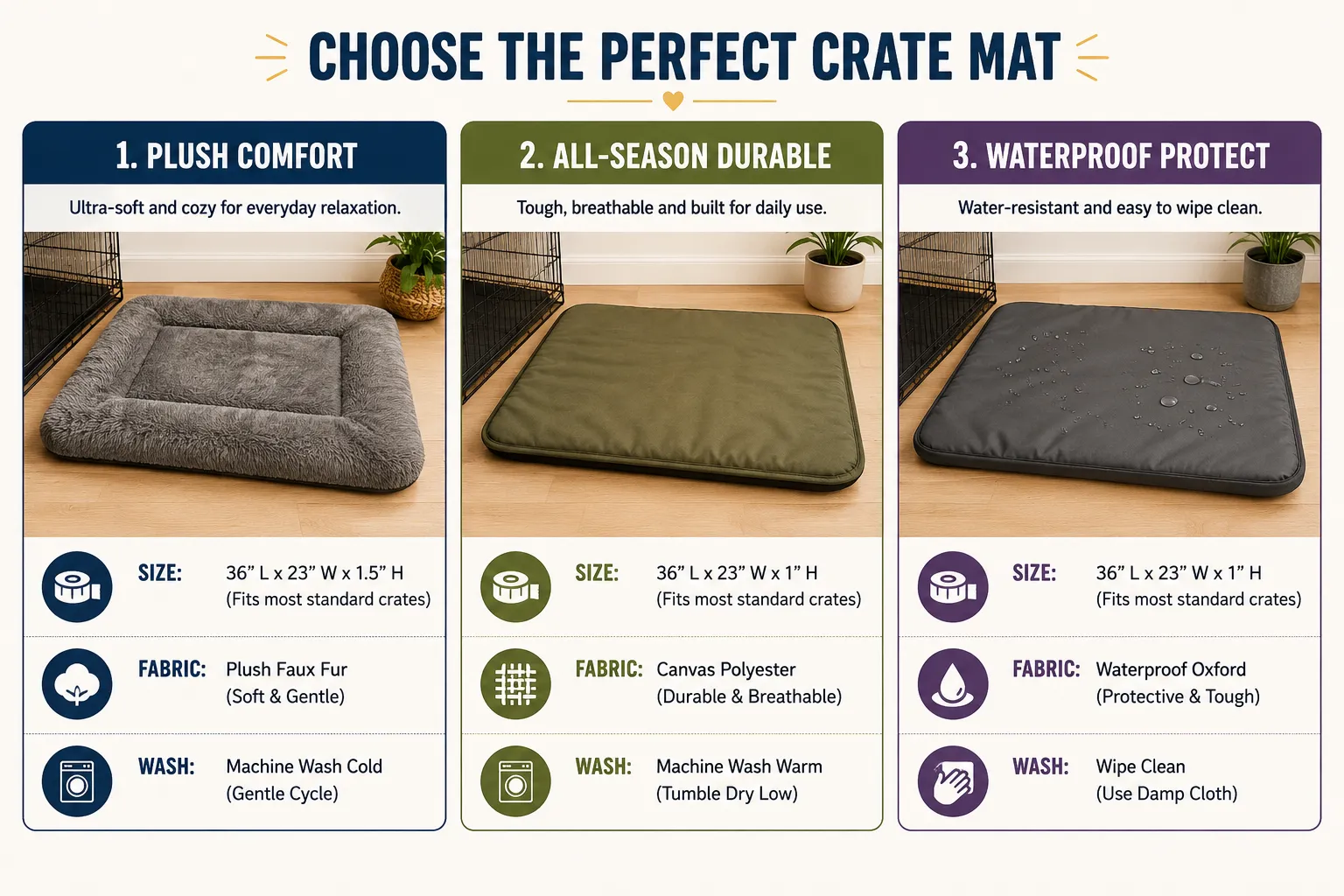
Choose the Bedsure Washable Dog Beds Large if your dog is large or senior and needs extra cushion for joints, since the sherpa surface and bigger footprint give more coverage for a dog that sleeps stretched out rather than curled up.
Choose the KSIIA Washable Dog Bed Medium if your dog is calm, already house-trained, and the crate mostly functions as an indoor resting spot rather than an active training tool. Its plush surface is comfortable but isn’t built to survive chewing.
Budget pick: the Exsnugy Washable Dog Bed Mat at around $20 to $30 covers a standard 36 by 23 inch floor pan without the premium price tag of orthopedic foam, making it a reasonable starting point while you confirm your dog won’t chew it.
None of these three options is built for a heavy chewer. For that use case, a ripstop or ballistic-weave pad from a chew-focused brand is the more honest recommendation, even though it costs more upfront than a standard plush mat.
Best dog crate pad: What material should a dog crate pad have?
The right material depends on the dog’s chewing habits and accident risk more than on softness alone. A dog who never touches bedding can wear plush or sherpa fabric comfortably, while a dog who mouths or digs at the pad needs a tighter weave with reinforced stitching.
- Plush or sherpa: comfortable, good for calm, house-trained dogs, but tears easily under teeth or claws.
- Canvas or tight-weave polyester: more resistant to snagging, a middle ground for dogs who occasionally mouth bedding without fully destroying it.
- Ripstop or ballistic-weave nylon: built for dogs who have already shredded two or more soft beds, holds up against repeated chewing far better than standard fabric.
- Waterproof-backed fabric: useful for puppies, seniors, or any dog prone to accidents, since it keeps fluid from soaking into the foam underneath.
Common mistake: picking a fabric based on how it looks in photos rather than how the dog actually behaves in the crate. A soft-looking pad that gets shredded in a week costs more over time than a tougher pad that costs more upfront.
Do dogs actually need a crate pad or is it optional?
A crate pad is optional in the sense that a dog can survive without one, but most dogs are more comfortable and more willing to settle in a crate when the floor isn’t bare wire or hard plastic. For puppies still learning that the crate is a safe space, a comfortable surface can make the difference between quick acceptance and ongoing resistance.
That said, a crate pad isn’t necessary in every situation. A young, not-yet-house-trained puppy that soils bedding daily may do better on a thin, easy-to-wipe liner or even a crate tray without fabric until house-training is further along, as the AKC’s crate-training guidance notes regarding puppies who shred or soil soft bedding before they’re reliable. In that case, skipping a plush pad temporarily is the more practical choice.
Best orthopedic crate pad for dogs
An orthopedic crate pad uses memory foam or high-density foam, usually at least 2 to 3 inches thick, to reduce pressure on joints, hips, and elbows for larger or older dogs. These pads work best in crates with enough interior height that the extra thickness doesn’t crowd the dog’s ability to stand or turn around.
Orthopedic foam matters most for dogs over 50 pounds, senior dogs with arthritis, or breeds prone to hip and elbow issues like German Shepherds and Labradors. The Spruce Pets’ testing of orthopedic dog beds points to foam density and thickness as the features that separate a bed that actually supports joints from one that flattens out within months. For a crate specifically, look for orthopedic foam that’s still thin enough to fit the crate’s interior height along with a washable cover, since orthopedic foam itself usually can’t go in a washing machine.
Decision rule: choose orthopedic foam if your dog is large, senior, or has a diagnosed joint condition, and your crate has at least a few inches of clearance above the dog’s head when standing. Skip it for small or young dogs without joint issues, since standard foam or fiberfill is sufficient and costs less.
How much should you spend on a dog crate pad?
Standard washable crate pads typically run $20 to $50 depending on size and fabric, while chew-resistant pads built for destructive dogs often start around $75 and climb higher for larger sizes. Spending more only pays off if the extra cost buys a feature your dog actually needs, like reinforced seams for a chewer or thicker foam for a senior with joint pain.
A reasonable spending guide:
- $15 to $25: basic thin liners, good for puppies during house-training or as a backup pad.
- $20 to $50: standard plush or sherpa washable pads, suitable for most calm, house-trained dogs.
- $50 to $75: thicker orthopedic or waterproof-backed pads, better for larger or senior dogs.
- $75 and up: chew-resistant ripstop or ballistic-weave pads for dogs who have already destroyed softer bedding.
Common mistake: buying the cheapest pad available for a dog who chews, then replacing it twice within a year, which ends up costing more than one durable pad would have.
Best crate pad for large dogs
A crate pad for a large dog needs enough surface area for the dog to stretch out fully, plus enough thickness to cushion a heavier frame without flattening within weeks. The Bedsure Washable Dog Beds Large, at 36 by 27 inches, is sized for large-breed wire crates and uses a sherpa top that holds up under regular use from dogs in the 50 to 90 pound range.
For dogs over 90 pounds, measure the crate’s floor pan carefully since large-breed crates vary more in interior dimensions than medium crates do. A pad that’s too narrow leaves a big dog’s legs hanging off the edge onto bare metal, which defeats the purpose of padding the crate in the first place.
Waterproof dog crate pad recommendations
A waterproof crate pad uses a sealed barrier layer beneath the fabric surface to keep urine, drool, or spilled water from soaking into the foam core. This matters most for puppies in house-training, senior dogs with incontinence, and any dog recovering from surgery who may have limited bladder control.
Many waterproof pads use a soft top layer over the sealed barrier, so comfort depends on the top fabric, not the waterproofing itself. Check the surface material separately from the backing when comparing options. A waterproof pad with a thin, scratchy top layer isn’t more comfortable just because it’s waterproof.
Common mistake: assuming “water-resistant” means the same thing as “waterproof.” Water-resistant fabric slows absorption but doesn’t fully block it, which still allows odor and moisture to reach the foam over time.
My dog keeps moving the crate pad around, what do I do
A dog that shoves a pad around inside a crate is usually dealing with one of three issues: the pad lacks nonslip backing, the pad is sized too loosely for the floor pan, or the dog is anxious and pawing at bedding before settling. Fixing the fit and backing solves the first two causes quickly.
Steps to try, in order:
- Remeasure the crate’s floor pan and compare it to the pad’s actual dimensions, not the crate’s labeled size.
- Check for a nonslip rubber or silicone grip on the pad’s underside. If it’s missing, a nonslip crate mat liner placed underneath can help.
- If the pad still shifts, consider a pad with tie-down loops that anchor to the crate’s floor grate or corners, common in travel-rated crate pads.
- If the behavior looks anxious rather than mechanical (digging, circling repeatedly, whining), the issue may be more about crate comfort or routine than the pad itself. The guide on puppy crying in crate at night covers settling-in behaviors separately from bedding choice.
Can I just use a blanket as a crate pad instead?
A blanket can work as a temporary crate pad, especially for a puppy during early house-training when a washable, low-cost option is more practical than a full pad. Folded blankets are easy to wash, replace, and don’t represent a big loss if they get chewed or soiled.
The tradeoffs: blankets bunch up more easily than a fitted pad since they aren’t cut to the crate’s floor dimensions, they don’t offer the same cushioning as foam, and a determined chewer can pull a corner of a blanket loose and swallow fibers, which is a choking and blockage risk. A blanket is a reasonable short-term or budget option but isn’t a long-term substitute for a properly sized pad once a dog settles into a routine.
Best crate pad for senior or arthritic dogs
A senior or arthritic dog benefits most from a thicker pad with supportive foam, a low-friction surface that’s easy to get on and off of, and a washable design that handles accidents without needing to be replaced. The AKC’s guidance on making a home more accessible for senior dogs points to joint support and ease of movement as priorities that extend naturally to crate and resting surfaces.
A pad can be too thick if it crowds standing or turning room in the crate, but for most senior dogs, additional cushion for joints is beneficial as long as the pad still fits the floor without bunching at the edges. The Bedsure Washable Dog Beds Large works well here given its size range and softer surface, provided the crate has enough height clearance.
Washable dog crate pads that are actually durable
A durable washable crate pad holds its shape and seams through at least 20 to 30 wash cycles without the fabric pilling, the foam flattening, or the stitching coming loose at the corners. Reinforced seams and a medium-to-heavy fabric weight are the features most associated with that kind of longevity.
Signs a pad is built to actually survive regular washing:
- Double-stitched or bar-tacked corners, visible in product photos before purchase.
- A care label that specifies machine wash cold, not just “spot clean” or “hand wash only.”
- A manufacturer that explicitly states the foam core (not just the cover) can go in the washing machine, when that’s the design.
- Reviews mentioning the pad after several months of use, not just initial unboxing impressions.
Crate pad for puppies during potty training
During potty training, a thinner, easy-to-clean pad serves a puppy better than a thick plush bed, since accidents are more frequent and a thinner pad dries faster and costs less to replace if chewed. A liner around 1 to 1.5 inches thick is a practical middle ground between comfort and manageability.
The Spruce Pets’ testing of beds for puppies found that washable, lower-cost options tend to hold up better during this phase than premium orthopedic beds, simply because puppies are harder on bedding and house-training mistakes are expected. Once a puppy is reliably house-trained, usually somewhere between 4 and 6 months for many dogs though this varies widely, upgrading to a thicker or plusher pad makes more sense.
Dog crate pad for hot weather that won’t overheat
A crate pad for hot weather should use breathable fabric and avoid thick memory foam that traps body heat, since dense foam can make a crate warmer than it needs to be during summer months or in homes without air conditioning. Cooling gel pads or raised mesh platforms are alternatives worth considering for dogs who overheat easily.
The Spruce Pets’ guide to cooling mats for dogs outlines gel-based and water-activated cooling pads as options for hot climates or dogs with thick coats. For a crate specifically, a thin cooling mat combined with good airflow around the crate (not pressed against a wall or in direct sun) does more for comfort in summer than a thick padded bed would.
How often should you replace a dog crate pad?
Most washable crate pads need replacing every 12 to 18 months with regular daily use, though this varies based on the dog’s size, chewing habits, and how often the pad is washed. Signs it’s time to replace a pad include flattened foam that no longer springs back, seams that have come apart in more than one spot, or persistent odor that survives multiple wash cycles.
A pad that’s chewed through in a single spot but otherwise intact might be patchable short-term, but a pad with multiple failure points is a sign the fabric or construction wasn’t matched to the dog in the first place, which points back to choosing the right material from the start.
Affordable dog crate pads that don’t fall apart
An affordable crate pad doesn’t have to mean a disposable one. Pads in the $20 to $35 range, like the KSIIA Washable Dog Bed Medium or the Exsnugy Washable Dog Bed Mat, can last well over a year with regular washing as long as the dog isn’t a chewer and the pad is sized correctly to the crate’s floor pan.
The budget trap to avoid: buying the cheapest pad repeatedly after each one wears out, rather than spending slightly more once on a pad with reinforced seams that lasts through more wash cycles. Over a year or two, the cheaper-but-shorter-lived option often costs more in total.
Things to Watch Out For
Watch for a pad that lists only the crate size it “fits” rather than its own exact dimensions in inches, since that’s a sign the listing is written for search terms, not accuracy.
- A pad with only a removable cover and foam that isn’t separately washable, which leaves odor trapped after an accident.
- Drying instructions that don’t match the fabric. Waterproof backing and high heat don’t mix.
- Pads with no mention of seam reinforcement at all, often the first failure point on a daily-use mat.
- A pad listed as “fits most crates,” a phrase that tells you nothing about your specific floor pan.
Who Should Skip This
Skip a standard washable crate pad if your dog is a confirmed heavy chewer who has already destroyed two or more soft beds, since fabric and light foam won’t survive contact with a determined jaw. A ripstop or chew-resistant mat is the more sensible spend in that case.
Skip soft plush pads if your dog is a young, not-yet-house-trained puppy. Some puppies soil or shred soft bedding before they’re reliable, and a thin, easy-to-clean liner may serve better during that stretch.
Skip a full-size orthopedic pad if your crate is a compact travel or car crate where every inch of height matters for the dog to stand and turn, since thick foam can crowd that space unnecessarily. For more on crate sizing in general, the AKC’s guide to choosing the best crate for a dog is a useful starting point before buying bedding at all.
If you’re also comparing crate models themselves, not just the pad inside one, it helps to read up on general crate buying fundamentals, and training basics like the ones covered in 5 essential commands every puppy should learn pair well with crate routines during the same training period.
FAQ
What size crate pad fits a 42 inch crate?
Measure the actual floor pan first. Most 42 inch wire crates have a floor between 41 and 42 inches long and 27 to 28 inches wide, so buy a pad sized to that measurement rather than to the “42 inch” label on the box.
What is the best dog crate pad for chewers?
A ripstop or ballistic-weave pad with reinforced seams holds up better against chewing than standard plush mats. These pads cost more upfront, usually starting around $75, but last significantly longer for a dog that has already destroyed softer bedding.
Are waterproof crate pads comfortable?
Many waterproof pads use a soft top layer over a sealed barrier, so comfort depends on the top fabric, not the waterproofing itself. Check the surface material separately from the backing before assuming a waterproof pad will feel rough or plastic-like.
How do you wash a dog crate pad?
Check the care label first since instructions vary by brand. Some pads wash whole on a cold, delicate cycle and dry on low heat, while others require removing the cover and air-drying the foam insert separately to avoid damaging the waterproof backing.
Should a crate pad be thick or thin for a puppy?
A thinner liner, around 1 to 1.5 inches, is often more practical for a puppy who hasn’t finished house-training, since it’s easier to clean and less costly to replace if chewed or soiled during an accident.
Can a crate pad be too soft for a senior dog?
A pad can be too thick if it crowds standing or turning room in the crate, but for most senior dogs, additional cushion for joints is beneficial as long as the pad still fits the floor without bunching at the edges.
Do crate pads need tie downs?
Tie downs aren’t required for most indoor use but help prevent sliding in travel crates or for dogs who paw and dig at bedding before lying down. They’re worth looking for in a pad meant for car travel specifically.
How often should you replace a crate pad?
Most crate pads need replacing every 12 to 18 months with regular use, sooner for heavy chewers or dogs prone to accidents. Flattened foam, multiple open seams, or odor that survives washing are all signs it’s time for a new one.
Is a blanket a good substitute for the best dog crate pad?
A blanket works as a short-term or budget substitute, especially during house-training, but it bunches up more easily than a fitted pad and offers less cushioning. For long-term use, a properly sized washable crate pad is the more practical choice.
What’s the difference between a crate pad and a crate mat?
The terms are often used interchangeably, but “mat” sometimes refers to thinner, flatter products while “pad” can imply more cushioning or foam thickness. When shopping, focus on the actual dimensions and foam thickness listed rather than the product name alone.