Quick Answer
Dry eye in dogs, known clinically as keratoconjunctivitis sicca (KCS), happens when the eye stops making enough tears to stay lubricated, and it is genuinely painful. The signs owners notice first are usually thick sticky discharge, redness, squinting, excessive blinking, rubbing at the face, and a dull or cloudy look to the eye surface, as PDSA’s dry eye guidance describes. Diagnosis is quick and cheap: a Schirmer tear test strip tucked under the lower eyelid for one minute. Untreated, low tear production can scar the cornea and cause vision loss, so same-day veterinary attention is the right call for a painful, cloudy, or suddenly sticky eye.
Guidance in this article was checked in October 2026. It is general information, not a diagnosis.
Key Takeaways: Dry Eye in Dogs
- Dry eye in dogs is a tear production problem, not a dirt problem. Wiping the discharge away clears the symptom for about an hour and does nothing for the cause.
- Six signs deserve a vet appointment: redness, squinting, excessive blinking, thick sticky mucus, face rubbing, and a dull or cloudy cornea. None of them are specific to KCS, which is exactly why testing matters.
- The test is a one minute paper strip. The Royal Veterinary College gives normal canine tear production as roughly 15 to 25 mm per minute on a Schirmer tear test.
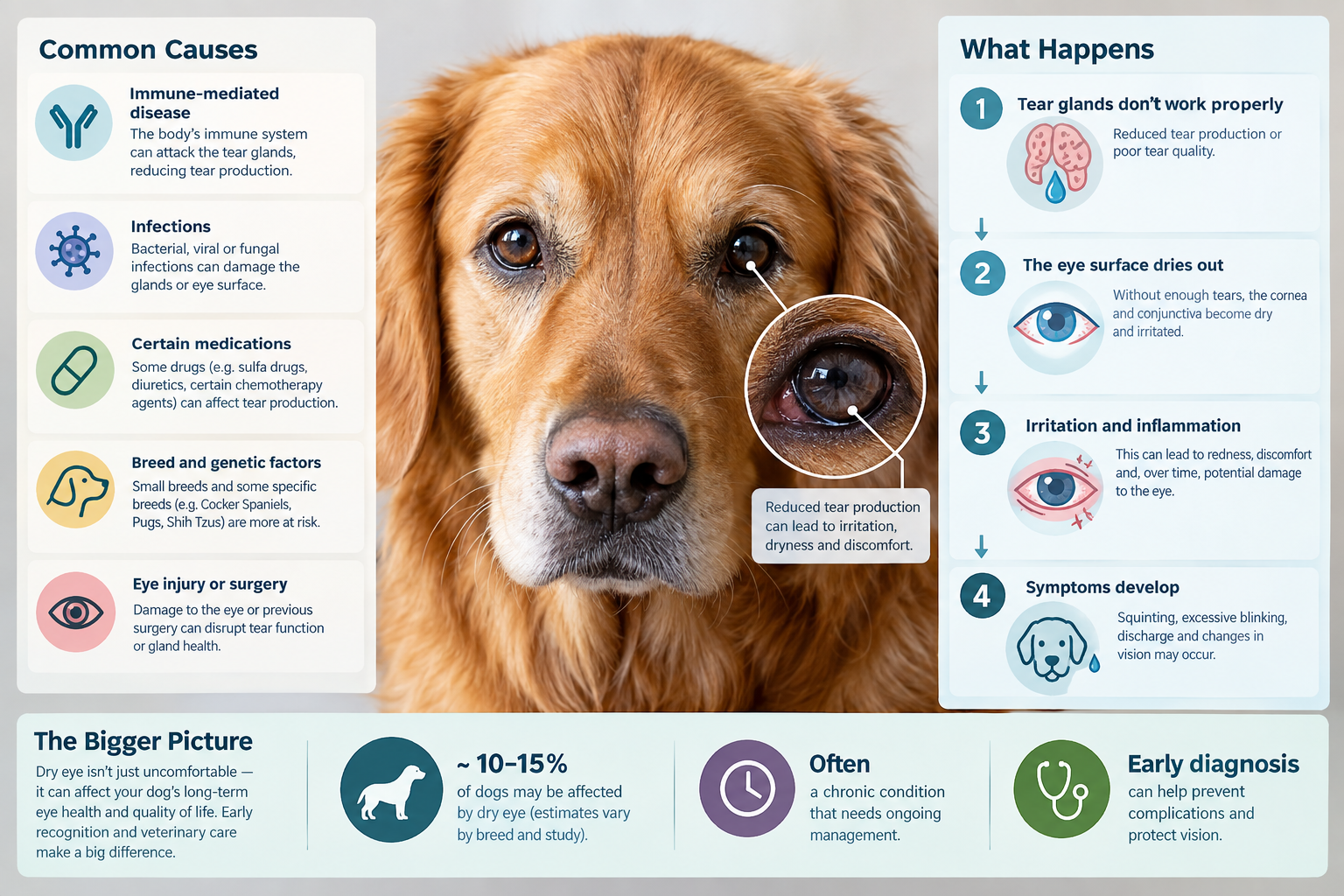
- Most cases are immune-mediated, where the dog’s own immune system attacks the tear glands. Less common causes include nerve damage, certain drugs, injury, and some infections.
- A UK investigation is still open. The British Association of Veterinary Ophthalmologists (BrAVO) reported in September 2026 that more than 200 acute bilateral KCS cases had been reported by vets. Affected dogs had not all eaten the same diet, and no cause has been proven.
- First-line treatment is a prescription immune-modulating ointment, most often ciclosporin, supported by lubricants. Treatment is usually long term and often lifelong.
- Home remedies are comfort measures only. Lubricating drops and gentle cleaning help between doses. They do not restore tear production.
The 6 Painful Signs of Dry Eye in Dogs Owners Notice First
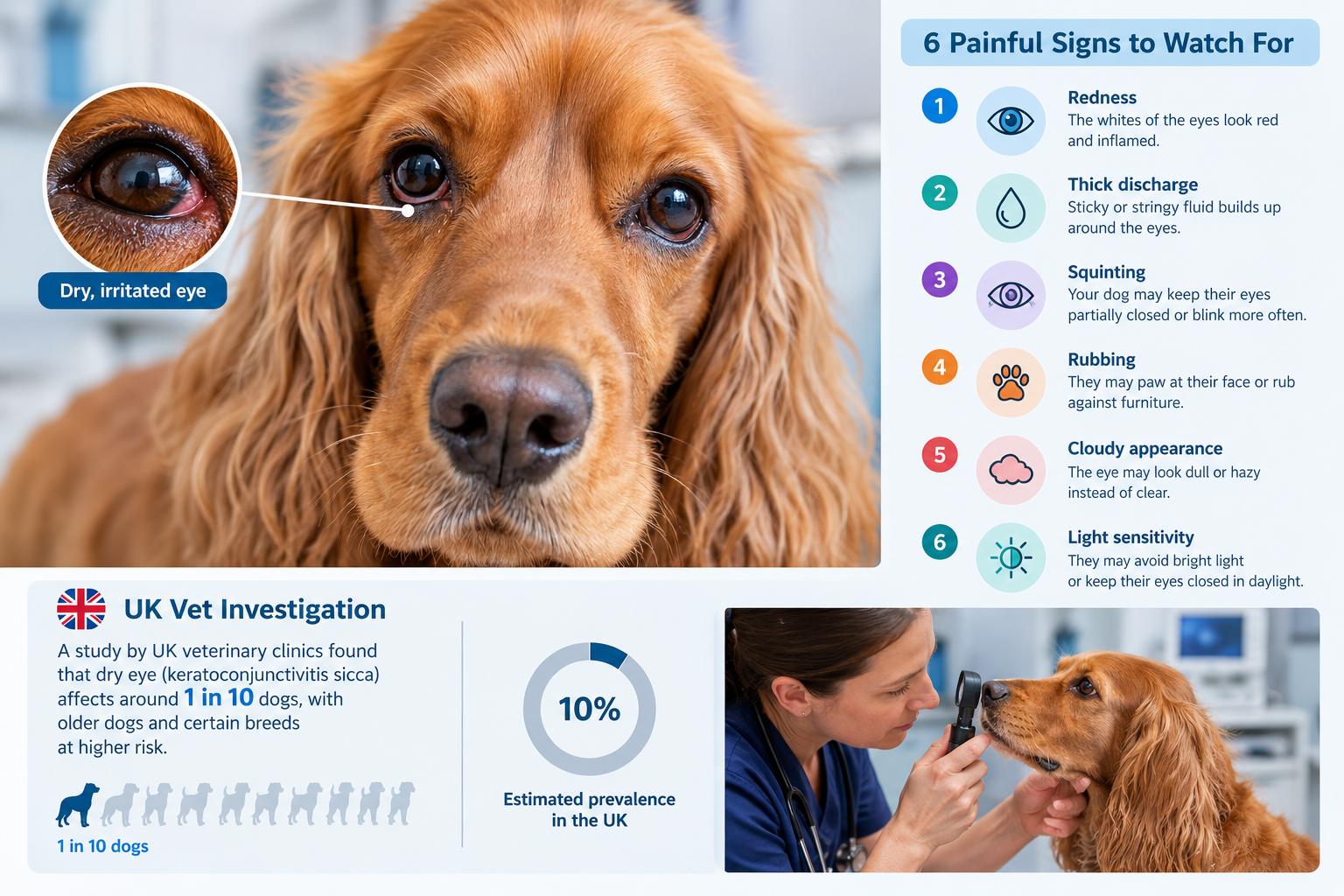
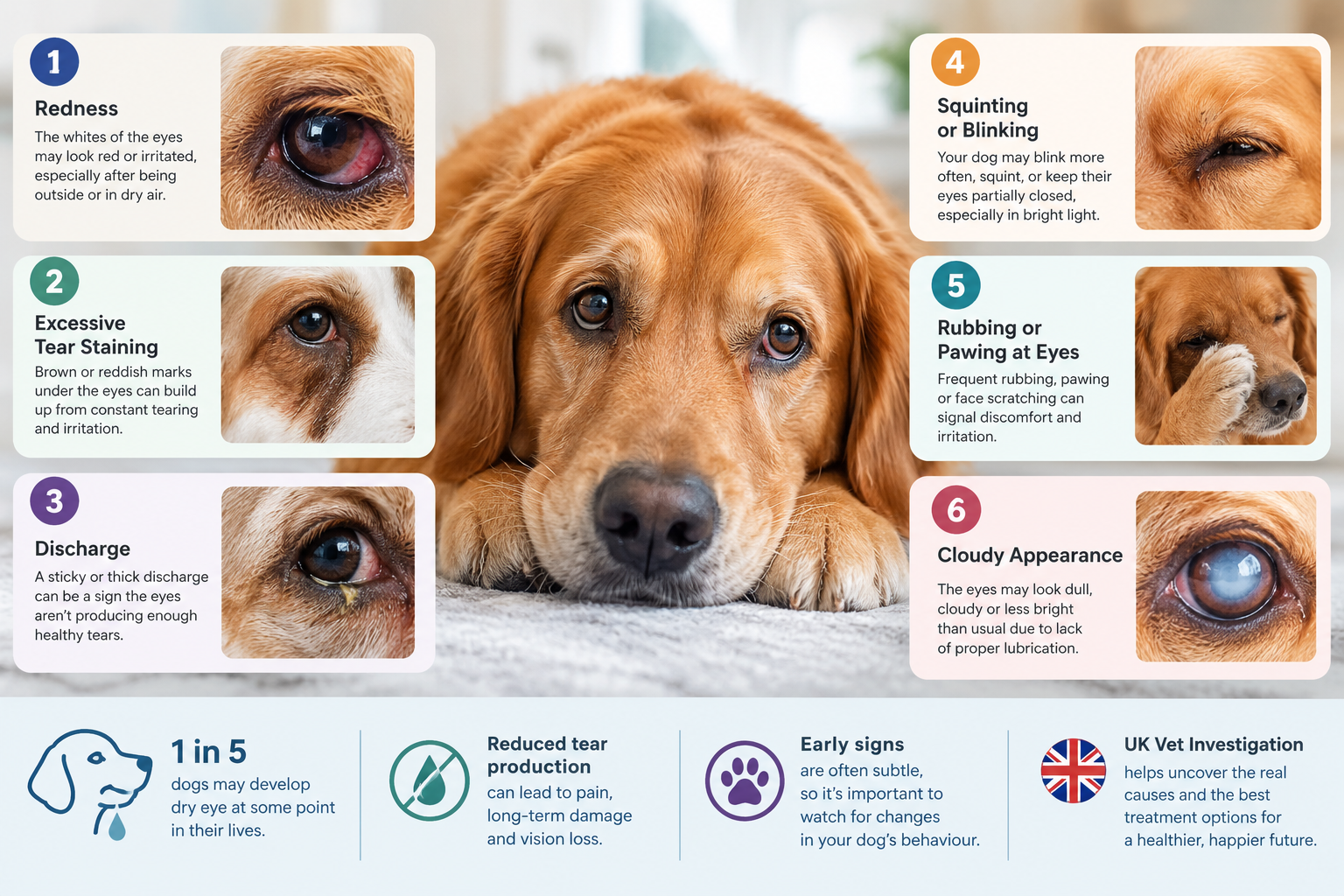
Dry eye in dogs usually shows up as a combination of discharge, redness, and discomfort rather than one dramatic symptom. PDSA lists redness, squinting or holding the eye shut, excessive blinking, thick sticky discharge, rubbing or pawing at the face, and a dull or cloudy corneal surface among the signs that warrant veterinary assessment.
Here is what each one looks like in an ordinary living room, not a textbook.
- Thick, sticky discharge that keeps coming back. Yellow, green, grey, or white mucus is the sign owners describe most. It is particularly suspicious when it reappears within an hour of being wiped away. Low tear volume reduces the eye’s natural flushing and antibacterial protection, which raises the risk of secondary infection, as the Eye Vet and specialist fact sheet on keratoconjunctivitis sicca explains.
- Redness that does not settle. The white of the eye and the inner lids look inflamed, sometimes for weeks.
- Squinting or a tightly closed eye. Dogs with a dry, inflamed cornea hold the lids shut because blinking over a dry surface hurts.
- Excessive blinking or twitching lids. Watch during a calm moment on the sofa. Rapid, repeated blinking on one side is easy to miss when the dog is moving.
- Rubbing the face on carpet, furniture, or your leg. Pawing at the eye is the version people spot. Face planting into the rug on every lap of the hallway is the version people assume is a habit.
- A dull, hazy, or cloudy eye surface. A healthy cornea reflects light cleanly. A dry one loses that wet shine and can look matte, then grey or blue-tinged as chronic changes develop.
15 to 25 mm
Normal canine tear production per minute on a Schirmer tear test (
RVC fact file)
Under 15 mm
Tear readings below this level are low and need clinical interpretation alongside signs (
RVC)
200+ cases
Acute bilateral KCS cases reported by UK vets as of the September 24, 2026 update (
BrAVO)
0.2%
Ciclosporin concentration in Optimmune 2 mg/g eye ointment, a UK prescription medicine for KCS (
VMD product information)
Is dry eye in dogs painful?
Yes. A dry cornea is an exposed, inflamed surface being swept by an eyelid several times a minute. The squinting, blinking, and face rubbing are pain behaviours, not quirks. Dogs are also good at carrying on with dinner and walks while something hurts, which is why the discomfort often goes unrecognised until the discharge becomes obvious. If the eye is cloudy or the dog will not open it, that is a same-day problem, because a corneal ulcer can develop on a dry surface and ulcers can deepen fast.
What Causes Dry Eye in Dogs?
Most dry eye in dogs is immune-mediated: the immune system gradually attacks the tear-producing glands, so tear volume falls over months or years. Other recognised causes include nerve damage affecting tear signalling, drug side effects, injury or removal of the tear gland, some infections, and congenital gland underdevelopment, as described by Animal Trust’s dry eye advice.
The main categories worth knowing:
- Immune-mediated KCS. The most common form. Usually affects both eyes, often slowly, and often responds well to immune-modulating treatment because some gland tissue survives.
- Neurogenic dry eye. The nerve supply to the tear gland is interrupted. Davies Veterinary Specialists’ overview of canine neurogenic dry eye notes it frequently affects one eye and may come with a dry nostril on the same side, which is a useful clue for your vet.
- Drug-associated. Certain medications can reduce tear production. Tell your vet every drug and supplement your dog has had recently.
- Mechanical and structural. Scarring, previous gland removal, or chronic lid disease can leave the surface poorly protected.
- Acute bilateral onset. A sudden, severe drop in both eyes at once is the pattern now under investigation in the UK. More on that below.
What breeds are prone to dry eye?
Breed is a risk factor, not a prediction for an individual dog. Breeds reported at higher risk include the West Highland White Terrier, English Bulldog, Cocker Spaniel, Shih Tzu, Pug, Lhasa Apso, Pekingese, Cavalier King Charles Spaniel, and Yorkshire Terrier, according to PDSA and the RVC.
Flat faces add a mechanical problem on top of the tear problem: wider lid openings, more exposed cornea, and sometimes incomplete blinking. Individual variation still rules. A Labrador can develop KCS and a Westie can live fifteen years without it. If you are weighing up which dog fits your household, the eye care commitment of a brachycephalic breed belongs in that calculation alongside everything else in our guide to choosing a breed as a first time owner.
The 2026 UK Investigation Into Sudden Bilateral Dry Eye
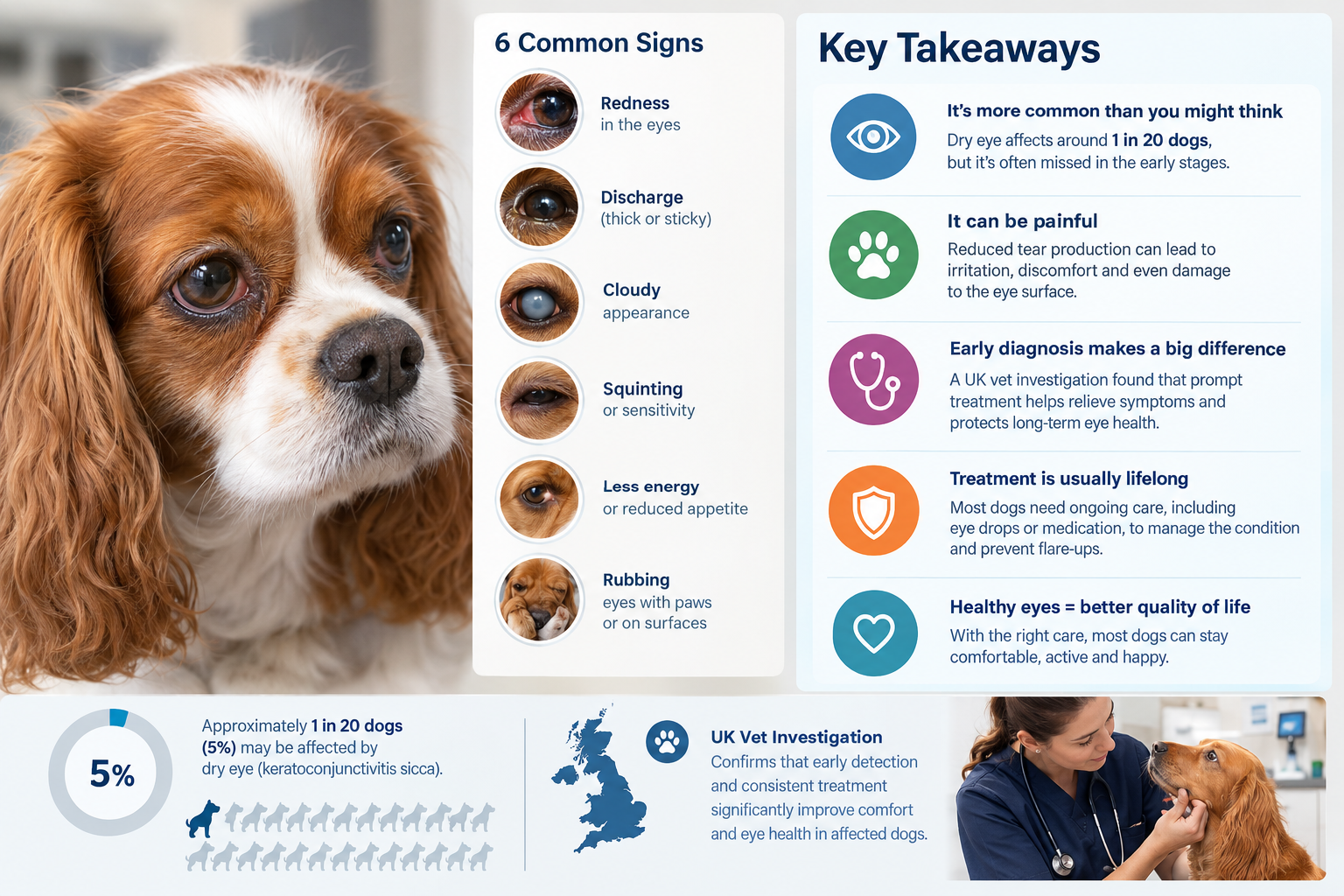
A cluster of sudden, severe dry eye cases in UK dogs triggered an open veterinary investigation in 2026, and as of October 2026 no cause has been established. In its September 24, 2026 update, BrAVO reported that more than 200 acute bilateral KCS cases had been submitted by veterinary surgeons, with cases still being validated and analysed, and noted that affected dogs had not all eaten the same diet.
What is on the record, in order:
- August 2026. The pet food brand Years voluntarily recalled most of its fresh meal products after reports of sudden bilateral dry eye in dogs. UK Pet Food’s owner information page carries the recall details and ongoing updates for owners.
- A possible dietary association was raised, then not confirmed. BrAVO acknowledged that diet had been suggested in some cases and explicitly warned against drawing conclusions before clinical data were validated.
- Cases appeared in dogs with no history of eating the recalled food. That weakens any simple brand-specific explanation on its own, and it does not identify the real cause either.
- October 2, 2026. UK Pet Food reported that the Food Standards Agency had found no evidence of a food-safety risk and had no further action planned at that stage, while BrAVO’s independent investigation continued.
- The investigation remains live. Reporting by STV News on the continuing investigation into serious eye issues in dogs reflects the same position: open question, no proven cause.
This is where the facts end. Nobody has demonstrated a causal chain from any food to these cases, and nobody has ruled out an environmental or dietary factor either. Two things can be true at once: a recall was a reasonable precaution, and a recall is not evidence of causation.
If your dog is already on dry eye medication, do not stop it because of the news. BrAVO specifically advises owners to continue treatment unless their veterinary surgeon or ophthalmologist says otherwise, because stopping can allow irreversible tear gland damage and painful corneal disease.
Practical steps for UK owners right now: keep feeding records and packaging batch details, report any sudden eye change to your vet the same day, and ask your vet whether they are submitting the case to BrAVO. If you are reviewing your dog’s whole diet anyway, do it on nutritional grounds rather than panic, and keep the basics in mind from our guides to human foods dogs can eat safely and foods dogs cannot eat at all.
How Do I Know If My Dog Has Dry Eye? The Schirmer Tear Test
You cannot confirm dry eye at home. The standard first-line test is the Schirmer tear test (STT-1): a calibrated paper strip rests inside the lower eyelid for 60 seconds and the wetted length is measured in millimetres. The RVC gives normal canine values as approximately 15 to 25 mm per minute, with lower readings treated as abnormal when they come with compatible clinical signs.
A full eye workup usually also includes:
- Fluorescein staining to look for corneal ulcers. This matters before any treatment decision, because steroid drops on an ulcerated eye can make things far worse.
- Examination of the lids, conjunctiva, and third eyelid, since lid position and blinking affect the tear film.
- Intraocular pressure measurement in some cases, to help separate dry eye from glaucoma or uveitis.
- Repeat tear testing at follow-up, to see whether treatment is working rather than guessing from the amount of goo.
A review of diagnostic methods and routine tear testing in canine KCS makes the same practical point vets repeat in consults: the number needs interpreting next to the eye in front of you. Borderline readings with clear clinical signs can still mean early or emerging disease.
Decision rule: if the discharge has lasted more than a couple of days, or keeps returning after treatment for “conjunctivitis”, ask directly for a Schirmer tear test. It takes a minute and it changes the diagnosis.
Dry Eye in Dogs vs Allergies and Other Red Eye Causes
Allergic eye irritation usually produces watery, clear discharge with itching, while dry eye produces thick, sticky mucus on an eye that looks dull rather than wet. Both cause redness and rubbing, which is why guessing from the sofa fails so often. The table below compares the most common look-alikes.
| Condition | Discharge | Typical clues | What settles it |
|---|---|---|---|
| Dry eye (KCS) | Thick, sticky, yellow to green, returns quickly | Dull or matte cornea, squinting, often both eyes, chronic | Schirmer tear test plus fluorescein stain |
| Allergic conjunctivitis | Watery and clear, sometimes stringy | Itching, seasonal pattern, often paw licking or itchy skin too | Normal tear test, response to treatment of the allergy |
| Corneal ulcer | Watery to mucky, often one eye | Marked pain, eye held shut, visible surface defect or haze | Fluorescein stain uptake, same-day vet visit |
| Foreign body | Sudden watering, then mucus | Abrupt onset in one eye after a walk, heavy blinking | Examination under the lids and third eyelid |
| Glaucoma or uveitis | Often minimal | Cloudy eye, dilated or constricted pupil, obvious pain, vision change | Intraocular pressure measurement, urgent care |
Common mistake: repeatedly buying over-the-counter “eye wash” for a sticky eye and never testing tear production. Weeks of cleaning a dry cornea is weeks of untreated disease.
Dry Eye in Dogs Treatment Options That Work
The core treatment for immune-mediated dry eye in dogs is a prescription immune-modulating eye ointment, most commonly ciclosporin, used alongside lubricants and, where needed, antibiotics for secondary infection. The UK Veterinary Medicines Directorate lists Optimmune 2 mg/g eye ointment, containing 0.2% ciclosporin, as a prescription-only medicine for dogs with KCS and chronic superficial keratitis.
| Treatment | What it does | Who it suits | Limits to know |
|---|---|---|---|
| Ciclosporin ointment (e.g. Optimmune 0.2%) | Reduces immune attack on tear glands and can restore tear production | First-line for immune-mediated KCS | Prescription only, takes weeks to show effect, usually long term |
| Tacrolimus eye preparation | Alternative immune-modulating option used when ciclosporin response is poor | Dogs needing a second option under veterinary direction | In the UK this is typically unlicensed or specially prepared and must be prescribed and monitored by a vet |
| Artificial tears and lubricant gels | Replace missing moisture, improve comfort, protect the surface | Every dog with low tear production, as support | Comfort only, does not restore tear production, needs frequent dosing |
| Topical antibiotics | Treat secondary bacterial infection | Infected eyes, short courses | Not a treatment for the dryness itself |
| Pilocarpine | Stimulates tear secretion in selected neurogenic cases | Some nerve-related cases, vet directed | Not appropriate for typical immune-mediated KCS |
| Parotid duct transposition surgery | Redirects a saliva duct to lubricate the eye | Rare, severe cases that fail medical treatment | Specialist referral, saliva causes its own surface deposits and complications |
Best eye drops for dogs with dry eye
The best eye drops for dogs with dry eye are the prescription medication your vet chooses plus a veterinary lubricant that fits your dosing reality. Thin drops are easy to apply and wash away quickly, so they need frequent use. Thicker gels and ointments last longer between applications and suit owners who are out of the house for parts of the day. Never use human medicated drops, and never use anything containing a steroid unless your vet has confirmed there is no corneal ulcer, a point Animal Trust makes plainly.
How long does it take to treat dry eye in dogs?
Expect weeks, not days, before tear production improves on immune-modulating treatment, with a repeat Schirmer tear test at the interval your vet sets. Comfort often improves sooner because lubricants work immediately. Most dogs with immune-mediated KCS stay on treatment for life, and signs usually return if medication stops. Put the drops next to something you already touch twice daily. The dog will learn the routine faster than you expect, which is one small upside of how dogs read our daily patterns.
Can Dry Eye in Dogs Go Away on Its Own, and What Happens If It Is Left Untreated?
Immune-mediated dry eye in dogs does not resolve on its own, and untreated low tear production leads to chronic corneal damage, ulceration, pigment and scar formation, and in severe cases blindness. Some drug-related or short-lived cases improve once the trigger is removed, and some neurogenic cases recover nerve function over time, but that is a decision for a vet to monitor with repeat tear testing, not a reason to wait and see.
The progression without treatment, as set out by PDSA and the specialist KCS fact sheet:
- Persistent irritation and sticky discharge
- Secondary bacterial infection as the eye loses its natural flushing
- Corneal ulceration, which can be deep and painful
- Chronic surface change: blood vessel growth, brown pigment, and scarring
- Reduced vision, and in advanced cases blindness in the affected eye
Can dry eye cause blindness in dogs?
Yes, in advanced or untreated cases. Blindness from KCS is caused by the cornea becoming scarred and pigmented rather than the dryness itself blocking sight. Those changes are permanent once established, which is why early testing and consistent medication matter far more than any product on a shelf. Dogs adapt remarkably well to reduced vision, partly because they were never relying on sharp colour detail in the first place, as explained in our piece on what colours dogs can actually see. Adapting well is still not a substitute for keeping the eye comfortable.
Dry Eye in Dogs Home Remedies: What Helps and What to Skip
Home care for dry eye in dogs is comfort care alongside veterinary treatment, never instead of it. There is no home remedy that restores tear gland function.
Reasonable at home:
- Veterinary lubricating drops or gel at the frequency your vet advises
- Gentle cleaning of discharge with a clean, damp cotton pad, wiping away from the eye, using a fresh pad per eye
- Keeping the face fur trimmed clear of the eyes by a groomer
- Running a humidifier in very dry rooms and avoiding direct fan or car vent airflow at the dog’s face
- Swapping a collar for a well-fitted front-clip or body-fitting walking set-up if your dog pulls, to reduce pressure around the neck and head
Skip these:
- Human medicated eye drops, including anything with a decongestant or steroid
- Saline rinses used as a replacement for prescribed medication
- Tea bags, oils, honey, or diluted essential oils on or near the eye
- Omega-3 supplements marketed as a dry eye cure. Fish oil has general uses, and claims that it fixes KCS are not supported. If you are adding food extras for other reasons, keep it sensible with our guide to genuinely useful superfoods for dogs.
When Should I Take My Dog to the Vet for Dry Eye?
Book a same-day appointment if the eye is cloudy, held shut, visibly painful, or suddenly sticky in both eyes at once. Book within a few days for mild redness or intermittent discharge that is not improving. Sudden bilateral signs are the pattern currently under investigation in the UK, so same-day reporting helps your dog and helps the data.
Use this symptom diary in the days before the appointment. It turns “he has been a bit gunky” into a record your vet can use.
How Much Does Dry Eye Treatment Cost for Dogs?
Costs vary widely by practice, region, and whether referral is involved, so ask for a written estimate rather than relying on a figure from an article. Doggy Rank IQ did not verify current UK prices for this guide, and quoting a number we have not checked would be worse than useless.
What to ask about when you phone:
- Consultation fee for the initial eye exam, including the Schirmer tear test and fluorescein stain
- Medication cost per tube and how long a tube typically lasts at your dog’s prescribed frequency
- Written prescription fee if you want to buy the medication from a registered online pharmacy
- Recheck appointments and repeat tear tests in the first few months
- Referral costs if a specialist ophthalmologist or surgery is being considered
- Insurance position, since dry eye is usually a lifelong condition and pre-existing exclusions matter a great deal
If money is tight, say so at the appointment. Practices can often prioritise the essential steps, and PDSA provides low-cost veterinary care for owners who meet their eligibility criteria. Nobody at a reasonable practice thinks less of an owner for asking what something costs.
FAQ
Can a dog recover from dry eye? Tear production often improves substantially with prescription treatment, and many dogs become comfortable with normal vision. Immune-mediated KCS is managed rather than cured, so medication usually continues for life.
What is the difference between KCS and dry eye in dogs? They are the same condition. KCS stands for keratoconjunctivitis sicca, the clinical name for inflammation of the cornea and conjunctiva caused by insufficient tears.
Is tacrolimus better than ciclosporin for dry eye in dogs? Neither is automatically better. Ciclosporin is the licensed first-line option in the UK, and tacrolimus is generally used when the response to ciclosporin is inadequate. In the UK a tacrolimus eye preparation is typically unlicensed or specially prepared, so it must be prescribed and monitored by a vet.
Should I stop feeding my dog a recalled food if the eyes look fine? Follow the recall instructions on the UK Pet Food owner information page and your vet’s advice. Keep the packaging and batch details, and report any new eye signs the same day.
Can dry eye affect only one eye? Yes. One-sided dry eye raises the possibility of a nerve-related or mechanical cause, and Davies Veterinary Specialists note that a dry nostril on the same side can be an added clue in neurogenic cases.
How often should tear production be rechecked? At the intervals your vet sets, usually within the first few weeks of starting treatment and periodically afterwards. Repeat Schirmer tear tests show whether the medication is working, which guesswork cannot.
Are there dog breeds I should avoid if I cannot manage daily eye care? Several flat-faced and terrier breeds carry higher reported dry eye risk, so daily medication is a realistic possibility with them. Breed risk is a tendency, not a forecast for one dog, and temperament and exercise needs still belong in the decision. Our notes on breeds that suit active families with children may help you weigh the whole picture.
Conclusion: Your Next Three Steps
Dry eye in dogs is one of the more treatable painful eye conditions, and it is also one of the easiest to mistake for ordinary gunk for far too long. The difference between a comfortable dog and a scarred cornea is often a one minute paper strip.
- Tick the diary for two or three days, or go straight to the vet today if the eye is cloudy, closed, or clearly sore.
- Ask for a Schirmer tear test and a fluorescein stain by name. Write down the millimetre reading for each eye so you can compare at recheck.
- If medication is prescribed, keep giving it and book the recheck before you leave the building. If news coverage of the UK investigation worries you, call your vet. Do not stop treatment on your own, which is exactly what BrAVO advises against.
That is the honest version of this topic in October 2026: clear answers on signs, testing, and treatment, and an open question on the 2026 UK cluster that nobody has yet solved. Dog advice that actually answers the question includes saying where the facts end.