
Quick Answer
Bobbie the Wonder Dog was a Scotch collie mix who disappeared from his family during a 1923 road trip to Indiana and turned up back home in Silverton, Oregon, about six months later, having crossed roughly 2,500 to 2,800 miles depending on the route used. The Oregon Humane Society investigated the claim by collecting letters from people along the route who said they had fed or sheltered a dog matching Bobbie’s scars and markings, which is the closest thing to physical proof the case has. Bobbie the wonder dog is treated by historians as a genuine historical episode, not an invented legend, though the exact mileage and whether he ever got a ride for part of the trip remain impossible to confirm. He became a national celebrity, appeared in a 1924 silent film, and is buried at the Oregon Humane Society in Portland.
Key Takeaways: bobbie the wonder dog
- Bobbie was a Scotch collie and English Shepherd mix owned by Frank and Elizabeth Brazier of Silverton, Oregon.
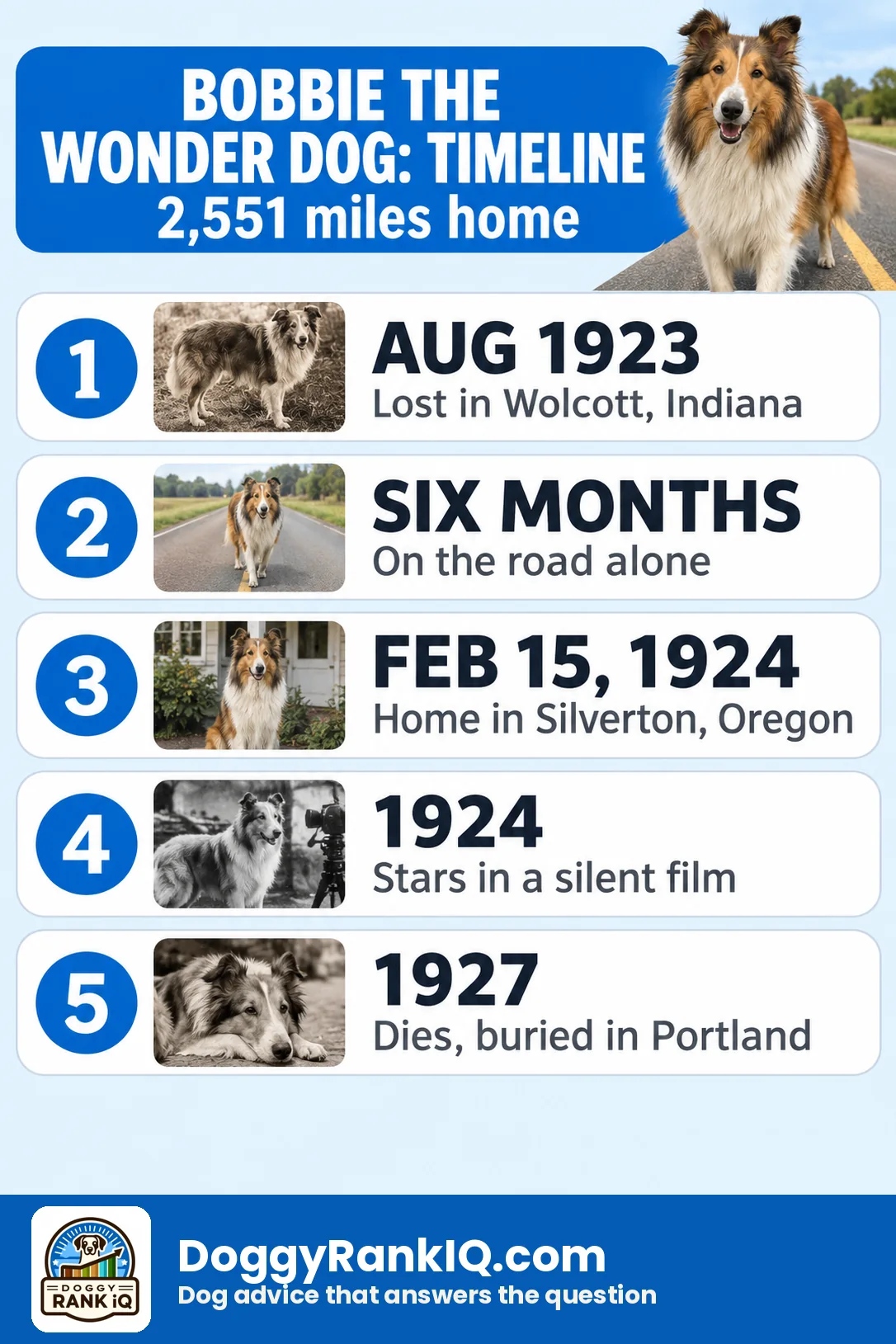
- He went missing near Wolcott, Indiana, in August 1923 and reappeared in Silverton on February 15, 1924.
- The commonly cited distance is 2,500 miles, though the Oregon Encyclopedia puts the figure closer to 2,800 miles.
- The Oregon Humane Society investigated witness letters from along the route and concluded the trip happened.
- Bobbie route was pieced together after the fact, from people’s memories, not a tracked path.
- Bobbie starred in the 1924 silent film The Call of the West and received a jeweled harness and a miniature bungalow.
- He died in 1927 and is buried at the Oregon Humane Society, where Rin Tin Tin reportedly laid a wreath.
- Scientists still do not fully understand canine long-distance homing, though smell and spatial memory are the leading explanations.
- Modern GPS trackers now answer the question Bobbie’s story could never fully settle: where is my dog, right now.

What do you want to know?
Tap an option to see the answer.
Who was Bobbie the Wonder Dog?
Bobbie was a family pet from Silverton, Oregon, who became a national news story in 1924 after walking an estimated 2,500 miles back to his owners from Indiana. He was not a trained working dog or a show animal before his trip. He was an ordinary farm town collie who happened to live with a family that drove cross country in an era when that trip itself was unusual.
Frank and Elizabeth Brazier ran a gas station and garage in Silverton, and Bobbie was known locally before 1923 simply as the family dog who rode along on errands. His sudden fame afterward surprised the family as much as anyone, according to accounts collected by the Oregon Encyclopedia. What separates Bobbie from a tall tale passed around a small town is that newspapers, a humane society, and a published book all documented the case close to the time it happened, not decades later.
What breed was Bobbie the Wonder Dog?
Bobbie is generally described as a Scotch collie mixed with English Shepherd, a working farm dog type common in the Pacific Northwest during the 1920s. He was medium sized, rough coated, and built for the kind of outdoor, all-weather work that farm dogs of that era were expected to handle.
This breed background matters for anyone trying to judge how plausible the 2,500 mile claim is. Scotch collies and English Shepherds were bred as all-day working dogs, with decent stamina and a strong homing instinct toward people and property they knew. That does not prove Bobbie walked the entire distance unassisted, but it does mean he was not a small, short legged, low endurance breed that would make the claim implausible on its face. Readers comparing working breed temperaments more broadly might find the background in America’s top dog breed guide useful context.
The short answer: the Bobbie the Wonder Dog story
Bobbie is a documented case, not folklore invented decades later. A dog did go missing over 2,000 miles from home, and a dog matching his description did return to that home roughly six months afterward. The disagreement among historians is not about whether something happened. It is about distance, route, and how much of the walk was unassisted.
The Oregon Encyclopedia, maintained by the Oregon Historical Society and Portland State University, treats the broad outline as confirmed history. The family’s own 1924 account, newspaper coverage of the time, and a Humane Society investigation all point the same direction. What nobody has is a tracking collar or a continuous paper trail. That gap is exactly why “myth or real” is still a fair question to ask about Bobbie, even a century later.
Bobbie the Wonder Dog story: true or false?
The core claim, that a lost family dog traveled roughly 2,500 miles and returned home, is treated as true by Oregon historians based on contemporary documentation rather than later invention. The parts that cannot be verified are the fine details: the exact path, whether Bobbie received help for any stretch, and the precise mileage.
Skeptics are right to note that nobody watched Bobbie the entire way. But the skepticism usually targets the wrong thing. The question is not whether the Braziers or newspapers made the whole story up. Multiple independent witnesses along a rough path, collected by the Oregon Humane Society after the fact, described a scarred, travel worn collie that matched Bobbie’s description months before he turned up in Silverton. That is corroboration from strangers with no reason to coordinate a hoax.
Decision rule: if you need a short answer for a classroom report or trivia night, call it true, with the caveat that exact mileage is an estimate. If you are writing a detailed historical piece, note that the middle of the trip rests on witness memory, not direct observation.
Timeline table: the trip in dates
Lost in Indiana, 1923
Bobbie was lost the ordinary way most dogs go missing: a sudden scare, a bolt, and a family that had no way to call him back. In August 1923, Frank and Elizabeth Brazier drove from Silverton, Oregon to Wolcott, Indiana to visit relatives, with Bobbie along for the trip. Local dogs chased him off during the visit, and he could not be found before the family had to head home, according to accounts in Weekly View.
This detail matters for anyone reading the Bobbie story today, because it was not a dramatic abandonment. It was the same scenario that plays out at rest stops and relatives’ yards every year: an unfamiliar place, no fence, and a dog that runs on instinct. The Braziers searched before leaving, found nothing, and drove back to Oregon without him. Six months passed with no word.
That gap, roughly from mid-August 1923 to mid-February 1924, is the entire unverified middle of the story. Nobody tracked Bobbie during those months. Whatever happened between Indiana and Oregon has to be reconstructed after the fact, which is exactly what investigators tried to do once he turned up.
When did Bobbie the Wonder Dog make his trip, and how long did it take?
Bobbie’s trip began around mid-August 1923, when he was separated from the Brazier family in Wolcott, Indiana, and ended on February 15, 1924, when he arrived back in Silverton, Oregon. That puts the total travel window at roughly six months, though nobody knows how many of those days were spent actually moving versus resting or sheltering in one place.
Six months to cover an estimated 2,500 to 2,800 miles works out to an average of about 14 to 16 miles a day, assuming steady travel with no major stops. In practice, the pace was almost certainly uneven: faster across flat stretches, slower or stalled during winter weather in the mountains, and possibly paused for days at a time wherever Bobbie found food and shelter. This is an estimate based on the known start and end dates, not a tracked pace, since no one recorded his daily position.
How did Bobbie the Wonder Dog travel across America?
Bobbie is believed to have traveled on foot for most or all of the distance between Indiana and Oregon, relying on instinct, scent, and whatever food and shelter he could find along the way. There is no confirmed evidence that he rode in a vehicle or train for any portion of the trip, though historians note it cannot be fully ruled out either.
The Oregon Encyclopedia describes his physical condition on arrival (thin, footsore, with worn toenails and damaged paw pads) as consistent with months of walking rather than riding. People who wrote in afterward described feeding a scarred collie at homes and farms strung loosely along a path running from the Midwest, across the Rockies, and into the Pacific Northwest. Those accounts are the basis for the commonly cited route, though they were gathered from memory after national news coverage, not recorded as Bobbie passed through.
2,500 miles home: the route investigators pieced together
There was no GPS trail in 1924, so the Bobbie route was built entirely from human memory after his arrival home. People who believed they had seen or fed a dog matching his description wrote letters once his story made national news, and those letters, strung together, formed a rough path from Indiana back to Oregon, as described by the Oregon Encyclopedia.
The widely repeated figure is 2,500 miles. The Oregon Encyclopedia, in its most recent update, cites a figure closer to 2,800 miles depending on which path is assumed. The discrepancy exists because the story spread through newspapers, a 1924 first-person account by Frank Brazier in Animal Pals, and later retellings, rather than through a single standardized survey of mileage.
A few things to keep in mind about the route:
- It crossed mountains, plains, and winter weather, a route that would challenge a conditioned sled dog, let alone a family pet.
- The path was assembled from witness accounts collected after Bobbie’s arrival, not logged in real time.
- Distance estimates vary by 300 miles depending on which crossing points are assumed, which is why you will see both “2,500 miles” and “2,800 miles” in reputable sources.
Choose the 2,500-mile figure if you are citing the popular, widely circulated version of the story. Choose the roughly 2,800-mile figure if you want the number closest to the Oregon Historical Society’s own summary.
Where did Bobbie the Wonder Dog travel from and to?
Bobbie’s trip started near Wolcott, Indiana, where he was separated from the Brazier family during their visit to relatives, and ended in Silverton, Oregon, the family’s hometown. The route in between is believed to have crossed the Midwest, the Rocky Mountains, and the high desert and valleys of the Pacific Northwest, based on witness letters collected after his return.
Silverton sits in the Willamette Valley, so the final leg of any westward route would have brought Bobbie through mountain passes before descending into farm country he would have recognized by smell alone, if the leading theories about canine homing are accurate. For readers wanting a sense of how sensitive a dog’s nose is to familiar ground, how a dog’s sense of smell works breaks down the mechanism in more detail.
Bobbie the Wonder Dog owner name
Bobbie’s owners were Frank and Elizabeth Brazier of Silverton, Oregon, who ran a gas station and garage in town during the 1920s. Frank Brazier later published his own account of the trip in 1924, which remains one of the closest first-person sources to the event itself.
The Braziers did not set out to create a celebrity dog. They were a working family who lost a pet during a family visit and got him back six months later in rough shape. Their decision to document the story, combined with the Humane Society’s independent investigation, is a large part of why Bobbie is still treated as credible history rather than tall tale.
Myth or real? The evidence the Oregon Humane Society collected
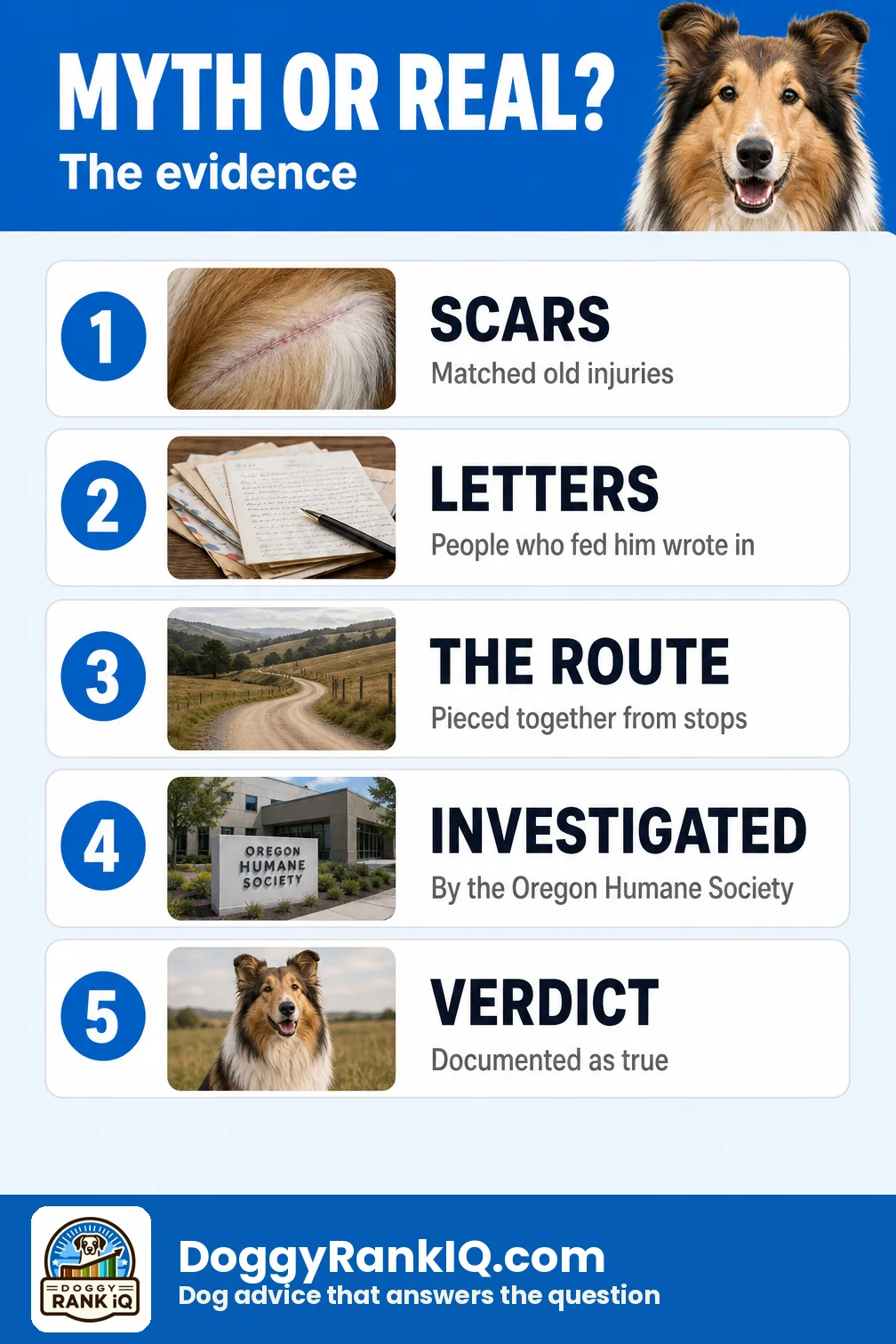
The Oregon Humane Society did not simply accept the Braziers’ account. It started skeptical and investigated, collecting letters from people along the presumed path who said they had sheltered or fed a collie-type dog with scars and markings matching Bobbie. That investigation is the strongest piece of contemporary evidence behind the Bobbie cause of death being unrelated to any hoax claim, and it is also the strongest evidence for the trip itself.
The physical condition Bobbie arrived in supports the story without proving every mile. Family accounts describe him as scrawny, matted, footsore, with worn toenails and damaged paw pads. That is consistent with months of hard travel. It does not rule out the possibility that he hitched a ride on part of the route, something no 1924 investigation could have disproven.
The Oregon Encyclopedia’s own phrasing is careful: Bobbie “appeared to have walked” the distance, while the Humane Society’s investigation is described as confirming that he traveled the route. That is a historian’s way of saying the broad claim holds up, while the fine details stay open. Historian Susan Stelljes, whose account appears in the Oregon Historical Society’s materials, treats the episode as real history rather than invented legend, without claiming certainty on every mile.
The practical read: if you are deciding whether Bobbie is myth or real, the honest answer is that it is a documented event with an unverifiable middle. That is different from a story with no evidence at all.
Did Bobbie the Wonder Dog really find his way home?
Yes, by the standards historians apply to this kind of case. A dog matching Bobbie’s description, with matching scars, wear patterns, and behavior, arrived at the Brazier home in Silverton roughly six months after he was separated from the family 2,500 or more miles away. Independent witnesses along the presumed route described feeding or sheltering a similar dog in the months before his arrival.
That said, “really found his way home” assumes the dog that arrived was the same dog that was lost, and assumes the trip was largely unassisted. Both assumptions are reasonable given the evidence but not provable with certainty. The family recognized him immediately by name, behavior, and physical markings, which is the strongest identification evidence available from that era, short of modern testing methods that did not exist in 1924.
Fame, a film and a bungalow
Bobbie’s return turned him into a national celebrity almost overnight. Newspapers across the country picked up the story after it was first reported locally, and Bobbie began receiving fan mail, gifts, and a jewel-studded harness.
He was given a miniature bungalow at the Portland Home Show, built to his scale, and he played himself in the 1924 silent film The Call of the West, a partial print of which the Oregon Historical Society still preserves. For a dog with no training, no agent, and no publicist, that is a fairly remarkable run of appearances, and it says something about how hungry the country was for a story about loyalty and instinct working out.
The Bobbie movie was not a polished production by today’s standards, but it cemented him as more than a local curiosity. By the mid-1920s he was arguably the most famous dog in America, a title that would not be seriously challenged again until Rin Tin Tin, who, fittingly, would later pay his own respects.
Owners curious about how dogs read people and situations without words might find how smart are dogs? a useful follow-up, since Bobbie’s story raises exactly that question.
Bobbie the Wonder Dog death and grave
Bobbie died in 1927, three years after his return home. The Bobbie cause of death is not detailed in the available historical sources reviewed for this article, and no verified medical cause should be stated without a source confirming it.
He is buried at the Oregon Humane Society in Portland, and according to accounts of the funeral, Rin Tin Tin laid a wreath at his grave, per Offbeat Oregon History. The Bobbie grave remains a point of local pride in the Pacific Northwest, and Silverton still holds an annual pet parade started in 1932 in his memory, alongside a mural and a statue of him in town, according to the Silverton Chamber of Commerce.
That the grave and the parade both still exist a century later says something about how the story settled into local history rather than fading as a one-season news item.
How could a dog find its way home? What science says
Dogs rely primarily on scent and spatial memory to handle familiar territory, and researchers have found evidence that some dogs may also use a sense tied to Earth’s magnetic field, though this does not fully explain a cross-country trip through unfamiliar ground. A 2020 study by Kateřina Benediktová and colleagues, published in eLife, tracked hunting dogs during off-leash excursions and found that many of them used a short run aligned with magnetic north before heading back toward their owner, a behavior the researchers called “scouting.” That study examined dogs returning across distances of a few miles in known territory, not hundreds of miles through places they had never been.
This is the honest limit of the science: nothing confirms that a dog can handle 2,500 unfamiliar miles using smell or magnetic sensitivity alone. What the research does support is that dogs have more going on than blind wandering when they try to get home, and that some navigational cue beyond vision is plausible. For context on the sensory tools dogs actually carry with them everywhere, see how a dog’s sense of smell works, which covers the mechanism most likely to have helped Bobbie near the end of his trip, once he reached familiar-smelling ground.
Readers interested in how dogs process loyalty and attachment more broadly might also like what is the most loyal dog breed, really, and the question of whether dogs track elapsed time the way the Braziers’ six-month wait suggests is covered in do dogs have a sense of time?
⭐ Top 5 Features We Love
- A documented investigation, not just a rumor. The Oregon Humane Society collected witness letters rather than taking the family’s word alone.
- A first-person account close to the event. Frank Brazier published his version in 1924, just a year after the trip, which is unusually close for a historical claim like this.
- Physical evidence on arrival. Worn paw pads and toenails matched what a genuine long-distance walk would produce.
- A lasting local legacy. Silverton’s pet parade, mural, and statue have run for close to a century.
- A surviving film record. A partial print of The Call of the West still exists at the Oregon Historical Society.
⚠️ Things to Look Out For
Bobbie’s story has a happy ending, but it is also a reminder that most lost dogs today do not need to walk home at all if they are properly identified and tracked. Here is what owners should watch for:
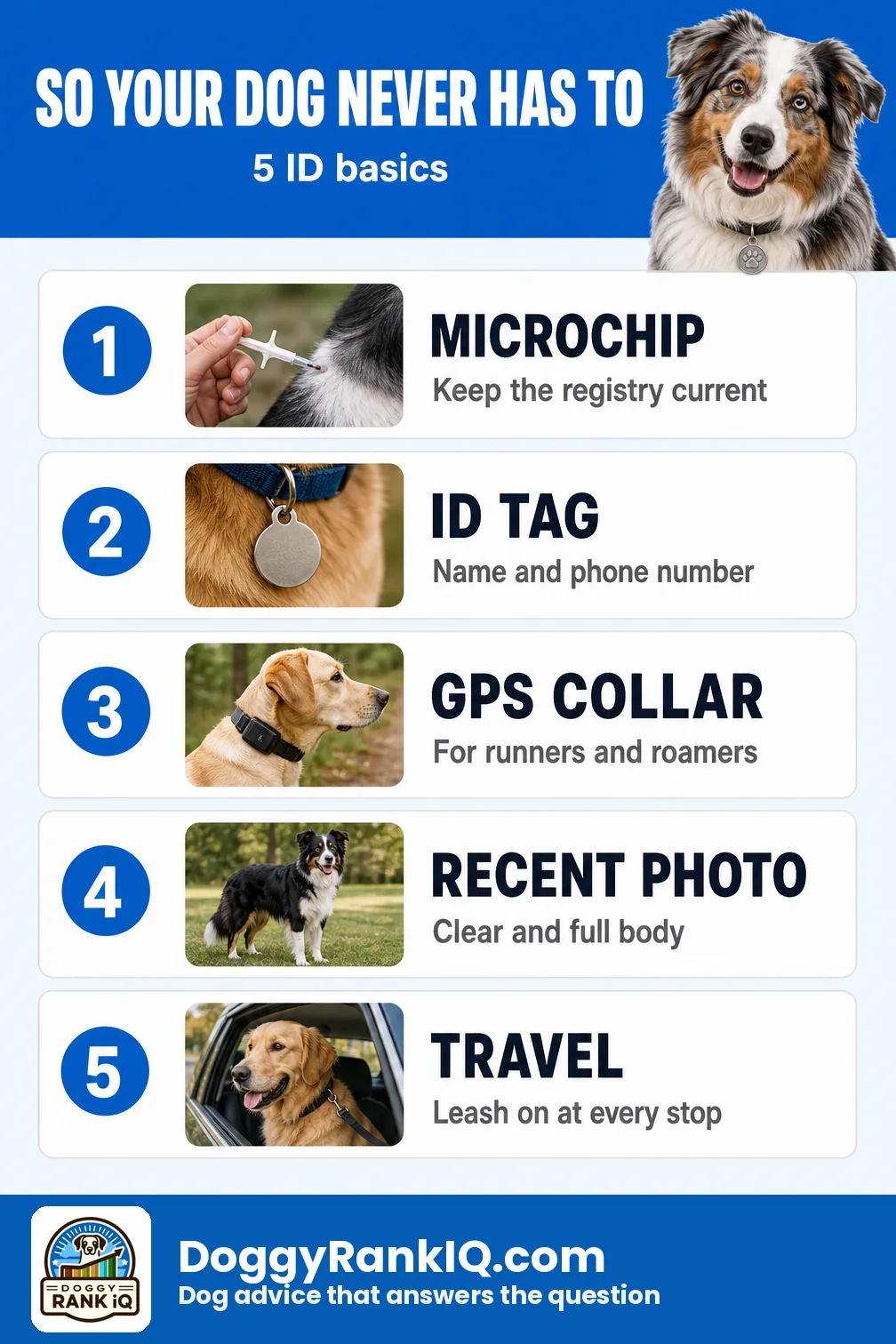
- A collar tag that fades or falls off. Replace tags yearly and check that the phone number is current.
- No backup microchip. A collar can slip off during the exact chase scenario that separated Bobbie from his family. A microchip, registered with current contact information, survives that.
- No real-time location option. Products like the Fi GPS collar give owners live location data that no amount of newspaper coverage could have offered the Braziers in 1923.
- Skipping the “what if we’re traveling” plan. Dogs are more likely to bolt in unfamiliar places, exactly like Bobbie did at a relative’s home. Have a plan before the trip, not after, and consider a secure airline approved carrier or a well fitted no-pull harness for any travel stops.
- Assuming it could not happen to a well-behaved dog. Bobbie was, by all accounts, a loyal, well-socialized collie. It happened anyway.
Bobbie the Wonder Dog book and reads
For readers who want the full story in more depth, a few books cover both the history and the broader science of canine behavior that makes Bobbie’s trip worth studying.
Bobbie: A True Story retells the 1924 trip for a general audience and draws on the same historical sources used by the Oregon Historical Society. Price: around $7.00 (price checked 2026). Check the current price.
The Dog Encyclopedia by DK is a useful reference for readers who want breed background on Scotch collies and English Shepherds, the mix Bobbie was believed to be. Price: around $13.29 (price checked 2026). Check the current price.
The Genius of Dogs covers canine cognition research more broadly, including navigation and problem-solving, for readers who want the science side of how a dog might find its way home. Price: around $12.75 (price checked 2026). Check the current price.
FAQ
The bottom line
Bobbie is one of the rare animal legends that holds up reasonably well under scrutiny, even if the exact mileage shifts depending on which historian you read. The core claim, that a family dog crossed most of the country and found its way home, is backed by a real investigation, a contemporary first-person account, and physical evidence on his arrival. What nobody can prove today is whether every mile was walked unassisted, and that gap is honest, not a cover-up.
If Bobbie’s story leaves you thinking about your own dog’s recall and identification setup, that is the useful takeaway here. A GPS collar and a current microchip registration do the job that letters from strangers along a highway had to do in 1924, and they do it in real time.
Doggy Rank IQ is reader supported. As an Amazon Associate we earn from qualifying purchases, at no extra cost to you.