
This post contains affiliate links. If you buy through one we may earn a commission at no extra cost to you. As an Amazon Associate I earn from qualifying purchases.
Quick Answer: An airline approved dog carrier is simply a carrier that matches the exact under-seat dimensions your airline publishes for the aircraft you’re flying, combined with enough interior room for your dog to stand, turn around, and lie flat. No federal agency certifies carriers as “airline approved,” so the label on the box means far less than measuring the bag yourself and checking it against your airline’s current policy page before every trip.
That one sentence is really the whole article. Everything else below fills in the specifics, because “airline approved” gets printed on plenty of carriers that still get turned away at the gate.
Key Takeaways
- Southwest permits its own branded carrier at 15 x 10 x 10 inches and other brands up to 18 x 10.5 x 10 inches, according to Southwest’s approved pet carrier guidance.
- United’s published soft-sided maximum is 18 x 11 x 11 inches, with hard-sided limits that vary by aircraft type.
- Delta recommends a soft-sided kennel up to 18 x 11 x 11 inches, per Delta’s pet travel overview, though the real ceiling depends on the plane assigned that day.
- American Airlines charges $150 per kennel each way as a carry-on pet fee on many routes, confirmed on American’s pet travel page, separate from the carrier’s purchase price.
- Brachycephalic breeds like bulldogs and pugs face added restrictions in cargo, and the AVMA’s air travel guidance for short-nosed dogs explains why heat and breathing risk drive many of these rules.
- No single soft-sided or hard-sided carrier fits every airline and every aircraft. The safest approach is checking your specific airline’s page the week of travel, not relying on a label from months earlier.
- Soft-sided carriers generally outperform hard-sided ones in-cabin because they compress slightly to fit different seat widths across aircraft types.
Airline Approved Dog Carrier: What That Phrase Actually Means
An airline approved dog carrier is a bag that fits the under-seat space of the specific aircraft flying your specific route, not a carrier certified by any government body. No federal agency inspects or stamps carriers the way a car seat gets a crash rating. The phrase is a marketing shorthand, and it only becomes true the moment your actual carrier fits under your actual seat.
Each airline sets its own numbers, and those numbers differ in ways that matter. Southwest’s branded carrier tops out at 15 x 10 x 10 inches, while other brands can go up to 18 x 10.5 x 10 inches according to Southwest’s carrier policy. United lists up to 18 x 11 x 11 inches for soft-sided bags, with hard-sided limits shifting by aircraft. Delta recommends 18 x 11 x 11 inches because that size “fits most aircraft” per its pet travel overview, which is a polite way of admitting it does not fit all of them. American splits rules by plane type, allowing 19 x 13 x 9 inches for hard-sided carriers on mainline jets but only 16 x 12 x 8 inches on American Eagle regional flights, as listed on American’s special assistance page.
So an airline approved dog carrier is approved by one airline, for one aircraft, on the day you checked. Recheck before every flight. The seat pitch under a regional jet is not the seat pitch under a wide-body, and nobody wants to learn that at the jet bridge with a dog in hand.
Covered airlines must now log animal loss, injury, or death through the DOT’s ACERS reporting system and report annual totals of animals transported to the USDA. That adds accountability but does not standardize carrier dimensions. The sizing patchwork is still yours to manage, every time you book.
Doggy Rank IQ Tool
Airline Carrier Under Seat Fit Checker

Airline approved is a marketing phrase. Enter your carrier and airline and compare against the published in cabin limits we checked.

Check the Actual Dimensions?
Yes, check them every time, even on a route you’ve flown before. Airlines swap aircraft on the same flight number constantly, and a carrier that cleared security in March can get rejected in November on the identical route number with a different plane assigned that day.
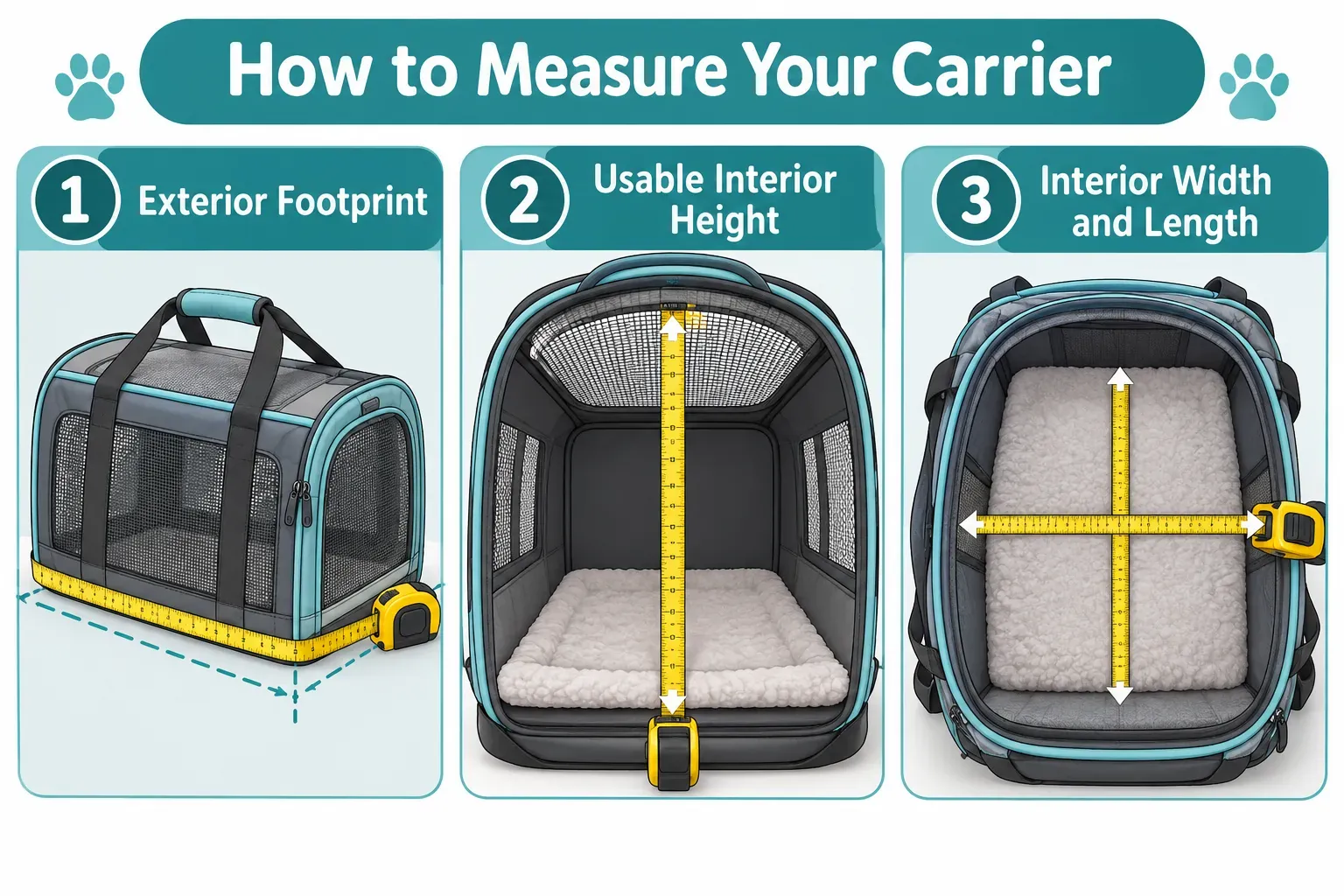
Checking the dimensions properly means three separate measurements, not one glance at a product listing:
- Exterior footprint: Measure the carrier yourself with a tape measure, not the number printed on the box. Zippers, wheels, and side pockets add bulk that product photos hide.
- Usable interior height: Measure from the floor to the mesh ceiling once padding is in place, not the frame height.
- Usable interior width and length: Measure at the narrowest padded point, because that is what your dog experiences, not the outer shell measurement.
Delta requires kennels to be leak-proof and ventilated on three sides for domestic flights, four sides for international ones. United asks that the carrier let the pet stand, turn around, and lie down in a natural position. Southwest requires the dog to stay completely inside the carrier at all times, with no paws or nose poking out, and the bag must remain under the seat in front for the entire flight.
None of that shows up clearly in a retail photo. It shows up when you put your actual dog inside the actual bag on your kitchen floor, zip it, and watch what happens for five full minutes.
What size dog carrier does the airline allow
Most US airlines cap soft-sided in-cabin carriers somewhere between 17 and 18 inches long, 10 to 11 inches wide, and 10 to 11 inches tall, but the exact number depends on the carrier, the airline, and the aircraft assigned to your flight. Hard-sided carriers tend to have smaller allowances because they cannot compress to fit a tighter seat gap.
For reference, published maximums include:
- Southwest: 15 x 10 x 10 inches (branded carrier) or up to 18 x 10.5 x 10 inches (other brands)
- United: up to 18 x 11 x 11 inches soft-sided
- Delta: recommends up to 18 x 11 x 11 inches, actual limit varies by aircraft
- American: up to 19 x 13 x 9 inches hard-sided on mainline jets, 16 x 12 x 8 inches on regional jets
- JetBlue: carriers must fit under the seat with pet remaining inside for the full flight, per JetBlue’s pet travel page
Choose the smallest common denominator if your trip involves a connection on a smaller regional aircraft. A carrier that clears the mainline leg can still get rejected on the connecting regional jet, and American explicitly warns that non-collapsible kennels cannot exceed the smallest aircraft’s under-seat space on the itinerary.
How much does an airline approved dog carrier cost
A solid airline approved dog carrier typically costs between $25 and $70, with most reliable soft-sided options landing in the $30 to $50 range. Price alone does not guarantee fit, since even premium carriers can run too tall or too wide for a specific aircraft.
Budget carriers in the $25 to $35 range, like the Henkelion, work fine for dogs under 15 pounds who mostly want to curl up and nap. Mid-range options in the $40 to $70 range, like the Sherpa Original Deluxe, add features like collapsible frames, padded straps, and reinforced stitching that hold up over repeated trips. Beyond the carrier price, budget for the airline’s pet fee separately. American charges $150 per kennel each way on many routes, and most major carriers charge somewhere in that neighborhood, so the carrier itself is often the smaller expense over a round trip.
Best airline approved dog carriers for small dogs
For dogs under 20 pounds, three soft-sided carriers consistently meet published airline dimensions and hold up to repeat travel: the Sherpa Original Deluxe, the Henkelion TSA Airline Approved carrier, and a generic 17x11x11 soft-sided option.
1. Exterior footprint that clears the specific airline’s number. The Sherpa Original Deluxe Travel Pet Carrier measures within the range most carriers publish for soft-sided bags, which is part of why it’s stayed a repeat pick for cabin flyers for years. Sherpa Original Deluxe Travel Pet Carrier, Airline Approved & Guaranteed On Board – Black, Medium (sponsored)
2. Collapsible structure for gate-side storage. A carrier that folds flat helps during boarding delays and tight overhead storage on connecting flights, and it matters more than people expect once you’re standing in a jet bridge line with a dog and a rolling bag.
3. Ventilation on multiple sides, not just the front mesh panel. Three or four-sided mesh keeps airflow moving during taxi delays on a hot tarmac, which matters more than most buyers think about until they’re sitting on the runway for forty minutes.
4. Weight capacity matched to the actual dog, with margin. The Henkelion carrier is rated for dogs up to 15 pounds, which gives a Chihuahua or small terrier mix room without pushing the bag’s seams. Henkelion Cat Carriers Dog Carrier Pet Carrier For Small / Medium Cats Dogs Puppies (Up To 15lbs), TSA Airline Approved Small Dog Carrier Soft Sided (sponsored)
5. A leak-proof base and washable liner. Nerves plus turbulence plus a three-hour flight sometimes equals an accident. A removable, washable pad saves the rest of the trip.
Can I use a regular carrier on a plane instead
A regular pet carrier can work on a plane only if it happens to match the airline’s published dimensions and allows your dog to stand, turn, and lie flat, but most generic carriers were designed for car rides and vet visits, not for the tighter under-seat space on commercial aircraft. Gate agents use sizers at the airport, and a carrier that’s an inch too tall or too rigid gets flagged regardless of what the label claims.
The safer approach is buying or confirming a carrier specifically marketed and measured against current airline limits, then double checking those measurements yourself rather than trusting the listing. If you already own a carrier you like, measure it against your airline’s published numbers before booking, and consider a trial run through a local pet store’s sizer display if the airline offers one at check-in counters.
Do airlines accept soft sided dog carriers
Yes, every major US airline accepts soft-sided dog carriers in the cabin, and most actually prefer them over hard-sided options because soft carriers compress slightly to fit varying seat widths across different aircraft. Southwest, United, Delta, and American all publish specific soft-sided dimension limits rather than treating soft and hard carriers identically.
Soft-sided carriers also tend to meet the ventilation requirements more easily, since mesh panels can wrap three or four sides without adding bulk. The tradeoff is less structural protection for the dog compared to a hard-sided kennel, which matters more for cargo travel than for an in-cabin flight where the carrier sits under a seat the entire time.

What are the dimensions for an airline approved dog carrier
The dimensions that matter for an airline approved dog carrier are the exterior footprint (to clear gate sizers) and the usable interior space (to fit your dog comfortably). Across major US airlines, soft-sided exterior limits generally fall between 15 x 10 x 10 inches and 18 x 11 x 11 inches, with hard-sided limits running slightly larger or smaller depending on the carrier.
A quick reference for common published maximums:
- Southwest branded carrier: 15 x 10 x 10 inches
- Southwest, other brands: up to 18 x 10.5 x 10 inches
- United soft-sided: up to 18 x 11 x 11 inches
- Delta recommended: up to 18 x 11 x 11 inches
- American hard-sided, mainline: 19 x 13 x 9 inches
- American hard-sided, regional jet: 16 x 12 x 8 inches
Interior usable space runs an inch or two smaller than exterior dimensions once padding, mesh seams, and structural wiring are accounted for. That gap is exactly why measuring your own carrier by hand matters more than trusting the number on the box.
Soft sided vs hard sided dog carrier for flying
Soft-sided carriers generally work better for in-cabin flying because they compress to fit tighter seat gaps, while hard-sided carriers work better for checked cargo because they offer more structural protection but far less flexibility under a passenger seat. For most dogs flying in the cabin, a soft-sided carrier is the right call.
Soft-sided pros include lighter weight, easier storage when empty, and better odds of fitting a range of aircraft. Soft-sided cons include less structural protection and a shorter lifespan with heavy daily use. Hard-sided pros include sturdier walls and better protection if ever checked as cargo. Hard-sided cons include fixed dimensions that cannot compress, which is exactly why American warns that non-collapsible kennels must fit the smallest aircraft on the itinerary, not just the biggest one.
Choose soft-sided if your dog is flying in the cabin on a standard domestic itinerary. Choose hard-sided only if cargo transport, not in-cabin travel, is the actual plan, since that’s a different product category with different airline rules entirely.
Top 5 Features That Decide the Purchase
Covered above under the small dog carrier picks, the same five features apply across weight classes: correct exterior footprint, collapsible structure, multi-sided ventilation, matched weight capacity, and a washable leak-proof base. These five criteria cover roughly every complaint buyers post after a rejected carrier or an uncomfortable flight.
Compare the Options
The table below lines up three airline approved dog carrier options by price band, exterior size, and best-fit dog, so you can match a carrier to your dog’s weight and your airline’s published limit before you buy.
| Model | Price Band | Exterior Size | Best For |
|---|---|---|---|
| Sherpa Original Deluxe Travel Pet Carrier | around $50 to $70 | approx. 17 x 11 x 10.5 in (medium) | dogs up to roughly 16 lbs, frequent flyers |
| Henkelion TSA Airline Approved Small Dog Carrier | around $25 to $40 | approx. 16.5 x 8.3 x 11 in | dogs up to 15 lbs, budget-minded buyers |
| Soft-Sided Pet Carrier (17x11x11) | around $30 to $45 | 17 x 11 x 11 in | dogs up to 16 lbs needing more width |
Prices checked November 2026 and subject to change. Confirm current pricing and sizing directly on the product page before purchase.
Where to buy airline approved dog carrier
Amazon and Chewy both carry a wide range of carriers marketed as airline approved, and both platforms let you filter by weight capacity and read recent buyer photos showing real fit, which is more useful than the product description alone. Chewy’s complete airline pet policy guide is also a handy cross-reference when comparing a specific product against a specific airline’s rules before you commit to a purchase.
Pet specialty stores sometimes stock a smaller selection but let you test the zipper, mesh panels, and interior space in person with your dog before buying, which matters if your dog has never been inside a soft-sided bag. Airport gift shops occasionally sell emergency carriers at a markup, but availability is unreliable and sizes are limited, so this should be a backup plan only, not the primary one.
Which Pick Fits Which Dog and Owner?
A thirteen-pound dachshund with a long body needs length more than height. The Sherpa’s roughly 17-inch length gives more stretch-out room than a boxier 16.5-inch bag, and the brand’s long track record with gate agents matters when you’re traveling alone with carry-on bags in both hands.
A nine-pound Yorkie or Chihuahua, the kind of dog who mostly wants to curl into a ball and disappear, does fine in the Henkelion. It’s the budget pick here, priced lower than the other two while still carrying the TSA airline approved label and a 15-pound weight rating. If your dog is small and your main worry is cost rather than extra interior inches, this is the one to check first.
A slightly stockier 14 to 16-pound dog, a Shih Tzu or small mixed breed with more chest width, may prefer the 17x11x11 soft-sided option for the extra inch of width over the Henkelion. That inch sounds small. It is not small to a dog trying to turn around.
None of these fit a 20-pound or 30-pound dog in the cabin. If your dog is in that range, you’re looking at checked cargo, a private pet relocation service, or driving. More on that below.
For owners managing a dog’s overall routine around travel stress, it also helps to understand why dogs sleep so much, since a dog who naps more before and after a flight is usually just managing stress the normal way, not getting sick. If your dog is still new to a crate or carrier, pairing travel prep with basic command training can make the whole process calmer for everyone at the gate.
Does my dog actually fit in an airline carrier
The only reliable way to know is a physical test at home: place your dog inside the zipped carrier on a flat floor and watch for five full minutes to confirm they can stand with a straight back, turn around without pressing against the walls, and lie flat with legs extended. A carrier that technically meets the airline’s exterior inches can still be too cramped if the interior padding eats into usable space.
Common signs a carrier is too small include a dog who can only sit hunched, who cannot turn without climbing over their own legs, or who paws constantly at the mesh within the first minute. If any of these show up during the test, size up before travel day, not after you’re already at security. The Cornell Riney Canine Health Center’s travel guidance recommends practicing with the carrier well before the trip for exactly this reason, since a dog’s comfort level inside the bag matters as much as the measurements.
Airline Approved Dog Carrier for Large Dogs
There is no true in-cabin airline approved dog carrier for large dogs, because under-seat space tops out around 18 x 11 x 11 inches across every major US airline, which fits dogs roughly up to 20 pounds combined with the carrier’s own weight. Dogs above that range need a different travel plan entirely.
Options for larger dogs include checked cargo through the airline (subject to breed, weather, and seasonal restrictions), a private pet relocation service that uses climate-controlled ground transport or charter flights, or driving the route yourself if time allows. Each option carries its own cost and risk profile, and cargo travel in particular comes with temperature restrictions that the AVMA’s pet travel brochure covers in more detail, including acclimation certificates required in cold weather.
Things to Watch Out For
Non-collapsible hard-sided carriers get rejected more often than soft-sided ones, because a rigid shape can’t compress under a different seat on a different aircraft the way a soft bag can. American explicitly warns that non-collapsible kennels cannot exceed the under-seat dimensions of any aircraft on the itinerary, which means the smallest plane on your route sets the real limit, not the biggest one.
Per-flight pet limits are real and separate from your ticket. Several US and Canadian airlines cap the number of in-cabin pets per flight, so a confirmed seat does not guarantee a confirmed pet spot, especially around Thanksgiving and Christmas. Call and reserve the pet spot the same day you book the ticket.
Winter weather restrictions apply from November 1 through March 31 on several carriers, and cargo-adjacent guidance commonly cites a 45 to 85°F range at the airport, with veterinary acclimation paperwork sometimes required below that, per AVMA’s travel guidance. This mostly affects cargo and checked pets, but it’s worth knowing if your trip touches a connecting city with extreme cold.
Fees are separate from the carrier’s price tag. American charges $150 per kennel each way on many routes. Budget that fee the same way you’d budget a checked bag fee, because it is not optional and it’s not refundable if your carrier gets rejected at the gate.
What Happens if Your Carrier Doesn’t Meet Airline Standards
If a carrier fails the gate agent’s sizer check, the most common outcomes are a last-minute carrier swap (if the airline sells backup carriers at the counter, which is rare), rebooking onto a later flight with a different aircraft, or being denied boarding with the pet entirely. None of these outcomes are pleasant, and none come with a refund for the pet fee already paid.
The common mistake behind most rejections is relying on a carrier that was approved for a past flight on a different aircraft, assuming the same route number means the same plane. Avoid this by checking the specific aircraft type for your exact flight number a few days before departure, which most airline apps display during check-in, and remeasuring your carrier against that aircraft’s published limit rather than a general policy page.
Do You Really Need an Airline Approved Carrier
Yes, if your dog is flying in the cabin, you need a carrier that fits your airline’s published under-seat limit, because gate agents and flight attendants check this before boarding and at random points during the flight. There is no workaround for in-cabin travel that skips this requirement.
The exception is ground travel or private charter services, where carrier dimensions are set by the service provider rather than a commercial airline’s under-seat policy, giving more flexibility for larger dogs or dogs who do not do well in tight spaces. For standard commercial flights, though, the carrier requirement is not optional, and skipping it risks denied boarding at the gate.
Airline Dog Carrier Ventilation and Safety Features
A safe airline approved dog carrier needs ventilation on at least three sides, a leak-proof base, secure zippers that a dog cannot push open from inside, and enough rigidity in the frame to keep its shape without collapsing onto the dog during the flight. These features matter more during delays than during the flight itself, since a grounded plane on a hot tarmac with limited airflow is the riskiest scenario for a carrier with poor ventilation.
Delta requires three-sided ventilation for domestic flights and four-sided for international ones. United and Southwest both require the dog to remain fully enclosed with no paws or nose protruding at any point, which rules out mesh openings large enough for a determined dog to push through. A washable, removable base pad is a safety-adjacent feature too, since a soaked carrier floor during a long flight creates discomfort that can escalate into a stressed, vocal dog mid-flight, which nobody around you wants either.
Who Should Skip This
Skip the in-cabin carrier entirely if your dog weighs more than roughly 16 to 20 pounds combined with the carrier. Cabin space under a seat does not grow for a motivated owner. A dog that can’t stand up or turn around inside the bag is not a dog who should be in that bag for a three-hour flight, full stop.
Skip it if your dog is a brachycephalic breed heading somewhere that restricts snub-nosed dogs from cargo, since several cargo carriers have tightened restrictions on bulldogs, pugs, boxers, and mastiffs due to breathing risk documented by the AVMA’s brachycephalic travel FAQ. For these dogs, cabin travel (if they’re small enough), private ground transport, or a specialized relocation service is the safer route, not a workaround.
Skip it if your dog has not spent real time inside the carrier before travel day. A dog who panics in a zipped bag at 30,000 feet is a problem for the dog, the owner, and everyone seated nearby. Build up carrier comfort over two or three weeks with short sessions at home before the flight, treats inside, door open at first, then zipped for a few minutes while you stay in the room.
Skip it if your main goal is checked cargo transport for a larger dog. That’s a different product category with different airline rules entirely, and conflating a soft-sided in-cabin bag with a hard plastic cargo kennel is one of the most common and costly mistakes people make.
The Sherpa Original Deluxe Travel Pet Carrier remains a reasonable starting point for small dogs flying in-cabin. Check current availability for the Sherpa Original Deluxe Travel Pet Carrier (sponsored)
Frequently Asked Questions
Will the carrier fit your airline’s rules and your dog’s actual size? Only if you check both separately. A carrier within the airline’s published dimensions can still be wrong for your dog if the dog can’t stand, turn, or lie flat inside it. Measure the dog first, then match the carrier, then confirm the airline’s current number before booking.
What is the difference between external dimensions and usable space? External dimensions are what the manufacturer prints on the box and what a gate agent measures with a sizer. Usable interior space is what’s left after padding, mesh seams, and structural wiring take up room. The gap between the two can be an inch or more on either side.
What size dog can fly in cabin? Generally dogs small enough, combined with their carrier, to fit entirely under the seat in front of the owner, typically up to around 15 to 20 pounds depending on the specific airline and aircraft. There is no single universal weight cutoff across all airlines.
Which airlines allow dogs in the cabin in 2026? Southwest, United, Delta, American, and JetBlue all allow small dogs in-cabin on most domestic routes, each with its own published under-seat dimension limit and per-flight pet caps. Always confirm the specific policy on the airline’s own page the week of travel, since aircraft assignments and seasonal restrictions change those limits.
Do all airlines require the same airline approved dog carrier size? No. Each airline publishes its own maximum dimensions, and even within one airline the limit can shift by aircraft type. A carrier approved for a United mainline flight is not automatically approved for a Delta regional connection.
Can I bring a cat carrier instead of a dog carrier on a flight? Yes, airlines generally care about the carrier’s dimensions and ventilation, not whether it’s marketed for cats or dogs, so a cat-labeled carrier that meets the same size and safety requirements works fine for a small dog.
Is a hard-sided or soft-sided carrier better for a nervous flyer? Soft-sided carriers tend to work better for nervous dogs because the fabric sides flex slightly and feel less like a cage, while still meeting most airlines’ structural requirements. Hard-sided carriers offer more protection but less give, which some anxious dogs find more confining.
What happens if my dog’s carrier is rejected at the gate? Outcomes vary by airline but commonly include denied boarding with the pet, rebooking onto a flight with a larger aircraft if one’s available same day, or in rare cases a last-minute carrier purchase at the airport. None of these are reliable backups, so confirm sizing well before departure.
Do I need a vet certificate to fly with my dog in the cabin? Policies vary by airline and destination, and some international routes require health certificates within a set window before travel. Check your specific airline’s pet travel page and, for international trips, consult Cornell’s travel safety guidance or your vet well ahead of booking.
Can my dog come out of the carrier during the flight? No. Every major US airline requires the dog to remain fully inside the carrier, zipped, under the seat for the entire flight, including taxi, takeoff, and landing. This is a safety and compliance rule, not a suggestion, and flight attendants do check periodically.