

Quick Answer
The hachiko dog was an Akita born in 1923 who waited at Shibuya Station for a professor who had already died. Hidesaburo Ueno collapsed at work on May 21, 1925, and Hachiko kept returning to the station for nearly ten years until his own death on March 8, 1935. A single 1932 newspaper article by Akita breed advocate Hirokichi Saito turned a local stray into a national symbol, and that article, not the station routine itself, is what made the hachiko dog famous (nippon.com). Shibuya’s bronze statue of him still stands today as one of Tokyo’s most photographed meeting points.
Key Takeaways: hachiko dog
- The hachiko dog was born in November 1923 in Odate, Akita Prefecture, and belonged to agriculture professor Hidesaburo Ueno.
- Ueno died suddenly of a cerebral hemorrhage on May 21, 1925, while Hachiko was still a young dog (tripguide.tokyo).
- Hachiko kept returning to Shibuya Station for close to ten years, though the University of Tokyo says the daily commute detail is likely exaggerated (tripguide.tokyo).
- A 1932 Asahi Shimbun article by Hirokichi Saito, describing (inaccurately, by seven years) a loyal wait, made the hachiko dog a national story (nippon.com).
- The original bronze statue went up in April 1934, was melted for metal during World War II, and was replaced in 1948.
- Hachiko died on March 8, 1935; a 2011 exam found terminal cancer and a heartworm infection.
- His preserved body is displayed at the National Museum of Nature and Science in Ueno, Tokyo.
- Two films, a 1987 Japanese version and the 2009 American remake with Richard Gere, retell the story with notable differences from the documented record.
- Akitas, Hachiko’s breed, are loyal but independent dogs that need experienced owners, not a guaranteed copy of the legend.

What do you want to know?
Tap an option to see the answer.
The short answer: who the Hachiko dog was
The hachiko dog was an Akita Inu born in November 1923 near Odate, in Akita Prefecture, Japan. He was brought to Tokyo as a puppy to live with Hidesaburo Ueno, a professor of agricultural science at Tokyo Imperial University.
Ueno and Hachiko developed a routine connected to Shibuya Station, and after Ueno’s unexpected death, Hachiko’s continued presence there turned him into a public figure. The dog spent most of the 1930s near that station, recognized by commuters and eventually by the entire country, largely because of newspaper coverage rather than the routine alone (nippon.com).
This is worth separating clearly: Hachiko’s loyalty was real. The scale of his fame was manufactured by press attention. Both things can be true at once, and the second one is often left out of the story people learned from the movie.
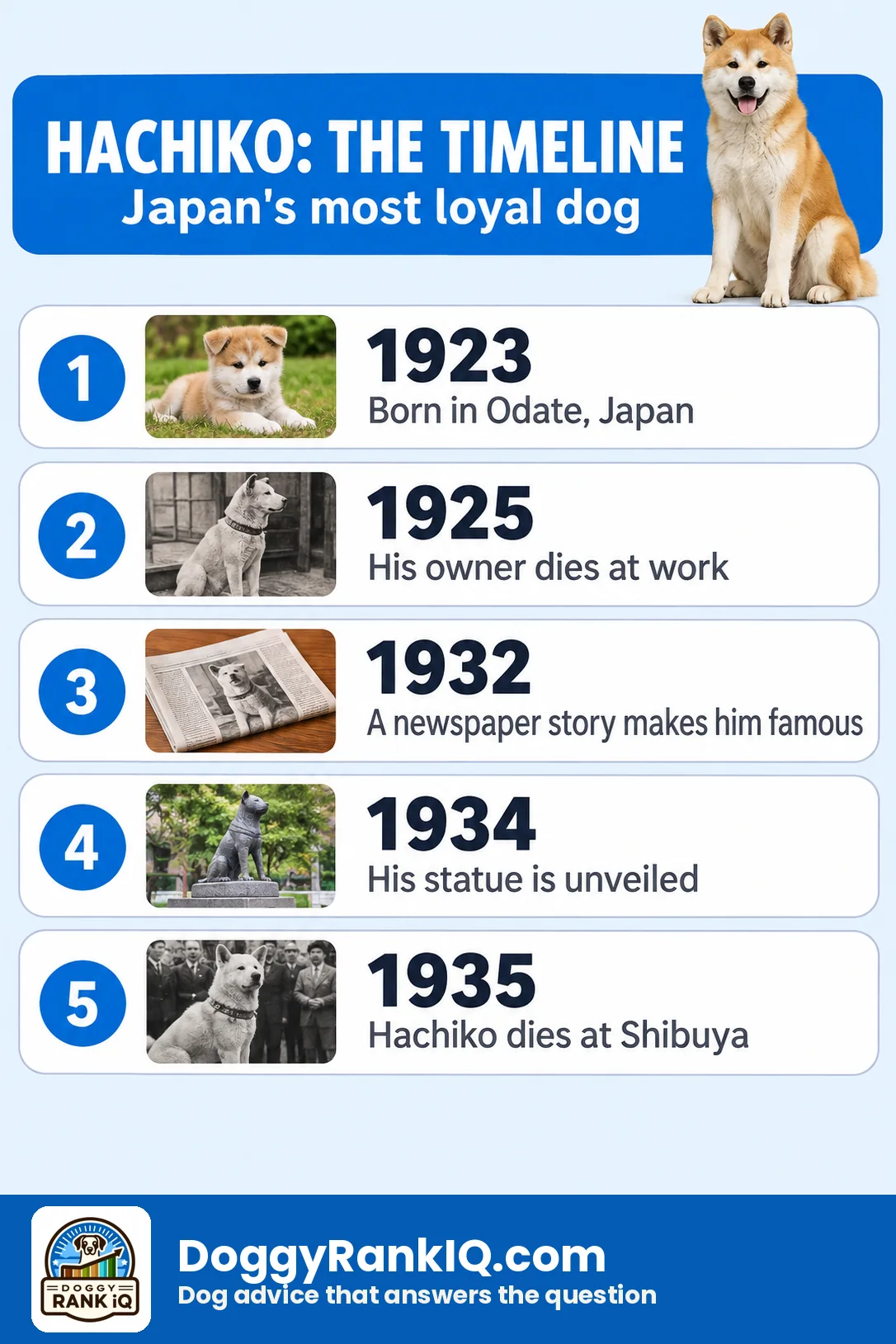
Timeline table: Hachiko’s life in dates
A clean timeline helps separate the documented facts from later retellings.
For readers curious about how long dogs typically live compared with Hachiko’s roughly 11 years, our guide on how long do dogs live breaks down the averages by size and breed.
The professor and the daily walk to Shibuya Station
Hidesaburo Ueno taught agricultural science at Tokyo Imperial University, and Hachiko is said to have greeted him at Shibuya Station after work. That image, the dog waiting at the gate as the trains empty out, is the one most people know. But the full picture is more complicated than the popular version suggests.
The University of Tokyo’s own account challenges the idea that Ueno commuted through Shibuya every single day. The university notes Ueno likely lived close enough to the Faculty of Agriculture in Komaba to walk to work, meaning Hachiko may have seen him off and waited at the campus gate rather than riding along to Shibuya Station on a daily basis (tripguide.tokyo). The university suggests the popular story may combine two separate routines: an earlier habit near the university, and a later one at Shibuya Station that started after Ueno’s death (tripguide.tokyo).
That detail matters because it reshapes the whole narrative. Hachiko’s waiting at Shibuya may not have begun as a daily reunion ritual at all. It may have started as grief, a dog returning to the last place strongly associated with his owner.
Historian Keita Matsui, curator of the Shibuya Folk and Literary Shirane Memorial Museum, has proposed a related idea: Ueno’s trips through Shibuya Station may have been tied to longer trips rather than an ordinary commute, meaning Hachiko could have learned to connect the station with Ueno’s return after one or a few especially memorable reunions, not years of identical daily pickups (english.elpais.com).
Ueno died on May 21, 1925, from a cerebral hemorrhage while at work, with no warning and no chance to say goodbye to his dog (tripguide.tokyo). Hachiko was not yet two years old.
Did Hachiko know his owner died? There is no way to confirm what the dog understood. What is documented is that he kept returning to the station for years afterward, a behavior people interpreted as grief and loyalty. For a broader look at how dogs process time and absence, see our piece on whether dogs have a sense of time.
The real 1932 story that made him famous
A single newspaper article is the real reason the hachiko dog became a household name in Japan. Before October 1932, Hachiko was a familiar stray around Shibuya Station, fed by vendors and tolerated by commuters. He was not yet a symbol.
That changed on October 4, 1932, when Hirokichi Saito, an Akita-dog enthusiast and founder of the Japanese Dog Preservation Society, published an article in the Asahi Shimbun. Saito had been researching the decline of native Japanese dog breeds and came across Hachiko’s story as an example worth telling. His article described Hachiko as having waited for seven years, a number that overstated the actual timeframe but gave the story emotional weight and a clear hook for readers (nippon.com).
The University of Tokyo’s account adds an important correction here too: the original 1932 Asahi article did not claim that Ueno and Hachiko traveled together to Shibuya every day. That specific detail, the daily train-platform reunion, appears to have been added later through retellings, textbooks, and eventually film adaptations (tripguide.tokyo).
Once the article ran, the response was immediate. Donations came in to support Hachiko’s care. Schoolchildren were taught the story as an example of loyalty and devotion. The narrative fit neatly into a national moment focused on preserving traditional Japanese dog breeds, since Saito’s advocacy work and Hachiko’s story reinforced each other (nippon.com).
A short recognition for readers: this is the part most retellings skip. The story people cried over in the movie theater was shaped first by a journalist with a cause, then smoothed further by decades of simplification. The dog waiting faithfully is documented. The exact mechanics of how and why are less settled than the legend suggests.
Hachiko dog breed: what the Akita is like
The hachiko dog breed is the Akita Inu, a large Japanese breed originally developed for hunting and guarding in the mountainous Akita Prefecture region. Akitas are known for being watchful, strong-willed, and deeply attached to their own households rather than outgoing with strangers.
A few traits worth knowing before anyone assumes their next dog will repeat Hachiko’s story:
- Size and build. Akitas typically weigh 70 to 130 pounds as adults, with a dense double coat built for cold weather.
- Independence. Akitas were bred to make decisions on their own while guarding livestock or property, which can make them harder to train than breeds bred for constant human direction.
- Loyalty to the household. Akitas often bond tightly with their own family but stay reserved or wary around unfamiliar people and dogs.
- Grooming demands. The double coat sheds heavily, especially during seasonal blowouts, and needs regular brushing.
- Individual variation. Not every Akita will behave like Hachiko, and breed tendencies describe averages, not guarantees for any one dog.
For a wider look at breeds often associated with devotion, our article on the top dog for loyalty compares several candidates, Akitas included, against the evidence.
Anyone considering an Akita because of Hachiko’s story should know this breed suits experienced owners who want a watchful, independent dog, not a plush companion that performs loyalty on command.
Hachiko dog death: what the 2011 study found
Hachiko died on March 8, 1935, near Shibuya Station, close to ten years after Ueno’s death. For decades, the exact cause was unclear beyond general old age.
In 2011, veterinarians at the University of Tokyo examined Hachiko’s preserved remains using modern techniques and reported two findings: terminal cancer and a filaria infection, more commonly known as heartworm. The combination likely contributed to his decline in his final months. This examination gave the legend a factual medical footnote that the 1930s newspapers never had access to.
Heartworm remains a real threat to dogs today, transmitted by mosquitoes rather than diet or environment alone. Owners managing prevention or looking at treatment options may find our comparison of oral flea medicine versus topical treatments useful, since some combination products also address heartworm prevention. As with any parasite prevention plan, confirm the right product and schedule with a veterinarian rather than guessing from a label.
Hachiko lived roughly 11 years, a lifespan within the normal range for a large breed like the Akita, though on the shorter end once cancer is factored in.
Hachiko dog statue and where to see him today
The original hachiko dog statue stood at Shibuya Station starting in April 1934, built while Hachiko was still alive and reportedly present at the unveiling. That statue did not survive the decade. During World War II, it was melted down as part of Japan’s wartime metal collection effort, a common fate for public bronze statues at the time.
A replacement statue went up in 1948 and remains in place today, just outside Shibuya Station’s Hachiko Exit. It functions less like a museum piece and more like a landmark meeting spot, one of the busiest in Tokyo, surrounded by the famous Shibuya Scramble crossing.
Shibuya has also started treating the statue as a crowd-control point rather than a purely sentimental one. During the 2026 Halloween period, the city enclosed the statue with barriers from around October 30 through November 1, alongside road restrictions and extra security, as part of a broader “Goodbye Bad Halloween” campaign aimed at reducing congestion and disorder near the station (bbc.co.uk). Reports describe roughly 60 private guards deployed on October 30 and around 125 on October 31, plus about 70 public-awareness staff working the area (bbc.co.uk). That is a strange modern footnote to a story about quiet devotion, but it shows how central the statue remains to Shibuya’s identity.
The story also continues to show up in local culture beyond the statue itself. A 2026 event called Shibuya Art Scramble used Hachiko imagery in a footprint-themed public art installation across the district from November 2 through 8, and a children’s planetarium program at Cosmo Planetarium Shibuya, built around a “Hachiko and the Lost Child of Space” theme, ran from October 18 through 2026. Neither event changes the historical record, but both confirm Hachiko’s image is still actively used, not just preserved in a museum.
His body, meanwhile, is preserved and displayed at the National Museum of Nature and Science in Ueno, Tokyo, for visitors who want to see the actual animal behind the statue. A separate 2015 statue at the University of Tokyo depicts Hachiko reunited with Ueno, a more recent addition meant to give the story a symbolic ending the real timeline never provided.
Hachiko movie vs the real story: facts table
Two films dramatized Hachiko’s life: Hachiko Monogatari in 1987 and the American remake Hachi: A Dog’s Tale in 2009, starring Richard Gere. Both are moving films. Neither is a documentary, and several details differ from the documented record.
The gap between film and fact does not erase the story’s meaning. It does mean viewers should separate what is emotionally true from what is historically documented, especially before repeating specific details as verified history.
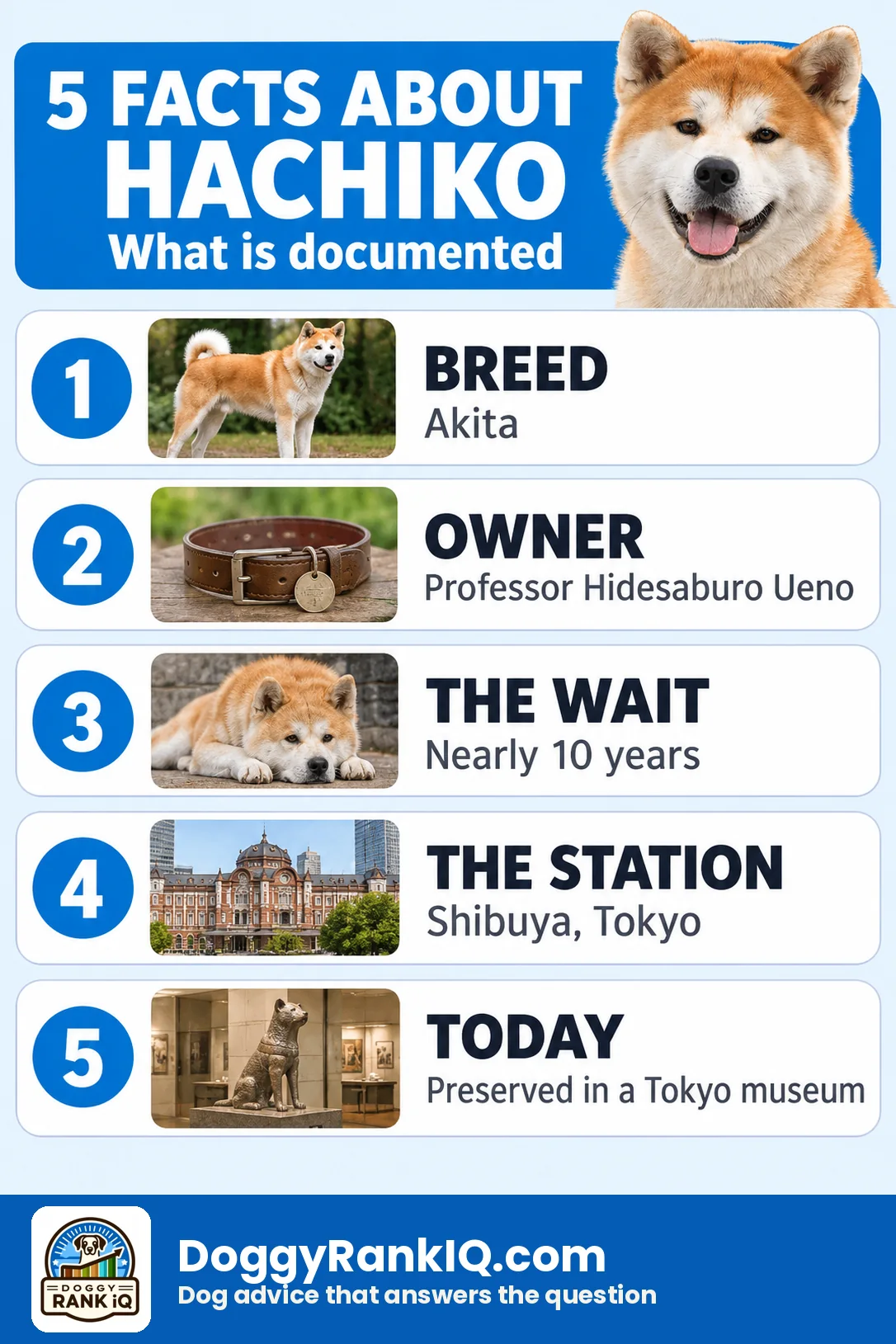
⭐ Top 5 Features We Love
- A documented act of loyalty, not just a legend. Hachiko’s repeated presence near Shibuya Station after Ueno’s death is recorded by multiple historical sources, not invented for the screen.
- A real journalist shaped the public story. Hirokichi Saito’s 1932 article gives the legend a verifiable origin point instead of vague folklore (nippon.com).
- Physical landmarks you can still visit. The Shibuya statue and the preserved remains at the National Museum of Nature and Science let people engage with the story directly.
- A scientific postscript. The 2011 University of Tokyo examination added real medical detail to a story that had mostly lived as sentiment.
- Ongoing cultural relevance. From the 2026 Shibuya Art Scramble installation to planetarium programming for kids, Hachiko’s image keeps finding new audiences nearly a century later.
⚠️ Things to Look Out For
- Don’t expect Hachiko-level devotion to strangers. Akitas typically bond tightly with their own household and stay reserved with outsiders.
- Independence can look like stubbornness. Akitas were bred to think for themselves, which means obedience training takes patience and consistency, not just repetition.
- Shedding is heavy, not occasional. The double coat blows out seasonally and needs real grooming commitment.
- Size requires planning. A 70 to 130 pound dog needs space, a properly sized crate, and gear built for a large breed, not an afterthought purchase.
- The legend is not a training method. Hachiko’s story is about grief and routine, not a blueprint for raising a loyal dog. Loyalty in real dogs comes from consistent care, not breed alone or a famous name.
Owners dealing with a dog that seems distressed by a person’s absence, rather than simply attached, should look at our guide on separation anxiety in dogs, since genuine anxiety needs a different response than ordinary waiting behavior.
Hachiko dog book picks
For readers who want more depth than a single newspaper article or a two-hour film, a few books cover the story and the breed in more detail.
Hachiko Waits: Based on a True Story retells the story for younger readers in novel form, based on the documented events rather than the 2009 film’s dramatized version. Check the current price ($5.86, price checked 2026).
The Most Loyal Dog in the World: Biography and Legends of the Akita Inu goes further into the breed’s background and the folklore that grew around Hachiko and other Akitas. Check the current price ($18.90, price checked 2026).
The Dog Encyclopedia (DK) is a broader reference that covers breed profiles, including the Akita, useful for anyone comparing Hachiko’s breed against others before adopting. Check the current price ($13.29, price checked 2026).
These are publisher-listed prices as of 2026 and can change. None of these were lab-tested by our editorial team; they are named here as relevant reading based on their publisher descriptions and reader reviews.

FAQ
The bottom line
The hachiko dog story holds up under scrutiny in its core shape: a young Akita lost his owner suddenly, kept returning to a train station for years, and became famous because a journalist with a cause told his story in 1932. What doesn’t hold up as cleanly is the daily-commute detail the films lean on, which the University of Tokyo itself calls into question (tripguide.tokyo).
Readers who want to see the story in context rather than through a movie lens can visit the Shibuya statue, read Saito’s legacy through the breed preservation movement he founded, or pick up one of the books above for the fuller account. For anyone drawn to get an Akita because of Hachiko, the honest next step is reading about the breed’s real temperament first, not just the legend attached to it.
Doggy Rank IQ is reader supported. As an Amazon Associate we earn from qualifying purchases, at no extra cost to you.