
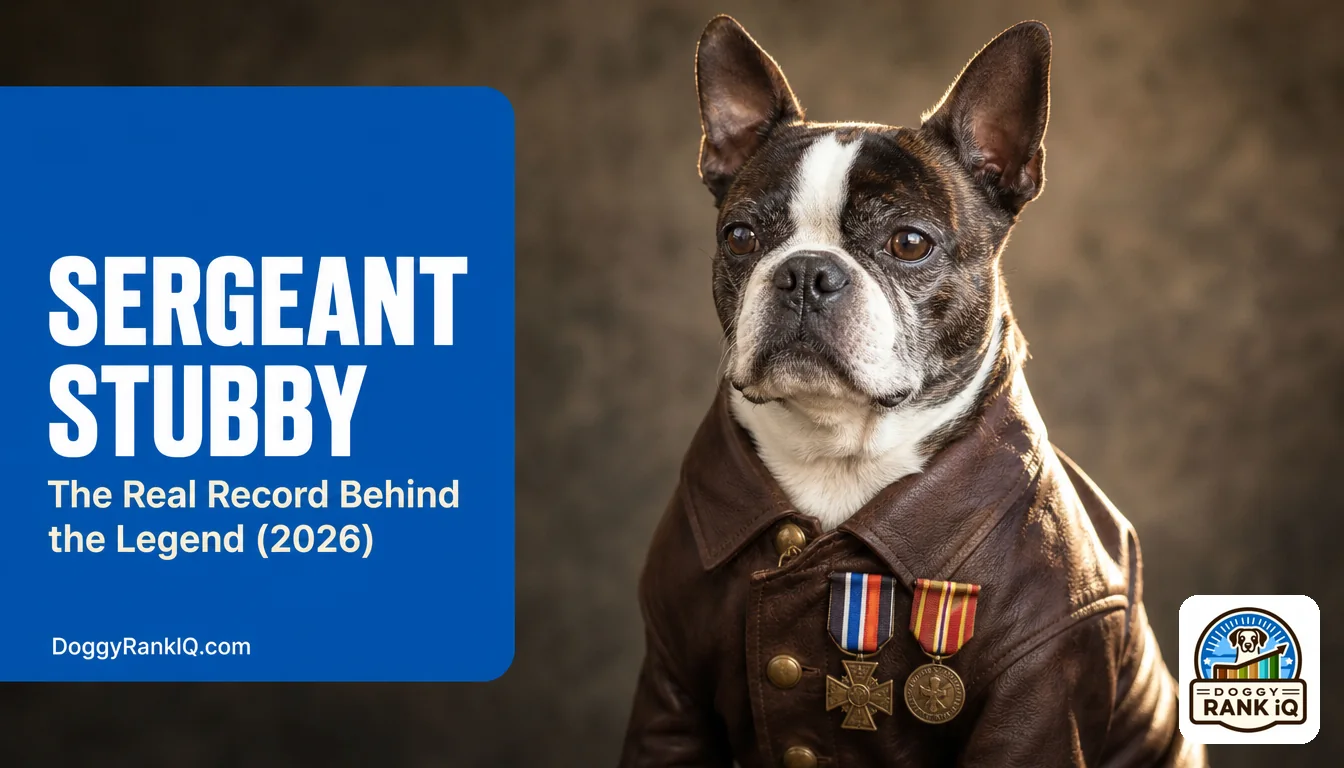
A taxidermied dog in a Smithsonian display case does not look like much. But that preserved body, cataloged as object AF.58280M, belonged to the most decorated dog of World War I, and his story has outlived everyone who served with him (siarchives.si.edu). Sergeant Stubby crossed the Atlantic in a coal bin, survived a grenade blast, and ended up meeting three U.S. presidents. Some of what gets repeated about him checks out. Some of it does not.
Quick Answer
Sergeant Stubby was a brindle stray, likely a bull terrier mix, adopted by Private J. Robert Conroy near Yale University in 1917 before the 102nd Infantry Regiment shipped to France (siarchives.si.edu, britannica.com). He spent about 18 months in France with the unit, was present for 17 battles, and survived a grenade injury, according to unit-history accounts and the Smithsonian (siarchives.si.edu, congress.gov). The “Sergeant” title was never an official Army rank; it grew through newspaper coverage after the war (britannica.com, en.wikipedia.org). Stubby died in 1926, and his preserved remains are held today at the Smithsonian’s National Museum of American History (siarchives.si.edu).
Key Takeaways: sergeant stubby
- Sergeant Stubby was found as a stray near the Yale University campus in New Haven, Connecticut, in 1917 (siarchives.si.edu).
- Private J. Robert Conroy smuggled him onto the troopship SS Minnesota by hiding him until the ship was at sea (siarchives.si.edu, congress.gov).
- The commonly cited service record is 18 months in France, 17 battles, and four offensives, drawn from unit-history and Congressional Record accounts rather than a surviving personnel file (congress.gov).
- There is no official Army record promoting Sergeant Stubby to sergeant; the Smithsonian and other sources describe the title as a product of later newspaper stories (siarchives.si.edu, britannica.com).
- Stubby’s preserved body and decorated blanket are held by the Smithsonian’s National Museum of American History under accession and object numbers 210736 and AF.58280M (siarchives.si.edu).
- A new life-size reproduction of Stubby was unveiled in Hartford in 2026 to mark the centennial of his death (ctpublic.org, portal.ct.gov).
- A remastered version of the 2018 animated film, Sgt. Stubby: An American Hero, returned to theaters in 2026 as part of America’s 250th-anniversary programming (nationalguard.mil).
- The German-soldier and gas-warning stories are widely repeated but rest on period accounts and institutional retellings, not independently verified military records (congress.gov, nationalguard.mil).

What do you want to know?
Tap an option to see the answer.
The short answer: who Sergeant Stubby was
Sergeant Stubby was a stray dog adopted by soldiers of the 102nd Infantry Regiment, part of the 26th “Yankee” Division, while they trained at Yale University in 1917 (siarchives.si.edu, britannica.com). He became the unit’s mascot, crossed to France with them, and spent roughly 18 months near the front lines.
He was not a military working dog in the modern sense. The United States did not run a formal military dog program during World War I, a fact the National Guard’s own historical coverage acknowledges when discussing how WWI dogs like Stubby led to the later official program (nationalguard.mil). Stubby’s role grew informally, through the attachment between him and Conroy and through the soldiers around him who taught him drills, a modified salute, and bugle-call responses (siarchives.si.edu).
What makes him famous is the combination of a good story and real documentation. Unlike most animal legends from that war, physical evidence survives: his decorated blanket, his photographs, and his preserved body at the Smithsonian (siarchives.si.edu). That object record is why his story has more staying power than similar tales about other unit mascots.
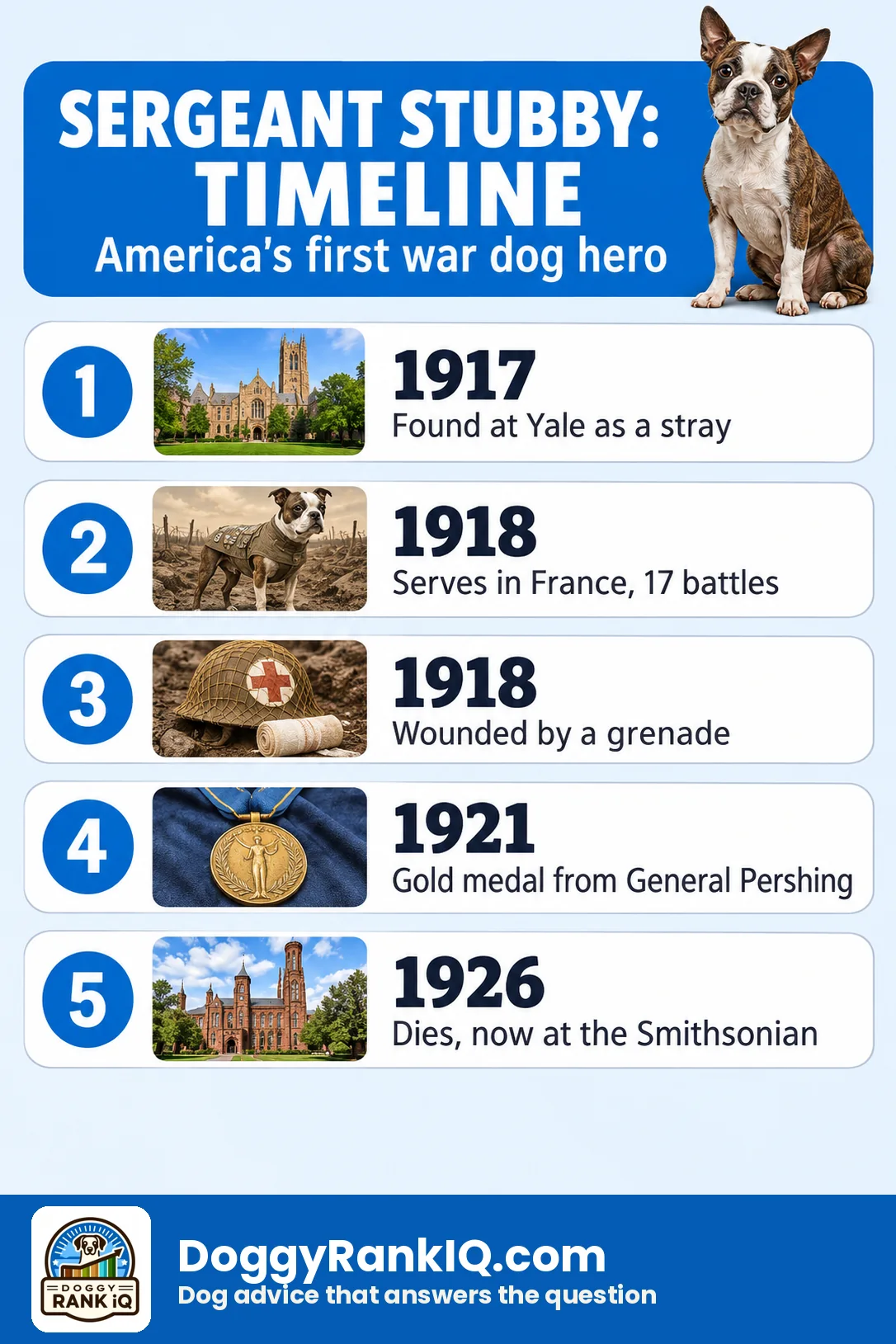
Timeline table: Stubby’s life in dates
From Yale stray to the trenches
The 102nd Infantry Regiment, a Connecticut National Guard unit folded into the 26th “Yankee” Division, was training on and around the Yale campus in New Haven when Stubby showed up (siarchives.si.edu, britannica.com). He was a brindle dog with a short tail, and nobody logged where he came from before that. He just stayed.
Conroy was the soldier who fed him, and the dog responded to drill routines enough that the unit let him stick around as an informal mascot. When orders came to deploy, Conroy had a problem: no dog allowed on a troopship headed to France. The Smithsonian’s account describes him hiding Stubby in a coal bin or an engine-room space on the SS Minnesota until the ship was far enough out to sea that officers and crew simply accepted the dog’s presence (siarchives.si.edu, congress.gov).
That single decision, smuggling a stray onto a military transport, is the hinge the entire legend turns on. Without it, Stubby stays a regimental pet who never leaves Connecticut. With it, he becomes the only dog most Americans can name from the war.
By February 5, 1918, the 102nd had reached the French front, and Stubby went with them under what accounts describe as special permission as the unit’s mascot (siarchives.si.edu). From there the commonly cited figures take over: about 18 months in France, 17 battles, four offensives (congress.gov, portal.ct.gov). Those numbers come from unit histories, the Congressional Record, and Connecticut state commemorations, not from a surviving individual service file. That distinction matters for anyone trying to separate Stubby’s record from the embellishments that came later.
If you’re curious how closely animals like Stubby can pick up on human routines and cues, the research on how smart are dogs gives useful context for what trained responses like a salute or a bugle-call reaction actually require.
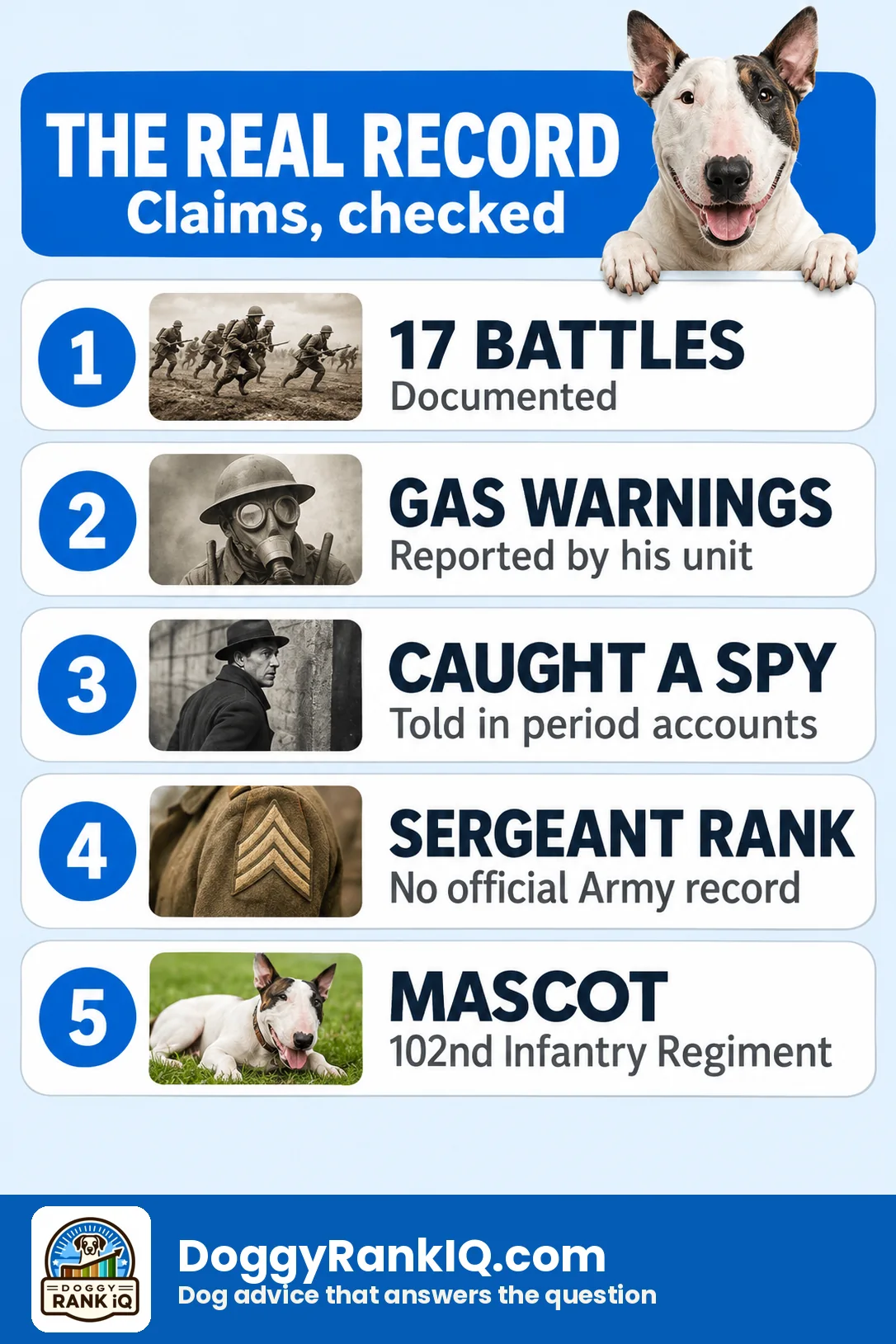
The real record: 5 famous claims checked
Sergeant Stubby’s reputation rests on a handful of specific claims. Some have institutional backing. Others are harder to pin down to a primary source. Here is each one, checked against what the record actually supports.
1The rank
Claim: Stubby held the rank of sergeant, outranking his own handler.
What the record shows: No official Army document promotes Stubby to sergeant. The Smithsonian and other reference sources describe the “Sergeant” title as something that grew through newspaper coverage after the war rather than a formal military action (siarchives.si.edu, britannica.com). The nickname stuck because it made a good headline, and it has stuck ever since.
2The spy
Claim: Stubby found a German soldier hiding or spying in Allied territory and held him by the seat of his pants until American soldiers arrived.
What the record shows: This story appears repeatedly in institutional and popular retellings, including National Guard coverage from 2026 (nationalguard.mil). It is one of the most widely repeated Stubby stories, but it functions more like an oral-history account passed down through unit lore than a documented incident with contemporary military paperwork attached. Treat it as a well-known period story rather than a verified record.
3The gas warnings
Claim: Stubby could smell poison gas before soldiers could and would bark or run through the trench to warn the unit.
What the record shows: Gas detection is the single most repeated Stubby anecdote, and it appears in National Guard materials describing him as Connecticut’s first military working dog (nationalguard.mil). Dogs do have far more sensitive noses than humans, which gives the story some plausibility, but there is no laboratory test or wartime medical record confirming Stubby specifically detected gas on command. It remains an attributed capability, not a documented test result.
4The 17 battles
Claim: Stubby took part in 17 battles across four offensives during his time in France.
What the record shows: This figure is the most consistently cited number across sources, including the Congressional Record and Connecticut’s own 2026 centennial materials (congress.gov, portal.ct.gov). It reflects the unit’s engagement record during the period Stubby accompanied the 102nd Infantry, which is a reasonable and commonly accepted figure, even though it describes the regiment’s campaign history rather than a personal log kept for the dog.
5The medals
Claim: Stubby wore a chamois coat covered in medals, including one awarded personally by General John Pershing.
What the record shows: This is better documented than the others. Photographs from the period show the decorated coat, and the Pershing medal presentation in 1921 is widely reported alongside his meetings with three sitting U.S. presidents. This part of the legend holds up well against the historical record.
Sergeant Stubby breed and owner
Sergeant Stubby’s breed is usually described as a Boston terrier mix or a bull terrier type, though no formal pedigree exists because he was a stray (siarchives.si.edu, britannica.com). The Smithsonian’s own catalog record calls him a brindle stray with a short tail, which is consistent with several terrier-type breeds common in Connecticut at the time (siarchives.si.edu).
Readers who want a side-by-side on the modern Boston terrier, which shares some of Stubby’s probable look and compact build, can check the Boston terrier breed guide for temperament and care details that apply to the breed today.
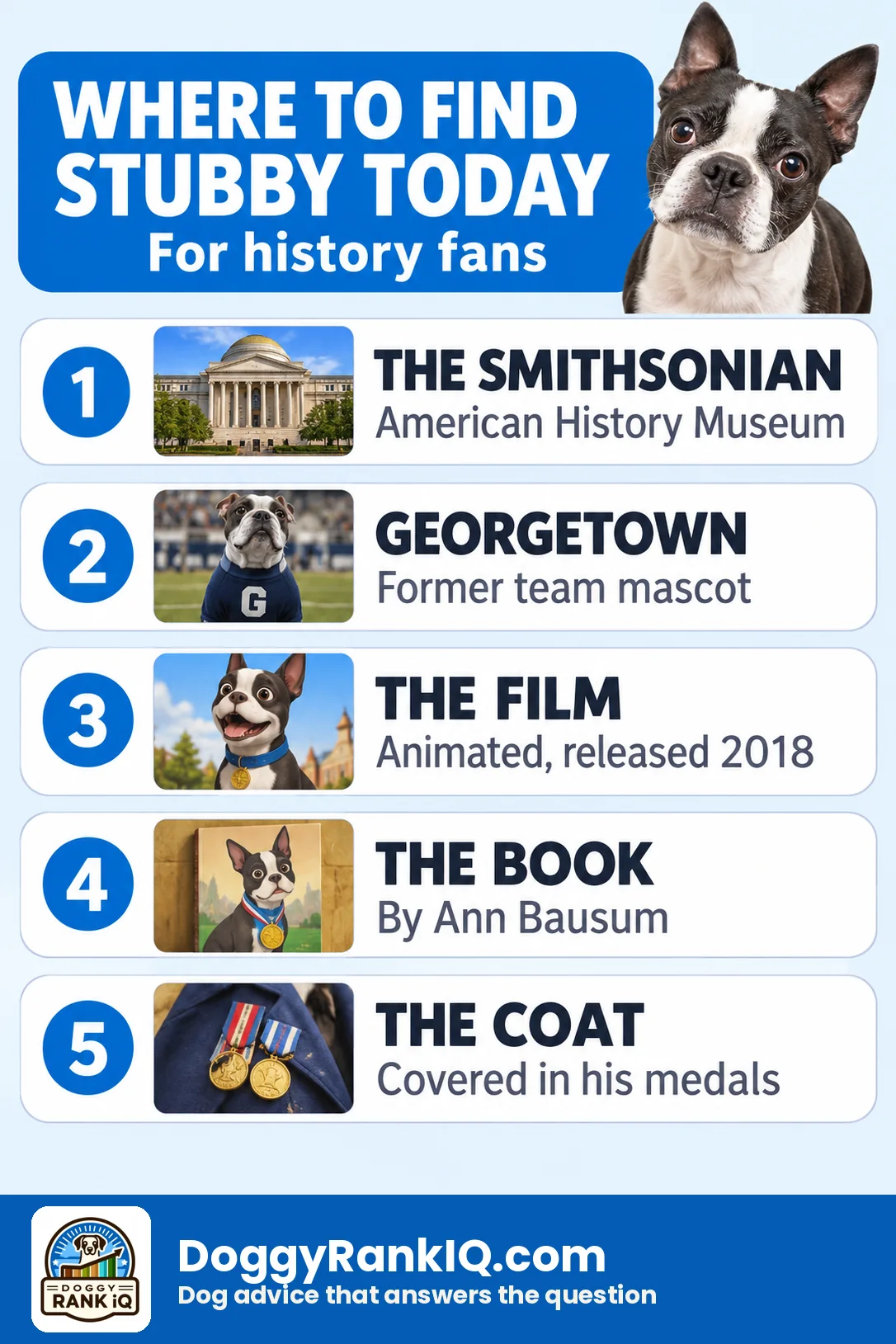
His owner was Private J. Robert Conroy, a soldier in the 102nd Infantry Regiment who found him, smuggled him overseas, and stayed his handler and eventual legal guardian through the rest of Stubby’s life (siarchives.si.edu). Conroy later attended Georgetown University Law School, and Stubby became the school’s unofficial mascot during that period, a detail that connects Stubby to Georgetown’s modern Hoya mascot tradition. Conroy’s grandson, Curt Deane, took part in the 2026 centennial ceremony in Hartford, a direct link between the original story and its current commemoration (ctpublic.org, portal.ct.gov).
Life after the war and Sergeant Stubby death
Stubby’s public life after the war was arguably bigger than his wartime service. He met Presidents Woodrow Wilson, Warren Harding, and Calvin Coolidge, received a gold medal from General John Pershing in 1921, and marched in veterans’ parades for years. He became something close to a national celebrity dog, which is part of why his legend grew past what any single wartime record could confirm.
Stubby’s death came in 1926, reportedly while he slept in Conroy’s arms. That timing is why 2026 marks his centennial, and it’s the reason Connecticut chose this year for its statue unveiling (ctpublic.org, portal.ct.gov). Conroy chose to have Stubby’s body preserved rather than buried, a decision that turned out to be the reason modern audiences can still see him today.
Where is Sergeant Stubby now?
Stubby’s preserved body and decorated blanket are held by the Smithsonian’s National Museum of American History in Washington, D.C., cataloged under accession number 210736 and object identifier AF.58280M (siarchives.si.edu). Conroy donated the remains, and the museum’s record lists the object plainly as a stuffed dog, a clinical description for what has become one of the most visited military-history artifacts tied to a single animal.
In 2026, the Museum of Connecticut History at the Connecticut State Library added a second physical tribute: a life-size reproduction of Stubby produced by David Hayes Studio, unveiled as part of a centennial ceremony that included U.S. Senator Richard Blumenthal and Connecticut National Guard Adjutant General Maj. Gen. Francis J. Evon Jr. (ctpublic.org, portal.ct.gov). That statue now sits inside the museum’s “Small but Mighty: Connecticut Makes History” display, giving Connecticut its own permanent Stubby exhibit separate from the Smithsonian original.
“Small but mighty” has become the working description for a dog whose actual physical size never matched the size of his story.
Sergeant Stubby movie and book
The most recognizable Stubby movie is the 2018 animated feature Sgt. Stubby: An American Hero, which dramatizes his trip from stray to decorated war dog for a family audience. In 2026, a remastered version of that film was announced for a theatrical re-release tied to programming around America’s 250th anniversary, giving a new generation of theater audiences a chance to see it on the big screen (nationalguard.mil).
Is the Stubby movie historically accurate? It compresses and dramatizes events, the way animated history films generally do, and leans into the more legendary claims, like the gas warnings and the German-soldier capture, without flagging which parts rest on firmer ground. Families using it as an entry point should treat it as a starting place for curiosity rather than a documentary.
Is it appropriate for kids? Yes, it is rated PG and built for family viewing, with war violence handled gently rather than graphically.
For documentary-style programming, Chamizal National Memorial in El Paso scheduled a free Veterans Day screening of the animated film in 2026, paired with a kids’ art activity, which reflects how Stubby’s story keeps getting used in public, family-oriented history programming rather than strictly military retrospectives (nationalguard.mil).
For the written record, a Stubby book worth starting with is a youth nonfiction title that walks through documented events in plain language, useful for readers who want the timeline without the dramatization.
⭐ Top 5 Features We Love
- A physical record that survives. Few WWI animal stories come with an actual preserved body and catalog number you can look up at the Smithsonian (siarchives.si.edu).
- A traceable human connection. Conroy’s family, through grandson Curt Deane, is still involved in Stubby commemorations a century later (ctpublic.org).
- An honest gap between legend and record. The rank controversy gives the story real texture instead of flattening it into pure myth (siarchives.si.edu, britannica.com).
- Modern commemoration that keeps growing. The 2026 Hartford statue adds a second physical tribute beyond the original Smithsonian remains (portal.ct.gov).
- Crossover appeal. The story works as serious military history and as a family film topic at the same time (nationalguard.mil).
⚠️ Things to Look Out For
- The rank claim gets repeated as fact. Treat “Sergeant” as a popularized nickname, not a documented Army promotion (siarchives.si.edu, britannica.com).
- The spy and gas stories lack primary documentation. They are widely repeated in institutional retellings, which is not the same as a verified wartime record (nationalguard.mil).
- Service numbers come from unit history, not a personal file. The 18 months, 17 battles figure describes the regiment’s campaign, which Stubby accompanied, rather than a dog-specific log (congress.gov).
- “Military working dog” is an anachronistic label. The U.S. had no formal WWI dog program; that program came later, something the National Guard’s own history notes (nationalguard.mil).
- Animated-film dramatization can blur fact and legend for young viewers. Pair the film with a factual source if accuracy matters for a school project.
Books for Stubby fans
For readers who want the documented history in book form, three titles cover the story at different reading levels.
Prices checked 2026. Check the current price on the adult history title, check the current price on the middle-grade book, or check the current price on the early-reader edition. None of these were lab tested by our team; this is a format comparison based on publisher listings and reading-level labeling, not hands-on review.
If Stubby’s loyalty and protective instincts have you thinking about what makes a dog suited to guarding or alert work today, the guide to protection dog breeds and the piece on which breeds rank highest for loyalty both cover traits that echo what made Stubby useful to his unit a century ago.
FAQ
The bottom line
Stubby earned his fame honestly, even if the details got polished along the way. He really was a stray who crossed an ocean in a coal bin, really did spend about 18 months near the front with the 102nd Infantry, and really is preserved today at the Smithsonian for anyone who wants to see him in person. The rank was never official, and the gas-warning and spy stories lean more on repetition than documentation. That gap between legend and record doesn’t make the story less worth telling. It makes it worth telling accurately. For a next step, visit the Smithsonian’s online object record, watch the remastered film with a factual source close at hand, or start one of the books above with a young reader who wants the real timeline behind the legend.
Doggy Rank IQ is reader supported. As an Amazon Associate we earn from qualifying purchases, at no extra cost to you.