
Quick Answer
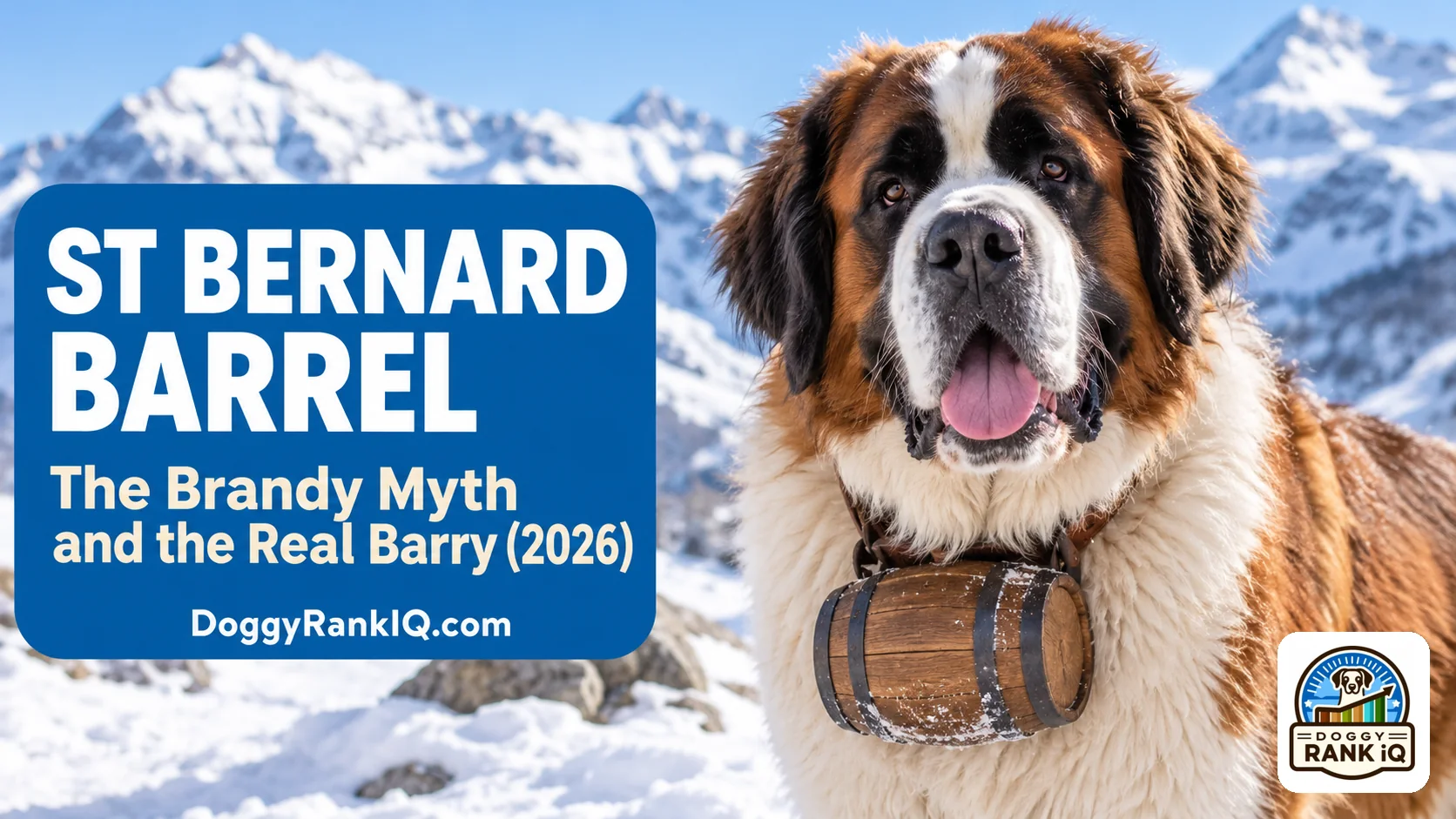
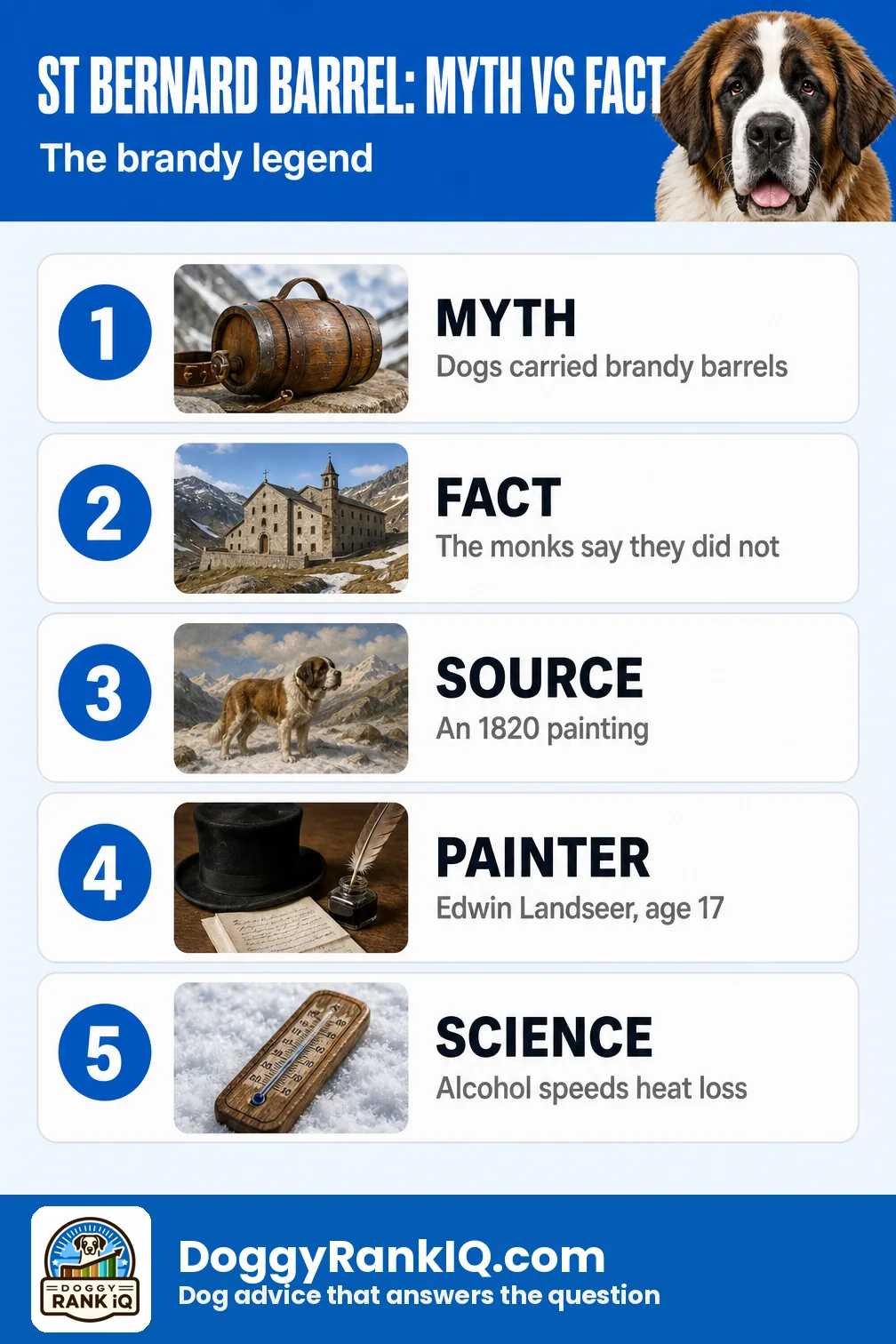
The st bernard barrel shown on every stock photo and costume collar is not real history. No documented record shows Great St. Bernard Hospice dogs carrying brandy casks on rescue missions, and the hospice’s own museum says the barrel “belongs to the area of fantasy” (independent.co.uk). The image traces to a 1820 painting by Edwin Landseer, not to actual mountain rescue practice (akc.org). The real story is better: a dog named Barry is credited with saving more than 40 people in the early 1800s, and his preserved body still draws visitors to the Natural History Museum of Bern.
Key Takeaways: st bernard barrel
- The st bernard barrel is a myth. Hospice monks and modern museum curators have repeatedly denied it (independent.co.uk, beerconnoisseur.com).
- Barry (1800-1814) is the actual hero of the breed, credited with saving more than 40 lives, not with wearing a keg (akc.org).
- The barrel image comes from Edwin Landseer’s 1820 painting Alpine Mastiffs Reanimating a Distressed Traveller (akc.org).
- Alcohol speeds heat loss in a cold body, so brandy on a rescue dog would have worked against survival, not for it.
- Hospice dogs and monks are credited with helping save around 2,000 travelers over roughly 200 years (beerconnoisseur.com).
- A st bernard barrel collar sold today is a costume prop, not rescue gear, and should stay light, empty, and short-term.
- The Barry Foundation (Fondation Barry) in Martigny has managed hospice dog breeding since 2005 (whitemarmotte.com).
- Saint Bernards are a giant breed with health needs, including bloat risk and heat sensitivity, worth knowing before buying any st bernard barrel collar for sale.

What do you want to know?
Tap an option to see the answer.
The short answer: the truth about the St Bernard barrel
No credible historical source shows a Great St. Bernard Hospice dog wearing a cask of brandy on patrol. The claim shows up on postcards, beer logos, and pet costumes, but it never shows up in the hospice’s own records.
The Natural History Museum of Bern, which houses Barry’s preserved body, states plainly that the barrels “belong to the area of fantasy” (independent.co.uk). A hospice chaplain said it even more directly in 1956: “At no point in time did the dogs carry such barrels” (independent.co.uk). That is about as close to a flat denial from the source as history gets.
Some dogs may have carried small packsaddles with supplies for stranded travelers. A cask of liquor strapped to a working rescue dog’s collar is a different claim entirely, and it is the one that does not hold up. Worth noting too: alcohol actually speeds heat loss in a body that is already dangerously cold, so giving brandy to a hypothermic traveler would have made things worse, not better. If you want to understand the opposite risk at home, our guide on how cold is too cold for dogs covers what actually protects a dog’s body heat.
Which dog has a barrel around its neck, and why
The dog pictured with a barrel around its neck is almost always meant to represent a Saint Bernard, and the barrel is there because of a painting, not a rescue log. Edwin Landseer’s artwork fixed the image in public imagination long before photography existed to prove or disprove it (akc.org).
Saint Bernards themselves are a giant mountain breed developed at the Great St. Bernard Hospice, a refuge on a pass between Switzerland and Italy at roughly 2,500 meters above sea level (independent.co.uk). Monks kept large dogs there from the late 1600s, and the dogs’ keen sense of smell and size made them useful for finding travelers buried in snow (independent.co.uk). That working history is documented. The barrel is the part that got added later for visual effect.
Choose the barrel-free version of the story if you want the accurate one: a giant, snow-savvy dog working alongside monks, no keg required.
The brandy myth: where it came from in 1820
The st bernard brandy barrel story starts with a painting, not a rescue report. In 1820, a 17-year-old English painter named Edwin Landseer completed Alpine Mastiffs Reanimating a Distressed Traveller, and he added a small keg to one dog’s collar as a dramatic flourish (akc.org).
The image was memorable. It spread through prints, advertising, and tourist souvenirs, and by the late 1800s it had become shorthand for Alpine rescue generally (independent.co.uk). The Natural History Museum of Bern notes that barrels do not even appear in imagery until the end of the nineteenth century, decades after the hospice dogs’ most famous working period (independent.co.uk).
That timing matters. Barry, the breed’s most celebrated dog, worked and died years before the barrel image existed. A hero cannot carry a prop that had not been invented yet.
Why the myth stuck:
- A single vivid painting is easier to remember than a written record.
- Breweries and liquor brands adopted the image for advertising, reinforcing it for new generations (beerconnoisseur.com).
- Stock photography and costume makers kept recycling the same visual, so each new generation inherits the myth fresh.
The st bernard brandy barrel became, essentially, a marketing symbol that outlived the facts it was based on (independent.co.uk).
The real Barry: the hospice dog who saved 40 lives
Barry lived from 1800 to 1814 and is credited with saving more than 40 people during his working years at the hospice (akc.org). No keg, no cask, just a dog with a strong nose, thick coat, and the judgment to find travelers buried in snow.
His body is preserved and displayed at the Natural History Museum of Bern, where a dedicated exhibition separates documented history from legend [source]. One detail worth knowing: the body on display today is not the original mount. The original deteriorated over time, and taxidermist Georg Ruprecht created a completely new mount in 1923 [source]. So the Barry visitors see in Bern reflects a later recreation, built to honor the dog’s memory rather than preserve an untouched specimen from 1814.
Barry was one dog among a larger effort. Hospice dogs and monks together are credited with helping save around 2,000 travelers over roughly 200 years of operation (beerconnoisseur.com). That is a real number with real weight, earned without a drop of brandy.
“At no point in time did the dogs carry such barrels.”, hospice chaplain, quoted by the Natural History Museum of Bern, 1956 (independent.co.uk)
Facts table: myth vs fact
St. Bernard barrel collar history and the hospice today
The st. bernard barrel collar history is really a history of marketing, not mountain rescue, and it continues today mostly through tourism and breeding programs rather than working patrols. The Fondation Barry in Martigny has managed breeding of the hospice’s dogs since 2005 (whitemarmotte.com), keeping the bloodline connected to its origin point even though modern rescue work on the pass no longer depends on dogs the way it once did.
Recent news from the foundation shows how the legacy is kept alive now. In late 2026, the foundation announced two litters totaling 11 Saint Bernard puppies: Scully had eight puppies in late September, and Finesse had three in mid-October [source]. Visitors began meeting Scully’s puppies in early November, with Finesse’s litter scheduled for public viewing in December [source]. Barryland, the foundation’s visitor center, also hosted a free Night of Museums event in mid-2026 with meet-and-greets and workshops, though organizers noted the puppies themselves would be resting rather than attending [source].
None of this involves barrels. It involves breeding records, public education, and a museum exhibition built specifically to separate Barry’s real story from the legend that grew around him [source].
St bernard barrel size and barrel collars for sale: props, not gear
A st bernard barrel size question usually comes from someone shopping for a costume accessory, and the honest answer is that any barrel collar on the market today is decorative, not functional rescue equipment. Real hospice dogs never wore one, so there is no “correct” working size to match.
Costume barrel collars are typically scaled to fit medium and large dog necks, holding a small keg shape roughly comparable to a half-liter prop. If you are shopping for a st. bernard barrel collar for sale, look for:
- Adjustable straps or hoops so the collar fits without choking or restricting movement
- Lightweight material (the keg should be hollow or very light, never filled with liquid)
- Easy removal for photos only, not all-day wear
Two options worth a look if you want the classic look for photos: the St Bernard Rescue Barrel Collar, 1/2 Liter Keg with Adjustable Hoops ($39.99, price checked 2026) and the St Bernard Rescue Barrel Collar for Medium and Large Dogs ($39.99, price checked 2026). Both are built for costume use, not functional carrying.
Choose a barrel collar if you want a holiday photo or a parade costume. Skip it if your dog chews at collar accessories or shows any stress wearing a wide neck piece, since no prop is worth a dog’s discomfort.
Saint Bernard basics before you fall for the breed
A Saint Bernard is a giant breed, typically 120 to 180 pounds, with a short lifespan of about 8 to 10 years and some specific health considerations worth knowing before adoption. The size and coat that made them useful in Alpine snow also make them heat sensitive in warm climates, so summer walks and travel need planning.
Saint Bernards are prone to bloat, a sudden and dangerous stomach condition, and to joint disease common in large, fast-growing breeds. If your dog shows a swollen abdomen, restlessness, or unproductive retching, that is an emergency, not a wait-and-see situation; our guide on bloat in dogs symptoms covers what to watch for. Giant breeds in general carry their own set of care tradeoffs, covered in our piece on what qualifies as a giant breed dog. If you’re comparing mountain breeds, the Bernese Mountain Dog shares some coat and size traits worth weighing side by side.
Confirm any breed-specific health concern with your veterinarian before making a buying or adoption decision. A big, friendly dog is still a dog with real medical needs behind the famous reputation.
🏔️ How a hospice rescue worked, without the brandy
Take away the St Bernard barrel and the routine that remains is more impressive.
The pass sits at about 8,000 feet and was snowbound for most of the year. Travelers crossed on foot. After storms, the hospice sent out guides with dogs to walk the route and look for anyone caught on the way. The dogs’ first job was path finding. They could follow the buried track when fog and fresh snow hid every landmark, and the men walked in their steps.
Their second job was finding people. Accounts from the hospice describe dogs locating travelers under snow by scent and digging down to them. In the versions the monks told, the dogs went out in twos and threes: one lay against the person for warmth while another went back to bring help. How often it went exactly that way is hard to verify two centuries later. The figure usually given is around 2,000 people helped over about 200 years.
“What the dog brought up the mountain: a nose, a memory of the trail and about 90 pounds of body heat.”
Nobody trained them in a formal sense. Young dogs learned by going out with older ones, and the hospice kept the line going by breeding the dogs that did the work well.
🐕 The breed nearly died out on the mountain
The dogs in Landseer’s painting would look small beside a modern Saint Bernard. Hospice dogs of the early 1800s were lighter and short-coated, built to move through snow all day.
Then the kennel hit trouble. Severe winters between 1816 and 1818 killed a large share of the dogs in avalanches. Around 1830 the monks crossed their remaining dogs with Newfoundlands, hoping for a warmer coat. The long hair turned out to be a mistake at altitude, because snow balled up in it and froze. The monks gave the long-coated dogs away to people in the valleys and kept working with the short-coated ones.
Those valley dogs, bred larger and heavier by Swiss and then English fanciers, became the show breed. The name “Saint Bernard” was made official in 1880. Before that the dogs were called hospice dogs, Alpine Mastiffs or Barry dogs, after the most famous one.
So the dog on the postcard is the cousin who moved to town. The mountain version was smaller, plainer and a great deal busier.

⭐ Top 5 Features We Love
- A real hero dog. Barry’s documented record of more than 40 saves needs no embellishment to be impressive (akc.org).
- An honest museum. The Natural History Museum of Bern actively corrects the barrel myth rather than profiting from it (independent.co.uk).
- A working history worth telling. Monks and dogs together are credited with roughly 2,000 saves over two centuries (beerconnoisseur.com).
- A traceable myth origin. Few legends come with a named painter and a specific year (1820, Edwin Landseer) attached (akc.org).
- A living legacy. The Fondation Barry keeps breeding hospice-line Saint Bernards today, with new puppies born as recently as September and 2026 (whitemarmotte.com).
⚠️ Things to Look Out For
- Overheating. A heavy-coated giant breed plus a bulky collar accessory is a bad combination in warm weather.
- Collar fit. Any barrel collar should never pull tight against the throat or restrict head movement.
- Chewing risk. Puppies especially may try to chew a hanging prop; supervise any wear time.
- Bloat warning signs. Giant breeds like Saint Bernards need owners who know the signs before an emergency, not during one.
- Marketing overreach. Be skeptical of any product or story that claims the barrel was “authentic” rescue gear. It was not (independent.co.uk).
Barrel collars and dog history books
If the myth-versus-fact format left you wanting the longer version, a general dog history reference is a reasonable next stop. The Dog Encyclopedia (DK) ($13.29, price checked 2026) covers breed origins, working roles, and historical development across many breeds, including large mountain and rescue breeds like the Saint Bernard. Check the current price.
Pair that kind of reading with a visit to the Natural History Museum of Bern’s own Barry exhibition if travel allows. It was built specifically to show visitors which parts of Barry’s story are documented and which parts are legend, which is a rare and useful thing for a museum to commit to doing openly.

FAQ
The bottom line
The st bernard barrel is a great story and a bad fact. It came from a painter’s imagination in 1820, not from a monk’s rescue kit, and the hospice’s own museum has said so plainly (independent.co.uk). The real story, a dog named Barry saving more than 40 lives without a drop of brandy, is more interesting precisely because it is true. If you want the costume version for a photo, buy the lightweight prop and keep it short-term. If you want the actual history, start with Barry’s exhibition in Bern and work backward from there.
Doggy Rank IQ is reader supported. As an Amazon Associate we earn from qualifying purchases, at no extra cost to you.