
Quick Answer: Is a Bernese Mountain Dog Right for You?
A bernese mountain dog suits a family with space, cool weather, and realistic expectations about a short life. Berners are affectionate, steady with children, and easier to train than most giant breeds, but they shed year round, overheat quickly, and pull hard before they learn leash manners. The breed’s biggest cost is emotional: a 2024 analysis of 584,734 UK dogs put median survival at 10.1 years against roughly 12.5 years across all breeds.
Skip the breed if you live in a hot climate without air conditioning, work long days away from home, or want a dog that stays out of your personal space.
Key Takeaways: Bernese Mountain Dog
- Median lifespan 10.1 years in the 2024 UK study of 155 breeds, based on 1,116 Berners and 449 recorded deaths. A Swiss cohort of 389 dogs born in 2001 to 2002 found a median of 8.4 years, with males at 7.7 and females at 8.8.
- Size: males roughly 25 to 27.5 inches and 80 to 115 pounds, females 23 to 26 inches and 70 to 95 pounds, per the AKC breed standard.
- The Bernese Mountain Dog Club of America recommends screening hips, elbows, eyes, heart and degenerative myelopathy, plus one of von Willebrand disease, thyroid disease or histiocytic sarcoma risk.
- Cancer drives the short clock. A November 2026 study of 27 Berner lymphoma samples found somatic mutations in 26 of 27 (96.3%), with recurrent EP300 changes flagged as possibly breed specific. Research finding, not a clinical test.
- Temperament per the AKC standard: “self-confident, alert and good-natured, never sharp or shy.”
- Heat is a real hazard. Double coat plus a heavy frame means limited tolerance above roughly 75°F. Walk early, walk late.
- Puppy price typically $1,500 to $4,000 from health-testing breeders, with first-year costs commonly landing near $3,000 to $5,000.
Where Does the Bernese Mountain Dog Come From?
The bernese mountain dog is a Swiss farm dog from the canton of Bern, bred to pull carts, drove cattle, and guard the property without picking fights. One of four Sennenhund (Swiss mountain dog) breeds, the Berner is the only one with a long coat.
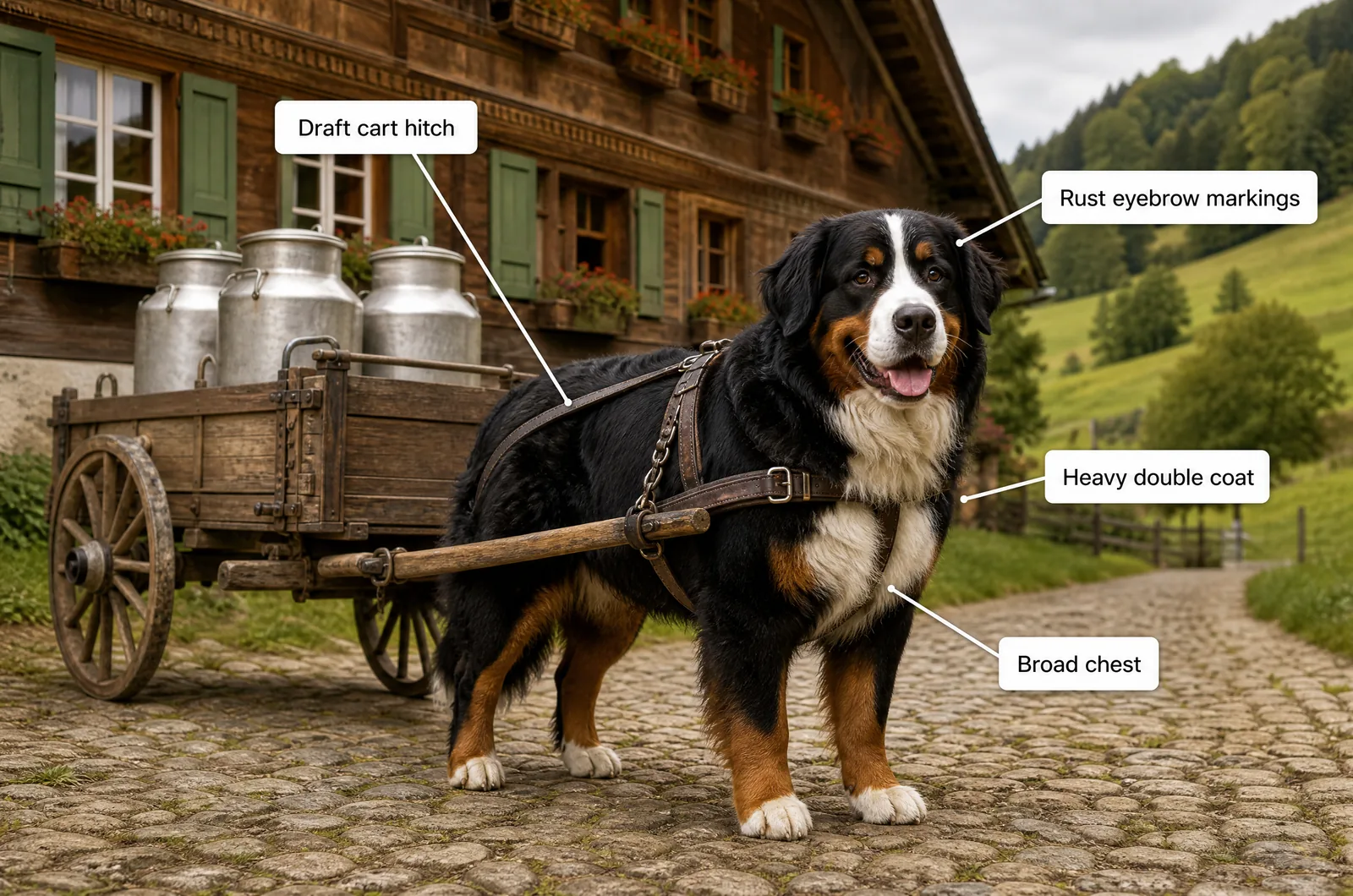
Farmers in the Bern region needed a dog that could do three jobs with one body. Haul milk cans and cheese to market in a small wooden cart. Move stock between pasture and barn. Bark at strangers, then stand down when the farmer said so. That job description still shapes the dog in your living room: strong enough to tow, calm enough to stop, and oriented toward people rather than independent problem-solving.
By the early 1900s the type had nearly faded out as mechanized transport took over. Swiss fanciers rebuilt it, and the breed reached the United States in the 1920s. The American Kennel Club recognized it in 1937.
Why the history matters for you: carting instincts mean a young Berner leans into pressure rather than yielding to it. That is also why a 100-pound adolescent can walk you down the sidewalk.
What Makes the Bernese Mountain Dog So Special (and So Cute)?
Three things explain the appeal: the face, the coat, and the way the dog treats people as furniture it is allowed to lean on.
The markings are standardized and symmetrical, which is part of why the breed photographs so well. Jet black body, rust points above the eyes, on the cheeks, chest and legs, and a white blaze running up the muzzle to a white chest cross. The rust eyebrows read as eyebrows to human eyes, so a Berner looks like it is reacting to your every sentence. It is not. The markings are just sitting there. The effect is the same.
Then there is the lean. Berners park against your shins and transfer about forty pounds of weight to your leg with total confidence. Owners call it the Berner lean. It is affection, and it is also a dog who was bred to work in physical contact with a handler.
The coat does the rest. Thick, slightly wavy, and genuinely plush in winter. If you want the same gentleness in a smaller package, read our guide to the best emotional support dog breeds.
There is no recognized mini or miniature bernese mountain dog. Dogs marketed as a “bernese mini mountain dog” are crosses, usually with Cavaliers or Poodles, and they inherit a mixed and unpredictable health picture.
Bernese Mountain Dog Size, Weight and Lifespan
A bernese mountain dog is a large to giant breed: males commonly 80 to 115 pounds, females 70 to 95 pounds, with a median lifespan around 10 years.
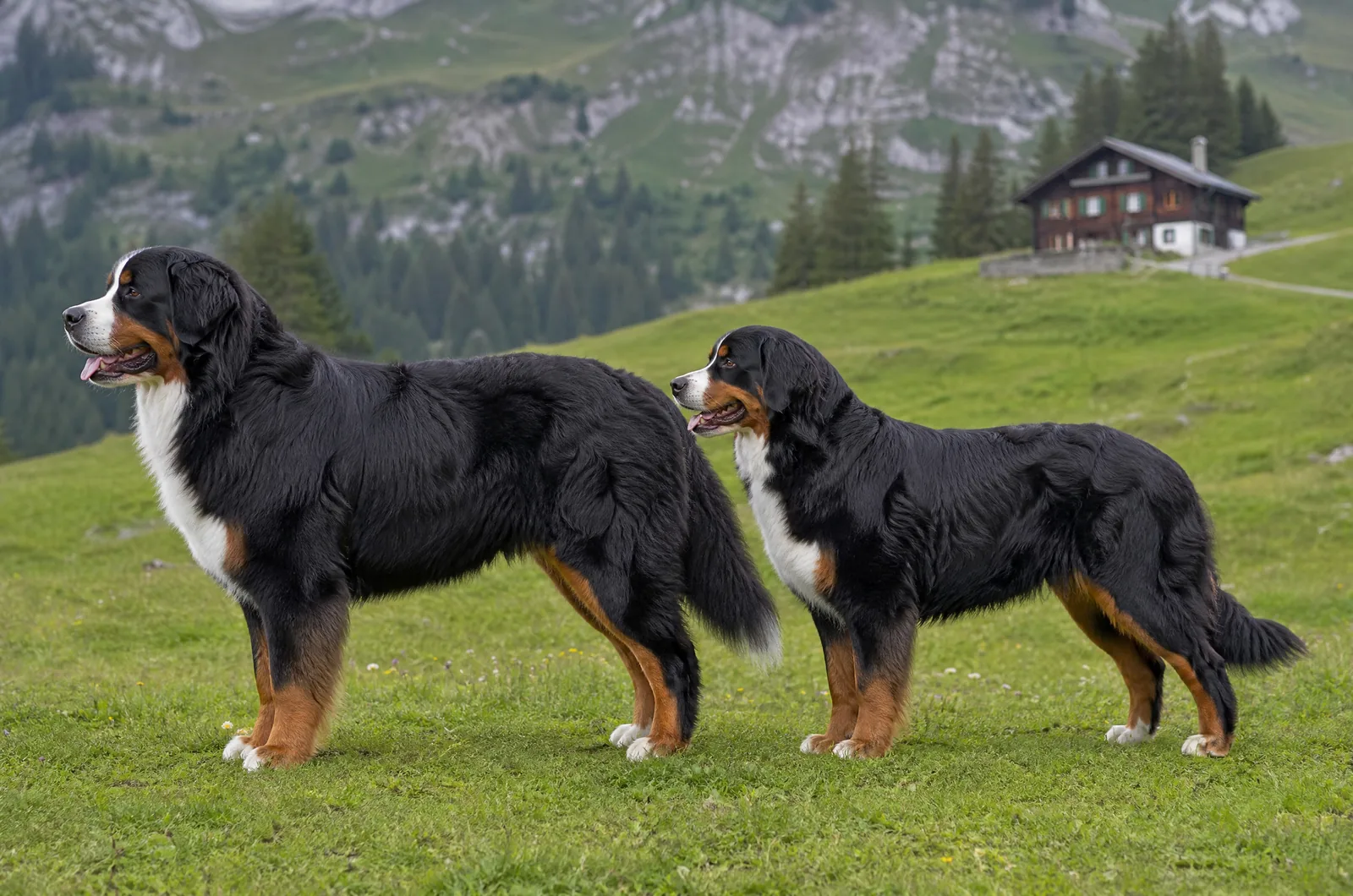
| Measure | Male Berner | Female Berner | Golden Retriever (comparison) |
|---|---|---|---|
| Height at shoulder | 25 to 27.5 in | 23 to 26 in | 21.5 to 24 in |
| Typical weight | 80 to 115 lb | 70 to 95 lb | 55 to 75 lb |
| Median lifespan (2024 UK data) | ~10.1 yrs (breed median) | ~10.1 yrs (breed median) | ~12.0 yrs |
| Full physical maturity | 2 to 3 yrs | 2 yrs | 2 yrs |
Height ranges follow the AKC breed standard; lifespan figures come from the 2024 Scientific Reports longevity analysis.
The 10.1 and 8.4 year figures are not a contradiction. The UK study estimated survival across a huge veterinary database. The Swiss cohort followed 389 dogs born in 2001 to 2002 until 381 had died, which captures completed lifespans in one population and era. Different methods, related answers. Both are better evidence than the common claim that every Berner dies at seven.
The honest version: the distribution is short, and individual variation is unusually wide. For broader context on canine aging, see our overview of how long dogs live and the ongoing Dog Aging Project. Not sure where your dog sits on the scale? Our large versus giant breed size guide sorts it out.
What Is the Bernese Mountain Dog Temperament Like?
The AKC standard calls for a dog that is “self-confident, alert and good-natured, never sharp or shy.” In practice most bernese mountain dog adults are soft, people-focused, and slightly reserved with strangers.
What that looks like day to day:
- Affectionate to the point of inconvenience. A Berner follows you to the bathroom and lies across the doorway.
- Reserved, not suspicious. A polite Berner watches a new visitor, then settles. Growling at guests or trembling in new places is outside the standard and worth a behavior consult.
- Sensitive to tone. Harsh corrections shut these dogs down fast. Reward-based, humane training works better and faster.
- Slow to mature. Mentally adolescent until around two years old. The gentle giant arrives late.
- Prone to separation distress. The AKC specifically warns that Berners are highly social and can develop separation anxiety when left alone for long stretches.
Common mistake: treating the breed’s sweetness as a substitute for training. A gentle 110-pound dog that has never learned to settle is still a 110-pound dog in a crowded kitchen.
Decision rule: choose a Berner if someone is home most of the day, or if you can build a reliable dog-walker or daycare routine before the puppy arrives.
Are Bernese Mountain Dogs Good With Kids and Other Pets?
Yes, with supervision. The bernese mountain dog is one of the steadier large breeds around children, tolerating noise, hugging and general chaos better than most dogs its size.
The caveat is physics, not temperament. The AKC’s own puppy guidance notes that a mature Berner can knock over a child or an older adult without meaning to. A happy spin in a hallway is enough.
Practical rules that work:
- Teach “four on the floor” before the puppy hits 40 pounds. Greetings happen with all feet down or they do not happen.
- Give the dog a gated room or crate it can retreat to. Children do not follow it in. Our dog gate buying guide covers mounting and doorway measuring.
- Supervise toddler-and-dog time at floor level. Every time.
- Introduce cats slowly. Most Berners coexist fine, but adolescent herding pressure can stress a cat.
Berners usually accept other dogs well, especially when socialized before 16 weeks. Same-sex pairs of intact dogs are the most likely friction point. For a wider family view, see our guide to the most child friendly pets.
Who Is the Bernese Mountain Dog Made For, and Who Should Skip It?
Good fit: families with a yard and a cool climate, empty nesters who are home often, and owners who want a calm indoor companion that still enjoys hikes.
This breed suits you if:
- You live where winter is real. Berners come alive at 25°F.
- Someone is home most of the day, or you can arrange midday company.
- You can budget for giant-breed veterinary care and pet insurance taken out early.
- Hair on your clothes is an accepted fact rather than an ongoing argument.
- You want a dog that is strong but not driven, affectionate but not frantic.
Skip the breed if:
- You live in Phoenix, Houston or Orlando without serious climate control.
- You are gone 10 hours a day.
- You want a running partner. Berners are hikers, not distance athletes, and heavy roadwork is hard on their joints.
- You cannot physically manage a dog that may outweigh a third grader.
- A short lifespan would be unbearable. This is a legitimate reason to choose another breed.
Apartment living: possible but hard. A quiet adult Berner can do well in a large apartment with an elevator and a cool interior. A Berner puppy in a third-floor walk-up is a bad plan, because carrying a growing giant-breed puppy up stairs becomes impossible around month five.
First-time owners: workable with support. The temperament is forgiving, the size is not. Budget for a group class at minimum.
Berner vs Golden Retriever: choose the Golden if you want lower weight, better heat tolerance, roughly two more years of median lifespan, and a more biddable adolescent. Choose the Berner if you want a calmer adult, a cold-weather dog, and a quieter indoor presence, and you accept the health risk. More giant-breed context sits in our giant breed dogs explainer.
How Much Exercise Does a Bernese Mountain Dog Need?
Plan on 45 to 90 minutes of moderate activity daily for a healthy adult bernese mountain dog, split across two or three sessions, plus daily mental work.
What that looks like in a real week:
- Two walks of 25 to 40 minutes at a pace the dog sets, not a jog.
- One longer weekend outing, like a 2 to 4 mile trail hike in cool weather.
- 10 to 15 minutes of sniffing or scentwork in the yard or on a long line. A snuffle mat or scatter-fed dinner counts.
- Short training reps, three to five minutes, two or three times a day.
Puppies need far less. The common rule of roughly five minutes of formal exercise per month of age, twice daily, exists because giant-breed growth plates close late. Free play on grass is fine. Forced jogging, long bike runs and repeated stair sprints before 18 months are not.
Heat rule: above roughly 75°F with humidity, move exercise to early morning or after dark. Heavy panting, bright red gums, stumbling, or vomiting during heat are veterinary emergencies. Cool the dog with water and call a vet immediately.
Enrichment matters as much as mileage. An under-stimulated adolescent Berner redecorates. Frozen stuffed toys, puzzle feeders, and carting or draft work through a local club all give the breed a job. Our Pupsicle review covers one frozen-treat option and its limits.
Bernese Mountain Dog Grooming and Shedding
Yes, bernese mountain dogs shed heavily, all year, with two dramatic blowouts in spring and fall. Plan on brushing two to three times a week and daily during a coat blow.
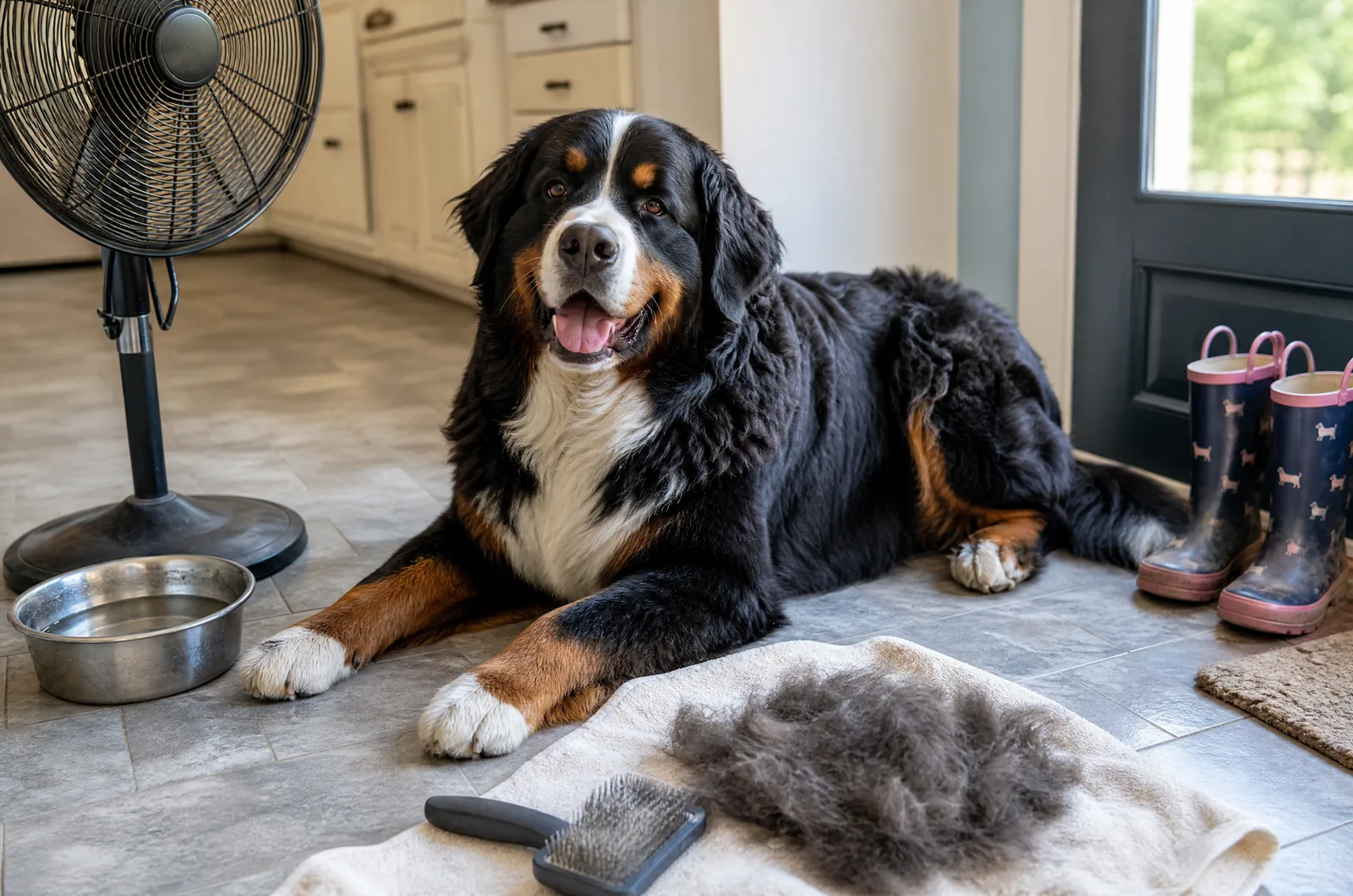
A working routine:
- Undercoat rake for the dense layer, used in sections along the hips, chest and ruff.
- Slicker brush for the feathering behind the ears, on the legs and the tail, where mats form first.
- Check four mat zones weekly: behind the ears, armpits, britches, and the tail base.
- Bath every 6 to 10 weeks, then dry thoroughly. A damp undercoat causes hot spots.
- Trim foot hair monthly so the dog keeps traction on hardwood. Slipping is hard on hips.
- Nails every 3 to 4 weeks. Long nails change how a heavy dog loads its joints.
Never shave a Berner for summer. The double coat insulates against heat as well as cold, and shaved coats often grow back patchy. Cool the dog instead: shade, fans, a raised cot bed, a wet towel under the chest.
Dental care gets skipped on big dogs because it is awkward. It still matters. See our notes on cleaning dog teeth without brushing and the beginner’s dog grooming guide.
Expect hair on the stairs, in the car, and woven into the sofa. This is the tax.
Common Bernese Mountain Dog Health Problems
Cancer is the leading cause of death in the breed, followed by orthopedic disease. That combination is what shortens the clock.
Cancers seen disproportionately in Berners:
- Histiocytic sarcoma, an aggressive cancer with a strong breed-associated risk. The BMDCA screening list names histiocytic sarcoma risk as one of its optional additional tests.
- Lymphoma. A study published November 5, 2026 analyzed 27 Berner lymphoma samples using a 499-gene cancer panel. Somatic mutations turned up in 26 of 27 samples (96.3%), with TRAF3 altered in 25.9%, TP53, EP300 and MYC in about 22% each, and MAP3K14 in 19%. Copy-number changes appeared in 66%.
- Mast cell tumors and osteosarcoma also appear above baseline.
What the lymphoma study does not establish: it is exploratory, the sample is small, and recurrent EP300 mutation is described as a possible breed-specific molecular feature, not a screening test. Sequencing your dog’s lymphoma today does not have evidence showing it improves survival. It points at future molecular classification and targeted therapy work.
Non-cancer problems to know:
- Hip and elbow dysplasia
- Degenerative myelopathy (a DNA test exists)
- Von Willebrand disease and hypothyroidism
- Gastric dilatation volvulus (bloat). A distended abdomen, unproductive retching and restlessness is an emergency. Go to a vet immediately. Preventive gastropexy surgery is worth discussing at the spay or neuter visit.
- Back pain with weak or dragging hind legs needs same-day veterinary attention.
What to screen for before buying
Ask the breeder for OFA or PennHIP results on hips and elbows, plus eye (ophthalmologist), cardiac, and degenerative myelopathy clearances, and at least one of von Willebrand, thyroid, or histiocytic sarcoma risk testing. Verify the results yourself in the OFA database rather than taking a photo of a certificate.
Can you prevent hip dysplasia
Not entirely. Genetics set the ceiling. You control the rest: keep the puppy lean (ribs easy to feel), feed a large-breed puppy formula to slow growth, avoid stairs and slick floors in the first year, skip forced running before 18 months, and keep adults at a working weight. Lean body condition is the single best-supported lever an owner has.
What Do Bernese Mountain Dogs Love to Eat? Favorite Foods and Feeding
Feed an adult bernese mountain dog a complete, AAFCO-compliant large-breed food in two measured meals, roughly 4 to 6 cups total daily depending on the food’s calorie density and your dog’s activity.
Puppy rule that matters most: use a food formulated for large-breed growth, with controlled calcium (commonly around 1.2% or lower on a dry-matter basis) and a controlled calorie level. Overfeeding a Berner puppy accelerates growth and raises orthopedic risk. Fat puppies are not a head start. Our life-stage feeding guide explains the transitions.
Treats Berners tend to love, in moderation:
- Plain cooked chicken or turkey, no seasoning
- Carrot sticks and green beans (great for a dog on a diet)
- Blueberries and apple slices without seeds
- Plain pumpkin puree, a spoonful
- Freeze-dried single-ingredient meat treats for training
Foods to avoid outright: grapes and raisins, onion and garlic, xylitol, chocolate, macadamia nuts, cooked bones, and very fatty table scraps, which can trigger pancreatitis in a big dog fast.
Bloat precautions worth taking: two or three smaller meals instead of one large one, a slow-feeder bowl if your dog inhales food, and no hard exercise within an hour of eating. The evidence on raised bowls is mixed, so do not treat them as protection.
Also useful: how to read a dog food label and what AAFCO means and switching foods without stomach upset.
How to Train a Bernese Mountain Dog
Train a bernese mountain dog with reward-based methods, short sessions, and early emphasis on leash manners, because the strength problem arrives before the brain does.
Priority order for the first year:
- Loose-leash walking, starting at 12 weeks. Teach it on a 15-pound puppy, not a 90-pound adolescent. Use a well-fitted front-clip or Y-front harness and stop moving whenever the leash goes tight. Reward every check-in.
- Settle on a mat. Ten-minute mat sessions while you cook or watch TV build the off-switch this breed needs.
- Alone-time practice from week one. Leave for 30 seconds, then 2 minutes, then 10. Build it before anxiety develops rather than after. A treat-dispensing camera helps you see what actually happens while you are out.
- House training on a clock. Out every 45 to 60 minutes while awake, immediately after eating, waking and play. Accidents mean the schedule slipped, not that the dog is defiant. Most Berners are reliable by 5 to 6 months with consistency.
- Handling and grooming tolerance. Paws, ears, mouth, nails, brush. Two minutes daily.
- Crate comfort. If nights are rough, our guide to a puppy crying in the crate at night has gentle fixes.
Destructive chewing in adolescence is usually boredom plus under-exercise plus loneliness. Rotate chews, freeze stuffed toys, add a sniff walk, and limit unsupervised access with gates.
Berners are sensitive. If a correction makes your dog shut down and stop offering behavior, back off and pay better.
Try It: Berner Life Stage Planner
Bernese Mountain Dogs grow up fast and age early, so the care that matters at 10 months is not the care that matters at six years. Enter your Berner’s age below to see the priorities for that stage.
Doggy Rank IQ Tool
Berner Life Stage Planner

Bernese Mountain Dogs grow up fast and age early. Enter your Berner's age to see the care that matters most at this stage.
How Much Does a Bernese Mountain Dog Cost?
Expect $1,500 to $4,000 for a puppy from a breeder who performs the full health-testing panel, and $3,000 to $5,000 in total first-year spending.
| Cost area | Typical range | Notes |
|---|---|---|
| Puppy from a health-testing breeder | $1,500 to $4,000 | Lower prices usually mean missing clearances |
| First-year extras (crate, gear, vaccines, neuter, classes) | $1,500 to $3,000 | Giant-breed gear costs more and gets replaced |
| Food, adult year | $700 to $1,400 | Driven by 4 to 6 cups daily |
| Routine vet and preventives, adult year | $500 to $1,000 | Twice yearly after age four |
| Grooming (if outsourced) | $400 to $900 | Many owners do it at home |
| Pet insurance | $600 to $1,400 | Buy before any condition appears |
Rescue through regional Bernese clubs typically runs $300 to $800 and often means adopting an adult with known history.
The number people miss: cancer treatment. A chemotherapy protocol for lymphoma commonly runs several thousand dollars, and surgery for a histiocytic sarcoma or an emergency bloat correction can land in the same range on one night. Insurance bought at eight weeks is the cheapest form of future optionality.
Bernese Mountain Dog Puppy Tips for the First 90 Days
The first 90 days decide whether you get a manageable adult. Spend them on body handling, alone-time tolerance, and leash manners, in that order.
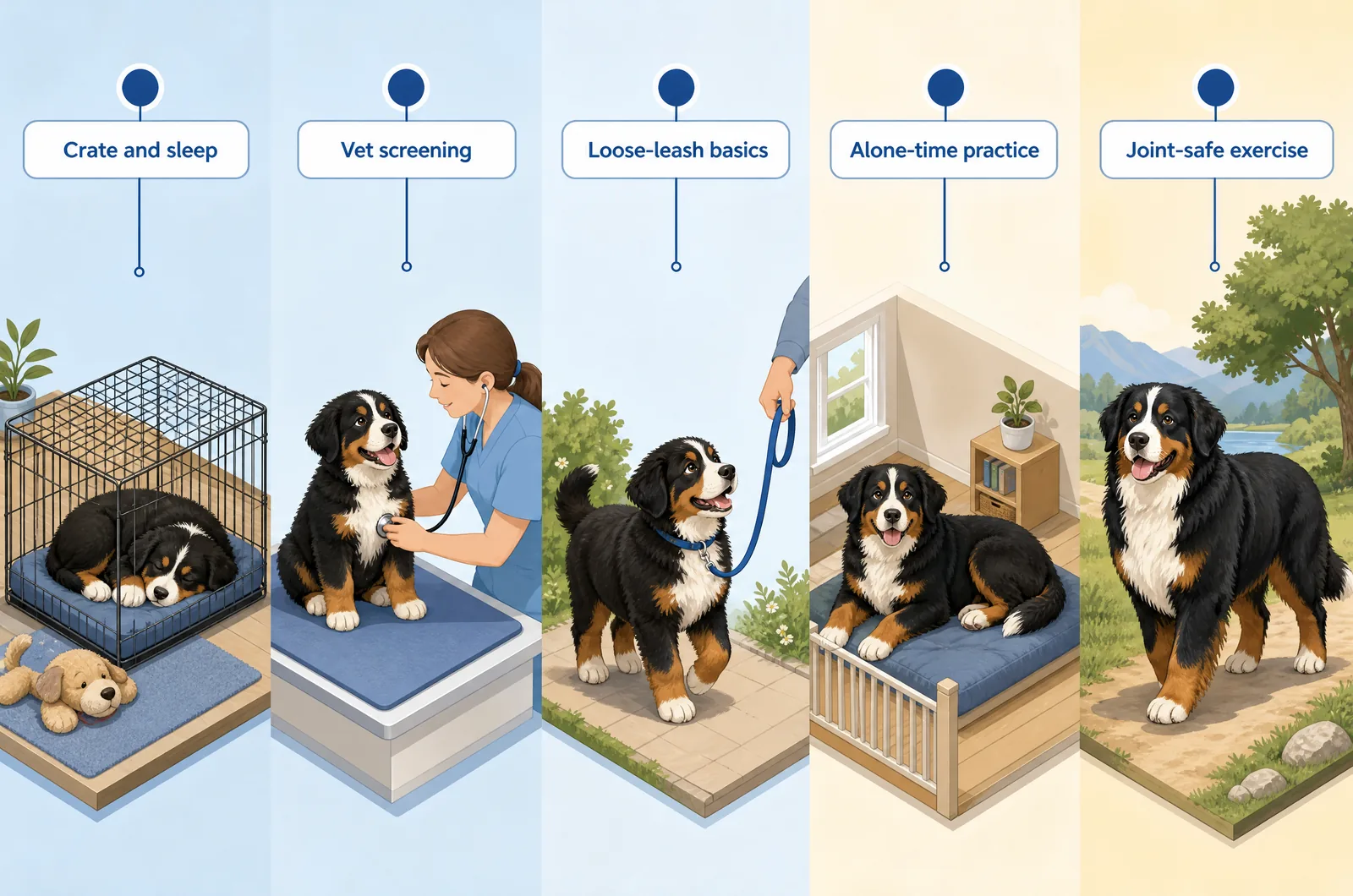
Weeks 1 to 2
- Set a potty clock: outside every 45 to 60 minutes awake, after every meal and nap.
- Crate beside your bed at night. Carry the puppy out for a 3 a.m. break without conversation.
- Begin 30-second departures while the puppy is awake and calm.
Weeks 3 to 6
- Puppy class with a reward-based trainer.
- Socialize with surfaces, sounds, umbrellas, bikes, hats, vacuum, strangers of varied appearance. Quality over quantity.
- Start the brush, paws and ears routine for two minutes a day.
- Fit a Y-front harness and teach the leash in the hallway before the sidewalk.
Weeks 7 to 12
- Build mat settle to five minutes with you in the room.
- Add one new calm location per week: hardware store, patio, friend’s porch.
- Book the 16-week vet visit and ask about gastropexy timing and growth tracking.
Avoid: stairs, long leash walks on pavement, slick floors without rugs, and any training method that relies on fear. One frightening experience at nine weeks can take months to undo in a sensitive breed.
What Bernese Mountain Dog Owners Say
Three real owner posts, quoted as written.
“These dogs are seriously the sweetest things on earth”
An owner on Reddit, in a thread titled Why didn’t anyone warn me. The sweetness is the consensus and the trap. A dog this soft gets excused from training it genuinely needs. Set the rules anyway while the dog still fits on your lap.
“the strength is intense. I worry he is going to dislocate my shoulder.”
An owner on Reddit in a thread on Bernese frustrations. This is the single most common Berner complaint, and it is fixable. Switch to a Y-front harness with a front clip, stop walking the instant the leash tightens, and reward at your knee. Do ten minutes of focused leash work in a quiet place twice a week instead of hoping it improves on the regular walk. If your shoulder is already sore, add a second handler point or a short traffic handle for control.
“it feels like a rollercoaster with this puppy”
An owner on Reddit, posting in a days like these I regret getting a puppy thread. Berner adolescence lasts longer than most owners expect, and regret during month seven is ordinary rather than a sign you picked wrong. Lower the stakes: more enforced naps in the crate, fewer high-arousal sessions, and one small training win a day. Most of the rollercoaster flattens between 18 and 24 months.
Bernese Mountain Dog FAQ
How long do bernese mountain dogs actually live? Median survival was 10.1 years in a 2024 UK study of 584,734 dogs. A Swiss cohort of 389 dogs found 8.4 years median, 7.7 for males and 8.8 for females. Individual variation is wide, and some Berners pass 11.
Why is the bernese mountain dog lifespan so short? Mostly cancer, especially histiocytic sarcoma and lymphoma, combined with giant-breed body size, which is independently linked to earlier death across breeds.
Do bernese mountain dogs shed a lot? Yes. Moderate shedding year round and heavy seasonal coat blows in spring and fall. Brush two to three times weekly, daily during a blow.
Can bernese mountain dogs handle hot weather? Poorly. Limit activity above roughly 75°F, provide shade, water and air conditioning, and never shave the coat. Collapse, bright red gums or stumbling in heat is an emergency.
Are bernese mountain dogs good for first-time owners? They can be, for a first-time owner who is home often, lives somewhere cool, takes a training class, and budgets for giant-breed vet care. The temperament is forgiving. The size is not.
Is there a real miniature bernese mountain dog? No. No kennel club recognizes a mini or miniature bernese mountain dog. Dogs sold under that name are crossbreeds with unpredictable size, coat and health.
How much exercise does a bernese mountain dog need daily? Roughly 45 to 90 minutes of moderate activity for a healthy adult, plus daily sniffing or puzzle work. Puppies need much less and should avoid forced running before 18 months.
Can a bernese mountain dog live in an apartment? A calm adult can, given a cool interior, elevator access and committed daily walks. A puppy in a walk-up is a poor plan once the dog outgrows being carried.
Next steps
If you are still deciding, do three things this week: find two breeders with verifiable OFA results on hips, elbows, eyes, heart and degenerative myelopathy; price pet insurance for an eight-week-old puppy in your zip code; and check your summer indoor temperature honestly. If all three check out, you are a good candidate for the breed. If the summer answer is no, pick a different dog and keep the Berner photos.