
Quick Answer: Is a Great Dane Right for You?
A great dane suits people with space, a flexible budget, and a plan for bloat. These dogs are affectionate, mostly low-energy indoors, and surprisingly easy to live with once adolescence passes. The hard parts are the short lifespan (roughly 7 to 10 years), the giant-breed vet and food bills, and a lifetime risk of gastric dilatation and volvulus that UC Davis estimates near 36.7% for the breed. If you can plan for a gastropexy conversation and a 24-hour emergency hospital, the rest is drool management.
Key Takeaways: Great Dane
- Size: Males reach about 32 inches at the shoulder and 140 to 175 pounds; females run roughly 110 to 140 pounds, per AKC breed data.
- Lifespan: About 7 to 10 years. A 2026 Dog Aging Project study in Science analyzed blood from 894 dogs and found larger dogs pick up age-related DNA methylation changes faster than small dogs. It does not prove causation.
- Bloat: UC Davis puts estimated lifetime GDV risk at roughly 36.7%. The American College of Veterinary Surgeons names Great Danes as candidates for preventive gastropexy, often done during spay or neuter.
- Heart: Dilated cardiomyopathy is a leading cause of death. An AKC Canine Health Foundation project narrowed more than 137,000 genetic variants in affected dogs down to about 180 candidates.
- Exercise: Two brisk walks a day, roughly 30 to 60 minutes total. Skip jogging until about 2 years old while growth plates close.
- Cost: Expect $1,500 to $3,500 for a health-tested puppy, $4,000 to $6,000 in year one, and $2,500 to $4,500 a year after that.
- Temperament: AKC describes the standard as friendly, patient, dependable, and trainable. Spirited, never timid or aggressive.
Where Does the Great Dane Come From?
The great dane is German, not Danish. The breed was developed in Germany as a boar hound, bred from mastiff-type dogs crossed with sighthounds to produce an animal fast enough to run down wild boar and heavy enough to hold it.
That origin explains the body you see today. The deep narrow chest and long legs come from the sighthound side. The bone and the head come from the mastiff side. Germans later called the breed Deutsche Dogge, and the English name stuck anyway, which is how a German hunting dog ended up permanently misfiled under Denmark.
By the late 1800s, breeders had deliberately softened the temperament. The boar work disappeared, and the dog became an estate companion and guardian. Modern breed guidance describes a dog bred for presence rather than aggression, which matches what most owners report: a very large animal that would rather lean on you than confront anyone.
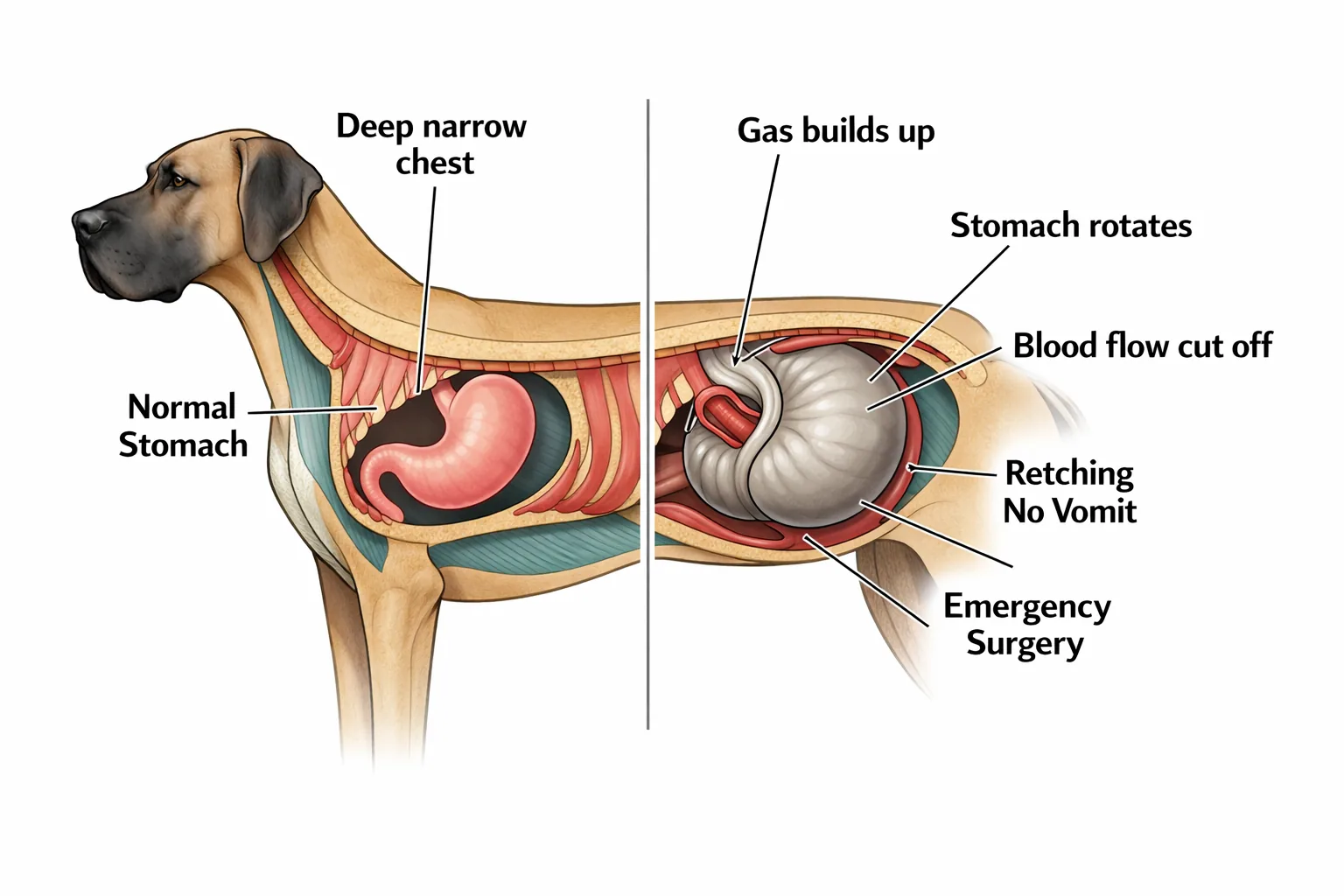
One practical takeaway from the history. The chest shape that made the dog fast is the same chest shape that raises bloat risk. You cannot separate the two.
)
What Makes the Great Dane So Special (and So Cute)?
What people fall for is the contradiction: a dog tall enough to drink from the kitchen sink who behaves like a 15-pound lap dog with no spatial awareness.
Great Dane owners talk about the same three things over and over.
The leaning. Danes press their full body weight against your legs as a greeting. It is affectionate, it is constant, and it will move you about six inches if you are not braced.
The goofiness. Adult Danes are famously silly. The zoomies happen in a house that is too small for them. The attempt to fit on a 24-inch dog bed, with four limbs hanging off, is a near-universal owner photo.
The eye contact. Danes track their people closely and follow them room to room. Breed descriptions from AKC-aligned sources call them devoted and eager to please, and that attachment is the reason so many owners tolerate the drool.
The cuteness is partly structural. Big dark eyes, a soft expression, and a huge head on a dog who keeps trying to sit in your lap. The brain reads it as baby-shaped even at 150 pounds.
Great Dane Size, Weight and Lifespan
Great Danes are one of the tallest breeds in the world, with males around 32 inches at the shoulder, and one of the shortest-lived, averaging 7 to 10 years.
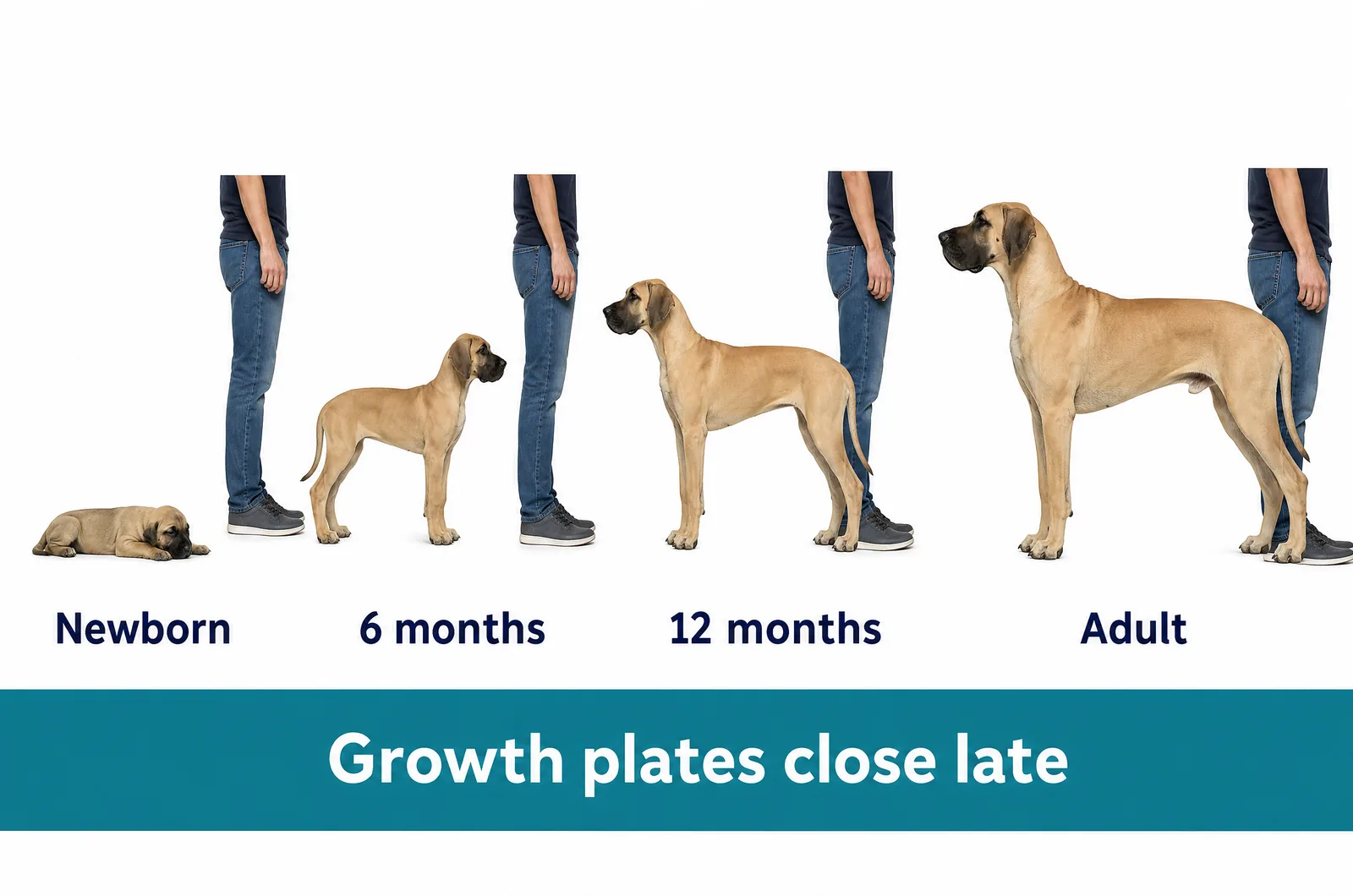
| Measure | Male Great Dane | Female Great Dane | Notes |
|---|---|---|---|
| Height at shoulder | 30 to 32 inches | 28 to 30 inches | AKC breed standard minimums |
| Adult weight | 140 to 175 lb | 110 to 140 lb | Lean condition, ribs easily felt |
| Full maturity | 24 to 36 months | 24 to 30 months | Growth plates close late |
| Average lifespan | 7 to 9 years | 8 to 10 years | Larger males often shorter |
The short lifespan is the part people underestimate. A 2026 epigenetics study published in Science looked at blood samples from 894 Dog Aging Project dogs and found that larger dogs accumulated age-related DNA methylation changes faster than smaller dogs. That is an association, not a mechanism. It does not prove epigenetic aging shortens a Great Dane’s life, and it does not predict any individual dog. It does line up with decades of observation that giant breeds age faster.
Planning note: if you are comparing giant breeds generally, our large versus giant breed size guide explains where the weight thresholds actually fall and what changes in care above them.
What Is the Great Dane Temperament Like?
The AKC standard calls for a dog that is friendly, patient, dependable and trainable, spirited and courageous but never timid or aggressive. In daily life that translates to a calm, people-focused dog who wants to be in the same room as you.
Three honest caveats.
Adolescence is real. Between 8 and 18 months, many Danes regress. Recall goes, counter surfing appears, leash manners evaporate. This is normal development, not a training failure, and it resolves with consistency rather than force.
Size turns friendliness into a management problem. A delighted Dane who jumps can knock an adult down and genuinely injure a child or an older relative. Teach four-on-the-floor before the dog weighs 100 pounds, because you cannot physically correct it afterward.
Sensitivity cuts both ways. Danes respond well to reward-based training and poorly to harsh handling. A spooked Dane does not get smaller.
A Great Dane is not a guard dog with a soft side. It is a companion dog with a deterrent silhouette.
Are Great Danes Good With Kids and Other Pets?
Yes, with supervision and early socialization. Well-bred Great Danes are typically patient and tolerant with children, which is exactly why size management matters more than temperament here.
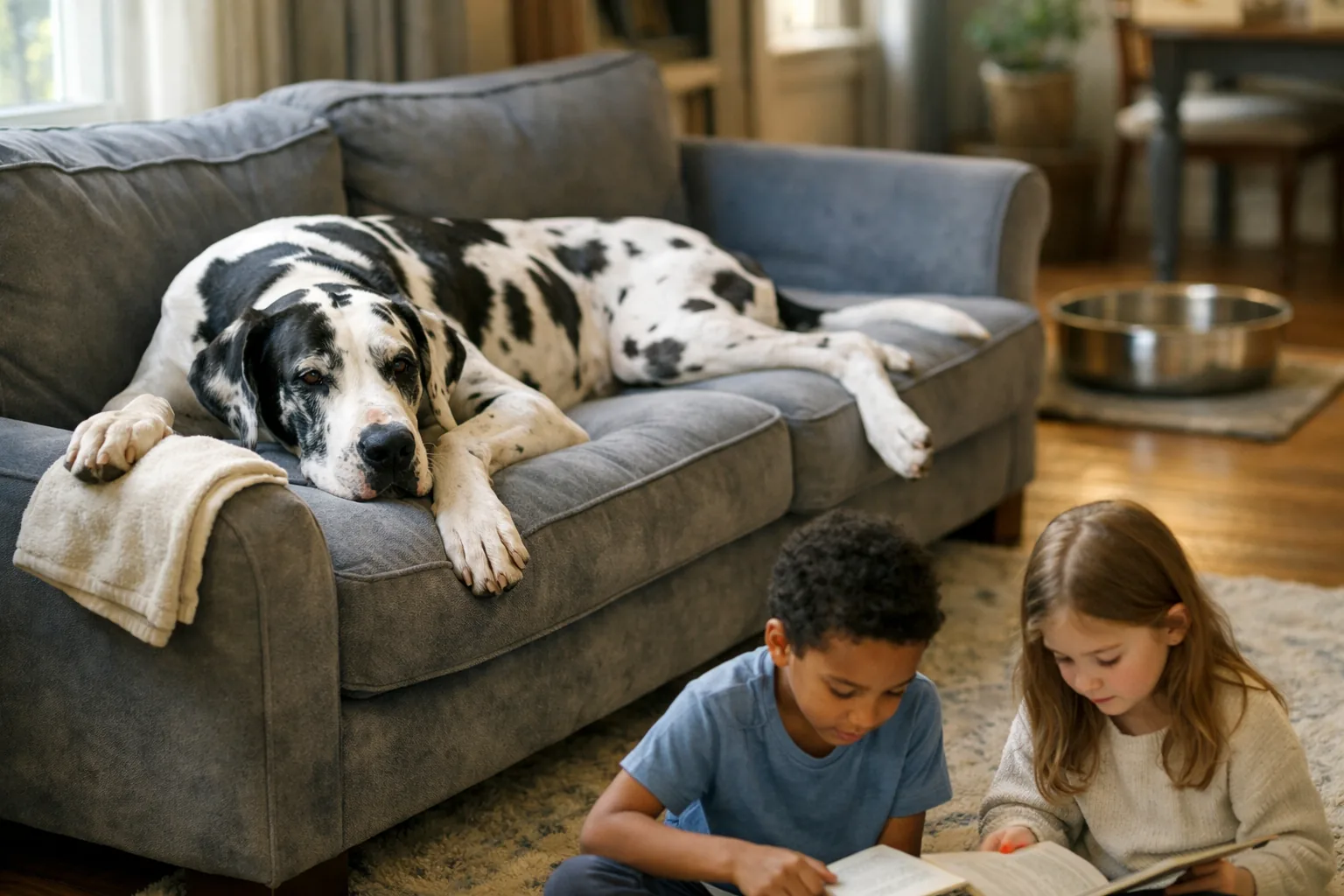
Practical rules that work in real households:
- Supervise all toddler and Dane interaction. Not because of aggression, because of a swinging tail at face height and 150 pounds turning around in a hallway.
- Teach the dog a solid “place” cue. A Dane on a mat during dinner solves half of all household friction.
- Give kids one job each: filling the water bowl, holding the treat pouch during training. Involvement beats rules they will forget.
- Other dogs: usually fine when socialized young. Danes play with their chest and shoulders, which smaller dogs can find overwhelming.
- Cats: many Danes live happily with cats, but the sighthound ancestry means some have real chase drive. Introduce slowly and judge the individual dog.
If you are still weighing breeds for a household with young kids, compare notes with our roundup of family-friendly dog breeds for kids.
Who Is the Great Dane Made For, and Who Should Skip It?
Choose a Great Dane if you have floor space, a car that fits one, an emergency vet fund of at least $5,000, and tolerance for drool on the ceiling.
A great dane suits you if:
- You work from home or have someone around most of the day. Danes get genuinely distressed alone for long stretches.
- You want a calm indoor dog and a moderate walker, not a running partner.
- You can budget for giant-breed food, meds dosed by weight, and surgery sized for a 150-pound patient.
- You are prepared, emotionally, for a 7 to 10 year dog.
Skip the breed if:
- You want a 12 to 15 year companion. This is the single most common regret.
- Your budget has no slack. One GDV emergency can run several thousand dollars.
- You dislike public attention. Strangers will approach, reach out, and ask the same four questions daily.
- You live somewhere with weight limits, or a third-floor walk-up with no elevator.
Apartment living: possible, and sometimes better than expected, because adult Danes sleep most of the day. The real constraints are elevator access, floor space for a 48-inch bed, and neighbors in hallways. See our picks for apartment-friendly dog breeds if you are unsure.
First-time owners: not ideal, but not disqualifying. A calm, organized first-timer with a trainer booked before the puppy arrives does better than an experienced owner who improvises.
Great Dane vs Mastiff: choose the Dane if you want a taller, leaner, more mobile dog who still fits through doorways gracefully and drools less. Choose an English Mastiff if you want lower energy, more mass, and a dog less likely to counter surf. Mastiffs typically outweigh Danes while standing shorter, and both carry serious orthopedic and bloat risk. Our guide to the largest mastiff breeds breaks down the differences.
How Much Exercise Does a Great Dane Need?
Adult Great Danes need about 30 to 60 minutes of daily activity, usually split into two brisk walks. They are couch potatoes between walks, and that is by design, not laziness.
AKC-aligned breed care guidance describes two reasonable walks a day as adequate for most adults. Add sniffing time. A 30-minute walk where the dog gets to investigate hedges is worth more mentally than a 45-minute forced march.
Puppy rules matter more than adult rules. Growth plates in a giant breed stay open far longer than in a Labrador. Skip jogging, repetitive fetch on hard surfaces, long hikes, and stairs-heavy routines until roughly 24 months. Damage done at 9 months shows up as arthritis at 5 years.
Mental work that suits the breed:
- Scatter feeding part of a meal in the yard
- A snuffle mat or food puzzle for slower eating and enrichment
- Five minutes of trick training twice a day, which tires a Dane more than a mile of walking
- Short, calm socialization outings so strangers become background noise
Edge case: hot weather. Danes overheat fast and a heavy panting dog who collapses or cannot settle is an emergency. Call a vet immediately, cool with room-temperature water, and do not wait it out.
Great Dane Grooming and Shedding
Great Danes have short coats and still shed a surprising amount, simply because there is a lot of dog. Expect steady year-round shedding with heavier seasonal periods in spring and fall.
A workable routine:
- Weekly: rubber curry brush or grooming mitt, five minutes, outdoors if possible
- Monthly: nail trim, because overgrown nails change the foot angle on a heavy dog and stress the joints
- Weekly: ear check, especially on uncropped ears
- Daily: teeth brushing if you can manage it, three times a week minimum
- As needed: bathe every 6 to 8 weeks or when the dog has found something memorable
The drool. Danes with looser flews drool more, and some drool very little. The fix is logistics, not grooming. Keep a microfiber towel in every room you both use, one by the water bowl, one in the car. Raised water bowls with a deep lip and a mat underneath cut the hallway flooding problem considerably. Wipe the face after drinking and the walls stay cleaner.
If you are building a home grooming setup from scratch, our beginner’s guide to dog grooming covers tools that work on short, dense coats.
Common Great Dane Health Problems
The three conditions that shorten Great Dane lives most often are gastric dilatation volvulus, dilated cardiomyopathy, and orthopedic disease.
)
Bloat and GDV. Veterinary references separate two things. Gastric dilatation means the stomach fills with gas or food and distends. Volvulus means it twists, which can cut off blood supply and send the dog into shock within hours. The MSD Veterinary Manual describes GDV as a surgical emergency. UC Davis puts estimated lifetime risk for the breed at about 36.7%.
Warning signs: unproductive retching, a swollen or drum-tight abdomen, restlessness and pacing, drooling, hunched posture, pale gums. This is a call-the-vet-now situation, not a wait-until-morning situation. Our full breakdown of bloat symptoms in dogs covers what to look for.
Dilated cardiomyopathy. The heart muscle weakens and enlarges. Great Danes are among the most predisposed breeds. An AKC Canine Health Foundation project used whole-genome sequencing on affected and unaffected Danes, identified more than 137,000 variants in affected dogs, and narrowed the candidate list to about 180. The genetic mechanism is still unresolved. Practical response: annual cardiac exams from middle age, and echocardiogram or Holter monitoring if your vet recommends it.
Orthopedic. Hip and elbow dysplasia, wobbler syndrome (cervical spinal compression causing a wobbly, uncoordinated gait), and osteosarcoma. Sudden weakness in the rear legs or neck pain warrants a same-day vet call.
Screening to ask a breeder for: OFA or PennHIP hips, OFA elbows, cardiac evaluation by a cardiologist, thyroid panel, and eye exam. A breeder who shrugs at this list is the wrong breeder.
What Do Great Danes Love to Eat? Favorite Foods and Feeding
Feed a large- or giant-breed formula with controlled calcium and moderate calories, split into two or three meals a day. Never one large meal.
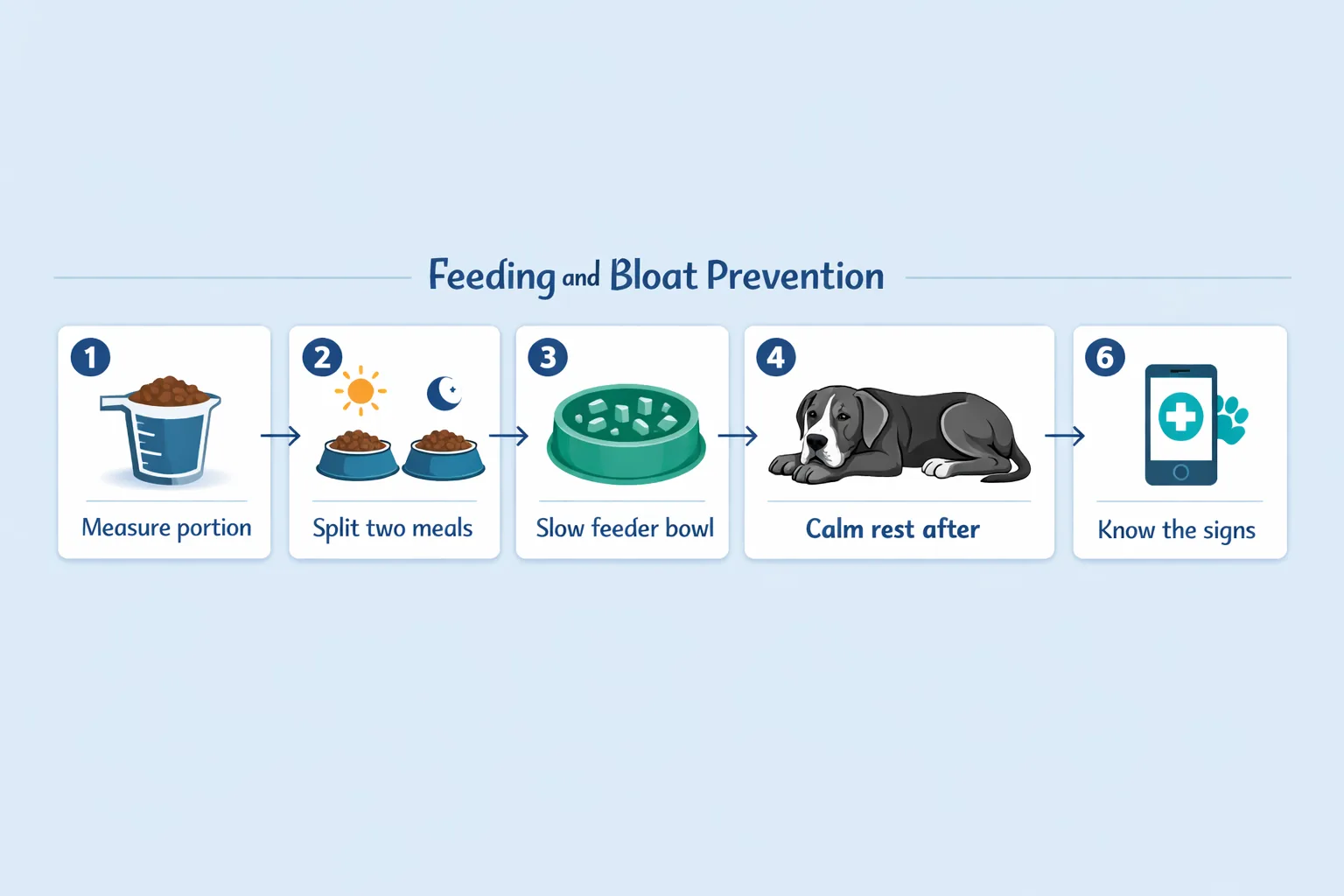
A Canadian Kennel Club review of the research found that larger meal volume was associated with higher GDV risk, especially when a dog got one big meal daily. That same body of work did not establish that feeding speed, meal frequency, or raised bowls independently cause or prevent GDV. So: split the meals because volume is the clearer signal, and treat everything else as sensible rather than proven.
Puppy feeding is the part people get wrong. Giant-breed puppies need a growth formula with controlled calcium and phosphorus. Overfeeding a Dane puppy to make it grow faster is directly linked to skeletal problems. Keep the puppy lean. You should feel ribs easily.
Rough daily amounts (always follow the label and your vet):
- 3 month puppy: 4 to 6 cups, split into 3 meals
- 6 month puppy: 6 to 8 cups, split into 3 meals
- Adult male: 6 to 10 cups, split into 2 meals
- Senior: reduce 10 to 20 percent, watch body condition
Budget note: a Great Dane eats through roughly a 30-pound bag of food every two to three weeks. That is a real line item.
Treats Danes tend to love: plain cooked chicken, green beans, carrot sticks, small pieces of plain pumpkin, low-fat training treats broken small. Keep treats under 10 percent of daily calories.
Foods to avoid: grapes, raisins, onions, garlic, xylitol, chocolate, macadamia nuts, cooked bones, and anything high-fat enough to trigger pancreatitis. Also monitor the FDA pet food recall database rather than relying on breed forums for contamination news.
For help reading labels and comparing formulas, see our guide to choosing the best food for your dog.
)
How to Train a Great Dane
Train a Great Dane early, with rewards, and finish the physical-control skills before the dog outweighs you. Danes are willing students who become immovable objects.
Priority order for the first year:
- Name and recall from week one, indoors, with high value food
- Loose leash walking starting at 10 weeks, before pulling is physically possible to ignore
- Four on the floor instead of jumping, rewarded every single time
- Place or settle on a mat, built to 20 minutes
- Handling tolerance: paws, ears, mouth, so vet visits are not a wrestling match
- Car loading with a ramp, taught small and reinforced
The adolescent dip. Around 10 to 16 months, previously solid cues fall apart. Go back to shorter sessions, higher-value rewards, and a long line outdoors. Do not escalate to harsher corrections. A sensitive giant-breed dog who shuts down is a much harder training problem than one who is temporarily distracted.
Public attention management. Strangers will approach without asking. Teach your Dane a sit-stay for greetings and practice saying “not today, he is in training” out loud, because you will say it several times a week. The dog learns faster if you control the interactions.
Crate training helps enormously with house manners, and if nights are rough early on, our guide to a puppy crying in the crate at night has gentle fixes that work for giant breeds too.
Try It: Great Dane Bloat Risk Check
Great Danes carry one of the highest GDV risks of any breed, and some risk factors you can change while others you cannot. Use the check below to see where your dog stands and to memorize the warning signs that mean you call a vet immediately.
The American College of Veterinary Surgeons names Great Danes as a breed for which preventive gastropexy may be appropriate, especially when combined with spay or neuter. A gastropexy tacks the stomach to the body wall so it cannot twist. It does not reliably prevent the stomach from distending in the first place, which is why the procedure reduces danger rather than eliminating it. Some owners decline it. That choice is defensible if you can recognize symptoms fast and you already know which 24-hour hospital you are driving to.
Doggy Rank IQ Tool
Great Dane Bloat Risk Check

Great Danes carry one of the highest bloat (GDV) risks of any breed. Check the factors you can and cannot change, and know the warning signs.
How Much Does a Great Dane Cost?
Budget $1,500 to $3,500 for a puppy from a health-testing breeder, roughly $4,000 to $6,000 for the first year, and $2,500 to $4,500 annually after that.
| Cost item | Typical range | Notes |
|---|---|---|
| Puppy from health-tested breeder | $1,500 to $3,500 | Lower prices usually mean no cardiac or hip screening |
| Rescue adoption | $200 to $600 | Great Dane rescues exist in most US regions |
| First-year setup | $900 to $1,800 | XL crate, ramp, beds, bowls, XL harness, gates |
| Food, annual | $1,000 to $1,800 | Roughly a 30 lb bag every 2 to 3 weeks |
| Routine vet, annual | $600 to $1,200 | Giant-breed med doses cost more |
| Preventive gastropexy | $400 to $1,500 | Cheapest when combined with spay or neuter |
| Emergency GDV surgery | $3,000 to $8,000 | Higher with complications and ICU stay |
Pet insurance for a Great Dane typically runs higher than for a medium breed, and some policies exclude GDV if the dog has a history. Read the bloat clause before you sign. The elective gastropexy is one of the few places where spending money early reliably reduces the chance of spending far more later.
Great Dane Puppy Tips for the First 90 Days
The first 90 days with a Great Dane puppy decide how the next decade goes, because every habit you allow at 25 pounds becomes a negotiation at 130.
Days 1 to 14
- Crate training from night one, crate next to your bed
- Three meals a day, giant-breed puppy formula, measured not eyeballed
- Name recognition and potty routine every 90 minutes awake
- Vet visit within 72 hours, start the health-record file
Days 15 to 45
- Socialization with surfaces, sounds, calm adults and vaccinated dogs
- Car ramp introduced now, flat on the ground, with treats
- Begin loose-leash work indoors on carpet
- Handling practice: paws, ears, teeth, 60 seconds daily
Days 46 to 90
- Puppy class with a reward-based trainer
- Build the settle-on-mat cue to 10 minutes
- Introduce the slow feeder and the two- or three-meal structure you will keep
- Ask your vet to pencil in the spay or neuter plus gastropexy conversation
Things to buy in XL from the start: crate (48 inch minimum), orthopedic bed, elevated bowls with a mat, a car ramp, a front-clip harness, and more towels than feels reasonable.
Mistake to avoid: letting the puppy on furniture “just for now.” A Dane who learns the sofa at four months owns the sofa at four years. Decide once.
What Great Dane Owners Say
Owner reports are not research, but they are good at showing what daily life actually feels like.
“Noodle is exactly what our family was missing and I am over the moon”
That comes from a first-time Dane owner on Reddit, in this r/greatdanes thread. The useful part for anyone in the same position: the honeymoon is real and so is the drop-off around month eight, when adolescence hits. Book the training class while you are still over the moon, not after the recall breaks. A Dane who learned a settle cue at 12 weeks is a very different animal at 14 months.
“she makes me want 10 more great danes”
Another owner on Reddit, posting in a thread titled “I regret adopting my Dane”, which turns out to be sarcastic. Worth noting anyway: the regret threads that are genuine almost always name the same two things, cost and lifespan. Before the second Dane, run the actual numbers for two giant-breed dogs, including two sets of emergency funds. Enthusiasm is cheap. Two gastropexies are not.
Great Dane FAQ
How long do Great Danes live on average? About 7 to 10 years, with females often slightly longer than males. Good body condition, late neutering timed with your vet, and cardiac screening are the levers you control.
Are Great Danes good for first-time dog owners? They can be, for calm, organized first-timers with space and budget. The breed is willing and gentle. The difficulty is size management during adolescence and the cost of giant-breed care, not stubbornness.
Can you keep a Great Dane in an apartment? Yes, if you have elevator access, floor space for a large bed, and you commit to two daily walks. Adult Danes sleep most of the day and are often quieter indoors than a terrier.
What is bloat in dogs and why are Great Danes at risk? Bloat is the stomach filling with gas and distending. GDV adds a twist that cuts off blood flow and becomes fatal within hours. Deep-chested breeds like the Great Dane are at the highest risk, with UC Davis estimating lifetime GDV risk near 36.7%.
Does a gastropexy prevent bloat completely? No. A gastropexy tacks the stomach so it cannot rotate, which prevents most volvulus. The stomach can still distend. The surgery greatly reduces the deadliest version of the problem.
Do Great Danes shed a lot? More than their short coat suggests, simply because of body size. Weekly rubber-curry brushing and heavier grooming in spring and fall keep it manageable.
How much exercise does a Great Dane need daily? Roughly 30 to 60 minutes for adults, usually two brisk walks. Avoid jogging and repetitive impact until about 24 months while growth plates close.
Great Dane vs Mastiff, which should I choose? Pick the Great Dane for a taller, leaner, more agile dog with slightly less drool. Pick an English Mastiff for lower energy and more mass. Both carry serious bloat and orthopedic risk, so screen either breeder carefully.
A Great Dane gives you a decade at most, so the planning is the kindness. Book a vet conversation about gastropexy timing before the spay or neuter, save the nearest 24-hour emergency hospital in your phone today, and switch to two or three measured meals this week. The rest is towels.