
Quick Answer: Is a Boston Terrier Right for You?
A boston terrier suits apartment dwellers, families and first-time owners who want a compact, affectionate, low-grooming companion and can accept real brachycephalic risk. These dogs weigh 12 to 25 pounds, live roughly 11 to 13 years, and shed less than most breeds. The weak spots are specific and manageable: prominent eyes that injure easily, a flattened face that struggles in heat, and a stubborn streak that punishes repetitive drilling.
Skip the breed if you leave the house for ten hours a day, live somewhere with brutal summers and no air conditioning, or want a running partner.
Key Takeaways: Boston Terrier
- 38% of Boston Terriers tested by the University of Cambridge scored Grade 0 on respiratory function, meaning roughly 62% showed at least some detectable breathing signs (University of Cambridge).
- The Boston Terrier Club of America tested 54 dogs at its 2024 National Specialty: 42.6% Grade 0, 35.2% Grade 1, 20.3% Grade 2, 1.8% Grade 3 (BTCA).
- The OFA Respiratory Function Grading Scheme uses a physical exam plus a three-minute brisk walk, scoring 0 to 3 (OFA).
- Cambridge researchers linked higher BOAS risk to higher body condition score, narrower nostrils and a lower craniofacial ratio, plus thicker necks specifically in Boston Terriers (University of Cambridge).
- The AKC breed standard describes the breed as “friendly and lively” with high intelligence, which is a standard, not a promise about your individual dog (AKC health statement).
- Corneal ulcers are the most common emergency owners face, and they can go from scratch to serious within 24 to 48 hours.
- Expect $1,200 to $3,000 for a well-bred puppy from a health-testing breeder, with first-year costs commonly landing near $2,500 to $3,500 including gear, vaccines and spay or neuter.
Where Does the Boston Terrier Come From?
The boston terrier is one of the few dog breeds developed entirely in the United States, originating in Boston, Massachusetts in the 1870s. The founding dog was a crossbred bulldog-and-terrier type named Judge, imported from England and sold in Boston. Nearly every Boston Terrier alive today traces back to him.
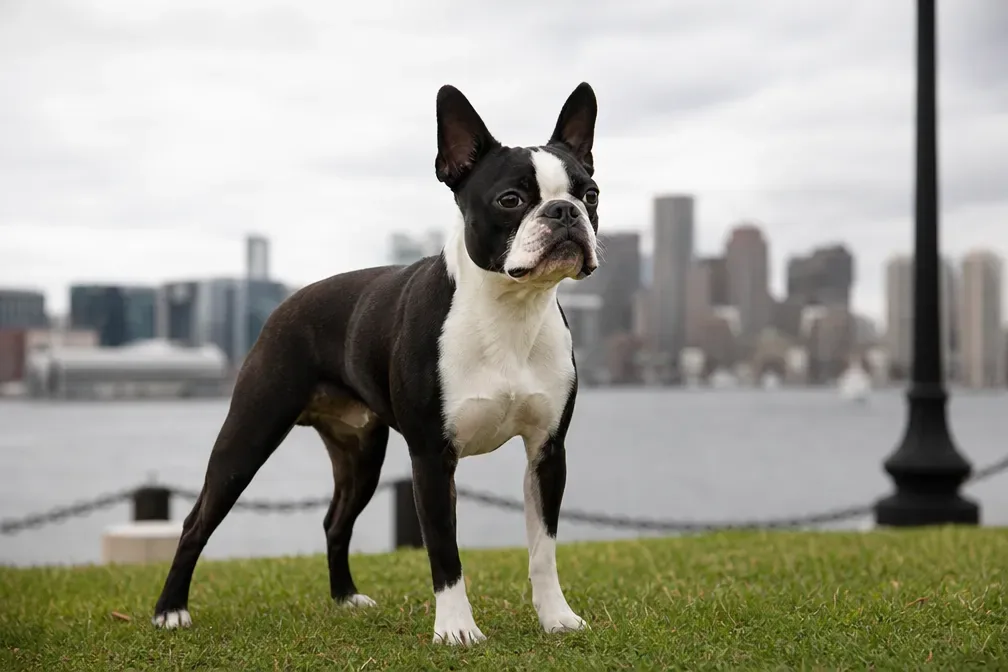
The early dogs were heavier, rougher, and bred for pit fighting, which was still legal in parts of New England. Within two decades, Boston breeders had done something unusual. They bred the fight out and the manners in. By 1893 the American Kennel Club recognized the breed, making it the first American breed the AKC admitted.
The size came down. The muzzle came in. The temperament went from scrappy to sociable. That last change is the reason the breed survived into pet homes at all.
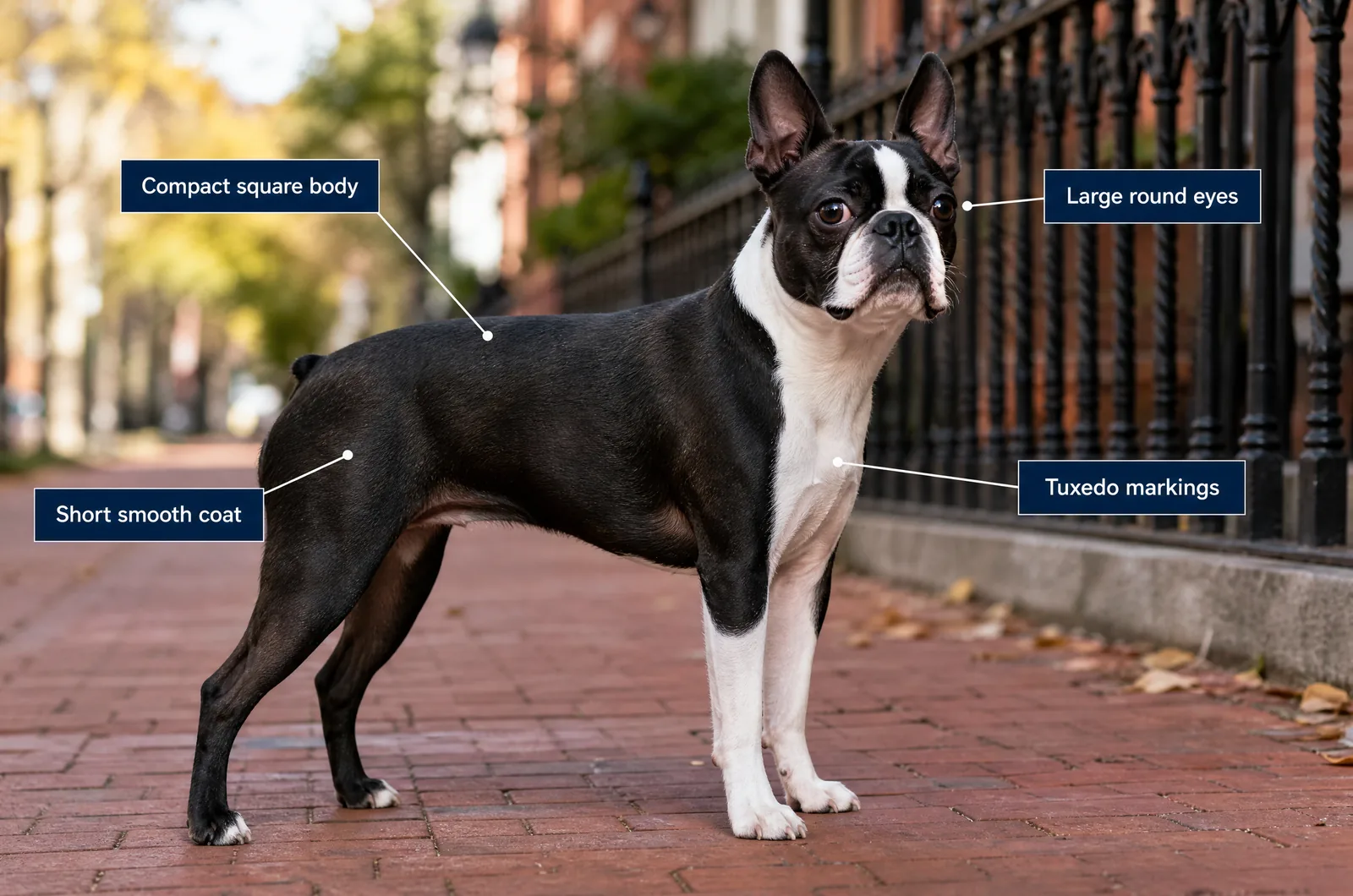
The nickname “American Gentleman” came from the coat and the conduct together: the tuxedo markings, plus a dog that was unusually polite for something with terrier in its name. Boston University adopted the breed as its mascot. Massachusetts named it the state dog in 1979.
One honest caveat about the history. The same selective breeding that produced the tidy, round-headed modern Boston also shortened the muzzle. The charm and the breathing problems come from the same decisions.
)
What Makes the Boston Terrier So Special (and So Cute)?
What makes the boston terrier special is the combination almost no other small breed manages: genuine sociability, apartment-sized energy, and a face that looks permanently mid-reaction. Owners describe shadow-level devotion. The dog follows you to the bathroom. The dog follows you to the bathroom every single time.
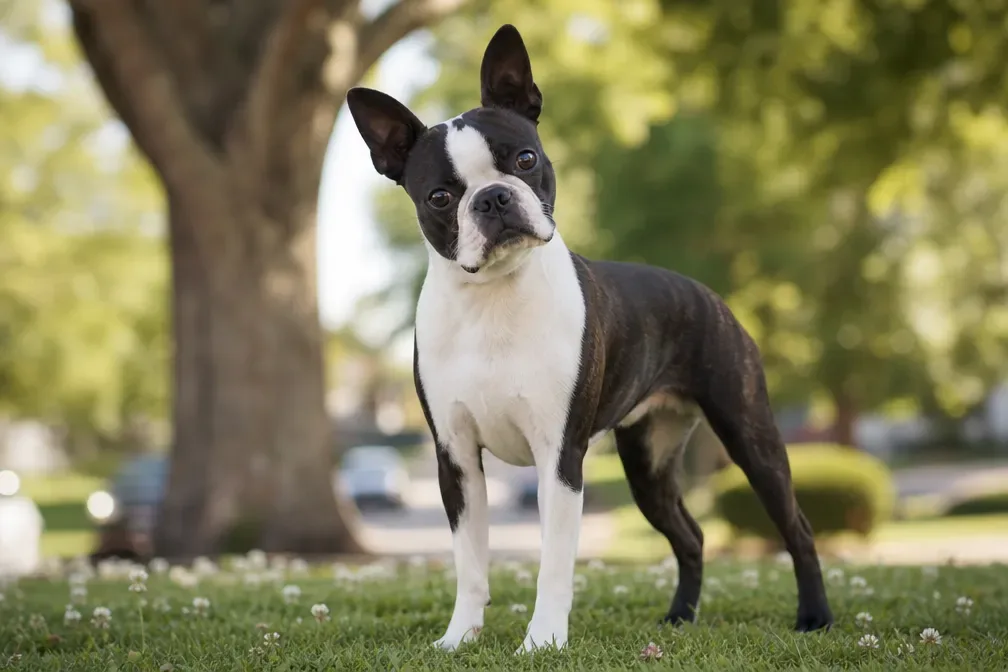
The visual appeal has a rough biological explanation. Large forward-facing eyes, a rounded skull and a shortened muzzle hit the same perceptual buttons as a human infant face, which is one reason flat-faced breeds keep gaining popularity despite their health costs. That is a well-documented pattern in brachycephalic breed research, not a judgment about anyone’s taste.
Then there is the personality, which is where owners get properly attached. The tuxedo coat is the joke everyone makes. The actual charm is behavioral:
- Expressive communication. Bostons use a wide range of grumbles, huffs and head tilts. If you want to read them better, our guide to understanding dog body language covers what those signals usually mean and where interpretation gets shaky.
- Comic timing. The breed does a specific thing where it sprints a lap of the apartment, stops dead, and stares at you. Owners call it the zoomie audit.
- Velcro affection. They want contact. Lap, ankle, armpit, whatever is available.
They also come in brindle and white, seal and white, and black and white, all with the required white chest and muzzle markings. The “rare blue Boston” being advertised for $4,000 is not a recognized color and often comes from breeders who are not testing anything.
Boston Terrier Size, Weight and Lifespan
A boston terrier stands 15 to 17 inches at the shoulder and weighs 12 to 25 pounds, with an average lifespan of 11 to 13 years. The AKC divides the breed into three weight classes rather than separating males and females by size, which is unusual.
| Group | Typical height | Typical weight | Typical lifespan |
|---|---|---|---|
| Boston Terrier (male) | 15 to 17 in | 15 to 25 lb | 11 to 13 years |
| Boston Terrier (female) | 15 to 17 in | 12 to 20 lb | 11 to 13 years |
| French Bulldog (comparison) | 11 to 13 in | 19 to 28 lb | 10 to 12 years |
| Pug (comparison) | 10 to 13 in | 14 to 18 lb | 12 to 15 years |
Males usually carry more chest and a blockier head. Females tend to run leaner and slightly shorter in body. The difference is modest, and temperament varies far more by individual and socialization than by sex.
The AKC weight classes are under 15 pounds, 15 to under 20 pounds, and 20 to 25 pounds. A Boston over 25 pounds is outside the standard, and in practice an overweight Boston is a breathing problem waiting to happen. Cambridge researchers found higher body condition score was one of the strongest risk factors for airway disease across brachycephalic breeds (University of Cambridge).
Two extra pounds on a 17-pound dog is not cosmetic. It is roughly 12% of body weight.
What Is the Boston Terrier Temperament Like?
Boston Terrier temperament is friendly, lively, people-focused and moderately stubborn. The AKC standard describes the breed as having an excellent disposition and high intelligence, and AKC behavior guidance characterizes well-socialized Bostons as open with strangers, eager to please and strongly bonded to family (AKC).
A breed standard describes the intended dog. Your dog is an individual, and genetics, early socialization and your household all push the result around.
Three traits owners consistently report:
Attachment that can tip into anxiety. Bostons are companion dogs, not independent ones. They want substantial human contact. If you work ten-hour days away from home, separation distress is a realistic outcome, not a worst case.
Intelligence with a side of negotiation. The breed learns fast and then tests whether the rule still applies. Reddit threads titled “why are Bostons so stubborn” exist for a reason. What looks like stubbornness is often a bored dog who has done the same sit fifteen times and found the arrangement unconvincing.
Demand behavior when under-stimulated. Barking at you, pawing, stealing a sock and parading it past the sofa. Mental work usually fixes this faster than more exercise.
Some Bostons show territorial barking at the door or resource guarding around food and toys. That is not a breed inevitability, it is a common dog behavior that responds to early management and trade-based training. If guarding escalates to growling or biting, get a certified behavior professional involved rather than confronting the dog.
Are Boston Terriers Good With Kids and Other Pets?
Boston Terriers are generally good with kids and other pets when socialized early, and they are sturdier than their size suggests. AKC guidance lists them as open with children and other dogs. The practical risk is not aggression. It is the eyes.
A toddler’s grabbing hand and a Boston’s prominent, shallow-set eye are a bad combination. Corneal injuries from a child’s fingernail, a cat’s claw, or an enthusiastic sibling dog are among the most common urgent-care reasons Boston owners show up at a vet clinic.
House rules that actually help:
- Teach children to pet the chest and shoulders, never the face.
- Supervise any play involving a cat. Cat claws and Boston eyes are a documented pairing.
- Give the dog an off-limits retreat spot, crate or bed, that children are not allowed to enter.
- Watch for stiffening, lip licking and whale eye during play. Those are early requests for space.
With other dogs, Bostons usually do well in size-matched play. Rough wrestling with a 70-pound adolescent Labrador is where the breathing and eye risks stack. If you are comparing options for a household with young children, our roundup of family-friendly dog breeds for kids covers trade-offs across temperaments.
Who Is the Boston Terrier Made For, and Who Should Skip It?
A boston terrier is made for apartment residents, retirees, remote workers and families who want a compact, affectionate dog with modest exercise needs. Skip the breed if you are gone all day, live in sustained heat without air conditioning, or want a trail or running partner.
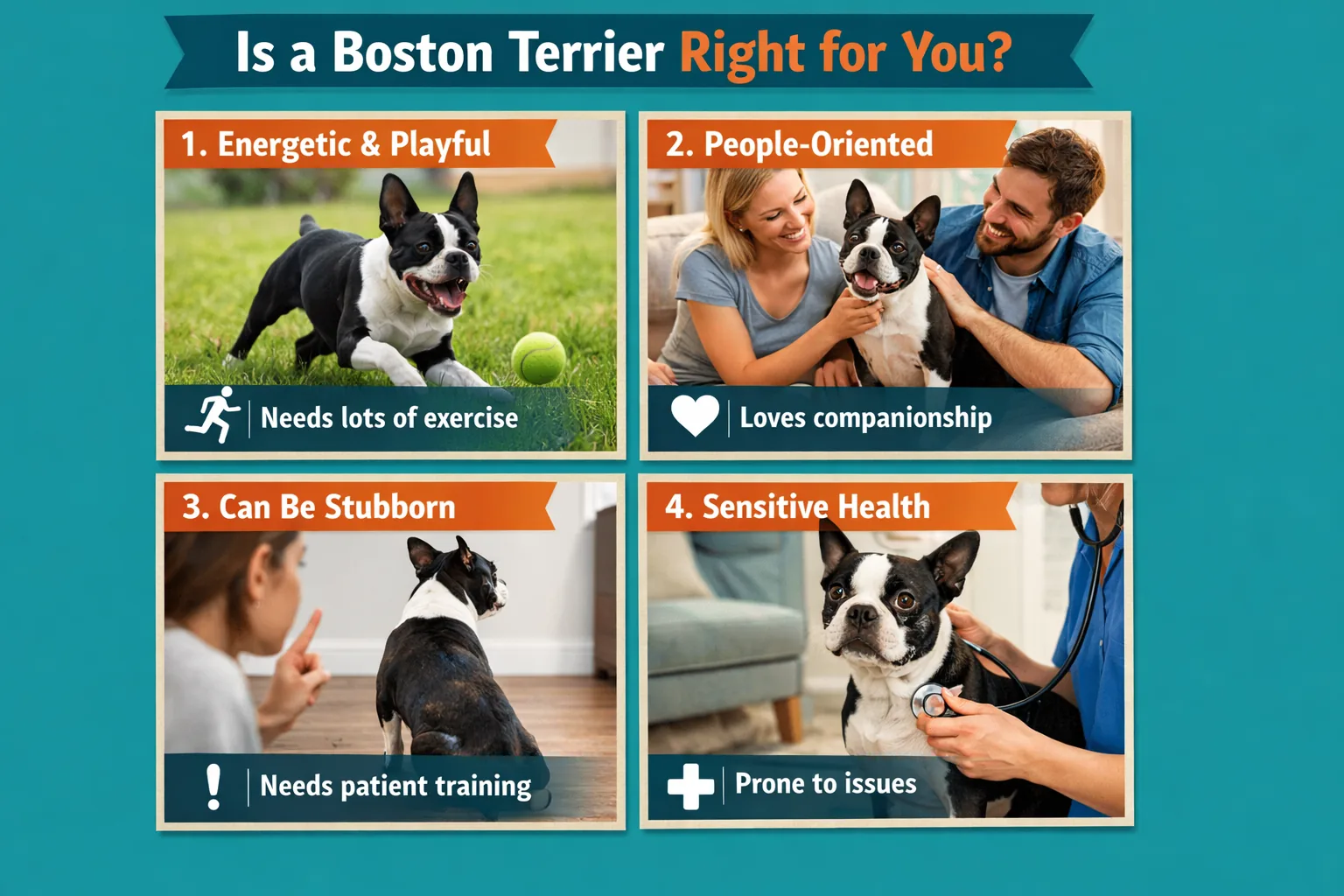
Choose a Boston Terrier if:
- You live in an apartment or small home. Low shedding, moderate noise, small footprint. They rank well on most apartment-friendly dog breed lists.
- Someone is home most of the day, or you can arrange midday company.
- You want a dog who participates in everything you do indoors.
- You can budget for possible airway or eye surgery.
Skip the Boston Terrier if:
- You want a jogging or hiking companion in summer. Their cooling system is compromised by design.
- You travel frequently by air. Many airlines restrict snub-nosed breeds in cargo.
- You need a quiet dog. Many Bostons are vocal communicators.
- Veterinary surprises would break your finances. BOAS surgery commonly runs into four figures.
A decision rule that holds up: if you cannot describe your plan for a hot July afternoon and a scratched eye at 9pm on a Sunday, you are not ready for this breed yet. Not a judgment. Just the two scenarios that catch new owners.
)
How Much Exercise Does a Boston Terrier Need?
Boston Terriers need roughly 45 to 60 minutes of activity per day, split into short sessions, with mental work carrying a meaningful share of it. They are energetic but not endurance dogs. Thirty minutes of hard running in July can be dangerous. Thirty minutes of sniffing, training and indoor play is usually ideal.
A workable daily structure:
- Morning walk, 15 to 20 minutes. Let them sniff. Sniffing tires dogs more than pace does.
- Midday training, 5 to 10 minutes. Two or three behaviors, high-value treats, stop before boredom.
- Evening play, 15 minutes. Flirt pole, tug, fetch down a hallway.
- Enrichment, 10 minutes. Snuffle mat, frozen stuffed toy, scatter feeding, a cardboard box with kibble inside.
AKC guidance notes that mental stimulation often works better than more strenuous exercise for this breed’s mischief and demand barking. That matches what most owners find. A bored Boston does not need a longer run, it needs a puzzle.
Heat rule, non-negotiable. Above roughly 75°F with humidity, move walks to early morning or after dark. Signs of overheating include loud raspy breathing, a bright red or purple tongue, excessive drooling, staggering or collapse. Heatstroke is a medical emergency. Cool the dog with room-temperature water and call a veterinarian immediately.
Boston Terriers also swim poorly. Dense front end, short muzzle, low buoyancy. A life jacket is not optional near pools.
Boston Terrier Grooming and Shedding
Boston Terrier grooming is genuinely easy: a weekly brush, monthly baths, nail trims every three to four weeks, and daily attention to the face folds and eyes. They shed lightly year-round, less than a Beagle, more than a Poodle. Short white hairs will still turn up on dark clothing.
The grooming routine that matters:
- Weekly rubber curry brush. Pulls dead coat, takes four minutes.
- Face and nose-roll cleaning, two to three times a week. Any wrinkle traps moisture. Wipe with a damp cloth, then dry fully.
- Eye check daily. You are looking for squinting, redness, discharge or pawing. More on that below.
- Nails every three to four weeks. Long nails change how a short-legged dog loads its front end.
- Ears weekly. Erect ears get good airflow, but Bostons still get yeast and bacterial infections, often tied to allergies. Head shaking, brown waxy discharge or a sour smell means a vet visit, not a home remedy.
- Teeth, most days. Shortened jaws mean crowded teeth. Dental disease is extremely common in this breed.
If you are new to any of this, our beginner’s guide to dog grooming walks through tools and technique.
Skin allergies are common in Bostons. Itching, red belly, recurring ear infections and paw licking often travel together. Chronic ear infections in this breed are usually a symptom of allergy, not a hygiene failure.
Common Boston Terrier Health Problems
Boston Terrier health problems cluster in four areas: breathing, eyes, joints and skin. The breed’s respiratory risk is now formally measured. In August 2026 the Royal Kennel Club recognized breathing assessment for Boston Terriers using the Kennel Club and University of Cambridge Respiratory Function Grading Scheme, with formal incorporation into the breed Health Standard scheduled for January 2027.
Brachycephalic Obstructive Airway Syndrome (BOAS). Narrowed nostrils, an elongated soft palate and a narrow windpipe make breathing work harder. The OFA grading scheme combines a physical exam with a three-minute brisk walk and assigns grades 0 to 3, where Grade 0 means no detectable signs and Grade III means severe disease (OFA). A February 2026 PLOS One study of 898 dogs across 14 brachycephalic breeds found nearly every breed had some detectable breathing abnormality (PMC).
Cambridge classes Bostons as moderate risk, with 38% of tested dogs scoring Grade 0 (University of Cambridge). The Boston Terrier Club of America’s 2024 National Specialty testing of 54 dogs found 42.6% Grade 0 and 35.2% Grade 1 (BTCA). Snoring, snorting and reverse sneezing are common. Loud laboured breathing at rest, blue-tinged gums or collapse is an emergency. Call a vet.
Eye problems. Prominent eyes in shallow sockets mean corneal ulcers, dry eye, cataracts, glaucoma and corneal dystrophy all appear in this breed. Squinting, held-shut eye, cloudiness or green discharge needs same-day veterinary care. An untreated ulcer can perforate. If your dog produces thick discharge and dull-looking eyes, read our guide to dry eye in dogs.
Patellar luxation and hemivertebrae. Skipping gait on a back leg suggests a slipping kneecap. The screw tail is a vertebral malformation, and some Bostons have malformed spinal vertebrae further up that can cause weakness or incoordination in the hind legs. Sudden back pain with weak or dragging back legs is an emergency.
Deafness. Linked to the white coat pattern. Reputable breeders BAER test.
What to ask a breeder for: OFA patella evaluation, CAER eye exam within the last year, BAER hearing test, and an RFGS respiratory grade. The Royal Kennel Club recommends assessing breeding dogs from 12 months of age and repeating every two years while in use for breeding.
)
What Do Boston Terriers Love to Eat? Favorite Foods and Feeding
Most Boston Terriers do best on 3/4 to 1.5 cups of quality dry food per day, split into two meals, adjusted to keep ribs easily felt. Weight control is the single highest-value health decision you make for this breed, because body condition is a named BOAS risk factor in the Cambridge research.
Feeding guidance by life stage:
| Stage | Meals per day | Rough daily amount |
|---|---|---|
| Puppy, 8 to 16 weeks | 3 to 4 | Per bag chart, adjusted weekly |
| Puppy, 4 to 12 months | 3 | 1 to 1.5 cups |
| Adult, 1 to 7 years | 2 | 0.75 to 1.25 cups |
| Senior, 8+ years | 2 | Reduce 10 to 20%, watch weight |
Amounts vary by food calorie density. Check the label, then check the dog. Our guide to reading a dog food label and what AAFCO means explains what the numbers on the bag actually mean.
Treats Bostons tend to love: plain cooked chicken breast, small cubes of low-fat cheese, carrot coins, green beans, blueberries, plain pumpkin puree, and freeze-dried single-ingredient meat. Training treats should be pea-sized. For a 17-pound dog, five training treats can be a meaningful chunk of daily calories.
Foods to avoid entirely: grapes and raisins, xylitol, chocolate, onions, garlic, macadamia nuts, alcohol, cooked bones, and anything high-fat like bacon grease. Boston Terriers are also notoriously gassy, and rich fatty food makes it worse.
Many Bostons have food sensitivities that show up as itchy skin and ear infections rather than digestive upset. If that pattern appears, talk to your vet about a proper elimination diet rather than switching brands repeatedly. Any food change should be gradual: our walkthrough on switching dog food without stomach upset covers the 7 to 10 day transition.
A slow-feeder bowl is genuinely useful here. Flat-faced dogs gulp air while eating, and gulped air comes out somewhere.
How to Train a Boston Terrier
Train a boston terrier with short reward-based sessions, high-value food and frequent variation, because this breed gets bored before it gets obedient. The AKC notes that their sensitivity and sociability make reward-based methods particularly appropriate. Harsh correction tends to produce a shut-down dog rather than a trained one.
What owners call stubbornness is usually one of three things: the reward is not worth the effort, the session is too long, or the dog does not understand the cue in that environment.
A session format that works:
- Pick two behaviors.
- Run 90 seconds to 3 minutes maximum.
- Use food your dog rarely gets. Chicken beats kibble.
- End while the dog still wants more.
- Repeat three to five times a day.
Priority behaviors for this breed:
- Settle on a mat. Gives a wound-up Boston an off switch.
- Leave it. Directly protects the eyes from things on the ground and the face from other dogs.
- Recall. Build it indoors first, then a long line outdoors.
- Alone-time training. Start at 30 seconds behind a closed door, build gradually. Do not jump from five minutes to four hours.
- Handling tolerance. Practice touching the face, ears and around the eyes with treats, so vet exams and eye drops are not a wrestling match.
Housetraining can run slow. Bostons have small bladders and real opinions about rain. Take them out every two hours as puppies, reward outdoors immediately, and clean indoor accidents with an enzymatic cleaner.
If your Boston barks at the door or guards toys, work on trading and management first. Escalating confrontations with a sensitive dog usually goes badly.
Try It: Boston Terrier Eye Alert Checker
Boston Terriers have large, exposed eyes that injure easily, and a corneal ulcer can go from a scratch to a vision-threatening problem within a day or two. Describe what you are seeing and this checker will tell you how urgent it looks and what to do next.
Doggy Rank IQ Tool
Boston Terrier Eye Alert Checker

Boston Terriers have big, prominent eyes that injure easily, and corneal ulcers can worsen fast. Describe what you see to know how urgent it is.
How Much Does a Boston Terrier Cost?
A boston terrier puppy from a health-testing breeder typically costs $1,200 to $3,000, with first-year total ownership commonly landing between $2,500 and $3,500 and annual costs after that around $1,200 to $2,000. Rescue and rehome options usually run $200 to $500.
What drives the puppy price up or down:
- Breeders doing OFA patella, CAER eye, BAER hearing and RFGS respiratory testing charge more, and are worth it.
- “Rare” colors (blue, lilac, merle) are marketing, not breed standard, and often come from untested lines.
- Show-prospect pedigrees carry a premium you do not need as a pet owner.
First-year budget, rough:
| Item | Typical range |
|---|---|
| Puppy | $1,200 to $3,000 |
| Vaccines, vet visits, microchip | $300 to $600 |
| Spay or neuter | $300 to $800 |
| Crate, bed, harness, bowls, toys | $250 to $450 |
| Food, year one | $350 to $600 |
| Training class | $150 to $350 |
Then there is the brachycephalic asterisk. BOAS corrective surgery often runs $1,500 to $5,000 depending on region and what needs doing. Corneal ulcer treatment can be a few hundred dollars for a simple case, considerably more if it requires a graft. Pet insurance taken out before any symptoms appear is a reasonable choice for this breed specifically, because pre-existing exclusions bite hard once a breathing or eye issue is on record.
Rehoming a Boston Terrier through breed-specific rescue is a real option, and adult dogs come with known temperaments. If you are still comparing breeds, our breed matchmaker section helps narrow by household needs.
Boston Terrier Puppy Tips for the First 90 Days
The first 90 days with a boston terrier puppy should focus on four things: a vet baseline, alone-time practice, eye-safety habits and broad socialization before 16 weeks. Everything else can wait.
Days 1 to 14. Vet visit within 72 hours. Ask for a baseline eye exam and a note on nostril openness. Set up the crate in a room where people are. Start potty trips every two hours and after every nap. Expect noise at night and keep the crate in your bedroom at first. If the crying is persistent, our guide on a puppy crying in the crate at night has gentle fixes.
Days 15 to 45. Socialization window closes around 16 weeks, so use it. Aim for new surfaces, sounds, people and calm adult dogs weekly, always paired with food and always at the puppy’s pace. Start alone-time practice now, 30 seconds to 2 minutes behind a door, before separation distress has a chance to form. Begin handling drills around the eyes and ears.
Days 46 to 90. Add a controlled puppy class. Introduce a flat-faced-safe harness with a front clip (never a neck-only collar for walks, it pushes directly on a compromised airway). Teach “leave it” properly. Start brushing teeth.
The heat rule starts immediately. Puppies overheat faster than adults. No midday summer walks, no car left running “just a minute,” no dog park on an 85°F afternoon.
Common first-90-day mistakes:
- Free-feeding, which sets up lifelong weight problems in a breed where weight is a named airway risk.
- Letting the puppy play rough with much bigger dogs.
- Skipping alone-time practice because the puppy is adorable and you are home anyway.
- Using a neck collar for leash pressure.
What Boston Terrier Owners Say
Owner reports line up well with the breed research: enormous affection, real health worry, and a training style that needs adjusting. Here are three, quoted exactly.
“Their personalities, loyalty, and goofy charm make life so much brighter.”
That comes from an owner on Reddit in a thread about whether the breed has a lot of health problems. The honest reading is that both things are true at once. Protect the affection by budgeting for the health side: insure early, keep the dog lean, and know your nearest emergency vet before you need it.
“Why are Bostons so stubborn?”
Asked by an owner on Reddit. Practical answer: shorten the session to under three minutes, raise the treat value from kibble to chicken, and change location often so the dog generalizes the cue. Most Bostons labelled stubborn are being asked to repeat something they already find pointless.
“Are Boston Terriers just naughty?”
From an owner on Reddit. Naughty in this breed usually reads as under-stimulated. Add a snuffle mat at breakfast, a frozen stuffed toy mid-afternoon, and two short training bursts. Also do a boredom audit before blaming the dog: a Boston alone for eight hours with one rope toy is behaving exactly as predicted.
One pattern worth flagging. Owners posting about biting and territorial behavior often describe a dog who was confronted during guarding. If that is your situation, stop the confrontation and bring in a certified behavior consultant. That is not a training-video problem.
)
Boston Terrier FAQ
How long do Boston Terriers live on average? Most Boston Terriers live 11 to 13 years. Lean body condition, dental care and managed airway health are the factors owners can actually influence.
Why does my Boston Terrier snore and make snorting noises? Shortened facial anatomy narrows the airway. Snoring and reverse sneezing are common. Loud raspy breathing at rest, blue or grey gums, or collapse is an emergency. Call a vet immediately.
Boston Terrier vs French Bulldog, which is better? Boston Terriers are taller, lighter, more athletic and typically slightly lower in BOAS risk. Frenchies are heavier, more stoic and usually calmer indoors. Choose a Boston for an active, vocal companion, a Frenchie for a lower-energy lap dog.
Are Boston Terriers good for apartment living? Yes, among the better small breeds for it. Low shedding, modest exercise needs and a compact size. The caveat is barking, which can be managed with enrichment and training.
Can Boston Terriers handle hot weather? Poorly. Above roughly 75°F with humidity, limit activity to early morning and night, keep water available and use air conditioning. Heatstroke is a genuine risk in this breed.
Are Boston Terriers easy to train or stubborn? Both. They learn quickly and lose interest quickly. Sessions under three minutes with high-value food work far better than long drills or correction-based methods.
Do Boston Terriers shed a lot? No. Light year-round shedding of short white and dark hairs. A weekly rubber curry brush handles most of it. They are not hypoallergenic.
What dog breeds are similar to Boston Terriers? French Bulldog, Pug, Miniature Schnauzer, Rat Terrier and Italian Greyhound. The Rat Terrier and Mini Schnauzer offer similar size and personality without the flat face.