

Quick Answer
Belka and Strelka were two stray dogs from Moscow who became the first animals to orbit Earth and return alive, launching aboard Sputnik 5 on August 19, 1960, and landing safely the next day. Their flight proved a living creature could survive orbital spaceflight and come home, a result that shaped the planning for Yuri Gagarin’s 1961 mission. Belka and Strelka are not alive today (dogs do not live 65 years), but their preserved bodies remain on public display in Moscow, and one of Strelka’s puppies ended up living at the White House.
Key Takeaways: belka and strelka
- Belka and Strelka launched August 19, 1960, aboard Korabl-Sputnik 2 (Sputnik 5) and orbited Earth 17 times in about a day (en.wikipedia.org).
- They were the first animals to complete an orbital spaceflight and return alive, a milestone NASA credits as paving the way for human orbital missions (bbc.com).
- Belka showed signs of distress during the fourth orbit, information that fed into the decision to keep Gagarin’s first flight to a single orbit (bbc.com).
- The mission also carried a rabbit, mice, rats, insects, and plants, since Soviet engineers were testing life support systems broadly, not just on dogs (en.wikipedia.org).
- Strelka later had six puppies; one named Pushinka was gifted to the Kennedy family in 1961 and had puppies of her own with the Kennedys’ dog Charlie (smithsonianmag.com).
- Three weeks before this flight, two other dogs named Chaika and Lisichka died when their rocket failed, a loss rarely mentioned alongside the celebrated success (bbc.com).
- Belka and Strelka lived out normal lifespans after their flight and are now preserved and displayed at a museum in Moscow (smithsonianmag.com).
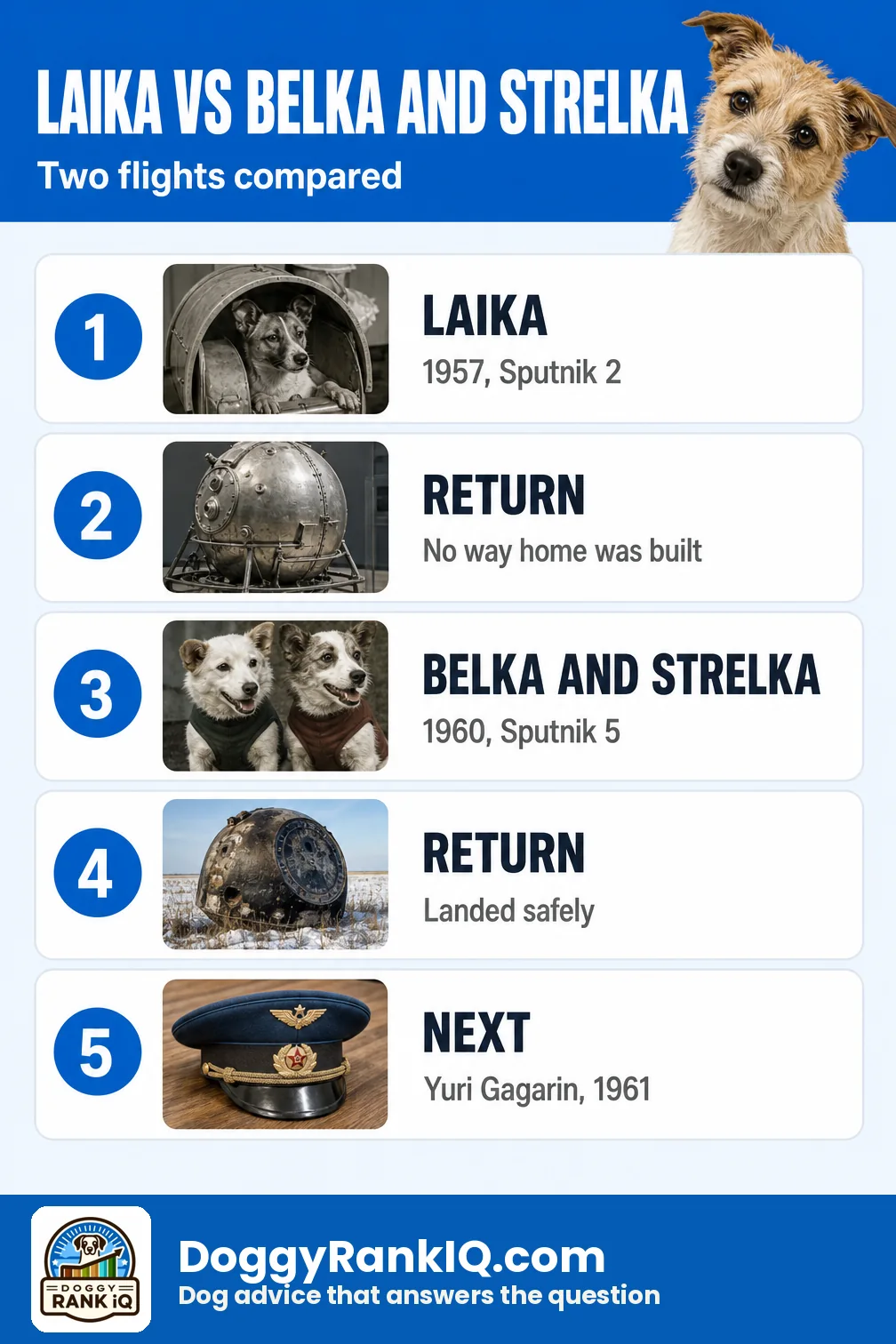
- Unlike Laika, who died during her 1957 mission, Belka and Strelka represent the version of the story with a landing.

What do you want to know?
Tap an option to see the answer.
The short answer: who Belka and Strelka were
Belka and Strelka were small stray mixed-breed dogs picked up off the streets of Moscow and trained for the Soviet space program’s animal flight tests. Soviet scientists preferred strays because they assumed an animal that had already survived cold, hunger, and crowded city life would handle the stress of spaceflight better than a pampered pet.
Belka’s name is often translated as “Squirrel” or “Whitey,” and Strelka’s name means “Little Arrow.” Both were females, both were small enough to fit the compact pressurized cabin, and both went through weeks of training that included centrifuge spins, loud noise exposure, and confinement in increasingly small capsules.
They were not the first dogs the Soviets sent up. Laika had already flown in 1957, but that mission was never designed for recovery. The two dogs’s flight was different from the start: this one needed a dog that could survive, and come back down in one piece.
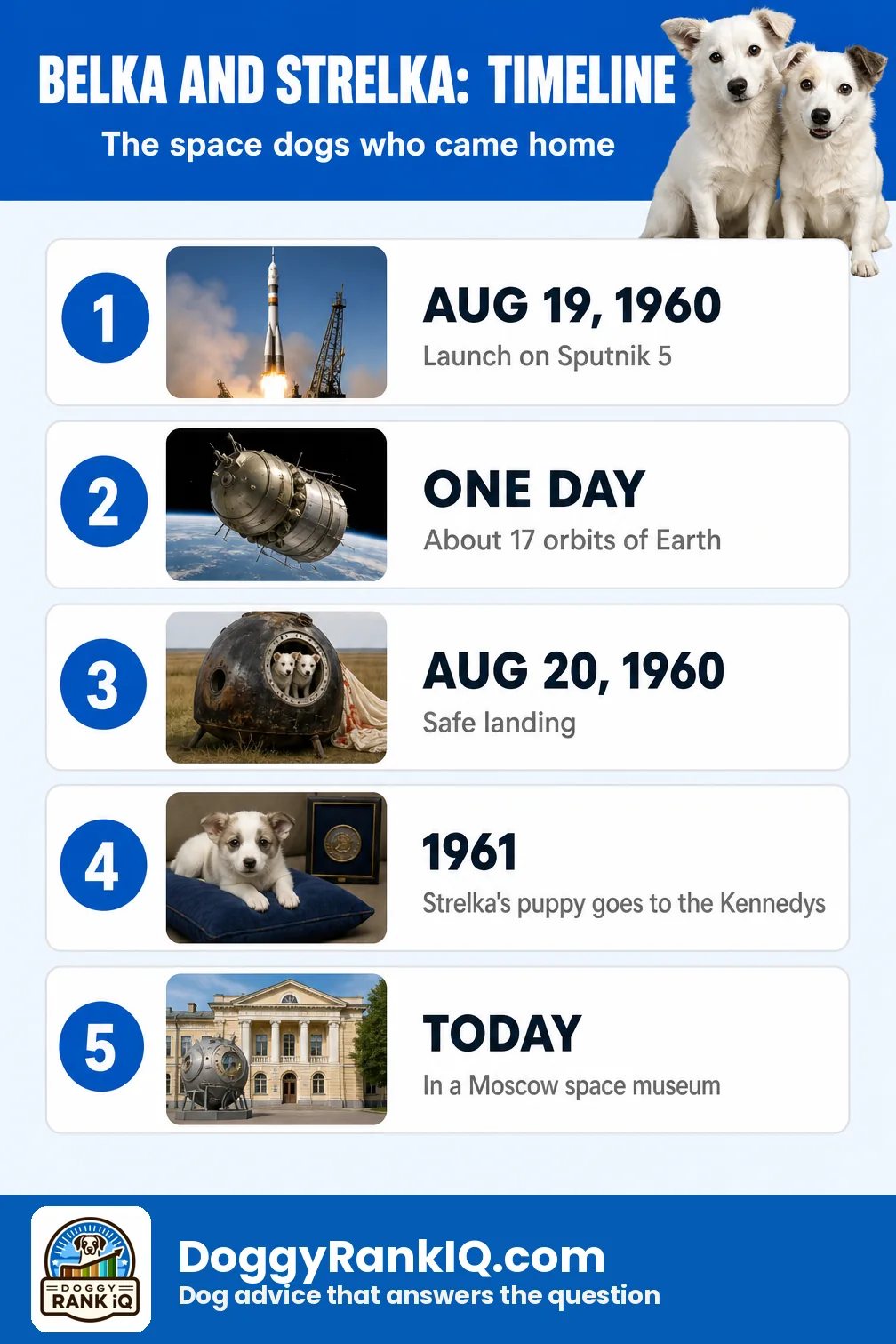
Timeline table: the flight in dates
Two strays chosen for space
Soviet space medicine teams selected dogs rather than primates partly because dogs were calmer to train and easier to monitor with the harnesses and sensors available at the time. The two dogs were chosen from a pool of stray females, screened for temperament, size, and physical condition.
Training was not gentle by modern standards. The dogs were confined in progressively smaller boxes for days at a stretch, exposed to the vibration and noise of rocket engines, and spun in centrifuges to simulate launch g-forces. Some owners researching this history for the first time are surprised at how much preparation went into a flight that lasted barely a day. It took months.
The Soviet program also used biomedical monitoring that was advanced for its time: sensors tracked heart rate, breathing, and blood pressure, and an onboard television camera actually filmed the dogs in flight, which is how researchers know what happened during the fourth orbit. That camera turned out to matter more than anyone expected.
The flight of Sputnik 5: one day in orbit
Sputnik 5, known in the Soviet Union as Korabl-Sputnik 2, launched from Baikonur Cosmodrome on August 19, 1960, carrying Belka, Strelka, a gray rabbit, 42 mice, two rats, flies, and several plant specimens into a low-Earth orbit of roughly 306 by 340 kilometers (en.wikipedia.org). The flight was built to test more than the dogs; it was a full rehearsal of the life support, environmental control, and recovery systems the Soviets intended to use for a human flight.
The mission carried far more biology than any prior flight. Engineers wanted data on how multiple organisms, not just one dog, responded to the radiation, weightlessness, and reentry forces of an orbital trip. This made Sputnik 5 something closer to a flying laboratory than a single-animal test.
During the fourth orbit, onboard footage showed Belka becoming agitated, barking, and vomiting (bbc.com). Strelka appeared to fare better and remained calmer through the flight. This single data point, a dog getting sick partway through an orbital mission, became one of the more consequential details in the whole program.
Choose this detail if you’re explaining the Gagarin connection: Belka’s distress during orbit four is the direct thread historians point to when explaining why Gagarin’s first crewed flight was limited to a single orbit rather than a longer mission (bbc.com). The reasoning was not fully explained in public Soviet records at the time, so the exact weight given to this single incident is debated among historians, but the sequence of events is well documented.
The space dogs who came home: the landing and what it proved
The two dogs’s capsule reentered the atmosphere and landed on August 20, 1960, after roughly 17 orbits, with both dogs recovered alive and in reasonably good condition (en.wikipedia.org). NASA’s own historical account identifies this as the first successful recovery of living organisms following an orbital spaceflight (bbc.com).
That distinction matters. Earlier flights, including Laika’s, had sent animals into orbit, but none had brought a living passenger back down from a full orbital trajectory. The difference between “survived launch” and “survived launch, orbit, and landing” is the entire point of the mission, and it is the reason The two dogs are remembered specifically as the dogs who came home.
What the flight actually proved, in plain terms:
- A mammal could survive multiple orbits of weightlessness without lasting physical damage.
- The capsule’s reentry and parachute recovery systems worked as designed.
- The onboard life support (oxygen, temperature, food delivery) held up for roughly a day in space.
- Behavioral and physiological monitoring equipment could capture usable data mid-flight.
A common mistake readers make is assuming this flight guaranteed Gagarin’s success eight months later. It reduced the uncertainty considerably, but Soviet engineers still treated his flight as a first attempt with real risk, which is part of why it was kept short.
Pushinka: the puppy who went to the White House
Strelka’s story did not end with the landing. Back on Earth, she had six puppies, and one of them, Pushinka (“Fluffy” in Russian), became a small but memorable piece of Cold War history (smithsonianmag.com). Soviet premier Nikita Khrushchev gave Pushinka to President John F. Kennedy’s family in 1961, a gesture aimed at softening the public mood between the two superpowers during a tense stretch of the Cold War.
Pushinka lived at the White House and later had puppies with Charlie, the Kennedy family’s own Welsh Terrier. Caroline Kennedy reportedly called the mixed litter “pupniks,” a nod to their unusual parentage (smithsonianmag.com). It’s a strange and genuinely charming detail: a dog born from a Soviet space mission ended up raising a family on the White House lawn.
Readers who enjoy this kind of crossover between animal behavior and human history might also like our explainer on how dogs show affection, since Pushinka’s White House years are well documented in family photos and letters that capture ordinary canine behavior playing out in an extraordinary setting.
What happened to Belka and Strelka afterward?
Neither dog flew in space again. After recovery, The two dogs became minor celebrities in the Soviet Union, appearing at public events and in press photographs as symbols of the country’s technological reach (smithsonianmag.com). They lived out the rest of their lives at the research institute that had trained them.
When they eventually died of natural causes, their bodies were preserved and are now displayed at the Memorial Museum of Cosmonautics in Moscow, where visitors can still see them today (smithsonianmag.com, mos.ru). This is a detail worth being precise about: The two dogs are not alive in 2026, and no dog from 1960 would be. What persists is the preserved specimens and the story, not the animals themselves.
It’s also worth remembering what almost happened instead. Three weeks before The two dogs’s flight, two other dogs, Chaika and Lisichka, died when their rocket failed shortly after launch on July 28, 1960 (bbc.com). Their deaths rarely make it into popular retellings of the space dog story, but they’re part of the same program and the same risk calculation that made The two dogs’s safe return feel so significant at the time.
Facts table: Laika vs Belka and Strelka
For more on Laika’s specific mission and why no recovery was ever planned for her, see our deeper look at the Laika story and what Sputnik 2 hid for 45 years.
Belka and Strelka name meaning
Belka’s name translates roughly to “Squirrel” or sometimes “Whitey,” likely a reference to her light coloring, while Strelka’s name means “Little Arrow,” possibly describing a marking or her quick movements. Soviet space dogs were routinely given simple, descriptive Russian names rather than formal titles, which made them easier for the public to remember and relate to.
This naming style mattered for propaganda purposes. A dog named “Little Arrow” is a far easier figure to put on a stamp or a children’s book cover than a dog identified only by a test subject number. The names humanized the mission in a way that mattered both inside the Soviet Union and internationally.
🚀 The dogs who flew after them, right up to Gagarin
The two dogs proved a living passenger could orbit and come home. The engineers still needed the spacecraft to do it more than once.
The next attempt, in December 1960, carried two dogs named Pchyolka and Mushka. They reached orbit and spent a day there. On the way down the capsule came in on the wrong path and was destroyed, and both dogs died. A second December launch failed on the way up. Its two dogs survived an emergency landing in Siberia and were recovered days later in deep cold.
Two clean flights followed in March 1961. Chernushka flew a single orbit on March 9 and landed safely. Zvezdochka did the same on March 25. Each shared the cabin with a life-size mannequin in a spacesuit that the technicians had nicknamed Ivan Ivanovich, strapped into the seat a cosmonaut would use. Those two flights were full dress rehearsals: one orbit, one landing, one dog walking out healthy.
“Eighteen days after Zvezdochka’s flight, the seat held Yuri Gagarin.”
Seen in order, the flight of The two dogs sits in the middle of a hard run. Dogs died before them and after them. Their mission is the famous one because it was the first to go right, and because it showed the people planning a human flight that the odds could be moved.
⭐ Top 5 Features We Love
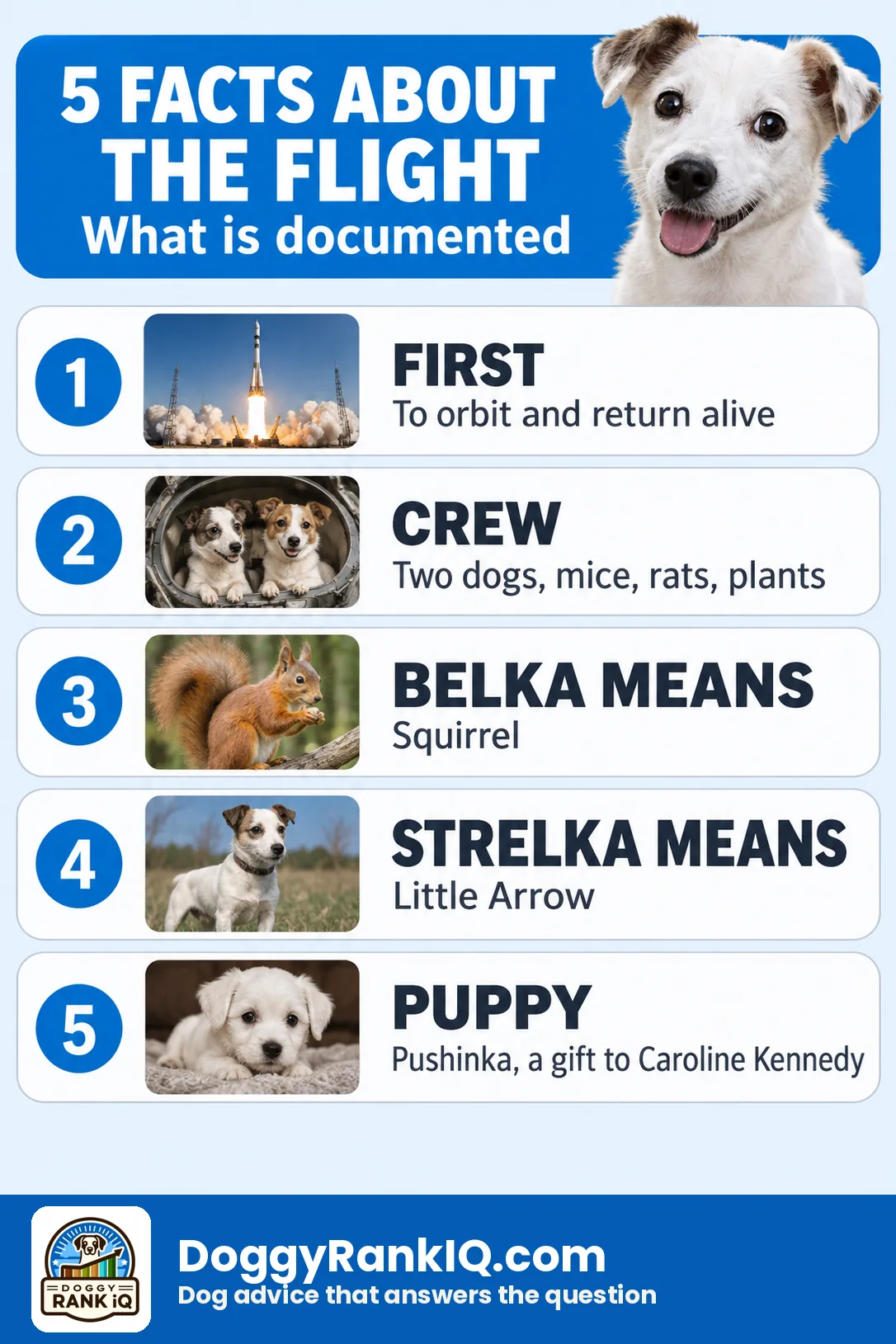
- A documented happy ending. Unlike many animal spaceflight stories of the era, this one has verified, government-documented survival and recovery (en.wikipedia.org).
- A real scientific payoff. Belka’s in-flight distress directly informed the planning around Gagarin’s historic flight (bbc.com).
- An unexpected Cold War footnote. Strelka’s puppy Pushinka ended up living at the White House, connecting a Soviet space mission to American political history (smithsonianmag.com).
- A museum you can actually visit. Both dogs are preserved and on display at the Memorial Museum of Cosmonautics in Moscow, not just described in old records (smithsonianmag.com, mos.ru).
- A full biological experiment, not just two dogs. The flight carried mice, a rabbit, rats, and plants, giving researchers a broader data set than a single-animal test could (en.wikipedia.org).
⚠️ Things to Look Out For
- The myth that all Soviet space dogs survived. Chaika and Lisichka died three weeks before The two dogs’s flight when their rocket failed (bbc.com). Not every mission ended well.
- Confusing Laika’s mission with The two dogs’s. Laika died in orbit in 1957; The two dogs survived a different mission in 1960 (en.wikipedia.org). These are frequently mixed up in casual retellings.
- Overstating the Gagarin connection. Belka’s distress contributed to flight planning decisions, but historians note the exact decision-making chain behind limiting Gagarin to one orbit is not fully documented in public records (bbc.com).
- Assuming the dogs are still alive somewhere. They are not. What remains are preserved specimens in a museum, not living animals (smithsonianmag.com).
- Skipping the other animals on board. The flight also carried a rabbit, mice, rats, flies, and plants, a detail that often gets dropped from shorter retellings (en.wikipedia.org).
Space dog books
For readers who want the deeper history beyond a single article, a few books cover this material in detail. Dogs in Space (check the current price) walks through the full program of Soviet animal flights, including The two dogs’s mission, priced at $14.35 (price checked 2026).
Laika’s Window: The Legacy of a Soviet Space Dog (check the current price) focuses on Laika specifically but gives useful context for comparing her mission to The two dogs’s, priced at $16.39 (price checked 2026).
For general dog breed and behavior background unrelated to spaceflight, The Dog Encyclopedia (DK) (check the current price) is a reasonable reference to keep around, priced at $13.29 (price checked 2026). These are informational picks, not a ranked comparison; choose based on whether you want the space history angle or general dog reference material.
FAQ
The bottom line
The two dogs earned their place in history by doing something Laika never got the chance to do: coming back. Their flight on Sputnik 5 proved a living animal could survive orbit and reentry, data that fed directly into the planning behind Gagarin’s 1961 mission (bbc.com). The story also carries a quieter thread worth remembering, the dogs who didn’t make it, like Chaika and Lisichka, and the unlikely family tree that connected a Soviet lab to the Kennedy White House through a puppy named Pushinka.
If this kind of animal history interests you, it’s worth pairing with how much we still don’t fully understand about dog cognition and behavior today. Our guide on how smart dogs actually are and our piece on when dogs were domesticated both offer a useful next stop for readers who started here looking for space history and ended up curious about the dog on their own couch.
Doggy Rank IQ is reader supported. As an Amazon Associate we earn from qualifying purchases, at no extra cost to you.