

Quick Answer
The laika dog story is about a small stray from Moscow who became the first living creature to orbit Earth aboard Sputnik 2 on November 3, 1957. Soviet officials announced she survived for days and died painlessly. The real cause, overheating and extreme stress within about five to seven hours of launch, was not confirmed publicly until October 2002, when scientist Dimitri Malashenkov presented the mission’s telemetry data at the World Space Congress in Houston. That gap, roughly 45 years, is the “hidden truth” in this laika dog story.
Key Takeaways: laika dog
- The laika dog was a female stray from Moscow, originally called Kudryavka, meaning “Little Curly” (smithsonianmag.com).
- Sputnik 2 launched her into orbit on November 3, 1957, making her the first animal to orbit Earth (nasa.gov).
- The spacecraft had no heat shield, no parachute, and no way to bring her home. The mission was one-way from the start (nasa.gov).
- Soviet statements in 1957 claimed she lived for days and died without pain. That was not accurate (britannica.com).
- In October 2002, scientist Dimitri Malashenkov reported she died from overheating and stress about five to seven hours after launch (britannica.com).
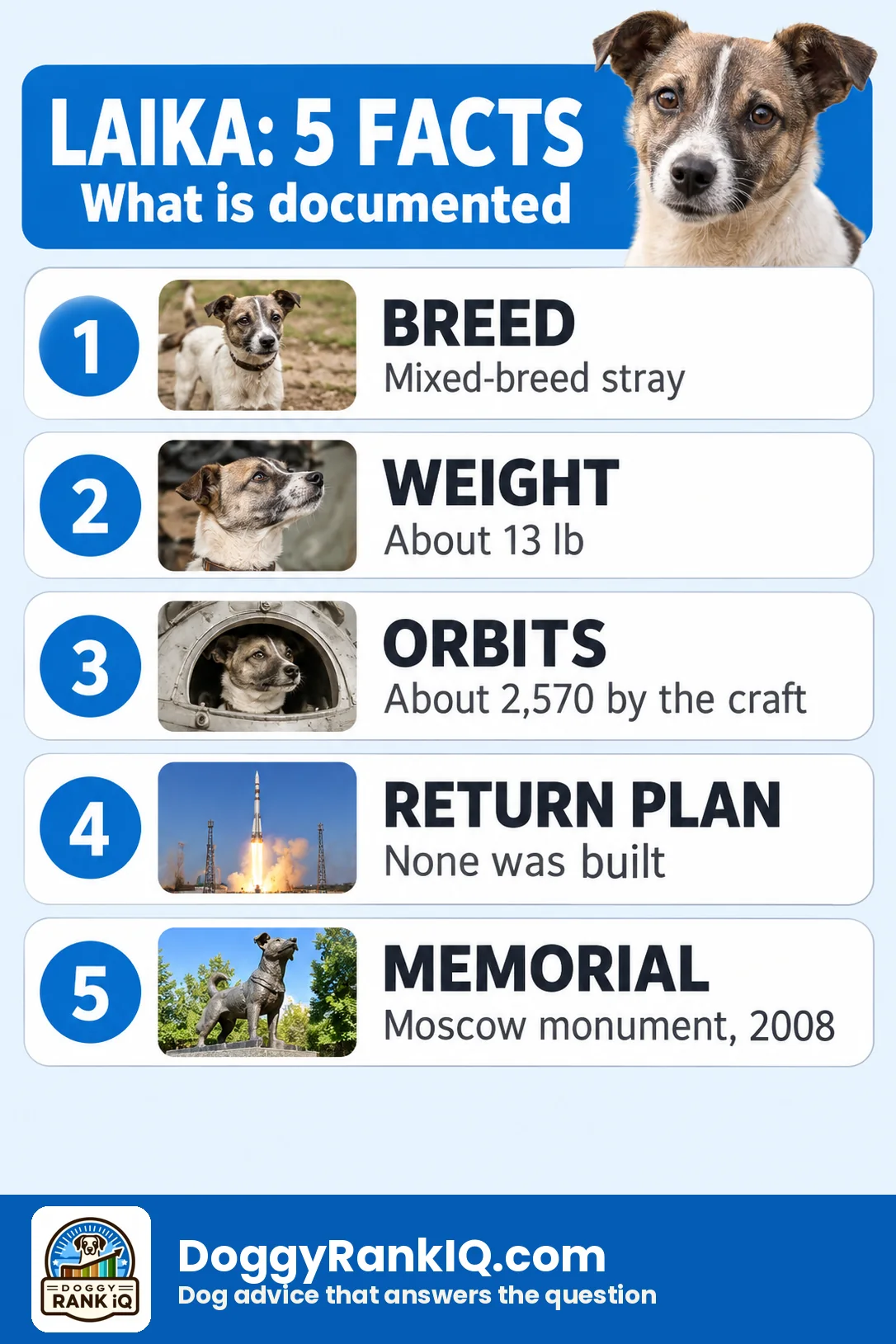
- Sputnik 2 orbited Earth roughly 2,570 times before burning up on re-entry April 14, 1958. Her remains were never recovered.
- Trainer Oleg Gazenko later said publicly that he regretted the mission.
- Belka and Strelka, two Soviet space dogs who flew in 1960, became the first dogs to survive orbital flight and return alive.
- A monument to Laika stands in Moscow, unveiled in 2008 near the military research facility that prepared her for flight.

What do you want to know?
Tap an option to see the answer.
The short answer: the Laika dog story
Laika did not come home. That is the entire plot, and everything else is detail.
She launched aboard Sputnik 2 in November 1957 as part of the early Soviet space program, and she reached orbit alive. The engineers building the capsule knew, before launch, that there was no way to bring her back (nasa.gov). For 45 years the public version softened that fact. The 2002 disclosure did not change what happened to Laika. It changed what people were allowed to know about it.
This matters for anyone researching the laika dog story today, in 2026, because the gap between the announced version and the documented version is itself part of the history. Soviet space officials had a political incentive to make the mission sound heroic and humane. The later data told a different, harder story (britannica.com).
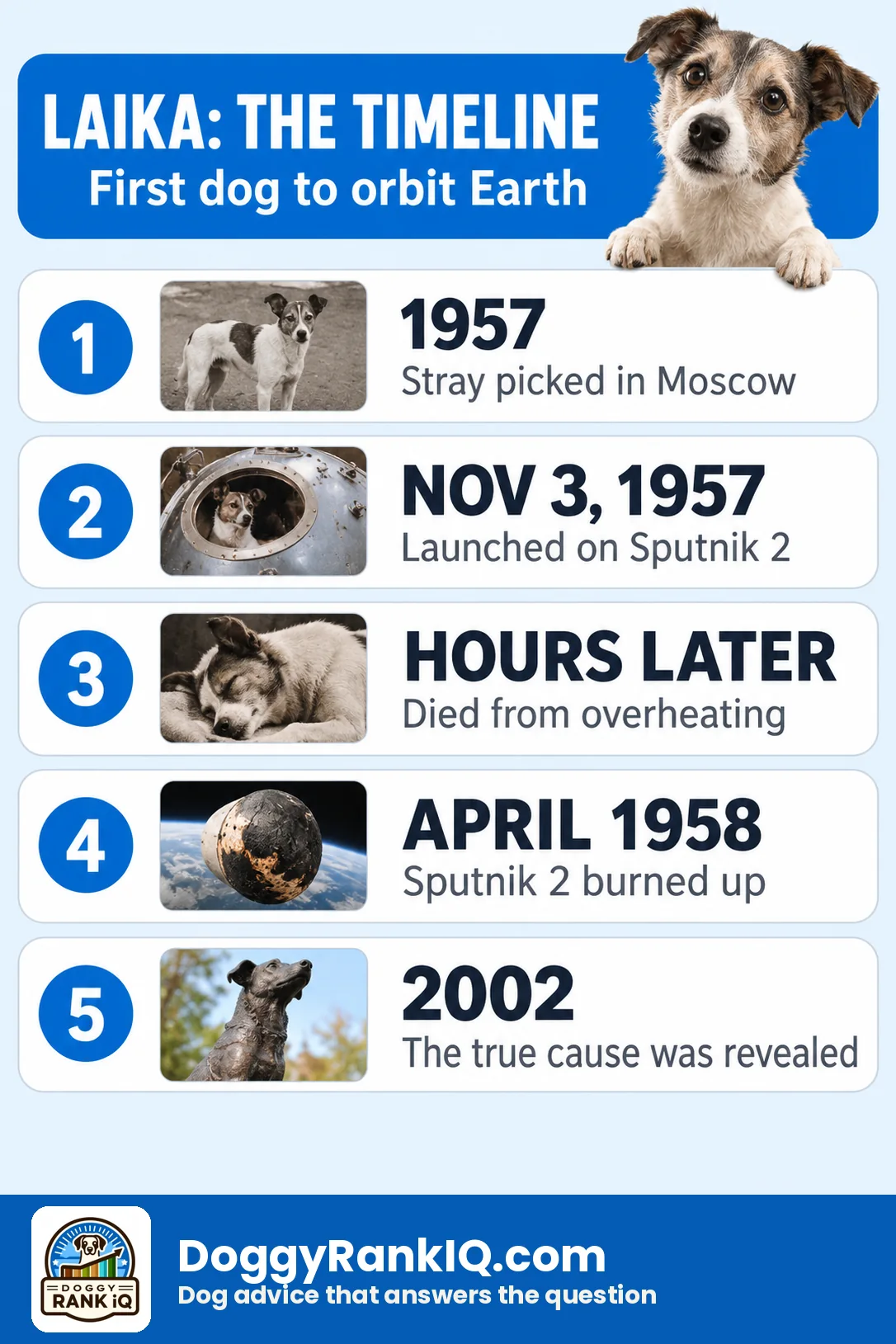
Timeline table: Laika and Sputnik 2 in dates
Who Laika was: laika dog breed and how she was chosen
Laika was not a purebred of any kind. She was a mixed-breed stray picked off the streets of Moscow, and the laika dog breed question comes up often enough that it deserves a direct answer: there is no official “Laika breed” connected to her. The name Laika is a common Russian word for several barking hunting dog breeds, and it became attached to her almost by coincidence.
Soviet researchers favored street dogs for the biomedical space program because they assumed strays had already survived cold, hunger, and chaos, and would tolerate confinement better than a pampered household dog (nasa.gov). She was originally named Kudryavka, “Little Curly,” and NASA’s history program later gave her the informal American nickname “Muttnik” (nasa.gov).
Before the flight, she went through training for confinement in small spaces, exposure to vibration and loud noise, and eating a gelatin-based food formulated for the capsule (britannica.com). She was reportedly around two years old at launch (britannica.com). Choose her story as a starting point if you want to understand how urgency, not cruelty for its own sake, shaped a program working at a frantic pace.
The flight of Sputnik 2
Sputnik 2 followed Sputnik 1 by less than a month, built in a rush to keep the political momentum of the first satellite going (nasa.gov). The spacecraft reached an orbit of roughly 212 by 1,660 kilometers, circling Earth about every 103.7 minutes, meaning Laika would have passed over the planet roughly fourteen times a day had she lived [NASA NSSDCA].
The capsule had a sealed cabin with air, food, and a harness, but it had no reentry system capable of bringing a living passenger home. NASA’s own history notes that the program had not yet solved orbital recovery (nasa.gov). Telemetry showed her heart rate spiking to roughly three times its normal resting level during launch, a sign of real stress before the capsule even reached orbit (britannica.com).
The truth hidden for 45 years: what was said in 1957 vs what was revealed in 2002
In 1957, Soviet statements described a controlled, painless end to Laika’s life, framed as days of survival in orbit. That account stood, largely unchallenged in public records, for 45 years.
Dimitri Malashenkov, of the Institute for Biomedical Problems in Moscow, presented the telemetry record at the World Space Congress in Houston in October 2002 (britannica.com). His report is the source most often cited when people ask what really happened to Laika the space dog, and it is the moment that closed the 45-year gap in the public record.
How did Laika die, and is Laika’s body still in space?
How did Laika die comes down to one mechanism: a failure in the capsule’s thermal control system that let cabin temperature and humidity climb after launch, combined with the stress of the flight itself. Malashenkov’s data showed no further physiological readings after approximately five to seven hours in orbit, pointing to death from overheating rather than the slow, days-long decline the Soviet Union originally described (britannica.com).
As for whether Laika’s body is still in space, the dog did not survive to re-entry, so there was no recovery attempt to speak of. Sputnik 2, carrying her remains, stayed in orbit for about 2,570 trips around Earth before it re-entered the atmosphere on April 14, 1958, and burned up. Laika’s body was never recovered. It was lost with the spacecraft during that re-entry, which means the honest answer to “where is Laika’s body now” is simple: nowhere recoverable. It did not survive the capsule’s destruction.
Where is Laika the dog remembered now?
Laika is remembered mainly through monuments, museum exhibits, and recurring anniversary coverage rather than through any surviving physical trace. A monument to her was unveiled in Moscow in 2008, placed near the military research institute that prepared her for flight, and she also appears on the larger Monument to the Conquerors of Space.
Her story resurfaces every November around the anniversary of the November 3, 1957 launch, and 2026 marked the 69th anniversary, prompting fresh retrospectives from major outlets revisiting her selection, flight, and legacy (washingtonpost.com, bbc.com). She is frequently cited in animal-rights discussions as an early example of the ethical cost of scientific ambition, a framing that has only grown stronger as more records became public (washingtonpost.com).
What her flight taught spaceflight
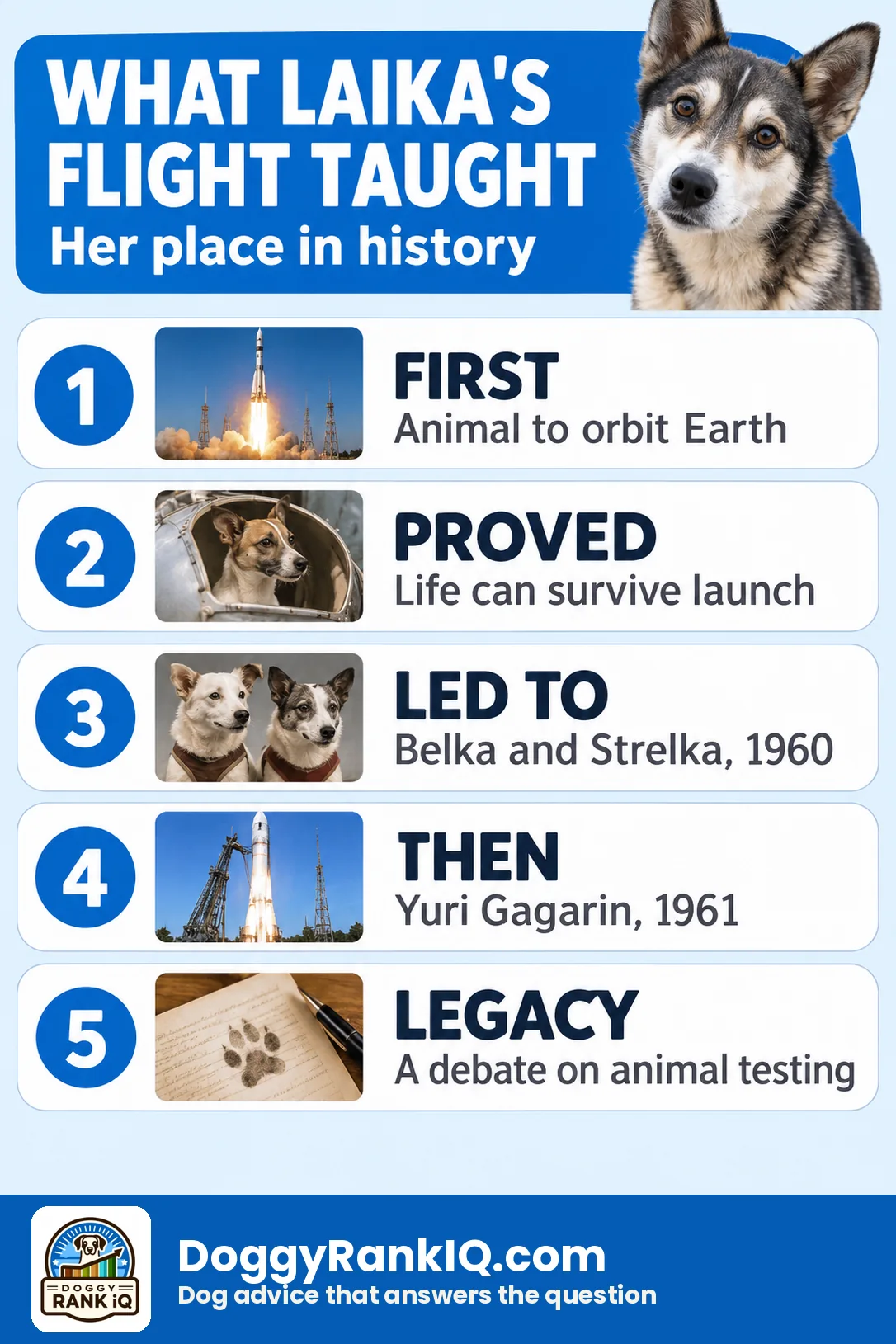
Laika’s flight proved that a living mammal could survive the launch phase and reach orbit, which was itself unverified before November 1957. It also exposed exactly what Soviet engineers did not yet know how to do: regulate a sealed cabin’s temperature over time and bring a capsule back safely with a living passenger inside.
Those lessons shaped the program that followed. By 1960, Belka and Strelka flew aboard Sputnik 5 and returned alive, the first living creatures to survive an orbital spaceflight, a milestone that would not have been attempted without the data, grim as it was, from Laika’s mission. Readers who want the fuller account of that successful follow-up mission can read our piece on Belka and Strelka, the space dogs who came home.
🐕 The other two dogs: Albina and Mushka
Laika did not train alone. Soviet space medicine teams prepared dogs in small groups, and three were readied for Sputnik 2.
Albina was the most experienced. She had already flown twice on high-altitude rockets and come back, and she was named as the backup. Mushka, the third dog, was used on the ground to test the cabin’s instruments and life support. Accounts from program staff written decades later say the team was reluctant to send Albina, who had already done her share. That comes from memoirs, so treat it as testimony.
The training is better recorded. The dogs were kept in progressively smaller cages for days at a time, up to about 20 days, to get them used to the cabin. They rode centrifuges, sat through recorded launch noise and learned to eat a jellied food that would be both meal and water in orbit. Confinement made some dogs stop eating and eliminating. Laika coped with it better than most, which counted in her favor.
🌙 The night before launch
One detail survives from Vladimir Yazdovsky, the physician who led the dog program. Shortly before the flight he took Laika home to play with his children. He later wrote that he wanted to do something nice for her, since she had so little time left.
“He took her home to play with his children because she had so little time left.”
It is a small scene, and it shows that the people closest to the Laika dog project understood exactly what they were doing. They had named her, fed her and trained her, and the spacecraft had been built in about four weeks with no way home.
🌍 How the world reacted in 1957
Outside the Soviet Union, the launch produced awe and anger in the same week. In Britain, the National Canine Defence League asked dog owners to observe a minute of silence on each day Laika was in orbit, and animal welfare groups reported a flood of calls. Pickets appeared outside the United Nations in New York. Inside the Soviet bloc the tone was celebration: Laika appeared on postage stamps, cigarette packets, matchbox labels and chocolate wrappers, and she became one of the most recognized dogs on Earth while most people never learned how the flight ended.
That split shaped what came next. Animal flights continued on both sides of the Cold War, but the one-way design was not repeated for dogs. Every later Soviet dog capsule was built to come back.
🎬 Why Laika still shows up in films, music and brand names
Few animals have had a longer afterlife. A Swedish film in 1985 built its narration around her, and a British band in the 1990s and an American animation studio founded in 2005 took her name. Graphic novels and children’s books retell the flight every few years, some truthfully and some with a gentler ending invented for young readers.
If you are choosing a book for a child, read the last chapter first. The true ending is hard, and a parent should decide how much of it to tell.
⭐ Top 5 Features We Love
- The monument in Moscow. Unveiled in 2008, it gives Laika a permanent, physical marker rather than just a footnote in space history.
- The Malashenkov data release. The 2002 presentation replaced decades of vague claims with an actual timeline, which is rare in Cold War-era science.
- The shift toward honest framing. Current outlets, including Washington Post and BBC retrospectives published around the 2026 anniversary, treat Laika as a symbol of the cost of the Space Race, not just a triumph (washingtonpost.com, bbc.com).
- Gazenko’s public regret. A scientist on the program later saying publicly that the mission troubled him adds a human layer that official statements never gave.
- The connection to Belka and Strelka. Laika’s flight set up the successful 1960 mission, giving her story a throughline instead of leaving it as an isolated tragedy.
⚠️ Things to Look Out For
- The myth that Laika lived for days. This was the original 1957 claim, and it still circulates in outdated articles and trivia sites.
- The myth of a painless death. The 2002 telemetry data contradicts this directly, showing signs of acute stress within hours (britannica.com).
- The myth that her body was recovered or preserved. It was lost during Sputnik 2’s re-entry and burn-up in April 1958.
- The claim that Laika was the first animal in space. She was the first animal to orbit Earth, not the first animal sent into space; earlier suborbital flights with other animals preceded her (nasa.gov).
- Confusing “Laika” the dog with the laika dog breed group. The name is a coincidence of Russian vocabulary, not a breed credential.
Laika dog book picks
For readers who want the fuller laika dog story in book form, a few titles cover different angles, from factual history to illustrated narrative. None of these have been tested by our team; details below reflect publisher and retailer listings checked in 2026.
- Laika’s Window: The Legacy of a Soviet Space Dog, a detailed nonfiction account of the mission and its aftermath. $16.39, price checked 2026. Check the current price
- Laika (graphic novel by Nick Abadzis), an illustrated, narrative take on her life before and during the mission. $14.99, price checked 2026. Check the current price
- Laika the Space Dog: First Hero in Outer Space, a shorter, accessible book suited to younger readers or a quick overview. $9.99, price checked 2026. Check the current price
FAQ
The bottom line
The laika dog story holds up as one of the clearest examples of how official history and documented history can diverge for decades before lining up. She reached orbit alive, she died within hours from overheating and stress, and the Soviet Union’s original account of a peaceful, days-long survival stood unchallenged until 2002 (britannica.com). That 45-year gap is not a minor footnote. It is the actual subject of this story.
If this kind of animal history interests you, it is worth comparing Laika’s one-way mission against the later success of Belka and Strelka, or reading one of the books above for a fuller account than any single article can give.
For readers curious about dogs closer to home, our guides on how long dogs typically live and when dogs were first domesticated offer useful context on the broader history between dogs and humans.
Doggy Rank IQ is reader supported. As an Amazon Associate we earn from qualifying purchases, at no extra cost to you.