
A small bronze dog with a worn-down nose sits at a street corner in Edinburgh, and tourists line up to touch it. Most of them have never read a single historical source about greyfriars bobby. They just know the story: a dog, a grave, fourteen years of loyalty. The real record is messier, and that’s what makes it worth a closer look.
Quick Answer
Greyfriars Bobby is the name attached to a Skye Terrier said to have guarded his owner’s grave in Edinburgh’s Greyfriars Kirkyard for 14 years after the man’s death in 1858, until the dog himself died in 1872. The story is documented well enough to confirm a real dog, a real fountain and statue funded in 1873, and a real licence paid by the city in 1867, but historian Dr Jan Bondeson argued in 2011 that the vigil narrative and even the single-dog claim do not hold up to the visual evidence (bbc.com). Greyfriars Bobby sits in the gap between confirmed civic history and a story shaped by Victorian tourism. Readers heading to the kirkyard today should expect a legend with real documentation on one side and real doubt on the other.
Key Takeaways: greyfriars bobby
- The traditional greyfriars bobby story says a Skye Terrier guarded his owner John Gray’s grave for 14 years, from 1858 to 1872.
- Lord Provost Sir William Chambers paid for Bobby’s dog licence in 1867 and gave him a collar, now held at the Museum of Edinburgh (bbc.com).
- Baroness Angela Burdett-Coutts funded the statue and fountain unveiled in 1873 across from the kirkyard (bbc.com).
- Historian Jan Bondeson of Cardiff University argued in 2011 that Bobby was likely a stray fed by locals, and that photos show two different dogs, not one loyal animal (bbc.com, telegraph.co.uk).
- No new archival find or DNA study has overturned Bondeson’s thesis as of 2026; recent coverage mostly repeats the existing debate (timespets.com).
- Rubbing the statue’s nose is a modern tourist habit that wears down the bronze, and Edinburgh asks visitors not to do it.
- Bobby is buried just inside the kirkyard gate, near but not inside John Gray’s plot, with a headstone added in 1981.
- A 2026 pilot project proposed a QR-code plaque at the statue to present both the legend and the historical doubts side by side.

What do you want to know?
Tap an option to see the answer.
The short answer: the Greyfriars Bobby story
Greyfriars Bobby is traditionally described as a Skye Terrier owned by John Gray, an Edinburgh night watchman. Gray died in 1858 and was buried in Greyfriars Kirkyard. The dog is said to have spent the next 14 years at the grave, leaving only for food, until his own death in 1872.
That’s the version printed on postcards and repeated by tour guides. It’s a tidy story with a clear moral, and it has sold a lot of souvenirs in the past 150 years. The trouble is the documentary chain connecting a specific dog to a specific John Gray is thin. Reporting on the controversy notes there is no firm paper trail tying the watchman to the dog, and multiple men named John Gray were buried at Greyfriars during that period. That detail alone should make anyone pause before treating the story as settled fact.
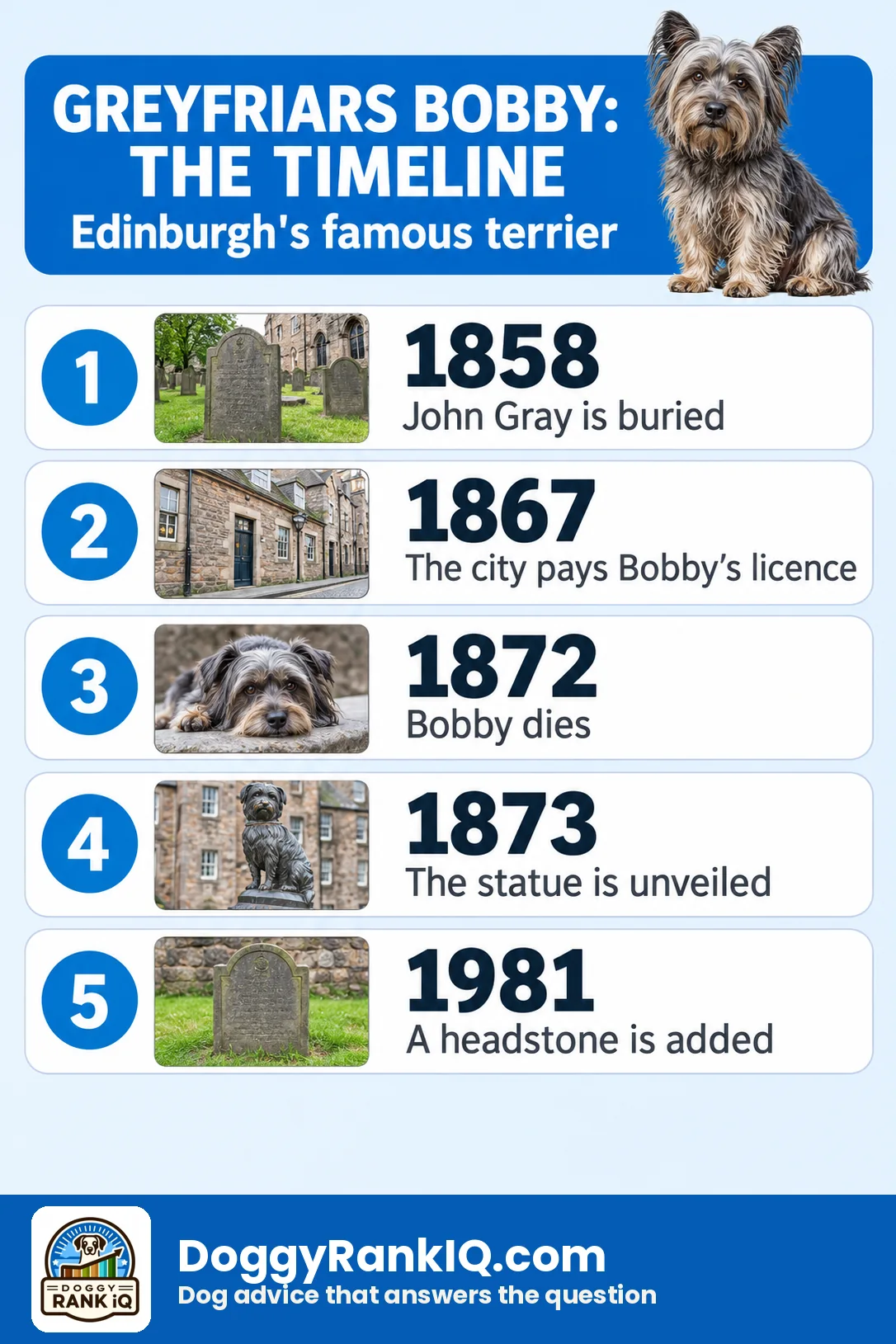
Timeline table: Bobby’s story in dates
The legend as Edinburgh tells it
The city’s version of greyfriars bobby presents a single, devoted dog who refused to leave his master’s grave for 14 years, through Scottish winters, until his own death. It’s the version in gift shops, on Disney posters, and in most tour scripts near Candlemaker Row.
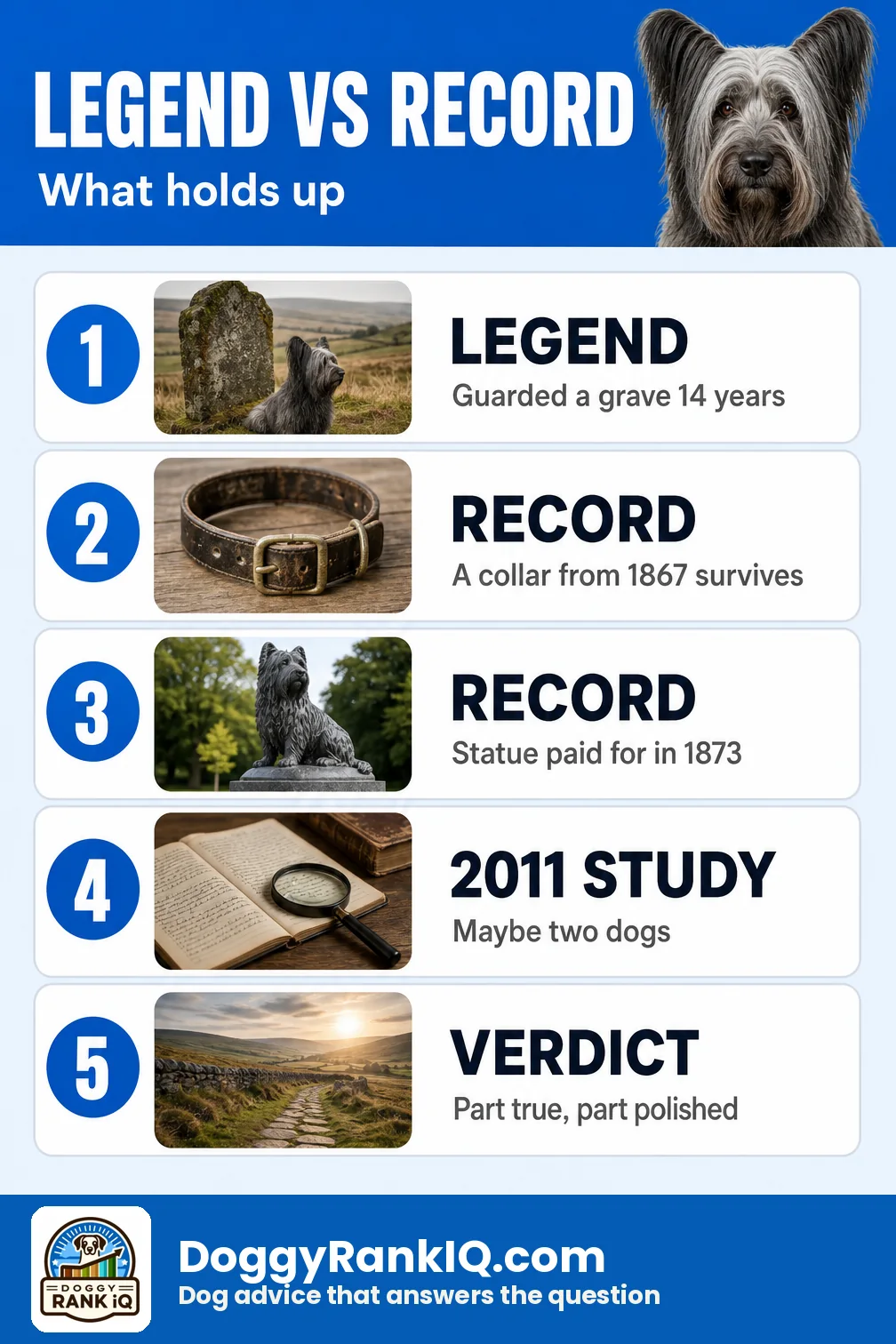
The civic record does support parts of it. Chambers paying the dog licence in 1867 was a real act, and the collar he gave still sits in the Museum of Edinburgh (bbc.com). The statue and fountain Burdett-Coutts funded went up in 1873, and it still stands at the corner of Candlemaker Row and George IV Bridge. Those are documented facts, not folklore.
What the record doesn’t clearly support is the emotional core of the story: one dog, one owner, fourteen unbroken years of grief. That’s where legend and documentation separate.
Pull quote: “The statue is real. The vigil is the part historians can’t confirm.”
Loyal dog or Victorian myth? What a 2011 study argued
Dr Jan Bondeson, formerly a senior lecturer at Cardiff University, argued in 2011 that the familiar Bobby story is fundamentally wrong, and that the dog was probably a stray mongrel fed by people around the churchyard rather than a grieving animal keeping a continuous watch (bbc.com).
Bondeson’s main evidence is visual. He identified two distinct groups of images: pre-1867 pictures show an older, rough-coated dog, and later images show a younger, better-groomed dog resembling the one depicted on the fountain (bbc.com). He places the first dog’s likely death around May or June 1867, suggesting a replacement animal may have been brought in to keep the attraction, and the business built around it, going (telegraph.co.uk).
He also names two local figures in his account: James Brown, the cemetery curator, and John Traill, a nearby restaurant owner. Bondeson’s interpretation is that both men had a financial interest in keeping the Bobby story alive, since it drew visitors and customers to the area.
Decision rule for readers: if you want the tourist-brochure version, the kirkyard and statue deliver it fully. If you want the sourced version, read Bondeson’s argument before you visit, because the two photographs of “Bobby” don’t show the same dog.
No major new archival discovery, DNA study, or scholarly publication overturning this 2011 thesis has surfaced as of 2026. Recent coverage largely repackages the existing debate rather than resolving it (timespets.com).
Facts table: legend vs documented record
Greyfriars Bobby grave, statue and why people rub his nose
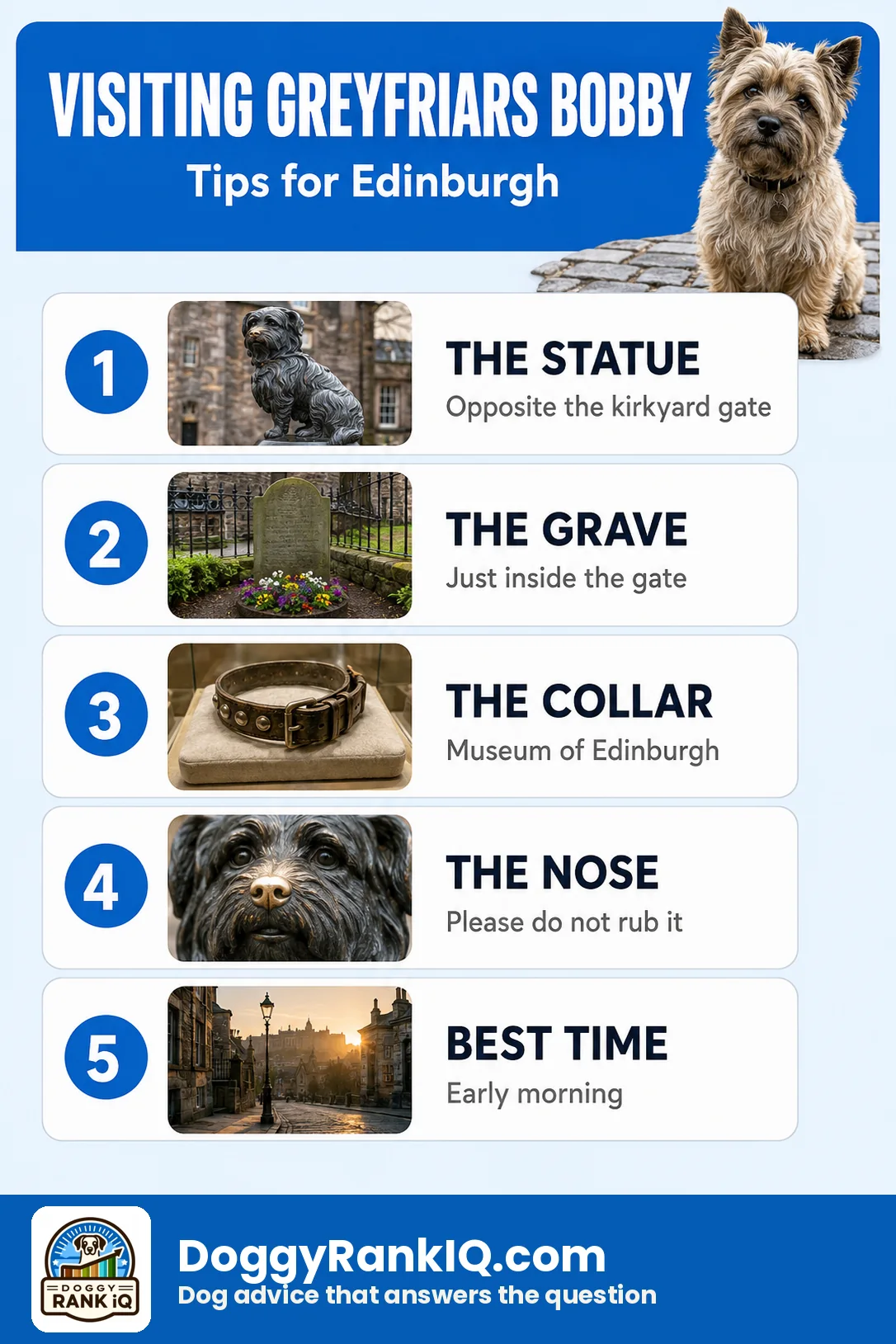
Bobby is said to be buried just inside the gate of Greyfriars Kirkyard, close to but not inside John Gray’s plot, with a red granite headstone added in 1981 marking the spot. The statue stands across the street, a small bronze Skye Terrier on a drinking fountain base.
The nose-rubbing habit is recent, not historical. Visitors rub the bronze nose for luck, a custom that wears the metal thin and has required Edinburgh to repeatedly address it with signage and requests to stop. It’s worth knowing before you visit: the shiny nose isn’t original patina, it’s foot traffic. If you want a photo, take one. Skip the rub.
In 2026, a pilot project called The Plinth Monologues proposed a temporary A4-sized QR-code plaque attached reversibly to a nearby lamppost for 28 days, offering free digital interpretation of the statue’s history. Notably, the planning language describes the statue as representing a “legendary” dog rather than asserting every detail as fact, a small but meaningful shift toward presenting the legend and the doubts together.
Greyfriars Bobby pub and visiting tips
The Bobby pub sits directly across from the statue on Candlemaker Row and is a common stop for visitors pairing a pint with the kirkyard visit. It’s a working pub, not a museum, so treat it as a casual meal or drink stop rather than a historical exhibit.
Practical visiting notes:
- The kirkyard itself is free to enter during daylight hours.
- The statue corner gets crowded with tour groups midday; early morning is quieter for photos.
- Guides on walking tours often tell the uncomplicated version of the story. Nothing wrong with that for atmosphere, but it’s not sourced history.
- Watch where you walk. Greyfriars is a working cemetery with uneven older stones.
If you’re planning a dog-related trip more broadly, it’s worth brushing up on general canine history and behavior before you go, including 12 warning signals owners miss in dog body language, which helps make sense of how a real dog, stray or not, would have behaved around strangers feeding it daily.
Greyfriars Bobby movie and book: where to watch and read
For the Bobby movie, Disney released a live-action version in 1961, and a separate film, The Adventures of Bobby, came out in 2005. Both dramatize the loyal-vigil version of the story rather than the disputed historical record. As of 2026, availability shifts between streaming platforms and digital rental services, so check current listings before planning a watch night.
The Bobby book that shaped the popular image most is Eleanor Atkinson’s 1912 novel, which took the local legend and turned it into a sentimental narrative read widely in both the UK and the US. It’s fiction built on folklore, not a historical account, and that distinction matters if you’re citing it for anything beyond entertainment.
For readers curious how the loyalty angle compares across breeds generally, see what the research says about the top dog for loyalty.
🚉 Other dogs who waited: Hachiko, Fido and Shep
Bobby’s story spread because people wanted it to be true, and versions of it keep turning up on other continents. Three are documented well enough to compare.
Hachiko, an Akita in Tokyo, met his owner, Professor Hidesaburo Ueno, at Shibuya Station each evening. Ueno died suddenly at work in 1925. Hachiko kept coming to the station for nearly ten years, until his own death in 1935. A newspaper article in 1932 made him famous while he was still alive, and he was present when his own bronze statue went up in 1934.
Fido lived in Borgo San Lorenzo, near Florence. His owner, a factory worker, was killed in an air raid in 1943. Fido went to the bus stop each afternoon for about 14 years. The town honored him with a gold medal in 1957, while he was still alive, and his statue stands in the main square.
Shep turned up at the railway station in Fort Benton, Montana, in 1936, after his owner’s coffin was loaded onto an eastbound train. He met trains there for close to six years and was killed on the tracks in 1942.
Set beside these, the Bobby account has the oldest date and the thinnest paper trail. Hachiko has photographs, press coverage from his lifetime and a preserved body in a Tokyo museum. Bobby has a licence collar, a handful of newspaper reports and a statue paid for by a wealthy admirer. That gap is part of why historians keep returning to him.
“Hachiko has photographs. Bobby has a collar, a statue and a very good story.”
🏴 The Skye Terrier is now rarer than the legend
The breed shown on the statue is in trouble.
The Kennel Club in Britain keeps a list of vulnerable native breeds, those with fewer than 300 puppy registrations a year, and the Skye Terrier has been on it for years, often with only a few dozen puppies registered. A breed popular with Victorians, Queen Victoria included, is now one most British people have never met.
If the statue makes you want one, expect a waiting list and a long conversation with a breeder. Skyes are long, low and heavier than they look, with a coat that needs brushing down to the skin every week. They bond closely with their own people and tend to be reserved with strangers, which, legend or not, fits the dog in the story.
🗿 The sculptor and a very small listed building
William Brodie modeled the bronze, and it went up in 1873, the year after Bobby died. It stands on a granite fountain that originally had two drinking levels, an upper one for people and a lower one for dogs. The water was switched off long ago. The monument is protected as a Category A listed structure, and it is often described as the smallest listed building in Edinburgh.
⭐ Top 5 Features We Love
- The statue’s scale. A small, unassuming bronze figure, easy to miss if you’re not looking, which makes finding it feel like a small discovery.
- The pairing of fact and folklore. Few tourist sites so openly mix confirmed civic records (the licence, the fountain) with genuinely disputed claims.
- The 1867 licence detail. A real government record, the dog licence and collar, now sitting in a museum, is a rare piece of hard evidence in an otherwise soft story.
- The ongoing historical debate. Bondeson’s 2011 argument keeps the story alive as a real research question, not just a postcard caption (bbc.com).
- The 2026 interpretation pilot. The proposed QR-code plaque shows a willingness to present both sides rather than just the legend.
⚠️ Things to Look Out For
- Don’t rub the statue’s nose. It wears the bronze and Edinburgh actively discourages it.
- Don’t treat the vigil story as confirmed history. Present it as a beloved legend with real doubts attached, especially if you’re writing about it or explaining it to kids.
- Skye Terriers have specific grooming needs. The breed’s long double coat requires regular brushing; if you’re considering one because of the story, research the breed’s actual care demands separately from the legend. For general small-breed terrier comparisons, see our Yorkshire Terrier guide.
- Watch for uneven ground in the kirkyard. Older cemeteries have settled, cracked stones.
- Check opening hours before visiting the pub or kirkyard, since both can change seasonally.
Greyfriars Bobby book picks
A few Amazon-available titles help separate the Victorian legend from general dog history, useful if you want more context before or after a visit.
Bobby by Eleanor Atkinson is the 1912 novel that turned the local legend into the widely known sentimental story. Price: $4.99 (price checked 2026). Check the current price.
Bobby: A Puppy’s Tale offers a gentler, illustrated retelling aimed at younger readers. Price: $11.89 (price checked 2026). Check the current price.
The Dog Encyclopedia (DK) is useful if you want general, well-sourced breed and dog history context beyond the Bobby legend, including background on Skye Terriers. Price: $13.29 (price checked 2026). Check the current price.
These are reader suggestions based on what the publishers document about each title’s content, not a hands-on review.
FAQ
The bottom line
Bobby makes a better story than a settled historical record. The statue, the fountain, and the 1867 licence are real and documented. The 14-year vigil and the single-dog narrative rest on far less, and Jan Bondeson’s 2011 photographic argument remains unanswered as of 2026 (bbc.com, telegraph.co.uk). Visit the kirkyard, see the statue, skip the nose rub, and enjoy the legend for what it is: a story Edinburgh built around a real dog, shaped by real people with real reasons to keep it going.
If you’re interested in how dogs actually bond with their owners and what loyalty looks like in documented behavior rather than folklore, how smart are dogs, according to brain research and dog years to human years, explained with a calculator are good next reads.
Doggy Rank IQ is reader supported. As an Amazon Associate we earn from qualifying purchases, at no extra cost to you.