
Quick Answer
Can dogs sense bad people? The honest answer is no, not in the way the phrase usually gets used. Research shows dogs can read tone of voice, posture, facial expression, and even the scent of human stress, and they track whether a specific person has treated their owner fairly in the past. Studies have not shown that dogs detect moral character or “evil” directly. What looks like a dog judging someone’s soul is usually a dog reading very real, very physical signals that a person is nervous, tense, or unfamiliar.
Key Takeaways: can dogs sense bad people
- No study has shown dogs can sense bad people in a moral sense. They respond to behavior, scent, and tone, not character.
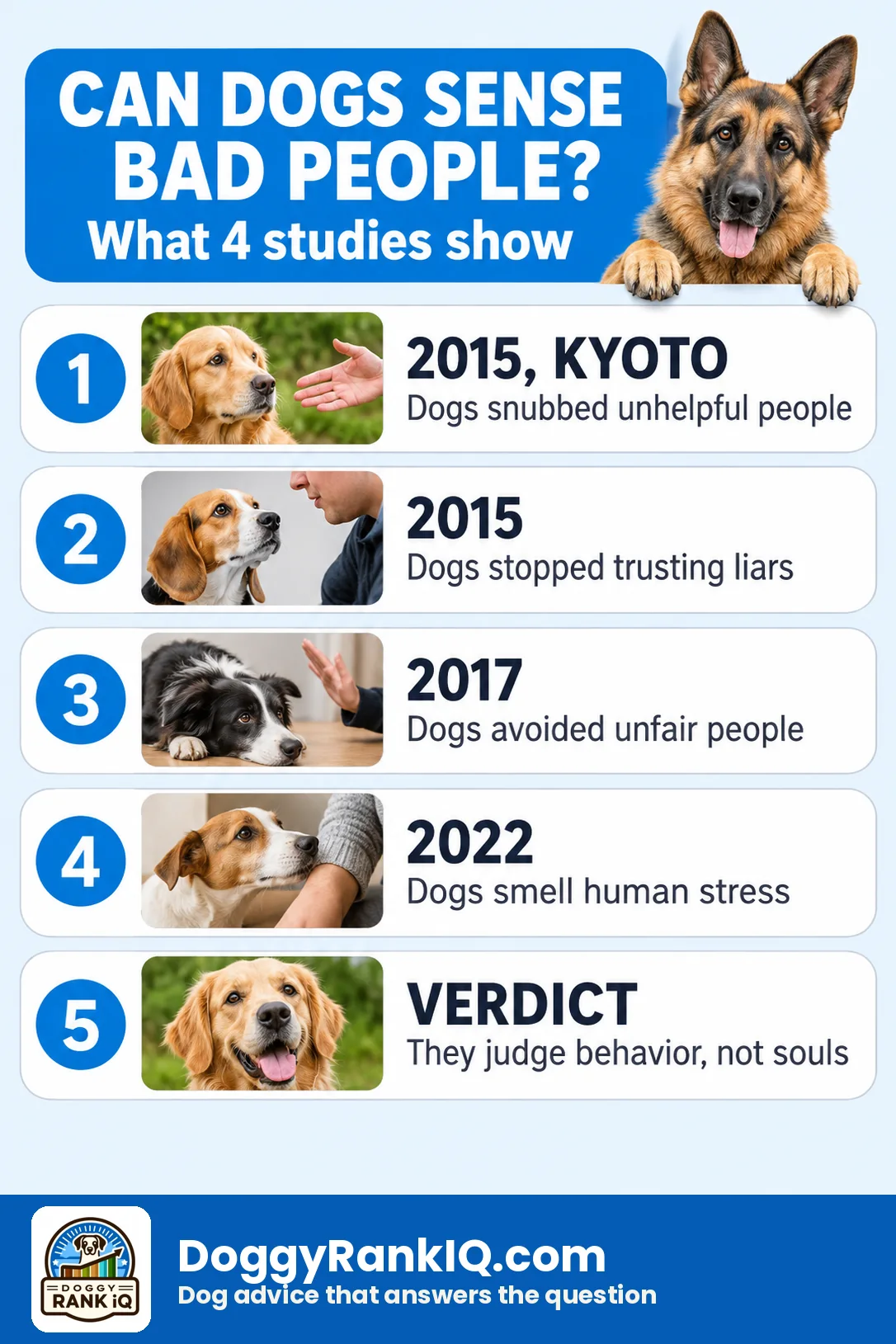
- Dogs track fairness toward their owner. A 2015 Kyoto University study found dogs avoided people who refused to help their owner.
- Dogs can smell acute human stress. A 2022 PLOS ONE study found trained dogs identified stress odor correctly in 93.75% of 720 trials.
- A 2024 Scientific Reports study found dogs became more cautious around locations linked to stress odor, likely from learning, not judgment.
- Takaoka’s 2015 Animal Cognition study found dogs stopped following the pointing cues of a person who had previously misled them.
- Dislike of a person is often about fear of hats, beards, sudden movement, or past bad experiences, not hidden instinct.
- Can dogs sense bad people better than they sense good ones? Evidence suggests dogs respond more to a stranger’s behavior toward the owner than to any built-in good or bad radar.

What happened?
Tap an option to see the answer.
The short answer: can dogs sense bad people?
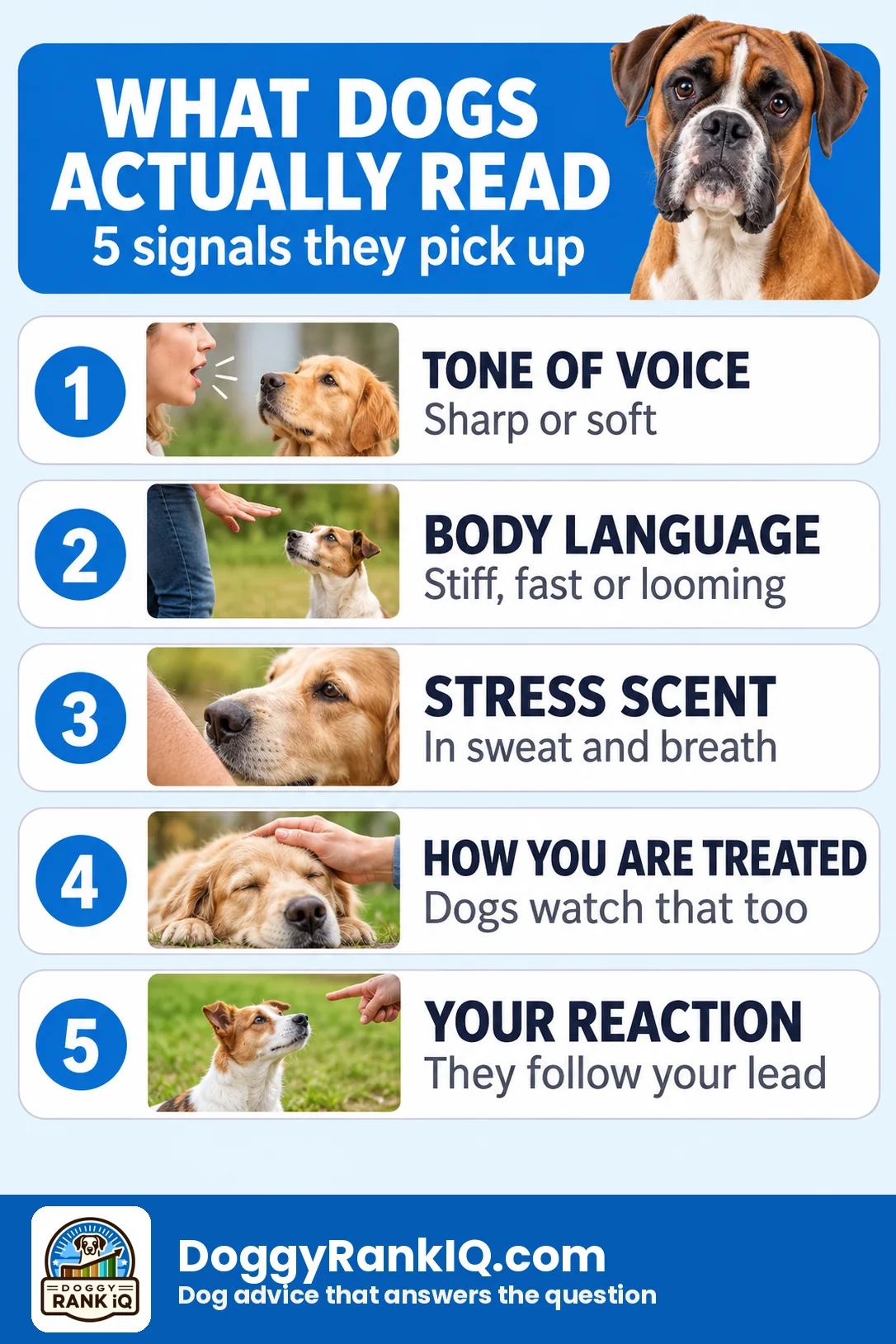
Dogs do not have a documented ability to sense bad people the way a smoke detector senses smoke. They sense specific, physical things about people: stress chemicals in breath and sweat, tension in a voice, a stiff posture, a hand that moves too fast near the face. Those signals often line up with how people actually treat others, which is why a dog’s reaction can feel eerily accurate.
The research gap is real. A September to 2026 study using brain imaging in pet dogs found distinct neural activity when dogs viewed happy versus fearful or angry human faces, but it involved only 8 to 12 dogs and the researchers stopped short of claiming dogs interpret emotion the way humans do (CORDIS). A related 2026 preprint on 24 dogs found brain regions sensitive to human body language showing happiness versus anger, but as a preprint it has not completed peer review (bioRxiv).
Decision rule: if your dog reacts to someone’s posture, voice, or scent, trust that something physical triggered it. Do not assume the dog has diagnosed the person’s intentions.
What studies actually show
Four studies get cited again and again when people ask whether dogs can sense bad people. Here is what each one actually tested, and what it did not test.
1The unhelpful person experiment
Dogs watched a stranger refuse to help their owner open a container. Afterward, dogs were less likely to accept food from that unhelpful stranger. This is social evaluation based on a single observed act, not a reading of someone’s general character. The study did not test strangers who had done nothing at all, and it did not follow the dogs home to see if the effect lasted.
2The unreliable pointer experiment
Published in Animal Cognition, this is the study most often stretched into “dogs know who to trust.” A person pointed toward food. The dogs followed. Then that same person pointed toward an empty container. In later trials, many dogs stopped following that person’s pointing, but kept following a new person’s cues (Animal Cognition). That is a dog updating trust in a specific signal from a specific person after being misled once. It says nothing about detecting dishonesty in general, and it was not designed to.
3The fairness-tracking research
This review, published in Neuroscience and Biobehavioral Reviews, reported that dogs and monkeys tend to avoid people who act unhelpfully or unfairly toward someone else. The pattern shows up across species, which suggests a basic social instinct rather than anything uniquely moral or human-like in dogs.
4The stress scent experiment
Published in PLOS ONE, this study trained four dogs to tell apart breath and sweat samples collected before and after a stress task. Across 720 trials, the dogs correctly identified the stress sample in 675 trials, or 93.75%, with individual dogs ranging from 90.00% to 96.88% (npr.org, people.com). That is detection of a physiological state, acute stress, not detection of dishonesty or bad intent. A 2024 Scientific Reports follow-up with 18 dogs found that stress odor made dogs less willing to approach an ambiguous food bowl location, with the approach hazard dropping to about 0.53, and to roughly 0.42 after a prior relaxed-odor session (nature.com). The same study found the effect shifted with learning and test order, meaning caution built up with experience rather than appearing instantly (nature.com).
Common mistake: treating any one of these four studies as proof dogs can spot a “bad person” on sight. Each one tested a narrow, specific behavior under controlled conditions.
Facts table: what dogs can detect vs what is not proven
This table answers “can dogs sense bad people” at a glance.
Signs a dog senses something is off about a person
A dog that reacts strongly to someone is reading something concrete, even if it is hard for the owner to spot in the moment.
- Stiff body, raised hackles, or a low growl when a person gets close
- Avoiding eye contact or backing toward the owner instead of greeting
- Barking directed at one specific stranger while ignoring others
- Sniffing a person’s hands or clothing longer than usual, which may relate to scent detection described in the dog sense of smell research
- Refusing treats offered by that one person, echoing the Kyoto University food-refusal pattern
Quick example: a dog that calmly greets the mail carrier every day but stiffens around a new guest wearing a hood and moving quickly is likely reacting to posture and unfamiliarity, not character. Learning the broader vocabulary in dog body language helps owners tell the difference between caution and genuine distress.
Can dogs sense good people, danger before it happens, pregnancy or death?
Can dogs sense good people? The evidence is the same in reverse: dogs respond positively to people who are calm, generous with their owner, and predictable in movement and tone, which can look like liking a “good person” without any moral judgment involved.
Can dogs sense danger before it happens? Dogs can sometimes react before a human notices a threat because of sharper hearing, smell, and attention to subtle movement, which is different from predicting an unseen future event. This connects to the same sensory advantages covered in can dogs sense human emotions.
Can dogs sense pregnancy? Anecdotal reports describe dogs changing behavior around pregnant owners, likely tied to hormonal scent changes and shifts in posture and routine, though this has not been tested with the same rigor as the stress-scent studies above.
Can dogs sense death? Dogs have been reported to change behavior near dying people, possibly detecting changes in breath, metabolism, or scent, but no controlled study in this research set confirms a specific mechanism.
Can dogs sense evil spirits? There is no scientific research supporting this claim. Reactions attributed to spirits are more plausibly explained by sound, scent, or light that humans cannot detect.
🧠 Dogs read your reaction before they judge the stranger
Before a dog makes up its mind about a person, the dog often checks you.
Isabella Merola and colleagues at the University of Milan tested this in 2012. Dogs and their owners met a strange object, an electric fan with plastic ribbons streaming off it. Most dogs looked from the fan to the owner and back. When the owner spoke in a happy voice and walked up to it, dogs were more willing to approach. When the owner sounded afraid and backed away, dogs hung back. Psychologists call this social referencing, and human babies do the same thing with their parents around their first birthday.
Smell carries the message too. Biagio D’Aniello’s team at the University of Naples collected sweat from people watching frightening or happy videos, then let dogs sniff the samples. In results published in 2018, dogs exposed to fear sweat showed more signs of stress, had higher heart rates and stayed closer to their owners. Dogs who smelled happy sweat paid more friendly attention to a stranger in the room.
“Your dog may be reacting to the visitor. Your dog may also be reacting to you reacting to the visitor.”
Put those together at your front door. You tense up because the delivery driver startled you, your grip shortens the leash, your breathing changes. The dog reads all of it and barks. From the outside it looks like the answer to “can dogs sense bad people” is yes. In that moment, the dog sensed you.
That does not make the dog wrong. The bark is one piece of evidence, and you need to check what it is evidence of.
🚪 Four questions to ask before you trust or dismiss the reaction
- What was the person doing? Reaching over the dog’s head, staring, moving fast or carrying something odd explains most reactions.
- What were you doing? If your hand was tight on the leash or your voice went up, repeat the meeting on a loose leash with a relaxed tone.
- Does it happen with one person or a type? A dog who barks at every tall man in a cap has a gap in early experience. A dog who is fine with everyone except one specific neighbor, across a dozen calm meetings, is telling you something more particular.
- Does the dog recover? Sniffing, shaking off and taking a treat within a minute or two points to surprise. Staying stiff, hiding or refusing food points to fear that deserves respect.
A pattern that survives all four questions is worth listening to. You do not need a study to keep some distance from a person who makes both of you uneasy. You also do not need to decide your brother-in-law is a villain because he wore sunglasses indoors.
⭐ Top 5 Features We Love
- Scent-based stress detection. Trained dogs hit 93.75% accuracy identifying human stress odor across 720 trials (npr.org, people.com), a genuinely impressive sensory skill.
- Memory for unfair treatment. Dogs in the Kyoto University study remembered which stranger had refused to help their owner and avoided that person afterward.
- Quick recalibration of trust. In Takaoka’s 2015 study, dogs adjusted their trust in a misleading pointer within a few trials.
- Cross-species consistency. The fairness-avoidance pattern Anderson and colleagues reviewed in 2017 shows up in both dogs and monkeys, suggesting a deep, reliable instinct.
- Multi-channel reading. Dogs combine voice, face, posture, and scent rather than relying on one signal, according to the Scientific Reports review (nature.com).
⚠️ Things to Look Out For
A few cautions for anyone asking “can dogs sense bad people”:
- Breed and individual variation. Do all dog breeds sense bad people equally well? No study has ranked breeds this way, and individual temperament, socialization, and age likely matter more than breed alone.
- Fear of appearance, not character. A dog may react to a hat, beard, uniform, or wheelchair because of poor early socialization, not because the person is unsafe.
- Learned caution mistaken for insight. The 2024 Scientific Reports study found dogs grew more cautious with repeated exposure to stress odor, meaning the reaction built over time rather than appearing instantly (nature.com).
- Puppies are less reliable readers. Can puppies sense bad intentions like adult dogs do? Puppies have had far less exposure to human behavior patterns, so their reactions are less predictable than an adult dog’s.
- Liking someone who later turns out to be bad. A dog’s warm greeting reflects calm scent and behavior in that moment, not a background check. Dogs have been wrong about people plenty of times.
If your dog growls at a trusted guest, do not treat it as proof of hidden danger. Check for a more ordinary explanation first, such as a fast movement, a new cologne, or a tone of voice the dog has not heard from that person before.
What to do when your dog dislikes someone
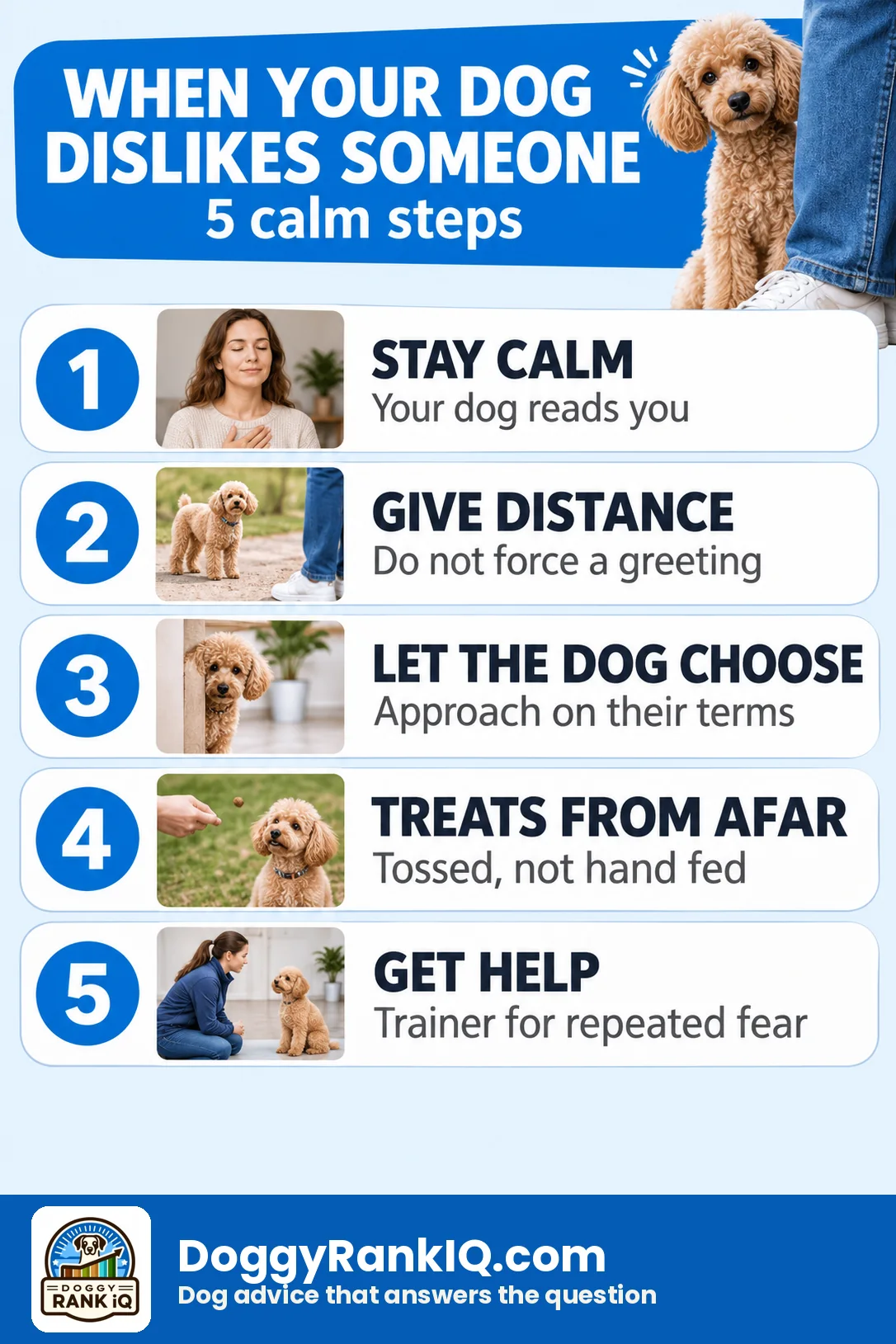
Start by looking for the physical trigger before assuming the dog has judged the person’s character. Why does my dog dislike someone I trust? Often it traces back to voice pitch, sudden gestures, unfamiliar scent, or a resemblance to someone from the dog’s past.
- Watch the dog’s body, not just the bark. Stiff posture and a low growl suggest discomfort; a bark with loose, wiggly movement suggests excitement, not warning.
- Ask the person to slow down, lower their voice, and let the dog approach rather than reaching first.
- Reward calm behavior near the person with treats, building a new, positive association.
- If the reaction is a one-off, consider whether the person was simply unfamiliar that day.
- If the reaction is intense, consistent, and includes snapping or lunging, treat it as a behavior and safety issue, not a character reading, and get guidance from a certified trainer or your veterinarian.
Introducing a new person slowly follows many of the same principles used in how to introduce dogs to each other: controlled pace, calm body language, and no forced contact.
Is it a myth that dogs can judge character? Treating it as a reliable character detector is a myth. Treating it as a dog noticing something real about tone, scent, or past behavior is supported by evidence.
Helpful reading and calming tools
A few resources help owners separate real signals from assumptions, and a few products support dogs that react anxiously to new people.
Doggie Language: A Dog Lover’s Guide to Understanding Your Best Friend is an illustrated guide to canine body language, useful for telling fear from excitement in the moment. Price checked 2026: $8.99. Check the current price.
The Genius of Dogs covers canine cognition research, including social reasoning studies like the ones referenced above. Price checked 2026: $12.75. Check the current price.
Inside of a Dog explains how dogs perceive the world through scent and behavior, which helps explain why dogs react to stress odor the way the 2022 PLOS ONE study documented. Price checked 2026: $11.21. Check the current price.
Calming Anxiety Vest for Dogs, Small applies gentle, consistent pressure, which some owners report helps a nervous dog settle around unfamiliar people. Manufacturer claims describe a swaddling effect; owner reports vary, and this is not a substitute for training. Price checked 2026: $38.99. Check the current price. If your dog’s anxiety around people is frequent or severe, confirm an anxiety plan with your veterinarian before relying on a product alone.
FAQ: can dogs sense bad people
The bottom line: can dogs sense bad people?
Can dogs sense bad people in the way folklore suggests, as some kind of moral radar? The research says no. Can dogs sense bad people’s specific behaviors, like unfairness toward an owner, a misleading gesture, or the chemical signature of acute stress? Yes, and the data behind that is solid. The next time a dog reacts strangely to a guest, look for the physical signal first: a stiff voice, a fast hand, an unfamiliar scent. That explanation is almost always sitting right there, waiting to be noticed. For more on how dogs read people day to day, see can dogs sense human emotions and dog body language.
Doggy Rank IQ is reader supported. As an Amazon Associate we earn from qualifying purchases, at no extra cost to you.