
Quick Answer
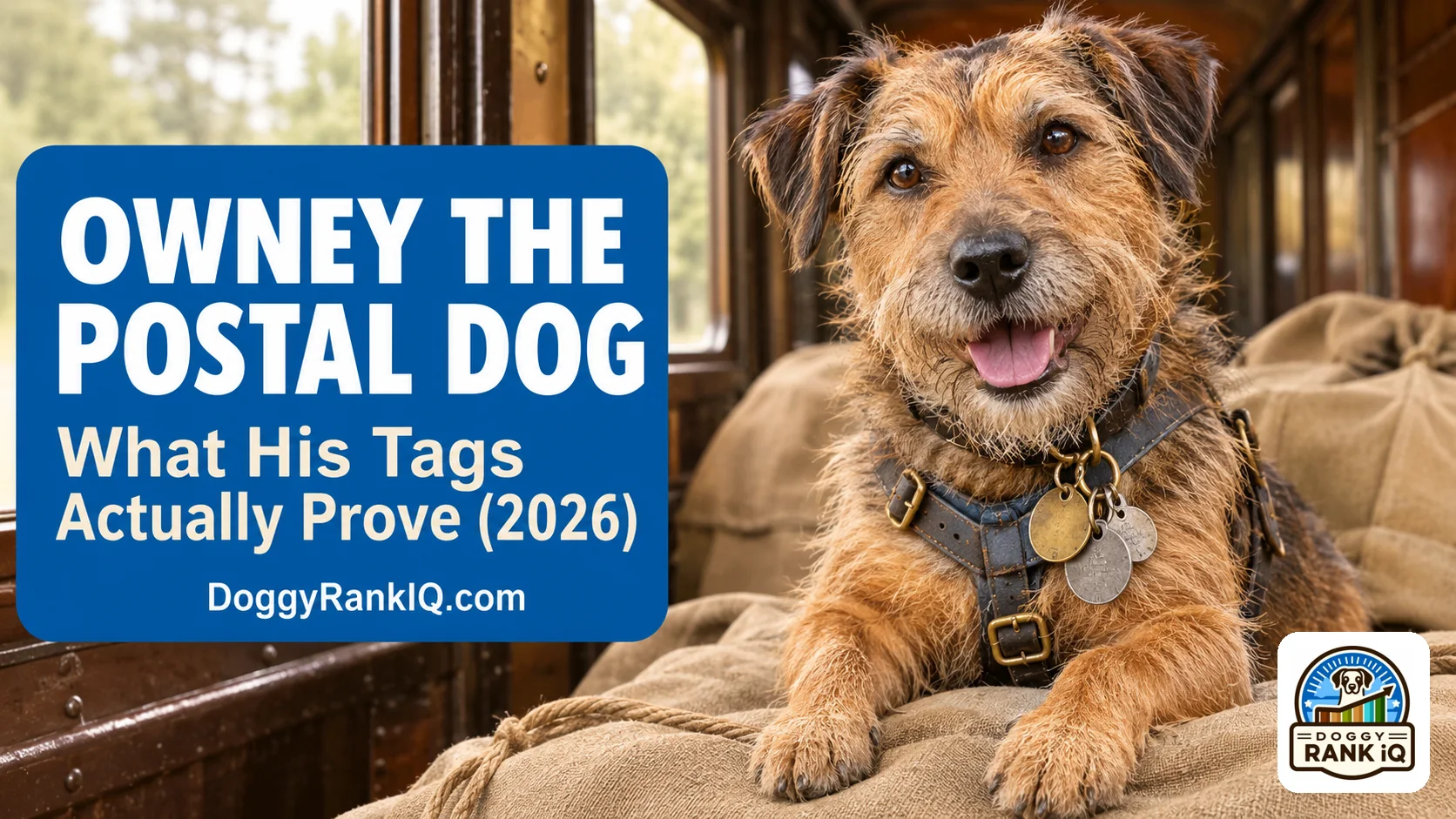
Owney the postal dog was a scruffy terrier mix who rode mail trains with the Railway Mail Service starting around 1888, collected hundreds of tags and medals from clerks and admirers, and became the unofficial mascot of the U.S. mail system. His tags prove he was handled, identified, and honored by postal workers and the public across many stops, but historians say the tags alone do not prove every single location was a personal visit. Owney the postal dog died in 1897, was preserved and donated to the Smithsonian, and now sits on permanent display at the National Postal Museum in Washington, D.C.
Key Takeaways: owney the postal dog
- Owney the postal dog showed up at the Albany, New York post office around 1888 and started riding mail cars (facts.usps.com).
- His famous collar tags, baggage checks, and medals came from railway clerks and towns along his routes (postalmuseum.si.edu).
- In 1895 Owney the postal dog completed a documented trip around the world carrying mail, departing from Tacoma, Washington (facts.usps.com).
- He died in Toledo, Ohio, on June 11, 1897, under disputed circumstances (facts.usps.com).
- The Smithsonian received his preserved body in 1911, and he has been on public display at the National Postal Museum since 1993 (facts.usps.com).
- The USPS issued an Owney forever stamp on July 27, 2011, commemorating his legacy.
- Museum curators say the tags document association and honor, not always confirmed physical travel to every spot (postalmuseum.si.edu).
- Owney the postal dog mascot status grew out of a railway clerk tradition that treated him as good luck (trains.com).

What do you want to know?
Tap an option to see the answer.
The short answer: who Owney the postal dog was
Owney was a terrier mix with no fixed owner on record, first noticed at the Albany, New York post office around 1888 (facts.usps.com). Clerks started feeding him, and then something stranger happened: he followed the mail bags onto a train and rode along.
That single decision turned into a nine-year habit. Railway Mail Service clerks across the country came to recognize Owney the postal dog as a traveling companion, not a stray. He rode baggage cars, slept near mail sacks, and apparently liked the rhythm of a moving train more than staying in one town.
The National Postal Museum’s own research pushes back on the romantic version of his origin story. Curator Nancy Pope and researcher Rachel Barclay dug through old newspapers, railroad maps, and surviving tags while preparing a 2009 exhibit, and their conclusion was more grounded than the folklore: his owner was likely a postal clerk, and Owney simply stayed behind when that person moved on (postalmuseum.si.edu, smithsonianmag.com). So “abandoned stray wanders in from the cold” is a tidier story than the record actually supports.
What is not disputed is the effect he had. Railway mail clerks, a workforce that handled sorting on moving trains under rough conditions, adopted him as something close to a good luck charm (trains.com). A dog on board became part of the job.
Related reading on dog cognition and history: when were dogs domesticated covers how far back the human-dog partnership actually goes, which gives some context for why a dog riding a mail train in the 1880s felt remarkable rather than routine.
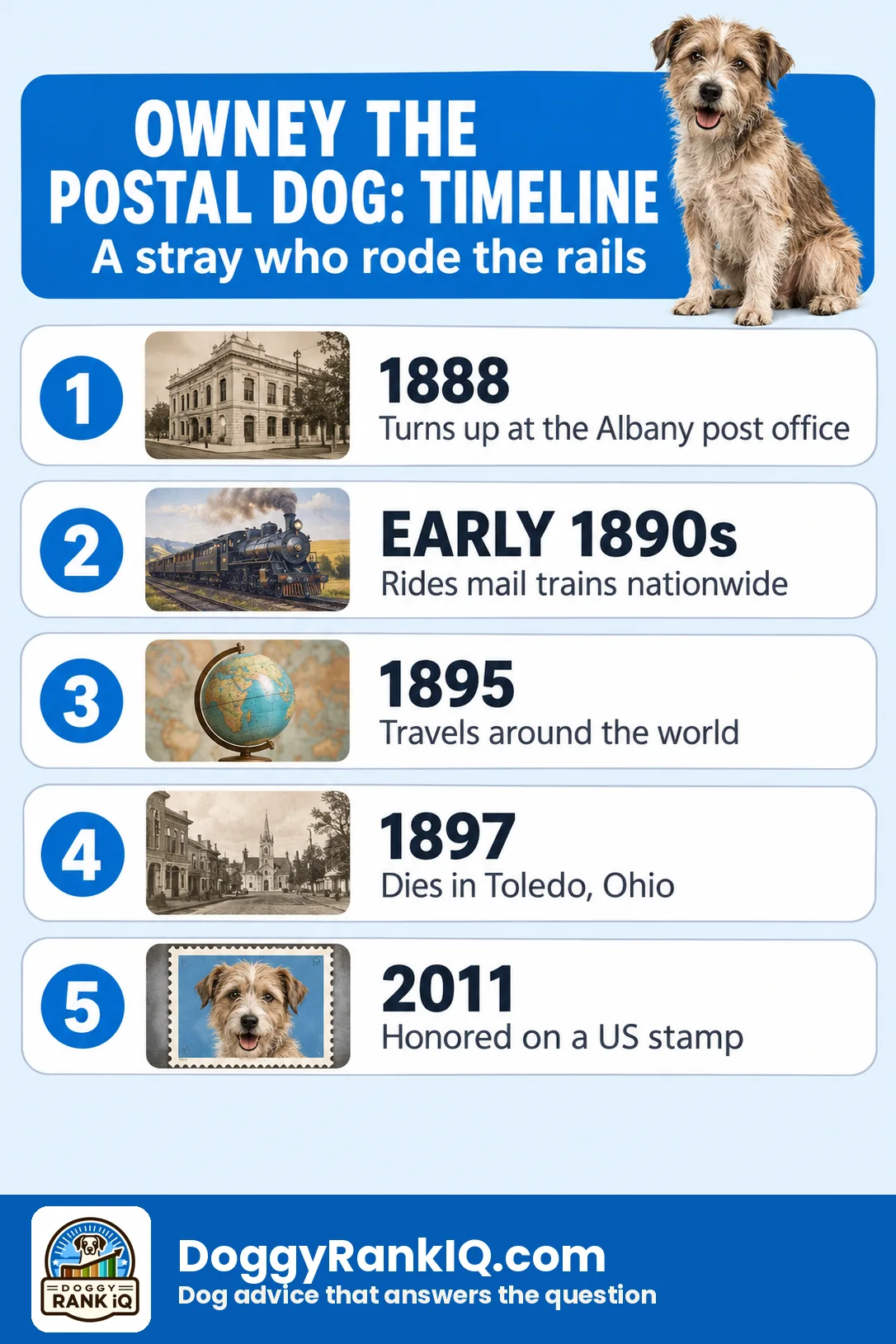
Timeline table: Owney’s life in dates
This table separates the hard dates from the parts of the Owney the postal dog story that rely on tradition, which matters because several popular retellings blur the two.
How a stray became the Railway Mail Service mascot
Owney’s mascot status grew from repetition, not a single dramatic event. Clerks kept seeing the same dog on multiple routes, decided he brought good luck, and started marking that association with physical objects.
The belief took hold that no train carrying Owney had ever wrecked (trains.com). That is worth stating plainly for what it is: a tradition passed between railway workers, not a tracked statistic with a published source. It is the kind of claim that gets repeated because it is comforting and memorable, which is exactly how legends attach themselves to real history.
A few concrete factors helped the mascot idea stick:
- Railway mail clerks worked long, repetitive shifts sorting mail inside moving train cars, often in difficult conditions. A friendly, well-traveled dog broke up the monotony.
- Clerks along different routes recognized Owney by sight and by his growing collection of tags, which worked like a traveling reputation.
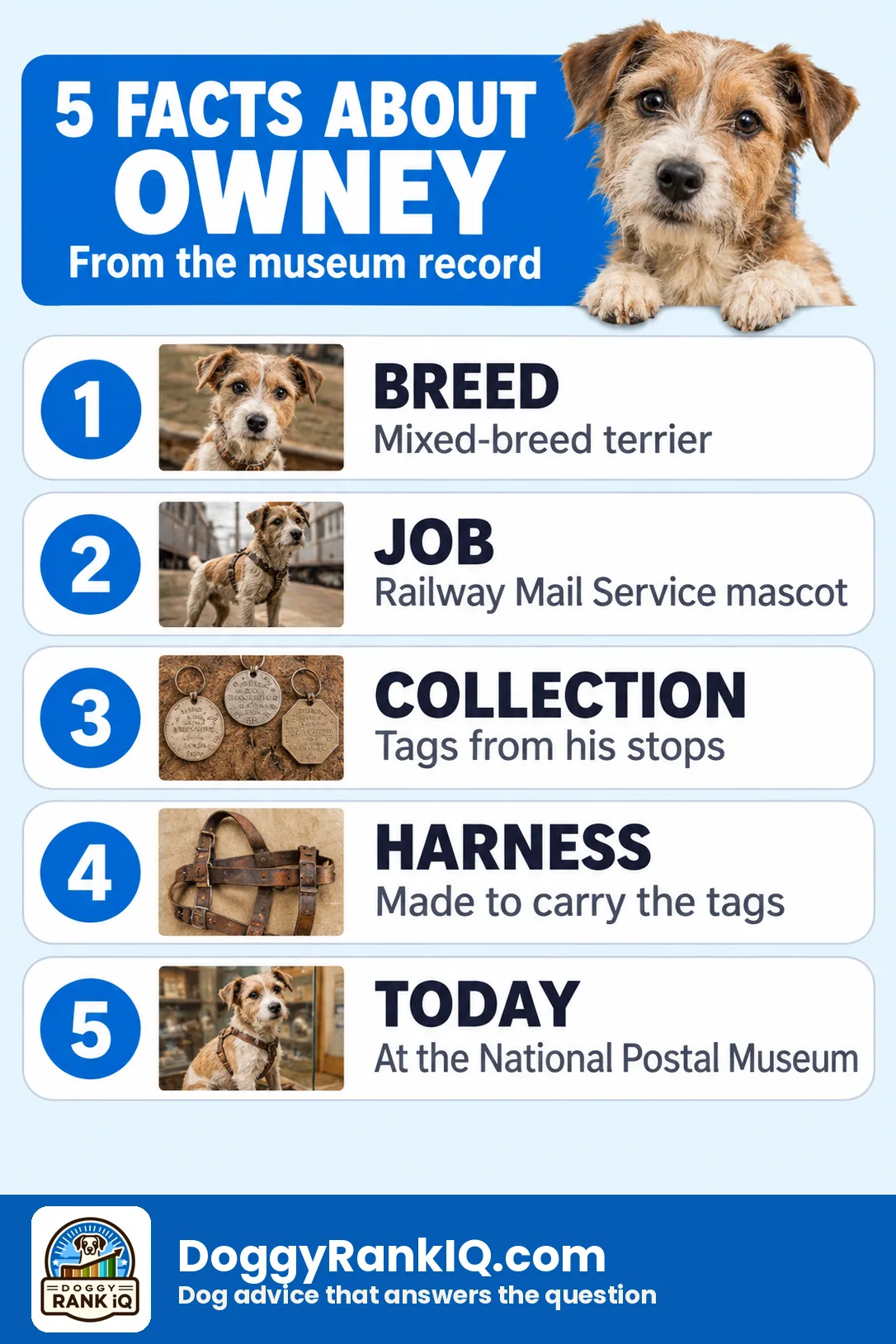
- Postmaster General John Wanamaker reportedly had a harness made for Owney so the growing pile of tags and medals could be worn without weighing down his collar (facts.usps.com).
Decision rule: if you are trying to separate “documented history” from “beloved tradition” anywhere in the Owney the postal dog mascot story, ask whether the claim is tied to a specific tag, newspaper account, or museum record. If it is tied only to oral tradition among clerks, treat it as folklore worth repeating with a caveat, not as settled fact.
One edge case worth naming: Owney’s fame depended partly on contrast. Smithsonian Magazine quotes curator Nancy Pope describing him as a “scruffy mutt” whose ordinary looks made his extraordinary travel schedule more charming to the public (smithsonianmag.com). An elegant show dog doing the same thing might not have become a national mascot at all.
What his tags actually prove: the travel record on his harness
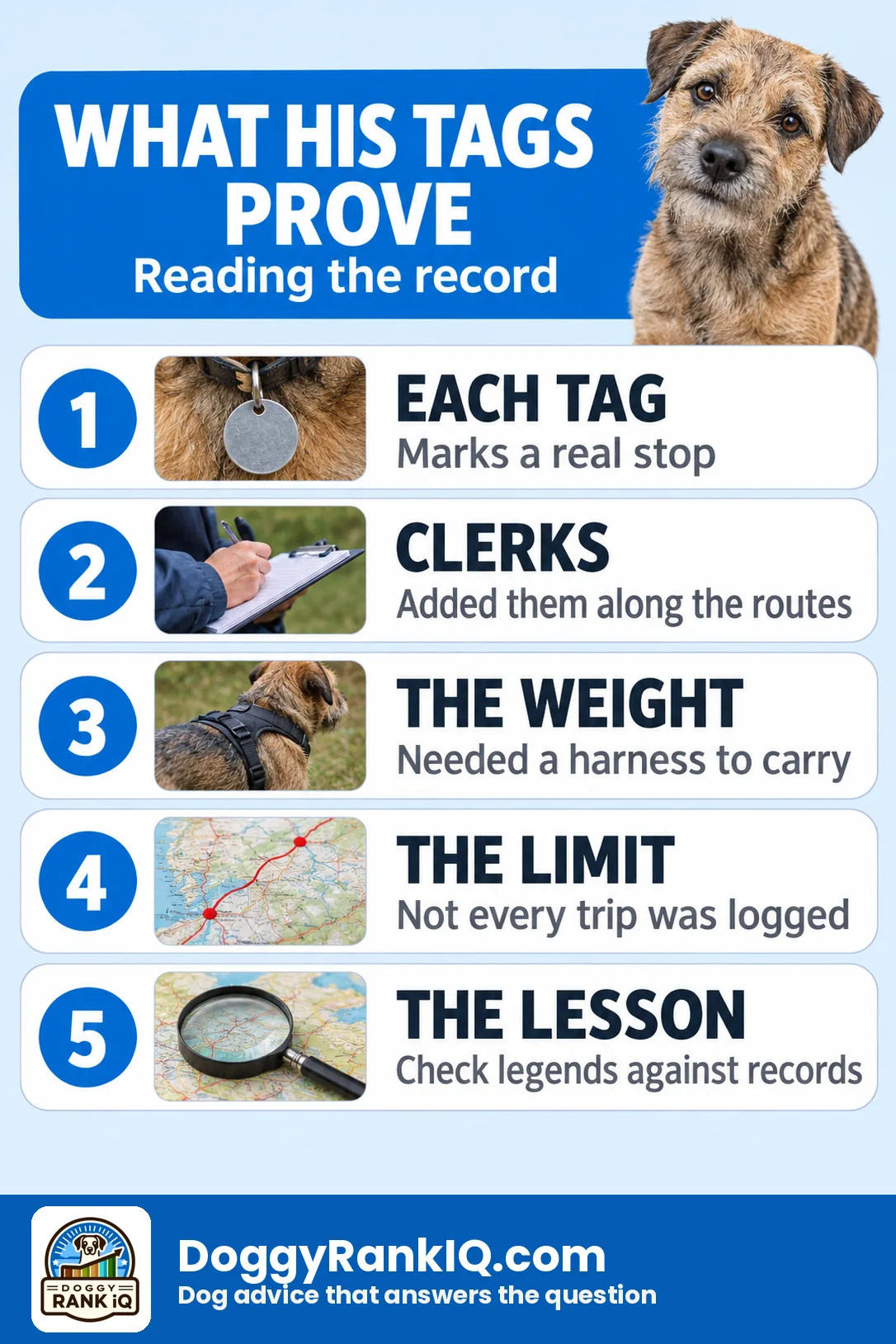
Owney the postal dog’s tags prove he was repeatedly handled, identified, and honored by postal workers, railway employees, hotels, civic groups, and individual admirers across many places (postalmuseum.si.edu). They do not automatically prove that he personally traveled to every location stamped or engraved on every object.
That distinction matters more than it sounds like it should. The National Postal Museum categorizes the surviving items into several types: baggage checks, hotel tokens, dog licenses, commercial tokens, medals, coins, identification tags, and assorted souvenirs (postalmuseum.si.edu). Each category tells a slightly different story about Owney’s relationship to the places it names.
Here is the breakdown that actually supports the “proof” question:
- Baggage checks and railroad tags were attached by mail clerks as Owney rode specific lines, which is reasonably direct evidence of travel on that route (facts.usps.com, postalmuseum.si.edu).
- Hotel tokens could mean Owney stayed somewhere, or could mean a hotel simply wanted to be part of his growing fame by handing over a souvenir token when he passed through, even briefly.
- Commercial tokens and medals from towns or businesses often functioned as gifts or promotional items, not travel receipts. A town could honor Owney with a medal through the mail without him ever setting foot there (postalmuseum.si.edu).
- Dog licenses suggest some level of local registration or recognition, which leans toward an actual visit, though licensing practices of the 1890s were not standardized enough to confirm this in every case.
The original collar tag reading “Owney, Post Office, Albany, N.Y.” was practical, not ceremonial. It was meant to get him sent home if he got lost, the same basic function as a modern pet ID tag (facts.usps.com). Everything added after that point was clerks and admirers layering status onto a working dog.
So when someone asks whether Owney really visited every place listed on his harness, the honest answer is: probably not all of them, and the museum’s own research leans on newspapers and railroad maps alongside the tags to reconstruct where he actually went, rather than treating the objects as a standalone travel log (postalmuseum.si.edu, smithsonianmag.com). The tags are strong evidence of fame and affection. They are partial evidence of an actual itinerary.
Common mistake: assuming a tag equals a visit. The safer reading is that a tag equals an interaction, documented somewhere between “Owney was physically here” and “someone wanted to be associated with Owney.”
The 1895 trip around the world
Owney the postal dog’s best-documented single trip is his 1895 trip around the world with the mail, which departed from Tacoma, Washington, and concluded that December (facts.usps.com). This is the one piece of the story that reads less like legend and more like a logged itinerary, because it involved formal mail shipments crossing oceans rather than informal train hopping between American towns.
The trip put Owney on ships and in foreign ports as part of actual mail transport, which is a very different kind of evidence than a souvenir medal from a stateside admirer. A dog riding along as cargo-adjacent mail escort across the Pacific and back, in an era before easy global travel, is the kind of detail that made him a minor celebrity well beyond railway circles.
What made this trip notable at the time:
- It extended Owney’s reputation past domestic rail lines into an international mail story, which fit the Gilded Age fascination with speed, distance, and the postal system as a modern marvel.
- It added another distinct layer of tags and recognitions tied to specific countries and ports, strengthening the physical record of where he actually went during that stretch.
- It gave Owney a clean narrative arc: departure, global route, return, which is easier to document and verify than years of scattered domestic rail trips.
This trip is a good example of where fact and legend sit closest together without actually conflicting. The departure point, destination type, and return timing are documented (facts.usps.com). The exact day-by-day experience on board, understandably, was not something anyone was transcribing in detail in 1895.
What happened to Owney the postal dog?
Owney the postal dog died in Toledo, Ohio, on June 11, 1897 (facts.usps.com). Accounts describe him being shot after reportedly biting a postal clerk, though the full circumstances remain disputed and not fully settled in the historical record.
This is the part of the Owney story that deserves a steady tone rather than a dramatic flourish. A working animal’s death, even one documented more than a century ago, is not a plot twist to play for effect. The record available today does not give a single, confirmed, agreed-upon account of exactly what happened in that moment in Toledo. What is clear is the aftermath: mail clerks who had known him for years were upset enough to act.
Those clerks raised money to have Owney’s body professionally preserved rather than let a nine-year traveling companion simply disappear from the record (facts.usps.com). That decision is arguably the reason any of this story survives in physical form today. Without that preservation effort, Owney would likely be a handful of newspaper mentions and a fading oral tradition among retired railway clerks, not a museum centerpiece.
The preserved body was eventually donated to the Smithsonian in 1911 (facts.usps.com). For eighty-plus years after that, Owney moved between storage and occasional display before settling into his current long-term home.
Where to see Owney today, and the stamp
Owney is on permanent public display at the National Postal Museum in Washington, D.C., where admission is free and the museum is open daily from 10:00 a.m. to 5:30 p.m. (postalmuseum.si.edu). He has held this exhibit spot since 1993, and the Smithsonian conserved his mount in 2011 to keep the display stable for future visitors (facts.usps.com).
The museum sits at 2 Massachusetts Avenue NE, and the Owney exhibit is part of the museum’s larger section on postal operations and popular culture, placing him alongside the broader story of how the mail system shaped everyday American life (postalmuseum.si.edu).
On July 27, 2011, the United States Postal Service marked his legacy with an Owney forever stamp, timed close to the conservation work on his display mount. The stamp turned a regional railway legend into a small piece of postal history that collectors can hold, which fits neatly given that Owney’s own fame was built partly on physical tokens.
The museum also holds hundreds of Owney’s original tags and medals in its collection, cataloged by type (baggage checks, hotel tokens, medals, licenses, and more), and its exhibition pages remain the most reliable public reference for sorting documented fact from retold legend (postalmuseum.si.edu).
If you are researching the broader question of loyalty and bonding in working dogs, the Owney story pairs naturally with what is the top dog for loyalty, since Owney’s entire reputation was built on sticking with a job and a group of people rather than one household.
Fact vs legend: 4 claims checked
1Owney was found starving and freezing outside the Albany post office
This is the popular version, but it overstates what the museum’s research actually supports. The National Postal Museum’s investigation suggests his owner was likely a postal clerk, and Owney stayed on after that person left the job, which is a quieter and less dramatic origin than the rescue-from-the-cold story (postalmuseum.si.edu, smithsonianmag.com).
2No train carrying Owney ever wrecked
This claim circulated among railway mail clerks as a point of pride, treating Owney as a good luck charm (trains.com). It is a tradition, not a verified statistic drawn from railroad accident records, and no source in the available record ties it to an actual tally of trips and incidents.
3Every tag on Owney’s harness marks a place he personally visited
Not confirmed. The museum’s own categorization of the tags, baggage checks, hotel tokens, commercial tokens, medals, and licenses, shows that several categories functioned as gifts or souvenirs rather than travel confirmations (postalmuseum.si.edu). Some tags likely mark genuine stops; others mark admiration from a distance.
4Owney completed a full around-the-world trip carrying mail in 1895
This one holds up. The departure from Tacoma, Washington, and the return in December 1895 are part of the documented record, making it one of the more solid single claims in the entire Owney story (facts.usps.com).
⭐ Top 5 Features We Love
- A genuinely documented origin point. Owney’s arrival at the Albany post office around 1888 is traceable, giving the whole story a real starting line rather than a vague “once upon a time” (facts.usps.com).
- Physical proof you can still see. Hundreds of his actual tags and medals survive in the Smithsonian’s collection, which is rare for a 19th-century animal story (postalmuseum.si.edu).
- A clean, verifiable centerpiece event. The 1895 trip around the world gives the narrative a strong, dated arc with a real departure and return (facts.usps.com).
- A human ending, even if a hard one. Clerks paying to preserve his body shows the actual affection behind the mascot status, not just a cute anecdote (facts.usps.com).
- A permanent, accessible home. Free admission at the National Postal Museum means anyone can go verify the display in person rather than relying on retellings (postalmuseum.si.edu).
⚠️ Things to Look Out For
- The “freezing stray” origin story. Museum research leans toward a clerk-owned dog left behind, not a rescue from the cold (postalmuseum.si.edu, smithsonianmag.com).
- Treating every single tag as a personal visit record. Several tag categories were gifts or souvenirs, not travel confirmations (postalmuseum.si.edu).
- The “never wrecked a train” statistic. It is oral tradition among railway clerks, not a sourced count (trains.com).
- Exaggerated mileage totals. Be cautious of any specific total-miles figure online; the available sourced record does not confirm a precise worldwide mileage number, so unverified totals should be treated skeptically rather than repeated as fact.
- Confusing updated museum webpages with new historical discoveries. The USPS and Smithsonian pages have been refreshed in 2026, but they reiterate the same long-settled chronology rather than reporting new findings (facts.usps.com, postalmuseum.si.edu).
Books and keepsakes for Owney fans
For readers and classrooms who want to go deeper than a museum visit, a few print options cover the Owney story in different formats. These are named for convenience, not tested in-house, so check each listing’s current details before buying.
- Owney (Applewood Books) retells the history for general readers and works well as a gift for stamp collectors or postal history fans. Price checked 2026: $14.95. Check the current price
- Owney: The Mail-Pouch Pooch is a shorter, more classroom-friendly telling, suited to younger readers learning about the Railway Mail Service for the first time. Price checked 2026: $9.19. Check the current price
- The Dog Encyclopedia (DK) is not Owney-specific but gives broader context on dog history, breeds, and behavior for readers who want the bigger picture around famous working dogs. Price checked 2026: $13.29. Check the current price
None of these publishers or the museum have endorsed any ranking of these titles; they are simply three relevant, currently available options for readers who want the story in book form.
FAQ
The bottom line
Owney earned his fame honestly: nine years of riding mail trains, a documented trip around the world, and a pile of tags that prove he mattered to the people who handled the mail. The tags themselves are strong evidence of affection and recognition, not a flawless travel log, and the museum’s own research treats newspapers and railroad maps as equally important for reconstructing where he actually went (postalmuseum.si.edu, smithsonianmag.com). If you want to see the actual objects behind the legend, the National Postal Museum in Washington, D.C. has them on free, permanent display, which is a better next step than trusting any single retelling, including this one.
Doggy Rank IQ is reader supported. As an Amazon Associate we earn from qualifying purchases, at no extra cost to you.