
Quick Answer
Bummer and Lazarus were two stray dogs who roamed Montgomery Street in San Francisco during the early 1860s, and their partnership turned them into the city’s most talked-about animals. Bummer built a reputation as a rat killer at Frederick Martin’s saloon, and the pair became local celebrities after Bummer reportedly helped an injured dog recover in 1861, a dog the newspapers named Lazarus. Citizens petitioned to protect them from the dog catcher, and Mark Twain wrote about Bummer’s death in 1865. The bummer and lazarus story mixes documented newspaper coverage with legends that grew after the dogs were gone, and this article separates the two.
Key Takeaways: bummer and lazarus
- Bummer and Lazarus were real stray dogs, not fictional characters, and they lived around San Francisco’s Montgomery Street district between roughly 1861 and 1865 (cal170.library.ca.gov).
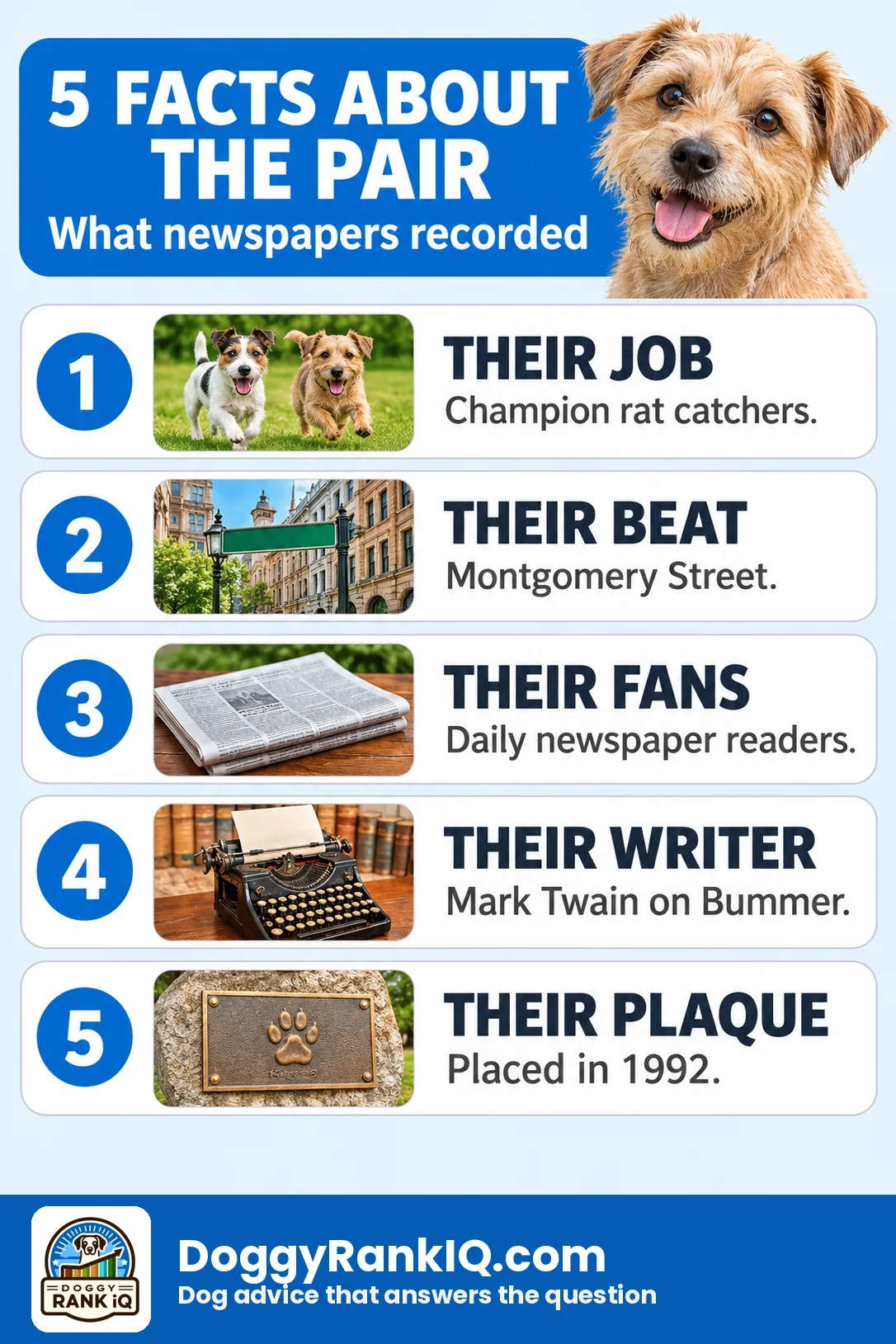
- Bummer earned his name and his following as a rat killer near Frederick Martin’s saloon.
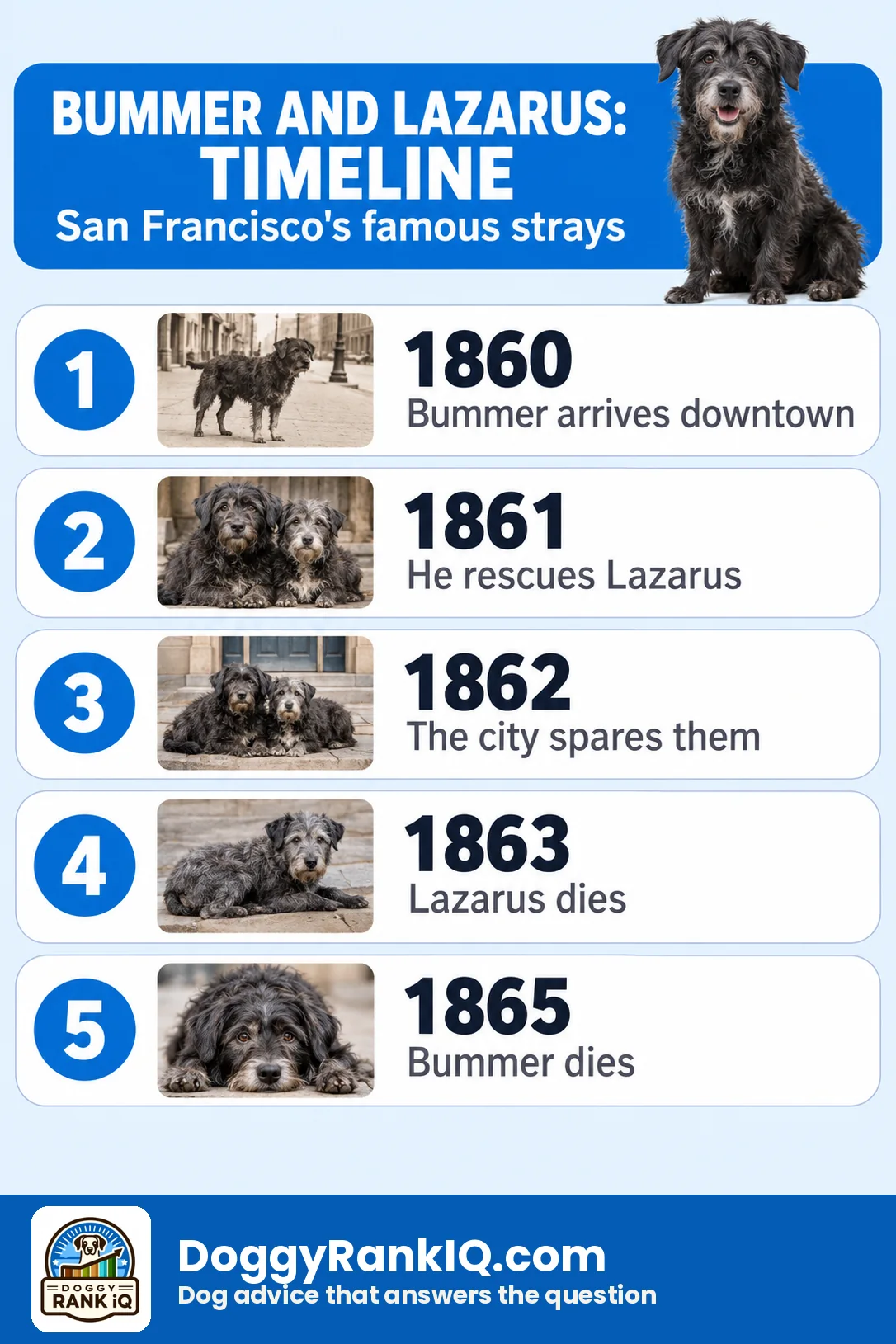
- The two dogs first appeared together in print in the Daily Alta California on January 18, 1861, after Bummer defended the injured Lazarus from a larger dog (kqed.org).
- Lazarus died in October 1863, likely poisoned, and Bummer died in November 1865 after being kicked by a man (en.wikipedia.org, kqed.org).
- Mark Twain wrote a firsthand account of Bummer’s death that is less flattering than most modern retellings (kqed.org).
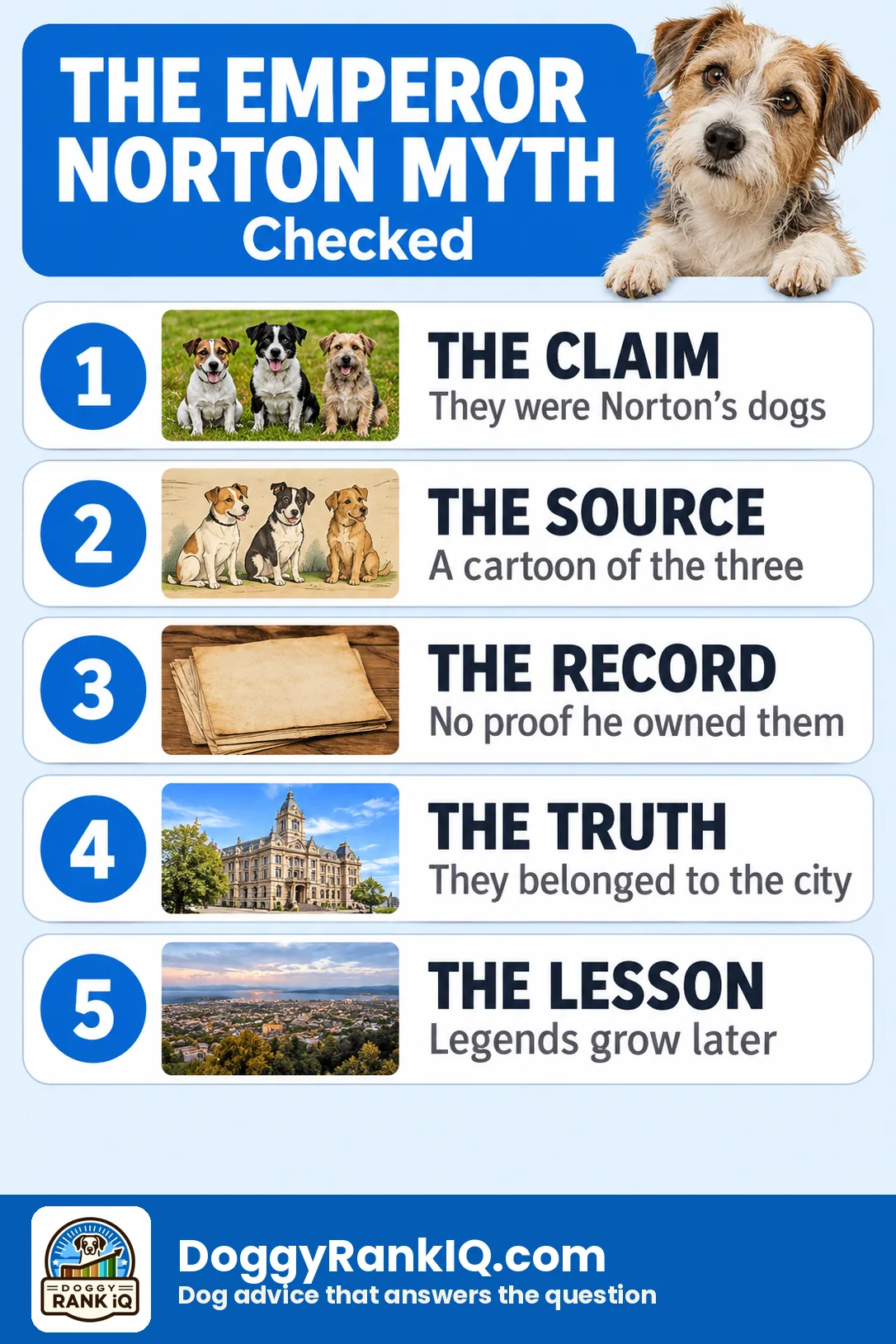
- They were never owned by Emperor Norton. That connection comes from cartoonist Edward Jump, who drew them together (foundsf.org).
- A bronze plaque honoring the pair sits in Transamerica Redwood Park in San Francisco today.
- Rat-kill counts credited to the dogs vary wildly across sources and should be treated as legend, not verified data (kqed.org, dogster.com).

What do you want to know?
Tap an option to see the answer.
The short answer: who Bummer and Lazarus were
Bummer and Lazarus were two ownerless dogs who lived on the streets of San Francisco’s financial district in the early 1860s, and the city adopted them as unofficial mascots. Bummer showed up first, a stray with a talent for killing rats around Montgomery Street’s saloons and shops. Lazarus arrived later, injured and unlikely to survive, until Bummer reportedly intervened on his behalf.
San Francisco in 1861 was still a rough, fast-growing Gold Rush city, and strays were common. What made these two different was publicity. Local papers like the Daily Alta California and the Daily Evening Bulletin covered their exploits the way a modern outlet might cover a local celebrity, and that attention is a large part of why we still know their names (kqed.org, cal170.library.ca.gov).
The California State Library frames them as part of the state’s broader animal history, noting their active years ran from about 1861 to 1865 (cal170.library.ca.gov). That five-year window is short. The legend that outlasted it is long.
Timeline table: their story in dates
Bummer, the rat killer of Montgomery Street
Bummer made his name doing a job nobody assigned him: clearing rats out of a saloon. He’s commonly described as a Newfoundland mix who showed up near Frederick Martin’s saloon and started killing rodents with enough skill that patrons started feeding him and talking about him (cal170.library.ca.gov).
A 19th century saloon with sawdust floors and open barrels was basically a rat buffet, so a dog that could clear them out had real value. Bummer’s reputation grew the old-fashioned way: word of mouth from saloon regulars, then newspaper mentions, then a kind of folk fame that stuck to him for the rest of his life.
Here’s where the numbers get slippery. Some tellings credit the pair with 85 rats killed in 20 minutes, others cite roughly 80 rats in an hour, and still others claim more than 400 rats in a single outing (kqed.org, dogster.com). None of these figures come from an audited count. They come from newspaper tradition and later retellings, so treat them as folklore with a basis in fact rather than a verified statistic.
How Lazarus got his name
Lazarus got his name from the biblical figure who was raised from death, and the name fit because nobody expected the injured dog to live. According to the Daily Alta California‘s January 1861 account, Bummer stepped in when a larger dog attacked a smaller, hurt stray, then reportedly brought the injured dog food and let him sleep curled against him for warmth (kqed.org).
The dog recovered. San Franciscans, already primed to follow Bummer’s exploits, named the survivor Lazarus and started treating the two as a pair rather than as separate strays.
Newspaper descriptions of Lazarus weren’t consistent. He was called part hound, part terrier, a mongrel, and a mixed breed stray depending on which paper ran the story (kqed.org). That inconsistency says less about Lazarus and more about how loosely 19th century reporters used breed language. If you’re curious how dogs ended up living alongside people in the first place, the longer history is covered in our piece on when dogs were first domesticated.
The city’s favorite strays: newspapers, cartoons and a petition
San Francisco didn’t just tolerate Bummer and Lazarus, it actively defended them. When a dog catcher seized Lazarus in 1862 under the city’s stray ordinance, residents pushed back with a petition, and the pair are reported to have been granted an exemption from that ordinance (en.wikipedia.org).
That’s a remarkable civic moment for two animals with no owner and no formal status. It tells you how much the newspaper coverage had shaped public opinion. Papers like the Daily Alta California and the Daily Evening Bulletin ran items on the dogs regularly, and cartoonist Edward Jump illustrated them repeatedly, often alongside the city’s other famous eccentric, Emperor Norton (foundsf.org, kqed.org).
Those cartoons did more than entertain. They cemented an image of Bummer and Lazarus as fixtures of San Francisco’s commercial district, the kind of local characters a city points to with pride. For context on why some dogs earn that kind of devotion from people, our article on what makes a dog loyal looks at the behavior research behind it.
What happened to Bummer and Lazarus?
Lazarus died first, on October 3, 1863, and the Mark Twain Project’s scholarly edition records the likely cause as poisoning (kqed.org). Bummer outlived him by about two years, dying on November 2, 1865, after being kicked.
Mark Twain, then working as a San Francisco journalist, wrote a firsthand account of Bummer’s death. His portrayal wasn’t purely sentimental. Twain described Bummer in his later years as aging and in decline, and he noted that Lazarus had been “canonized” by the newspapers partly because his death looked violent and mysterious, which made for better copy (kqed.org). That’s a useful corrective. Modern retellings tend to flatten both dogs into uncomplicated heroes, but even the writer closest to the events saw something messier and more human in how the city mythologized them.
A note on tone: losing a dog to poisoning or violence is not a quaint historical footnote, it’s the same loss any owner recognizes today. The 1860s newspapers treated it as a story. It was also, plainly, a death.
The Emperor Norton myth, checked
Bummer and Lazarus were never Emperor Norton’s dogs, and that misconception comes almost entirely from cartoon imagery rather than any documented ownership. Edward Jump’s illustrations frequently placed the three figures together because they were all recognizable San Francisco characters, and viewers over time assumed a relationship that the drawings never actually claimed (foundsf.org, kqed.org).
Historical summaries are consistent on this point: the dogs were free-ranging strays tied to the city’s commercial district, not pets belonging to any single person, including Norton (foundsf.org). Some accounts even suggest Norton disliked being lumped in with them in Jump’s cartoons, though that detail is harder to pin down with a primary source.
Decision rule for readers sorting fact from legend: if a claim about Bummer and Lazarus traces back to a newspaper article or a documented letter, treat it as reasonably solid. If it traces back only to a cartoon or a later retelling with no citation, treat it as probable folklore.
Bummer and Lazarus plaque: where to find it today
A bronze plaque honoring The two dogs was installed in 1992 at Transamerica Redwood Park in San Francisco, near the heart of the old Montgomery Street district where the dogs actually lived and worked. It’s a small, easy-to-miss marker for two animals who once had the whole city talking about them.
The park itself sits beside the Transamerica Pyramid, so visitors tracing Gold Rush history or Mark Twain’s old newspaper beat can fold a stop here into a short downtown walk. It’s one of the few physical, permanent acknowledgments that these were real animals, not just a story that got repeated until it became legend.
🌉 The city behind the legend: San Francisco in 1860
The two dogs make more sense once you see the streets they worked.
The 1860 census counted 56,802 people in San Francisco. Twelve years earlier, before the Gold Rush, it had been a village of about a thousand. A city that grows that fast outruns its own plumbing. Wharves and warehouses were built on fill and on the hulls of abandoned ships, food was stored wherever there was a dry corner, and rats did very well. A dog with a talent for killing them was pest control, and saloon keepers and shop owners along Montgomery Street had a business reason to toss him scraps.
Stray dogs in general were less welcome. Strays were rounded up and killed under city ordinance, and poisoned meat left in the street was common. That is the background to the petition after Lazarus was seized: citizens were asking for an exception to a rule that was killing dogs every week.
“Two rat killers got what no other stray in the city had: permission to exist.”
The newspapers supplied the rest. San Francisco had a crowd of daily papers competing for the same readers, and local writers were paid to be funny. Two strays with distinct personalities gave them recurring characters. Bummer was written as the dignified veteran, Lazarus as the scrappy hanger-on, and reporters assigned them motives, loyalties and quarrels the way a columnist today might narrate a celebrity feud. The dogs did the deeds. The papers decided what the deeds meant.
📰 How to read the original reports yourself
You do not have to take anyone’s retelling on trust, including this one.
The California Digital Newspaper Collection, run by the University of California, Riverside, hosts searchable scans of the Daily Alta California and other papers from the period, free to use. Search “Bummer” with the years 1861 to 1865 and you can read the items as San Franciscans did, between shipping notices and patent medicine ads.
A few tips for reading them:
- Expect jokes. A report that Bummer “attended” a theater opening is a writer amusing himself.
- Compare two papers on the same event. Where they agree on a date and a place, you are probably looking at something that happened.
- Watch the dates on anything about Emperor Norton. The items that link him to the dogs are mostly cartoons and later memories, as the myth check above explains.
🕰️ What became of the bodies
By most accounts both dogs were preserved by a taxidermist after they died and displayed in a saloon, where customers could still raise a glass to them. The mounts are said to have been handed to the museum in Golden Gate Park in 1906 and discarded a few years later. No one has produced them since. What survives is paper and bronze: the cartoons, the columns and a plaque.
⭐ Top 5 Features We Love
- A documented first meeting. The January 18, 1861 Daily Alta California item gives the story an actual starting date, not just a vague “sometime in the 1860s” (kqed.org).
- A genuine civic defense. The 1862 petition to save Lazarus from the dog catcher is a rare example of a city actively protecting strays (en.wikipedia.org).
- A primary-source account of the ending. Mark Twain’s own writing on Bummer’s death is a firsthand record, not secondhand legend (kqed.org).
- Visual documentation. Edward Jump’s cartoons give the pair a visual presence that most 1860s stray dogs never got.
- A physical marker that still exists. The 1992 plaque at Transamerica Redwood Park lets the story stay connected to a real place today.
⚠️ Things to Look Out For
- Inflated rat-kill numbers. Figures ranging from 85 rats in 20 minutes to 400-plus rats in one outing come from tradition, not an audited count (kqed.org, dogster.com).
- The Emperor Norton ownership myth. Cartoons implied a connection that no documented source confirms (foundsf.org).
- An overly tidy “public health hero” framing. One reading treats the dogs as informal rat-control workers; the more accurate read is that they were unowned strays in a city that otherwise controlled stray populations rather than celebrated them (axios.com, kqed.org).
- A flattened, purely heroic narrative. Twain’s own account shows an aging, declining Bummer, which complicates the simple hero story (kqed.org).
- Inconsistent breed descriptions. Newspapers called Lazarus a hound, a terrier, and a mongrel in different write-ups, which reflects loose 19th century reporting, not a settled fact (kqed.org).
Books on Bummer and Lazarus and dog history
For readers who want the deeper version of the the two dogs story, a few books are worth checking.
Barker’s book is the most direct source on this specific story. Its stated approach is to work from actual 1861 to 1865 newspaper reporting and separate that record from the legends that formed afterward, which lines up with the primary-source approach this article relies on. It’s told in a style accessible to older kids and adults with an interest in local history, though it’s not a children’s picture book. The Dog Encyclopedia and The Invention of the Dog are broader reference options for readers whose interest in The two dogs has turned into a general interest in dog history and breeds.
Check the current price on the Malcolm Barker book.
Check the current price on The Dog Encyclopedia.
Check the current price on The Invention of the Dog.
No standalone audiobook edition of Barker’s book was confirmed through available sources, so readers looking for an audio format should check the retailer page directly before assuming one exists.
FAQ
The bottom line
The the two dogs story holds up because real newspapers, a real petition, and a real account from Mark Twain back up most of the core facts. What doesn’t hold up under scrutiny is the Emperor Norton ownership claim and the more dramatic rat-kill numbers, both of which drifted from documented fact into local legend over the decades. If this kind of history interests you, the plaque at Transamerica Redwood Park is a short, worthwhile stop next time you’re near the Financial District, and Malcolm Barker’s book is the clearest way to read the original newspaper record for yourself.
Doggy Rank IQ is reader supported. As an Amazon Associate we earn from qualifying purchases, at no extra cost to you.