

Quick Answer
The AKC trick dog program lets a dog earn an official title by performing a set list of behaviors for an approved evaluator, either in person or through a submitted video. Most owners start with Novice, which asks for 10 tricks (or five, if the dog already has a Canine Good Citizen certificate). Evaluations can happen entirely at home through AKC’s virtual testing option, and applications now go through AKC’s online Title Application Portal instead of paper mail. A Novice akc trick dog title is realistic in about two weeks of short daily sessions.
Key Takeaways: akc trick dog
- AKC trick dog has five titles: Novice (TKN), Intermediate (TKI), Advanced (TKA), Performer (TKP), and Elite Performer (TKE). (akc.org)
- Novice needs 10 tricks from the official list, or five if the dog holds a CGC certificate. (akc.org)
- Evaluations happen two ways: in person with an approved CGC Evaluator, or by video submission, which is how owners complete the whole thing from home. (akc.org)
- Dogs need an AKC number, a PAL number, or an AKC Canine Partners number, so mixed breeds qualify too. (akc.org)
- The minimum age for any akc trick dog title award is four months. (akc.org)
- Applications now go through AKC’s Title Application Portal (TAP), an online system that replaced most paper submissions. (akc.org)
- More than 200 dogs competed in AKC’s 2026 virtual trick dog competition, including teams from Canada and Australia. (akc.org)

Where is your dog now?
Tap an option to see the answer.
The short answer: what AKC Trick Dog is
AKC trick dog is a titling program, not a conformation show or an obedience trial. A dog performs a specific set of tricks for an evaluator, passes, and the title gets recorded with AKC.
There’s no ring, no judge in a blazer, no waiting for your number to be called. A CGC Evaluator watches the dog perform the required behaviors, checks them off, and signs the paperwork. The dog does not have to be registered as a purebred. It needs some kind of AKC-recognized number: an AKC Registration Number for purebreds, a PAL number for unregistered purebreds, or a Canine Partners number for mixed breeds. (akc.org)
The program was built to reward ordinary training, not performance polish. A dog that sits reliably, shakes on cue, and spins for a treat already has a start on a title. For owners who also want basic manners covered first, our guide to five essential commands every puppy should learn pairs well with trick training, since several novice tricks build directly on sit, down, and stay.
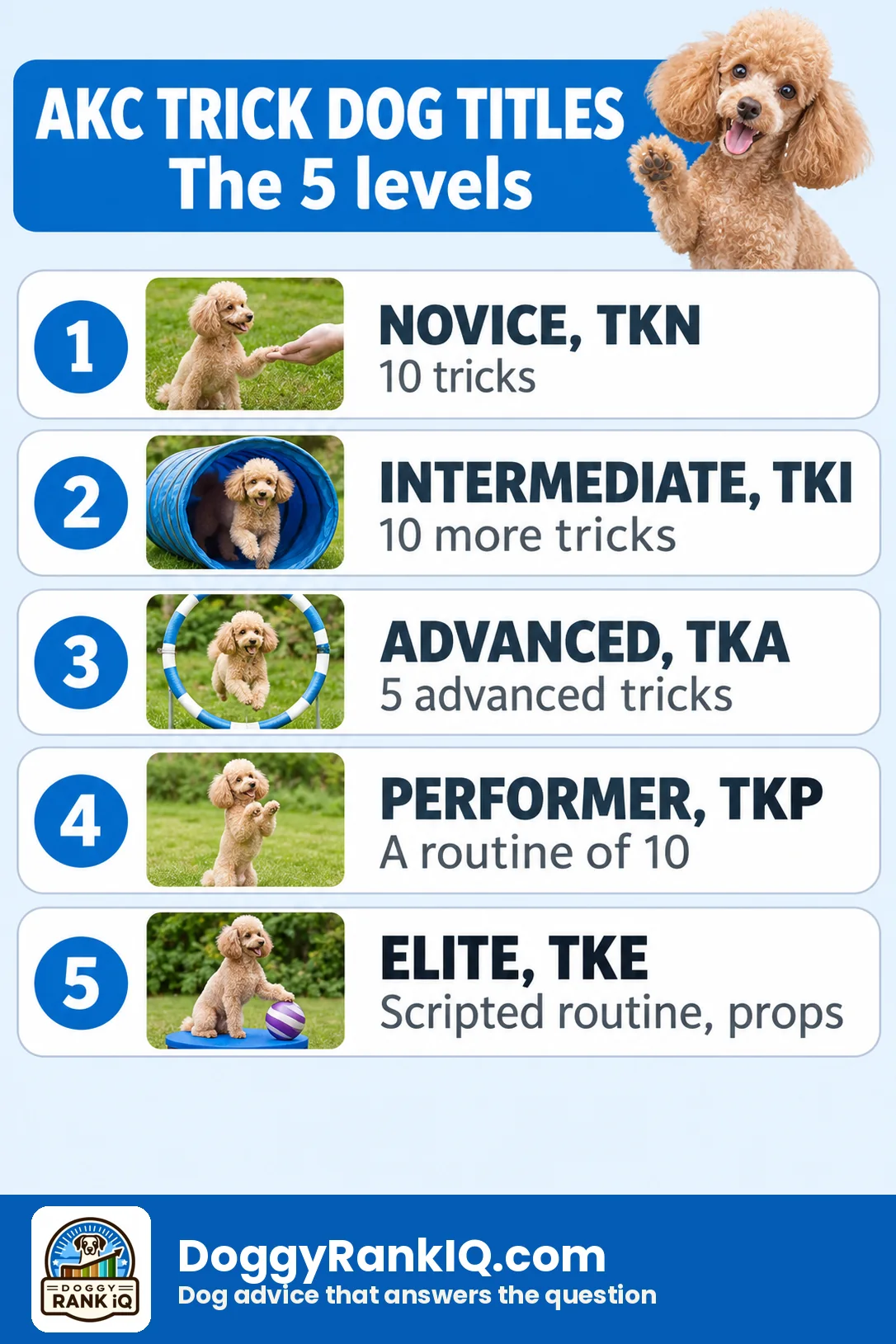
AKC Trick Dog titles list: the 5 levels
The akc trick dog titles list runs in a fixed order: Novice, Intermediate, Advanced, Performer, Elite Performer. Each one builds on the last.
- Novice (TKN): 10 tricks from the novice checklist, or five plus a CGC.
- Intermediate (TKI): requires Novice first, plus 10 intermediate tricks. Lures used at the novice stage mostly need to disappear. (akc.org)
- Advanced (TKA): requires Novice and Intermediate, plus five advanced behaviors.
- Performer (TKP): not a checklist anymore. The dog performs a routine of at least 10 previously learned tricks, including at least two intermediate and two advanced tricks, often involving props. (akc.org)
- Elite Performer (TKE): a scripted routine using props, the top of the ladder.
Decision rule: if your dog is young, nervous in new places, or you’re simply curious whether trick training is worth the effort, start at Novice. Nobody skips ahead in this program, so there’s no reason to plan past it yet.
Facts table: title ladder
Source: AKC Trick Dog rules and program page. (akc.org)
Easy titles you can earn from home: the video route, step by step
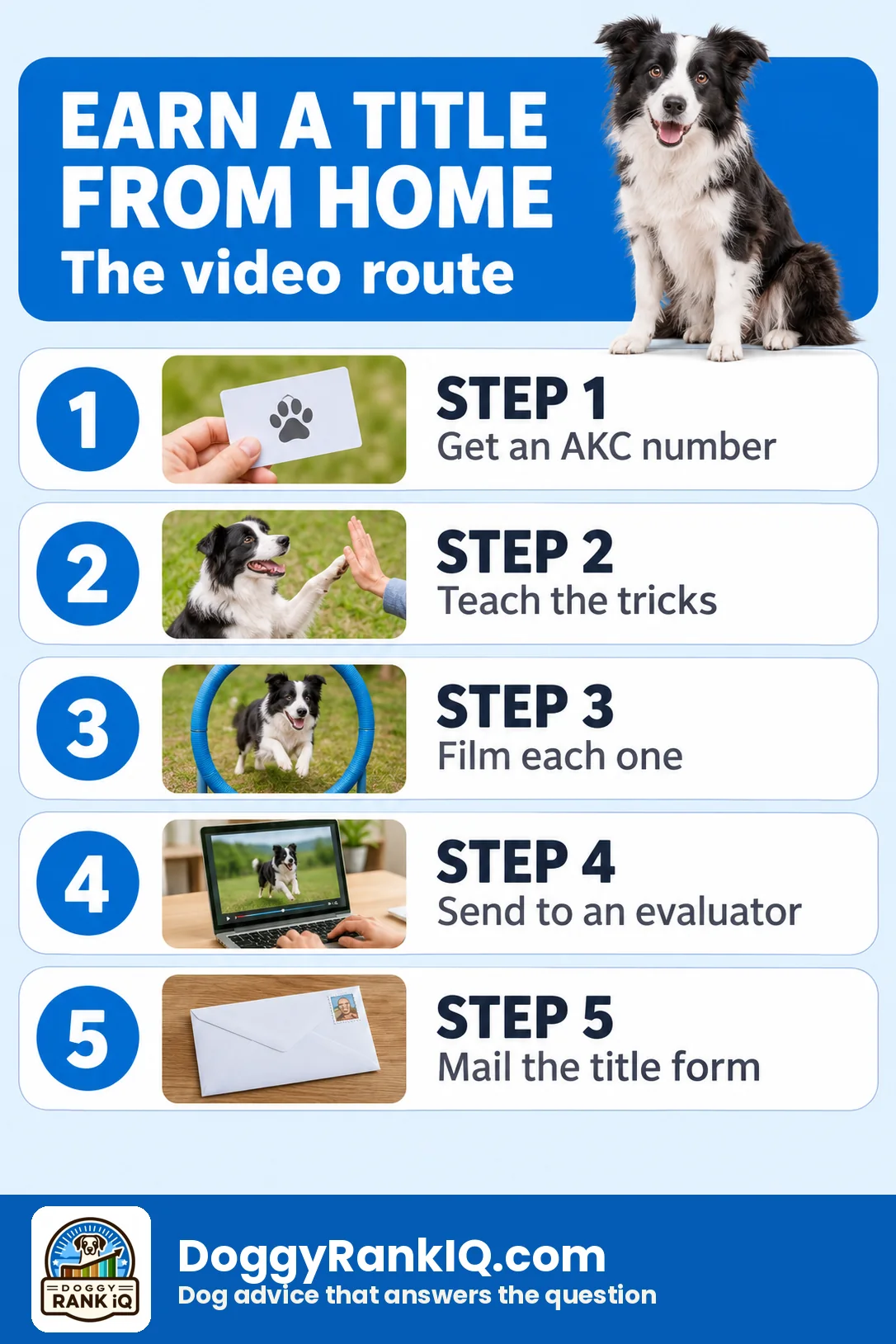
Yes, you can really earn an Trick Dog title without leaving the house. The dog trains at home, the evaluation happens through a submitted video, and the paperwork goes in online.
1 Confirm the dog’s AKC number
 Confirm the dog’s AKC number
Register the dog, get a PAL number for an unregistered purebred, or enroll in AKC Canine Partners for a mixed breed. This step happens once and opens up every AKC title program, not just trick dog.
2Pick a title level and pull the checklist
Download the current novice list from AKC’s trick dog page and pick 10 tricks the dog already half-knows. Starting with tricks close to mastery speeds up the whole process.
3Train in short, daily sessions
Five minutes, twice a day, beats one long weekend session. Dogs retain new behaviors better with frequent short repetition than with marathon cramming.
4Find an approved CGC Evaluator offering virtual testing
AKC recognizes two testing methods: in-person observation and virtual evaluation by an approved evaluator. (akc.org) Search AKC’s evaluator directory for one offering remote testing, or ask a local trainer if they hold the credential.
5Record and submit
Film the dog performing each required trick clearly enough for the evaluator to judge. Then submit the title application through AKC’s Title Application Portal, described as a faster online alternative to mailing paper forms. (akc.org)
AKC Trick Dog Novice list: 10 easy tricks to start
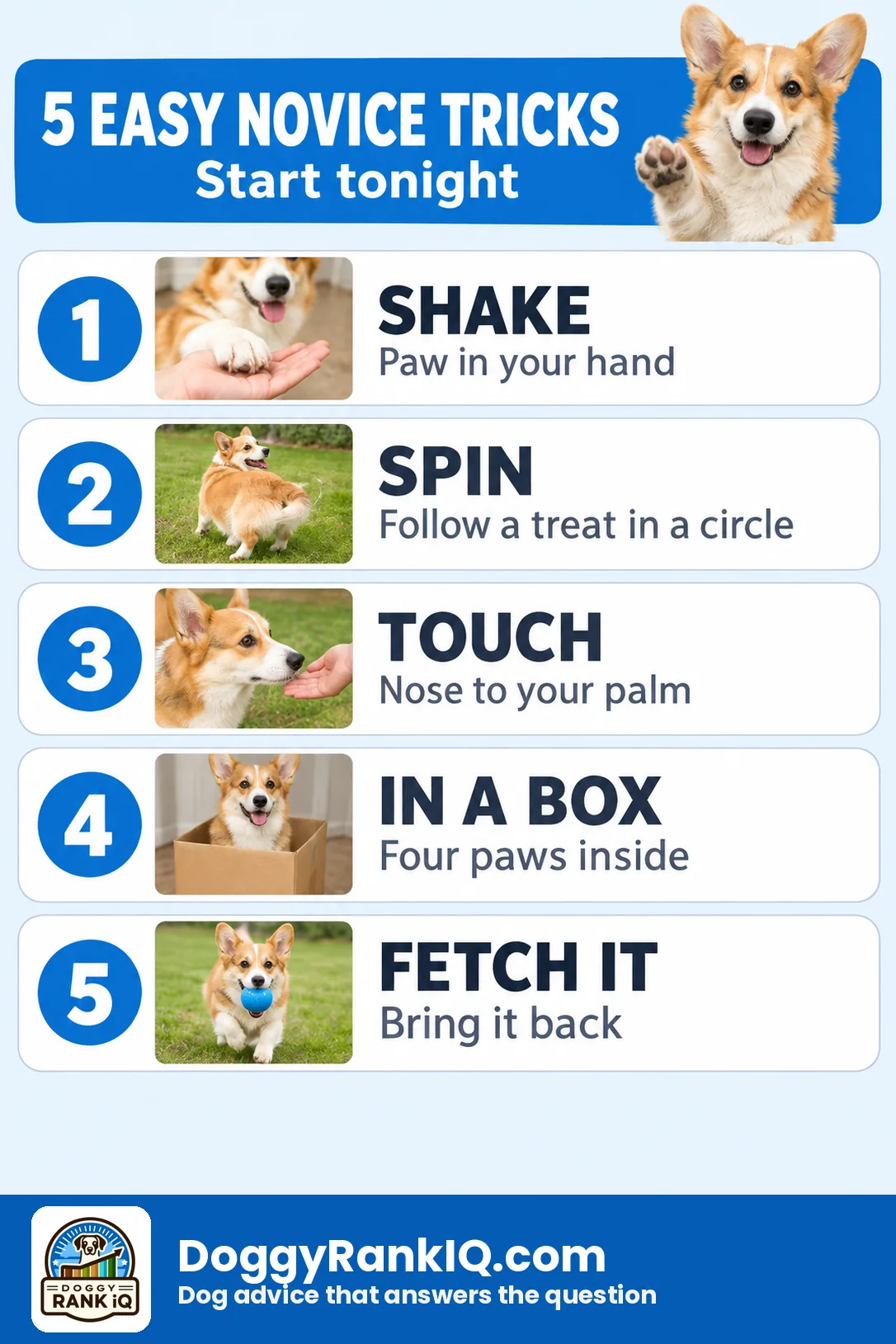
The novice checklist rewards dogs that already know basic manners. Pick from behaviors most dogs pick up within days.
1Sit
The foundation trick and usually the fastest to confirm for an evaluator.
2Down
Builds directly on sit and shows up again at higher title levels.
3Shake
A crowd favorite and often the first “trick” owners teach without meaning to.
4Spin
A full turn in place, usually lured with a treat at first.
5Touch (hand target)
The dog touches its nose to an open palm. This single skill becomes the building block for dozens of later tricks.
6Get in a box
Tests comfort with a confined space, useful prep for crate training too.
7Kennel up
Sends the dog into its crate or a designated spot on cue.
8Fetch it
Retrieving a specific object on command, not a general game of fetch.
9Speak
A single bark on cue. Some dogs offer this one for free.
10Stay
A held position for a few seconds, often the last piece owners polish before testing.
If the dog already has a Canine Good Citizen certificate, the CGC counts as five tricks automatically, so only five additional novice tricks are needed. (akc.org) For owners who want a broader look at trainable breeds before picking a dog, our guide to the most obedient dog breeds is worth a read, with the reminder that individual variation matters more than breed averages.
AKC Trick Dog Advanced and Performer: what changes
Advanced and Performer stop being simple checklists and start asking for sequencing and presentation. The dog needs more reliability under distraction, not just a longer list of behaviors.
Advanced requires five new behaviors on top of the completed Novice and Intermediate titles. These tend to be multi-step tricks: weaving through legs, retrieving by name from a group of objects, or holding a longer stay with distractions nearby.
Performer drops the checklist format entirely. The dog performs a routine of at least 10 previously learned tricks, including at least two from the intermediate list and two from the advanced list, often with props worked into the sequence. (akc.org) This is closer to a short show than a test. Owners filming for Performer should plan the order of tricks in advance the same way a trainer would plan a competition routine, which is covered in AKC’s own guidance on preparing for trick dog competitions.
Elite Performer sits above Performer with a scripted routine and heavier prop use, aimed at dogs and handlers who already enjoy the performance side of training.
Do mixed breeds qualify? AKC trick dog breed rules
Mixed breed dogs qualify for every Trick Dog title through AKC Canine Partners enrollment. Breed, size, and pedigree status don’t limit which titles a dog can earn.
AKC’s trick dog program accepts any dog with a qualifying number: AKC Registration, PAL, or Canine Partners. (akc.org) A rescue mutt with no paperwork history can enroll in Canine Partners and start from the same Novice checklist as a show-bred retriever. There’s no breed restriction built into the rules, and no minimum size. A ten-pound terrier and a ninety-pound mastiff perform the same list of tricks, adjusted only for what’s physically reasonable for that dog’s body.
The one firm rule is age: AKC will not award any trick dog title until the dog is at least four months old. (akc.org) Training can start earlier in short, puppy-appropriate sessions, but the title itself waits for that age threshold.
🎓 Three ways to teach any trick on the list
Every trick an evaluator will ask for can be taught with one of three methods. Picking the right one saves days.
Luring is the fastest for position tricks. Hold a treat at the dog’s nose and move it where you want the head to go, and the body follows: up for sit pretty, in a circle for spin, between your legs for peekaboo. The risk is a dog who only performs when food is in your hand. Fade it early. After five or six successful repetitions, make the same hand motion with an empty hand and pay from your pocket.
Capturing suits things your dog already does. A dog who stretches into a bow every morning or sneezes when excited is offering you tricks for free. Say “yes” or click at the exact moment it happens, pay, and repeat for a few days until the dog starts offering it on purpose. Then name it.
Shaping builds a behavior in slices and works best for prop tricks, such as getting in a box or closing a door. Pay for looking at the box. Then for a step toward it, then one paw in, then two. Each slice should take only a few repetitions before you ask for a little more. If the dog stalls, your slice was too big.
“Name the trick last. The dog learns the motion first and the word second.”
Whichever you use, add the word last. Dogs learn the motion first and attach the cue later, so say “spin” only once the dog is already spinning reliably. Keep sessions to three to five minutes and end while the dog still wants more. For an Trick Dog video, film on a day when the trick has been reliable for a week, in the room where you practiced it. A new location on filming day is a common reason a solid trick falls apart on camera.
⭐ Top 5 Features We Love
- Home-based evaluation. The virtual testing option means a dog can earn a real AKC title without ever getting in a car.
- A CGC head start. Dogs with a Canine Good Citizen certificate skip straight to needing only five novice tricks instead of ten.
- No breed gatekeeping. Canine Partners numbers put mixed breeds on equal footing with registered purebreds.
- Online applications. AKC’s Title Application Portal replaced most of the mailed paperwork, which speeds up getting the title on record. (akc.org)
- A clear ladder. Five titles, in fixed order, make progress easy to track instead of guessing what’s next.
⚠️ Things to Look Out For
- Finding a virtual evaluator takes effort. Not every approved CGC Evaluator offers remote testing, so search before assuming it’s available locally.
- Lures need to disappear by Intermediate. A dog that only performs tricks with a treat held in front of its nose will struggle once lures are phased out at higher levels. (akc.org)
- Video quality matters. A shaky or poorly lit submission can cost a pass even when the dog performed correctly.
- Performer and Elite Performer ask for real sequencing. These aren’t a quick weekend project the way Novice often is.
- Age cutoff is firm. A dog under four months cannot receive a title yet, regardless of how well it performs. (akc.org)
A 14-day plan to your Novice title
A Novice title is realistic in two weeks for most healthy adult dogs with no major behavior issues. The plan below assumes two five-minute sessions a day.
Common mistake: training all 10 tricks at once instead of layering three or four at a time. Dogs generalize better when a handful of behaviors are solid before new ones get added.
Puppies as young as four months can start this plan, and senior dogs with no mobility limits do just as well, since most novice tricks don’t demand athleticism. For dogs with anxiety or general fearfulness, a slower version of this same plan still works. Training at home in a familiar space, with no audience and no pressure to perform in public, tends to suit anxious dogs better than a crowded class ever would.
AKC Trick Dog book and tools that help
A few inexpensive tools make the 14-day plan easier without requiring a professional trainer.
101 Dog Tricks: Step by Step Activities is a widely used Trick Dog book that breaks tricks into small steps with photos, useful for owners who want a script rather than guesswork. Check the current price. $12.46, price checked 2026.
The Big Book of Tricks for the Best Dog Ever covers a larger range of tricks at a lower price point, good for owners planning ahead to Intermediate and Advanced. Check the current price. $7.07, price checked 2026.
Dog Training Clicker with Wrist Strap helps mark the exact moment a dog gets a trick right, which speeds up learning compared to a verbal “good dog” alone, according to clicker training methods widely taught by trainers. Check the current price. $4.99, price checked 2026.
heouvo Magnetic Dog Treat Pouch with Training Clicker combines a pouch and clicker in one, convenient for the two-sessions-a-day rhythm the 14-day plan asks for. Check the current price. $9.99, price checked 2026. Our dog treat pouch guide compares more options if this style doesn’t fit.
Cato Board Dog Training Platform gives a dog a dedicated spot to target for tricks like “get in a box” or holding a position, and some owners use it to teach body awareness tricks that carry into Intermediate and Advanced work. Check the current price. $78.95, price checked 2026.
None of these replace basic judgment about a dog’s health or temperament. If a dog shows pain, reluctance, or sudden behavior changes during training, that’s a conversation for a veterinarian, not a training fix.
FAQ
The bottom line
Trick Dog turns ordinary training time into a real, recorded title, and the virtual evaluation option means a dog never has to leave home to earn one. Start with Novice, lean on tricks the dog already half-knows, and use the 14-day plan as a loose template rather than a strict deadline. Mixed breeds, seniors, and even anxious dogs can work through this program at their own pace, since the test rewards reliability over performance polish.
The next step is simple: register for the right AKC number, pick 10 tricks from the novice list, and book five minutes twice a day for the next two weeks.
For more on how dogs actually process training and repetition, our piece on how smart are dogs explains what the cognition research supports and where it stops. For owners managing anxious or reactive dogs who still want to try trick training, our separation anxiety in dogs guide covers calming strategies that pair well with short, low-pressure training sessions.
Doggy Rank IQ is reader supported. As an Amazon Associate we earn from qualifying purchases, at no extra cost to you.