
Quick Answer
Nose work for dogs is a scent-detection sport where a dog hunts for a hidden target, usually food or a specific odor, and gets rewarded for finding it. You can start beginner nose work for dogs at home today with cardboard boxes and treats, no training kit required. The two main U.S. paths are NACSW (the original, odor-focused, trial-based system) and AKC Scent Work (a more widely available ladder with online entry through AKC Canine Partners for mixed breeds). Most dogs, including reactive, shy, senior and high-energy dogs, can do some version of nose work because they search one at a time and work at their own pace.
Key Takeaways: nose work for dogs
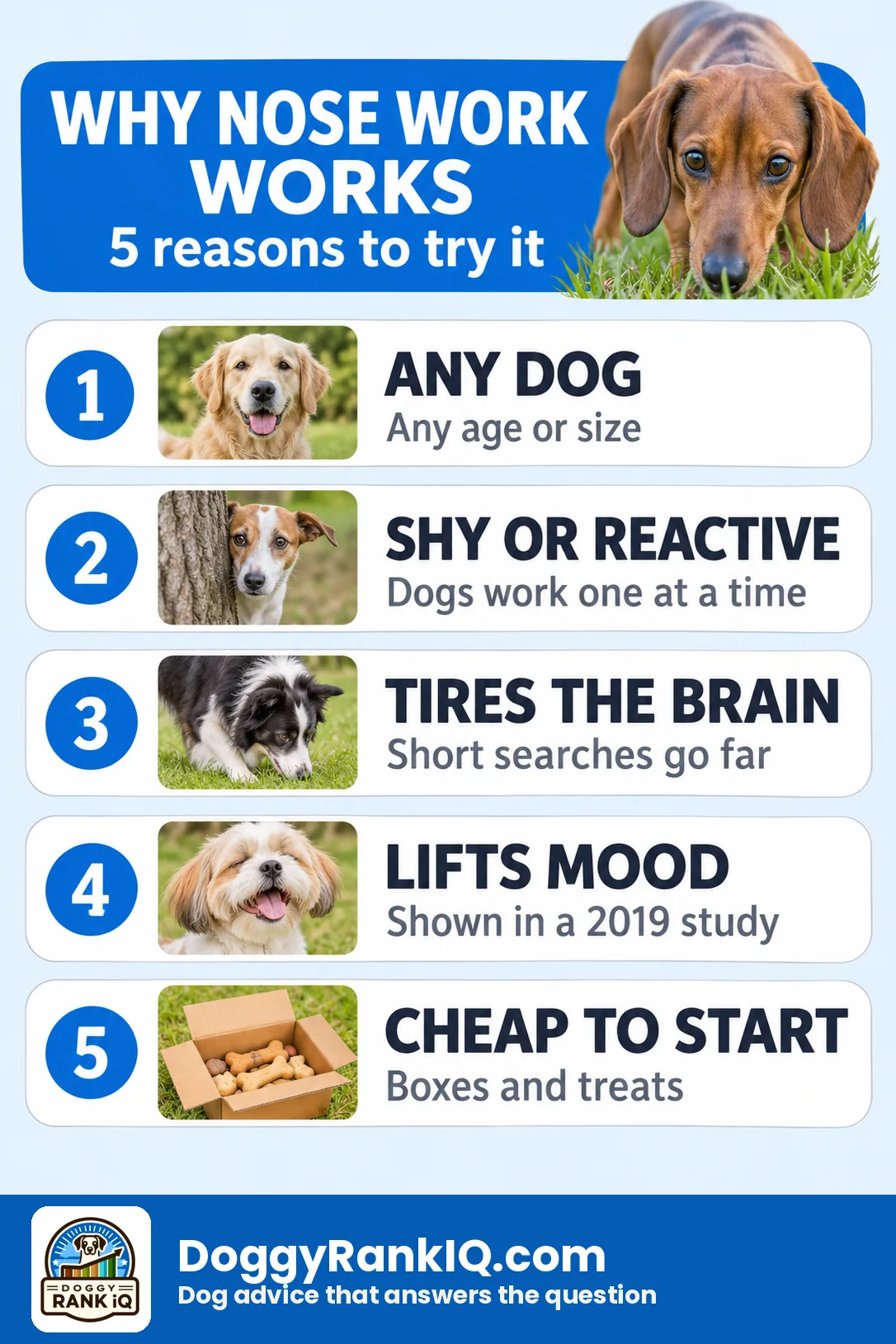
- Nose work for dogs started as K9 Nose Work in 2006, created by detection dog trainers Ron Gaunt, Amy Herot and Jill Marie O’Brien.
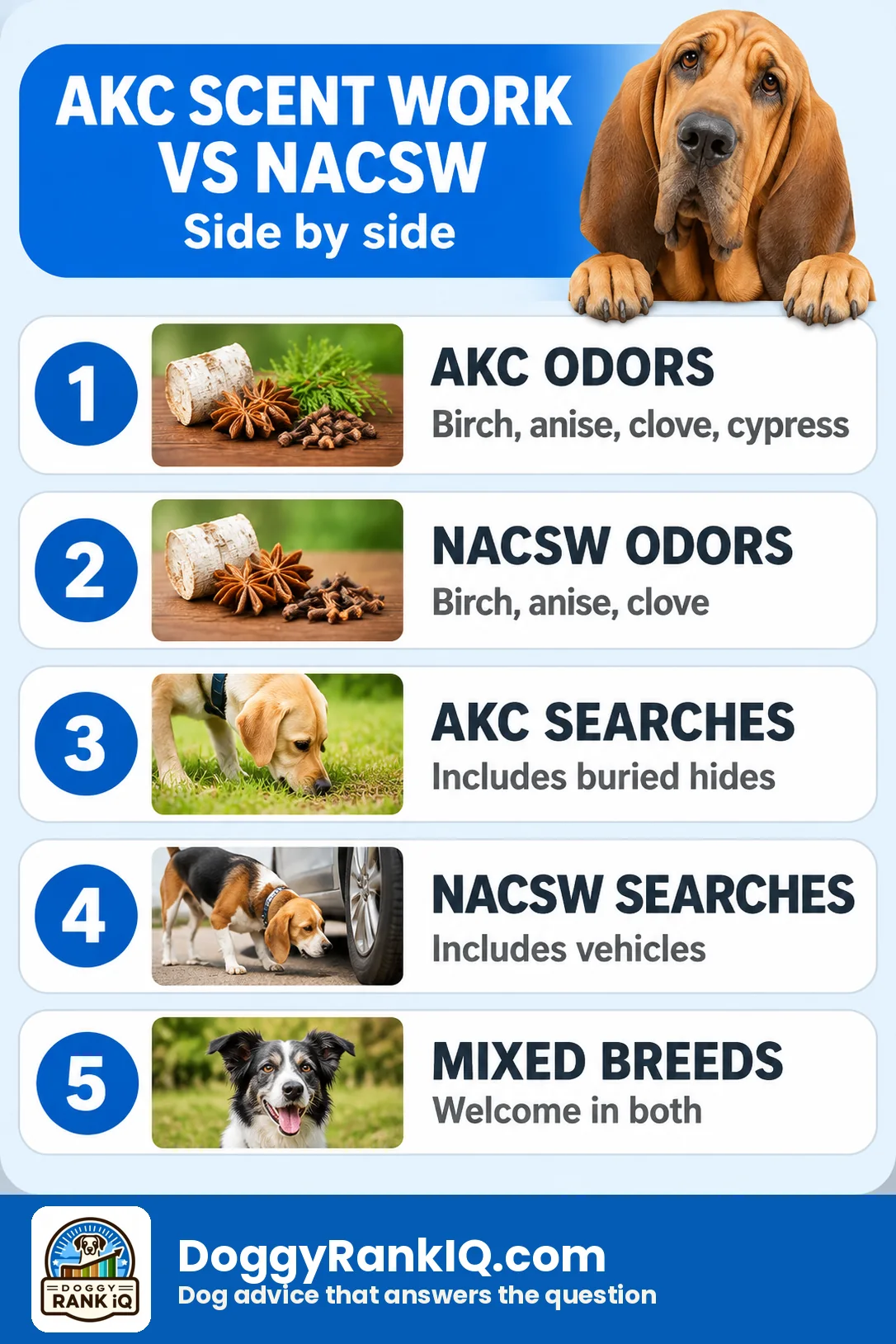
- NACSW trials use three target odors (birch, anise, clove); AKC Scent Work uses four (adds cypress) (akc.org).
- Dogs search one at a time in both organizations, which is why the sport suits reactive and shy dogs.
- A 2019 study on pet dogs found nosework practice was linked to more optimistic responses on a judgment bias test (Duranton and Horowitz, Applied Animal Behaviour Science, 2019).
- You can begin beginner nose work for dogs at home this week with boxes, a treat, and a “find it” cue, no odor needed yet.
- NACSW requires passing an Odor Recognition Test (ORT) before a dog can enter standard odor trials (nacsw.net).
- AKC Scent Work welcomes mixed breeds through AKC Canine Partners, which NACSW does not formally require but AKC explicitly supports (akc.org).
- NACSW added online Skills Achievement Challenges in 2026, letting handlers submit video searches for a fee instead of traveling to a trial (nacsw.net).
- Essential oils used for odor training should stay away from direct dog contact; scented swabs in vented tins are the safer, standard setup.
- Keep sessions short. Nose work tires a dog mentally, which often matters more than a long physical walk.

Where are you starting?
Tap an option to see the answer.
The short answer: what nose work for dogs is
Nose work for dogs means teaching a dog to search for a hidden target and signal or indicate the find, built on the dog’s natural scavenging instinct rather than on obedience drills. The sport traces back to K9 Nose Work, founded in 2006 by detection dog trainers Ron Gaunt, Amy Herot and Jill Marie O’Brien, who adapted professional detection-dog methods for pet dogs. The National Association of Canine Scent Work (NACSW) grew out of that work and now sanctions trials across the country.
The appeal is simple: a dog’s nose does the work, the handler mostly stays out of the way, and there’s no obedience component to fumble. Compare that to dog sense of smell basics: a dog’s nose has far more scent receptors than a human’s, and dog sense of smell explains how airflow and nostril movement change what a dog can actually detect. Nose work puts that biology to work on purpose instead of letting it default to counter-surfing.
Choose nose work if your dog already sniffs everything on walks, gets bored easily indoors, or struggles with group classes that require close contact with other dogs.
Why sniffing tires and calms a dog
Sniffing engages a dog’s brain in a way that’s mentally tiring, often more tiring than a jog, because the dog is processing scent information constantly rather than just moving its legs. This is one reason trainers and behaviorists recommend scent games for dogs that seem restless even after physical exercise.
The research backing this is limited but promising. A 2019 study published in Applied Animal Behaviour Science by Charlotte Duranton and Alexandra Horowitz tested pet dogs on a cognitive bias task after sessions of nosework-style searching. Dogs that practiced the searching task showed more optimistic responses on an ambiguous-cue test compared to dogs that did a simple heelwork exercise instead. That’s a specific finding in a specific study design, not proof that nose work cures anxiety in every dog.
What it does suggest: a dog choosing where to search and getting rewarded for using its nose may experience the activity as a form of control and payoff, which matters for dogs that otherwise feel anxious or under-stimulated. If you’re managing a dog with separation anxiety, nose work is a reasonable addition to a broader plan, not a replacement for one. A snuffle mat can serve as an easy daily version of the same concept; see snuffle mat for dogs for pocket depth and capacity comparisons.
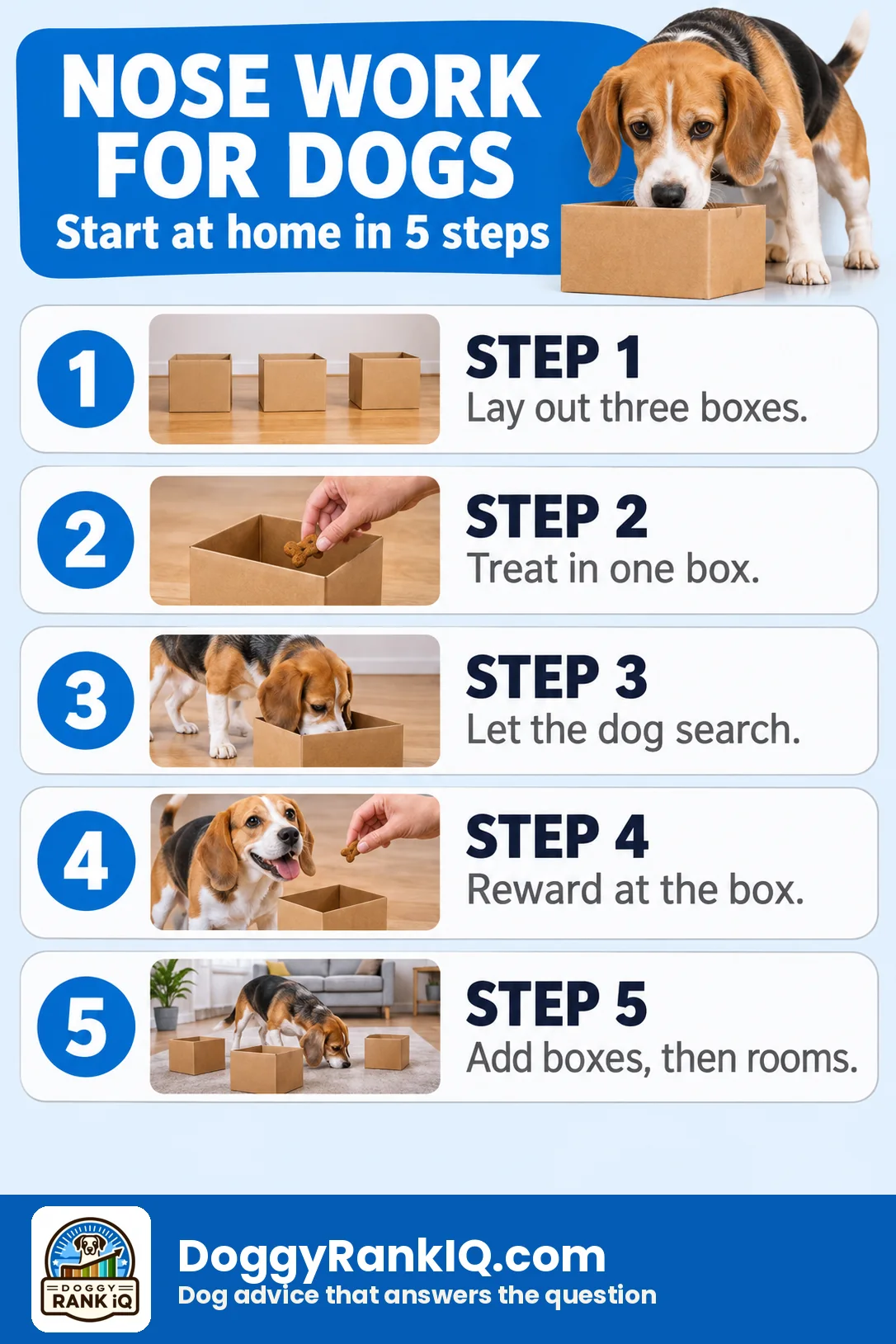
A simple start: beginner nose work for dogs at home in 5 steps
Beginner nose work for dogs starts with visible, easy wins, not hidden odor. Build confidence before you add difficulty.
1Set up visible box searches
Line up 3 to 5 cardboard boxes on the floor. Let your dog watch you drop a treat into one box. Say “find it” and let the dog search. This is pure scavenging, no training skill required yet.
2Reward at the box, every time
When your dog’s nose finds the treat, reward right there, not by calling the dog back to you. The reward should happen at the source of the scent so the dog learns the find itself pays off.
3Add more boxes and room
Increase from 3 boxes to 8 or more. Spread them around a bigger space, like a living room or hallway. Keep placing the treat where your dog can see it at first.
4Hide the target out of sight
Once your dog is confident, place the treat in a box while the dog is out of the room, or behind furniture instead of in an obvious box. This moves from visible finds to blind finds, matching the beginner progression also recommended by Chewy’s nose work guide (akc.org).
5Change locations and height
Move the game to a new room, the garage, or outside. Start placing treats at nose height on shelves or chair legs, not just on the floor. This mimics the “interior” and “exterior” elements used in actual trials.
A dog that gets bored of boxes quickly might do better with a broader rotation of activities; see dog enrichment ideas for more low-cost options to mix in.
 Facts table: AKC Scent Work vs NACSW
 Facts table: AKC Scent Work vs NACSW
Choose NACSW if your dog has already passed an ORT and you want the original odor-focused format. Choose AKC Scent Work if your dog isn’t purebred-registered and you want an easier entry path through Canine Partners, or if you want the added buried and handler-discrimination elements.
Dog nose work games you can play today
Dog nose work games don’t require a trial entry fee or a kit. Start with what’s already in a kitchen drawer.
- Muffin tin game: drop treats in a few cups of a muffin tin, cover all cups with tennis balls, let the dog nose off the right ball.
- Towel roll search: roll treats inside a towel, let the dog unroll it to find them.
- Yard scatter: toss a handful of kibble across the grass and let the dog forage.
- Car search: hide a treat in the car’s cupholder or door pocket for an outdoor-style exterior search.
- Stair search: place a treat on one step of a staircase and let your dog search up and down.
These games double as calm-down activities on rainy days when a walk isn’t realistic. If your dog is already food-driven on walks, this is usually an easy sell.
Nose work for dogs near me: finding a class or trial
Searching “nose work for dogs near me” usually turns up local training clubs, NACSW-affiliated instructors, or AKC Scent Work clubs running classes out of training centers. NACSW’s site lists trial information and intro resources for handlers looking for their first event (nacsw.net), and AKC maintains club resource pages for finding Scent Work clubs and trials (akc.org).
Before signing up for an in-person class, ask whether the instructor teaches toward NACSW or AKC rules, since the odor sets and elements differ. If no class exists nearby, NACSW’s 2026 expansion of online Skills Achievement Challenges offers a way to work toward recognized skills from home: each challenge tests four skills, requires video of the dog’s search and setup, costs $25 per complete submission, allows multiple entries with the same dog, and states submissions are judged within 30 days (nacsw.net). It’s not the same as attending a live trial, but it’s a real option for handlers without nearby events.
🎯 Handler habits that slow a dog down
In nose work for dogs, the animal already has the skill. Most early problems sit at the other end of the leash.
Hovering is the big one. A handler who stands over each box and stares at it tells the dog where to look, and the dog starts checking the person’s feet. Stand back, keep moving slowly, and let the leash hang in a loose curve.
Talking is the second. “Find it, find it, where is it, good boy, keep going” is noise to a dog who is concentrating. Give the search cue once. Then say nothing until the nose is on the source.
“Say the cue once. Then let the nose do the talking.”
Late pay comes third. The reward belongs at the hide, delivered right where the nose is, within a second or two of the find. Calling the dog back to you for the treat teaches that the game ends at your hand, and the dog begins leaving odor to come get paid.
The last is making it harder too soon. If your dog needed 90 seconds to find a hide on Tuesday, Wednesday is the wrong day to put it on a shelf. Add one kind of difficulty at a time: more boxes, or a new room, or a higher hide.
🧴 Handling target odor safely
When you move from food to birch, anise and clove, you are handling concentrated essential oils. Two or three drops on a batch of cotton swabs in a sealed jar scents them for weeks. Put a scented swab inside a vented tin or a straw so the dog can smell it and cannot touch or lick it. Wash your hands after setting hides, since oil on your fingers leaves a trail across everything you touch, and store the kit away from where the dog sleeps and eats.
⭐ Top 5 Features We Love
- Dogs work one at a time. No group obedience line, no close contact with strange dogs, which is why reactive and shy dogs often do better here than in agility or group classes.
- No physical agility required. Senior dogs and dogs with mobility limits can still search at nose height or in a single room.
- Low-cost entry point. You can start with cardboard boxes and kitchen treats before spending a dollar on gear.
- Mental fatigue without joint stress. A 10 to 15 minute search session can tire a dog out without the impact of running.
- Clear progression ladder. Both AKC and NACSW offer a leveled structure, from container searches to full trials, so there’s always a next goal.
⚠️ Things to Look Out For
- Essential oils are not pet toys. Store essential-oil odor supplies away from the dog and use only scented swabs inside vented tins, never let a dog chew or lick an oil-soaked item.
- Frustration builds fast if hides are too hard too soon. Jumping from visible treats to fully blind hides overnight can shut a dog down instead of building confidence.
- Not every dog cares about the target odors. A dog that isn’t food-motivated may need a toy-based reward system instead, and some dogs just won’t engage with birch, anise or clove the way they do with food.
- Rules change between organizations and over time. NACSW’s current rulebook is Version 12.3, dated August 15, 2024 (ohio4h.org), and AKC applies its August 2025 regulations (cdn.akc.org); always check the current document before entering a trial rather than trusting an old article.
- Over-arousal is still arousal. A dog that gets frantic rather than focused during searches needs shorter sessions and easier hides, not more repetitions.
From living room to first trial: the path
The path from living room games to a first trial follows a predictable order: visible food searches, then partly hidden targets, then fully blind hides, then multiple rooms, then odor introduction, then an Odor Recognition Test if going the NACSW route (akc.org).
Here’s the realistic sequence:
- Visible box or toy searches at home (weeks 1 to 2)
- Hidden targets behind furniture, still food-based (weeks 2 to 4)
- Blind searches where the dog doesn’t watch the hide (weeks 4 to 6)
- Multiple rooms and outdoor searches (ongoing)
- Formal odor introduction, usually birch first, paired with a reward
- ORT entry for NACSW, or straight into AKC’s leveled trials
There’s no fixed timeline. Some dogs are ready to try an ORT within a few months of consistent practice; others take a year of casual home practice before a handler feels ready to enter anything formal. Treat the timeline as dog-dependent, not a race.
Nose work for dogs kit: what to buy
A nose work for dogs kit isn’t required to start, but a few items make the early stages easier and let you progress toward formal odor work later. The following are supplied as helpful product options, not lab-tested by our team; details below reflect manufacturer listings and buyer feedback.
- Dog Scent Work Tins Training Kit, 6 tins (rel=”sponsored”): a set of vented tins useful once you’re ready to move from treats to scented swabs. $19.99, price checked 2026. Check the current price.
- Dog Scent Training Kit, Hide and Seek Nosework (rel=”sponsored”): a beginner-labeled kit built around hide-and-seek style games rather than formal odor. $16.98, price checked 2026. Check the current price.
- K9King Interactive Dog Scent Training Kit (rel=”sponsored”): an interactive kit marketed for mental enrichment and early scent games. $15.99, price checked 2026. Check the current price.
- heouvo Magnetic Dog Treat Pouch with Training Clicker (rel=”sponsored”): a hands-free pouch that keeps rewards ready during fast box-to-box searches. $9.99, price checked 2026. Check the current price.
- Buddy Biscuits Trainers Soft and Chewy Training Treats (rel=”sponsored”): small, soft treats that are easy to place in boxes or tins without crumbling. $6.99, price checked 2026. Check the current price.
AKC also publishes its own list of recommended beginner supplies for handlers planning to compete under AKC rules (akc.org). Check both lists before buying if you’re unsure which organization you’ll pursue.
FAQ
The bottom line
Nose work doesn’t require a trial entry, a kit, or even a backyard. It needs a few boxes, a treat your dog actually wants, and a willingness to let the dog set the pace. Start with the five-step beginner plan this week, watch whether your dog lights up over blind hides or loses interest fast, and decide later whether AKC’s broader entry path or NACSW’s odor-focused trials fit your goals. If your dog seems distracted during group classes but locks in during solo search games, that’s useful information for choosing training formats going forward, not just for nose work.
Meta Title and Description
Tags
nose work, nosework, scent work dogs, AKC Scent Work, NACSW, dog enrichment, beginner nose work, dog nose work games, reactive dog training, humane training, dog sense of smell, dog sports 2026
Doggy Rank IQ is reader supported. As an Amazon Associate we earn from qualifying purchases, at no extra cost to you.