
Quick Answer
The canine good citizen test is a 10-skill evaluation run by the American Kennel Club that checks whether a dog can behave politely around people, other dogs, and everyday distractions. It covers things like greeting a stranger, walking on a loose lead, sitting for grooming, and staying calm during a short separation. Any dog, purebred or mixed, can take it with no age limit, and it usually takes less than 10 minutes with an AKC Approved CGC Evaluator1. The canine good citizen test is not a service dog or therapy dog certification, though many therapy groups ask for it as a baseline.
Key Takeaways: canine good citizen test
- The canine good citizen test has 10 items, from greeting a stranger to a 3-minute supervised separation.
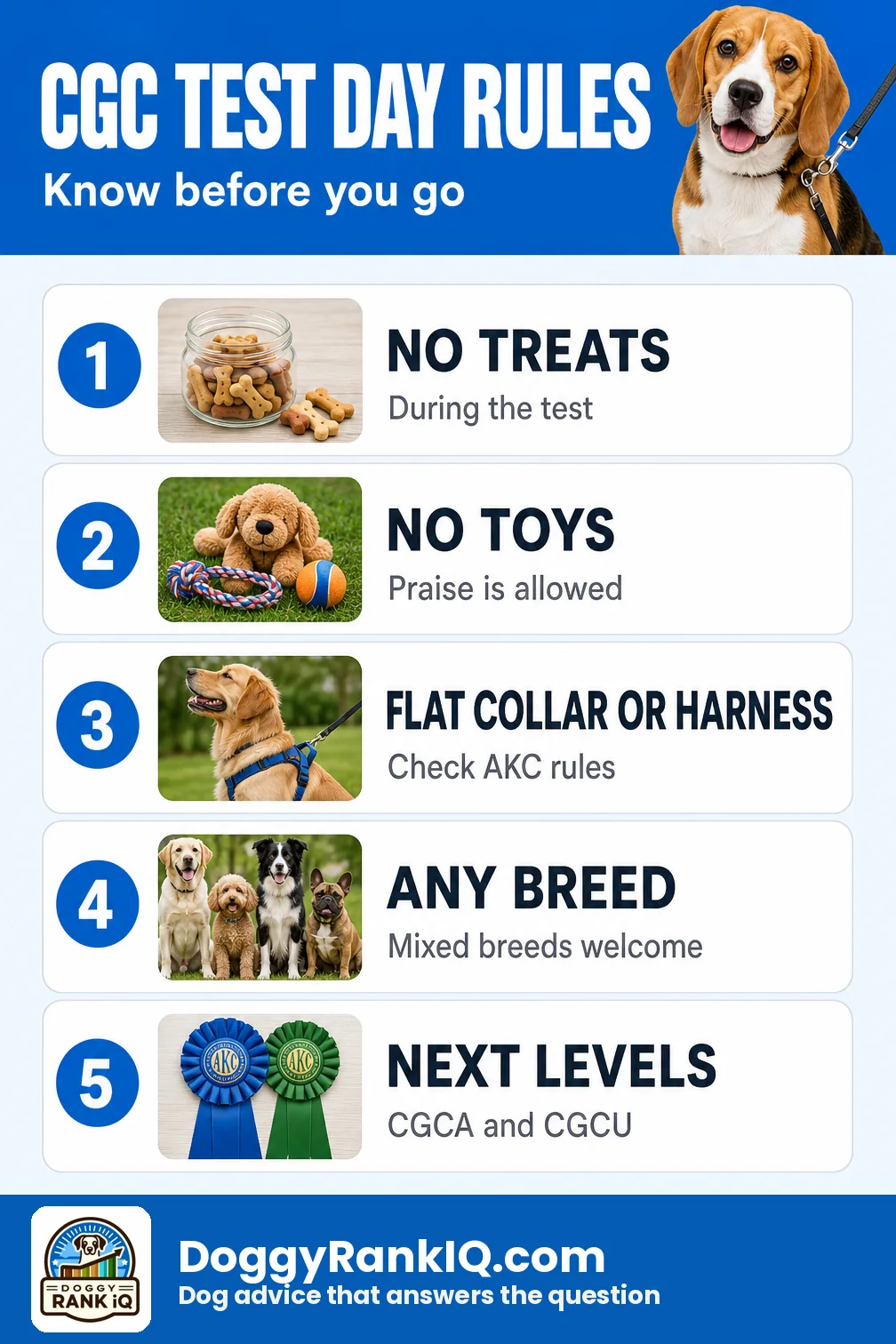
- No food or toys are allowed during the actual test. Praise and petting are fine.
- Any dog can take the canine good citizen test: purebred, mixed breed, rescue, any age.
- Evaluators set their own testing fees, so cost varies by location and club.
- Dogs wear a flat buckle collar, slip collar, or body harness. Check the current rules with your evaluator before test day.
- Owners sign the AKC Responsible Dog Owner’s Pledge as part of the process.
- Most failures come from excitement, not aggression: jumping, pulling, or breaking a stay.
- A 4-week practice plan built around short daily sessions is enough prep for most dogs who already know basic cues.
- CGC leads naturally into AKC Community Canine (CGCA) and Urban CGC (CGCU) for dogs who want more.

What is your dog's weak spot?
Tap an option to see the answer.
The short answer: what the Canine Good Citizen test is
The canine good citizen test is a 10-item AKC evaluation that measures whether a dog can handle normal public situations without drama. It was built to reward manners, not competition-level obedience.
The AKC’s official description frames the skills as practical behaviors meant to help dogs function politely in the community, and the test-item page was last refreshed 20261. There’s no scorecard with points. An evaluator watches the dog do all 10 items and marks each one pass or fail. Pass all 10 in one sitting and the dog earns the title.
A few things the test is not: it’s not a government license, not an obedience title, and not a therapy dog credential by itself. It’s an AKC program, and local trainers or testing organizations set their own fees23. The pledge owners sign at the end asks them to commit to responsible care: regular vet visits, safety, and cleaning up after their dog in public. Owners preparing a dog for a therapy group, an apartment with breed-neutral insurance requirements, or simply a first formal training goal will find the canine good citizen test fits all three uses.
If your dog already struggles with greeting new people calmly, our guide on dog body language can help you read the early warning signs before a greeting goes sideways.
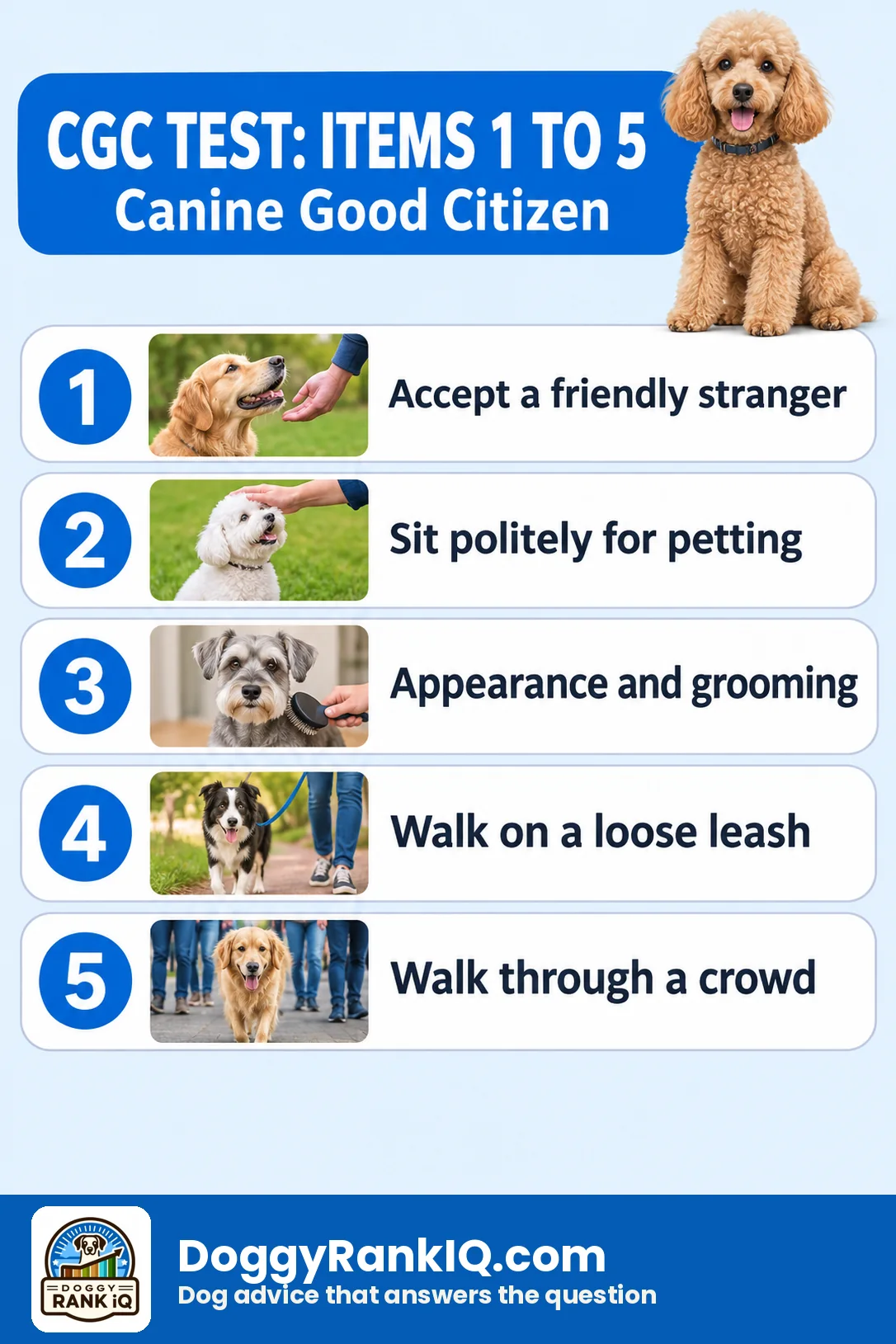
Facts table: the 10 items
The 10 items with easy practice for each
1Accepting a friendly stranger
The evaluator greets the handler first, speaking to them, not the dog, and the dog is expected to stay relaxed without shyness or resentment1.
Teach a solid “watch me” cue first. Start with a familiar person standing a few feet away, mark eye contact on your dog, and reward. Slowly close the distance over several sessions, then swap in people of different heights, voices, and clothing so the dog generalizes the skill rather than only recognizing one helper24.
2Sitting politely for petting
The dog may stand during petting, but fear or resentment is a fail. This item trips up dogs who are either undersocialized or overly excited.
Have a helper approach only when your dog is already calm, not mid-bounce. If the dog jumps, the helper pauses and steps back, then tries again at a lower intensity. Repeating this pattern teaches the dog that calm earns attention, while jumping makes the good stuff disappear.
3Appearance and grooming
The evaluator brushes the dog and checks ears and front feet, a quick simulation of a vet or groomer handling the dog.
Build tolerance gradually: touch the back first, then move to ears and paws, pairing each brief touch with a treat. Increase duration and pressure over days rather than restraining a squirmy dog in one long session. Dogs with grooming sensitivities often do better with multiple two-minute sessions than one long drill.
4Walking on a loose lead
The test course includes right, left, and about turns plus stops. The dog does not need to heel precisely or sit at every halt1.
Practice indoors or in a driveway first. Stop the moment the leash goes tight, and only move again once there’s slack. Add turns, new smells, and sidewalk traffic gradually. Our loose leash walking guide covers why dogs stall and pull and gives five specific fixes worth trying before test day.
5Walking through a crowd
The dog and handler pass within a few feet of at least three people without jumping, straining, or excessive shyness.
Set up a “human slalom” at home using family members standing in a loose line. Walk your dog between them, rewarding calm passes. Move the drill outside during quiet hours, then work up to busier sidewalks once the dog reliably stays near you instead of trying to greet strangers.
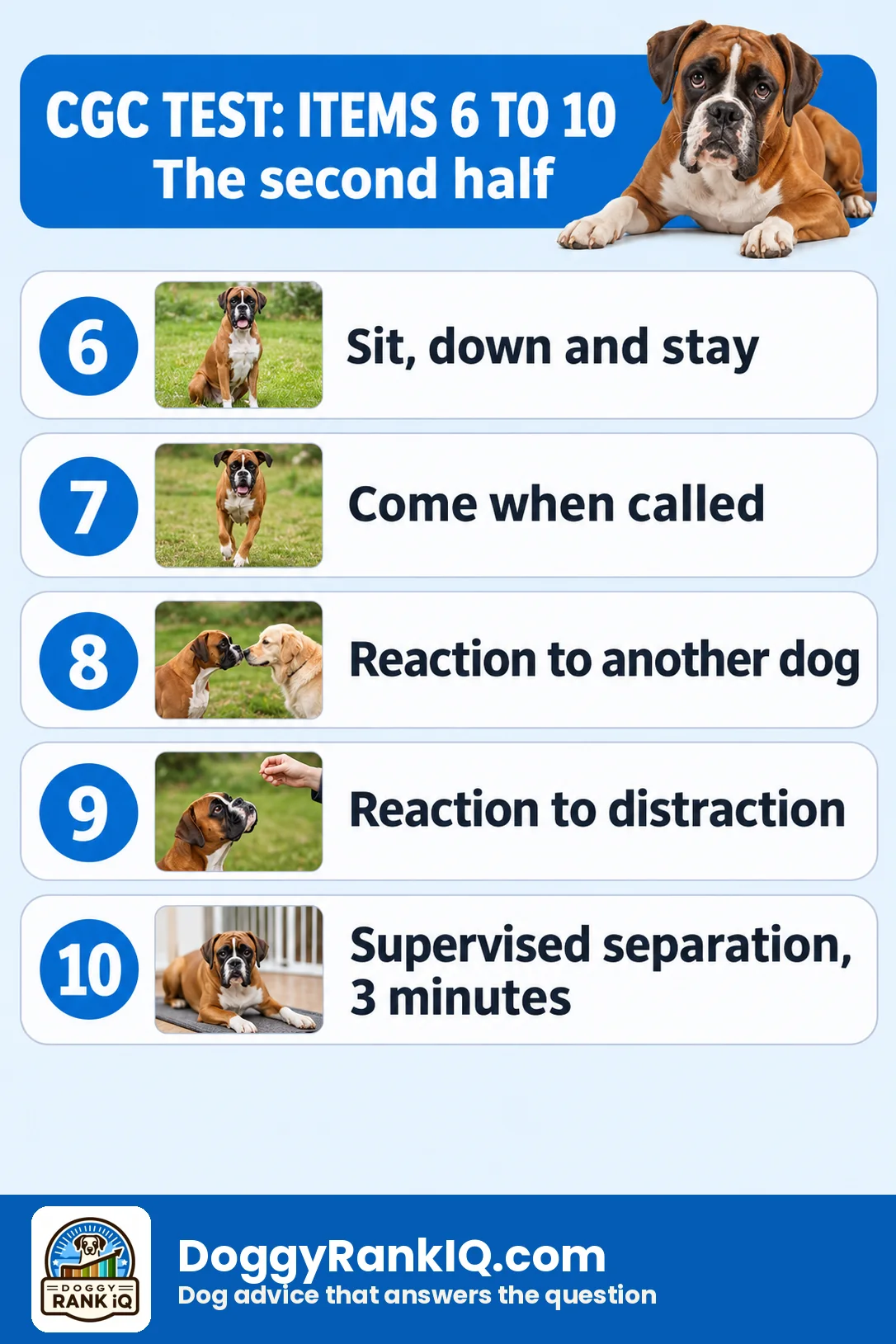
6Sit and down on cue, staying in place
The dog sits and lies down on cue, then holds that position while the handler walks the length of a 20-foot line and back1.
Build the stay using the three Ds: duration, distance, and distractions. Start with a half-second stay, add one second or one step at a time, and always use a consistent release word like “free” so the dog knows exactly when the stay ends2. If your dog knows the basics but breaks position early, our 5 essential commands every puppy should learn covers the foundation cues this item depends on.
7Coming when called
The handler walks 10 feet away on a 20-foot line, turns, and calls the dog, who should come promptly.
Pair the dog’s name with “come,” reward immediately on arrival, and slowly increase distance and environment difficulty. One mistake many owners make: using the recall cue only to end fun activities like play at the park. That teaches the dog coming when called means fun is over, which weakens the whole behavior2. Our full recall training guide breaks this down step by step.
8Reaction to another dog
Two handlers approach each other, shake hands, and walk on. Dogs should show casual interest at most, no straining or aggression.
Practice with a calm, known dog first, keeping distance wide enough that neither dog reacts. Gradually narrow the gap over multiple sessions. Dogs with a history of reactivity benefit from working with a trainer rather than guessing at distance thresholds alone.
9Reaction to distraction
A sudden noise or visual distraction, like a dropped chair or a jogger passing, tests whether the dog startles but recovers rather than panicking.
Practice with mild, controlled versions of common distractions: a dropped book, a bike rolling by at a distance. Reward calm recovery rather than preventing any reaction at all. A little surprise is normal; prolonged barking or bolting is the fail condition.
10Supervised separation
The handler hands the leash to the evaluator and walks out of sight for three minutes. The dog does not need to sit and stay, just remain reasonably calm.
Start with very short separations at home, counting seconds rather than minutes, and build up slowly. If your dog shows signs of panic rather than mild unease, that’s worth addressing directly. Our separation anxiety guide walks through the signs and a real plan for dogs who struggle here.
How hard is the Canine Good Citizen test?
For a dog who already knows sit, down, stay, and loose-leash walking, the canine good citizen test is moderately easy, closer to a check-in than an exam. The hard part for most dogs is distraction, not the individual skills.
AKC notes the test usually runs under 10 minutes and happens in a controlled setting, such as a separated section of a pet store or a trainer’s show ring2. That means a dog who’s perfect in the living room can still struggle the first time a stranger’s dog walks by at test distance. Practicing in real public spaces, not just at home, closes that gap.
Dogs with reactivity toward people or other dogs face a steeper climb. It’s doable with consistent work, often with a trainer’s help, but owners should budget more than four weeks if reactivity is part of the picture. Choose a slower prep timeline if your dog shows stiffening, growling, or lunging around triggers; rushing a reactive dog to test day usually backfires.
Canine Good Citizen test cost and where to find a test near me
Testing fees are set by the individual AKC Approved CGC Evaluator or club, not by AKC directly, so canine good citizen test cost varies by location2. AKC also charges a separate fee for recording the title if you choose to submit it.
To find a canine good citizen test near me, start with local dog training schools, AKC-affiliated clubs, and some pet stores that host CGC evaluations. Many evaluators also run canine good citizen training near me classes that combine weekly lessons with a test at the end, which can be a practical option for owners who want structured coaching rather than DIY practice.
Questions worth asking before you book:
- Is the test fee separate from any class fee?
- Does the evaluator use AKC’s current 10 items exactly as published?
- Can you observe a test session before signing up your own dog?
AKC’s newer Title Application Portal (TAP) is meant to speed up submitting a CGC title application, though owners can also receive a certificate without recording it as an official AKC title2.
What is required on test day
No food or toys are allowed during the actual test items; praise and petting are permitted. Dogs typically wear a flat buckle collar, slip collar, or body harness, though owners should confirm current equipment rules with their evaluator ahead of time1.
Bring a regular leash (not a retractable one) and expect to use a separate 20-foot line for the stay and recall items, which the evaluator or testing site may supply. Owners sign the AKC Responsible Dog Owner’s Pledge as part of the process, a commitment to things like regular veterinary care and good public behavior, not a skills test itself.
Arrive with a dog that’s had a bathroom break and a short walk beforehand. A dog who’s wound up from the car ride rarely performs its best in the first five minutes.
⭐ Top 5 Features We Love
- No breed restrictions. Mixed breed dogs and purebreds compete on equal footing, with no pedigree requirement at all.
- No age ceiling. There’s no maximum age for CGC, so senior dogs and newly adopted adult rescues are just as welcome as young dogs2.
- A realistic skill set. The 10 items reflect everyday situations (vet visits, sidewalks, visitors) rather than competition-grade precision.
- A clear next step after passing. Dogs who enjoy CGC can move on to AKC Community Canine (CGCA) and Urban CGC (CGCU) for more advanced real-world scenarios.
- A useful baseline for other goals. Many therapy dog organizations and some housing or insurance policies accept CGC as a starting credential, even though it isn’t a certification itself.
⚠️ Things to Look Out For
- CGC is not a service dog or therapy dog certification. Passing it doesn’t grant public access rights or therapy credentials on its own.
- Testing fees vary widely, so ask upfront rather than assuming a flat national rate.
- One bad moment can mean a retest, not a permanent fail; most evaluators allow dogs to try again another day.
- Puppies may not be developmentally ready. AKC suggests the S.T.A.R. Puppy program as a better fit for very young dogs before attempting full CGC2.
- Reactive dogs need a longer runway. Rushing items 8 and 9 before the dog is ready tends to create setbacks rather than progress.
A 4-week practice plan
This plan assumes a dog who already knows basic sit, down, and come, and is meant as a general framework, not a guarantee.
Week 1: Foundations at home. Work items 1, 2, 3, and 6 in short five-minute sessions, several times a day. Focus on calm greetings, handling tolerance, and a one-second stay building toward longer durations.
Week 2: Add movement. Introduce loose-leash walking drills (item 4) in the yard or a quiet street, plus recall practice (item 7) on a long line like the Hi Kiss 30 ft Long Line Training Leash. Keep stays going, now with mild distractions like a dropped spoon.
Week 3: Public exposure. Practice the crowd walk (item 5) and the other-dog pass (item 8) in a real but quiet public space, like a parking lot at an off-peak hour. Keep sessions short to avoid overwhelming the dog.
Week 4: Full run-throughs. String all 10 items together in sequence, including a 3-minute supervised separation with a trusted friend holding the leash. If the dog handles the full sequence calmly twice in a row, it’s reasonable to book the actual test.
Helpful practice gear and the official guide
A few tools make practice sessions smoother, based on what the manufacturers document and what owners commonly report in reviews.
The Canine Good Citizen: The Official AKC Guide, 2nd Edition walks through each of the 10 items with AKC-aligned explanations, priced at $14.06 (price checked 2026). Check the current price.
For loose-leash practice, the Taglory 6 FT Rope Dog Leash with Padded Handle is listed at $8.99 (price checked 2026). Check the current price.
Since treats aren’t allowed during the actual test but are essential for practice, Buddy Biscuits Trainers Soft and Chewy Training Treats run $6.99 (price checked 2026). Check the current price.
To keep treats handy hands-free during drills, the heouvo Magnetic Dog Treat Pouch with Training Clicker is priced at $9.99 (price checked 2026). Check the current price.
For the stay and recall items, a longer line like the Hi Kiss 30 ft Long Line Training Leash lists at $9.97 (price checked 2026). Check the current price.
None of these items are required by AKC. They’re practical aids owners commonly use, not official test equipment.
Doggy Rank IQ: CGC 4-Week Practice Tracker
Check off each week as your dog masters the skills. Click a row to mark it done.
0 of 4 weeks complete
FAQ
The bottom line
The CGC test rewards a dog that can greet a stranger, walk through a crowd, and settle during a short separation without drama. Most dogs who already know basic cues can get there with focused practice over a few weeks, built around real public exposure rather than living-room perfection alone.
If your dog struggles with jumping on guests or greeting strangers, our guide on how to stop a dog from jumping pairs well with item 1 and item 2 practice. And if the end goal is eventually working toward therapy or support roles, our emotional support dog guide explains how CGC fits into that larger picture, and where it doesn’t.
Start with one item this week, not all 10. Pick the skill your dog struggles with most, work it in five-minute sessions, and build from there.
Doggy Rank IQ is reader supported. As an Amazon Associate we earn from qualifying purchases, at no extra cost to you.