
This post contains affiliate links. If you buy through one we may earn a commission at no extra cost to you. As an Amazon Associate I earn from qualifying purchases.
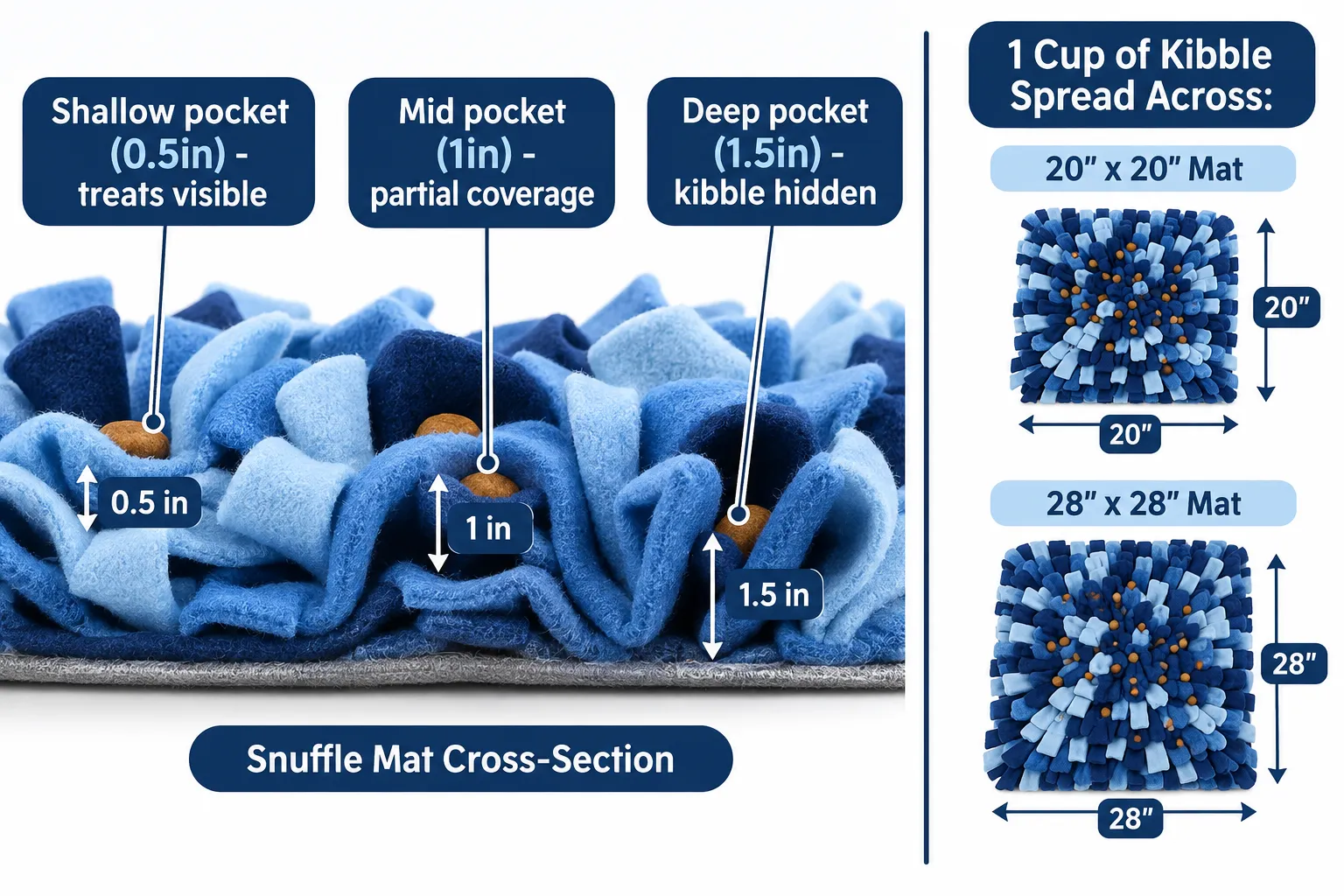
Quick answer: A snuffle mat for dogs holds kibble only as deep as its pockets allow, usually well under an inch and a half, so most mats are built for a treat-sized portion or a partial meal rather than a full bowl. Pocket depth, fabric density, and backing grip determine whether a dog calmly forages or flips the whole thing in frustration within the first minute.
Key takeaways
- Most snuffle mat pockets measure under 1.5 inches deep, limiting capacity to roughly a cup of kibble spread across the surface, since sellers rarely publish exact depth specs.
- The American Kennel Club notes snuffle mats mimic natural foraging behavior and can slow down fast eaters, but the benefit depends on matching pocket size to kibble size.
- VCA Animal Hospitals lists foraging mats among enrichment tools that reduce boredom, but stresses supervision for dogs that chew or swallow fabric.
- Amazon US prices for common mats ranged from roughly $12 to $34 depending on size, materials, and brand, and several listings still skip published dimensions entirely.
- The AWOOF Snuffle Mat measures 28 by 28 inches, giving fast eaters more surface area to slow down on.
- The HOPET Snuffle Mat uses an adjustable design meant to address dogs that grab and shake smaller mats.
- The Spruce Pets 2026 testing notes that washability and backing grip separate mats that get used daily from ones that end up in a drawer after a week.
- No independent lab has verified seller claims like a 15 to 20 minute feeding session on a 25-inch mat, so treat those numbers as marketing, not data.
Snuffle Mat for Dogs: What It Actually Does at Mealtime
A snuffle mat for dogs is a flat textile feeder, usually fleece or fabric strips knotted or sewn onto a perforated backing, where kibble or small treats get scattered into the folds so a dog has to sniff, root around, and work for each piece instead of eating straight from a bowl. VCA Animal Hospitals categorizes this kind of foraging toy as a form of enrichment that taps into a dog’s natural scavenging instinct, giving the brain a job to do beyond just chewing and swallowing.
That’s the honest starting point, because social feeds tend to show the dreamy version: a mat fully loaded, a dog calmly working every corner for ten peaceful minutes. The reality for a lot of apartment dogs, especially small or food-motivated breeds, is closer to a mat getting flipped, shaken, or finished in under a minute. That gap between the video and your kitchen floor is almost always about pocket depth and fabric density, not about your dog doing something wrong.
Dogs with mobility limits, including some seniors, may do well with a snuffle mat for dogs because it stays flat on the floor rather than rolling or requiring batting the way a treat ball does. VCA Animal Hospitals also notes that enrichment routines work best when predictable, so using the same mat at the same point in a feeding routine tends to build engagement over time rather than a single try-it-once session.
Watch for frustration signs during use: excessive pawing at the floor around the mat, whining, or chewing and swallowing fabric strips. Any of those can mean a trip to the vet for a blockage, not just a mess to clean up, and it’s worth pulling the mat if a dog starts ingesting material rather than just working around it.
Research on whether dogs actually prefer this kind of foraging over a bowl is more mixed than marketing suggests. Studies on foraging enrichment in dogs generally find that willingness to engage does not always equal measurable preference over free access to food, and most of the stronger evidence comes from kennel, shelter, and lab settings rather than home environments. The practical takeaway: a snuffle mat for dogs is a reasonable enrichment option worth trying, not a guaranteed behavior fix, and your dog’s actual response at the bowl matters more than any claim on the packaging.
If your dog is an anxious eater who gulps meals in seconds, pairing a snuffle mat with other calming strategies can help. The guide on calming products for dogs covers options ranked by evidence rather than marketing claims.
What Is a Snuffle Mat and How Does It Work?
A snuffle mat works by hiding small amounts of food inside layers of fabric so a dog has to use its nose, not its eyes, to find each piece. The dog pushes its snout and paws through fleece strips, and the search itself (not just the eating) is what provides mental stimulation.
Most mats are built one of two ways:
- Woven or tied strips: fleece or felt strips are individually knotted through a rubber or fabric mesh base, creating dense folds where kibble settles.
- Flower or petal style: fabric is cut into overlapping petal shapes stitched to a backing, often with less depth but easier cleaning.
The Humane Society Silicon Valley and Nevada Humane Society both list scent-based foraging activities, including snuffle mats, as low-cost enrichment that shelters use to reduce stress and boredom in kenneled dogs, a signal that the same principle translates reasonably well to home use for dogs that spend long stretches alone.
Decision rule: choose a woven strip mat if your dog is a methodical sniffer who likes a challenge, and choose a flower-petal style if your dog is new to foraging toys and might get frustrated by dense fabric on the first try.
Doggy Rank IQ Tool
Snuffle Mat Sniffer Type Sorter

Grabbers, gulpers and fabric chewers each need a different pocket design. Sort yours.
Sort Your Dog’s Eating Style First
Before buying anything, watch one actual meal. Does your dog sniff carefully and nose pieces out one at a time? Does she paw at the fabric like she’s digging for buried treasure? Does he grab a mouthful of strips and shake the whole mat like a stuffed toy that owes him money? Does the dog chew on the fabric itself rather than just the kibble?
Use the sorter below to get a quick read on pocket depth and construction before you shop.
Sniffer Type Sorter
function cgSort(){ var style=document.getElementById(‘cg-style’).value; var size=document.getElementById(‘cg-size’).value; var out=””; if(style==”sniff”){out=”Look for: shallow to mid pockets (around 0.5 to 1 inch). Our pick: the AWOOF Snuffle Mat, 28×28 inches, plenty of surface for calm sniffing.”;} else if(style==”paw”){out=”Look for: a dense, snag-resistant weave with secured backing so digging does not pull strips loose.”;} else if(style==”shake”){out=”Look for: deeper pockets and an adjustable or weighted design. Our pick: the HOPET Snuffle Mat for grabbers who shake lighter mats loose.”;} else{out=”Caution: fabric chewing raises ingestion risk. Supervise closely or skip fabric mats for this dog. See the lick mat guide for a chew-resistant silicone alternative.”;} if(size==”large”){out+=” With a larger meal, split the kibble across two mats or add a slow feeder bowl for the rest, since no fabric mat here is rated for a full large-breed meal without spilling.”;} document.getElementById(‘cg-result’).style.display=’block’; document.getElementById(‘cg-result’).innerText=out; }If your dog falls into the “chews fabric” category, a lick mat with wet food pressed into silicone grooves is a safer starting point than any fleece mat, since there’s no loose fabric to swallow.
Pocket Depth and Kibble Capacity: How Much Food Actually Fits?
Here’s the gap nobody puts on the box: pocket depth is almost never listed as an actual measurement. Scroll ten product pages and you’ll see “longer pile,” “thicker fleece,” “deep pockets,” but rarely a number in inches or millimeters. One current listing, the Rundik mat, advertises longer and thicker pile with an edge guard and still skips a measured pocket-depth spec. That’s not a flaw unique to one brand. It’s the norm in this category today.
What that means for your kitchen floor: a typical snuffle mat pocket runs somewhere under an inch and a half deep. Spread one cup of kibble across a standard 20-by-20-inch surface and most pieces will sit visible, tucked between fabric strips rather than buried. That’s fine for a treat-sized session. It’s not enough depth to hide a full 2-cup dinner for a 60-pound dog without kibble spilling over the edges the second a paw lands wrong.
Hiding-spot counts get used as a stand-in for capacity, and it’s an imperfect one. A listing for the Vivifying mat counts eight hiding spots across a 26-by-16.5-inch surface, but neither the retailer page nor independent comparisons convert that into a standardized gram or cup measurement. Eight pockets sounds generous until you realize nobody has told you how big each pocket actually is.
The practical fix: treat a snuffle mat for dogs as a portion-of-the-meal tool, not the whole bowl replacement, unless you’ve tested your specific mat with your dog’s actual kibble size and watched what happens. Small kibble (think toy breed formulas) nests easily into tight fleece strips. Large kibble sits higher and rolls off during the first few pokes of an enthusiastic nose. If your dog eats large biscuit-style kibble, look for a mat with wider, looser strip spacing, or expect some floor cleanup regardless.
For dogs with bloat risk or a history of eating too fast, pairing portion control with the right surface matters more than the mat alone. Bloat in dogs is worth reading if your dog is deep-chested or has gulped a meal fast enough to worry you, and the slow feeder guide covers bowl-based pacing in more depth if fabric isn’t the right call for your dog’s size or eating speed.
Best Snuffle Mats for Dogs
The best snuffle mat for a given dog depends more on eating style and size than on brand name, but a handful of models consistently show up in both retail bestseller lists and independent comparisons like The Spruce Pets 2026 roundup.
- AWOOF Snuffle Mat (28×28 inches): a large, dense surface best suited to fast eaters and bigger dogs who need more room to spread out.
- HOPET Snuffle Mat, adjustable large breed: built with tunable tension in the backing, aimed at dogs that grab and shake lighter mats.
- Adjustable Snuffle Mat for Dogs Large Breed, Puppy Puzzle Toys: marketed from puppy through large breed sizing, a reasonable starting point if you are not sure how your dog will respond.
Common mistake: buying the smallest, cheapest mat available for a large or food-motivated dog. A mat under 16 inches across gives a 50-plus pound dog almost nowhere to spread kibble, which pushes the dog toward grabbing and shaking rather than sniffing.
Top 5 Features That Decide the Purchase
1. Pocket depth and fabric density. This single spec decides whether kibble stays put or spills during the first enthusiastic sniff. The AWOOF Snuffle Mat uses dense, overlapping fleece strips across its full 28×28 inch surface, giving kibble more places to settle before a paw disturbs the pile.

2. Backing stability. A mat that slides across tile the moment a dog leans on it gets abandoned fast, or worse, flipped and shaken like a toy. Rubber-backed or non-slip bottoms keep the mat anchored during active digging.
3. Adjustability for different dogs in the household. The HOPET Snuffle Mat for Dogs Large Breed is built with an adjustable design, useful if one dog in your home is a gentle sniffer and another is a mat-shaker, since you can tighten the construction for the rougher eater.
4. Machine washability. Fleece traps drool, crumbs, and the occasional dropped piece of kibble that rolls behind the couch anyway. A mat that can’t go in a standard washing machine becomes a mat that quietly gets used less.
5. Size matched to the dog, not the dog bed. The Adjustable Snuffle Mat for Dogs Large Breed, Puppy Puzzle Toys is marketed across sizes from puppy to large breed, which matters because a mat too small for a big dog’s nose and paws gets outgrown functionally even if it still fits the floor space.
Kibble Capacity, Pocket Depth, and Backing Comparison
The table below compares the three snuffle mat for dogs models referenced throughout this guide, using published price bands rather than exact specs since most sellers do not publish measured pocket depth.
| Model | Price band | Size | Backing | Best for |
|---|---|---|---|---|
| Adjustable Snuffle Mat for Dogs Large Breed | around $15 to $25 | adjustable, multi-size | non-slip rubber | puppies through large breeds, gentle to moderate sniffers |
| HOPET Snuffle Mat for Dogs Large Breed | around $18 to $28 | large breed sizing | adjustable construction | dogs that grab or shake lighter mats |
| AWOOF Snuffle Mat Pet Dog Feeding Mat | around $20 to $30 | 28 x 28 inches | dense fleece, wide surface | fast eaters needing more surface area to slow down |
Check the AWOOF Snuffle Mat{rel=”sponsored nofollow”} for current availability if your dog’s issue is speed, not grabbing.
Snuffle Mat vs Puzzle Toy vs Lick Mat
A snuffle mat for dogs works through smell and fabric texture, a puzzle toy works through problem solving and manipulation, and a lick mat works through repetitive licking of a spread food, and each suits a different kind of dog or situation. Choosing between them comes down to what behavior you’re trying to influence and how your dog reacts to each format.
- Snuffle mat: best for dogs that enjoy sniffing and rooting, and for slowing down kibble-based meals. Lower cost, usually $12 to $34.
- Puzzle toy: best for dogs that like a mental challenge with sliders, levers, or compartments, often used for treats rather than full meals. Typically $15 to $40.
- Lick mat: best for anxious dogs, dogs recovering from surgery, or chewers who would otherwise destroy fabric. Works with wet food, pumpkin, or peanut butter pressed into silicone, and is dishwasher safe. Usually $8 to $20.
Edge case: a dog that destroys snuffle mats within days by chewing through the fabric backing is often better served by a lick mat or a hard rubber puzzle toy, since neither presents loose fibers to swallow.
How Much Does a Snuffle Mat Cost?
A snuffle mat for dogs typically costs between $12 and $34 on Amazon, with price driven mainly by surface size, fabric density, and backing material rather than brand recognition. Smaller mats under 16 inches sit at the low end, while mats 24 inches and up with reinforced backing tend to land in the $20 to $34 range.
Budget does not always track with durability. A $12 mat with loosely sewn strips can come apart within a few weeks of daily use by a persistent digger, while a $25 mat with a woven rubber base can last a year or more with regular washing. If your dog is rough on toys generally, spending toward the middle of the price range on a mat with a reinforced backing is usually the better value over time.
Where to Buy a Snuffle Mat for Dogs
Amazon and Chewy carry the widest in-stock selection of snuffle mats for dogs, and both offer return windows if the mat doesn’t fit your dog’s size or eating style. Specialty pet boutiques and some big-box pet stores also carry a narrower in-person selection, useful if you want to feel the fabric density before buying.
Buying on Amazon generally gives faster delivery and easier price comparison across brands, while Chewy tends to have stronger return policies specifically for pet gear that a dog rejects or destroys quickly. Whichever platform you use, read the most recent reviews rather than the overall star average, since fabric quality and stitching can change between manufacturing batches even under the same listing.
My Dog Won’t Engage With the Snuffle Mat
A dog that ignores a snuffle mat is usually either not hungry enough to work for food, confused about what the mat is for, or mildly anxious about a new object on the floor. This is common with dogs that have only ever eaten from a bowl and have no prior experience foraging for food.

Try these steps in order:
- Start with a nearly empty mat and just a few high-value treats scattered on top, not buried, so the dog learns the mat equals food.
- Use a hungrier moment, like right before a usual mealtime, rather than right after a big walk when the dog is tired and less food-motivated.
- Gently place a paw or point near a visible treat the first few times to show the dog where to look.
- If the dog still ignores it after a week of short daily tries, the format itself may not click, and a puzzle toy or a lick mat may be a better fit.
Common mistake: loading the mat fully on day one. A dog with zero foraging experience can get overwhelmed by a dense, fully loaded mat and walk away rather than dig in.
DIY Snuffle Mat: How to Make One
A homemade snuffle mat for dogs can be built from a rubber sink mat or drainage mat and strips of fleece fabric, and costs less than most retail versions if you already have fabric scraps on hand. This is a reasonable weekend project for anyone comfortable with basic knot-tying.
Materials needed:
- A rubber mat with holes (a sink mat or drawer liner works well), roughly 12 by 18 inches for a small to medium dog
- Fleece fabric cut into strips about 1 inch wide and 8 inches long
- Scissors
Steps:
- Cut fleece into uniform strips.
- Thread each strip through a hole in the rubber mat and tie a secure double knot on the underside.
- Repeat across the entire mat until the surface is densely covered, leaving no large gaps.
- Wash the finished mat before first use to remove loose fibers.
A DIY mat gives you full control over pocket depth, since you decide how long to cut the strips and how tightly to knot them, something most retail mats don’t disclose. The tradeoff is time: a densely packed 12 by 18 inch mat can take an hour or more to tie by hand.
Snuffle Mat for Senior Dogs or Puppies: Is It Safe?
A snuffle mat for dogs is generally safe for both seniors and puppies when supervised, but each group carries its own specific risk that owners should watch for. Seniors with reduced sense of smell or arthritis may need shallower, easier mats, while puppies are more prone to chewing and swallowing fabric strips.
- Seniors: a flat, stationary mat is easier on joints than a rolling treat ball, and VCA Animal Hospitals notes that predictable, low-effort enrichment routines suit older dogs well. Watch for frustration if the mat is too dense for a weaker sniffing effort.
- Puppies: still teething and more likely to chew fabric rather than just sniff it. Supervise every session, and remove the mat the moment a puppy starts gnawing on strips rather than searching through them.
Decision rule: if a puppy under six months shows more interest in chewing the mat than finding kibble, switch to short, supervised sessions of five minutes or less, or hold off until the dog is past the heaviest teething phase.
Snuffle Mat for Anxious or Stressed Dogs
A this snuffle mat can help some anxious dogs by giving them a low-stakes task that channels nervous energy into sniffing rather than pacing or whining, though it is not a replacement for addressing the root cause of anxiety. Scent work in general has a calming effect on many dogs because sniffing engages a large part of the canine brain and can lower arousal.
That said, a genuinely stressed dog may ignore the mat entirely at first, since food interest often drops during anxious episodes. In that case, introduce the mat during calm moments rather than during an anxious spike, and build a positive association before expecting it to work as a calming tool during stress itself. For dogs with more persistent anxiety, the calming products for dogs guide covers a wider range of evidence-based options beyond feeding tools.
How to Clean and Wash a Snuffle Mat
Most fabric snuffle mats for dogs can be washed in a standard washing machine on a gentle cycle, though drying method matters more than people expect. Daily or near-daily use means crumbs, drool, and oils from kibble build up quickly in the fleece, so washing every one to two weeks is reasonable for a mat in regular rotation.
- Shake out loose crumbs before washing.
- Use a mesh laundry bag to prevent the fleece strips from tangling with other items in the wash.
- Wash on cold or warm with a mild detergent, no fabric softener, since softener can coat fibers and reduce scent absorption.
- Air dry rather than machine dry on high heat, since heat can warp rubber backings and shrink some fleece blends.
Edge case: mats with a rubber or silicone backing should be checked after a few wash cycles for cracking or peeling at the edges, since a degraded backing loses its non-slip grip and becomes easier for a dog to flip.
Snuffle Mat for Aggressive Chewers: Will It Hold Up?
A standard fleece snuffle mat generally does not hold up well against a determined, aggressive chewer, since loose fabric strips are easy to grab, pull, and swallow compared to a solid toy. Dogs in this category need either heavy supervision every single session or a different enrichment format altogether.

If your dog chews fabric rather than just sniffing through it, consider these alternatives:
- A lick mat with silicone construction that resists tearing and has nothing loose to swallow.
- A hard rubber puzzle toy designed for aggressive chewers, often rated for stronger jaw pressure.
- Supervised snuffle mat sessions limited to a few minutes, with the mat removed the instant chewing starts rather than sniffing.
Common mistake: leaving a known chewer alone with a snuffle mat because the first few sessions went fine. Chewing behavior can develop over repeated exposure as a dog gets more comfortable and more bored with the format.
Benefits of Snuffle Mats for Enrichment
The main benefit of a this snuffle mat is mental stimulation through scent-based foraging, which can reduce boredom-driven behaviors like excessive barking or destructive chewing in dogs that don’t get enough daily mental engagement. VCA Animal Hospitals places foraging toys alongside puzzle feeders and food-dispensing toys as tools that give dogs a job, which matters especially for working breeds or high-drive dogs left alone for long stretches.
Specific, realistic benefits include:
- Slower meal pace for dogs that typically finish a bowl in under 30 seconds.
- A mental outlet for dogs that don’t get enough off-leash sniffing time on walks.
- A low-impact activity option for dogs recovering from injury or surgery who still need stimulation without running or jumping.
The benefit depends heavily on the individual dog. A dog that already eats slowly and calmly from a bowl may get little added value from a mat beyond novelty, while a food-driven dog that normally inhales meals in seconds is likely to see the most noticeable change in pace and engagement.
Snuffle Mat Alternatives If My Dog Doesn’t Like It
If a dog consistently ignores or destroys a snuffle mat, several alternatives can deliver similar slow-feeding or enrichment benefits without the fabric. The right alternative depends on whether the goal is slowing down eating, mental stimulation, or both.
- Slow feeder bowls: raised ridges inside a bowl force a dog to eat around obstacles rather than gulp, good for dogs that reject fabric textures entirely. See the slow feeder guide for specific models and sizing.
- Lick mats: better for anxious dogs or chewers, as covered above.
- Frozen food puzzles: a Kong or similar toy stuffed with wet food and frozen adds both time and mental challenge.
- Scatter feeding on grass or carpet: a free, low-cost option that mimics the same scent-foraging concept without buying a mat at all.
Quick example: a 65-pound Labrador that shakes every snuffle mat within 20 seconds but loves food puzzles might do better with a slow feeder bowl paired with a frozen Kong for enrichment, splitting the slowing-down job and the mental stimulation job across two tools instead of expecting one mat to do both.
Can Snuffle Mats Help With Boredom and Mental Stimulation?
Yes, a this snuffle mat can meaningfully help with boredom when used regularly, particularly for dogs that spend long hours alone or don’t get enough sniffing time during walks. The scent-search element engages a different part of a dog’s attention than chewing a toy or chasing a ball, which is part of why shelters and humane societies list it as a standard low-cost enrichment option.
That said, a snuffle mat alone rarely solves significant boredom-driven behavior problems like destructive chewing of furniture or excessive barking when left alone. It works best as one piece of a broader routine that includes physical exercise, basic training, and other forms of mental engagement. For owners building out a fuller enrichment and training routine, the guide on 5 essential commands every puppy should learn pairs well with feeding enrichment as part of a daily structure.
Which Pick Fits Which Dog and Owner?
If your dog is a calm, methodical sniffer who noses around for five minutes without disturbing the mat, the Adjustable This snuffle mat Large Breed{rel=”sponsored nofollow”} works across sizes and makes sense as the budget pick for a first-time buyer unsure whether their dog will even engage with the concept.
If your dog grabs mouthfuls of fabric and shakes, the HOPET Snuffle Mat’s adjustable construction gives you more control over tension, which can reduce how easily the mat gets flipped during an aggressive session. And if your dog eats fast and just needs more surface area to slow the pace, the AWOOF Snuffle Mat’s 28 by 28 inch size spreads kibble farther than most standard mats, giving a determined eater more ground to cover before finishing.
Things to Watch Out For
Fabric ingestion is the single biggest safety concern with any this snuffle mat, and it’s worth checking a mat after every few sessions for loose threads, torn strips, or strips a dog has managed to pull free. VCA Animal Hospitals also recommends keeping an eye on total treat and food volume used in enrichment toys, since mats loaded with high-calorie treats on top of a normal meal can add up over a week.
Other issues to watch:
- Sliding mats on hard floors: a non-slip backing matters more on tile or hardwood than on carpet.
- Odor buildup: fleece holds onto food smells, and infrequent washing can make a mat unappealing even to a dog that liked it initially.
- Color dye transfer: cheaper mats with saturated dyes can occasionally transfer color onto light-colored fur during a damp, sweaty session, usually harmless but worth knowing.
Who Should Skip This
Dogs with a documented history of eating non-food objects (pica) or dogs that have required surgery for foreign body ingestion are generally poor candidates for fabric snuffle mats, since the risk of a repeat blockage outweighs the enrichment benefit. A lick mat or a hard rubber puzzle toy is a safer substitute for these dogs.
Dogs on strict, measured medical diets where every gram matters may also be poor candidates, since kibble lost in deep fabric folds or pushed under furniture can throw off portion tracking for conditions like diabetes or kidney disease. In those cases, a slow feeder bowl keeps food fully visible and accounted for.
FAQ
What is a this snuffle mat used for? A this snuffle mat is used to slow down fast eaters and provide mental stimulation by hiding kibble or treats in fabric folds that a dog has to sniff out, rather than eating straight from a bowl.
How deep are snuffle mat pockets? Most snuffle mat pockets measure under 1.5 inches deep, and many sellers don’t publish an exact depth measurement, so checking recent buyer reviews and photos is the most reliable way to estimate capacity before buying.
Can a snuffle mat replace a dog’s bowl entirely? For most dogs, no. A this snuffle mat works better as a partial-meal or treat-based tool rather than a full bowl replacement, since pocket depth typically can’t hold a full meal without kibble spilling over the edges.
Is a snuffle mat safe for puppies? Yes, with supervision, though puppies are more prone to chewing fabric rather than just sniffing through it. Remove the mat if a puppy starts gnawing on strips instead of searching for kibble.
How often should I wash a snuffle mat? Every one to two weeks for a mat in regular daily rotation, using a gentle cycle and air drying to protect any rubber or silicone backing from heat damage.
What’s the difference between a snuffle mat and a lick mat? A this snuffle mat uses hidden kibble in fabric folds to encourage sniffing and foraging, while a lick mat uses wet food spread across silicone grooves to encourage repetitive licking, which tends to suit anxious dogs or chewers better since there’s no loose fabric involved.
My dog destroyed the snuffle mat in one sitting. What now? Switch to a lick mat or hard rubber puzzle toy, since a dog that chews through fabric quickly is at ongoing risk of swallowing loose strips regardless of how durable the next mat claims to be.
Are snuffle mats worth the money? For food-motivated or fast-eating dogs, generally yes, given prices typically range from $12 to $34 and the mat can be reused for months with regular washing. For dogs that show little interest after a few tries, the value is lower and an alternative enrichment tool may be a better investment.