
Quick Answer
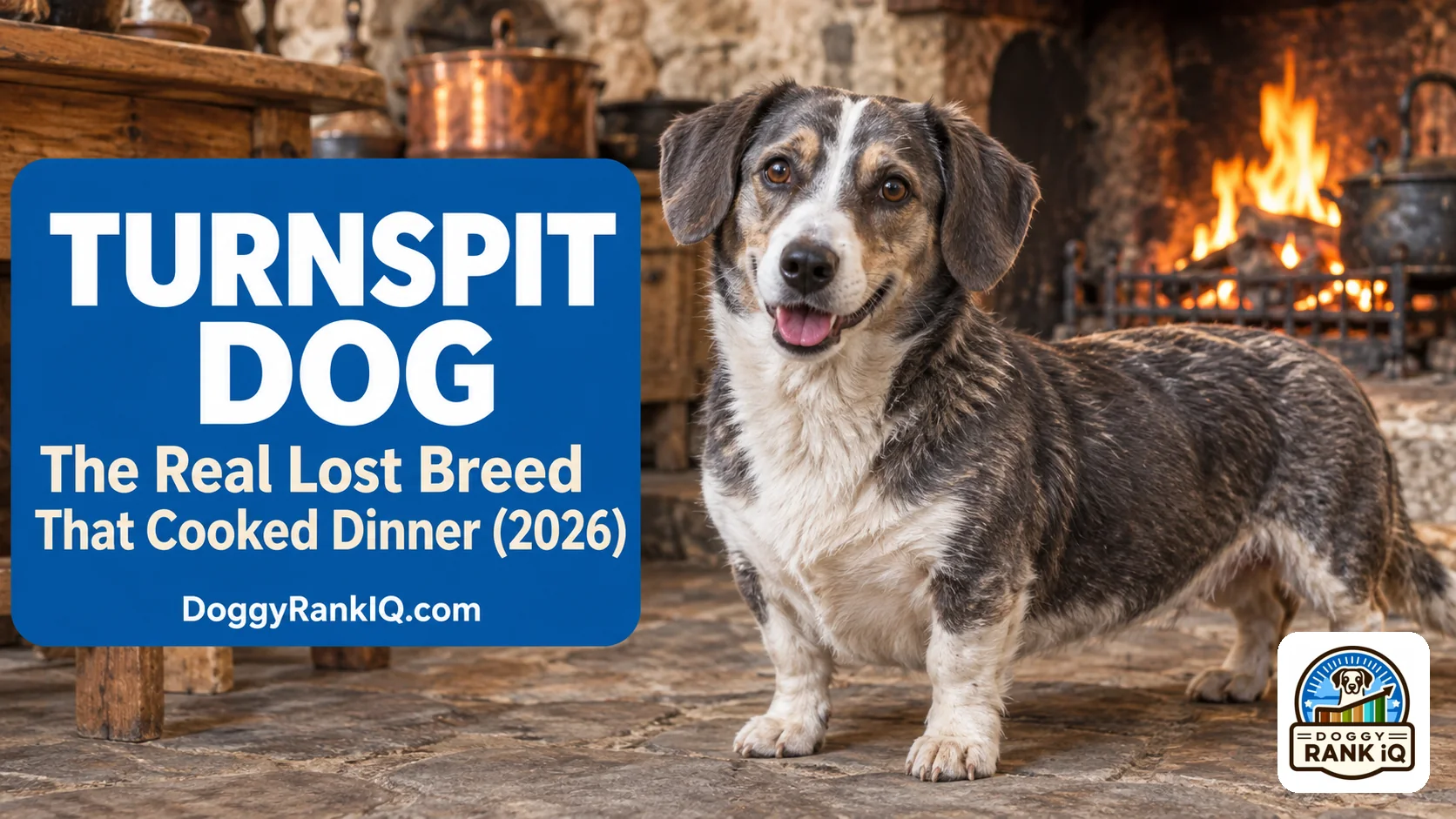
The turnspit dog was a real, short-legged working breed kept in British and European kitchens from at least the 1570s to run inside a wheel that turned meat on a spit over an open fire. John Caius described this kitchen dog in his 1576 book, and Carl Linnaeus later classified it as Canis vertigus, “dizzy dog.” The breed was pushed out by mechanical clock jacks and had effectively disappeared by around 1900, leaving behind only one confirmed preserved specimen. There is no verified turnspit dog for sale today and no proven living descendant, though writers have pointed to the Welsh Corgi and the Glen of Imaal Terrier as possible relatives.
Key Takeaways: turnspit dog
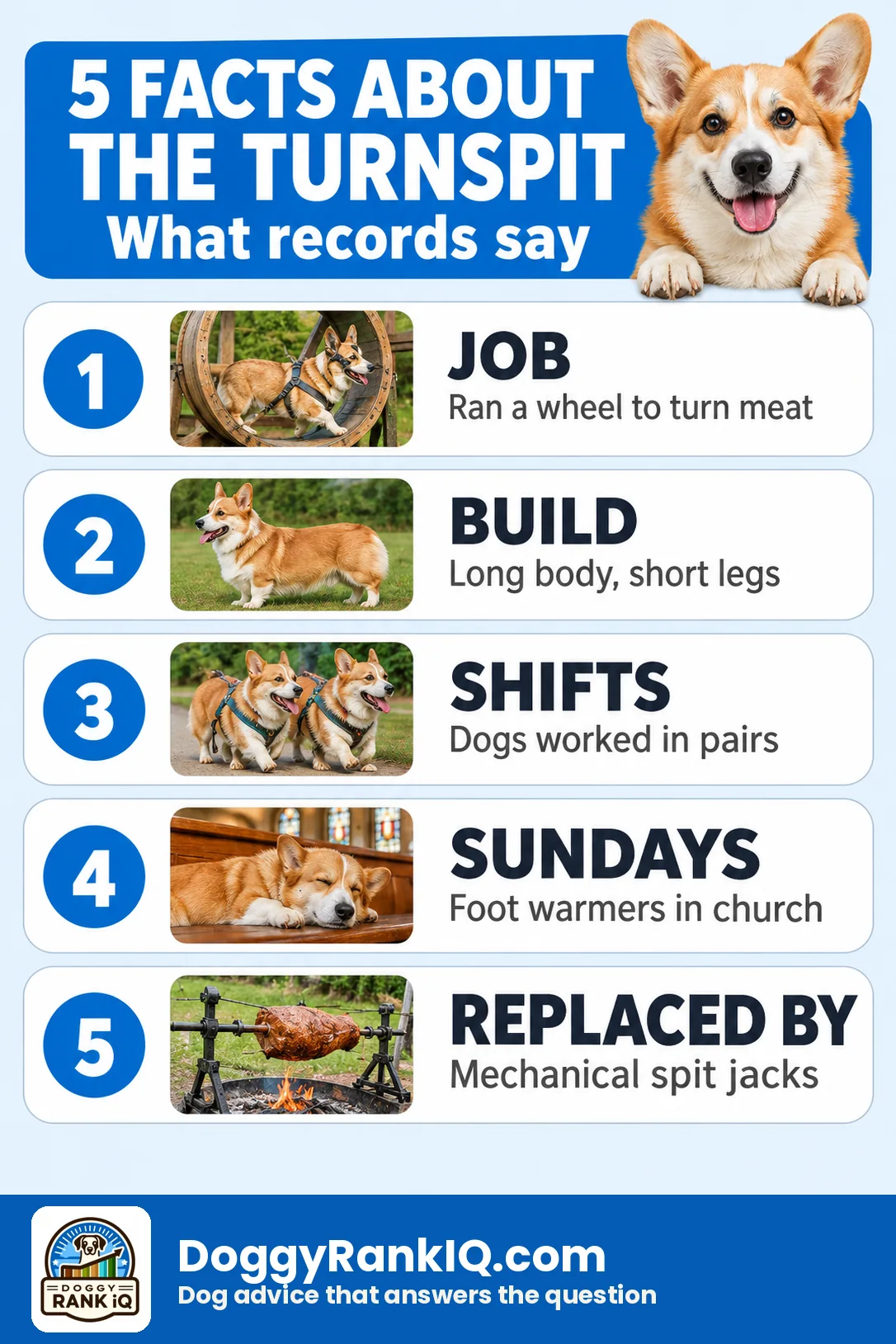
- The turnspit was a short, long-bodied kitchen dog bred to walk inside a wheel connected by a chain to a roasting spit.
- John Caius described the breed in 1576, and Linnaeus later gave it the scientific-sounding label Canis vertigus.
- Dogs usually worked in pairs, taking shifts so one could rest while the other ran the wheel near the hearth.
- Mechanical clock jacks, also called spit jacks or roasting jacks, made the turnspit’s job unnecessary by the mid-1800s.
- The only known preserved turnspit, named Whiskey, is on display at Abergavenny Museum in Wales.
- The rough conditions turnspit dogs worked under are cited as part of the early history that shaped animal welfare advocacy.
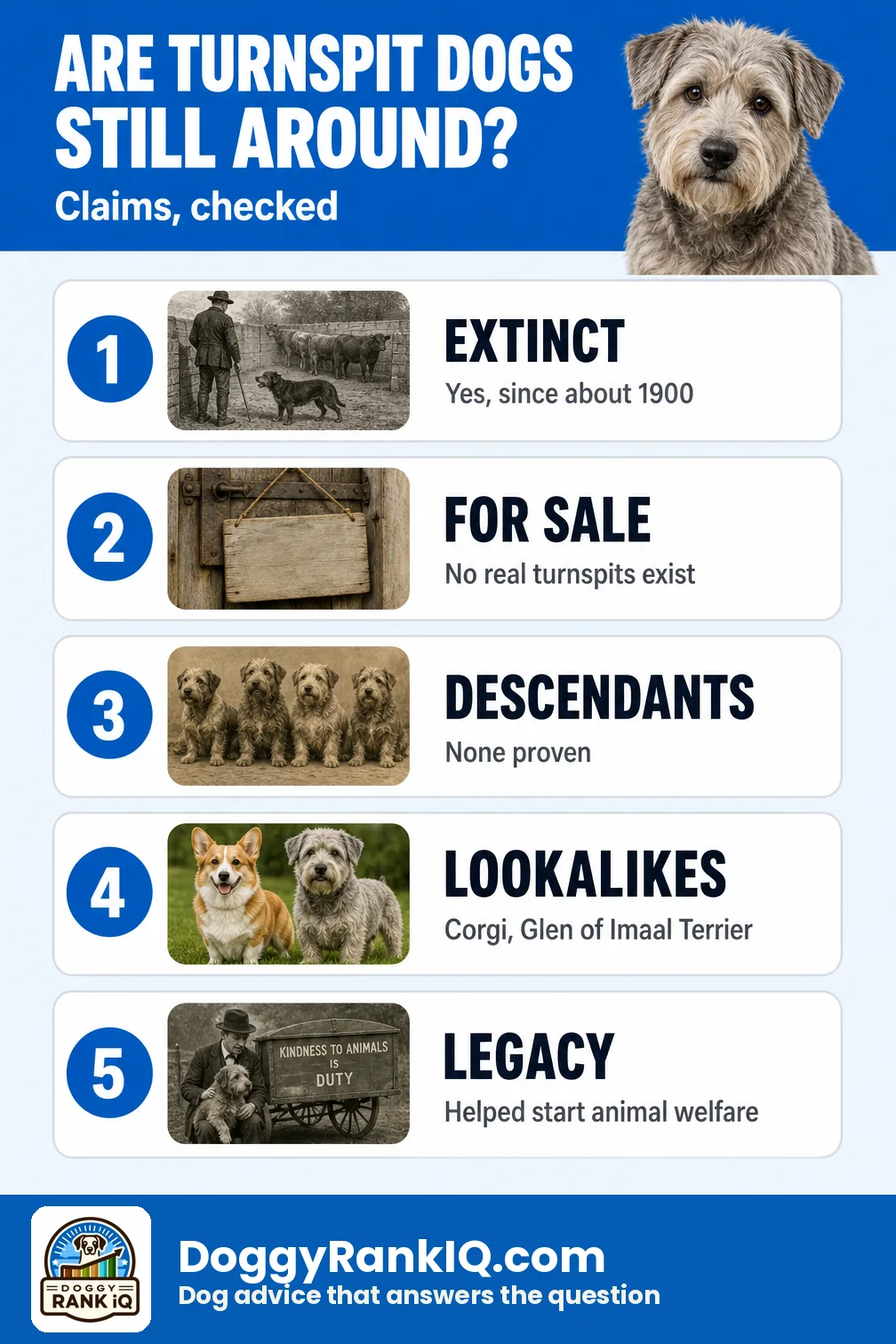
- No confirmed turnspit descendants exist, and no legitimate breeder currently sells the breed.
- Modern references to a “turnspit revival” are speculative at best; there is no documented breeding program recreating the original type.

What do you want to know?
Tap an option to see the answer.
What is a turnspit dog?
A turnspit was a small to medium working breed bred for one specific job: walking inside a wooden wheel to turn a roasting spit in a kitchen. It wasn’t kept for companionship, hunting, or herding, and it wasn’t judged on looks the way show breeds are today.
John Caius gave the breed its earliest detailed written description in his 1576 text Of Englishe Dogges, a translation of his original 1570 Latin work. Caius placed the turnspit among the “mongrel” working dogs of England, animals valued for a specific job rather than a pedigree, according to Mental Floss. Caira Farrell, library and collections manager at The Kennel Club in London, has confirmed this early reference and noted that the dogs went by several names, including kitchen dog, cooking dog, and vernepator cur.
Carl Linnaeus later classified the breed as Canis vertigus, commonly translated as “dizzy dog,” a reference to the dizzying circular motion of life inside the wheel, as discussed by IFLScience. The Latin label shows up confidently in modern retellings, though the surviving historical record on taxonomy from that era is thin enough that some caution is warranted.
This was not a show breed or a pet breed. It was, functionally, a piece of kitchen equipment that happened to be alive, and understanding that framing matters: it explains why so little effort went into preserving the line once a machine could do the same job.
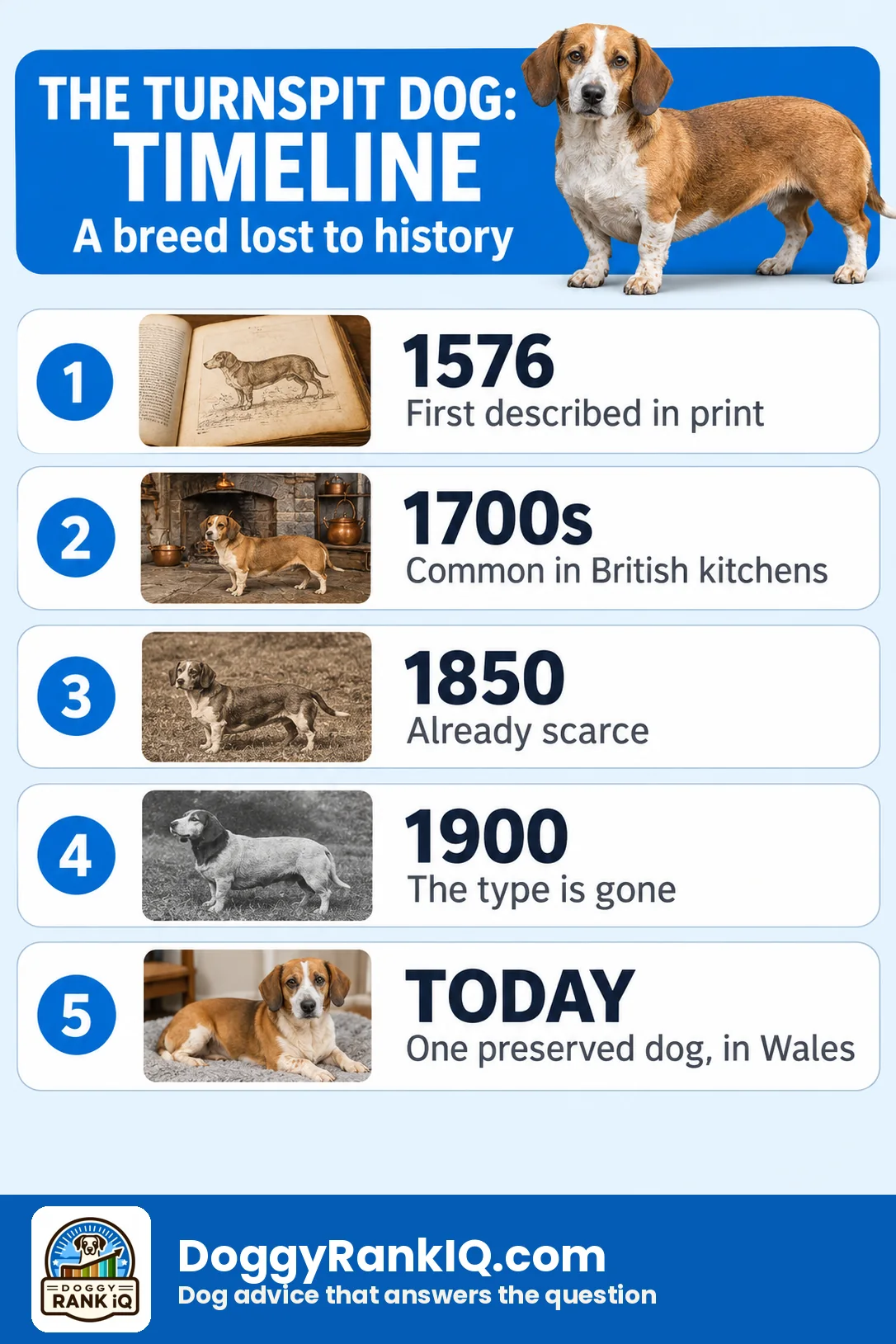
Timeline table: the turnspit dog in dates
| Date | Event |
|---|---|
| 1570 | John Caius writes the Latin text describing the kitchen dog type |
| 1576 | Abraham Fleming publishes the English translation, Of Englishe Dogges |
| ~1750 | Turnspit dogs reportedly common in British kitchens |
| 1761 | Documented household inventory references a clock jack, a mechanical alternative to the dog wheel |
| 1866 | Henry Bergh founds the ASPCA, reportedly influenced partly by seeing turnspit dogs working in Manhattan hotel kitchens |
| ~1850 | The breed becomes scarce as clock jacks spread |
| ~1900 | The turnspit type is considered effectively gone |
This chronology, popularized by historian Jan Bondeson and summarized by Wyoming Public Media / NPR, is widely repeated, but no reliable national census of turnspit dogs ever existed, so the dates mark general trends rather than precise endpoints.
How did turnspit dogs work in kitchens?
A turnspit cooked dinner by walking, not by any skill resembling what we’d call cooking. The dog stepped into a wooden wheel mounted on the kitchen wall near the hearth, and its weight and forward motion turned the wheel like a hamster wheel built for a working animal instead of a pet.
A chain or belt connected the wheel’s axle to the spit holding the meat over the fire. As the dog walked, the spit rotated, so the roast cooked evenly instead of burning on one side. Some accounts describe a small door or flap in the wheel that the cook could close, trapping the dog inside and forcing it to keep moving, a detail that appears repeatedly in historical retellings of kitchen life, including in a 2026 piece from Boing Boing.
Because the job demanded hours of steady walking, most households that used this system kept at least two turnspit dogs so they could work in shifts, letting one rest while the other took over the wheel. The dogs never saw the meal they were cooking from any angle but the wall in front of them.
Example: picture a large roast turning slowly over an open hearth in a manor kitchen around 1750. A cook drops a coal into the wheel behind a reluctant dog, the dog starts walking, the chain pulls taut, and the spit begins turning at a steady pace that no human arm could sustain for two straight hours.
If you’re curious how dogs became capable of this kind of specialized work in the first place, it connects to a much longer story about when dogs were domesticated and how humans have shaped breeds around specific jobs ever since.
Turnspit dog size and looks: facts table
The turnspit was small to medium, long-bodied, and built low to the ground, a shape well-suited to fitting inside a wheel and generating steady walking power.
| Trait | Description |
|---|---|
| Body shape | Long-bodied, crooked or bowed legs |
| Coat colors | Often grey or spotted |
| Eyes | Some individuals reported with odd-colored eyes |
| Other names | Kitchen dog, cooking dog, vernepator cur, Canis vertigus |
| Build purpose | Low center of gravity for stable, sustained wheel walking |
What did turnspit dogs look like?
Turnspit dogs looked somewhat like a stretched, bow-legged terrier mix, with a long back, short crooked legs, and a build described in historical texts as grey or spotted. There was no single standardized look because the breed was defined by function rather than appearance, so individual dogs varied in coat pattern, size, and exact leg shape depending on the region and the household that bred them.
The crooked, low-slung legs show up repeatedly in historical descriptions, which is part of why writers have compared the turnspit’s build to today’s Dachshund and Corgi. Compared to the turnspit, the Dachshund was bred for tunneling into badger dens, a different job that happened to produce a similarly low, long shape. The turnspit’s size would have landed it firmly in small-to-medium territory, nowhere near the proportions covered in guides on large or giant breed sizing.
Common mistake: assuming every long, low-bodied dog breed today descends from the turnspit. Resemblance in silhouette is not proof of ancestry, and several unrelated breeds independently developed short legs for entirely different working purposes.
A day in a kitchen wheel: turnspit dog treatment
A turnspit’s day revolved entirely around the fire, the wheel, and whatever meal needed turning. Cooks reportedly relied on the dogs for hours at a stretch during meal preparation, especially in larger households and inns where roasting happened daily, according to accounts cited by Wyoming Public Media / NPR.
Historical accounts describe harsh conditions. Some cooks were said to drop a hot coal into the wheel to keep a reluctant dog moving, and the physical demand of walking for hours near an open fire took a visible toll on the animals, a pattern discussed by Boing Boing and Mental Floss. One detail that recurs across sources: turnspit dogs were reportedly brought to church on Sundays, not for companionship, but to serve as foot warmers for their owners, a strange footnote that underlines how little their comfort factored into their daily use.
Whether the dogs were treated as pets outside their work hours seems to have varied by household. Some accounts suggest affection existed alongside the labor; others describe the dogs as interchangeable kitchen tools, replaced without much sentiment when they aged out or died. There’s no single, confirmed picture of turnspit welfare, only a pattern of accounts suggesting the job was physically hard and the dogs had little say in it.
Were turnspit dogs good pets?
Turnspit dogs were not bred or kept primarily as pets, so there’s limited reliable information about their temperament outside of work. What historical accounts do suggest is a dog tolerant enough to be handled roughly, sturdy enough to work for hours, and accustomed to close contact with humans in a busy, noisy kitchen environment.
Some households seem to have treated individual dogs with some warmth once their working years ended, but there’s no consistent record of turnspit dogs being bred for friendliness, trainability, or companionship the way modern pet breeds are. Anyone trying to imagine a turnspit as a modern household pet is really projecting onto a breed that was never evaluated on those terms.
Turnspit dog health problems and issues
No veterinary records survive that document specific health conditions in turnspit dogs, so claims about their health issues are largely speculation based on body shape. Given the long back and short, sometimes crooked legs described in historical texts, it’s reasonable to assume these dogs may have faced the kind of spinal and joint strain seen in other long-bodied breeds today, similar to issues modern Dachshund owners manage with supportive gear like a harness built for long-backed dogs.
Beyond skeletal strain, the daily physical demand of hours inside a wheel near an open fire likely caused joint wear, paw injuries from the wheel’s rough wooden surface, and heat stress from proximity to the hearth. None of this is documented in formal veterinary terms because no veterinary profession in the modern sense existed during the breed’s working peak.
How long did turnspit dogs live?
There is no verified lifespan data for turnspit dogs, and no historical source provides reliable average ages at death. Given the physical demands of the job, exposure to heat and smoke, and the generally harsh living conditions described in period accounts, it’s reasonable to assume working turnspit dogs did not enjoy particularly long or easy lives compared to companion dogs of the same era, though no number should be treated as confirmed fact.
Why the turnspit dog went extinct
The turnspit went extinct primarily because a machine did its job better, cheaper, and without needing rest, food, or a vet. The clock jack, also called a spit jack or roasting jack, used weights, gears, and clockwork mechanisms to rotate a spit automatically, a shift documented by The Kennel Club.
A household that bought a clock jack never again needed to feed, house, or manage a kitchen dog for that purpose. The 2026 reproduction project at Moland House, built from an April 1761 household inventory, illustrates just how early this mechanical alternative was already appearing in real kitchens, well before the breed’s reported decline in the mid-1800s.
As clock jacks spread through British and European households, the economic case for keeping a turnspit collapsed. By roughly 1850 the breed was described as scarce, and by around 1900 it had effectively disappeared, according to the commonly cited chronology associated with historian Jan Bondeson. No one holds a precise extinction date because no formal population records were ever kept for a working dog type that nobody thought to register or count.
What happened to turnspit dogs after industrial ovens?
Industrial and gas-powered ovens finished what the clock jack started, removing open-hearth roasting (and therefore the need for any spit-turning mechanism, mechanical or canine) from most kitchens by the late 1800s. Once roasting moved into enclosed ovens, there was no wheel to walk and no spit to turn, so even households that had kept a dog out of habit lost the practical reason to do so.
A 2026 University of Delaware talk by Dr. Julian Yates reframed this history usefully: the “spit jack” role in a kitchen could be filled by a child, a servant, a dog, or a machine. The turnspit’s extinction, in that light, is really a story about which laborer got replaced first when a cheaper option arrived, and the oven simply closed the door on any remaining uses for the role altogether.
Decision point for history buffs: if you’re trying to date a period kitchen scene in a book or film, a wall-mounted dog wheel points to roughly pre-1800, while a visible clock jack suggests the household had already modernized, and an enclosed oven points to the late 1800s or later.
Turnspit dog taxidermy: Whiskey at Abergavenny Museum
The only confirmed physical turnspit specimen that survives today is a preserved dog named Whiskey, displayed at Abergavenny Museum in Wales. Sally Davis, a longtime custodian associated with the museum, has described the dogs as short, low-bodied working animals and connected their disappearance to the arrival of cheap mechanical spit-turners.
Whiskey is referred to as the “only known” surviving specimen, a phrase that describes the current state of documented collections rather than a guarantee that no other specimen exists anywhere, unlabeled, in storage somewhere. Taxidermy practices from that era were inconsistent and poorly recorded, and broader collections like those catalogued by Museum Wales show how much material from this period sits unclassified or loosely attributed.
If you want to see turnspit history in person rather than in a book, Abergavenny Museum remains the one confirmed destination. There is no equivalent specimen on public display anywhere in the United States, despite the breed’s documented presence in Manhattan hotel kitchens during the 1800s.
Turnspit dog historical facts and origin
The turnspit’s documented history begins in 1570 with John Caius’s Latin description of English working dog types, later published in English in 1576. Reference works such as Oxford Reference catalogue the breed alongside other historical working dog types noted for function rather than pedigree, underscoring that the turnspit was treated as a category of labor, not a formally recognized breed in the modern sense.
Key facts worth remembering:
- The breed had no formal registry or breed standard; it was identified by job and body type, not papers.
- The name “vernepator cur” appears in some historical texts as an alternate Latin-derived label.
- Turnspit dogs were used in both British and broader European kitchens, with American use documented in 1800s Manhattan hotels.
- The breed’s working conditions are frequently cited in discussions of early animal welfare history, including the founding of the ASPCA in 1866.
Are turnspit dogs still around today?
No, turnspit dogs are not still around today in any confirmed form. The last reliable sightings of the working type date to around 1900, and no breeding program has maintained the line since, leaving only historical records and the single preserved specimen at Abergavenny Museum as physical evidence the breed ever existed.
Can you buy a turnspit dog breed now?
No, you cannot buy a genuine turnspit today because the breed has no living population and no verified breeders anywhere in the world. There is no confirmed turnspit for sale today, and no verified living descendant of the original breed exists. Anyone advertising a “turnspit” puppy is either mislabeling another breed or making an unsupported claim.
Common mistake: confusing a small, long-bodied mixed-breed dog with a genuine turnspit. Without documented pedigree or genetic testing, a resemblance in shape proves nothing about ancestry.
Dog breeds similar to turnspit dogs
Writers have floated possible relatives based on body shape alone, most often the Welsh Corgi and the Glen of Imaal Terrier, the latter also historically used in turnspit-style wheels. Neither connection has been proven through genetics or documented breeding records.
Turnspit dog vs Corgi comparison
The turnspit and the Corgi share a similar silhouette (short legs, a long body, and a sturdy frame) but they were bred for completely different jobs, and no genetic study has confirmed a direct lineage between them. The Corgi was developed primarily for herding cattle in Wales, using its low build to avoid kicks from livestock, while the turnspit’s short stature served a stationary, repetitive walking task inside a wheel.
Resemblance is not ancestry, and a short-legged build shows up independently across many breeds shaped for different jobs, from den-hunting to herding low cattle. For readers generally curious about how modern breed identity gets confirmed or debunked, a DNA comparison like Embark vs Wisdom Panel shows how far testing has come since the days when “looks like a turnspit” was the only available evidence.
Turnspit dog descendants and the breed today: revival, for sale claims checked
As for a turnspit revival: nothing in the current historical or veterinary literature describes an active breeding program attempting to recreate the original type. The 2026 academic interest in the breed, including the University of Delaware lecture, is historical and cultural scholarship, not a genetics project aimed at reconstruction.
Anyone claiming to sell a “revived” turnspit in 2026 should be treated with the same skepticism you’d apply to any breed claim without papers, pedigree records, or a named, verifiable breeder. If you’re considering any small, long-bodied breed as a pet based on turnspit curiosity, it’s worth researching actual documented breeds like the Corgi or Dachshund rather than chasing an unsubstantiated label.
How turnspit dogs helped start animal welfare law
The turnspit’s working conditions are cited as part of the backdrop that shaped early animal welfare advocacy, most notably the 1866 founding of the ASPCA by Henry Bergh, who reportedly witnessed turnspit dogs working in Manhattan hotel kitchens before establishing the organization. This connection, discussed in the timeline from Wyoming Public Media / NPR, suggests that visible, repetitive animal labor in public-facing settings like hotel kitchens helped push welfare concerns into public conversation at a time when there was little formal protection for working animals.
It’s worth noting that the turnspit’s role in this history is cited as contextual influence, not as a documented cause with a direct paper trail connecting the dog wheel to specific legislation. Still, the pattern fits a broader historical trend: visible animal suffering in commercial and household settings has repeatedly nudged public opinion and law toward stronger protections, a trend that continues to shape modern conversations about responsible pet care, covered in guides like choosing the best food for your dog and best practices in dog grooming.
⭐ Top 5 Features We Love
- A documented 1576 source. John Caius’s written description gives this breed something most lost breeds never get: a named author and a dated text (mtpr.org, en.wikipedia.org).
- A real, visitable specimen. Whiskey at Abergavenny Museum turns an abstract history lesson into something you can actually stand in front of.
- A clear technological turning point. The clock jack gives the extinction story an identifiable cause instead of a vague fade-out.
- A link to modern animal welfare. The ASPCA connection gives the breed’s suffering a lasting, positive legacy.
- A built-in mystery. The unresolved descendant question, Corgi, Glen of Imaal Terrier, or neither, gives dog history fans something to keep debating.
⚠️ Things to Look Out For
- “Turnspit for sale” listings. No verified breeder or registry offers this breed. Treat any such listing as a different dog, possibly mislabeled.
- Overconfident descendant claims. Statements that the Corgi or Dachshund “is” a turnspit descendant go beyond what the evidence supports; resemblance isn’t proof.
- Exaggerated population numbers. Claims about exactly how many turnspit dogs existed at any point are not backed by real census data.
- “Revival breed” marketing. No documented genetic reconstruction project currently exists; be wary of novelty pet marketing borrowing the name.
- Taxidermy authenticity claims. Any specimen claiming to be a second confirmed turnspit beyond Whiskey deserves scrutiny and provenance documentation.
Dog breed history books
Readers who want to dig past a single article into full breed history have a few solid options worth the shelf space.
The Invention of the Dog: 75 Breeds that Changed the World covers how working roles, including unusual ones like the turnspit, shaped the breeds we recognize today. Price checked 2026: $32.62. Check the current price
The Dog Encyclopedia (DK) is a broad visual reference covering hundreds of breeds, useful for comparing body types against historical descriptions like the turnspit’s. Price checked 2026: $13.29. Check the current price
Every Dog: A Book of Over 450 Breeds is a compact catalog format good for quick breed-to-breed comparisons, including extinct or rare types. Price checked 2026: $12.82. Check the current price
What manufacturers describe as a reference book and what owners report after reading it can differ, so check reviews for your specific interest, whether that’s breed history, genetics, or working-dog stories, before buying.
FAQ
Are turnspit dogs a real thing?
Yes. The turnspit was a real working breed documented as early as 1576 by John Caius, kept specifically to run a wheel that turned meat on a kitchen spit. It was common in British kitchens through the 1700s before mechanical alternatives made it unnecessary.
The bottom line
The turnspit was a documented working breed, not a folk tale, and its story runs from a 1576 written description through a slow replacement by mechanical clock jacks to a single preserved specimen in a Welsh museum today. No verified turnspit descendants or revival breeding programs exist, so treat any “turnspit for sale” claim as unsupported. If this kind of breed history interests you, the next useful step is comparing the turnspit’s working build against living low-bodied breeds like the Corgi or Dachshund, or picking up one of the reference books above to see how many other working dogs disappeared the same way: replaced by a machine that didn’t need feeding.
Doggy Rank IQ is reader supported. As an Amazon Associate we earn from qualifying purchases, at no extra cost to you.