
Quick Answer: Is a Dachshund Right for You?
A dachshund suits you if you want a bold, funny, deeply attached small dog and you are willing to manage weight, stairs and jumping for the next 14 years. This is a badger hunter in a loaf-shaped body: clever, loud, independent, and built with a long spine that carries real risk of intervertebral disc disease (IVDD). The breed sits at No. 5 in the American Kennel Club’s 2025 popularity ranking, and most of what new owners struggle with is predictable. Slow potty training, a bark that outsizes the dog, constant begging, and a back that needs ramps and a lean body condition.
Skip the dachshund if you want an easy off-leash recall, a quiet apartment neighbor, or a dog that will happily be left alone for ten hours.
Key Takeaways: Dachshund
- Two sizes, three coats. Standard dachshunds run 16 to 32 pounds; miniatures are 11 pounds and under at 12 months, per the AKC breed standard. Coats are smooth, longhaired and wirehaired.
- IVDD is the headline health risk. The breed’s short legs come from an FGF4 retrogene (CDPA), while a separate retrogene (CDDY) is linked to early disc degeneration. European breed-health groups now treat these as two different things, which matters because reducing disc risk does not require changing the short-legged look.
- Lifespan is long: roughly 12 to 16 years. Plan for a 14-year commitment, not a 9-year one.
- Cornell’s veterinary guidance focuses on risk reduction, not prevention. Keep the dog lean and fit, limit repeated stairs and furniture jumps, and call a vet at the first sign of back pain.
- No ramp has been proven in a study to prevent a disc extrusion. A November 2026 veterinary review makes that point plainly. Weight and conditioning have the stronger evidence behind them.
- Expect barking. Alert barking is part of the original job description, not a training failure.
- Budget roughly $1,200 to $3,500 for a puppy from a health-focused breeder, plus a first year that commonly lands between $2,000 and $4,000 all in.
Where Does the Dachshund Come From?
The dachshund was developed in Germany to hunt badgers underground, and the name says it outright: dachs (badger) plus hund (dog). Everything odd about the body is job-related.
Short legs to work at ground level. A long body to turn in a tunnel. A deep chest for lung capacity. Loose skin that does not tear easily. Large paws for digging. And a loud, carrying bark so a handler above ground could find the dog below.
German hunters eventually split the breed by quarry size. Standards took badger. The smaller ones, which became the miniature dachshund, went after rabbit and fox in tighter burrows. The three coats arrived through different crosses: smooth first, then longhaired (likely spaniel influence), then wirehaired (terrier influence), which is why wires often behave the most like scruffy little terriers.
The breed also goes by teckel in Germany and, in the United States, by every nickname you have ever heard shouted across a dog park. Weiner dog. Wiener dog. Weenie dog. Sausage dog.
The practical point: a dog bred to make independent decisions in a dark tunnel, out of sight of its human, is not going to be a push-button obedience dog in your kitchen. That is not stubbornness for its own sake. That is the design brief.
What Makes the Dachshund So Special (and So Cute)?
What owners talk about most is not the shape. It is the attachment. Dachshunds tend to pick a person and then stay within three feet of that person for the rest of their lives.
They burrow. Under blankets, into laundry piles, behind your knees on the sofa. That is tunneling instinct repurposed for upholstery, and it makes them unusually good company for people who live alone, work from home, or want a dog that actually wants to be touched.
The cuteness is partly geometry. Short limbs, a long low body, a head that looks slightly too serious for the frame, and ears that flop at exactly the wrong moment. Then the dog barks at a delivery driver with the volume of a German Shepherd and you keep in mind what you signed up for.
A dachshund does not think it is small. It thinks the badger is late.
Personality-wise, the AKC breed standard describes the dachshund as clever, lively, courageous and persistent “to the point of rashness.” That last phrase does a lot of work. It explains the fearless charge at a Great Dane, the refusal to abandon a squeaky toy at 11 p.m., and the dog that stands on the back of the sofa surveying the street like a tiny, furious security guard.
If you want a dog that is genuinely interested in you, the dachshund delivers. If you want independence, look elsewhere. Our breed matchmaker guides can help you compare temperaments before you commit.
Dachshund Size, Weight and Lifespan
Dachshunds come in two official AKC sizes, and the split is decided at 12 months of age, not by appearance. A dachshund lives roughly 12 to 16 years, which is long even by small-dog standards.
| Variety | Weight (AKC standard) | Height at shoulder | Typical lifespan |
|---|---|---|---|
| Standard dachshund | 16 to 32 lb | 8 to 9 in | 12 to 16 years |
| Miniature dachshund | 11 lb and under at 12 months | 5 to 6 in | 12 to 16 years |
| “Tweenie” (unofficial) | 12 to 15 lb | 6 to 8 in | 12 to 16 years |
Sex differences are modest. Males often sit a pound or two heavier and slightly broader through the chest; females tend to be a touch finer in bone. Within each size, individual variation is larger than the male-female gap, so do not choose a sex expecting a specific adult weight.
“Tweenie” is not a recognized size. It is a useful shorthand for dogs that land between the two, and breeders use it honestly or as a sales term depending on the breeder. Ask for the parents’ adult weights instead.
Note what is not on this chart: “teacup.” There is no teacup dachshund. Dogs marketed that way are either undersized miniatures or the product of breeding for extreme smallness, which brings its own fragility problems. If you want a frame of reference for how size categories actually work across dogs, see our guide to dog size categories and what counts as a large breed.
For lifespan context across the dog world generally, our explainer on how long dogs live covers why small breeds outlast big ones.
What Is the Dachshund Temperament Like?
Confident, affectionate at home, suspicious of strangers, and loud. The AKC describes the dachshund as intelligent but independent, and recommends reward-based training rather than pressure.
Here is what that looks like day to day:
- Velcro attachment. Following you to the bathroom is standard. Separation anxiety is a genuine risk if you never teach alone time.
- Alert barking. The breed was built to vocalize. Doorbells, hallway footsteps, pigeons, the wind.
- Prey drive. Squirrels, rabbits, and anything that moves fast through grass. Recall is unreliable in many dachshunds. Use a long line.
- Digging. Garden beds, sofa cushions, your duvet.
- Resource guarding in some lines. This one deserves attention.
That last point is worth naming directly because Reddit threads are full of it. Dachshunds can guard food, chews, beds and sometimes a favorite person, and that guarding can escalate into growling or snapping at family members. It is not a character flaw and it is not rare. It is a behavior with a well-established treatment path: trade-up exchanges, never grabbing items from the dog, managing access to high-value chews, and early help from a credentialed behavior professional (look for a veterinary behaviorist or a certified behavior consultant) if a dog has already bitten.
Do not wait on this one. Guarding gets harder to change the longer it is practiced.
Are Dachshunds Good With Kids and Other Pets?
Dachshunds can do well with calm, dog-literate children over about eight, and are a poor default choice for homes with toddlers. The problem is mechanical as much as behavioral.
A small child picking up a dachshund wrong, or dropping one, puts direct strain on a spine that is already the breed’s weak point. Add a dog that is bold, quick to object, and small enough to be grabbed, and you have a combination that goes wrong fast.
Practical rules if you have kids:
- Teach children to pet the dog where it already is, never to lift it.
- Give the dachshund a child-free bed or crate that nobody is allowed to approach.
- Feed and give chews behind a closed door.
- Supervise every interaction under age eight. All of them.
With other dogs, dachshunds are usually fine when socialized early, though many are opinionated with same-sex dogs and some will pick fights with dogs five times their size. With cats, it depends entirely on the individual and the introduction. With rabbits, hamsters, guinea pigs and ferrets, be careful. This breed was engineered to hunt small burrowing animals, and no amount of training reliably removes that.
If kid-friendliness is your top filter, compare against our roundup of family-friendly dog breeds.
Who Is the Dachshund Made For, and Who Should Skip It?
A dachshund suits you if:
- You live in an apartment or small home. Dachshunds are good apartment dogs on space, with one caveat: the barking. If you have thin walls and a dog reactive to hallway noise, you will be doing management work.
- You are home often. Couples, remote workers, empty nesters and retirees do well with this breed.
- You enjoy training as a hobby rather than a chore.
- You can commit to ramps, gates and a strict food policy for 14 years.
- You want a dog that is genuinely devoted to you.
Skip the dachshund if:
- You have a toddler or plan to soon.
- Your home is built around a staircase the dog cannot avoid.
- You want off-leash hiking with reliable recall.
- You work long days away from home.
- You are a soft touch with food. This breed will get fat, and fat is the single clearest modifiable IVDD risk factor.
- You need a quiet dog for a shared-wall building with strict noise rules.
Dachshund vs Corgi for families: Corgis generally tolerate children better, train with more enthusiasm, and have fewer spinal problems, though they shed dramatically more and need more exercise. Corgis are also loud and nippy with heels. For a busy family with young kids, a Corgi is usually the easier dog. For a quiet two-adult household that wants a close, comic companion, the dachshund wins. See also our list of breeds that work well in apartments.
How Much Exercise Does a Dachshund Need?
Most adult dachshunds do well on 30 to 60 minutes of walking a day, split into two or three outings, plus daily sniffing and problem-solving work. Walking is safe for the back. Repeated high-impact leaping is the activity to limit.
Cornell’s guidance draws exactly that line: ordinary walking is fine, while jumping hard for thrown toys is the kind of high-impact movement worth avoiding in a breed already predisposed to disc disease.
What to do instead of fetch:
- Scent work. Hide treats around a room and let the dog hunt. Ten minutes of nose work tires a dachshund more than a mile of walking.
- Snuffle mats and slow feeders. Turns dinner into twenty minutes of searching.
- Flat-ground tug, kept low and gentle, with no yanking or lifting.
- Food puzzles and frozen stuffed toys. A frozen treat toy handles the evening witching hour nicely.
- Trick training in short sessions. Five minutes, high rate of reward.
For walks, use a long line in open spaces rather than trusting recall. Our guide to choosing a long line dog leash covers length and grip.
Puppies need less structured exercise than owners expect. A rough guide used by many vets is five minutes of formal walking per month of age, twice daily, with free play on soft ground filling the rest.
Dachshund Grooming and Shedding
All three dachshund coats shed, and none of them are hypoallergenic. Smooth coats are the lowest effort, wirehaired coats need the most specialized work.
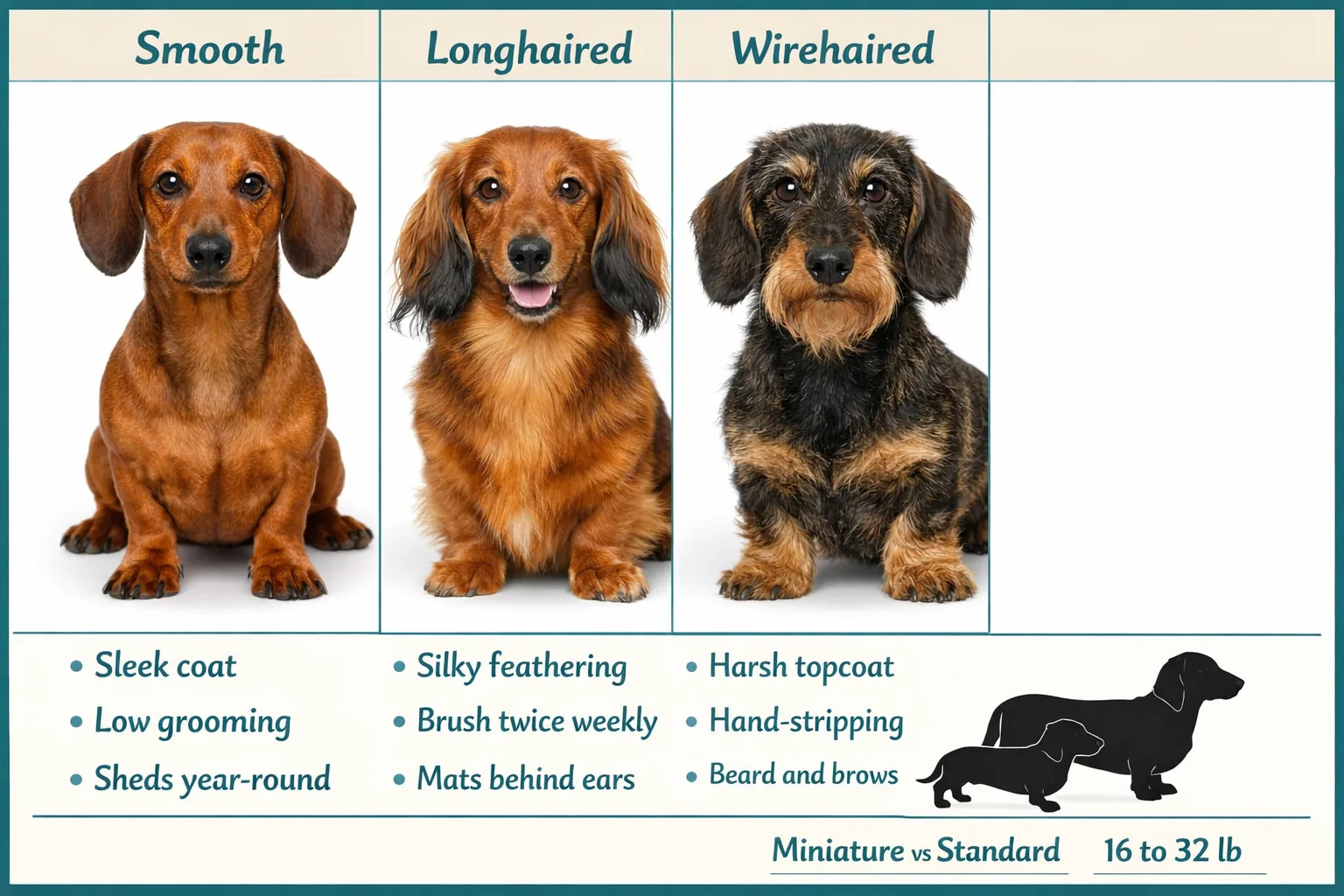
Smooth dachshund: Weekly rubber curry brush. Sheds steadily year-round, and the short stiff hairs weave themselves into upholstery. Bathe every 6 to 8 weeks.
Longhaired dachshund: Brush two or three times a week with a slicker and a comb. Mats form behind the ears, in the armpits and on the trouser feathering. Trim the hair between paw pads for traction on hard floors, which matters more for this breed than for most.
Wirehaired dachshund: The harsh topcoat is maintained by hand-stripping two or three times a year, which pulls dead hair out at the root and keeps the texture correct. Clipping is easier and cheaper but softens the coat over time. Weekly brushing, plus beard cleaning after meals.
Across all coats:
- Nails every 3 to 4 weeks. Long nails change how a dachshund loads its front end and reduce grip on slick floors. See our comparison of a dog nail grinder vs clipper.
- Ears weekly. Drop ears trap moisture.
- Teeth most days. Small breeds get dental disease early, and dachshunds are no exception.
New to this? Start with our beginner’s guide to dog grooming.
Common Dachshund Health Problems
IVDD is the condition that defines dachshund ownership. Intervertebral disc disease happens when the cushioning discs between the vertebrae degenerate and then bulge or rupture into the spinal canal, pressing on the spinal cord. In dachshunds it is usually the explosive type (Hansen Type I), and it can go from “my dog seems stiff” to “my dog cannot use its back legs” within hours.
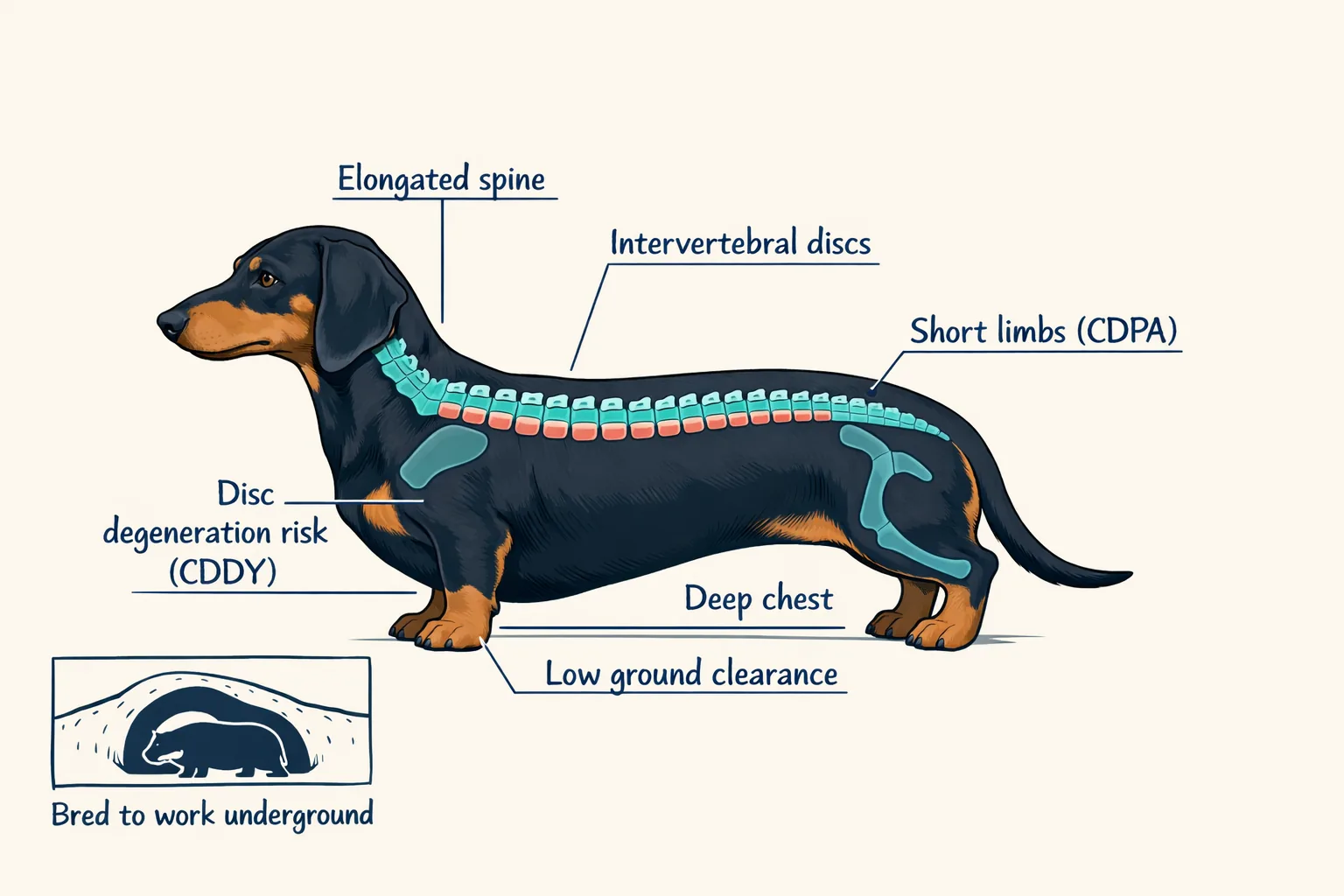
The genetics are becoming clearer. Breed-health researchers now separate two FGF4 retrogenes: CDPA on chromosome 18, which produces the short-limbed conformation, and CDDY on chromosome 12, which is linked to premature disc degeneration. Those are different genes doing different jobs. That distinction matters because it means breeding programs can work on disc risk without abandoning the breed’s shape.
Call a vet immediately if you see: yelping when picked up, a hunched or arched back, reluctance to jump or climb, shivering, wobbly or crossing back legs, dragging toes, or loss of bladder control. Back pain with weak legs is an emergency. Faster treatment means better outcomes.
Other conditions worth knowing:
- Obesity, which worsens nearly everything on this list
- Dental disease, very common in small breeds
- Patellar luxation (slipping kneecaps)
- Progressive retinal atrophy and, in dapples, deafness and eye defects from double-dapple breeding
- Cushing’s disease, seen more often in dachshunds than in many breeds
- Lafora disease in wirehaired miniatures, a late-onset epilepsy with a DNA test available
On DNA testing: Dachshund Health UK announced in October 2026 that it was pointing breeders toward Canine Genetic Testing, whose profits support the Canine Genetics Centre at the University of Cambridge. The organization said the centre needs roughly £350,000 to £400,000 a year to operate and has had no core funding since April 2024. The Royal Kennel Club has been closing its own DNA-testing service and recognizes CAGT results. If you are buying a puppy, ask the breeder which tests apply to that specific variety and ask to see the certificates.
Where the facts end: a November 2026 veterinary review notes that no study proves a ramp prevents disc extrusion, and that screening radiographs cannot guarantee a dog will never develop IVDD. Keeping a dachshund lean and conditioned has the better evidence. Ramps, gates and floor traction are sensible ways to remove avoidable impacts, not guarantees.
What Do Dachshunds Love to Eat? Favorite Foods and Feeding
Dachshunds love everything, which is the problem. Weight control is the most useful health work you will do for this breed, so feed measured meals from a labeled portion guide and count treats inside the daily total.
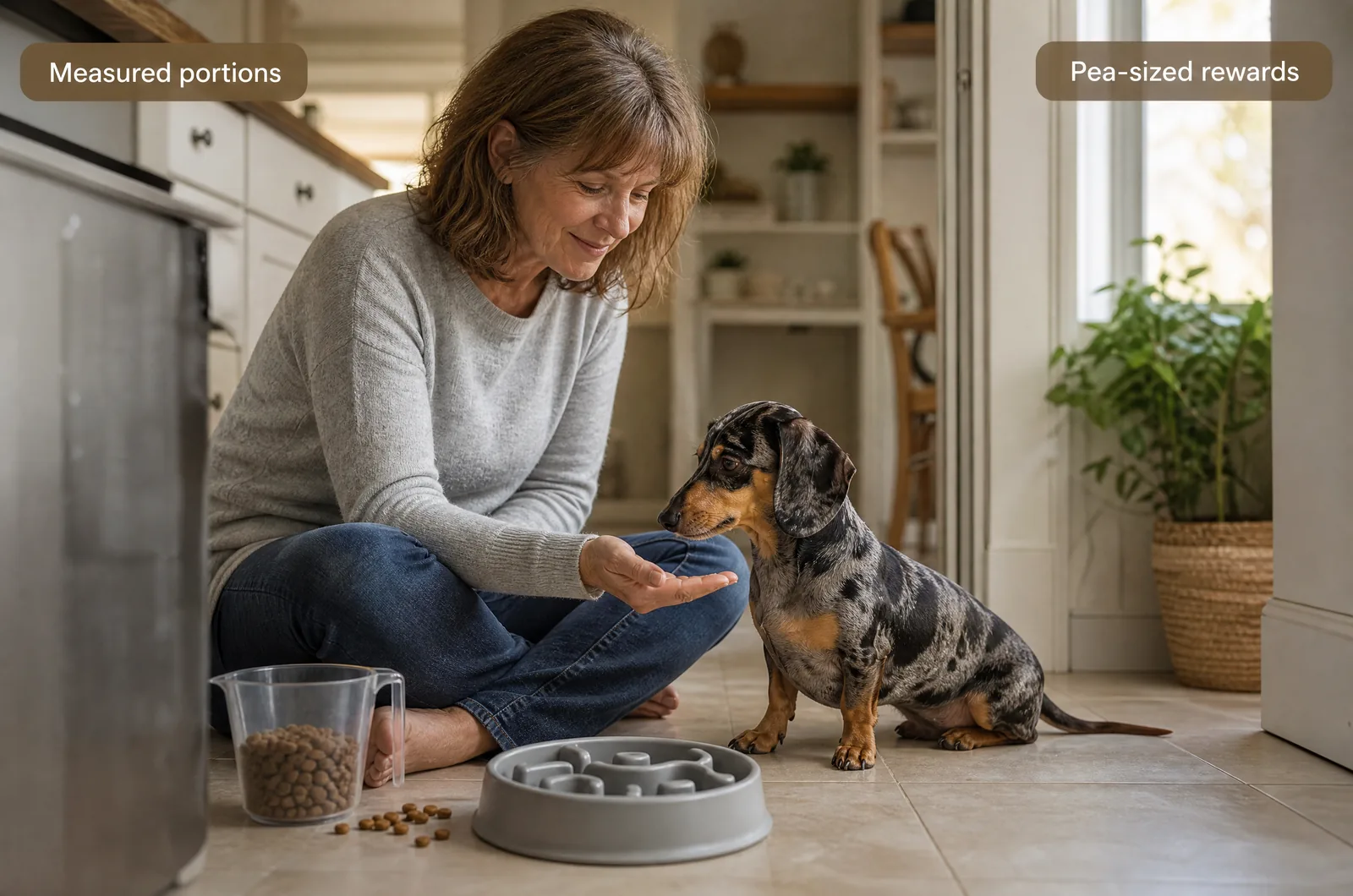
Daily feeding, roughly:
- Miniature dachshund (10 lb): about 1/2 to 3/4 cup of a typical adult kibble per day, split into two meals
- Standard dachshund (22 lb): about 1 to 1 1/4 cups per day, split into two meals
Those are starting points only. Adjust by body condition, not by the bag. Weigh food with a kitchen scale rather than scooping, because a heaped cup can be 40 percent more than a level one. Our guide to reading a dog food label and what AAFCO means explains how to read the statement that actually matters.
Treats dachshunds tend to love, at low cost:
- Green beans, plain and cooked
- Carrot coins (crunchy, nearly free calorie-wise)
- Cucumber slices
- Blueberries
- A spoon of plain pumpkin puree
- Freeze-dried single-ingredient meat, broken into pea-sized pieces
Avoid: grapes and raisins, onion and garlic, xylitol (birch sugar) in peanut butter and baked goods, chocolate, macadamia nuts, cooked bones, and anything heavily salted. Check the safe fruit and vegetable list before improvising.
Body condition check: run your hands along the sides. You should feel ribs under a thin layer, like the back of your knuckles. Looking down from above, there should be a waist. A dachshund with no waist is carrying load its spine does not need.
Choosing food is its own project. Our beginner’s guide to choosing dog food walks through life stage, format and cost per serving.
How to Train a Dachshund
Train a dachshund with short, high-value, reward-based sessions and accept that compliance is negotiated rather than automatic. This is a dog bred to work alone underground, so “because I said so” has no history behind it.
Potty training is the hardest part. Dachshunds are famously slow to house-train, and three things cause most of it: a small bladder, a strong dislike of cold or wet grass, and owners who reduce supervision too early.
What works:
- Take the puppy out every 45 to 60 minutes while awake, plus after every nap, meal and play session.
- Go outside with the dog. Reward within two seconds of finishing, outdoors, with food.
- Use a crate or a pen when you cannot watch. Not punishment. A bladder-management tool.
- Clean accidents with an enzymatic cleaner, never ammonia-based.
- Add a covered or sheltered potty spot for rain. Many dachshunds simply refuse weather.
- Expect 6 to 9 months for reliability, and expect regressions. Washable pee pads buy you patience during the slow months.
For stubbornness generally: raise the pay. A dachshund that ignores kibble will work for chicken. Keep sessions under five minutes. End while the dog still wants more. Never repeat a cue three times, because you are teaching the dog that the third one is the real one.
For barking: manage the triggers first (block window views, white noise near the door), then teach a “quiet” cue by rewarding the pause after barking. You will reduce it. You will not eliminate it, and anyone who promises you will is selling something.
Try It: Dachshund Back Safety Check
That long back makes dachshunds prone to disc problems, and most of the strain comes from small daily habits rather than one dramatic accident. Check the habits below and get specific changes you can make today.
Doggy Rank IQ Tool
Dachshund Back Safety Check

That long back makes Dachshunds prone to disc problems (IVDD). Check the everyday habits that add strain and get changes you can make today.
How Much Does a Dachshund Cost?
Expect $1,200 to $3,500 for a puppy from a breeder who health-tests, with rare colors and show lines pushing higher. Rescue adoption typically runs $150 to $500.
First-year costs beyond the purchase price, rough U.S. ranges:
- Vaccines, exams, deworming: $300 to $600
- Spay or neuter: $250 to $700
- Microchip, license: $40 to $90
- Crate, pen, bed, bowls, ramp, gates: $250 to $500
- Food: $300 to $600
- Training class: $150 to $300
- Pet insurance: $250 to $600
First-year total: roughly $2,000 to $4,000 on top of the puppy price.
Ongoing years: roughly $1,200 to $2,500, food, routine vet care, grooming and insurance included.
The number that breaks budgets is IVDD surgery. Spinal surgery with imaging and aftercare commonly runs several thousand dollars at a specialty hospital, and conservative management (strict crate rest, medication, rechecks) is not free either. Insurance bought before any back symptoms appear is one of the more defensible purchases for this specific breed. Buy it early. Pre-existing condition exclusions are strict.
Dachshund Puppy Tips for the First 90 Days
Before the puppy arrives: gate the stairs, put a ramp at the sofa, lay runners on slick floors, and decide now whether the dog is allowed on furniture. Changing that rule later is harder than enforcing it from day one.
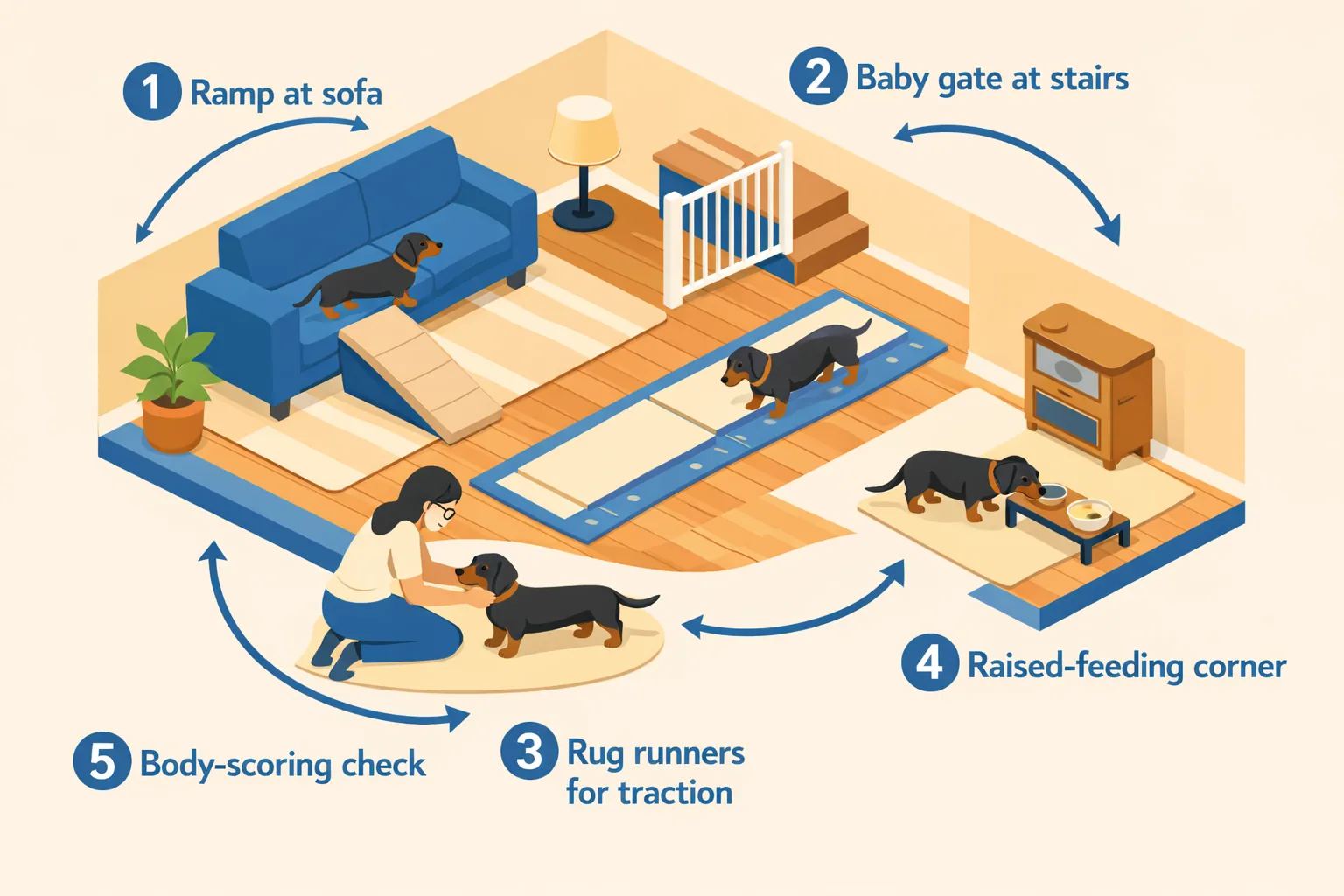
Days 1 to 14. Crate or pen whenever unsupervised. Potty breaks every 45 minutes while awake. Handle paws, ears and mouth daily in short friendly sessions so vet visits are easier later. Start feeding measured meals from a scale, because the begging starts immediately and the habit of eyeballing portions is hard to break.
Days 15 to 45. Socialization window. Short, positive exposures to surfaces, sounds, hats, umbrellas, vacuum cleaners, car rides and calm vaccinated adult dogs. Quality over quantity: three good experiences beat a chaotic trip to a busy park. Teach alone time in five-minute increments now, before the attachment hardens.
Days 46 to 90. Start a reward-based puppy class. Teach a settle on a mat, a hand-target, and a trade cue for taking items from the dog. Introduce a well-fitted harness and loose-lead walking, since pulling on a collar is something Dachshund IVDD Support Australia specifically flags as worth discussing with your vet. Our dachshund harness comparison covers fit for a long-bodied, deep-chested dog.
Throughout: no stairs, no couch jumping, no forced long walks, and no free-feeding.
What Dachshund Owners Say
Three real posts from the r/Dachshund community, with the practical response to each.
“You now have no room in your life for anything except dachshunds”
Posted by an owner on Reddit. This is affectionate, and it is also a warning. The velcro attachment that makes this breed wonderful becomes separation anxiety if the dog never practices being alone. Build a daily alone-time routine from week one: a chew in a pen, you in another room, five minutes, then ten. Do it even when you work from home.
“he acts like he hasn’t eaten in a week, every single day”
Posted by an owner on Reddit. Universal in this breed, and the single most useful thing you can push back on. Weigh food on a scale, move the whole daily ration into puzzle feeders and training rewards, add green beans or steamed carrots for bulk, and agree one feeding policy across everyone in the house. Then check body condition monthly against our guide on whether your dog is overweight.
“He was my angel when there was no other support available post partum”
Posted by an owner on Reddit. Worth sitting with. The companionship is not a side benefit of this breed, it is the main product, and it is why people who lose a dachshund grieve hard. Practically: a 14-year lifespan means planning for senior care, mobility support and end-of-life costs well in advance. That planning is a kindness to the dog and to yourself.
Dachshund FAQ
Why do dachshunds have such long backs? They were bred to work in badger tunnels. A long body with short legs lets the dog move and turn in a narrow burrow. The short limbs trace to an FGF4 retrogene (CDPA); a separate retrogene (CDDY) is linked to early disc degeneration.
Can dachshunds jump off the couch safely? Repeated jumping down from furniture is an avoidable impact and worth preventing with a ramp or steps. No study proves a ramp prevents a disc extrusion, but removing daily hard landings is sensible for a breed already at risk.
Do dachshunds live long? Yes. Most dachshunds live 12 to 16 years, which is long even among small breeds. Plan for a 14-year commitment including senior care.
Should I get a miniature or standard dachshund? Choose a miniature if you want a lighter dog that is easier to lift and carry up stairs. Choose a standard if you want a slightly sturdier dog with more stamina. Both carry IVDD risk, so size is not a safety shortcut.
Why do dachshunds bark so much? Alert barking was part of the original job: the dog had to be heard from underground. Socialization, a trained quiet cue, trigger management and enough mental work all reduce nuisance barking, but a naturally silent dachshund is not realistic.
What is the difference between wirehaired and smooth dachshunds? Smooth dachshunds have a short sleek coat needing weekly brushing. Wirehaired dachshunds have a harsh topcoat with a beard and eyebrows, usually hand-stripped two or three times a year, and often show more terrier-like boldness.
Are dachshunds good apartment dogs? Yes on space and exercise needs, with the caveat that barking can be a problem in buildings with shared walls. Avoid homes where the dog must use full staircases every day.
How do I protect a dachshund’s spine day to day? Keep the dog lean and conditioned, block stairs and furniture jumps, add floor traction, lift with support under both chest and hindquarters, avoid high-impact fetch, and call your vet at the first sign of back pain.