
Quick Answer: Is a Golden Retriever Right for You?
A golden retriever suits active families who can give the dog about 60 to 90 minutes of real exercise a day and accept constant hair as a permanent houseguest. The breed is friendly, trainable and genuinely good with children, which is why it keeps landing in the top three of AKC popularity rankings. The two things that surprise new owners most are the shedding (year round, with two heavy undercoat blowouts) and the mouthy, high-energy puppy stage that lasts well past the first birthday. Skip this breed if you want a low-maintenance coat, a dog who entertains itself in a yard, or a calm companion within the first 18 months.
Key Takeaways: Golden Retriever
- Shedding is daily, not seasonal. The Golden Retriever Club of America says weekly brushing works most of the year, but daily brushing is “almost mandatory” during the two big coat blows.
- Never shave a double coat. The undercoat insulates against heat as well as cold, and shaving can permanently change regrowth texture.
- Cancer research is unusually strong for this breed. The Morris Animal Foundation Golden Retriever Lifetime Study enrolled 3,044 privately owned Goldens, aged 6 months to 2 years at the start, across the contiguous United States.
- Weight matters more than most owners think. Analysis of Lifetime Study data reported in October 2026 found obese dogs were more than twice as likely to develop endocrine disease, osteoarthritis and cruciate ligament injury.
- A fenced yard is not exercise. The GRCA is explicit: Goldens do not self-exercise.
- The socialization window is roughly 2 to 4 months. The GRCA flags this period as the one that shapes the calm adult everyone wants.
- Real first-year cost runs roughly $3,000 to $6,000 including a responsibly bred puppy, vet care, food and gear.
Where Does the Golden Retriever Come From?
The golden retriever was developed in the Scottish Highlands in the 1860s by Dudley Marjoribanks, later Lord Tweedmouth, who wanted a gundog that could retrieve waterfowl from cold lochs and boggy ground.
His breeding records, kept from 1835 to 1890, trace the foundation cross: a yellow retriever named Nous bred to a Tweed Water Spaniel named Belle. Later additions included Irish Setter, Bloodhound and more Tweed Water Spaniel. The goal was a biddable dog with a soft mouth, a weather-resistant coat and enough drive to work all day in weather no sensible person would stand in.
Three practical things carried over from that job description and still shape life with the breed today:
- The soft mouth became the retrieve obsession. Your Golden will carry shoes, remote controls and the occasional live toad to you as a gift.
- The water work built the double coat with its oily outer layer. That coat is the shedding story.
- The partnership with a handler produced the breed’s famous trainability and its deep dislike of being left alone.
The AKC recognized the breed in 1925. A hunting dog bred to work beside one person for hours turned out to be very good at living inside a house with four people and a toddler. That was not the original plan, but it is why the breed sits near the top of America’s most popular dog breeds.
What Makes the Golden Retriever So Special (and So Cute)?
The appeal is social, not just visual. Goldens were bred to want human attention, and that shows up as a dog who follows you to the bathroom, brings you a sock during a work call, and greets your mail carrier like a long-lost cousin (theitem.com).
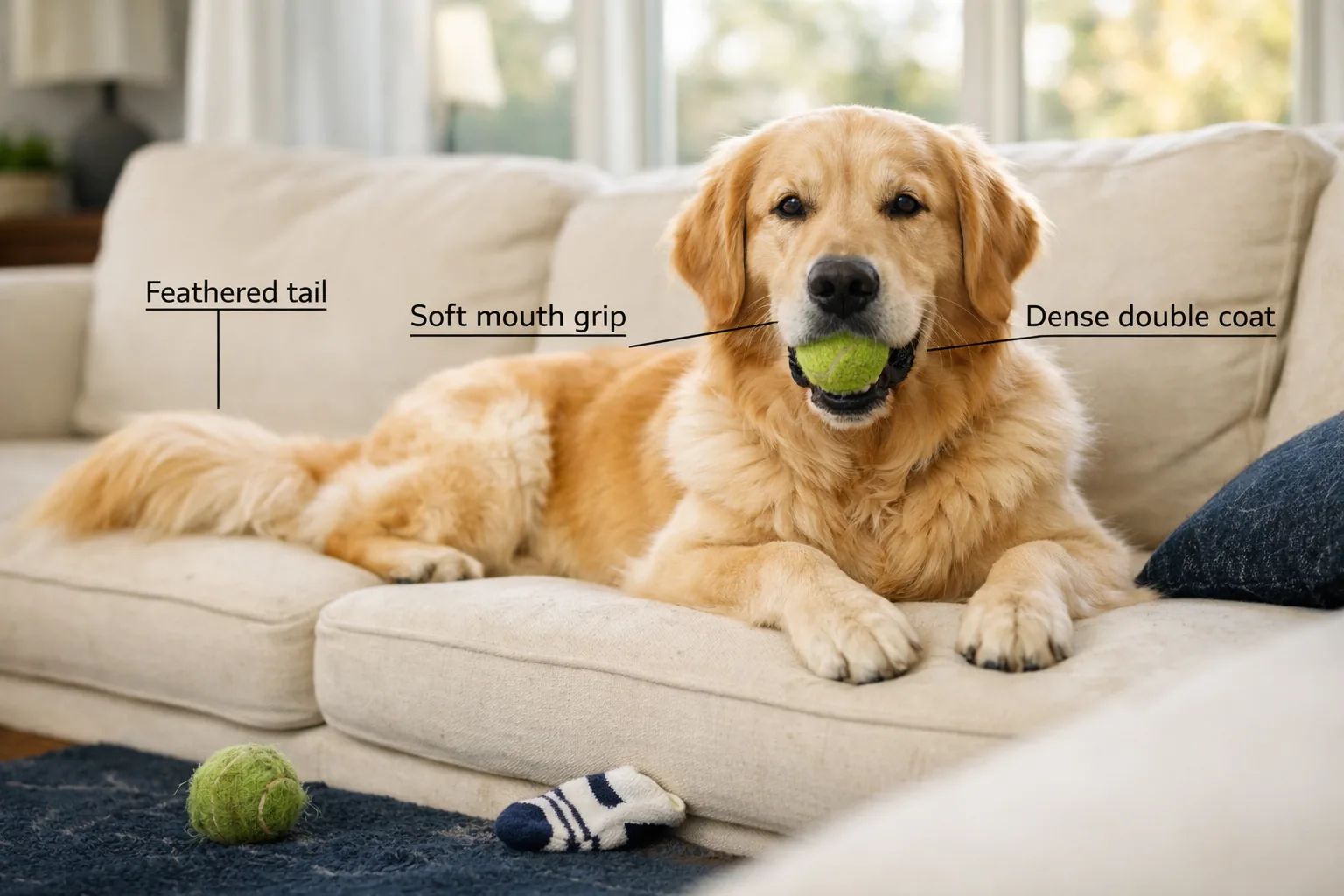
The cuteness is partly structural. Rounded skull, dark eyes set wide, feathered tail that moves in a wide sweep rather than a sharp wag. The feathering on the chest, legs and tail softens the whole outline, which is why a wet Golden suddenly looks half its size and twice as surprised.
Owners consistently name three things they love:
- The mood lift. A dog who is pleased to see you at 6 a.m. is hard to argue with.
- The street attention. People stop. Strangers ask to pet. If you want a quiet, anonymous walk, this is not your breed.
- The trainability. Goldens are food motivated, handler focused and quick to pattern. That combination makes them one of the most obedient dog breeds in practical family terms.
The AKC breed standard describes temperament as friendly, reliable and trustworthy, and specifically lists hostility, unwarranted timidity and nervousness as faults. That is a written standard, not a guarantee about an individual dog. Genetics, early socialization and daily handling all still apply.
Golden Retriever Size, Weight and Lifespan
Adult golden retriever size differs clearly by sex: males typically stand 23 to 24 inches at the shoulder and weigh 65 to 75 pounds, while females stand 21.5 to 22.5 inches and weigh 55 to 65 pounds. Typical lifespan is 10 to 12 years.
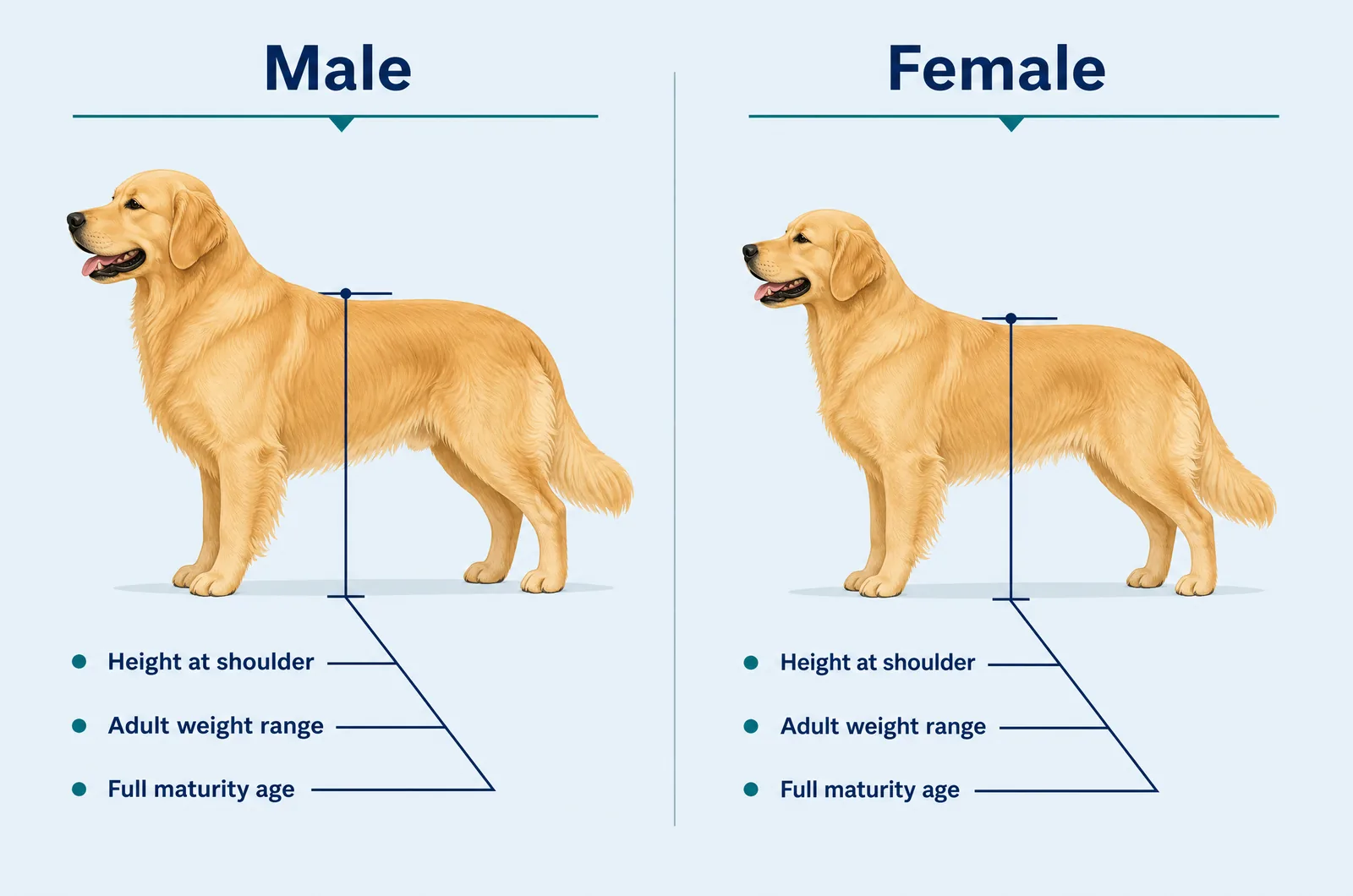
| Trait | Male Golden Retriever | Female Golden Retriever | Labrador Retriever (for comparison) |
|---|---|---|---|
| Height at shoulder | 23 to 24 in | 21.5 to 22.5 in | 21.5 to 24.5 in |
| Adult weight | 65 to 75 lb | 55 to 65 lb | 55 to 80 lb |
| Coat | Medium-long double coat, feathered | Medium-long double coat, feathered | Short, dense double coat |
| Typical lifespan | 10 to 12 yr | 10 to 12 yr | 11 to 13 yr |
| Grooming load | High, daily in shed season | High, daily in shed season | Moderate, still sheds heavily |
Golden retriever vs Labrador, the short version: Labs have short hair, so shedding is less visible but not less frequent. Labs tend to run slightly higher on raw drive and food obsession; Goldens tend to be softer and more sensitive to a harsh correction. Both need serious exercise. If your deciding factor is vacuuming, pick the Lab. If it is a gentler handler relationship, pick the Golden.
Goldens are a true large breed, not a giant one. If you are still sizing up your options, the large versus giant breed size guide sorts that out. On the longevity side, the Dog Aging Project is tracking lifespan factors across breeds, and body condition keeps showing up as one of the few things owners directly control.
A note on “mini golden retrievers”: these are crosses, usually Golden plus Poodle plus Cocker Spaniel, and they are not a recognized breed. Coat type and shedding in those crosses is genuinely unpredictable from puppy to puppy.
What Is the Golden Retriever Temperament Like?
Golden retriever temperament is social, biddable and emotionally reactive to household mood, with a long adolescence that catches first-time owners off guard. Friendly is the baseline, not the finished product.
The GRCA describes the breed as a family companion that wants to take part in household life rather than live in a yard or kennel. That is the practical core of the temperament. A Golden left alone in a garden for nine hours a day tends to produce barking, digging, fence patrolling and destroyed landscaping, not calm.
What this looks like at each stage:
- 8 weeks to 6 months: mouthy, fast, affectionate, shark-toothed. Biting is normal and peaks around teething.
- 6 to 18 months: the hard part. Full size, puppy brain. Jumping, counter surfing, selective hearing on recall.
- 18 months to 3 years: settling. Training sticks. People start calling your dog “so well behaved” as if you did nothing.
- 3 years onward: the dog from the postcards.
Goldens are sensitive. Loud corrections and jerk-based methods tend to shut them down rather than teach them. Humane training built on food, play and clear criteria works far better with this breed. Their emotional read on people is also why they turn up often among emotional support dog breeds.
Common mistake: assuming the friendly label means the dog needs no socialization. Friendly genetics plus zero exposure to traffic, nail trims and strangers still produces an anxious adult.
Are Golden Retrievers Good With Kids and Other Pets?
Yes, golden retrievers are generally reliable with children and other animals, which is why they rank among the most recommended family dogs. The risk with kids is not aggression, it is a 70-pound adolescent knocking a toddler flat during a game of fetch (showdogswest.com).
Practical rules that actually prevent problems:
- Teach the sit-to-greet before the dog outweighs the child. Start at 9 weeks, not 9 months.
- Supervise feeding. Goldens are food driven. Children and food bowls do not mix, regardless of breed reputation.
- Give the dog an off-limits space. A crate or bed where no child follows. Every dog needs an exit.
- Watch the mouthing. Puppy nipping on small arms needs redirection to a tug toy, not punishment.
With cats, Goldens usually succeed if introduced slowly and the cat has vertical escape routes. With other dogs, the breed is typically social, though unneutered males can get stiff with each other in adolescence. If you want more comparison across family options, the guide to popular family dog breeds lines them up side by side.
Edge case: households with a very young baby and a 10-month-old Golden at the same time. That combination is the single most common reason Goldens land in breed rescue. If a baby is due within a year, consider adopting an adult Golden instead of raising a puppy.
Who Is the Golden Retriever Made For, and Who Should Skip It?
A golden retriever suits households with daily time for exercise, tolerance for hair, and someone home for a meaningful part of the day. It does not suit people who want a tidy, independent, low-effort dog.
Choose a Golden if:
- Someone is home for most of the day, or you can arrange midday care
- You can commit 60 to 90 minutes of walking, swimming, fetch or training daily
- You own a vacuum you are willing to use several times a week
- You want a dog who will do training classes, hiking, dock diving or therapy work with you
- You have budgeted for pet insurance or a dedicated vet savings account
Skip a Golden if:
- You are gone 10 hours a day with no dog walker
- Shedding on black clothes is a dealbreaker
- You want a guard dog (Goldens are famously unhelpful here, see guard dog breeds instead)
- Allergies in the household are a factor
- You need a dog who is calm from month one
Are Goldens good for apartments? They can work, with conditions. The breed is quiet indoors and settles well once mature. But apartment living means every bit of exercise and bathroom access is on you, in all weather, including the adolescent year. Ground floor helps. Elevators plus wet dog does not. If apartment life is fixed, the best apartment dog breeds guide has better-fitting options.
Are Goldens good for first-time owners? Yes, with one honest caveat: the temperament is forgiving, the energy level is not. First-time owners do well with this breed when they book a puppy class before the puppy arrives, not after the chewing starts.
How Much Exercise Does a Golden Retriever Need?
Adult golden retriever exercise needs run 60 to 90 minutes of varied activity per day, and a fenced yard does not count. The GRCA states directly that Goldens are not self-exercising dogs.
A workable weekly mix:
- Daily: one long walk plus one shorter sniff walk
- 3 to 4 times a week: fetch, swimming, or a hard off-leash run in a safe space
- Daily, 10 to 15 minutes: training or scent games indoors
- Weekly: something new. A different route, a hiking trail, a training class
Mental work is not optional padding. A Golden who has done 20 minutes of nose work is often calmer than one who has run for an hour, because running builds stamina and sniffing burns cognition. Snuffle mats, frozen stuffed toys, and scatter feeding in the garden all count. For puzzle-style enrichment, the Pupsicle is one of the better-built options for a strong-jawed retriever.
Puppy caution: young joints. The GRCA recommends age-appropriate play, walks, swimming and training without heavy impact. Skip forced jogging, repetitive stair work and long fetch sessions on hard ground until growth plates close, usually 14 to 18 months. A rough guide many trainers use is five minutes of formal walk per month of age, twice daily, with free play on top.
Golden Retriever Grooming and Shedding
Golden retrievers shed year round and blow their undercoat heavily about twice a year, typically in spring and autumn. Weekly brushing handles most of the calendar. During a coat blow, the GRCA calls daily brushing almost mandatory.
Why they shed so much: the double coat. A soft, dense undercoat for insulation sits under a longer water-resistant outer coat. The undercoat grows and releases on a seasonal cycle triggered mainly by daylight length. Indoor lighting and central heating blur that cycle, which is why house dogs often seem to shed constantly rather than in two clean bursts.
How much is “a lot”? Expect visible hair on dark clothing daily, tumbleweeds under furniture within 48 hours of vacuuming, and during a blow, enough undercoat per session to fill a shopping bag. That is normal, not a health problem.
The routine that actually works:
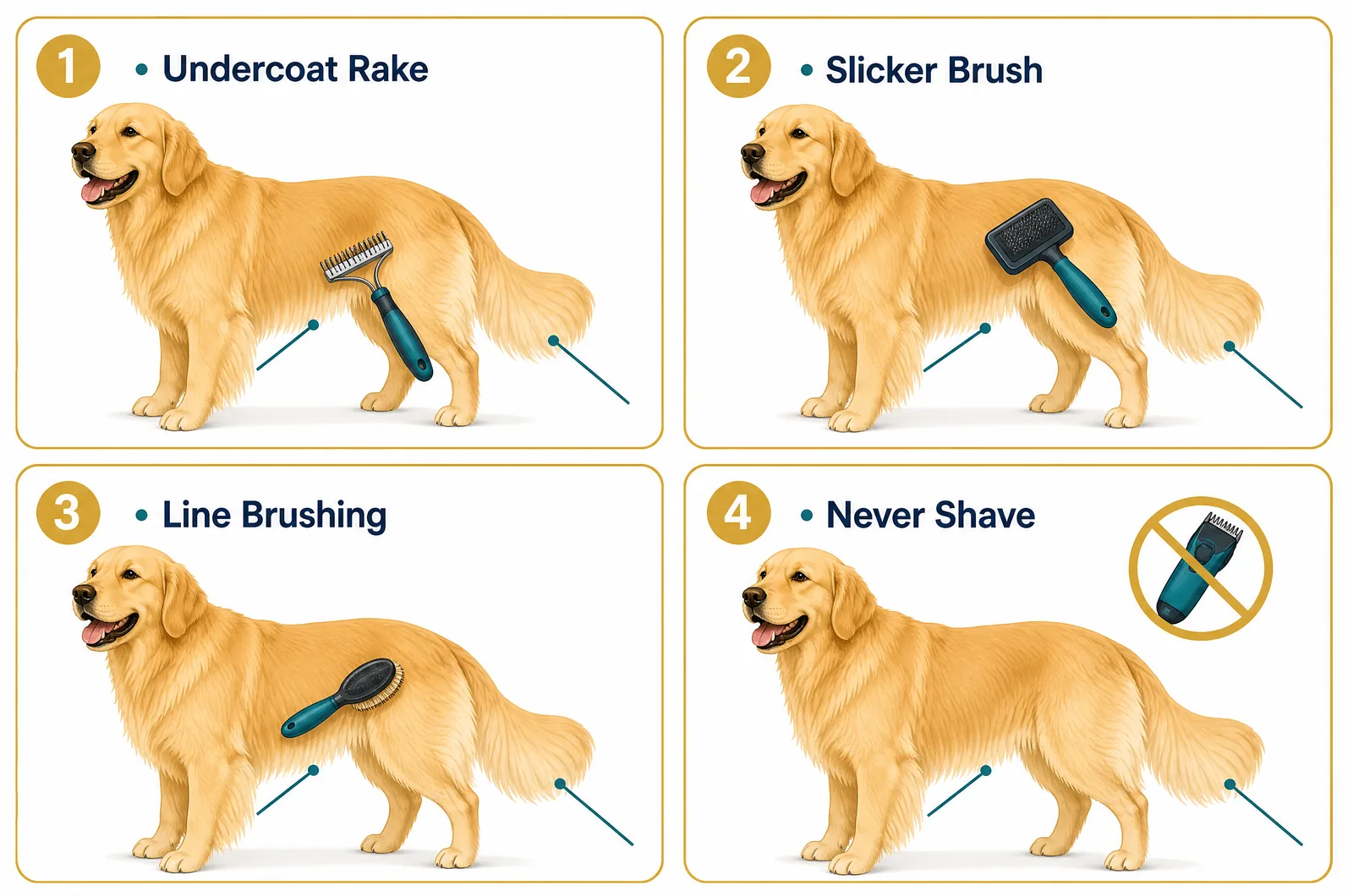
- Undercoat rake, 10 minutes, 2 to 3 times weekly (daily in shed season). This pulls loose undercoat before it reaches your rug.
- Slicker brush on the feathering behind the ears, legs, chest and tail. These are the mat zones.
- Line brushing during blows: part the coat, brush from the skin outward in sections.
- Bathe every 6 to 8 weeks with a full blow dry. A dryer forces out more dead coat than a week of brushing.
- Trim only feet, hocks and ear feathering. Nothing else.
Never shave a Golden. The undercoat insulates against heat as well as cold and protects skin from sun. Shaved double coats often regrow patchy, with coarse guard hair missing and fluffy undercoat dominating. If a groomer offers a summer shave, decline.
Do you need a professional groomer? Not strictly. Most Golden owners manage at home with the right tools. Professional grooming every 8 to 12 weeks is genuinely useful if you cannot blow dry at home, if mats have formed, or if nail trims are a fight. A high-velocity dryer session during a coat blow removes more hair in 40 minutes than most owners remove in two weeks. For tool selection, compare the best deshedding brushes by coat type, and if you are new to home grooming entirely, start with the beginner’s guide to dog grooming.
Allergies: no dog is truly hypoallergenic, and Goldens are one of the poorer choices for an allergic household. The allergen is largely Can f 1 protein in saliva and dander, not hair itself, but heavy shedding spreads it everywhere. Breeds that shed less include Poodles, Portuguese Water Dogs, Bichon Frise and Soft Coated Wheaten Terriers. Those coats require regular clipping instead, so the maintenance moves rather than disappears.
Common Golden Retriever Health Problems
Golden retriever health problems center on cancer, hip and elbow dysplasia, hypothyroidism, subvalvular aortic stenosis and eye conditions. Cancer rates in the breed are high enough that it became the subject of one of veterinary medicine’s largest prospective studies (myvetcandy.com).
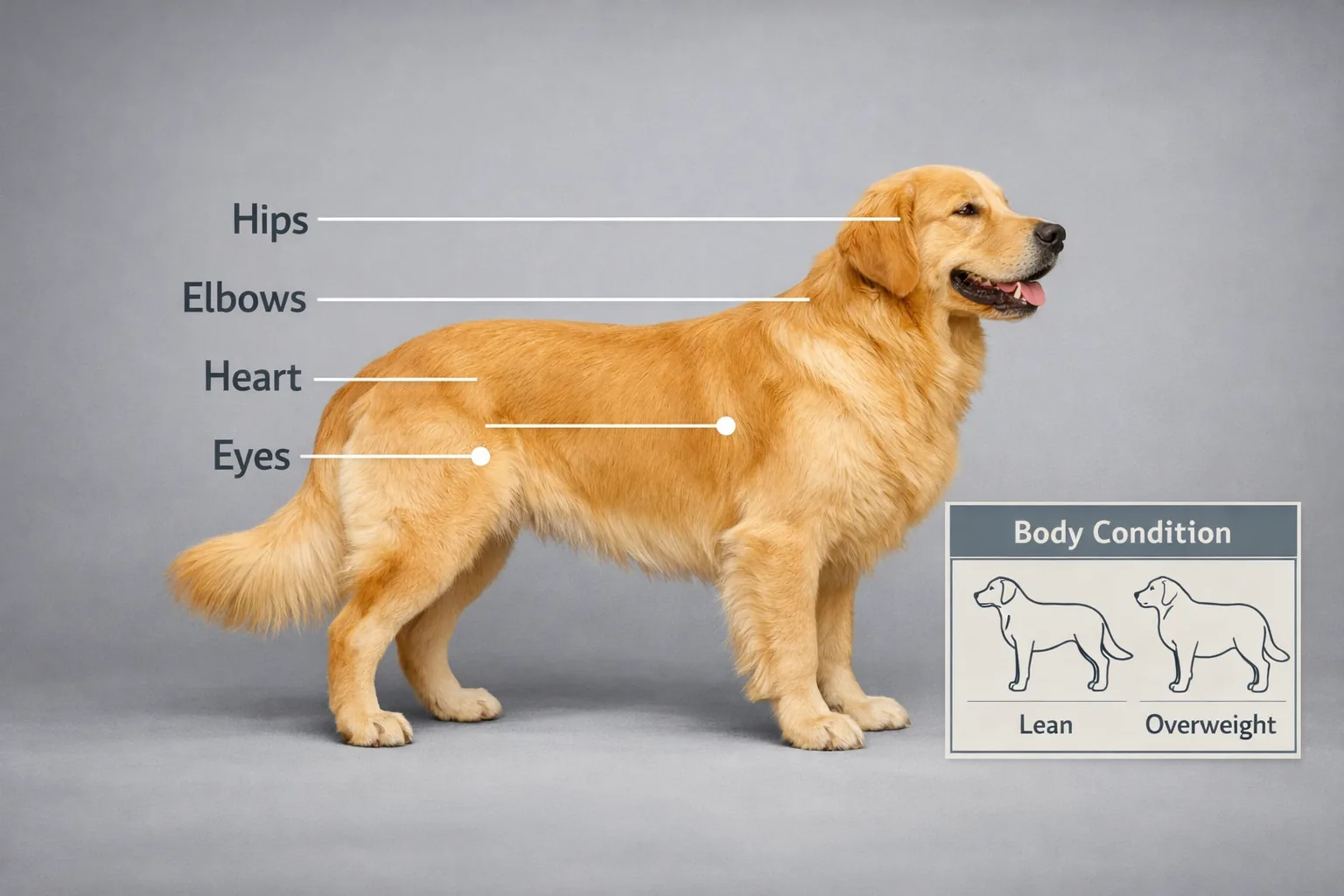
What a responsible breeder screens for:
| Screening | Clearance to ask for |
|---|---|
| Hips | OFA or PennHIP evaluation |
| Elbows | OFA elbow grade |
| Heart | Cardiologist exam for subvalvular aortic stenosis |
| Eyes | Annual ophthalmologist exam (CAER) |
| Thyroid | OFA thyroid panel |
Ask to see the paperwork. A breeder who says “the vet checked them over” has not done these screenings.
On cancer: the Morris Animal Foundation Golden Retriever Lifetime Study enrolled 3,044 privately owned Goldens aged 6 months to 2 years to track genetic, environmental and dietary risk factors over their lifetimes. It is an observational cohort, so it identifies associations rather than proving causes. Published work from the cohort is already adding detail: a 2026 mast cell tumor analysis found a median lifespan of 11.68 years among affected dogs compared with 11.75 years in the rest of the cohort, no significant difference, with only 11.59 percent of affected dogs recorded as dying from the tumor itself. Mast cell tumors are common in the breed and often, though not always, manageable.
On weight: an October 2026 analysis of Lifetime Study data found obese dogs were more than twice as likely to develop endocrine disease, osteoarthritis and cruciate ligament injury, and showed more evidence of cognitive decline with age. Body condition is one of the few risk factors fully under owner control.
Separately, a small pilot study published in October 2026 examined L-carnitine supplementation in 21 Goldens aged 8 to 10. The authors framed it as hypothesis generating, not proof of a weight loss treatment. Do not buy supplements on the strength of a 21-dog pilot.
Call a vet immediately for: a swollen, hard abdomen with unproductive retching and restlessness (possible bloat, a surgical emergency in deep-chested breeds), collapse or heavy panting in heat, sudden hind limb weakness, or breathing difficulty. Do not wait out any of these overnight.
Given the health profile, pet insurance is worth pricing before the puppy comes home, because pre-existing conditions are excluded once they appear.
What Do Golden Retrievers Love to Eat? Favorite Foods and Feeding
Golden retrievers eat enthusiastically and gain weight easily, so portion control matters more than brand choice. Feed a complete diet with an AAFCO statement matching the dog’s life stage, and measure every meal.
Rough daily amounts (adjust to body condition, not the bag chart):
- Puppy 3 to 6 months: 3 meals daily, large-breed puppy formula
- Puppy 6 to 12 months: 2 to 3 meals daily
- Adult 55 to 75 lb: roughly 2.5 to 3.5 cups daily, split into two meals
- Senior 8+ years: same split, often 10 to 20 percent fewer calories
Large-breed puppy food matters here. Controlled calcium and a moderate growth rate reduce orthopedic risk in a dog heading for 70 pounds. Learning to read a dog food label and what AAFCO means is more useful than any brand ranking, and if you are weighing formats, see dry, wet or raw dog food.
Safe treats Goldens tend to love: carrot sticks, green beans, blueberries, plain cooked chicken, apple slices without seeds, frozen plain yogurt in a toy, pumpkin puree. Keep treats under 10 percent of daily calories.
Never feed: grapes and raisins, onions and garlic, xylitol (in peanut butter, check the label), chocolate, macadamia nuts, cooked bones, alcohol. Corn cobs deserve a special mention for this breed because Goldens swallow them whole and they cause obstructions.
Switch food slowly: 25 percent new for three days, 50 percent for three days, 75 percent for three days, then full. Switching dog food without stomach upset covers the longer version.
Body condition check: you should feel ribs easily under a thin fat layer, see a waist from above, and see a tuck from the side. Given the obesity findings from the Lifetime Study, run this check monthly.
How to Train a Golden Retriever
Train a golden retriever with food, play and short sessions. The breed learns fast and sulks under harsh handling, so reward-based methods produce both faster results and a dog who keeps offering behavior.
Priority order for the first year:
- Name response and recall. Start indoors at 8 weeks. Pay heavily, every time, for the rest of the dog’s life. Our full recall training method breaks this down.
- Sit to greet. Jumping is cute at 15 pounds and a hazard at 70.
- Loose-leash walking. Retrievers pull toward interesting things, which is everything.
- Crate and alone-time training. Build duration before you need it, not during the first full workday back.
- Handling and grooming tolerance. Paws, ears, nails, brush. Pair with food, 60 seconds a day.
- Drop and leave it. A retrieving breed will pick up things it should not.
The biting problem, fixed: puppy mouthing peaks between 10 and 20 weeks. Three things work together. Keep a tug toy in every room so there is always something legal to grab. End play calmly for 30 seconds when teeth hit skin. Increase naps, because most evening shark behavior is overtiredness, and an 8-week puppy needs 18 to 20 hours of sleep daily.
Common mistakes with this breed: skipping the 2 to 4 month socialization window, under-exercising then punishing the resulting chaos, repeating a cue six times, and assuming the breed’s reputation means training is optional. Goldens are among the most trainable dogs in the practical sense of learning quickly, which also means they learn bad habits quickly.
Try It: Golden Retriever Shedding Planner
Goldens shed all year and blow their undercoat about twice a year, so the right brushing schedule changes with the season. Tell the planner your season and your current routine, and it returns a brushing plan sized to keep the fur off your floors instead of in them.
Doggy Rank IQ Tool
Golden Retriever Shedding Planner

Goldens shed all year and blow their undercoat about twice a year. Tell us your season and routine to get a brushing plan that keeps the fur off your floors.
Golden Retriever Shedding Planner
Pick your season and current routine for a brushing plan.
How Much Does a Golden Retriever Cost?
A golden retriever puppy from a health-screened breeder typically costs $2,000 to $3,500 in the United States, with first-year total costs landing around $3,000 to $6,000 and ongoing yearly costs around $1,500 to $3,000.
First-year breakdown (typical ranges):
- Puppy from a screened breeder: $2,000 to $3,500 (rescue adoption: $200 to $600)
- Initial vaccines, deworming, microchip, spay or neuter: $500 to $900
- Crate, bed, bowls, leash, harness, grooming tools: $250 to $450
- Food: $600 to $900
- Puppy class and basic obedience: $200 to $500
- Pet insurance: $400 to $900
Yearly after that: food $600 to $900, routine vet and preventives $400 to $700, insurance $400 to $900, grooming $0 to $600 depending on whether you do it yourself, plus replacement toys and beds.
Budget for the unexpected. Given the breed’s orthopedic and oncology profile, a cruciate repair can run $3,000 to $6,000 per knee and cancer treatment can exceed $10,000. That is the argument for insurance or a dedicated savings account started the week the dog arrives.
A cheap puppy is the expensive option. A $900 Golden with no hip, elbow, heart or eye clearances often costs more by age four. Ask for the paperwork.
Golden Retriever Puppy Tips for the First 90 Days
The first 90 days with a golden retriever puppy decide the next decade. Prioritize socialization between 8 and 16 weeks, sleep, and a crate the puppy actually likes.
Weeks 1 to 2: keep the world small. One room, a crate, a fixed potty route. Feed three meals. Expect night waking. Start handling paws and ears for 60 seconds a day.
Weeks 3 to 6: the socialization sprint. The GRCA flags roughly 2 to 4 months as the developmental window. Aim for new, positive, low-intensity exposures most days: car rides, umbrellas, bicycles, men in hats, vacuum at a distance, different floor surfaces, nail clipper touch without clipping. Quality beats quantity, and a frightened puppy learns the wrong lesson.
Weeks 7 to 12: add a puppy class, build recall in the garden, start alone-time practice in 5 to 20 minute blocks, and begin loose-leash work. Teething peaks. Freeze a wet rolled towel and rotate chew toys.
On puppy blues: regret in the first six weeks is extremely common and rarely talked about. Sleep deprivation, constant biting and the loss of your old routine stack up fast. It usually lifts between weeks 6 and 12 as sleep returns. If it does not lift, talk to someone. Hiring a walker or taking a weekend off from training is not failure.
Crate rule: feed every meal in the crate with the door open for the first two weeks. The crate becomes the food place before it becomes the alone place.
What Golden Retriever Owners Say
Reddit’s r/goldenretrievers is one of the more honest places to read about the breed, because the people posting already bought the dog.
“What’s one thing you weren’t prepared for about owning a golden?”
That question, posted by an owner on Reddit, gets the same answers on repeat: the hair, the velcro behavior, and how long adolescence lasts. The practical fix for all three is front-loaded. Buy the undercoat rake and a decent vacuum before the puppy arrives. Train alone-time in short blocks from week one rather than waiting for the first real separation. And set your expectations at two years to a settled adult, not six months, so the 14-month-old counter surfing feels like a stage instead of a failure.
“Hardest Part of Having a Golden”
This thread, also from an owner on Reddit, tends to land on two things: the energy level and the awareness of the breed’s cancer risk. On energy, the answer is structure, not more miles. Two scheduled exercise blocks, a daily training session, and an enforced nap in the crate midafternoon will do more for a wild Golden than an extra hour of fetch, which mostly builds a fitter wild Golden. On cancer, the useful response is the controllable part: keep the dog lean, do annual exams, learn to run your hands over the body monthly for lumps, and get anything new checked rather than watched.
Golden Retriever FAQ
How much do golden retrievers shed? A lot, constantly. Expect visible hair daily and two heavy undercoat blows a year, usually spring and autumn, when daily brushing becomes necessary rather than optional.
Do golden retrievers shed year-round or just seasonally? Both. There is a steady year-round baseline plus two seasonal blowouts. Indoor heating and artificial light can blur the seasonal pattern into near-constant shedding.
How long do golden retrievers live? Typically 10 to 12 years. Keeping the dog lean is one of the clearest things owners control, since Lifetime Study data links obesity to higher rates of osteoarthritis, endocrine disease and cruciate injury.
Can someone with allergies own a golden retriever? It is a poor match. The breed sheds heavily and spreads dander widely. Lower-shedding alternatives include Poodles, Portuguese Water Dogs and Bichon Frise, all of which need regular clipping instead.
Are golden retrievers good for first-time dog owners? Yes, if the household has time. The temperament is forgiving and the dog is easy to train. The energy level and shedding are what trip up unprepared first-timers.
Do golden retrievers need professional grooming? Not required, but useful. A professional high-velocity dry every 8 to 12 weeks removes far more dead undercoat than home brushing alone, especially during a coat blow.
What is the difference between golden retrievers and Labradors? Coat length and handler sensitivity, mostly. Labs have short coats and slightly tougher, more food-driven temperaments. Goldens have long feathered double coats and tend to be softer under correction. Both shed heavily and both need real daily exercise.
Is a golden retriever right for my family? Choose one if you have daily exercise time, someone home for part of the day, tolerance for hair, and a vet budget. Skip it if you need a calm dog in year one or a low-shedding coat.
Next step: before you contact a breeder, write down who in your household is doing the 7 a.m. walk, who is brushing on Sundays, and what your monthly vet budget is. If all three have a name and a number, you are ready for a golden retriever.