
Quick Answer
A long line dog leash is a fixed-length lead, usually 15 to 50 feet, used for recall training, sniff walks, and off-path exploring while keeping a dog physically attached. The right one for your dog depends on matching length to training goal, picking a material that handles your weather, and choosing a width wide enough to protect your hand on a hard pull.
This post contains affiliate links. If you buy through one we may earn a commission at no extra cost to you. As an Amazon Associate I earn from qualifying purchases.
A long line dog leash works for recall training when the length matches your dog’s distance goal, the material sheds water instead of soaking it up, and the grip does not shred your palm on the first hard pull.
Key Takeaways
- A long line dog leash is typically 15 to 50 feet long, used for recall training, sniffing, and field work, not for crowded sidewalks.
- Length should match the training stage: 15 to 20 feet for early recall, 20 to 30 feet for sniff walks, 30 to 50 feet for experienced dogs on hikes.
- Biothane-style coated webbing resists water far better than cotton rope, which can soak through and nearly double in weight.
- Width matters for hand safety. Thin cords under half an inch are a common cause of friction burns during a sudden pull.
- Attach a long line dog leash to a back-clip harness instead of a neck collar to reduce strain during sudden stops.
- A long line is not a retractable leash. It is a fixed length of material the handler manages by hand, not a spring-loaded cord.
- The Hi Kiss 30ft Recall Training Leash and Nylon Training Dog Leash (20ft) both sit in the $15 to $25 price band and work best with a harness.
- Dogs without a reliable recall foundation should start with structured leash work before adding distance with a long line.
Doggy Rank IQ Tool
Long Line Dog Leash Chooser

A 50 foot cotton line in the mud is how people quit long lines. Pick by dog, goal and terrain.

Affiliate disclosure
This article includes affiliate links to Amazon. Doggy Rank IQ may earn a commission on qualifying purchases, which supports the site at no extra cost to the reader. Product choices follow the dog’s needs first, commission size never decides the recommendation.
What is a long line dog leash and what’s it for
A long line dog leash is a leash longer than the standard 6-foot lead, typically ranging from 15 to 50 feet, built to give a dog room to range, sniff, or practice recall while staying physically connected to the handler. It is a fixed-length line, usually nylon, cotton webbing, or coated biothane, that plays out and reels in by hand rather than through a spring mechanism.
The purpose is distance without disconnection. A dog chasing a scent 25 feet away is still attached to something solid. That matters in an unfenced field, near a dog park entrance, or anywhere recall is still a work in progress. Dogs Trust recall training guidance treats a long line as a standard tool for building distance safely before a dog earns off-leash privileges.
Who it suits: owners working on recall, hikers who want their dog to range off the path, trainers building distance behaviors, and anyone whose dog needs more room than a sidewalk allows but is not reliable enough to go fully off leash.
Who it does not suit: apartment hallways, crowded sidewalks, multi-dog households where lines cross, or any dog still learning basic leash manners. A long line dog leash is a training tool for open space, not a daily walking leash. For crowded routes, see the guide on loose leash walking.
Material and grip decide whether the tool gets used weekly or abandoned in a drawer after one muddy walk. That is the real decision point, not just length.
How long should a dog long line be
The length depends on the task, not the biggest number on the listing page. Early recall training calls for 15 to 20 feet in an open, low-distraction area, while hiking or field work can stretch to 30 or 50 feet once a dog has some recall history.
- 15 to 20 feet: early recall work, small yards, beginner training, dogs still learning to respond to a cue at distance.
- 20 to 30 feet: sniff walks, intermediate recall, open parks with fewer obstacles.
- 30 to 50 feet: hiking, field training, experienced dogs with a reliable partial recall already in place.
Decision rule: start shorter than you think you need. A 50-foot line for a dog still learning recall just means more rope to manage, not more training value. Add length only after the dog responds consistently at the current distance.
Common mistake: buying the longest option available because it feels like better value. A 100-foot line sounds practical but is mostly extra material to coil, store, and keep untangled during a session.
Best long line dog leash brands and where to buy
Three brands cover most budgets and use cases: Hi Kiss and generic nylon training leashes for entry-level recall work, and Ruffwear for a heavier-duty field option. All three are available on Amazon, and most long lines in this category also show up on Chewy with similar pricing.
| Model | Length Options | Material | Price Band |
|---|---|---|---|
| Hi Kiss Dog/Puppy Obedience Recall Training Agility Lead | 15, 20, 30, 50, 100 ft | Nylon webbing | around $15 to $25 |
| Nylon Training Dog Leash for Small Medium Large Dogs | 15, 20, 30, 50 ft | Nylon webbing | around $15 to $20 |
| Ruffwear Rogue Long Line | 20 ft fixed | Polyester Tubelok webbing, 16% recycled | around $30 to $40 |
| Generic BioThane Long Line (various sellers) | 15 to 30 ft | Coated biothane | around $16 to $80 depending on length |
The Hi Kiss and generic nylon options are the most budget-friendly entry points for a first long line dog leash. The Rogue Long Line and biothane options cost more but hold up longer in wet or abrasive terrain.
Length, Material and Grip
The length you need depends on the task, not the biggest number on the listing page. Recall training wants 15 to 20 feet in an open area, while hiking or field work can stretch to 30 or 50 feet.
Length:
- 15 to 20 feet: early recall work, small yards, beginner training
- 20 to 30 feet: sniff walks, intermediate recall, open parks
- 30 to 50 feet: hiking, field training, experienced dogs with reliable partial recall
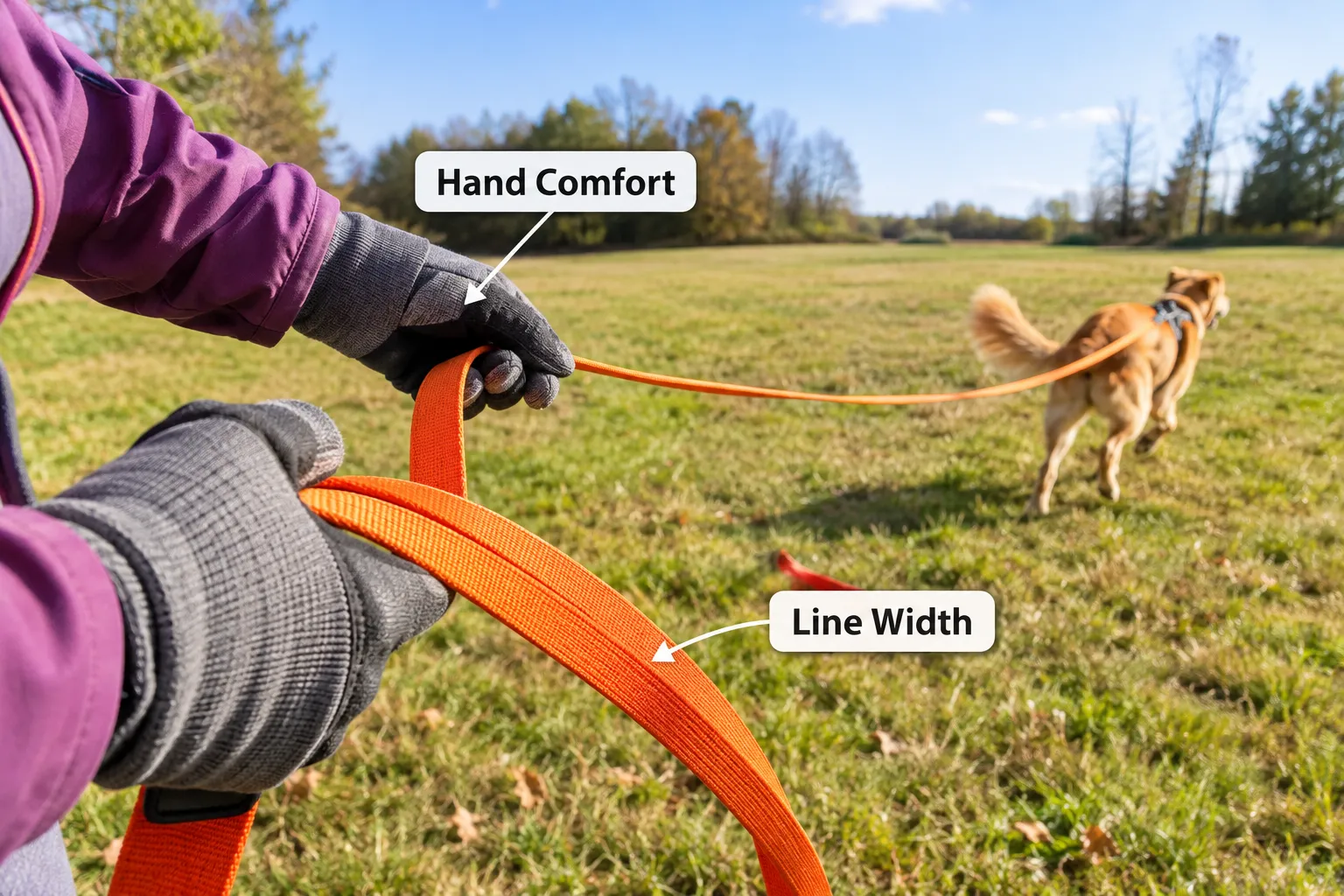
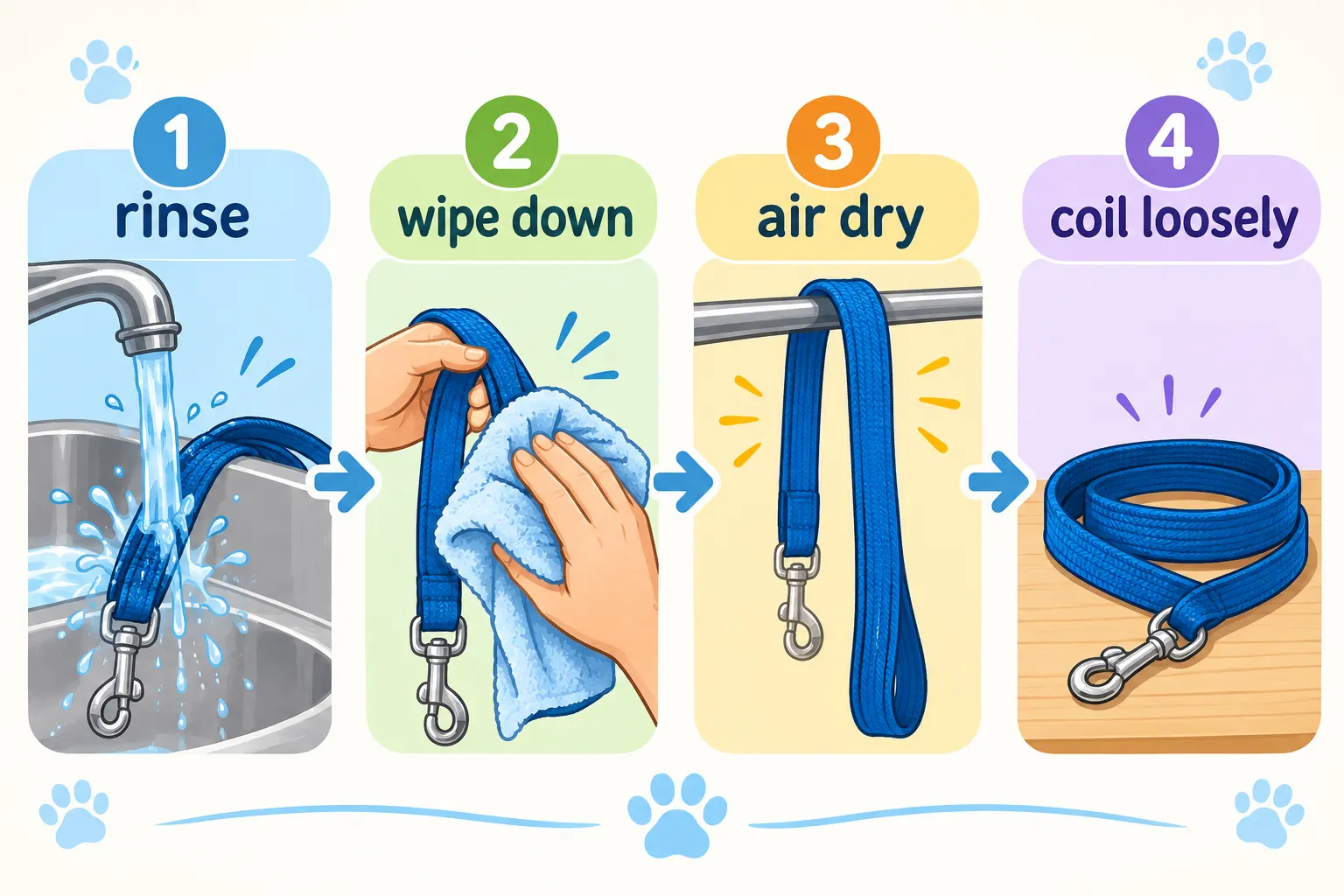
Material: Cotton rope absorbs water and can get noticeably heavier when soaked, which drags on a dog’s harness and turns into a muddy coil in your trunk. Nylon webbing holds up better but still soaks through in wet grass. Biothane-style coated webbing wipes clean with a damp cloth and barely absorbs water, which matters for the wet, cold, dark walking conditions many owners deal with for months at a time.
Grip: Thin leash material, including thin cords, can cause friction burns when a dog pulls hard and fast, a risk flagged by VCA Animal Hospitals’ guidance on off-leash training. A wider webbing (3/4 inch or more) spreads the load across more of your palm. A padded handle helps, but some designs, like Ruffwear’s Rogue Long Line, deliberately skip a handle so the line can also work as a drag line, trading hand comfort for fewer snag points in brush.
Decision rule: choose a wider, coated line if your walks are wet or your dog pulls hard. Choose a lighter nylon line if conditions are dry and the dog is smaller.
Long line vs retractable leash: which is better
A long line dog leash gives more direct control than a retractable leash because the handler manages the slack by hand instead of relying on a spring mechanism. Retractable leashes use a thin cord that can cause friction burns and are harder to lock quickly in an emergency.
VCA Animal Hospitals’ advice on loose leash walking notes that thin cord mechanisms common to retractable leashes carry a higher injury risk than flat webbing during a sudden pull. A long line dog leash, by contrast, is a single length of fixed material the handler feeds out and gathers manually, which means no moving parts to jam or snap back.
Choose a long line if you want to train recall at real distance in open space. Choose a short, fixed leash, not a retractable, for sidewalks and crowded areas. See the full breakdown in the guide on retractable leash risks.
How to train a dog on a long line
Training on a long line dog leash works by letting a dog range out to a set distance, then calling it back with a known recall cue, rewarding heavily when it returns. Dogs Trust’s recall training guidance recommends practicing in a low-distraction area first, then gradually increasing distance and distraction level as the dog’s response becomes reliable.
Steps:
- Start in a fenced or open area with minimal distractions, using a 15 to 20-foot line clipped to a back-clip harness.
- Let the dog explore to the end of the line at its own pace.
- Call the dog’s name followed by a single recall cue, in a happy, upbeat tone.
- Reward immediately and generously when the dog returns, even if it took a while.
- Gradually increase the length of line and the level of distraction over several sessions, not in one outing.
- Avoid repeating the cue multiple times if the dog does not respond right away; instead, use the line to gently guide it back and reset.
Blue Cross’s recall training resource points out that recall is a skill built over weeks, not a single session, and that rushing distance before the dog is ready often causes setbacks. A common mistake is increasing line length before the dog responds reliably at the current distance. If recall breaks down at 20 feet, stay at that distance until it improves instead of switching to a 50-foot line.
My dog got tangled in the long line, what do I do
Stop moving, call the dog calmly toward you to release tension, and walk the line hand over hand to gather slack before untangling it from legs or nearby brush. Avoid pulling hard on a tangled line, since sudden tension can tighten knots around a limb.
Battersea’s guidance on using a long line lead recommends keeping a loose loop of slack gathered in your free hand at all times during a walk, rather than letting the full length drag on the ground, which is the main cause of tangling around legs, stumps, and fence posts.
If a tangle happens:
- Stay calm and avoid sudden pulls, which can tighten the line further.
- Call the dog toward you a step or two to create slack rather than yanking the line taut.
- Gather the line by hand as you approach, rather than reeling from a distance.
- Check the dog’s legs and paws for any line marks or restricted blood flow before continuing the walk.
Edge case: tangling happens most in tall grass or brush with thinner, longer lines. A thicker line is slightly easier to see and separate from vegetation than a thin cord.
Is a long line safe for dogs
A long line dog leash is safe for most dogs when matched to the right harness, width, and terrain, but it carries real risks if used with a collar, left to drag unmanaged, or paired with a dog that has no recall foundation. The main hazards are tangling, neck strain from collar attachment, and hand friction burns for the handler.
VCA Animal Hospitals’ overview of off-leash training recommends a well-fitted harness over a collar for long line work specifically to reduce the risk of neck strain during a sudden stop or lunge. Clipping to a flat collar means a hard stop transfers force directly to the neck, which is avoidable with a back-clip harness.
Safety checklist:
- Use a back-clip harness, not a collar.
- Keep slack gathered by hand rather than letting the full line drag.
- Check hardware (clips, D-rings) before each use for wear.
- Avoid use near roads, cyclists, or crowded trails where the line could cross paths.
- Supervise closely around other dogs, since a long line can tangle between multiple animals quickly.
Long line for dog training recall: how does it work
A this long line leash works for recall by giving a dog the feeling of freedom at a distance while the handler retains a physical connection to guide, correct, or reward the response. The line removes the risk of a dog bolting out of range during the exact phase of training when recall is least reliable.
Blue Cross’s notes on adolescence in dogs point out that recall often becomes less reliable during adolescence, roughly 6 months to 2 years old, as dogs test boundaries and get more easily distracted. A this long line leash is particularly useful during this stage because it lets training continue in open space without the risk of a dog disappearing after a squirrel or another dog mid-session.
Example: a 10-month-old Labrador that recalls well in the living room but ignores cues at the dog park can practice on a 20-foot line in a quiet field, gradually working up to park-level distractions once recall holds at that length consistently.
Can you use a long line indoors or just outside
A this long line leash is built for outdoor use in open spaces such as fields, trails, and large yards, not indoor hallways or small rooms where the extra length has nowhere to go. Indoors, a long line mostly creates tangling hazards around furniture and foot traffic.
The only indoor exception is a very large open space, like an empty gymnasium or a large unfurnished room, where a short-leash session with 10 to 15 feet of controlled slack could support basic recall practice. For everyday indoor training, a standard 6-foot leash or no leash at all in a closed room works better. For apartment living and general indoor commands, see the guide on 5 essential commands every puppy should learn.
Dog keeps pulling on long line: how to fix
A dog that pulls hard against a this long line leash usually needs shorter-distance recall work and a wider line before the length is increased further. Pulling at the end of a long line is often a sign the dog has not yet learned to check in with the handler before reaching full extension.
Fixes:
- Shorten the working distance back to a length where the dog responds to cues, even if that means going back to 10 or 15 feet.
- Reward the dog for voluntarily checking back in before it hits the end of the line, not just for responding to a recall cue.
- Switch to a wider line (3/4 inch or more) if hand friction is an issue during pulls.
- Confirm the harness fits snugly; a loose harness can shift and increase pulling force on the body.
Dogs Trust’s guidance on dog walking problems and pulling on lead notes that pulling is often reinforced unintentionally when the dog gets closer to whatever it wants by pulling. The fix is to stop forward movement, or in the case of a long line, to call the dog back and reward disengagement rather than continuing to feed line.
What size long line for small dogs vs large dogs
Small dogs under 25 pounds do well with a narrower line, around 3/8 to 1/2 inch wide, to avoid unnecessary bulk and drag, while dogs over 60 pounds with strong pulling habits need 3/4 inch or wider webbing to spread the load and reduce hand friction for the handler.
- Under 25 lbs, light puller: 3/8 to 1/2 inch width, lightweight nylon or biothane, 15 to 20 feet to start.
- 25 to 60 lbs, moderate puller: 1/2 to 3/4 inch width, nylon or biothane depending on climate, 20 to 30 feet.
- Over 60 lbs, strong puller: 3/4 inch or wider, reinforced stitching and a sturdy clip, 20 to 30 feet before extending further.
Common mistake: buying a thin, light line for a large, strong dog because it is cheaper. The savings disappear fast if the line causes hand burns on the first hard pull or snaps under tension.
Alternatives to long line for dog training
A standard 6-foot leash with structured loose-leash walking is the main alternative for dogs that pull hard, lack recall basics, or walk mostly in crowded areas where a long line has no room to extend. A fenced yard or securely fenced dog park also allows off-leash recall practice without any line at all.
Other alternatives include:
- Flirt pole or structured fetch games to build engagement and recall motivation in a contained space.
- Short 10-foot training leads as a stepping stone between a 6-foot leash and a true long line.
- Fenced training areas, which some trainers and dog daycare facilities rent by the hour, allowing off-leash recall without any line.
Decision rule: choose a this long line leash when you need open space and distance but still want physical control. Choose a fenced area or shorter lead when the dog pulls hard, lacks any recall foundation, or the walking route has no open space to use the length safely. For general walking issues, see the guide on loose leash walking.
Top 5 Features That Decide the Purchase
- Length matched to the task. A 50-foot line for a dog still learning recall just means more rope to manage, not more training value.
- Water resistance. Biothane-style coating resists soaking; the Nylon Training Dog Leash (20ft) uses standard nylon webbing, which holds water longer.
- Width for grip comfort. The Hi Kiss Recall Training Leash is offered up to 100 feet but check the width spec against your dog’s pulling strength before buying the longest option.
- Hardware quality. A screwgate or bolt-snap clip that will not pop open under a sudden lunge matters more than color options.
- Attachment point. Clipping a this long line leash to a back-clip harness instead of a collar reduces neck strain during sudden stops.
Which pick fits which dog and owner? (budget pick included)
The right pick depends on your dog’s size, your training stage, and how often your walks involve mud or standing water. Match the tool to the actual walk you take, not the one in the product photo.
- Budget pick: the Nylon Training Dog Leash for Small Medium Large Dogs in 20 feet covers early recall work for small to medium dogs without overspending on a length you may not use yet.
- Beginner recall trainer, open yard: the Hi Kiss Dog/Puppy Obedience Recall Training Agility Lead at 15 or 20 feet, lightweight nylon, easy to coil.
- Large, strong-pulling dog: look for widths at 3/4 inch or more and a sturdy clip; thinner lines risk hand burns on a hard pull.
- Wet climate or frequent mud: a biothane-style coated line wipes clean in seconds instead of needing a wash cycle.
- Field or brush work: a handle-free design like the Rogue Long Line reduces snag points.
When should I use a long line vs regular leash
Use a this long line leash in open fields, large parks, trails, or any space with room to extend, when the goal is recall practice or off-path sniffing. Use a regular 6-foot leash on sidewalks, in stores, near traffic, or anywhere other people and dogs are passing within a few feet.
Quick decision rule: if you can see at least 30 feet of clear, open space ahead and the dog has some recall foundation, a long line fits. If the environment is crowded, narrow, or unpredictable, stick with a standard leash and work on loose leash walking instead.
Things to Watch Out For
The most common mistake is buying length before checking material. A 50-foot cotton line that soaks through on a wet morning walk gets heavy, drags mud across your car seat, and tangles around the dog’s legs before the first recall even happens.
- Tangling: happens most with longer, thinner lines in tall grass. Keep slack managed by hand, feed it out gradually, and avoid letting the dog circle you repeatedly.
- Hand burns: thin cords under half an inch are a common cause of friction injuries during a sudden pull. Gloves help; width helps more.
- Collar attachment: clipping a long line to a flat collar risks neck strain on a hard stop. Use a back-clip harness instead.
- Over-buying length: a 100-foot line is rarely useful for early training and is mostly extra line to manage and store.
- Retractable leash confusion: a long line is not a retractable leash. Retractable leashes carry their own friction and control risks tied to their thin cord mechanism. See the full breakdown of retractable leash risks.
Who Should Skip This
A this long line leash is not the right tool for every walk or every dog. Skip it if you walk primarily on crowded sidewalks, in apartment hallways, or anywhere a 20 to 50-foot line would cross paths, cyclists, or other dogs. Skip it also if your dog has no reliable recall foundation yet; a long line without any training behind it just becomes a longer way to get tangled.
Dogs that lunge hard at triggers like squirrels or other dogs may do better starting with a standard 6-foot leash and structured loose leash walking work before adding distance. Dogs Trust’s guidance on stopping chasing behavior recommends building impulse control in low-distraction settings before introducing more freedom of movement. Small toy breeds under 10 pounds can use a long line, but a lighter, narrower biothane option reduces unnecessary drag compared to standard nylon webbing.
FAQ
What length long line is best for recall training?
Start with 15 to 20 feet in an open, low-distraction area, then increase distance gradually as the dog’s recall becomes more reliable over multiple sessions.
Biothane vs nylon long line: which is better?
Biothane-style coated webbing resists water and wipes clean, making it better for wet or muddy conditions. Nylon webbing is lighter and often cheaper but absorbs water and takes longer to dry.
How do you use a long line dog leash without tangling?
Feed the line out gradually instead of dropping it all at once, keep slack gathered in loose loops in your free hand, and avoid letting the dog circle around you or nearby objects.
Is a long line safer than a retractable leash?
A fixed-length this long line leash gives the handler direct control over how much line is out, while a retractable leash’s thin cord mechanism can cause friction burns and offers less reliable stopping control.
What width long line for a large dog?
A width of 3/4 inch or more spreads the load across more of your hand and reduces friction risk during a sudden, strong pull.
Can you attach a long line to a regular collar?
It is not recommended. A back-clip harness spreads force across the chest and shoulders during a sudden stop, while a collar concentrates that force on the neck.
How often should you practice long line recall training?
Short, frequent sessions, a few times a week, tend to build reliable recall faster than occasional long sessions, since consistency matters more than duration at this stage.
What happens if a dog ignores recall on a long line?
Avoid repeating the cue multiple times. Instead, walk the line in gently to reset the distance and try again, rewarding any movement toward you rather than waiting for a perfect response.
Can a long line dog leash be used at the beach?
Yes, as long as the material resists sand and saltwater buildup. Biothane-style coated lines handle beach conditions better than cotton rope, which can trap sand in the fibers.
Is a 50-foot long line too much for a beginner?
For most beginners, yes. Starting at 15 to 20 feet makes the line easier to manage and keeps training sessions focused on recall rather than untangling rope.