
This post contains affiliate links. If you buy through one we may earn a commission at no extra cost to you. As an Amazon Associate I earn from qualifying purchases.
Best dog poop bags: Quick answer
The best dog poop bags hold up without tearing at the seam, measure around 9 x 13 inches to fit medium and large dogs with room to knot safely, and cost less than a nickel per bag once you divide the box price by the bag count. Earth Rated’s refill rolls and Amazon Basics’ leak-proof bags both matched this standard in independent testing, while thinner budget packs and unverified “compostable” bags often fall short on durability or disposal rules.
Key Takeaways
- Earth Rated’s 9 x 13-inch bags matched Amazon Basics in size and held up through Wirecutter-style puncture and leak testing with a 4-pound weight (pricing varies by retailer, see references).
- CNN Underscored’s testing of eight brands put Earth Rated at the top for durability, with no rips reported in their trials.
- A bag marketed as “100% botanical plant components” ranked near the bottom of independent durability tests, proof that a green label is not a strength guarantee.
- Seattle Public Utilities’ recent guidance tells residents to bin dog waste in the trash even with a compostable bag, because pathogens can contaminate compost.
- The ASTM D6400 standard covers industrial composting only, not backyard piles or curbside acceptance everywhere.
- The FTC has warned marketers that unqualified “biodegradable” and “compostable” claims on dog waste bags can mislead buyers who assume backyard breakdown is guaranteed.
- Refill multipacks commonly run from 150 to 300 bags per box across major retailers, and bulk bags typically price out between 4 and 7 cents per bag depending on thickness.
- The EPA’s guidance on plastic recycling and composting notes that most compostable plastics require industrial facilities most households simply do not have access to.

Best dog poop bags: Affiliate disclosure line
This article contains affiliate links to Amazon product pages. Doggy Rank IQ may earn a commission on qualifying purchases at no extra cost to the reader. Recommendations are based on published testing data, manufacturer specifications, and stated review methods, not commission size.
Best dog poop bags: what the data actually shows
The best dog poop bags for daily walks are thick, leak-resistant, sized at roughly 9 x 13 inches, and priced under a nickel per bag when bought in bulk. Scent, color, and “eco” wording on the box matter far less than seam construction and actual dimensions.
Here’s what separates a bag that works from one that fails mid-walk: seam construction, bag width relative to your dog’s typical output, tie length long enough to knot without your hand getting close to the contents, and roll fit inside your existing dispenser. A bag can look thick in the package and still split at the bottom seam the first time it meets cold, wet grass.
Independent testers at outlets like The Spruce Pets and Dogster collected real droppings and ran bags through puncture and leak checks, including filling bags with water and shaking them with added weight inside. Earth Rated passed that kind of test without tearing or leaking, and CNN Underscored’s separate eight-brand comparison landed on the same winner for durability.
Price matters too, but in a specific way. Cost per 100 bags, not the sticker price on the box, is the number worth comparing. A 15-count package and a 300-count refill roll look nothing alike until you convert both to a shared unit, which is why the calculator below exists.
Dogs that walk daily in cold, wet, or dark conditions put extra strain on a bag: frozen grass is abrasive, wet pavement makes knots slip, and a headlamp won’t help you spot a weak seam before it’s too late. Choose a thicker bag with a reinforced bottom seam if your routine regularly includes those conditions. If you’re also working on walking manners for a new dog, pairing a reliable bag habit with the basics covered in essential commands every puppy should learn makes the whole walk smoother.
Doggy Rank IQ Tool
Dog Poop Bag Cost per 100 Calculator

Enter your household and the pack price. Compare per 100 and per month before you pay triple for a label.
What makes a dog poop bag good
A good dog poop bag has four traits in order of importance: a seam that doesn’t split under weight, enough material to cover large output with slack left over, a tie long enough to double-knot, and a size that fits your current dispenser without jamming. Everything else, including scent and color, is secondary.
Seam quality is the single biggest predictor of failure. Bags are typically formed by folding plastic film and heat-sealing or crimping the bottom edge. A heat-sealed seam resists stress better than a crimped or glued one, especially when the bag is cold or wet. Thickness alone doesn’t tell you much: a bag can feel substantial in your hand and still have a weak seam, which is exactly the gap that independent lab testing is designed to catch.
Decision rule: if a bag passes a water-fill and shake test without leaking, trust it over a bag that simply advertises “extra thick” on the box.
Best dog poop bags with handles
Handle-style bags, sometimes called tie-handle or drawstring bags, add pre-formed loops at the top so you don’t need to twist and knot the opening yourself. They’re worth it if you have limited hand mobility or walk in freezing weather where numb fingers make standard knots difficult.
Most mainstream brands including Earth Rated and Amazon Basics use a flat bag with a long tie tail rather than a molded handle, since handle designs use more plastic and cost more per bag. If handle convenience matters more to you than price, look specifically for “handle-tie” or “drawstring” in the product title rather than assuming any poop bag includes one. For most owners, a bag with a tie tail of at least 3 to 4 inches works just as well and keeps the cost per 100 lower.
Are compostable dog poop bags actually better?
Compostable dog poop bags are not automatically better for the environment in practice, because most households have no access to the industrial composting facility required to break them down, and most cities still direct residents to throw dog waste bags in the trash regardless of the label. The material itself may be lower-impact to produce, but the end-of-life outcome for the average dog owner is usually identical to a plastic bag: landfill.
The ASTM D6400 standard defines what “compostable” means for plastics, but it applies to industrial facilities that reach specific temperatures and microbial activity over weeks, not a backyard bin or a standard municipal landfill. The FTC’s guidance to marketers specifically flagged dog waste bag sellers for making biodegradable claims without disclosing that the breakdown depends on conditions consumers rarely have.
Seattle Public Utilities’ current guidance is blunt on this: dog waste, compostable bag or not, goes in the trash, because pathogens in dog feces can contaminate finished compost even when the bag itself breaks down. The EPA’s composting FAQ echoes the same limitation for compostable plastics broadly: without an industrial facility accepting them, the material behaves like ordinary trash.
Common mistake: buying compostable bags and tossing them on a backyard compost pile assuming they’ll disappear along with the kitchen scraps. They won’t, and the pathogen risk is the bigger issue regardless of material.
If you want a genuinely lower-impact option without the compostability confusion, look for bags listing a percentage of post-consumer recycled plastic on the label. That’s a verifiable material claim rather than an end-of-life promise that depends on infrastructure you probably don’t have.
Cheapest dog poop bags that don’t leak
The cheapest dog poop bags that reliably don’t leak are bulk rolls priced between 4 and 7 cents per bag, bought in multipacks of 150 to 300 rather than small 15 or 30-count boxes. Below that price, thin film and crimped (not heat-sealed) seams become more common, and leak risk goes up noticeably.
To find a genuinely cheap option without sacrificing reliability:
- Compare cost per 100, not shelf price. A $5 box of 60 and a $14 box of 300 come out to roughly $8.33 and $4.67 per 100 respectively, so the bigger box is actually cheaper per use.
- Check for “leak proof” or “leak resistant” language plus a stated thickness in microns if available; vague marketing without a number is a minor yellow flag.
- Read recent buyer reviews specifically mentioning tearing, since seam defects tend to show up in review complaints before they show up in lab tests.
Decision rule: if a bag costs less than 3 cents per bag, treat it as a budget bet and buy a small quantity first to test it on your own dog’s output before committing to a bulk case.

Dog poop bags keep ripping, what should I buy instead
If your current bags keep ripping, the fix is almost always seam quality and bag size, not a thicker-feeling plastic. Switch to a 9 x 13-inch bag with a heat-sealed bottom seam, sized for medium to large dogs, rather than a smaller “egg bag” style that leaves no slack.
Ripping tends to happen in three specific spots: the bottom seam under sudden weight, the perforation line where bags tear unevenly off the roll, and the side edges when a bag is stretched to cover output larger than its cut size. Earth Rated’s refill rolls addressed the seam and perforation issues in independent testing by separating cleanly at the tear line and holding through a weighted shake test. If you’ve had rips with a scented multicolor pack from a dollar-store style brand, moving up to a tested bulk brand usually solves the problem without raising your monthly cost much, since bulk rolls are often cheaper per 100 anyway.
Edge case: if your dog has chronic loose stool, no bag size fully solves the mess risk, and a double-bagging habit or a scoop tool may serve you better than chasing a thicker single bag.
Seams, Size and Cost per 100
Seams decide whether a bag fails; size decides whether it’s comfortable to use; cost per 100 decides whether the whole habit is sustainable. All three matter together, not separately, and the best dog poop bags for most owners balance all three rather than maximizing one.
A bottom seam that’s heat-sealed rather than simply folded tends to hold up better under wet, heavy loads. Independent perforation testing found that Earth Rated separates cleanly at the tear line, while some competitors tore unevenly or resisted separating, which wastes bags in cold weather when your hands are already clumsy.
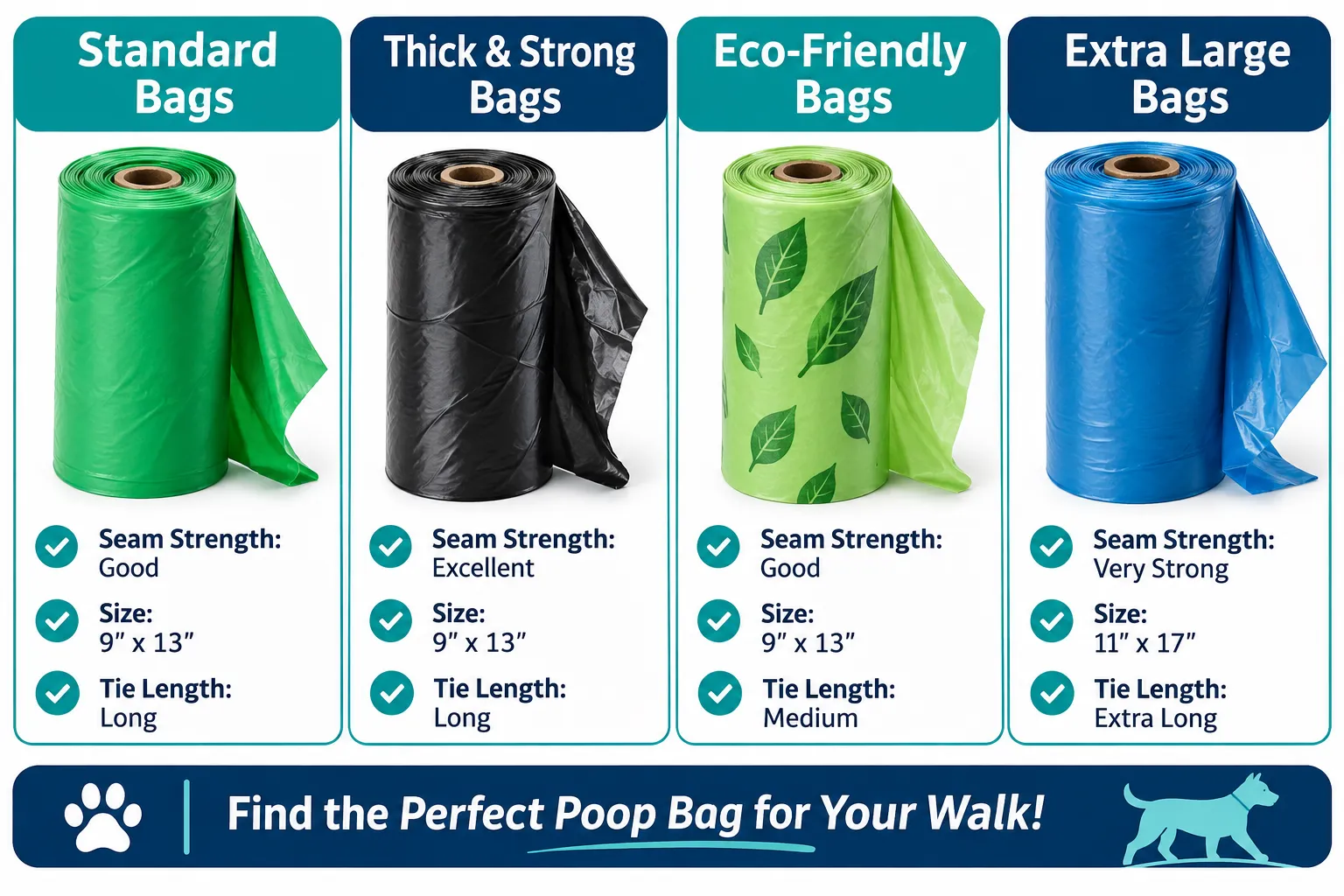
Size: 9 x 13 inches is the common “standard” size and fits most medium to large dogs with enough extra material to turn the bag inside out and knot it without your hand near the contents. Smaller egg-sized bags save material but leave almost no slack for a big dog’s output, which is where leaks start.
Cost per 100 bags is the only honest way to compare a $4 box of 15 to a $14 roll of 300. Multipacks and refill rolls at major retailers commonly range from 150 to 300 count, and bulk bags sold through grocery and pet retailers vary from roughly 4 to 7 cents per bag depending on thickness and quantity.
Decision rule: if your dog is over 50 pounds or regularly produces loose stool, pick the 9 x 13-inch size with a reinforced seam over a smaller or thinner bag, even if it costs a bit more per hundred.
Best dog poop bags for large dogs
For large dogs over 50 pounds, the best dog poop bags are full-size 9 x 13-inch bags with a heat-sealed bottom seam and a tie tail long enough to double-knot, since smaller bags leave little margin for larger stool volume. Earth Rated’s refill rolls and Amazon Basics’ leak-proof bags both measure in that range and performed well in independent puncture and leak testing.
Large-breed owners should also weigh thickness more heavily than scent, since a bigger dog’s output puts more stretch on the bag’s side seams. If you’re deciding on a large breed in the first place, guides to guard dog breeds and general breed matchmaking resources can help set expectations for daily walk routines and waste volume before you even get to bag shopping.
How many dog poop bags do I need per month
Most single-dog households need between 60 and 150 bags per month, depending on walk frequency. A dog walked three times a day with one bag per walk uses about 90 bags monthly; a dog walked twice daily uses closer to 60.
Use this rough formula: dogs x walks per day x bags per walk x 30 days. Multi-dog households should multiply accordingly, and owners who double-bag for large or loose stool should add 20 to 30 percent to the total. The calculator earlier in this article does this math automatically and also converts your numbers into a monthly cost estimate based on your pack price and count.
Quick example: two dogs, two walks per day, one bag per walk, works out to 4 bags daily and 120 bags monthly, which fits comfortably inside a single 150-count box with some left over for cleanup accidents at home.
Biodegradable vs plastic dog poop bags
Biodegradable bags are made from plant-based or blended materials designed to break down faster than standard plastic under the right conditions, while plastic bags (often polyethylene) are more durable and cheaper but don’t break down quickly in a landfill either way. In practice, the difference in real-world disposal outcome is smaller than marketing suggests, since both usually end up in the trash.
The meaningful difference between the two is durability, not eco-impact, for most households:
- Standard plastic bags tend to be thicker and more leak-resistant at a given price point, which is why they still dominate lab durability tests.
- Biodegradable and plant-based bags vary widely in quality; one bag marketed as “100% botanical plant components” ranked near the bottom of independent durability tests despite the green framing.
- Neither type should go in a backyard compost pile, per current municipal guidance, because of pathogen risk in the waste itself, not just the bag material.
Decision rule: choose based on tested durability and seam quality first; treat the biodegradable claim as a secondary preference, not a performance or disposal guarantee.
Best unscented dog poop bags
Unscented dog poop bags are the better default for most owners, since fragrance adds no durability benefit and can bother dogs or people with sensitivity. Earth Rated and similar brands typically sell an unscented version alongside their scented lines using the same seam and thickness specs, so you don’t lose durability by skipping the scent.
Choose unscented if you keep bags in a diaper genie, car console, or small apartment entryway where a concentrated lavender or fresh-linen scent becomes overwhelming in a confined space. Unscented bags are also the safer default for households with fragrance-sensitive members or dogs that sniff and sometimes mouth at the dispenser pouch.
Are scented dog poop bags worth it?
Scented bags help mask odor while a full bag sits in your pocket or car for a few minutes, but they have no effect on seam strength or leak resistance. They’re worth it only as a comfort feature, not a performance upgrade.
Choose scent based on personal tolerance and storage habits:
- If you tend to forget a full bag in your jacket pocket until laundry day, scent genuinely helps.
- If you or your dog react to synthetic fragrance, skip scented versions entirely; most brands offer an identical unscented SKU.
- Scent never substitutes for a good seam. A heavily scented bag with a weak seam is still a bag that will fail.
Dog poop bags for apartment living
Apartment dwellers benefit most from a dispenser that clips to a leash or door handle, a bag with decent odor control for short-term indoor storage, and a trash-compatible disposal routine since most apartment buildings don’t offer compost pickup for pet waste. The Amazon Basics bundle, which includes a clip-on holder and leash attachment, suits apartment owners who don’t already have a dispenser and want fewer trips back downstairs mid-walk.
Because apartment trash chutes and shared bins are usually the only disposal option, a compostable bag claim provides no real benefit in that setting. Unscented or lightly scented bulk rolls, stored in a small odor-sealed container near the door, tend to work better in practice than chasing a “green” label that won’t be honored by the building’s waste stream anyway.
Can you flush dog poop bags down the toilet?
No. Dog poop bags, including compostable and biodegradable versions, should never be flushed. They can clog pipes and septic systems, and most wastewater treatment plants are not designed to break down the bag material even if it’s labeled flushable-adjacent.
If you want to flush the waste itself rather than bag it, dog waste alone (without the bag) can sometimes go down the toilet depending on local sewage system rules, but check with your municipal water utility first, since some systems restrict pet waste disposal through sewage lines. The safest default for nearly all U.S. households remains bagging the waste and placing it in regular household trash.
What size dog poop bag do I need?
Most dogs are well served by the standard 9 x 13-inch bag size, which gives small to large breeds enough material to cover output and still leave slack for a secure knot. Toy and small breeds under 15 pounds can sometimes use smaller “egg bag” sizes without issue, but 9 x 13 remains the safer universal choice if you own multiple dogs or a dog whose size changes with growth.
Check the product listing dimensions before buying, since “standard” sizing isn’t perfectly consistent across brands. Earth Rated’s rolls and Amazon Basics’ bags both measure roughly 9 x 13 inches, which is a useful benchmark to compare other brands against.
Best dog poop bags for sensitive noses
For owners or dogs sensitive to fragrance, unscented bags made from standard polyethylene or a verified recycled-content blend are the safer pick over heavily perfumed lavender or lily-scented lines. Fragrance sensitivity is a common complaint in product reviews for scented multicolor packs, particularly in warm cars where scent concentrates.
If odor control still matters to you without added fragrance, look for bags described as “odor-blocking” through a thicker film rather than a scent additive, since thicker film genuinely slows odor permeation while scent only masks it temporarily.
Top 5 Features That Decide the Purchase
These five features determine whether a bag is worth buying again, not marketing copy on the box.
- Seam strength, Earth Rated Dog Poop Bags on Refill Rolls, 270 Bags, Lavender uses a heat-sealed bottom seam that held through water-fill and weighted-shake tests without leaking.
- Size relative to dog weight, the Amazon Basics Dog Poop Leak Proof Bags with Dispenser and Leash Clip measure 13 x 9 inches, matching Earth Rated’s dimensions, leaving enough slack to knot safely for larger dogs.
- Tie length, a longer tail lets you double-knot without stretching the bag thin near the waste; short ties are a common complaint on cheaper multicolor packs.
- Dispenser and roll fit, Best Pet Supplies Poop Bags for Dogs, Assorted Colors, 150 Count are sized for standard clip-on dispensers, useful if you already own a holder and don’t want to replace it.
- Cost per 100, comparing box price against count, not shelf price alone, determines whether a “premium” bag is actually a better deal than a bulk store brand.
Comparison table: Pack count and cost-per-100 for the best dog poop bags
| Product | Size | Count | Price band | Thickness note |
|---|---|---|---|---|
| Earth Rated Dog Poop Bags on Refill Rolls, 270 Bags, Lavender | 9 x 13 in | 270 | $10-$15 | Thick, reinforced seam |
| Amazon Basics Dog Poop Leak Proof Bags with Dispenser | 13 x 9 in | 300 | $10-$15 | Standard, leak resistant |
| Best Pet Supplies Poop Bags, Assorted Colors, 150 Count | Standard dispenser fit | 150 | $5-$10 | Thinner, budget grade |
Which pick fits which dog and owner?
Choose by dog size and routine, not by package color or scent claims. The best dog poop bags for a 90-pound Labrador on muddy trails are not the same as the best dog poop bags for a 10-pound apartment dog walked on a sidewalk.
- Large dog, daily walker in wet weather: Earth Rated’s refill rolls, thick enough to resist tearing on abrasive frozen grass, with a seam tested under weight and water.
- Any size dog, want a dispenser bundled in: Amazon Basics includes a clip-on holder and leash attachment, useful for new owners who don’t already own one.
- Budget pick: Best Pet Supplies’ 150-count assorted pack costs less per box and works fine for a small dog with solid, predictable stool, though it runs thinner.
Who it suits: owners walking in cold, wet, or dark conditions who need a bag sized to the dog’s actual output and a seam that won’t surprise them halfway through a knot. If you’re still building a daily walk routine with a new dog, pairing bag choice with basic training from a beginner’s guide to dog grooming and general care resources on Doggy Rank IQ rounds out the routine.
Things to Watch Out For
A “compostable” label doesn’t guarantee your city will take the bag, and a scented bag doesn’t guarantee odor control once it’s warm from your pocket.
- Compostability claims: the ASTM D6400 standard only applies to industrial composting facilities. Most households don’t have access to one, and current municipal guidance in cities like Seattle tells residents to put pet waste bags in the trash regardless of the compostable label, because dog waste can carry pathogens that contaminate compost.
- Thin bags that feel bulky: a thick-feeling roll doesn’t always mean a strong seam. Independent testing found a plant-based bag marketed around “100% botanical” materials ranked near the bottom for durability despite its packaging claims.
- Recycled content as a middle ground: municipal guidance increasingly favors bags with meaningful post-consumer recycled plastic content over both virgin plastic and unverified biodegradable claims, a detail worth checking on the label before assuming “eco” means “compost-ready.”
Common mistake: buying the smallest, cheapest bag available because it looks like a deal per box, then discovering the cost per 100 is actually higher than a reinforced bulk roll.
Who Should Skip This
Not every bag suits every situation, and the three picks above have real limits.
- Skip Earth Rated’s lavender-scented rolls if your dog or household is sensitive to fragrance; an unscented version exists but changes the comparison.
- Skip Amazon Basics if you already own a dispenser you like; the bundled holder adds bulk you don’t need.
- Skip Best Pet Supplies’ thinner bags if your dog regularly has loose stool or you walk on gravel and brush where punctures are common.
- Anyone expecting a compostable bag to break down safely in a backyard pile or standard landfill should reconsider; current regulation and municipal guidance point toward trash disposal regardless of the label.
FAQ
Q: What are the best dog poop bags that do not leak? A: Bags tested with a filled-water and weighted-shake method, like Earth Rated’s refill rolls, held without leaking in independent testing. Look for a heat-sealed bottom seam rather than a simple fold, and avoid bags under roughly 2 cents each, where thin film is more common.
Q: Are biodegradable dog poop bags actually biodegradable? A: Many break down only under specific industrial composting conditions covered by the ASTM D6400 standard, not in a home compost pile or ordinary landfill. Check the label for “industrial compostable” versus a generic “biodegradable” claim, and keep in mind the FTC has flagged misleading claims in this category before.
Q: What size dog poop bag for a large dog? A: 9 x 13 inches is the common standard size and gives large dogs enough slack to knot the bag safely without touching the waste. Dogs over 70 pounds with frequent loose stool may benefit from double-bagging rather than sizing up further.
Q: How thick should dog poop bags be? A: Thick enough to resist tearing on abrasive surfaces like frozen grass or gravel. Thickness claims on packaging are not a substitute for seam-quality testing, since some thin-feeling bags outperform thicker-feeling ones in independent lab results.
Q: Are scented dog poop bags worth it? A: Scent helps mask odor in a pocket or car but has no effect on seam strength or leak resistance. Choose durability first, scent second, and skip scent entirely if anyone in the household is fragrance-sensitive.
Q: Do compostable poop bags break down in a landfill? A: No. Compostable certification under standards like ASTM D6400 applies to industrial composting facilities, not sealed landfills where the oxygen and heat needed for breakdown are limited or absent.
Q: How much should dog poop bags cost per bag? A: Bulk bags commonly run between roughly 4 and 7 cents per bag depending on thickness and pack size. Anything priced much lower often means thinner film and a higher chance of tearing or leaking.
Q: Can you flush dog poop bags? A: No. Bags should never go down the toilet, even compostable ones, since they can clog pipes and aren’t designed to break down in wastewater systems. Bag the waste and dispose of it in household trash instead.
Q: How many poop bags does one dog need per month? A: A dog walked three times daily with one bag per walk needs roughly 90 bags a month; two walks daily brings that closer to 60. Multiply by the number of dogs in the household and add extra for accidents or loose stool.
Q: What’s the difference between unscented and scented bags in terms of quality? A: None, in most brands. Scent is an additive layered onto the same base film and seam construction, so choosing unscented doesn’t mean sacrificing strength or size.