
Quick Answer
Dog gut health comes down to a stable community of bacteria in the intestines, fed by a consistent, complete diet with enough fiber. The signs of trouble are loose or changing stool, gas, vomiting, appetite swings, weight loss and a dull coat. Most mild upsets settle in a few days with a steady diet and time. Probiotics help a little in some cases. Blood in the stool, repeated vomiting, a swollen belly or a puppy with diarrhea needs a vet the same day.
Key Takeaways: dog gut health
- Dog gut health depends mostly on boring things: one complete diet, slow food changes, fiber, clean water and regular parasite checks.
- Stool is the daily report card. Vets use a 1 to 7 scoring chart, and a firm, segmented log around 2 is the target.
- Antibiotics can disturb gut bacteria for weeks. In a 2020 study of 24 healthy dogs, changes from a 14-day course of metronidazole were still measurable in some dogs four weeks later.
- Probiotics are strain-specific. A handful have small trials behind them, and the benefit is usually modest: diarrhea that clears about a day sooner.
- There is no “gut reset.” The closest thing vets have is a fecal transplant, and it is a medical procedure.
- Red flags that skip home care: blood, black stool, repeated vomiting, bloating, pain, lethargy, or any diarrhea in a young puppy.

What is going on with your dog?
Check the current price
Tap an option to see the answer.
🦠 What “dog gut health” means, minus the marketing
Your dog’s intestines hold trillions of bacteria, along with fungi and viruses. (Yes, even the dog who gets bathed more often than the car.) Together they are called the gut microbiome. These microbes ferment fiber into short-chain fatty acids that feed the cells of the colon, convert bile acids into forms that keep harmful bacteria in check, help train the immune system, and crowd out invaders by taking up the space and the food.
In a healthy dog, most of those bacteria fall into a few large groups: Firmicutes, Bacteroidetes, Fusobacteria, Proteobacteria and Actinobacteria. One detail surprises people who read human health news. Fusobacteria, a group linked to disease in people, is a normal and welcome resident in dogs, which are built to digest more protein and fat than we are. Gut advice written for people does not always transfer to the animal on your couch.
Researchers at the Texas A&M Gastrointestinal Laboratory, led by Jan Suchodolski, turned this into something a vet can order: the Dysbiosis Index. It is a lab test on a stool sample that measures seven bacterial groups and reports a single number. Below zero is normal. Above two points to dysbiosis, the term for a bacterial community that has moved out of its healthy pattern. One species on the panel gets special attention. Clostridium hiranonis converts bile acids, and when it drops out, problems tend to follow.
“A healthy gut is a crowded one. The good residents take up the space so the bad ones cannot.”
That is the science in three paragraphs. The rest of this guide covers what you can see, what you can change and what to leave to your vet.
🚩 What are the 7 signs of an unhealthy gut?
The gut cannot send a text. It sends these.
- Loose stool or diarrhea, especially if it comes and goes for weeks.
- Constipation or straining.
- Vomiting more than the occasional grass-and-foam episode.
- Gas that clears a room, plus loud gurgling. (Vets call the noise borborygmi, which is fun to say and less fun to live with.)
- Appetite changes: picking at food, or suddenly ravenous while losing weight.
- Weight loss, or a pot belly with thin muscle over the spine.
- A dull, flaky coat or itchy skin with no flea in sight.
Any one of these for a day is a dog being a dog. A pattern is the thing to notice: the same sign three times a month, or two signs together. Keep a simple log on your phone with the date, the stool score and anything unusual the dog ate. It feels excessive until the vet asks, “When did this start?” and you have an answer.
The stool chart vets use
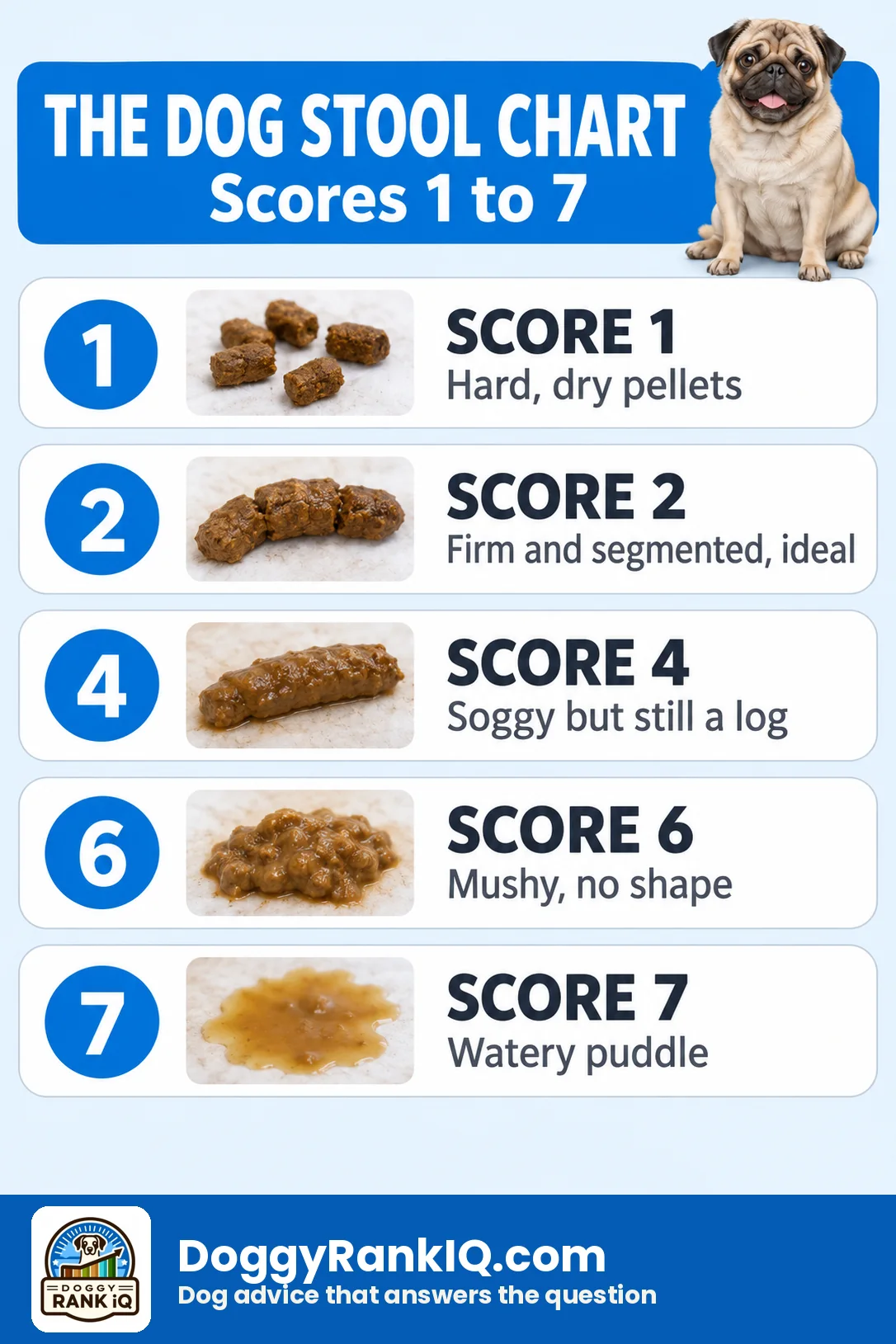
Most clinics score stool from 1 to 7 using a chart developed by Purina. A 1 is hard, dry pellets. A 7 is a puddle. The target is about a 2: firm, segmented, and leaving little or nothing behind when you pick it up. A 3 or 4 that holds its shape is common after a rich treat. A 6 or 7 that lasts past 48 hours is a reason to call.
Color counts too. Chocolate brown is normal. Black and tarry can mean digested blood from the stomach or small intestine. Red streaks point lower down. Gray and greasy suggests fat is not being digested. Each of those deserves a vet visit that week, and black stool deserves one that day.
🩺 What are some common gastrointestinal diseases in dogs?
“Sensitive stomach” covers a lot of ground. These are the conditions vets see most.
| Condition | What it looks like | Typical cause |
|---|---|---|
| Acute gastroenteritis | Sudden vomiting or diarrhea for 1 to 3 days | Garbage, a diet change, a rich treat |
| Intestinal parasites | Soft stool, pot belly, poor growth in puppies | Giardia, roundworms, hookworms, whipworms |
| Parvovirus | Severe bloody diarrhea, vomiting and collapse in puppies | A virus. Vaccination prevents most cases |
| Pancreatitis | Vomiting, a hunched or “praying” posture, belly pain | Often follows a fatty meal |
| Chronic enteropathy | Diarrhea, vomiting or weight loss for 3 weeks or more | Food-responsive in most dogs. Some need medication |
| Acute hemorrhagic diarrhea syndrome | Sudden bloody diarrhea that looks like raspberry jam | Linked to toxins from Clostridium bacteria |
| Bloat (GDV) | Swollen belly, retching with nothing coming up | The stomach twists. Minutes count |
Two points from that table. Parasites are common and cheap to rule out, so a stool test comes before any supplement. And bloat is a surgical emergency. A deep-chested dog who is pacing, drooling and trying to vomit with no result goes to the emergency clinic now.
Chronic enteropathy deserves a sentence of hope. When vets work through long-running gut trouble step by step, the majority of dogs improve on a diet change alone, usually to a hydrolyzed or novel-protein food fed strictly for a few weeks. Fewer need antibiotics or immune-suppressing drugs than owners expect.
🥣 How to improve gut bacteria in dogs?
You improve gut bacteria by feeding them well and not knocking them over. The list is short, and none of it is exciting.
Feed one complete diet, and change it slowly
Gut bacteria adapt to what arrives every day. A food labeled “complete and balanced” under AAFCO standards covers the nutrients. After that, consistency does the work. When you switch foods, take 7 to 10 days: a quarter new food for a few days, then half, then three quarters. A cold switch is the most common cause of the soft stool people blame on the new brand.
The WSAVA nutrition guidelines are a good checklist for choosing a manufacturer: who formulates the food, what testing they do and whether they will answer your questions.
Give the bacteria fiber
Fiber is what gut bacteria eat. Fermentable fibers such as beet pulp, inulin and fructooligosaccharides (FOS on a label) are turned into the short-chain fatty acids that feed the colon wall. These are the “prebiotics” on the bag. Non-fermentable fiber adds bulk and firms things up.
At home, the usual tools are plain canned pumpkin (not pie filling) and plain psyllium husk. A spoonful of pumpkin on a meal is a mild nudge for a dog whose stool runs a little soft. Start small, since too much fiber too fast produces the gas you were trying to avoid, and ask your vet for an amount that fits your dog’s size.
Be careful with antibiotics
Antibiotics save lives, and they also hit bystanders. In 2020, Rachel Pilla and colleagues at Texas A&M studied 24 healthy dogs, 16 of which received a 14-day course of metronidazole, a drug long handed out for diarrhea. The treated dogs’ gut bacteria changed sharply, Clostridium hiranonis dropped, and bile acid conversion fell with it. Four weeks after the last pill, some dogs had still not returned to where they started.
That study helped change practice. European guidelines published in 2024 advise against antibiotics for dogs with mild acute diarrhea who are otherwise bright and eating, because most recover just as fast without them. If your vet prescribes an antibiotic, give it exactly as directed. If your dog has simple diarrhea and seems fine otherwise, it is reasonable to ask whether an antibiotic is needed at all.
“For a bright, eating dog with one day of diarrhea, the modern answer is often food, fluids and time.”
Keep parasites and stress in check
A yearly stool test and regular parasite prevention protect the gut from the inside. Stress works on it from the outside. Boarding, moving house, a new baby or a week of fireworks can produce “stress colitis,” a bout of soft stool with mucus that shows up a day or two after the event. Routine helps: same food, same walk times, and something to chew or lick. A lick mat (about $8.99 for a two-pack when we checked) or a snuffle mat (about $11.98) slows a dog down and gives a worried brain a job. We cover more of these in our dog enrichment ideas guide.
Dogs who inhale dinner and then burp it back up often do better with a slow feeder bowl. Eating speed is the cause more often than the stomach is.
💊 Dog probiotics: what the evidence supports
Dog probiotics are the first thing most owners reach for, so here is the fair version.
A probiotic is a live microbe given in an amount shown to do something useful. The catch is in the last five words. Effects belong to a specific strain at a specific dose, and a tub that lists ten species with no strain names and no live count at expiry is a guess in a jar.
A few products have published trials in dogs. Enterococcus faecium SF68 is the strain in Purina Pro Plan FortiFlora (check the current price), the sachet most clinics stock. Multi-strain products such as Proviable and Visbiome have studies of their own. Across the small trials on sudden diarrhea, the typical result is that stool firms up about a day sooner than with a placebo. That is a welcome benefit when you are the one holding the bag at 6 a.m. It is also a modest one.
We compare the two best-known sachets, with cost per day, in FortiFlora for dogs vs Proviable.
Three practical rules for using a probiotic for dog gut health:
- Pick a product that names its strains and guarantees a live count through the expiry date.
- Give it for a situation it was studied in: sudden diarrhea, stress events such as boarding, or alongside antibiotics, spaced a couple of hours apart.
- Judge it by the stool chart after two to four weeks. If nothing changed, stop paying for it.
There is also early work on the gut and behavior. Purina’s Calming Care uses a Bifidobacterium longum strain that the company tested in anxious Labradors. The trial was small and run by the manufacturer, so treat it as promising and unproven. Our Calming Care vs Solliquin comparison goes through it.
🧴 Dog gut health supplements: which ones are worth it?
Dog gut health supplements fall into four groups, and they are not equally useful.
| Type | What it is | Worth trying when |
|---|---|---|
| Probiotics | Live bacteria or yeast | Sudden diarrhea, stress, after antibiotics |
| Prebiotics | Fermentable fiber (FOS, inulin, MOS) | Mildly soft stool on a low-fiber diet |
| Fiber | Psyllium, pumpkin, beet pulp | Soft stool, or mild constipation with plenty of water |
| Digestive enzymes | Pancreatic enzymes | Only for diagnosed pancreatic insufficiency |
Digestive enzymes are the group most often bought for no reason. A healthy pancreas makes all the enzymes a dog needs. Dogs with exocrine pancreatic insufficiency, a condition seen most in German Shepherds, need prescription-strength enzymes for life, and a vet diagnoses that with a blood test.
“Postbiotics,” bone broth powders and gut “detox” blends are mostly marketing at this point. Bone broth is fine as a flavor topper if it has no onion or garlic. It will not rebuild anything.
🍗 Dog gut health food: what to feed, and what is the 80/20 rule?
The best dog gut health food is the complete diet your dog does well on, measured in firm stools and steady weight. That can be kibble, canned, fresh or a mix.
A few food facts that hold up:
- Protein and fat levels shape the microbiome more than the brand name does. A sudden jump in fat is a classic trigger for loose stool and, in some dogs, pancreatitis.
- Treats and extras should stay under about 10 percent of daily calories. Past that, the diet stops being balanced and the gut gets something different every day.
- Plain cooked pumpkin, a spoon of plain unsweetened kefir or yogurt, and plain cooked vegetables are reasonable natural food for dog gut health in small amounts. Check any yogurt label for xylitol (also listed as birch sugar), which is toxic to dogs.
- Raw diets carry a contamination risk. In an FDA study of 196 raw pet food samples, 15 tested positive for Salmonella and 32 for Listeria monocytogenes. Freeze-drying does not sterilize. If you feed raw, handle it like raw chicken. Our freeze dried raw dog food guide covers which brands add a pathogen-kill step.
What is the 80/20 rule for dog food?
It depends who is saying it, which is the problem. In raw feeding circles, “80/20” or “80/10/10” means 80 percent muscle meat with the rest split between bone and organ. On some kibble bags, “80/20” means 80 percent animal ingredients and 20 percent fruit and vegetables with no grain. A third version tells owners to feed 80 percent regular food and 20 percent fresh toppers.
None of these is a nutritional standard. No regulator defines an 80/20 rule, and a ratio of ingredients says nothing about whether the finished food is complete. The label statement to look for is still “complete and balanced” for your dog’s life stage. If you like adding fresh food, the 10 percent treat guideline is the safer rule.
🌿 How to reset a dog’s gut naturally?
This is the most searched question on the topic, and the truthful answer is that a gut has no factory setting to return to. Bacteria recover on their own schedule once the thing that upset them is removed.
For a bright adult dog with a simple upset, the home plan looks like this:
- Keep water available. Dehydration is the main danger in diarrhea.
- Feed small, bland meals for two or three days. Boiled skinless chicken or lean turkey with plain white rice is the usual choice. Most vets no longer recommend long fasts.
- Add a little soluble fiber, such as a spoon of plain pumpkin.
- Consider a probiotic with a named strain.
- Return to the normal diet gradually over three or four days once stool is formed.
Bland diets are not complete, so they are a short bridge. If the dog is not clearly better in 48 hours, the plan has done what it can.
The procedure that comes closest to a reset is fecal microbiota transplantation: stool from a screened healthy donor dog, delivered by enema or capsule under a vet’s care. It has been studied in puppies with parvovirus, where treated pups recovered from diarrhea faster, and it is used in some dogs with chronic enteropathy. It is not a home project. (You were not going to. We mention it anyway.)
How to treat poor gut health in dogs naturally: what works and what is myth
“Natural” covers a wide range, so here is a quick sort.
Worth doing: a consistent complete diet, plain pumpkin or psyllium for fiber, small amounts of plain kefir for dogs who tolerate dairy, daily exercise (movement keeps the gut moving) and a predictable routine for anxious dogs.
Harmless but unproven: bone broth, slippery elm, goat milk. Dogs like them. The evidence is thin.
Skip: garlic “for parasites” (garlic damages red blood cells in dogs), essential oils by mouth, activated charcoal without a vet’s direction, long fasts, and any plan that swaps a prescribed medication for a herb. Parasites in particular need a dewormer chosen from a stool test. No food treats them.
🌱 Should I let my dog eat grass when sick?
Usually yes, if the grass is untreated. The belief that dogs eat grass to make themselves vomit is mostly wrong.
Benjamin Hart’s team at the University of California, Davis, surveyed more than 1,500 dog owners about plant eating. About two thirds said their dogs ate grass or other plants daily or weekly. Fewer than one in ten said the dog often seemed ill beforehand, and fewer than one in four said the dog often vomited afterward. Grass eating looks like normal behavior inherited from wild ancestors, and most of the time it means nothing.
Two cautions. Lawns treated with herbicide, pesticide or fertilizer are a hazard, as are cocoa mulch and some ornamental plants. And frantic grass eating with lip licking, gulping and drooling is different from casual grazing. That pattern can go with nausea or reflux, and if it keeps happening it is worth mentioning to your vet.
🧪 Dog gut health test: are the mail-in kits worth it?
Two very different products share this name.
The first is what a vet orders. A fecal flotation and a Giardia test look for parasites. Blood tests for cobalamin (vitamin B12) and folate show how well the small intestine is absorbing. The Dysbiosis Index from Texas A&M measures the bacterial groups with the most research behind them and comes with published reference ranges. These tests answer specific medical questions.
The second is the mail-in microbiome kit sold to owners. You send a stool sample, a lab sequences the bacterial DNA and you get a colorful report, often with supplement suggestions sold by the same company. The sequencing is legitimate. What the results mean for an individual dog is much less settled, since healthy dogs vary a lot and one sample is a snapshot. For a dog with ongoing symptoms, the money goes further at the vet. For a healthy dog, a kit is a curiosity purchase. Buy it for the same reason you would buy a breed DNA test, and do not change a working diet because of it.
🐶 Puppies and seniors: dog gut health by life stage
Puppies arrive with a gut community still under construction, a half-finished immune system and a habit of eating whatever is on the ground. That combination is why puppy diarrhea gets a faster phone call than adult diarrhea. Dehydration and low blood sugar develop quickly in a small body, and parvovirus stays on the list until vaccines are complete. Keep a puppy on the breeder’s or shelter’s food for the first couple of weeks before you change anything.
Older dogs lean the other way. Slower gut movement, dental pain that changes how they chew, and medications such as anti-inflammatories for arthritis can all upset digestion. New gut signs in a dog over eight deserve blood work as well as a stool test, because kidney, liver and thyroid problems often show up first as a picky appetite or a change in stool.
⭐ 5 habits that do the most for dog gut health
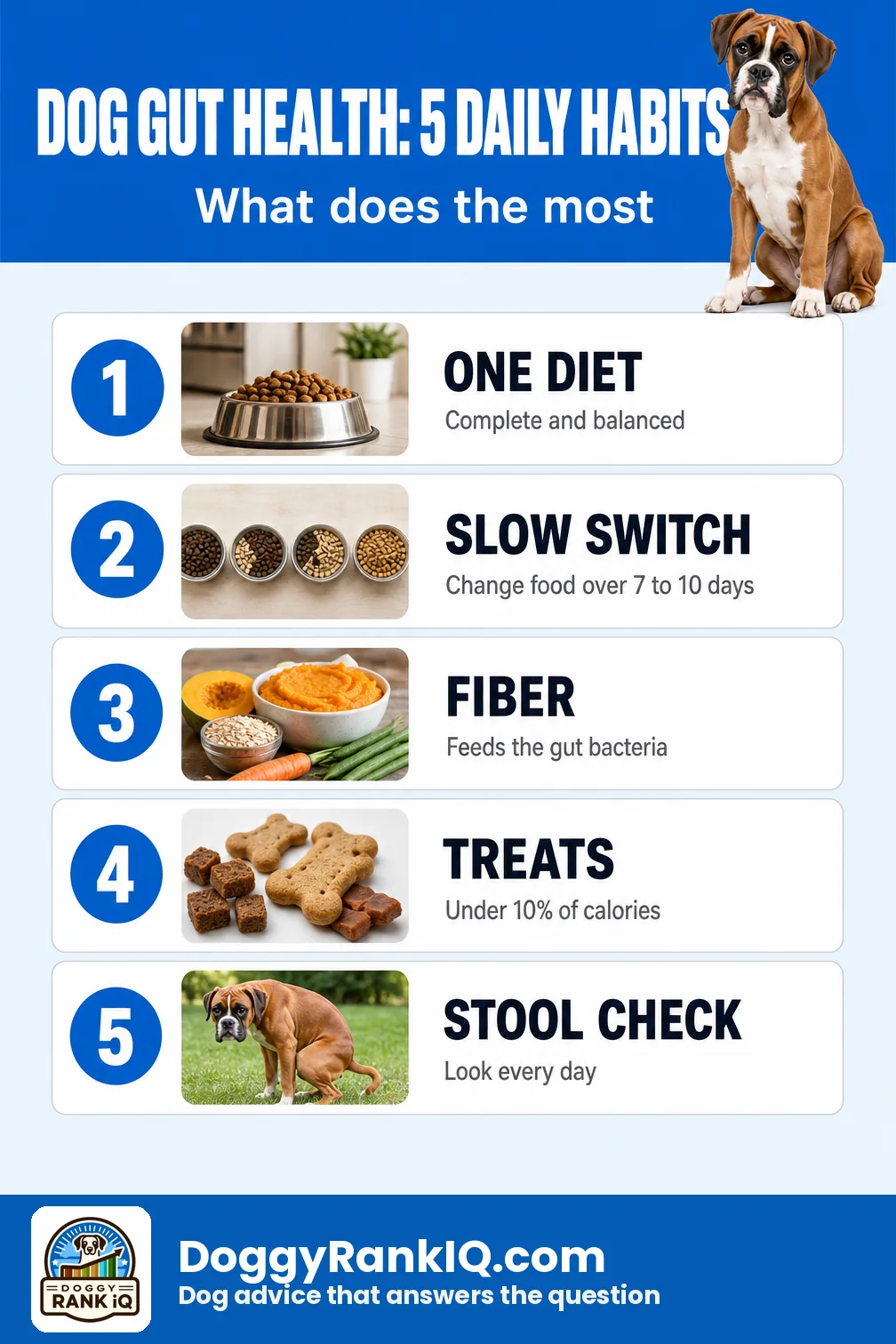
- One complete and balanced diet, fed on a schedule.
- Every food change stretched over 7 to 10 days.
- Treats, chews and table extras held under 10 percent of calories.
- A stool check every day and a stool test every year.
- Antibiotics only when your vet says they are needed, and a named-strain probiotic for the rough patches.
None of these costs much. Most cost nothing.
⚠️ When dog gut health is a vet problem
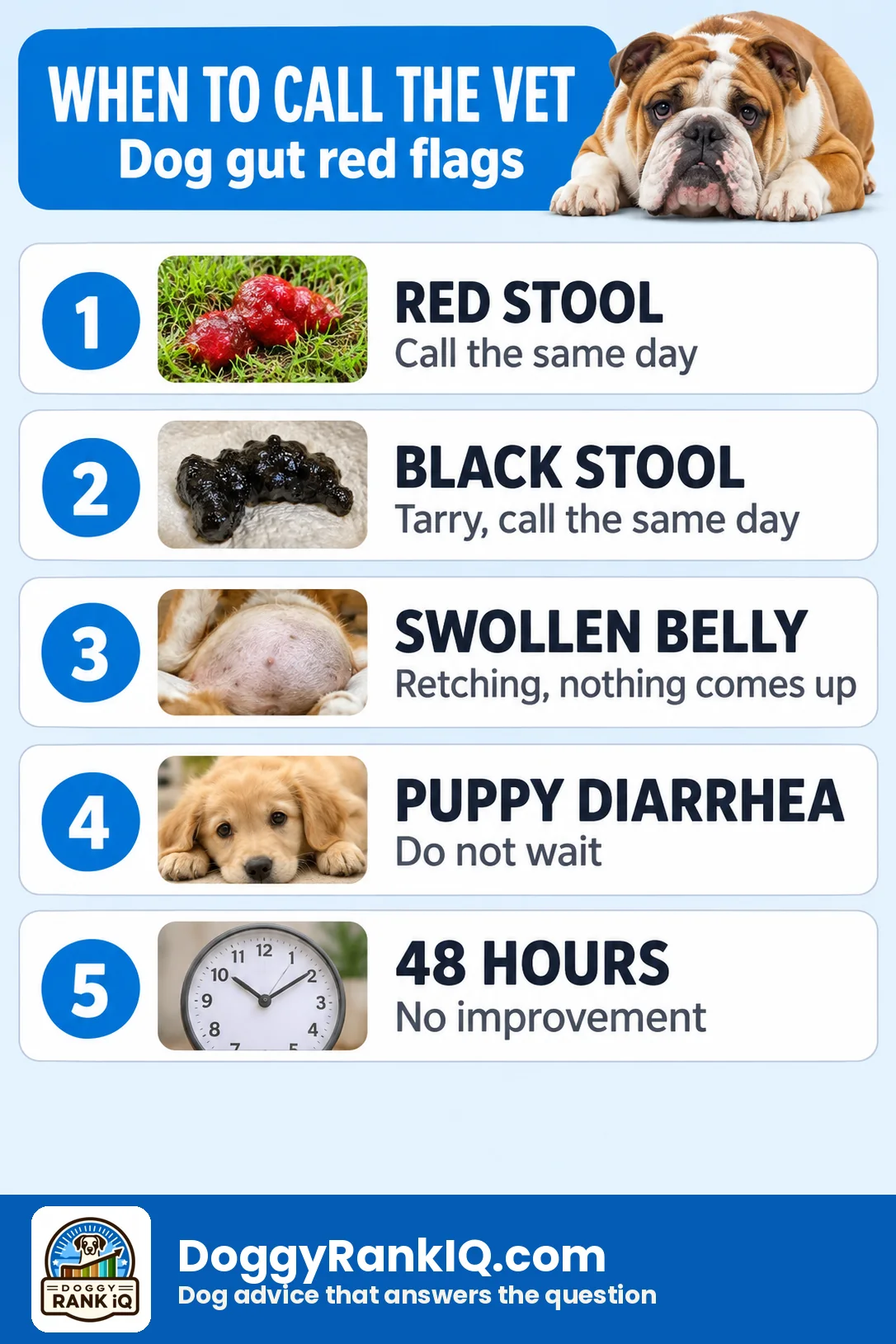
Skip the home plan and call your vet, or an emergency clinic after hours, for any of these:
- Blood in vomit or stool, or black, tarry stool
- Vomiting more than two or three times in a day, or being unable to keep water down
- A swollen, tight belly, or retching with nothing coming up
- Diarrhea in a puppy, a senior or a dog with another illness
- Lethargy, pale gums, a hunched posture or signs of pain
- Any chance the dog ate a toy, a sock, a corn cob, medication or something toxic
- Symptoms of poor gut health in dogs that last longer than 48 hours, or keep coming back
Bring a fresh stool sample and your log. It saves a step.
FAQ
The bottom line
Dog gut health rewards routine. Feed one good diet, change it slowly, give the bacteria some fiber, watch the stool and keep antibiotics for when they are needed. Supplements sit on top of that. They do not replace it.
If your dog’s stool has been soft for weeks, start with a stool test at the vet before you start with a tub of powder. It costs less, and it rules out the causes no probiotic can fix.
Doggy Rank IQ is reader supported. As an Amazon Associate we earn from qualifying purchases, at no extra cost to you.