
How cold is too cold for dogs? Quick Answer
How cold is too cold for dogs depends on wind, wetness, coat type, size, age, and health more than on the raw number on a weather app. A dry, double-coated adult dog can often handle temperatures into the 20s Fahrenheit without trouble. A small, thin-coated, wet, senior, or very young dog may need to come inside well above freezing. There is no single safe cutoff that applies to every dog on every sidewalk.
Most charts promise a tidy number. Dogs are not tidy. A specific animal with a specific coat, a specific age, and maybe a sore hip from last week’s zoomies does not fit one line on a graph. That is why veterinary groups like the American Veterinary Medical Association frame cold tolerance as a set of interacting factors rather than one fixed threshold.
Key Takeaways
- 20°F (-7°C) is the point where VCA Animal Hospitals recommends limiting walks to roughly 5 to 10 minutes, especially once wind chill is factored in.
- 32°F (0°C) is a common caution line across veterinary guidance: every dog becomes more vulnerable to hypothermia and frostbite at or below freezing.
- Wind chill, not just air temperature, is the variable most owners skip, and it can shift the real risk by 10 to 20 degrees.
- Wet fur loses insulating value fast; a soaked coat at 35°F can feel more dangerous to a dog than dry fur at 25°F, according to Cornell’s College of Veterinary Medicine.
- Thick double-coated breeds like Huskies and Newfoundlands tolerate cold far better than thin-coated breeds like French Bulldogs or Whippets, but every breed still needs caution below 32°F.
- Small dogs (under 20 pounds) and dogs with less body fat lose heat faster because of their higher surface-area-to-mass ratio.
- Puppies and senior dogs regulate body temperature less efficiently than healthy adults and should come inside sooner.
- Frostbite most often affects ears, tail tips, and paw pads, the parts of a dog’s body with the least insulation and blood flow, per VCA’s frostbite guidance.
When to call the vet: If your dog is shivering uncontrollably, moving stiffly, seems weak or disoriented, or has pale or grayish-blue skin on the ears, tail, or paw pads, stop the walk and call your veterinarian or an emergency clinic right away. Frostbite and hypothermia can get worse while you’re still deciding whether it’s “that bad.” Treat confusion or collapse as an emergency, not a wait-and-see situation.

How cold is too cold for dogs
There is no single temperature that makes a walk unsafe for every dog. Veterinary sources generally agree on a range: caution starts around 32°F, real risk builds at 20°F and below, and the actual threshold for your dog depends on coat, size, age, health, wind, and moisture.
Think of it as a dimmer switch rather than a wall. A dry, acclimated Alaskan Malamute at 20°F is having a fine day outside. A damp, 9-pound Chihuahua at 40°F is already uncomfortable and possibly at risk. The AVMA’s cold weather safety guidance makes this explicit: no single temperature is automatically unsafe for every dog, because size, breed, coat, age, health, acclimatization, wind, moisture, and exposure time all interact at once.
Two approaches show up in professional guidance:
- Temperature-band rules (easy to apply): caution below 32°F, shorten walks to 5 to 10 minutes at or below 20°F. Simple, but it can overgeneralize for an unusually hardy or unusually fragile dog.
- Individualized risk assessment (more accurate): judge your dog’s actual coat, fat stores, and behavior instead of leaning on a fixed number.
The practical move is to use the temperature bands as a starting checkpoint, then adjust based on your own dog’s coat and your route’s wind and wetness that day.
How cold is too cold for dogs? At what temperature should dogs stay inside
Most healthy adult dogs with average coats should stay inside, or limit outdoor time to brief bathroom breaks, once the temperature drops to 20°F or below, especially with wind chill factored in. Small, thin-coated, young, senior, or unwell dogs should get the same treatment starting around 32°F.
- Above 45°F: Comfortable for nearly all dogs, normal walk length.
- 32°F to 45°F: Fine for most healthy adult dogs, caution point for small, thin-coated, puppy, senior, or sick dogs.
- 20°F to 32°F: Shorten walks for everyone, watch closely for early cold signs, limit exposure for at-risk dogs to a quick bathroom trip.
- Below 20°F: High-risk range for all dogs, VCA recommends capping outdoor time at roughly 5 to 10 minutes, less for vulnerable dogs.
Decision rule: if your dog fits two or more risk factors (small, thin-coated, wet, senior, or unwell), treat 32°F as your “come inside soon” line instead of waiting for 20°F.
How cold is too cold for dogs? What changes the safe length of a cold-weather walk?
The biggest variables are wind chill, moisture, coat type, body size, age, and current health. Changing any one of these can shift a “safe” walk length by 15 minutes or more in either direction.
- Wind chill: a calm 25°F morning and a windy 25°F morning are not the same walk. Wind strips heat from exposed skin and thin fur far faster than still air.
- Wet versus dry: rain, slush, or a dog that just splashed through a puddle loses insulating value from its coat quickly. A wet dog at 35°F can be colder, functionally, than a dry dog at 20°F.
- Coat type: double-coated breeds (Huskies, Samoyeds, Newfoundlands) carry built-in insulation that single-coated or short-haired breeds (French Bulldogs, Boxers, Whippets) do not have.
- Size and body fat: smaller dogs lose heat faster because they have more surface area relative to body mass. A larger dog with some body fat holds heat longer.
- Age: puppies and senior dogs regulate temperature less efficiently than healthy adults.
- Health status: arthritis, heart conditions, hormonal issues like hypothyroidism, and recent illness all reduce a dog’s ability to handle cold.
Common mistake: owners check only the air temperature on their phone and skip wind chill entirely. That single omission explains most of the “but the app said it was fine” surprises when a dog starts shivering on what looked like a mild day.
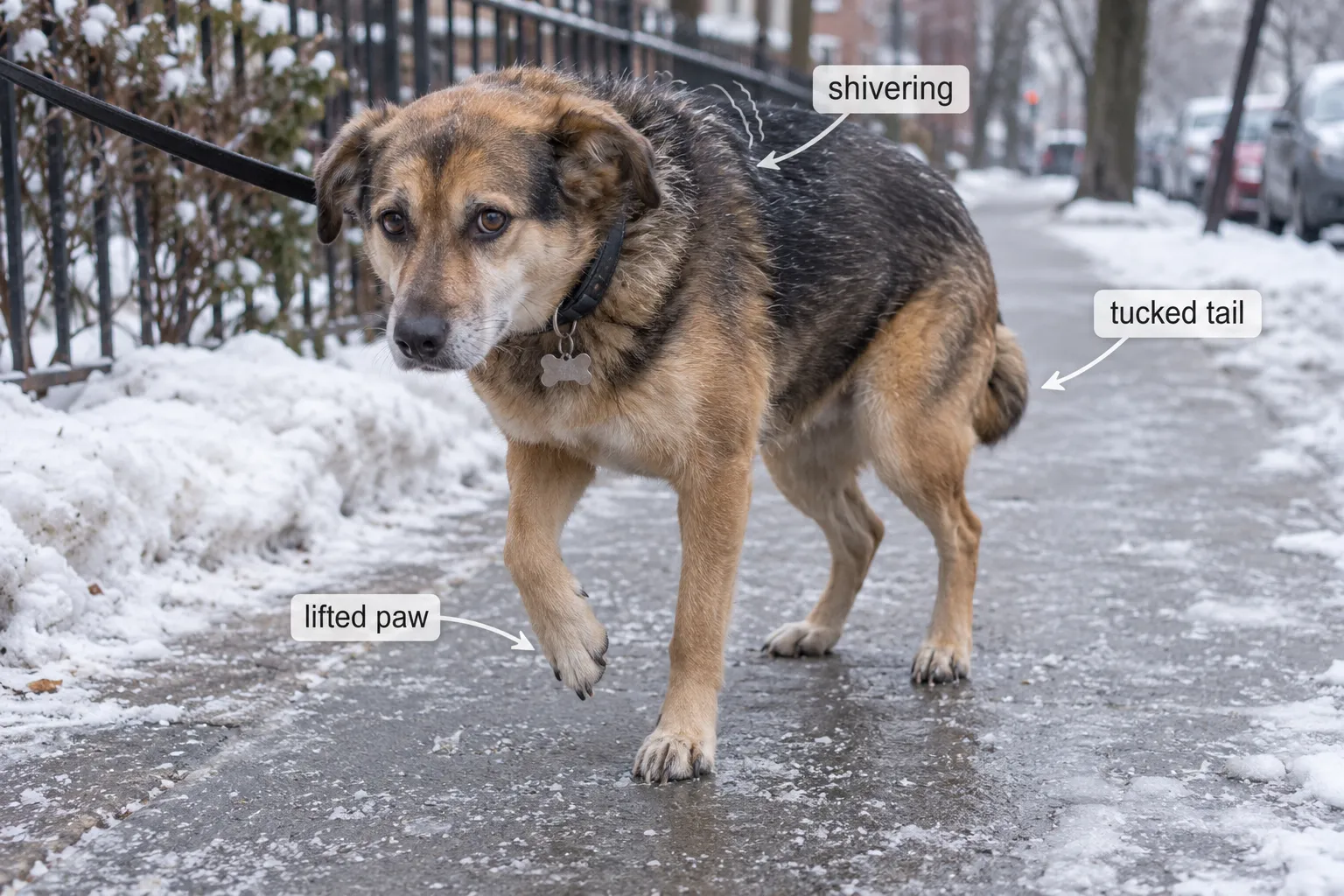
How cold is too cold for dogs? Signs your dog is too cold
Shivering, a tucked tail, lifted paws, slowed pace, whining, and seeking shelter are early signs that your dog is too cold and ready to head home. Pale or grayish skin, stiff movement, weakness, disorientation, or collapse are emergency signs that mean calling a veterinarian immediately.
Early signs (go home now):
- Shivering or trembling
- Lifting one paw at a time or stopping to chew at paws
- Slowing pace, lagging on the leash, or trying to turn back
- Whining or seeming anxious
- Curling or tucking the tail tightly
Emergency signs (call the vet):
- Muscle stiffness or uncoordinated movement
- Weakness or stumbling
- Reduced alertness or confusion
- Pale, gray, or bluish skin on ears, tail tip, or paw pads
- Slow or shallow breathing
- Collapse
A dog that goes from reluctant to stumbling within one block is past the point of finishing the walk. Head home immediately rather than pushing to the end of your usual loop.
How cold is too cold for dogs? Why is my dog shaking and seems cold
A dog that shivers or shakes on a walk is losing body heat faster than it can generate it, which is the body’s first visible attempt to warm up through muscle movement. This is an early warning sign, not something to wait out.
Shivering on a walk usually means one of three things: the air or wind chill is lower than the coat can handle, the dog’s fur is wet, or the dog has less body fat or muscle mass than it needs to hold heat (common in puppies, seniors, and very lean breeds like Whippets). If shaking continues after a few minutes inside a warm space, or is paired with lethargy, that combination points toward hypothermia rather than simple discomfort and is worth a call to your vet, per guidance from MSPCA-Angell.
How cold is too cold for dogs? Weather and dog risk checklist without fixed universal cutoffs
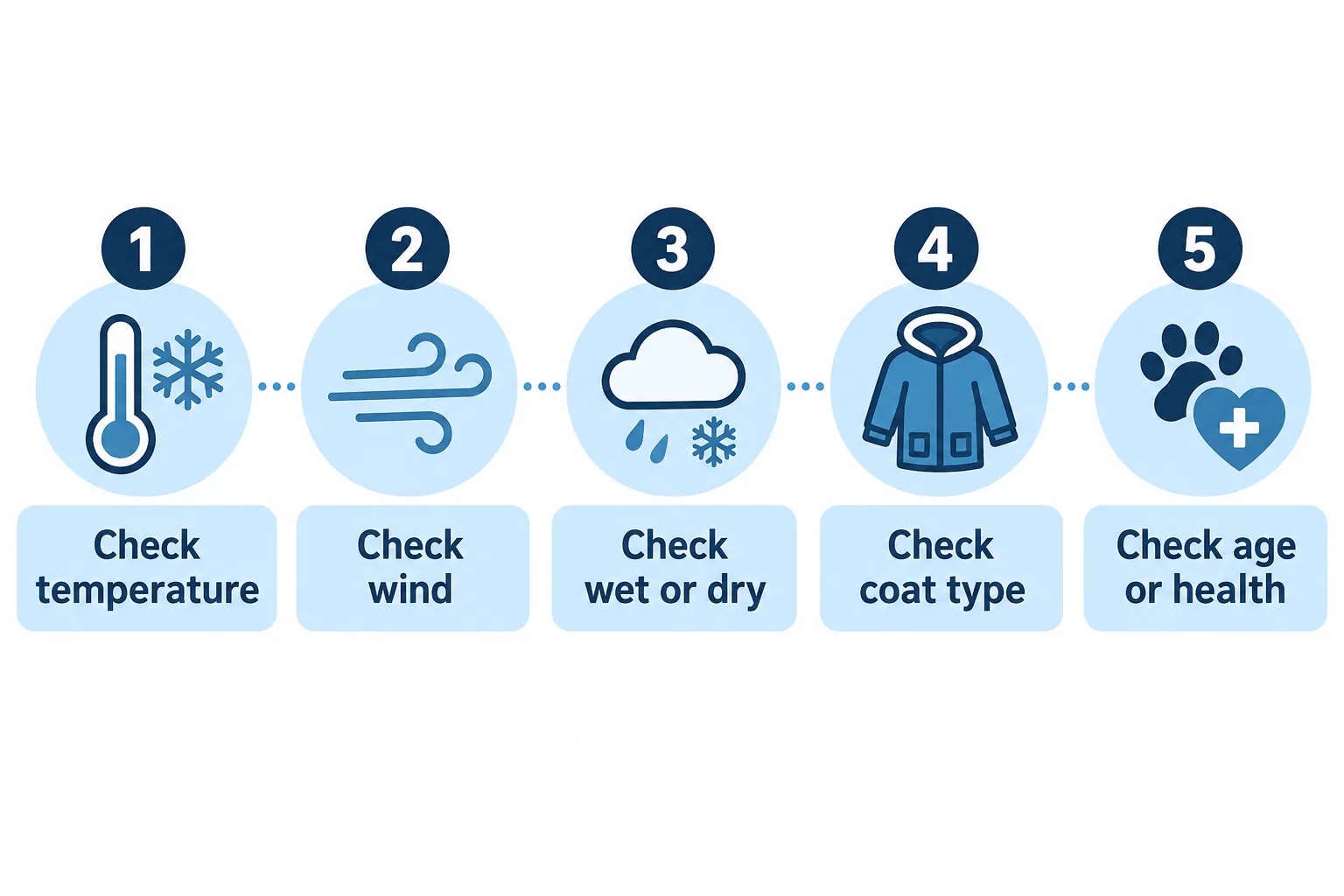
Instead of memorizing one number, run through a short mental checklist before clipping on the leash. The same temperature reading can mean two very different walks depending on the dog and the conditions.
- What does the thermometer say, and what does the wind chill say?
- Is the ground wet, icy, or salted?
- Is the coat thick and dry, or thin, clipped, or already damp?
- Is this a puppy, a senior, or a dog managing a health condition?
- Has the dog been outside much today, or is this the first exposure?
- Is there gear (coat, boots) that actually fits, or is it a guess?
Doggy Rank IQ Tool
Winter Dog Walk Planner

Charts give one number for every dog. This uses your dog and today's conditions. Guidance, not a medical threshold.
How cold is too cold for dogs? How long can dogs stay outside in the snow
Most healthy adult dogs can play in the snow for 15 to 30 minutes at temperatures above 20°F if they are dry and active, but time should drop to 5 to 10 minutes as temperatures fall below 20°F or the dog’s coat gets wet. Small, thin-coated, young, or senior dogs need shorter sessions at every temperature band.
Active play (fetch, running) generates body heat, which buys some extra time compared to a slow sniff-heavy walk. But snow also means wet paws and wet bellies, which speeds up heat loss even during an energetic game. Check paws for ice balls between toes and snow packed against pads every 10 minutes or so, and bring the dog in sooner if it starts biting at its feet.
How cold is too cold for dogs? Stages, scenarios, and thresholds: a side-by-side comparison
This table answers how cold is too cold for dogs across common real-world scenarios, since the same air temperature creates very different risk levels depending on coat, age, and moisture.
| Scenario | Approximate threshold | Suggested walk length | Primary risk |
|---|---|---|---|
| Dry, thick-coated adult dog, calm wind | Comfortable to ~20°F | 20 to 30 minutes | Low, monitor pace |
| Dry, thin-coated or small adult dog | Caution below 32°F | 10 to 15 minutes | Shivering, reluctance |
| Wet coat (rain, slush, puddles), any dog | Risk rises well above 20°F | 5 to 10 minutes | Fast heat loss |
| Puppy or senior dog, any coat | Caution below 32°F | 10 to 15 minutes | Poor temperature regulation |
| Any dog, 20°F or below with wind chill | High risk | 5 to 10 minutes | Frostbite, hypothermia |
| Active weather advisory in effect | Legally restricted in some states | Brief bathroom trip only | Tethering/exposure violations |
How cold is too cold for dogs? Which dog breeds handle cold weather best
Breeds with thick double coats, like Huskies, Samoyeds, Malamutes, and Newfoundlands, tolerate cold far better than short- or thin-coated breeds like French Bulldogs, Basenjis, and Whippets. Even cold-hardy breeds still need caution below 32°F and real concern below 20°F during prolonged exposure.
Individual variation matters here. A Husky with less undercoat because of age, illness, or recent shaving does not get the same cold tolerance as a full-coated littermate. Breed is a starting point, not a guarantee. If you’re comparing breeds for a cold climate before adopting, it helps to read up on best dog breeds for apartment living and general best dog breed guides that cover coat type alongside temperament.
How cold is too cold for dogs? Dog breeds that can handle freezing weather
Breeds built for freezing conditions, such as Siberian Huskies, Alaskan Malamutes, Saint Bernards, Newfoundlands, and Great Pyrenees, were developed to work in snow and sub-freezing temperatures and carry coats designed for that job. These breeds can often handle temperatures into the teens and 20s Fahrenheit for working periods, but they still need shelter, dry fur, and monitoring during long exposure, since wind chill and wetness affect even a working-bred coat.
Do small dogs get cold faster than large dogs
Yes. Small dogs lose body heat faster because they have more surface area relative to their body mass, and many small breeds also carry thinner coats. A Chihuahua and a Great Dane standing in the same 35°F yard are not having the same experience.
Decision rule: if a dog weighs under 20 pounds, treat 32°F as the starting point for shortening walks, not as a “still fine” number.
Do puppies get cold easier than adult dogs
Yes. Puppies have less body fat, smaller muscle mass, and less developed temperature regulation than adult dogs, which makes them more vulnerable to cold even at temperatures a grown dog of the same breed would tolerate fine.
Puppies under about 12 weeks old should have very limited outdoor cold exposure, mostly brief bathroom trips, until they build up body mass and coat thickness. A puppy that seems reluctant to walk, shivers quickly, or wants to be carried is signaling that the outing should end, not that it needs encouragement.
Senior dogs and cold weather: what you need to know
Senior dogs regulate body temperature less efficiently than younger adults and often have health conditions, like arthritis or thyroid issues, that make cold weather harder on their joints and circulation. Shorter, slower, more frequent walks work better than one long outing in winter for an older dog.
Arthritis pain can also get worse in cold, damp conditions, which may show up as stiffness, reluctance to walk, or a slower pace than usual. If a senior dog that normally walks fine suddenly seems hesitant on winter mornings, it is reasonable to treat that as both a comfort issue and a potential medical one worth mentioning at the next vet visit.
Can dogs get frostbite and hypothermia
Yes, dogs can develop both frostbite and hypothermia, and the VCA’s frostbite guidance notes that ears, tail tips, and paw pads are the most common sites because they have less insulation and reduced blood flow in extreme cold.
Frostbite symptoms include pale, gray, or bluish skin, coldness and hardness to the touch, and pain when the area starts to warm back up. Hypothermia symptoms include intense shivering that later stops (a dangerous sign that the body is losing its ability to regulate temperature), lethargy, weak pulse, and in severe cases collapse. Both conditions are medical emergencies once symptoms appear and require a veterinarian, not home treatment alone.
How to warm up a cold dog fast
Bring the dog indoors immediately, wrap it in dry towels or blankets, and offer a warm (not hot) spot away from direct heat sources like space heaters or heating pads that can burn chilled skin. Call a veterinarian if shivering does not ease within 10 to 15 minutes or if any emergency signs appear.
- Get the dog inside and out of wind and wet conditions right away.
- Dry the coat thoroughly with towels, paying attention to paws, belly, and ears.
- Wrap the dog in dry blankets and let it rest in a warm room, not pressed directly against a heater or heating pad.
- Offer water at room temperature; avoid forcing food or water if the dog seems weak or disoriented.
- Check gum color and alertness. Pale gums, confusion, or continued severe shivering after 15 minutes mean it’s time to call the vet.
Do short haired dogs need sweaters
Many short-haired dogs benefit from a sweater or coat once temperatures drop below 45°F, especially breeds like French Bulldogs, Boxers, Greyhounds, and Chihuahuas that lack a dense undercoat. A sweater does not replace watching for shivering and other cold-sign behavior during a walk.
Choose a coat or sweater that covers the chest and belly, fits snugly without restricting movement, and stays dry; a wet sweater can trap moisture against the skin and make things worse rather than better. For general care basics beyond cold-weather gear, a beginner’s guide to dog grooming covers coat maintenance that also affects natural insulation.
Does wet fur make dogs colder in winter
Yes. Wet fur loses most of its insulating value because trapped air pockets in the coat, which normally hold in body heat, collapse when fur is saturated. A wet dog at 35°F can lose heat faster than a dry dog standing in 20°F air, according to winter safety guidance from Cornell’s veterinary college.
Towel-dry a dog immediately after any walk through rain, slush, or deep snow, paying close attention to the belly, legs, and paws where moisture collects fastest. A dog that will be outside again soon after a wet walk is at higher risk than one who gets a full dry-off and a break indoors first.
Indoor dogs that hate cold temperature
Dogs bred or raised primarily as companion and indoor breeds, including many small toy breeds, Greyhounds, Boxers, and short-nosed breeds like Pugs and French Bulldogs, often show a strong dislike of cold and may refuse to go outside altogether once temperatures drop. This reaction is a legitimate signal, not stubbornness.
If an indoor-oriented dog plants its feet at the door in cold weather, consider shorter, more frequent bathroom trips instead of one long walk, add a coat and boots, and look at indoor enrichment options (puzzle feeders, short training sessions, like practicing basic commands) to make up for reduced outdoor time on the coldest days.
Do dogs need winter coats or sweaters
Dogs with thin coats, short hair, small bodies, or low body fat often benefit from a coat in cold or wet weather, while thick double-coated breeds usually do not need one for warmth. A coat does not replace watching for shivering and other warning signs during the walk itself.
Look for a coat that covers from neck to base of tail, closes snugly at the chest, and does not restrict leg movement or bathroom posture. Dogs new to wearing gear often need a few short practice sessions indoors before a coat feels normal outside.
Frequently asked questions
How cold is too cold for dogs in general terms? Caution starts around 32°F for most dogs, and real risk builds at 20°F and below, but the exact line depends on coat thickness, size, age, health, wind chill, and whether the dog is wet or dry.
What temperature is dangerous for small dogs? Small dogs under about 20 pounds should be treated with caution starting at 32°F, since their higher surface-area-to-mass ratio means they lose heat faster than medium and large dogs.
Can dogs get hypothermia above freezing? Yes. A wet, thin-coated, or small dog can develop hypothermia symptoms even in temperatures in the high 30s or low 40s Fahrenheit if exposure lasts long enough and wind chill is present.
How do I know if my dog has frostbite? Look for pale, gray, or bluish skin on the ears, tail tip, or paw pads, along with coldness or hardness to the touch and pain when the area warms up. This needs veterinary attention, not home treatment.
Do all double-coated breeds tolerate cold equally well? No. Age, illness, recent shaving, and individual coat density all affect how well a double-coated dog handles cold, so breed alone is not a guarantee of tolerance.
Should I skip walks entirely during extreme cold? Yes, for most dogs below 20°F with wind chill, a brief bathroom trip is safer than a full walk. Indoor play or short training sessions can fill the gap.
Is salt on sidewalks dangerous for dogs? Yes, ice-melting salt can irritate paw pads and cause stomach upset if licked off. Rinsing and drying paws after walks on salted surfaces helps, and booties offer extra protection.
Why does my dog seem fine outside and then shiver once inside? This can happen when the body starts releasing stored tension and adjusting back to a warmer environment. If shivering continues for more than 10 to 15 minutes indoors, treat it as a sign to check in with a veterinarian.