
This post contains affiliate links. If you buy through one we may earn a commission at no extra cost to you. As an Amazon Associate I earn from qualifying purchases.
Best dog water bottle: Quick answer
The best dog water bottle for most owners is one with a trough wide enough for the dog’s full muzzle, a reservoir matched to trip length (roughly 15 to 20 oz for a 45-minute walk, 30 oz or more for a half-day hike), and a seal built from a silicone gasket plus a mechanical lock rather than a snap-fit lid alone. Treeline Review’s testing found leak resistance varies widely between models even at similar price points, so checking the seal design before buying matters more than brand name.
Key Takeaways
- Treeline Review’s field test across 8 dogs from 20 to 95 lb over two months rated the Springer Flip bottle’s leak resistance 9/10.
- Springland’s nationwide Target launch on July 5, 2026 included a 15-oz Mini ($14.99) and 20-oz Flip ($24.99), both with a locking valve and water return.
- A silicone gasket paired with a mechanical lock is the most common point of failure in portable dog bottles, according to testing cited by Dogster.
- Trough geometry matters as much as capacity: shallow, wide troughs suit small and flat-faced dogs, while broad leaf-style troughs suit large breeds.
- The PupFlask Large bottle (27 and 40 oz) scored 7.5/10 for leaks in Treeline’s test, losing points because residual water stayed in the bowl after draining.
- The Springland insulated bottle (24 oz) scored a leak rating of 10/10 and reportedly kept water cold for roughly 12 hours, but its bowl may be undersized for dogs above roughly 65 lb.
- A 10-ounce bottle fits a short errand with a small dog; it will not cover a 90-minute hike with a large breed.
- Dogs with a flat face (Bulldogs, Pugs, French Bulldogs) need a wide, shallow trough, not a narrow channel.
Doggy Rank IQ Tool
Dog Water Bottle Capacity and Muzzle Planner

Enter the dog and the walk. You get ounces to carry and the trough width to look for.

Best Dog Water Bottle
The best dog water bottle does three things well: it holds enough water for the trip, it releases that water into a bowl the dog can physically reach, and it stops releasing water the second the dog walks away. Get any one of those three wrong and the bottle fails, no matter how nice the packaging looks.
Three specs decide whether a bottle clears that bar. Reservoir capacity determines how many refill stops you skip. Bowl width determines whether a Bulldog’s flat face or a Shepherd’s long muzzle can actually make contact with the water. And the seal, meaning the gasket and locking mechanism together, determines whether unused water stays inside the bottle or soaks your car seat, your backpack, or the carrier under an airline seat.
Most roundups rank bottles by looks or price. This guide ranks them by whether the trough clears a typical dog’s muzzle and whether the unit disassembles far enough to actually get clean. Treeline Review’s testers used eight dogs weighing 20 to 95 pounds over more than two months of walks, hikes, and car trips, and the resulting leak scores tell a more useful story than a star rating ever could. A useful rule from testing covered by Dogster: if a product listing does not specify both a gasket and a mechanical lock, assume it leaks until you have tested it at home yourself, upside down, over a sink.
Below is a planner to help translate your dog’s size and trip length into an actual ounce number, followed by the full comparison.
Capacity and Muzzle Fit Planner
function cgCalc(){ var w=parseFloat(document.getElementById(‘dw’).value)||40; var m=parseFloat(document.getElementById(‘wl’).value)||45; var t=parseFloat(document.getElementById(‘temp’).value); var muz=document.getElementById(‘muz’).value; var oz=(w*0.02*(m/30)*t).toFixed(1); var picks=[]; if(muz===’small’){picks=[‘Kalimdor 19oz (narrow bowl, fits small muzzles)’];} else if(muz===’medium’){picks=[’10oz Stainless Steel Portable Bottle’];} else{picks=[‘Dog Water Bottle Portable with Food Container (wider trough option)’];} document.getElementById(‘cgResult’).innerHTML=’Suggested reservoir: ‘+oz+’ oz minimum.Bottles worth checking for this muzzle size: ‘+picks.join(‘, ‘)+’.
Estimate only. Adjust up for heat, panting, or a dog who drinks more than average.’; }
Best dog water bottle: How do dog water bottles work?
A best dog water bottle holds water in a sealed reservoir and releases it into an attached bowl or trough only when the owner presses a button, flips a cap, or squeezes the body, so water doesn’t pool or spill while it’s being carried. Most designs fall into two mechanisms: a flip-top valve that opens a small bowl on top of the bottle when open up, or a push-button dispenser that forces water through a channel into a cupped tray as you squeeze the sides.
The flip-top style, used by the Springer Flip line and the Springland Target bottles, works like this: open up the side lever, flip the attached silicone or plastic bowl upright, and water drains from the reservoir into the bowl through gravity and a small valve opening. Once the dog finishes, flipping the bowl back down triggers the valve to seal again, and in better designs, any leftover water in the trough drains back into the main reservoir rather than sitting exposed. That water return feature, built into the Springland Flip design, is what keeps a backpack dry between stops.
The squeeze-bottle style skips the hinge entirely. Squeezing the bottle’s body pushes water up through a straw or channel into a molded cup at the top, and releasing the squeeze lets gravity pull most of the water back down. This style tends to be simpler and cheaper, but it depends entirely on grip strength and timing, which is harder to manage one-handed while also holding a leash.
Best dog water bottle: Dog water bottle vs regular bowl
A dog water bottle is built for water access away from home, while a regular bowl is built for stationary refill at a fixed spot; the bottle wins for walks, hikes, and car trips, and the bowl wins for anything happening in a yard or a kitchen. Neither replaces the other across all situations.
A regular bowl offers a flat, familiar surface and no valve or trough to interpret, which matters for dogs who simply will not drink from a shallow trough no matter how it’s shaped. A bowl is also easier to clean since there’s no cap or lever mechanism trapping residue. The tradeoff is portability: a bowl needs to be carried separately from the water source, and it spills if knocked over in a bag or back seat.
A bottle solves the portability and spill problem but introduces a new one, the trough has to fit the dog’s muzzle, and the valve has to seal reliably or the bottle leaks everywhere between stops. For short walks around the block, many owners get by fine with a collapsible fabric bowl and a plain water bottle, skipping the dedicated hydration gear entirely, a point covered later in Who Should Skip This Category.

Best dog water bottle for hiking
For hiking, the best dog water bottle is one with a large reservoir (30 oz or more), a wide trough built for sustained drinking on the move, and a leak rating tested under real outdoor conditions rather than a lab shake test. Treeline Review’s Springer Flip line, tested across 8 dogs over two months of actual trail and car use, scored 9/10 on leak resistance and scales up to a 44-oz option built for half-day outings.
Large-breed hikers should also check trough shape, not just capacity. The PupFlask Large (27 and 40 oz) uses an integrated leaf-style bowl designed for big tongues, but Treeline’s testers noted water stayed trapped in the bowl after draining, which dropped its leak score to 7.5/10. That’s a reasonable tradeoff for trail use (a little residual water in a leaf bowl is far less damaging than a soaked pack), but it’s worth knowing before a multi-day trip where every ounce of weight and every drop of water counts.
Choose a 30 to 44 oz bottle with a wide leaf-style trough if your dog is over 50 lb and the hike runs longer than 90 minutes in warm weather. Choose a 15 to 20 oz flip-top bottle for a small or medium dog on a standard 30 to 60 minute trail loop.
Dog water bottle leaking problem
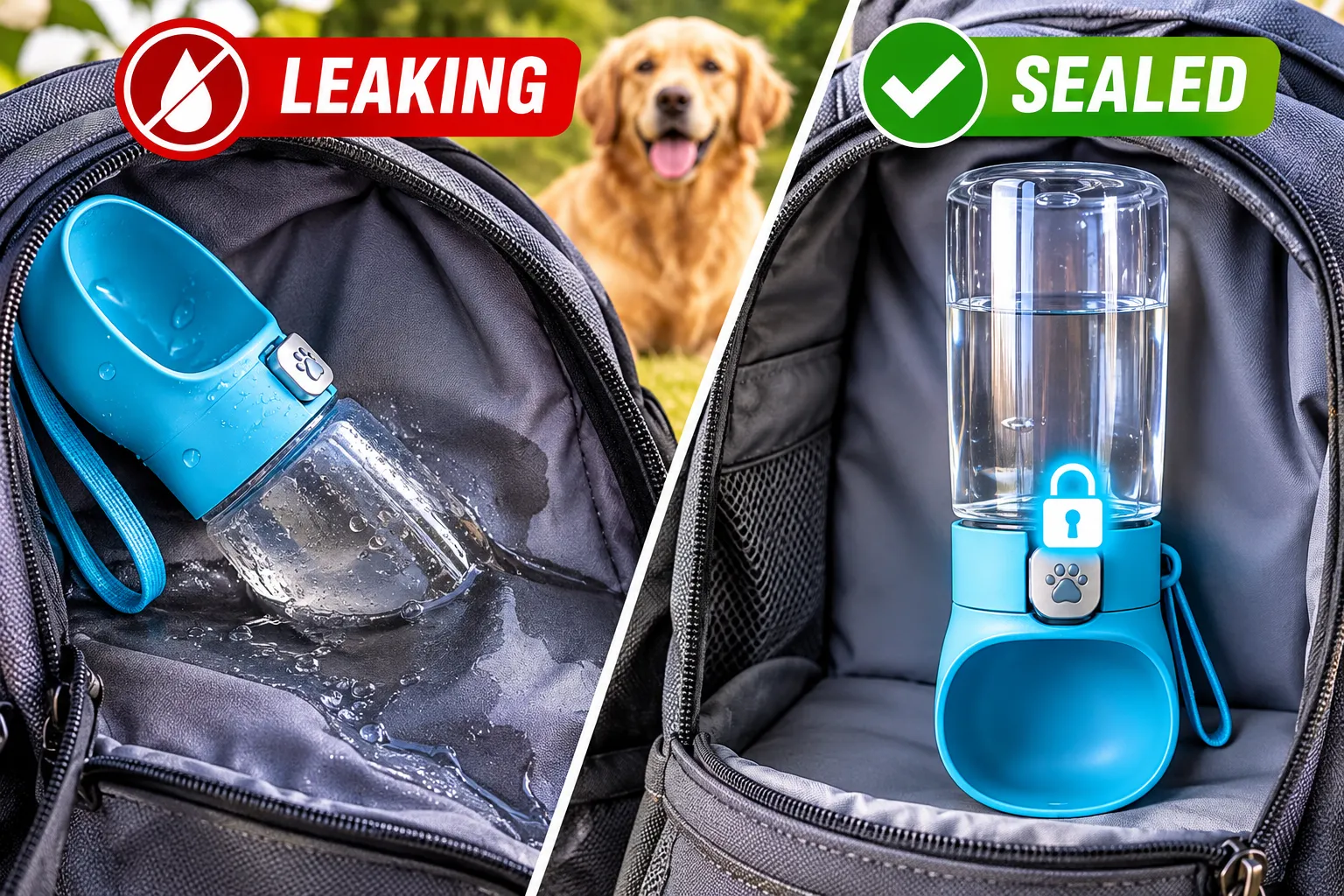
Dog water bottles leak almost always because of the gasket, not the bottle body, and the fix is either tightening the lock fully before every use or replacing a model that relies on a snap-fit lid with no separate seal. A silicone gasket paired with a mechanical lock is the design that held up best in testing covered by Dogster, while bottles marketed as “leakproof” with no named seal component failed more often in home tests.
Common leak causes include a gasket that’s worn thin after repeated washing, a lock lever that wasn’t fully clicked into place, grit or hair caught in the valve seam after a dirt trail, and simply buying a bottle where the trough never fully closes flush against the body. Treeline’s testers left the Springer Flip locked and upside down overnight with no leakage, earning it a 9/10, while the insulated Springland model scored a perfect 10/10 in the same conditions. Those numbers apply to the specific units tested, and some variation between individual bottles of the same model is normal, so testing your own unit at home before a trip is still worth the five minutes it takes.
How to get my dog to use a water bottle
Most dogs learn to drink from a bottle trough within a few short sessions at home, started before any real trip, using a familiar treat-and-praise approach rather than forcing the muzzle down to the water. Dogs who refuse a trough entirely usually do better with a flat collapsible bowl instead, covered in Who Should Skip This Category below.
A simple approach: fill the bottle at home, flip the trough open, and let the dog approach it on its own terms rather than holding the bottle up to the dog’s face. Most dogs investigate a new object by sniffing first; once the dog’s nose finds water in the trough, most will lap at it naturally within a minute or two. Repeat for two or three short sessions before the first real outing. Avoid squeezing water out forcefully while the dog’s head is positioned over the trough, since a sudden spray startles more dogs than it trains.
If a dog still won’t drink after several calm attempts, it’s often a trough shape issue rather than a training issue: flat-faced breeds in particular struggle with narrow channels and do better with a wide, shallow design.
Portable dog water bottle price
Portable dog water bottles for sale on Amazon, Target, and Chewy generally run from about $14.99 for a small 15-oz mini bottle to roughly $30 for an insulated or multi-chamber model with a food container attached. Mid-range options in the 19 to 24 oz range typically land between $15 and $30.
A rough price map based on current listings and the July 2026 Springland Target launch:
- Small bottles (10 to 15 oz): $14.99 to $25
- Mid-size bottles (19 to 24 oz): $15 to $30
- Insulated bottles (24 oz with cold retention): around $25 to $30
- Combo bottles with a separate food chamber: $20 to $30
- Large trail bottles (27 to 44 oz): typically $20 to $35 depending on insulation and material
Paying more doesn’t automatically buy a better seal. The Springland Mini at $14.99 and the pricier insulated Springland bottle share the same locking valve and water return design; the price difference mostly reflects the insulation layer and larger capacity, not seal quality.
Dog water bottle for small dogs
For small dogs, look for a bottle in the 10 to 19 oz range with a narrow-to-medium trough width, since oversized bowls make it harder for a small dog to reach water without tipping its head at an awkward angle. The Kalimdor 19oz and the 10oz Stainless Steel Portable Bottle both fit this profile for dogs roughly under 25 lb on standard walks.
Small dogs also drink less per sitting, so a massive 40-oz reservoir adds unnecessary weight to carry for no real benefit on a 20-minute walk. The exception is a flat-faced small breed like a Pug or French Bulldog, where trough width matters more than overall capacity. A narrow channel that works fine for a Chihuahua or terrier mix can be nearly unusable for a flat-faced dog that can’t dip its muzzle down into a thin groove, so check bowl shape against face shape, not just the dog’s weight.
Does my dog actually need a water bottle?
Not always. A dedicated dog water bottle earns its cost and bulk for car trips, hikes, flights, and anywhere a stationary bowl isn’t practical, but a dog doing only backyard time or five-minute curb walks does not need one at all.
For purely local, short outings, a standard bottle and a collapsible fabric bowl do the same job for less money and less bulk. Save the dedicated hydration gear, with its seal and water-return mechanism, for situations where those features actually get used: a two-hour hike, a cross-country drive, or a flight with a layover. If your dog’s daily routine never leaves a five-block radius, that budget is probably better spent elsewhere, perhaps on the right food for your dog’s size and activity level or on basic training tools that get daily use.
Best dog water bottle for car trips
For car trips, the best dog water bottle is a 15 to 24 oz flip-top model with a water return feature, since car trips involve the bottle sitting upright or rolling around a back seat or cargo area for extended periods between stops rather than constant motion like a hike. The Springland 20-oz Flip, sold nationwide through Target starting July 5, 2026, fits this profile with a BPA-free build and a locking seal designed for exactly this kind of intermittent, stop-and-go use.
A bottle that’s fine on a hike (where it’s constantly moving in a backpack) can still fail in a hot car if the seal weakens under sustained heat and pressure, so it’s worth checking the manufacturer’s temperature guidance before leaving a bottle in direct sun on a dashboard. For road trips longer than a few hours, an insulated option like the Springland insulated 24-oz bottle, which reportedly kept water cold for about 12 hours in testing, keeps water from going warm and unappealing by the third rest stop.
Dog water bottle bacteria and cleaning
The valve is the part of a dog water bottle that traps bacteria, since water sits in that narrow channel after every refill and rarely gets flushed out by casual rinsing. Bottles that cannot be taken apart past the main cap are harder to clean thoroughly and should be rinsed after every single trip, not just every few uses.
Practical cleaning steps:
- Rinse the trough and valve with warm water immediately after each outing, before residue dries.
- Check the manufacturer’s dishwasher guidance; several current models, including the Springland line, list top-rack dishwasher compatibility, but not every plastic bottle on the market does.
- Once a week, or more often in hot weather, use a bottle brush or valve brush to reach into the channel itself rather than just wiping the outer trough.
- Let the bottle air dry fully with the cap or lever open, since trapped moisture in a closed valve is exactly the environment that grows bacteria fastest.
- Replace the gasket if it starts looking worn, cracked, or discolored, since a degraded gasket both leaks and holds onto grime more easily.
A bottle with a simple single-piece bowl design, like the 10oz Stainless Steel Portable Bottle, is generally easier to scrub by hand than a multi-chamber valve system, though it sacrifices the one-handed squeeze mechanism some owners prefer.
Dog water bottle alternatives
The main alternatives to a dedicated dog water bottle are a collapsible fabric bowl paired with a standard human water bottle, a hydration pack with a built-in dog bowl attachment, or simply carrying a lightweight plastic bowl and refilling it from any water source along the way. Each alternative trades convenience for simplicity in a slightly different way.
A collapsible fabric bowl costs very little, folds flat into a pocket, and works for dogs who refuse to drink from a trough no matter how it’s shaped, since it offers a familiar flat surface rather than a shallow channel the dog has to tilt its head into. The downside is that it needs to be held steady while filling and doesn’t travel sealed, so it’s not ideal for a bag that also holds electronics or important documents.
A standard human water bottle without any dog-specific features works fine as a backup water source, refilling a separate bowl rather than pouring directly into a dog’s mouth. For owners who do only occasional short outings, this combination (plain bottle plus collapsible bowl) often makes more sense than buying dedicated hydration gear that mostly sits in a drawer.
Common mistakes with dog water bottles
The most common mistake is matching bottle capacity to price or appearance instead of to the dog’s weight and the trip’s length, which leads to running out of water on a long hike or carrying unnecessary bulk on a short walk. A few other recurring mistakes:
- Trusting the word “leakproof” on a package without checking for a named gasket and lock, since that word has no regulatory definition and means whatever the manufacturer decided it means.
- Buying based on a trough photographed next to a small dog, then discovering it’s too narrow for a Labrador or Shepherd’s longer muzzle.
- Skipping the home test. Locking the bottle and leaving it upside down in a sink for a few hours before a real trip catches most leak problems before they ruin a bag.
- Letting the valve go uncleaned for weeks, which lets bacteria build up in a part of the bottle that’s easy to forget about since it’s hidden inside the cap mechanism.
- Assuming a dog that refuses a shallow trough will eventually adapt; some dogs simply do better with a flat bowl, and forcing the issue on a long trip just means a thirsty, frustrated dog.
Can you bring a dog water bottle on a plane?
Yes, an empty dog water bottle can go through TSA security in a carry-on, since the liquid restrictions apply to full bottles, not empty containers; fill it after clearing security at a water fountain or bottle-filling station. Flying with a full bottle in a carry-on is not allowed under standard U.S. airport liquid rules.
For layovers, a combo bottle with a separate food chamber, like the Dog Water Bottle Portable with Food Container & Filter for Travel, earns its extra bulk here since it combines hydration and a snack in one item, which matters more than it sounds like when you’re already juggling a crate, a leash, and a boarding pass through a connection. Check the locking mechanism tightly before boarding, since cabin pressure changes and rough handling in overhead bins or under-seat storage make a weak seal more likely to fail mid-flight.
How much water should a dog drink daily?
Most healthy dogs need roughly 1 ounce of water per pound of body weight per day as a general guideline, meaning a 40-pound dog needs about 40 ounces (5 cups) daily under normal conditions, increasing with heat, exercise, or a dry kibble diet. This is a widely used estimate rather than a fixed medical rule, and individual dogs vary based on activity level, diet, and health status.
A dog on a long hike or in hot weather will need noticeably more than the baseline estimate, which is part of why the capacity planner above adjusts upward for warm and hot temperature settings. If a dog is drinking far more or far less than this rough guideline consistently, especially alongside changes in appetite or energy, that’s worth mentioning to a veterinarian rather than assuming it’s just a hydration preference.
Capacity, Bowl Width and Seals: What Actually Matters?
These three specs appear on every product page and get explained on almost none of them. Understanding what each one actually controls is the difference between a bottle that works on day one and one that gets returned after a single leaky car ride.
Capacity is the straightforward one. A 10-ounce bottle fits a short walk with a small dog. A 44-ounce reservoir, the largest size in the Springer Flip line, is built for a half-day hike with a dog drinking on the move. The common mistake is matching capacity to the bottle’s price tier instead of to the dog’s weight and the trip length. A 95-pound dog on a 90-minute summer hike needs far more water than a 12-pound dog on a 20-minute neighborhood loop, yet plenty of buyers just grab whatever bottle sits closest to the leash hook at the store.
Bowl width is less obvious and more often ignored entirely. A narrow trough works fine for a dog with a narrow muzzle. It does not work for a Bulldog, a Pug, or a French Bulldog, where a flat face simply cannot reach water pooled in a thin channel. The guidance here is specific: shallow and wide suits small and flat-faced breeds, while large dogs need a broad trough or a leaf-style surface with enough surface area for a big tongue to make real contact. Treeline’s large-dog pick, the PupFlask, uses an integrated leaf bowl for this exact reason, though testers noted some water stayed trapped in it after draining, docking it to a 7.5/10 leak score. Check the trough’s actual dimensions, not just the bottle’s total capacity, before buying for a big dog.
Seals are where most real-world failures happen. A bottle can have a locking lever and still leak if the gasket underneath has worn thin or never fit well in the first place. Treeline’s testers left the Springer Flip locked and upside down overnight with no leakage, earning a 9/10 on leak resistance. The insulated Springland model scored a perfect 10/10 for leaks in the same test, though its bowl runs small for dogs over roughly 65 pounds. The lesson: a seal rating isn’t a universal number, it’s tied to one tester’s one bottle under one set of conditions, and some variation between individual units within the same model line is normal.
Top 5 Features That Decide the Purchase
1. Reservoir capacity matched to trip length. The Springland 20-oz Flip, sold nationwide through Target starting July 5, 2026, sits in the middle of the range and suits a standard 30 to 60 minute walk. For longer outings, the tested Springer Flip line scales up to 44 oz.
2. Trough width relative to muzzle shape. The Kalimdor 19oz bottle uses a narrower integrated trough that suits small and medium dogs reasonably well, but owners of large or broad-muzzled dogs should check bowl dimensions before assuming a fit.
3. Seal type: gasket plus mechanical lock. Products that list only “leakproof” on the box without naming a gasket or lock deserve a home test before a trip.
4. Water return capability. Some bottles let unused water drain back into the reservoir after the dog stops drinking rather than staying trapped in an open bowl, cutting down on both waste and spills. The Springland Flip design includes an automatic return feature.
5. Disassembly for cleaning. A bottle that cannot be taken apart past the main cap traps bacteria in the valve. The 10oz Stainless Steel Portable Bottle’s simpler single-piece bowl design is easier to scrub by hand than multi-chamber valve systems, though it sacrifices the one-handed squeeze mechanism some owners want.
Bottle Capacity and Trough Width Comparison
The table below compares the best dog water bottle options covered in this guide by price band, capacity, and trough or seal notes, so you can match a model to your dog’s size and trip type at a glance.
| Model | Price Band | Capacity | Trough / Seal Notes |
|---|---|---|---|
| Dog Water Bottle Portable with Food Container & Filter for Travel | Around $20 to $30 | Approx. 17oz + separate food chamber | Wide-ish trough, includes filter; check lock tightness before a flight |
| Portable Dog Water Bottle with Bowl, 10oz Leak-Proof Stainless Steel | Around $15 to $25 | 10oz | Small-to-medium trough, stainless build, simple to hand-wash |
| Kalimdor Dog Water Bottle, Leak Proof Portable (19oz) | Around $15 to $22 | 19oz | Narrower trough, single-hand lever, food-grade plastic |
| Springer Flip Dog Travel Bottle (Treeline tested) | Around $20 to $30 | 15 to 44oz range | Leak score 9/10, silicone flip-up bowl, water return |
| Springland 20-oz Flip (Target) | Around $20 to $30 | 20oz | BPA-free, dishwasher top rack, locking seal |
Which Pick Fits Which Dog and Owner?
Matching a dog water bottle to the right dog comes down to weight, muzzle shape, and trip type more than brand reputation or price. The breakdown below gives a starting point for most common situations.
For a Bulldog or French Bulldog riding along on short errands, the 10oz Stainless Steel Portable Bottle makes sense mainly because the owner will refill it often anyway, and stainless steel resists odor better than plastic over repeated short trips. It will not satisfy a Mastiff on a two-hour hike, and nobody should expect it to.
For a medium dog on standard 30 to 60 minute neighborhood walks or short car errands, the Kalimdor 19oz sits at a reasonable middle ground. It is also the budget pick in this lineup, priced lower than most insulated or multi-chamber options while still offering a single-hand lever and a lock, according to the manufacturer listing.
For longer trips, flights with connecting layovers, or dogs that also need a snack mid-walk, the Dog Water Bottle Portable with Food Container & Filter for Travel earns its extra bulk by combining hydration and a food chamber in one carry item, which matters more than it sounds like when already juggling a crate, a leash, and a boarding pass.
Large-breed owners doing real trail mileage should look past this exact trio toward the Springer Flip line tested by Treeline, since its 44-oz option and 9/10 leak rating were built specifically around multi-hour outdoor use.
Things to Watch Out For
The valve is the part nobody cleans. Water sits in that little channel after every refill, and if the bottle cannot be pulled apart past the main cap, bacteria has a permanent address. Rinse thoroughly after every trip, not just every few uses, and check the manufacturer’s dishwasher guidance; several current models, including the Springland line, list top-rack dishwasher compatibility, but not every plastic bottle on the market does.
Marketing language is loose. “Leakproof” is not a certified standard. No major U.S. regulatory requirement specifically governs dog water bottle seals, so that word on a package means whatever the manufacturer decided it means. Treat it as a claim to verify at home, upside down, in a sink, before it goes in a bag with your laptop.
Bowl size claims can also mislead. A bottle photographed next to a Chihuahua looks generous. The same trough held up to a Labrador’s muzzle might barely cover the tongue. Compare the options against your own dog’s actual face width, not the stock photo’s dog.
Who Should Skip This Category
Dogs who flatly refuse to drink from anything but a still bowl on the ground are not going to suddenly change their mind because the bottle has a nicer flip-top. If your dog is a confirmed picky drinker, a collapsible fabric bowl paired with a standard water bottle may solve the problem more reliably than a specialized trough-bottle hybrid, since the dog gets a familiar flat surface instead of a shallow trough it has to tilt its head into.
Owners doing only backyard time or five-minute curb walks do not need a dedicated travel bottle at all. A regular water bottle and a collapsible bowl cost less and do the same job for that use case. Save the dedicated hydration gear for actual car trips, hikes, and flights, where the seal and the return mechanism earn their keep.
Dogs with megaesophagus or other swallowing conditions that require a specific feeding and drinking posture should stick with whatever bowl setup a veterinarian has already recommended rather than switching to a trough-style bottle without checking first, since posture during drinking can matter more for these dogs than convenience. If you’re still working out which breed or dog fits your household’s activity level in the first place, a broader resource like this guide to choosing the best dog breed for your lifestyle is worth reading before gear shopping starts.
FAQ
What is the best dog water bottle for everyday walks? For a standard 30 to 60 minute walk, a 15 to 20 oz flip-top bottle with a locking seal, like the Springland 20-oz Flip or the Kalimdor 19oz, covers most medium-sized dogs without adding unnecessary bulk.
How do I know if a dog water bottle will leak? Lock the bottle, fill it, and leave it upside down in a sink or on a towel for a few hours before relying on it for a real trip. If it stays dry, the gasket and lock are doing their job; if it drips, return it or replace the gasket.
Can small dogs use the same bottles as large dogs? Technically yes, but a trough sized for a Labrador often makes a small dog tilt its head at an awkward angle to reach the water. Smaller dogs generally do better with a 10 to 19 oz bottle that has a narrower, shallower trough.
Do flat-faced dogs need a special bottle? Yes. Bulldogs, Pugs, and French Bulldogs need a wide, shallow trough rather than a narrow channel, since their flat muzzles can’t dip down into a thin groove the way a longer-nosed dog can.
How often should a dog water bottle be cleaned? Rinse the trough and valve after every outing, and do a deeper clean with a bottle brush at least once a week, more often in hot weather, since residual water in the valve channel is where bacteria builds up fastest.
Is an insulated dog water bottle worth the extra cost? For hot-weather hikes or long car trips, yes. An insulated model, like the Springland 24-oz bottle that reportedly kept water cold for about 12 hours in testing, keeps water appealing far longer than an uninsulated bottle sitting in a hot trunk.
What’s the difference between a dog water bottle and a travel bowl? A dog water bottle combines the reservoir and the drinking surface into one sealed unit, while a travel bowl is just a container that needs to be filled separately from a bottle or tap. Bottles are more spill-resistant in transit; bowls are easier to clean and more familiar to picky drinkers.
Can I bring a dog water bottle through airport security? An empty bottle can go through security in a carry-on; fill it at a water fountain after clearing the checkpoint, since full containers are subject to standard liquid restrictions.
How much should I expect to pay for a good dog water bottle? Most reliable options run from about $15 for a small 10 to 15 oz bottle up to around $30 for an insulated or combo bottle with a food container, based on current Amazon, Target, and Chewy listings.
My dog won’t drink from the trough. What should I try? Practice at home before any trip, letting the dog approach the open trough on its own rather than forcing its muzzle toward the water. If several calm attempts don’t work, switch to a collapsible fabric bowl instead, since some dogs simply prefer a flat surface over a shallow channel.