
This post contains affiliate links. If you buy through one we may earn a commission at no extra cost to you. As an Amazon Associate I earn from qualifying purchases.
Benebone vs nylabone: Quick Answer
In the benebone vs nylabone comparison, the biggest difference is shape, not material. Benebone’s Wishbone has two curved arms designed to be pinned under a paw while a dog chews the free end at an angle. Nylabone’s Power Chew Original Bone is a straight shape with knobbed ends built for side-to-side gnawing. Both are hard nylon, both are non-edible, and both manufacturers now publish clear rules for when to throw the toy away: cracks, flattened ends, or any piece small enough to swallow Benebone’s safety guide and Nylabone’s guidelines for use.
Key Takeaways
- The Wishbone’s curved, two-arm shape is built to be pinned under a paw while a dog chews the other end, according to Benebone’s own safety page.
- Nylabone sizes its Power Chew line by dog weight, with bands that scale up to around 15, 25, 35, and 50 pounds, making size selection less of a guessing game.
- Benebone tells owners to discard the toy the moment cracks, sharp edges, or heavy wear show up, per its when to replace guide.
- Nylabone’s FAQ page states plainly that no chew toy is completely risk-free and recommends ongoing supervision and inspection, not a one-time check.
- VCA Animal Hospitals lists hard nylon chews among the common causes of tooth fractures in dogs, alongside bones, antlers, and hooves.
- Veterinary dentistry guidance commonly cites a thumbnail test: if a thumbnail cannot dent the surface of a chew, it may be too hard for a dog’s teeth.
- In hands-on testing with 25 dogs, The Spruce Pets found the Nylabone Power Chew held up best for a destructive pit bull, while the lighter Wishbone suited smaller dogs.
- Nylabone also makes an Ergonomic Hold & Chew Wishbone, which narrows the shape gap between the two brands.
- Neither chew is meant to be swallowed. Both brands state their products are for chewing, not eating.
Benebone vs Nylabone: What’s the Main Difference
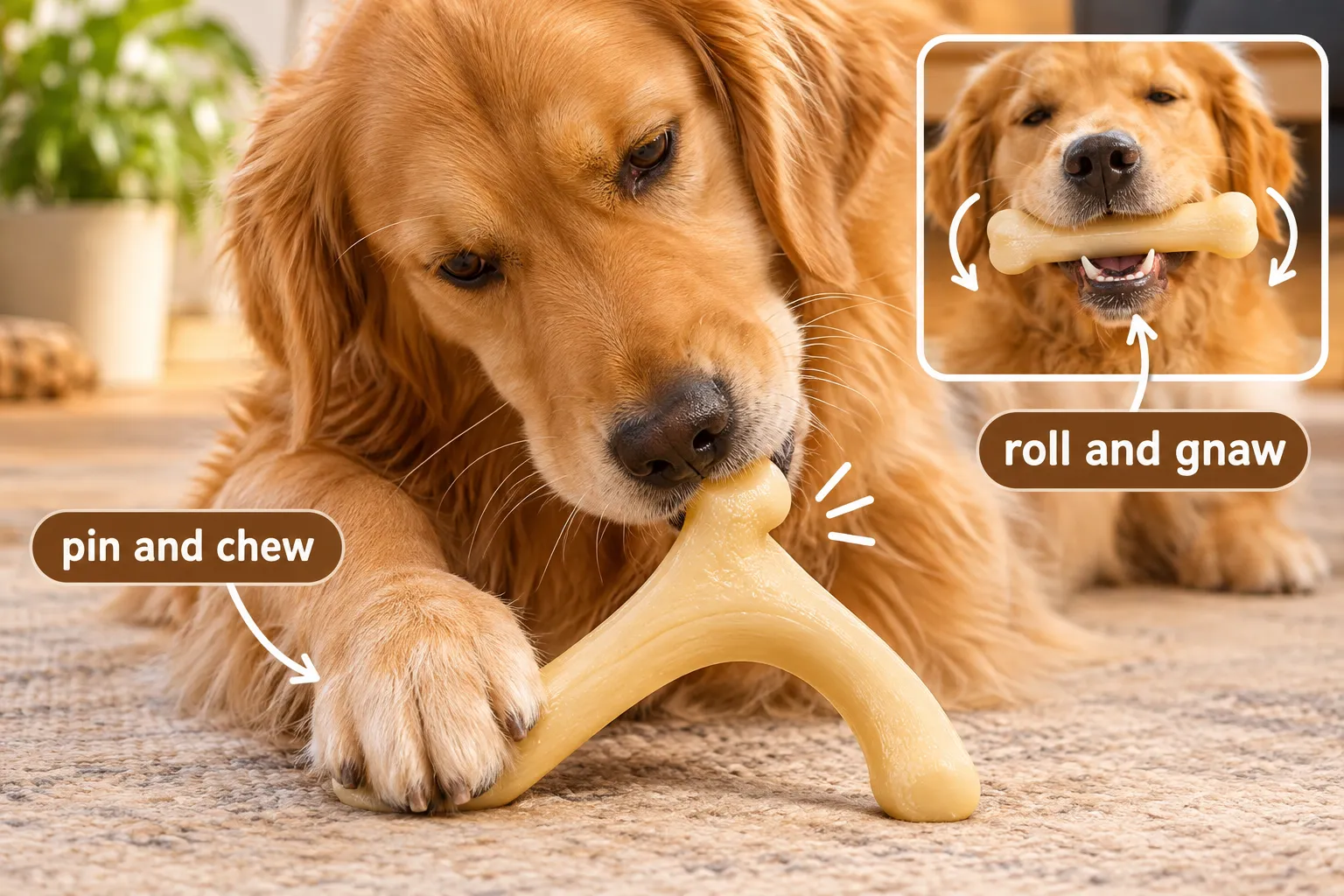
The core difference in benebone vs nylabone is shape philosophy, not just the nylon material underneath it. Benebone built the Wishbone around two curved, asymmetrical arms so a dog can hold the toy steady with a paw and chew the free end at an angle, almost like gripping a handle. Nylabone’s classic Power Chew Original Bone takes the opposite approach: a straight shaft with knobbed ends that encourages a dog to gnaw along the sides rather than bite straight down on one point.
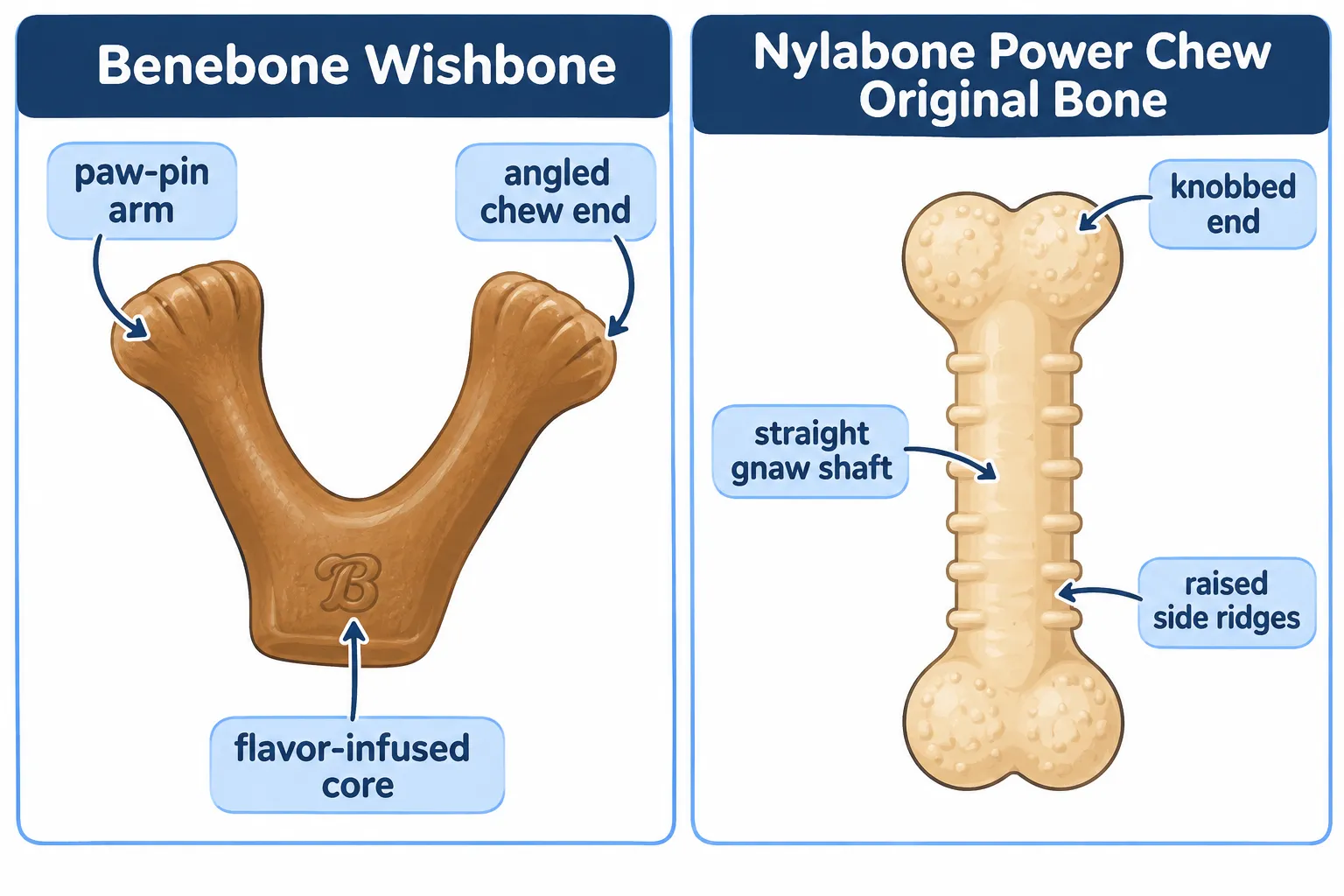
Both products are made of hard nylon. Both are marketed as long-lasting rather than edible. Both come from brands that have been in the chew toy business for decades, Nylabone since the 1950s and Benebone as a newer entrant focused on flavor-infused nylon. The shape is where the actual chewing experience splits.
- Benebone Wishbone: curved, two-arm design, meant to be pinned under a paw while the dog works the opposite end.
- Nylabone Power Chew Original Bone: straight bone shape with raised nubs along the length, built for side gnawing. See Nylabone’s product page for current sizing.
- Nylabone Ergonomic Hold & Chew Wishbone: Nylabone’s own curved-shape answer to the Wishbone, which means the shape gap between the two brands is smaller than most comparisons suggest.
Decision rule: if your dog likes to anchor a toy with a paw and work one end at an angle, the Wishbone shape usually wins out. If your dog prefers rolling a toy around its mouth and gnawing from multiple angles, a straight Power Chew bone or Nylabone’s own hold-and-chew wishbone will both work fine. A common mistake is assuming shape preference carries across all dogs of a breed. Two Labradors in the same household can have completely different chewing styles, so watch your specific dog for a session or two before committing to a multi-pack.
What’s the Difference Between Benebone and Nylabone
Beyond shape, the brands differ in flavor strategy, sizing systems, and how they talk about safety. Benebone infuses flavor (like bacon, chicken, or peanut) through the entire nylon body rather than coating the surface, which means the scent and taste persist even as the toy wears down. Nylabone relies more heavily on surface flavoring and texture variety across its product lines, with the Power Chew series focused on hardness and shape rather than flavor saturation.
Sizing also differs in presentation. Nylabone publishes explicit weight bands (roughly up to 15, 25, 35, and 50 pounds across various Power Chew models), which takes some of the guesswork out of picking a size. Benebone sizes its Wishbone as small, medium, large, and giant, with sizing guidance tied more to jaw size and chew aggressiveness than a strict weight chart alone.
- Choose Nylabone if you want a straightforward weight-to-size match and don’t mind a more generic flavor approach.
- Choose Benebone if flavor retention over the life of the toy matters more to your dog’s interest level.
Which Is Better for Aggressive Chewers, Benebone or Nylabone
For aggressive chewers, Nylabone’s Power Chew Original Bone tends to hold up slightly better in real-world testing, largely because of its straight shape and reinforced knobbed ends, but neither chew is truly indestructible. In hands-on testing with 25 dogs, The Spruce Pets found the Power Chew survived longest with a destructive pit bull, while the Wishbone performed better with smaller, less forceful chewers.
That said, “aggressive chewer” covers a wide range of behavior, and the right pick depends on exactly how your dog destroys toys:
- Dogs that gnaw steadily for long sessions: both products can last weeks to months, depending on jaw strength.
- Dogs that crack off large chunks quickly: this is the pattern most likely to lead to a swallowed piece or a cracked tooth, regardless of brand. If your dog does this with either toy, stop offering it and talk to your vet about alternatives.
- Dogs that lose interest fast: a lighter Wishbone might get more actual use even if it wears less dramatically than a Power Chew under a determined chewer.
Edge case: some owners report their dog treats both products the same way regardless of shape, in which case material hardness and size matter more than brand. A chew that’s too small for an aggressive chewer’s jaw strength will get cracked and swallowed faster than a properly sized one, no matter which brand made it.
Are Benebones Safe for Dogs
Benebones are reasonably safe for most moderate chewers when sized correctly and inspected regularly, but they are not risk-free, and the company says so directly on its own nylon safety page. Like any hard nylon chew, a Wishbone can contribute to a chipped or fractured tooth in a dog that bites down hard rather than gnaws, and a cracked piece can become a choking hazard if swallowed.
Safety depends heavily on matching the toy to the dog:
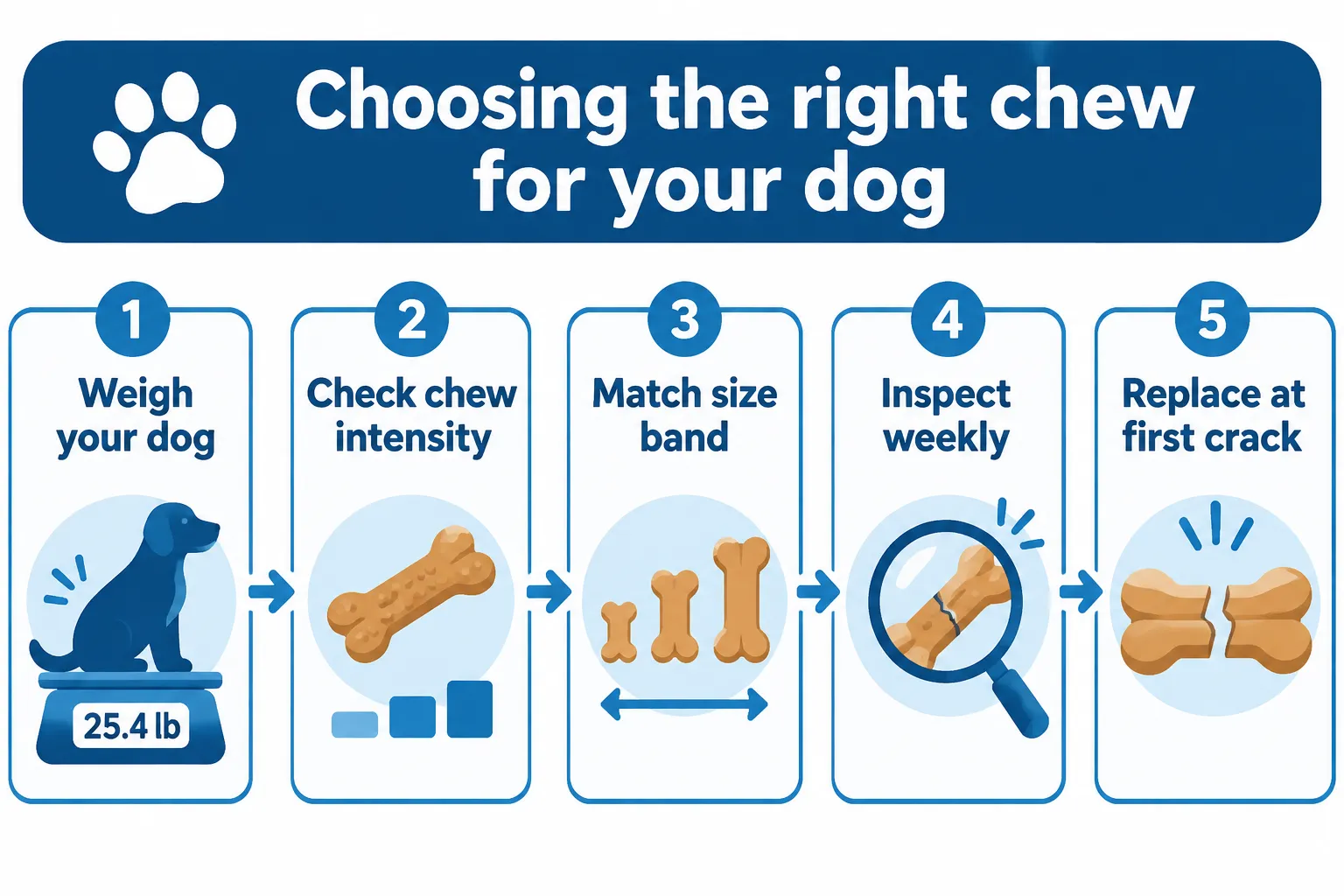
- Pick a size where your dog cannot fit the entire toy in its mouth.
- Inspect weekly for moderate chewers, more often for aggressive ones.
- Stop use immediately if you see a crack, a chip, or flattened ends.
- Supervise the first several sessions with any new size, since that’s when you’ll learn how your specific dog handles it.
VCA Animal Hospitals lists hard nylon chews among the common causes of tooth fractures in dogs, alongside bones, antlers, and ice cubes. That doesn’t mean every dog that chews a Benebone will fracture a tooth. It means dogs with a hard-biting style, prior dental work, or known fracture history are at higher risk and should be evaluated by a vet before offering any hard nylon chew.
How Long Does a Benebone Last
A Benebone Wishbone typically lasts anywhere from a few weeks to several months, depending on the dog’s size, chew intensity, and how often it’s offered rather than left out constantly. There’s no fixed lifespan because wear depends entirely on use pattern.
Rough patterns owners report:
- Light chewers: can keep the same Wishbone intact for months with occasional sessions.
- Moderate chewers: usually wear through knobs and edges within four to eight weeks of regular daily chewing.
- Aggressive chewers: may crack or chip a Wishbone within days to a couple of weeks, especially in smaller size bands that don’t match the dog’s jaw strength.
The lifespan question matters less than the inspection habit. Benebone’s guidance is to replace the toy the moment it shows cracks or chips rather than trying to get a fixed number of weeks out of it. A toy that looks intact after two months of light use is fine to keep. A toy that cracks after three days under an aggressive chewer needs to go immediately, regardless of how “new” it still looks overall.
Benebone vs Nylabone Price Comparison
In a straight benebone vs nylabone price comparison, Nylabone’s Power Chew Original Bone usually costs less per unit than the flavor-infused Wishbone, making it the more budget-friendly entry point for testing whether a dog even likes hard nylon chews.
| Model | Shape | Price band | Discard signal |
|---|---|---|---|
| Benebone Wishbone, bacon, medium | Curved, two-arm | around $15 to $20 | Cracks, chips, or a broken piece small enough to swallow |
| Nylabone Power Chew Original Bone, medium | Straight, knobbed ends | around $10 to $18 | Cracked, flattened, or small enough to choke on |
| Nylabone Ergonomic Hold & Chew Wishbone, Power Chew | Curved, hold-and-chew | around $12 to $20 | Same wear rules as other Power Chew models |
Price alone shouldn’t drive the decision. A cheaper toy your dog ignores or destroys in a day costs more per week of actual use than a pricier one that lasts a month. If you’re testing hard nylon chews for the first time, start with the smaller or cheaper option in your size band before committing to multiple toys or a bundle.
Discard Photo Checklist
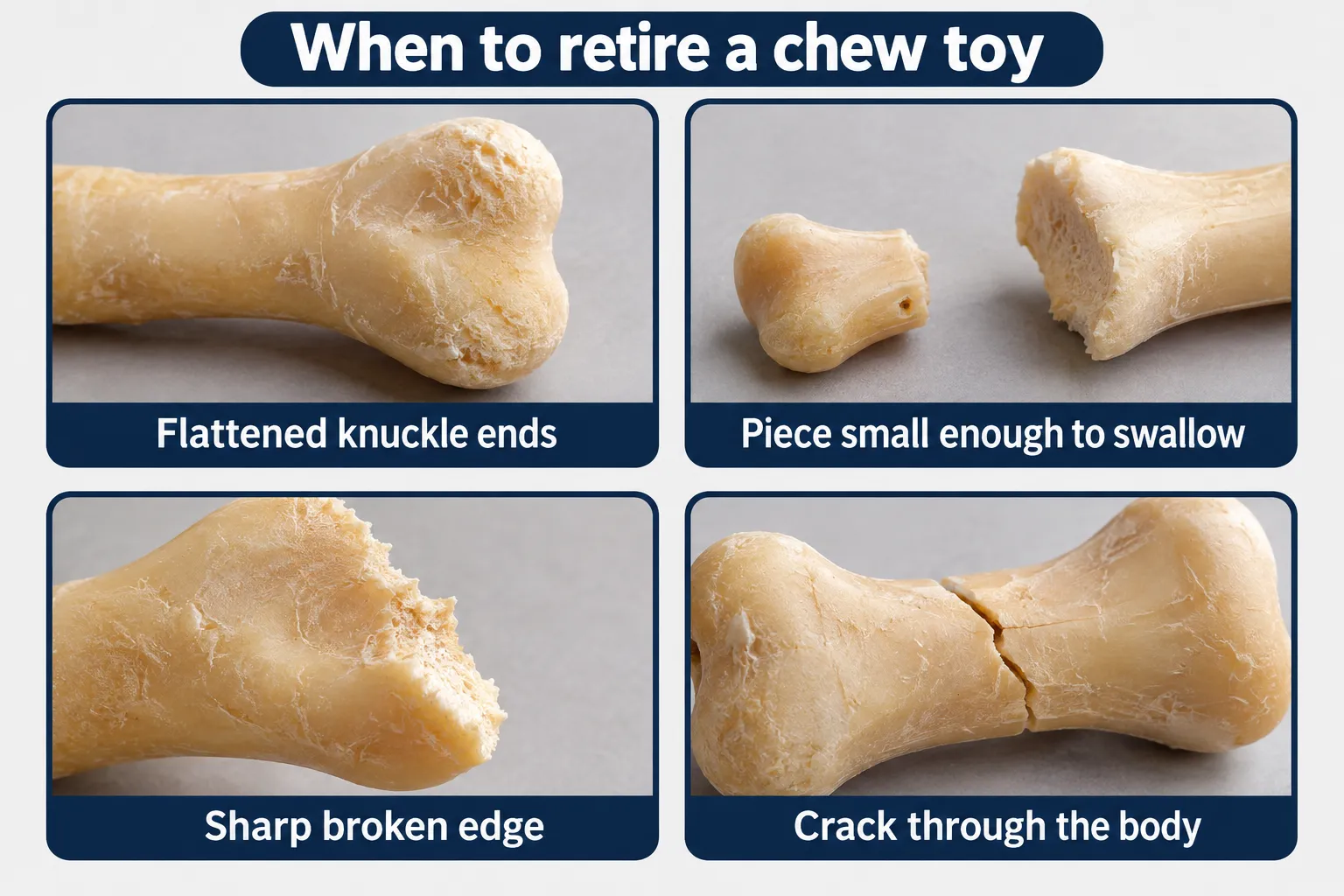
Here’s the comparison owners actually search for: exact models, price bands, and the specific signs each manufacturer says mean it’s time to toss the toy. Benebone’s safety page says to replace the Wishbone once it shows cracks, chips, or a piece small enough for a dog to swallow. Nylabone’s FAQ says to retire a Power Chew once it’s cracked, significantly worn down, or reduced to a size the dog could choke on.
Discard checklist, in plain terms:
- Knuckle ends flattened or worn smooth instead of rounded.
- Any piece that could fit entirely inside your dog’s mouth.
- Sharp edges where a chunk has broken off.
- Visible cracks running through the body of the toy, even if nothing has come loose yet.
A common mistake is waiting until a piece actually breaks off before throwing the toy away. By the time a crack is visible, the structural weak point already exists, and the next hard bite can finish the job while your dog is unsupervised.
Can Puppies Chew Benebone
Puppies under roughly 8 weeks old, with baby teeth still coming in, generally should not chew full-hardness Wishbone or Power Chew products. Both lines are built for adult jaw strength and permanent teeth, and using them too early can damage developing teeth or simply fail to interest a puppy whose jaw isn’t strong enough to engage with a hard nylon chew anyway.
Once a puppy has its adult teeth (usually by 6 to 7 months), a properly sized Wishbone or Power Chew becomes more appropriate, with supervision. Before that point:
- Look for puppy-specific, softer chew lines from either brand.
- Avoid letting a teething puppy gnaw on adult-hardness nylon, since teething gums are sensitive and a too-hard chew can cause more discomfort than relief.
- Check your puppy’s teeth periodically for wear or damage if you do introduce any hard chew early, and talk to your vet if anything looks off.
For broader guidance on raising a puppy through this stage, see our rundown of essential commands every puppy should learn, which covers related developmental milestones.
What Size Benebone Should I Get for My Dog
Benebone sizes the Wishbone as small, medium, large, and giant, and the right pick depends more on jaw width and chew force than weight alone. As a general guide:
- Small: toy breeds and light chewers under about 15 pounds.
- Medium: dogs in the 15 to 35 pound range with moderate chew habits.
- Large: dogs 35 to 50 pounds, or smaller dogs that chew aggressively.
- Giant: dogs over 50 pounds or any heavy, committed chewer regardless of weight.
The decision rule that matters most: size up if your dog is an aggressive chewer, even if its weight technically falls in a smaller band. A 30-pound dog that bites down hard and fast needs a size meant for a 50-pound dog more than it needs the size matched strictly to its weight. If you’re unsure, the smaller size risk is a toy getting destroyed and swallowed in pieces, while the larger size risk is mild disinterest, so err toward the bigger option when in doubt.
Is Benebone Digestible If Swallowed
No. Benebone’s Wishbone is not digestible, and the company states its products are meant to be chewed, not eaten. Nylabone makes the same statement about its Power Chew line: not intended to be ingested.
If a dog swallows a piece of either product:
- A small sliver may pass on its own, but watch closely for vomiting, straining, lack of appetite, or lethargy over the next 24 to 72 hours.
- A larger piece, especially anything wider than roughly an inch across in a small or medium dog, carries real blockage risk and needs a same-day vet call, not a wait-and-see approach.
- Never try to induce vomiting at home without a vet’s direction, since a hard nylon piece coming back up can cause additional injury on the way.
This is the single biggest reason both brands push supervision and regular inspection rather than treating these chews as something you can leave with a dog unattended for hours.
Why Won’t My Dog Chew Their Benebone
A dog ignoring a new Benebone usually comes down to one of a few things: wrong flavor match, wrong size, wrong texture preference, or simple unfamiliarity with a new object. This is common enough that it’s worth troubleshooting before assuming the toy itself is defective.
- Flavor mismatch: not every dog responds to every flavor. If bacon doesn’t get attention, try chicken or peanut before giving up on the brand.
- Size too large or too small: a toy that’s awkward to hold in the mouth, either too big to grip or too small to feel substantial, often gets abandoned.
- Texture preference: some dogs strongly prefer softer rubber chews or rope toys over rigid nylon, regardless of flavor.
- Introduction method: rubbing a small amount of wet food or broth on a new chew can help a hesitant dog associate it with something worth investigating.
If a dog consistently avoids hard nylon chews of any brand after a few honest attempts, that’s a reasonable signal to stop pushing nylon and look at calming products or softer enrichment chews instead, rather than assuming something is wrong with the dog.
Can Dogs Get Blockage From Benebone
Yes, a dog can develop an intestinal blockage if it swallows a large enough piece of a Benebone or any hard nylon chew, and this is one of the primary risks both brands warn about in their safety materials. Blockage risk rises sharply with piece size relative to the dog’s size, so a chunk that would pass harmlessly through a large dog can lodge in a small dog’s intestine.
Warning signs of a possible blockage after a dog has chewed off and swallowed a piece include:
- Repeated vomiting, especially if it continues past a single episode.
- Loss of appetite lasting more than a day.
- Visible abdominal discomfort, bloating, or a hunched posture.
- Straining to defecate or no bowel movement for an unusually long stretch.
Any of these signs after a known or suspected swallowed piece warrants a same-day vet visit rather than waiting to see if it resolves. For background on a related emergency, see this overview of bloat symptoms in dogs, which shares some overlapping warning signs with intestinal blockage even though the conditions are different.
Best Dog Chew Alternatives to Benebone
Owners whose dogs don’t take to hard nylon, or whose dogs have dental risk factors, have several reasonable alternatives that don’t involve the same fracture risk profile.
- Rubber chews (like Kong-style toys): softer than nylon, often hollow and stuffable, lower fracture risk for most dogs.
- Dental chews formulated for cleaning: softer, consumable, better suited to dogs that shouldn’t gnaw hard material at all.
- Rope and fabric tug toys: good for dogs that prefer texture and pulling over gnawing.
- Frozen food-based chews: safe, edible, and self-limiting since they disappear with use rather than cracking.
For dogs with known dental issues, it’s worth reading up on anesthesia-free dog teeth cleaning and general guidance on whether you need to brush your dog’s teeth, since dental health context matters when choosing any chew product. Our Doggy IQ Gear Lab category also covers softer rotating chew options outside the hard-nylon category entirely.
Do Benebones Cause Dental Problems
Benebones themselves don’t inherently cause dental problems, but like any hard chew, they can contribute to tooth fractures in dogs that bite down forcefully rather than gnaw. This isn’t unique to Benebone. VCA Animal Hospitals names hard nylon chews specifically, alongside bones, antlers, and hooves, as common contributors to fractured teeth in dogs, and the same risk applies to Nylabone’s Power Chew line and most hard chew products on the market.
The practical screening tool vets commonly reference is the thumbnail test: press a thumbnail firmly into the surface of the chew, and if it leaves no indentation at all, the material may be too hard for a dog’s teeth, particularly a dog with any existing dental sensitivity. Dogs with a history of fractured teeth, root canals, crowns, or periodontal disease are better off avoiding hard nylon chews of any brand rather than testing one to see what happens.
Benebone Flavors: Which One Do Dogs Like Best
There’s no single flavor that works best across all dogs, since individual preference varies, but bacon and peanut tend to get mentioned most often in owner feedback as strong first choices for food-motivated dogs. Benebone’s flavor-infused nylon means the taste runs through the material rather than sitting only on the surface, which is part of why interest can persist even as the toy wears down.
Practical approach for picking a flavor:
- Start with whatever treat or protein your dog already shows strong enthusiasm for during meals.
- If bacon doesn’t generate interest within the first couple of sessions, try chicken or peanut before concluding the dog dislikes hard chews altogether.
- Rotate flavors across multiple toys in multi-dog households rather than assuming one flavor fits every dog in the house.
Is Nylabone Better Than Benebone for Small Dogs
For most small dogs under about 15 pounds, either brand can work, but the lighter weight and smaller curved shape of the Benebone Wishbone often suits toy and small breeds slightly better for easy holding and carrying, while Nylabone’s clear weight-based sizing makes it simple to find a correctly scaled option as well.
- Choose Benebone small Wishbone if: your dog likes to carry toys around, pin them with a paw, and chew at an angle.
- Choose Nylabone small Power Chew if: your dog prefers gnawing along the sides of a toy or you want a slightly lower price point to start.
Small dogs carry a proportionally higher blockage risk from swallowed pieces than large dogs, since their intestinal diameter is smaller. That makes size matching and inspection frequency even more important for small-breed owners than the brand choice itself.
Who Should Skip Either Model
Dogs with a history of fractured teeth, periodontal disease, or jaw pain should probably skip both hard nylon chews entirely. VCA Animal Hospitals names hard nylon chews specifically, alongside bones, antlers, and hooves, as common causes of tooth fractures, and that risk applies across brands, not to one product line over another.
Puppies under roughly 8 weeks with baby teeth still coming in also don’t need full-hardness Power Chew or Wishbone products yet. Softer puppy-specific lines fit that developmental stage better.
Also consider skipping both if:
- Your dog is a known “chip and swallow” chewer rather than a gnawer.
- Your dog has had a root canal, crown, or prior tooth fracture.
- You can’t supervise chew sessions regularly, since both brands require inspection, not just purchase.
Top 5 Features That Decide the Purchase
1. Shape and grip. The Wishbone’s curve lets a dog pin one arm with a paw, a feature Benebone built the entire product around. The Power Chew Original Bone relies on a straight shape with side ridges instead, encouraging a different chewing motion entirely.
2. Weight-based sizing. Nylabone publishes clear weight bands, scaling up to around 15, 25, 35, and 50 pounds across various Power Chew models, which makes size selection less a matter of guesswork than eyeballing a bone in a store aisle.
3. Flavor infusion. Benebone’s Wishbone is flavor-infused through the material itself, not coated on the surface, which is part of why dogs keep returning to it even after the outer layer has worn down.
4. Manufacturer discard guidance. Both brands now publish explicit replace-it rules rather than claiming indestructibility, a shift worth noting for safety-minded owners comparing benebone vs nylabone on safety grounds specifically.
5. Bundle and variety options. Nylabone sells multi-chew bundles like the Power Chew Toy Souper Bundle, which suits households rotating several chewers or several dogs across different size needs.
Which Pick Fits Which Dog and Owner
The right answer in benebone vs nylabone depends on your dog’s chew style, size, and your living situation more than brand loyalty alone.
- Paw-pinning chewers, apartment dogs: the Benebone Wishbone, bacon, medium suits dogs that like to anchor a toy and work it from one side, and its curved shape keeps it from rolling under the couch quite as easily.
- Side-gnawing, destructive chewers: the Nylabone Power Chew Original Bone, medium held up well in hands-on testing with a destructive pit bull, making it a reasonable pick for heavier, more committed chewers.
- Budget pick: a single Nylabone Power Chew Original Bone typically runs cheaper per toy than the flavor-infused Wishbone, so it’s the lower-cost entry point if you’re testing whether your dog even likes hard nylon chews before buying more.
- Multi-dog households: Nylabone’s bundle option spreads cost across several chews rather than buying singles repeatedly.
Check current availability for the best-fit model before assuming your local pet store carries the exact size band your dog needs.
Things to Watch Out For
Hard nylon chews are durable, and durability is exactly the problem veterinary dentistry sources flag. The same resistance that makes a toy survive months of gnawing is what can crack a tooth before the toy itself gives way. VCA’s list of common fracture causes and general veterinary dental guidance both point to this tradeoff directly.
- Supervise chew sessions, especially the first few with a new size or model.
- Reassess size as your dog gains weight or gets more aggressive about chewing.
- Don’t assume flavor-infused means softer. Flavor and hardness are separate design choices.
- Watch for a dog cracking off large chunks quickly, which is a signal to size up or switch products entirely, not push through.
- A 2026 recall review found no current recall specific to Wishbone or Power Chew tied to fracture or obstruction concerns, though regional or retailer-specific pulls aren’t always captured in national databases, so periodic checking is still worthwhile.
Who Should Skip This
Owners who want a toy that disappears completely, like a digestible treat, should skip both. Neither the Wishbone nor the Power Chew Original Bone is meant to be eaten, and Nylabone explicitly states its Power Chew products are not intended to be ingested.
Skip both if:
- Your dog has swallowed large pieces of hard chews before.
- Your vet has already flagged dental sensitivity or a slab fracture history.
- You want an enrichment chew without any hard-nylon component at all. In that case, look at rubber or softer rotating options in our Doggy IQ Gear Lab coverage instead.
Doggy Rank IQ Tool
Benebone vs Nylabone Size and Retire Checker

Both are hard nylon. Weight and chew intensity pick the size. Then get the plain rule for retiring it.
FAQ
How do the Wishbone and Power Chew Original Bone differ for a similar-size dog? The Wishbone’s curved arms let a dog pin one side with a paw while chewing the other, while the straight Power Chew Original Bone encourages side-to-side gnawing instead. For a similarly sized dog, the actual chewing motion, not the hardness, is the main practical difference.
When should you throw away a Benebone? Benebone’s own safety guidance says to replace the Wishbone once it shows cracks, chips, or a piece small enough to swallow. Don’t wait for a visible chunk to break off; a crack alone is enough reason to retire it.
Is Nylabone safe for puppies to chew on? Nylabone makes puppy-specific, softer lines for young teeth, and the full-hardness Power Chew line is meant for adult dogs with permanent teeth. Nylabone’s FAQ recommends supervision at any age, puppy or adult.
Is Benebone a nylon bone? Yes, Benebone’s Wishbone is made of durable nylon infused with flavor, and it’s designed to be chewed, not eaten.
Can Benebones crack dog teeth? Any hard nylon chew, Benebone included, can contribute to tooth fractures in dogs that bite down hard rather than gnaw. Veterinary dental guidance recommends the thumbnail hardness test before giving any hard chew to a dog with known dental sensitivity.
What is safe for an 8 week old puppy to chew on? At 8 weeks, puppies are usually better suited to soft, puppy-specific chews rather than full-hardness Power Chew or standard Wishbone products, since baby teeth are still coming in and the jaw isn’t ready for high-resistance chewing.
Benebone vs Nylabone for aggressive chewers: which lasts longer? In hands-on testing with 25 dogs, the Nylabone Power Chew held up best for a destructive pit bull, while the lighter Wishbone suited smaller, less forceful chewers better. Neither is truly indestructible against a dog that chips off large chunks quickly.
Can a dog swallow a whole Benebone piece without harm? Small slivers sometimes pass without issue, but any piece wider than roughly an inch in a small or medium dog carries real blockage risk. Watch for vomiting, appetite loss, or straining and call a vet the same day if these appear.
What’s the difference between Benebone vs nylabone in terms of price? Nylabone’s Power Chew Original Bone generally costs a bit less per unit than the flavor-infused Benebone Wishbone, making it a reasonable starting point if you’re unsure whether your dog will take to hard nylon chews at all.
Do I need to supervise my dog with either chew? Yes. Both Benebone vs nylabone recommend active supervision and regular inspection rather than leaving a dog alone with a hard nylon chew for extended periods.
Is one brand better for small dogs specifically? Either brand works for small dogs if sized correctly, though the Wishbone’s lighter curved shape is often easier for toy and small breeds to carry and grip, while Nylabone’s clear weight bands make size selection simple too.