
Quick Answer
Seven. That is how many dogs, out of hundreds observed over several months by Federico Rossano’s team at UC San Diego, reliably used buttons to request the things researchers expected, according to his September 2026 PBS interview. So dog talking buttons can work as a trained request signal, and peer-reviewed work from 2024 found trained dogs respond correctly to recorded words like “play” and “outside.” What the evidence supports is learned association between a sound and an outcome. Not grammar, not conversation, and not a window into a dog’s private thoughts.
Key Takeaways: Dog Talking Buttons
- Dog talking buttons are recordable sound buttons, usually mounted on tiles or a mat, that play one human word when a dog steps on them.
- A 2024 study from the UC San Diego Comparative Cognition Lab found soundboard-trained dogs responded appropriately to “play” and “outside” whether a person said the word or a button produced it, including when a stranger pressed it, as summarized by the American Kennel Club’s review of soundboard-trained dogs.
- Rossano has described the findings as “a far cry” from human-like language, and researchers still separate comprehension of a word from production of language.
- An August 2026 methodological paper in Frontiers in Animal Science proposes a six-category coding system for presses and states plainly that it does not prove semantic communication.
- Individual variation is the headline, not the exception. Some dogs engage immediately, many press randomly, and some ignore the board entirely.
- Start with one word tied to an immediate, visible outcome. “Outside” beats “love you” by a mile.
- Expect weeks of modeling before anything looks intentional, and keep a press log so you are not grading yourself from memory.
- Buttons are sold as enrichment and training gear, not as validated communication or medical devices. No button press replaces a vet visit.
What are dog talking buttons and how do they work?
Dog talking buttons are plastic buttons with a built-in speaker and a record function. You press record, say a word, and the button plays that word back whenever enough weight lands on it. Mount several on foam tiles or a mat, and you have what owners and researchers call a soundboard.
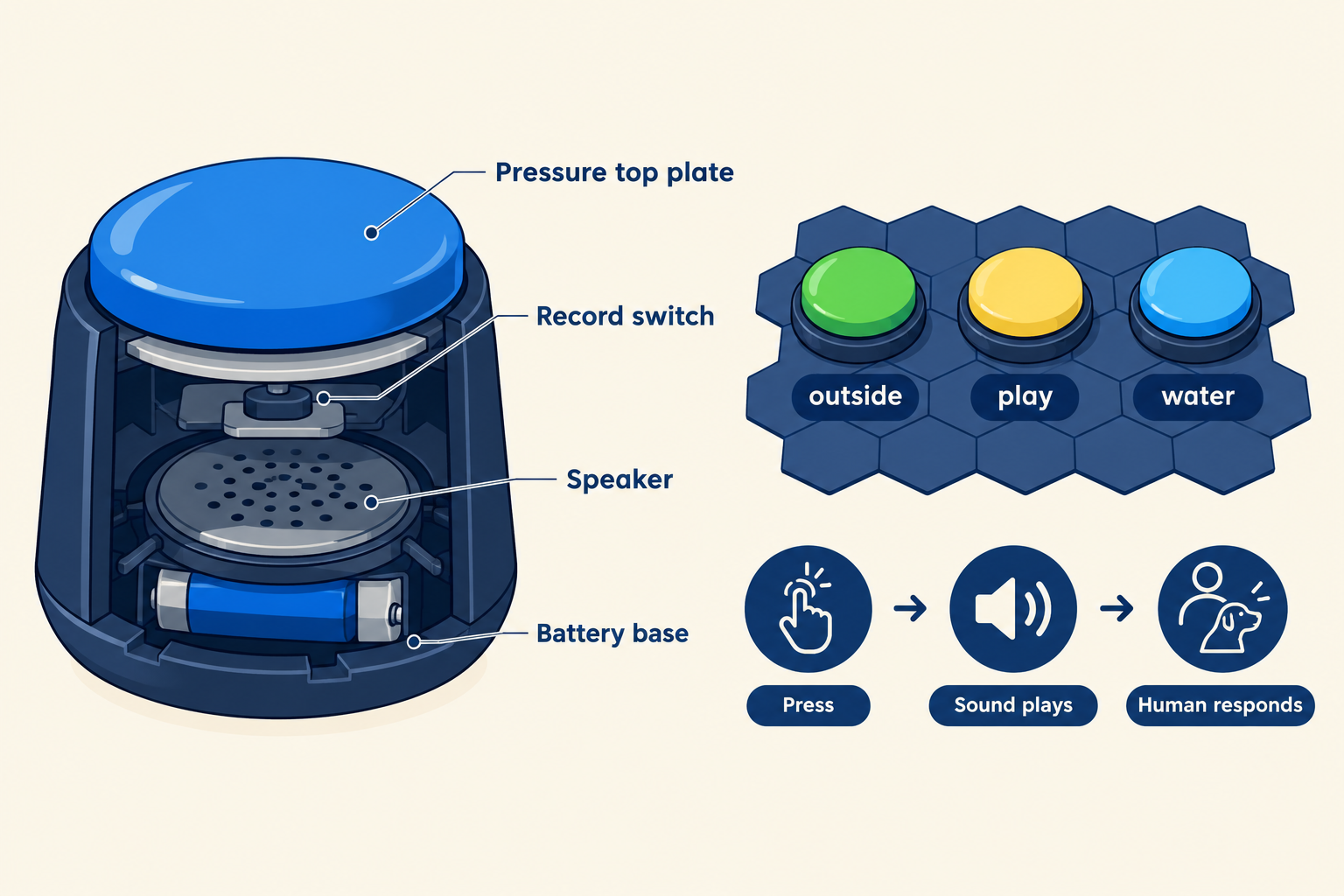
The mechanics are simple. The learning is not.
A soundboard works through association. The dog steps on the blue button, a voice says “outside,” a human opens the door. Repeat that enough times, in the same place, with the same result, and some dogs begin pressing on purpose to produce the outcome. That is the same learning process behind a doorbell, a food bowl tap, or your dog hearing your keys and appearing in the hallway.
Three parts matter more than the branding:
- Placement. Buttons live where the behavior happens. “Outside” by the door, “water” by the bowl.
- Spacing. Tiles and mats exist so a paw lands on one button, not three. Check the dimensions of your hallway before you commit to a nine-tile grid.
- Audio. The recording has to be loud enough to hear from the kitchen, and the same voice every time.
Common mistake: recording a word that has no visible result. If “patience” plays and nothing happens, the dog has learned that the button is a noisy floor tile.
Do dog talking buttons actually work? What the UC San Diego research found
Partly, in a specific and measurable way. The strongest published evidence shows that soundboard-trained dogs understand the recorded words, not that they are forming sentences.
The 2024 work led by Amalia Bastos and colleagues at the UC San Diego Comparative Cognition Lab tested dogs already trained on soundboards at home. Dogs responded with play-related behavior to “play” and door-related behavior to “outside,” and they did it whether the word was spoken aloud or produced by a button, and whether the presser was their owner or an unfamiliar person. That design matters, because it rules out the simplest objection: that the dog was only reading the owner’s face.
A separate quantitative analysis from the same year, indexed on PubMed Central, examined large volumes of owner-logged presses and found that button combinations were not random in the way a chance model predicted. The 2026 methodological review describes that paper as the most rigorous published quantitative analysis to date, while also noting that some researchers connected to the broader dataset had consulting or employment relationships with CleverPet, the company associated with FluentPet. The finding stands. Independent replication still matters.
“A far cry” from proving human-like language. That is Rossano’s own framing of what the soundboard data shows, reported in the University of California’s coverage of pet communication research.
Where the facts end: there is no published evidence that dogs use buttons with tense, syntax, metaphor, or abstract reference. Viral clips of a dog apparently reporting a dream or a feeling are not data. They are edited video with a caption written by a human who loves that dog very much.
How do dogs learn to use talking buttons?
Through operant learning plus a lot of repetition from you. The dog is not decoding English. The dog is discovering that one specific pressure plate produces one specific change in the world.
The process tends to run in this order:
- Exposure. The button exists. The dog sniffs it, ignores it, maybe licks it.
- Modeling. You press the button, say the word, and immediately deliver the outcome. Door opens. Toy appears.
- Accidental contact. A paw lands on it in passing. You respond as if it were a request.
- Deliberate pressing. The dog targets the button and then looks at you or at the door.
- Discrimination. With a second and third button present, presses start matching context more often than chance.
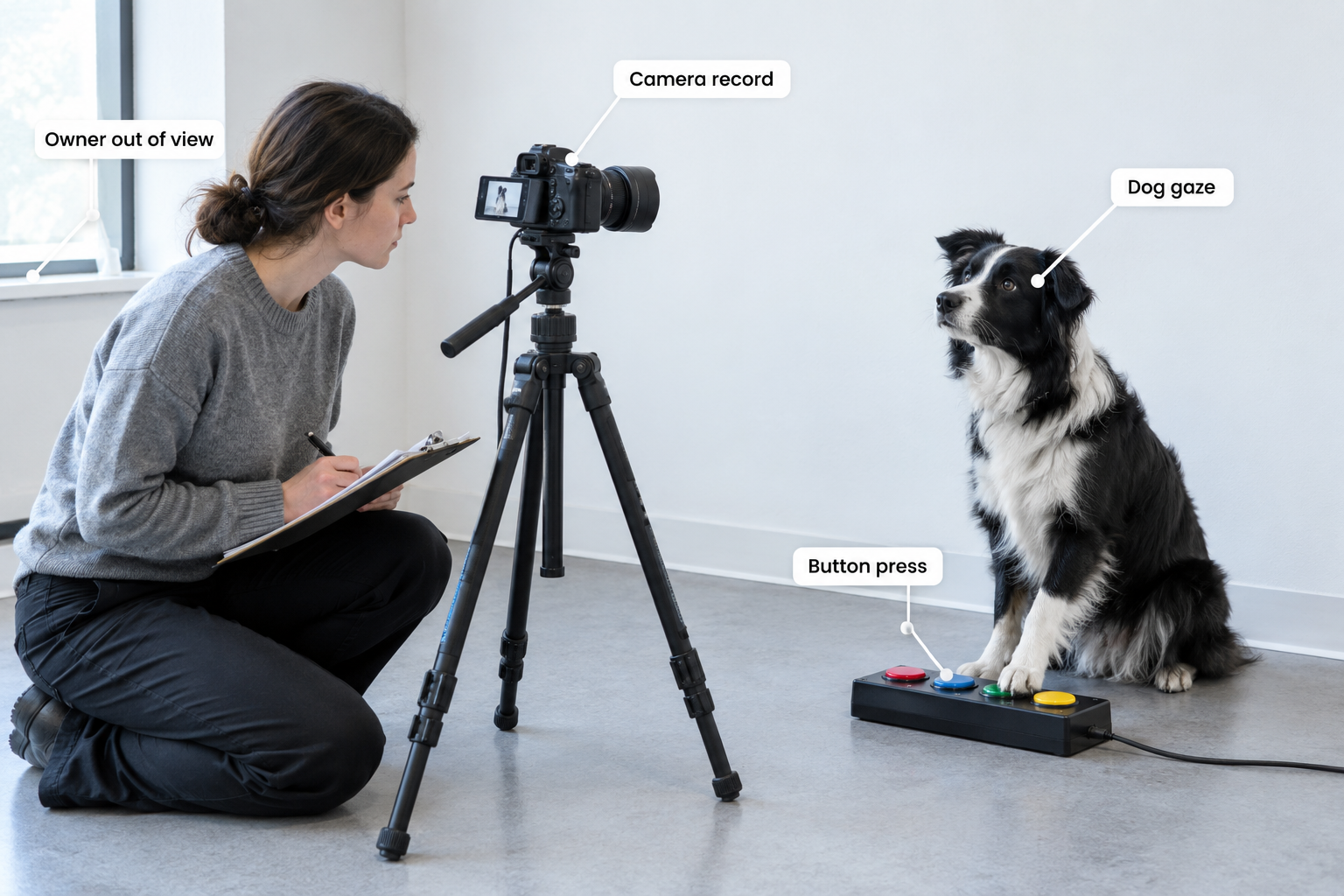
Step five is where most households stall, and that is normal. The 2026 Frontiers framework argues researchers should score the whole situated event, meaning the press together with gaze, body orientation, context, your response, and whether the dog accepts or rejects what it gets. A press with no follow-up glance is weaker evidence than a press followed by a stare at the leash hook.
Dogs are already fluent in signals we read without buttons. If you have ever watched a dog stop, swivel, and hold a stare at a closed door, you have received a complete message. The same attentional habits show up in other everyday behaviors, including the reason dogs tilt their heads when you talk to them.
How do you teach your dog to use talking buttons, step by step?
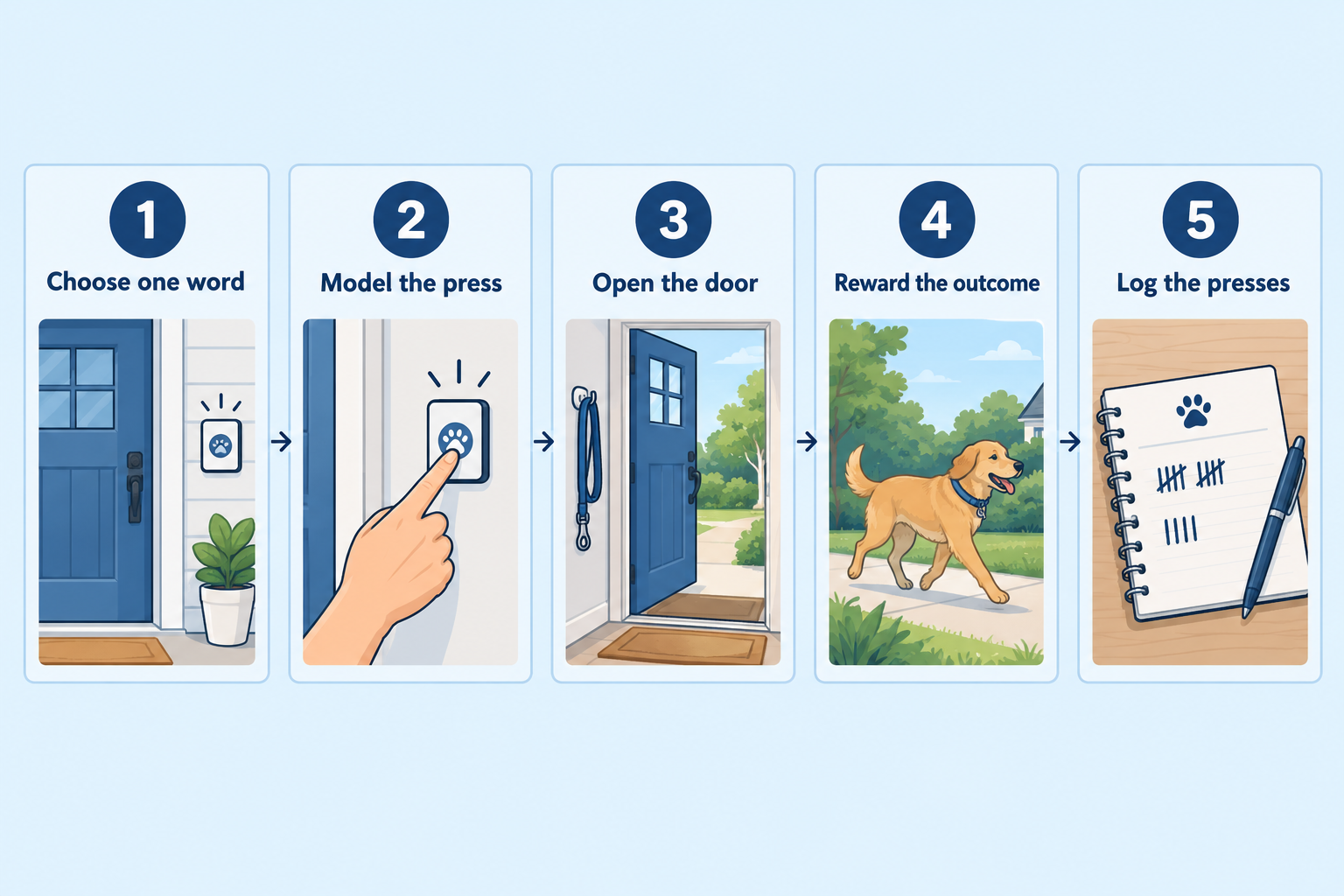
Start with one button, one word, and one outcome the dog already wants. Model it roughly ten times a day in context, respond every single time, and resist adding words until the first one is solid.
Here is the sequence that matches how the research dogs were trained at home:
- Pick the word. Choose an outcome the dog requests already: outside, play, water, food.
- Record clearly. One voice, one word, normal volume, no background TV.
- Place it where the thing happens. Button by the door for “outside.” Not in the middle of the living room.
- Model in context. Only press it when you are actually about to do the thing.
- Deliver immediately. Door opens within a second or two, every time, even when the timing is inconvenient.
- Reward the behavior, not the button. The reward is the outcome itself. A high value food reward can help early on, and if you need ideas for what to use, our guide to what to add to kibble and what to skip covers sensible options.
- Do not force the paw. No pushing, holding, or luring a limb onto the plate. Humane training means the dog chooses the press.
- Log it. Date, word, context, what you did next. Memory flatters us.
Decision rule: add a second button only when the dog presses the first one unprompted in the right context on several separate days. If you add words faster than that, you get a dog who stomps the whole board like a drum solo.
Which dog talking buttons sets are worth trying? Four options compared
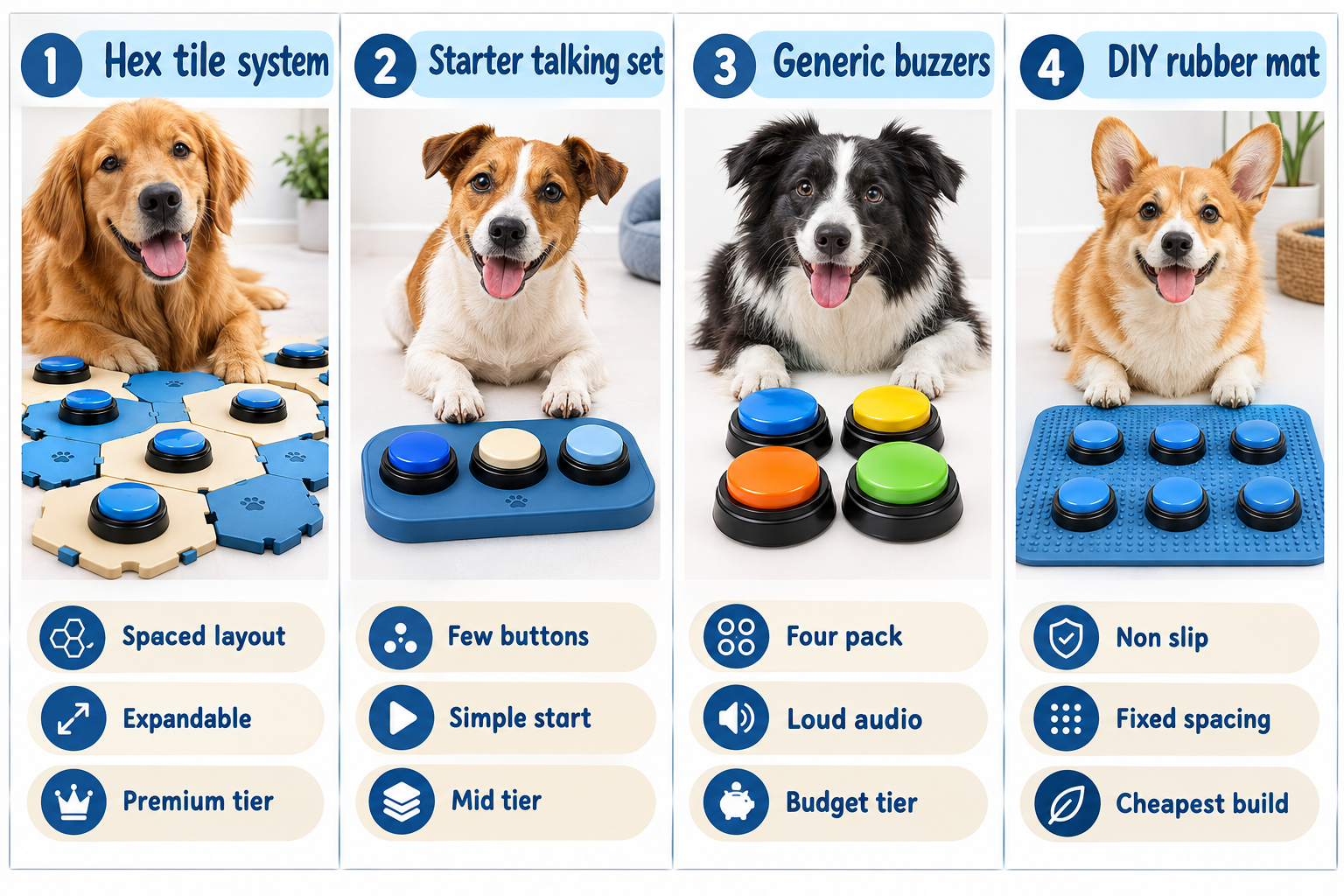
Four formats cover almost every household: a hex tile system, a branded starter set, generic recordable buzzers, and a do-it-yourself mat. Choose by spacing and expandability, not by how the box photographs.
Review method: documented research, manufacturer descriptions, and retailer listings reviewed October 2026. No hands-on testing by Doggy Rank IQ. Button counts and prices vary by kit version and retailer, so confirm both on the live listing before you buy. Affiliate disclosure: some retailer links may earn us a commission at no extra cost to you, and commission never decides the verdict.
| Set | Format and buttons | Price tier (checked Oct 2026) | Who it suits |
|---|---|---|---|
| FluentPet Get Started Kit | Hex foam tiles plus recordable buttons; count varies by kit, confirm on listing | Premium tier | Owners who want the system used by soundboard research households and plan to expand |
| Hunger for Words Talking Pet starter set | Small recordable starter set, no tile grid | Mid tier | Beginners testing one or two words before buying a full board |
| Generic recordable answer buzzers | Commonly sold in 4 or 6 packs at general retailers | Budget tier | Cost-conscious owners and anyone unsure the dog will engage at all |
| DIY mat setup | Generic buttons fixed to a non-slip rubber or bath mat | Cheapest build | Hard floors, slipping buttons, and owners who like a hot glue gun |
Where to compare the options: talking buttons for dogs on Amazon, dog talking buttons at Target, and dog communication buttons on eBay.
How much do dog talking buttons cost?
Costs sit in three bands. Single generic recordable buttons are the cheapest entry, branded starter sets land in the middle, and tile based kits with multiple buttons cost the most. Prices move constantly across Amazon, Target, eBay, and TikTok Shop, so treat any figure you read anywhere, including a listing from last month, as out of date.
Three things change the real cost:
- Expansion. Boards grow. Extra buttons and extra tiles are a recurring purchase.
- Batteries. Most buttons use replaceable cells, and a board of twelve goes through them.
- Replacement. Chewers and droolers kill buttons. Budget for one or two casualties.
Budget rule: buy two cheap buttons first. If your dog has not touched either in three weeks of honest modeling, you have saved the price of a full kit.
What the research numbers show
Can any dog learn to use talking buttons, and which dogs suit them best?
Most physically able dogs can learn one or two buttons. Far fewer become consistent multi-button users, and breed is a weaker predictor than the individual dog’s interest in you.
Dogs who tend to do well:
- Food or toy motivated, and willing to repeat a behavior for a result
- Comfortable targeting objects with a paw already
- Living with someone home enough to respond to presses within seconds
- Settled in the house, not newly adopted and still decompressing
Dogs for whom buttons are a poor fit:
- Sound sensitive dogs who startle at the recording
- Dedicated chewers who will treat a button as a snack
- Dogs with painful paws, wrists, or elbows, where repeated pressing is not reasonable
- Households where nobody can respond consistently, which teaches the dog the board does nothing
Breed tendencies give you odds, not a prediction for your dog. Herding and sporting types often enjoy the task, but the quiet terrier in the apartment may out-press them all. Our look at what “intelligent” really means across dog breeds explains why training speed and problem solving are not the same skill.
What age should you start teaching a dog talking buttons?
Any age where the dog has basic house routines and can take direction, often from around four to six months for puppies, and at any point in adulthood. Puppies learn associations fast but have short attention spans, so keep sessions to a minute or two. Senior dogs can learn buttons as well, and board placement matters more for them: no stairs, no slippery floors, and nothing that requires an awkward stretch. Sleep needs also shape session timing, which is worth knowing if your dog disappears for most of the afternoon, something our piece on why dogs sleep so much covers.
How long does it take?
Expect two to four weeks of daily modeling before a first unprompted press, and several months before anything resembling consistent use. Plenty of dogs never get past one or two words. That is an outcome, not a failure.
Dog talking buttons vs other training and enrichment tools
Buttons are a communication-flavored enrichment project, not a behavior fix. If your goal is a calmer dog, a solved problem behavior, or less boredom, cheaper tools usually do more.
| Tool | What it does well | What it will not do |
|---|---|---|
| Dog talking buttons | Adds trained request signals, structured interaction time | Fix anxiety, replace exercise, or report symptoms |
| Clicker and marker training | Fast, precise skill building with a strong evidence base | Give the dog a way to initiate requests |
| Snuffle mats and puzzle feeders | Low-cost mental work, slows eating, good for rainy days | Create any two-way signaling |
| Scent games | Uses the sense dogs are strongest in, tiring without impact | Produce anything you can label as “words” |
| Qualified behavior support | Addresses reactivity, separation distress, aggression | Be substituted by gear of any kind |
Decision rule: choose buttons if you want more structured interaction and you find the research interesting. Choose puzzle feeders and scent games if the actual problem is a bored dog at 9pm.
Color-coded tiles are a human aid, by the way. Dogs see blues and yellows well and do not distinguish red from green the way we do, which our explainer on what colors dogs can actually see walks through. The dog is likely using position and texture, not your color system.
What are the limits of dog talking buttons?
The main limits are cueing, owner interpretation, and the absence of evidence for language-like structure. All three are easy to fall into and all three are manageable if you know they exist.
Cueing, or the Clever Hans problem. A dog can look like a communicator while actually reading your posture, your glance at the door, or the slight lean you make before the “right” button. The 2024 UC San Diego design partly addressed this by having strangers press the buttons, which strengthened the comprehension result. In your living room, you have no such control. Stand still, keep your eyes off the board, and let the dog choose.
Owner interpretation. Logs are written by people who want a particular answer. Two presses of “outside” and “mad” after a vet visit reads as a complaint, and it could just as easily be two buttons near each other and a dog with wet paws. The 2026 Frontiers framework treats ambiguity and accidental presses as data to be coded, not noise to be ignored. Borrow that habit.
No evidence for language. Comprehension of a word is not production of language. Amritha Mallikarjun of the University of Pennsylvania School of Veterinary Medicine has described buttons as potentially useful for richer interaction while rejecting the idea that dogs speak as humans do, and Alexandra Horowitz has argued that a dog’s existing signals, the stare at the door, the leash delivered to your lap, may be clearer than a soundboard, both positions reported in Scientific American’s review of whether dogs can use language.
And the field is small. A handful of labs, a commercial partner, and a mountain of owner-submitted video. Guidance checked October 2026 found no government standard or regulatory classification specific to these devices.
Dog talking buttons not working? What to do
Start by checking the three failure points in order: the outcome, the placement, and your response time. Most stalled boards are a human scheduling problem wearing a dog costume.
- No presses at all after three weeks. Reduce to one button. Move it directly into the path to the thing. Model it more often, in context only.
- Random stomping of every button. Too many words too soon. Remove all but one or two for a fortnight.
- Presses only when you are watching. Likely attention seeking, which is itself useful information. Respond with the outcome, not with excited praise.
- Pressing then walking away. Normal early on. Score only presses followed by gaze or movement toward the outcome.
- Button not firing. Check batteries and the floor surface. Buttons on thick carpet often absorb the paw press.
- Dog chewing the buttons. Stop the board. Swap to a chew-safe enrichment option and revisit later.
Common mistakes people make with dog talking buttons
- Recording abstract or emotional words first.
- Responding inconsistently, which teaches the dog the board is unreliable.
- Physically placing the dog’s paw on the button.
- Reading sentences into two presses that happened to be adjacent.
- Filming before training, then letting the camera set the agenda.
- Adding buttons to impress visitors rather than to serve the dog.
Are dog talking buttons safe, and do vets recommend them?
The devices are generally low risk for physical safety when supervised, and no veterinary body was identified as formally endorsing them as of October 2026. They are sold as training and enrichment products, not as validated communication or diagnostic tools.
Safety points worth checking:
- Small parts and batteries. Confirm the battery compartment screws shut. Button cells are a serious ingestion hazard.
- Chewing. Supervise. Remove the board when you leave the room if your dog destroys plastic.
- Volume. Test the recording at a low level first with a sound sensitive dog.
- Joint load. Keep pressing occasional, not a drill, especially for large breeds and older dogs.
- Floor safety. Non-slip tiles or a mat, nowhere near stairs.
What buttons cannot do: diagnose pain, confirm nausea, or reliably report a symptom. If a dog presses “hurt,” that is a prompt to call your vet and describe the behavior you have observed, nothing more. Researchers at the UC San Diego lab frame their work as testing whether these devices allow communication at all, rather than assuming viral clips settle it.
FAQ
Do dog talking buttons actually teach dogs to talk?
No. They teach dogs that a specific button produces a specific outcome. The 2024 UC San Diego research supports that trained dogs understand some recorded words, and no published study shows dogs using buttons with grammar or abstract reference.
Which buttons did Bunny the talking dog use?
Bunny, the sheepadoodle whose videos made soundboards famous from 2020 onward, used a FluentPet hex tile system, and her owner contributed data to the UC San Diego research project. Viral clips from any dog are anecdote, not evidence.
How many buttons should a dog have?
Start with one and add a second only when the first is used unprompted in context on several separate days. Many successful home boards stay under six words for months.
Do dogs understand the words or just the sound?
The 2024 study found dogs responded appropriately to “play” and “outside” whether a person spoke the word or a button played it, which supports word level understanding for those specific words. It does not show understanding of sentences.
Are dog talking buttons worth the money?
They suit owners who enjoy a long, slow training project and are home enough to respond to presses. For a bored dog who needs more mental work, a snuffle mat and scent games cost less and deliver faster.
Can older dogs learn buttons?
Yes, with placement adjusted for comfort. Keep the board off slippery floors and within easy reach, and stop if pressing looks awkward or painful.
Does using buttons change the human-dog bond?
No study identified has measured that. What the research supports is more structured interaction time, which is worth something on its own. The affection was already there, and that shows up in plenty of other ways, including the behaviors covered in our piece on what loyalty in dogs really looks like.
Conclusion
Dog talking buttons sit in an honest middle position. The evidence supports learned word to outcome association, with the 2024 UC San Diego work showing dogs respond correctly to recorded words, and the 2026 Frontiers framework pushing researchers to study the full context of a press instead of the press alone. The evidence does not support conversation, and the seven consistent users out of hundreds of dogs is the clearest signal available about individual variation.
Your next step, in order:
- Buy two generic recordable buttons before any kit.
- Record one word with an immediate, visible outcome.
- Model it about ten times a day for two weeks and respond every time.
- Keep a plain log of presses and context.
- Compare the options for a tile system only if your dog is pressing on purpose.
Then re-read your log with a sceptical eye. If the pattern holds up when you are not the one hoping, you have something worth expanding. If it does not, you have a dog, two buttons, and a few extra weeks of paying close attention to each other. Not a bad trade.
#dogtalkingbuttons #dogcognition #humanetraining