
This post contains affiliate links. If you buy through one we may earn a commission at no extra cost to you. As an Amazon Associate I earn from qualifying purchases.
Quick answer: A dog ramp for car trips works only when its length matches your vehicle’s actual sill height closely enough to produce an angle your dog can climb, generally 20 to 25 degrees for a healthy adult dog and closer to 18 to 20 degrees for a senior or post-surgery dog. Measure your trunk or tailgate height with a tape measure, then pick a ramp that is roughly 2.5 to 3 times that height (or 4 to 5 times for dogs with joint problems), and check the folded length against your actual storage space before buying.
Key Takeaways
- A ramp roughly 2.5 to 3 times the vehicle’s floor height produces a workable angle for most healthy adult dogs, based on orthopedic-ramp guidance from VCA Animal Hospitals.
- Dogs recovering from surgery or managing arthritis often need 18 to 20 degrees or less, which can require a ramp 4 to 5 times the sill height, per VCA’s osteoarthritis guidance.
- A 30-inch SUV floor paired with a 42-inch ramp creates about a 46-degree angle, while a 72-inch ramp brings that down to roughly 25 degrees.
- The PetSafe Happy Ride Folding Ramp measures 62 inches long, folds to 31 inches, weighs 10 lb, and holds up to 150 lb, priced at $59.99 on PetSafe’s site as checked November 6, 2026.
- Nissan’s updated pet-travel guidance describes a telescoping ramp extending to 64 inches with a textured-polyester surface and a tether meant to attach to the vehicle’s center D-ring.
- Width and slip resistance matter as much as slope. Narrow or slick ramps cause dogs to refuse even a gentle incline.
- The AKC notes that dogs frequently hide joint pain, which is a reason to have a vet confirm whether a ramp is actually needed before assuming your dog is “fine” jumping (AKC, dog stairs and ramps guide).
- Pet stairs sometimes beat a ramp for tall vehicles where a folding ramp cannot reach a safe angle within its storable length.
Dog Ramp for Car
A dog ramp for car use is a portable incline, usually fabric stretched over an aluminum, plastic, or honeycomb frame, that bridges the gap between the ground and a trunk, tailgate, or back seat so a dog can walk in and out instead of jumping. The real question behind most searches isn’t whether these products exist. It’s whether a specific ramp will work at a specific vehicle’s height, for a specific dog’s size and mobility, and whether it will actually fit back in storage afterward.

That last part gets skipped constantly. A ramp marketed as fitting “all SUVs” can create a dangerously steep angle at a tall Suburban and feel absurdly long and heavy at a low hatchback. The honest starting point is three numbers: your vehicle’s sill height, the ramp’s full extended length, and the ramp’s folded footprint. Grip texture and weight rating matter too, but those three numbers decide whether a dog ramp for car trips gets used weekly or ends up folded behind the furnace after one failed attempt.
Owners shopping before a road trip, a flight connection, or a weekend getaway often buy based on vehicle category alone: “I drive an SUV, so I need the SUV ramp.” That shortcut is how a 13-year-old Labrador with hip dysplasia ends up facing a 45-degree incline because the box said “fits SUVs” and nobody measured anything. Road & Track’s testing of car ramps makes the same point: fit to the vehicle matters more than the brand name on the box.
Slope and Folded Length Calculator
Dog Ramp Slope Calculator
Measure the sill with a tape measure from the ground to the trunk floor or tailgate lip, not from a spec sheet, because trim packages, suspension lift, and even tire size can shift that number by an inch or two.
Slope, Grip and Folded Length: What Actually Matters
Three measurements decide whether a dog ramp for car use gets adopted by your dog or abandoned in the garage within a week. Get any one of them wrong and the ramp becomes dead weight.
Slope is the angle formed between the ramp and the ground. Orthopedic guidance treats 20 to 25 degrees as a practical ceiling for many healthy dogs, built on a rule that the ramp should run about 2.5 to 3 times the height it climbs. A 30-inch SUV floor needs roughly 72 to 75 inches of ramp to land near 25 degrees. A 42-inch ramp at that same height produces close to 46 degrees, which is essentially a wall as far as most dogs are concerned. For dogs recovering from surgery, managing arthritis, or dealing with neurologic weakness, veterinary guidance from VCA Animal Hospitals drops that target to 18 to 20 degrees or less, sometimes requiring 4 to 5 times the vehicle height. For a 24-inch tailgate, that means an 8 to 10 foot ramp, longer than almost any folding model sold at retail.
Grip is the surface a paw actually contacts. Width, gentle incline, slip resistance, and sturdiness tend to move together: improving all four usually adds weight and cost to the ramp. Textured polyester, rubberized ridges, and removable traction mats each solve the slip problem differently. A flat vinyl surface that looks fine dry turns into a skating rink the moment a wet or muddy paw lands on it, which is exactly when a dog needs the most confidence, not the least.
Folded length is the number nobody checks until the ramp is already in the cart. A ramp that performs beautifully at 72 inches extended might fold to 36 inches, which does not lie flat in a compact trunk, a hall closet, or a car already carrying a crate and a cooler. Telescoping designs collapse into a shorter tube. Bi-fold designs fold once in half. Tri-fold and four-fold designs fold smaller still but add hinge joints that can flex or wobble under a large dog’s weight mid-crossing.
Doggy Rank IQ Tool
Dog Ramp Slope Calculator

Measure the vehicle sill, enter the ramp length, and see the angle your dog will actually climb.
Top 5 Features That Decide the Purchase
1. Length relative to the vehicle, not the dog. The ramp needs to match the sill height of the vehicle it will serve most often, not a generic “fits SUVs” label. The Pawaboo Dog Ramp for Car’s 74-inch length suits taller vehicles where a shorter ramp would create a steep climb for large dogs.
2. Folded footprint versus trunk space. A longer ramp solves slope problems but only helps if it actually fits folded alongside groceries, a crate, or golf clubs. Telescoping models like the PetSafe Happy Ride Telescoping Dog Ramp, Extra Long collapse into a compact tube that stores more predictably than a wide bi-fold.
3. Weight capacity with a safety margin. A ramp rated for exactly a dog’s body weight is not the same as a ramp rated with headroom for momentum, hesitation stops, and uneven footing mid-climb. Most quality folding ramps in this category top out between 150 and 250 lb, and a dog that stops halfway and shifts its weight sideways puts more stress on a ramp than its static rating suggests.
4. Surface texture that performs wet. A textured, ridged, or rubberized surface matters more on rainy mornings and muddy trailheads than in a showroom. The Dog Ramp for Car Truck 63″ L × 17″ W, Pet Ramp Lightweight Foldable markets a lightweight frame, which is worth checking against grip quality since lighter materials sometimes trade texture depth for portability.
5. Latch and anchor security. Current vehicle manufacturer guidance recommends tethering a ramp’s attachment point to the vehicle’s center D-ring before loading, a detail that applies to any brand’s ramp, not just factory accessories. A ramp that shifts mid-step is a bigger hazard than one that is merely a little steep.
Ramp Comparison Table: Dog Ramp for Car Options by Length and Price
| Model | Length / Width | Weight Capacity | Price Band |
|---|---|---|---|
| Pawaboo Dog Ramp for Car | 74″ L x 20″ W | Large-dog rated | Around $60 to $80 |
| PetSafe Happy Ride Telescoping Dog Ramp, Extra Long | Telescoping, extends long | 150 lb (standard Happy Ride spec) | Around $50 to $70 |
| Dog Ramp for Car Truck 63″ L x 17″ W | 63″ L x 17″ W | Mid-size dog rated | Around $40 to $60 |
What size dog ramp do I need for my car
The right size depends on your vehicle’s sill height, not your dog’s breed. Measure from the ground to the trunk floor, tailgate, or back seat lip, then multiply by 2.5 to 3 for a healthy adult dog, or by 4 to 5 for a senior, post-surgery, or arthritic dog.
As a working guide:
- Sedan trunk or back seat (around 18 to 22 inches): a 48 to 55 inch ramp keeps most healthy dogs under 25 degrees.
- Midsize SUV (around 26 to 30 inches): a 65 to 75 inch ramp is usually needed for a comfortable angle.
- Full-size SUV, minivan, or truck bed (30 to 36 inches): ramps in the 72 to 90 inch range, or a two-piece/extendable design, work better than a single short folding ramp.
- Senior or recovering dogs at any of these heights: add 20 to 30 percent more length than the healthy-dog figure, or use a ramp with an adjustable low-angle setting.
A common mistake is buying based on the longest ramp available “just in case.” An oversized ramp at a low sedan creates an unnecessarily flat, long walk that some dogs find just as off-putting as a steep one, and it takes up more trunk space than needed.
Best dog ramps for cars 2024 (and what changed by 2026)
The strongest dog ramp for car use in any given year is still the one matched to your vehicle’s height, grip needs, and storage space rather than a single “best overall” pick. By 2026, telescoping designs and wider bi-fold ramps with reinforced center hinges have become more common at mainstream price points, and several brands now publish wet-traction ratings alongside dry ones, something that was rare a few years earlier.
Three models worth comparing directly:
- The Pawaboo Dog Ramp for Car (74″ L x 20″ W) suits large dogs and taller SUVs where reach matters more than portability.
- The PetSafe Happy Ride Telescoping Dog Ramp, Extra Long extends for taller vehicles and retracts for shorter ones, which matters for households that rotate between two cars.
- The Dog Ramp for Car Truck (63″ L x 17″ W) covers mid-height vehicles and dogs under about 100 lb on a tighter budget.
Whole Dog Journal’s ramp testing and Dogster’s roundup of ramps for SUVs and trucks both flag the same pattern: ramps that score well on paper sometimes fail in practice because the surface texture wears smooth after a season of use, so checking owner reviews after six months of ownership, not just initial unboxing reviews, gives a more honest picture.
How much do dog car ramps cost
Most folding dog ramp for car use options run from about $40 to $150, with telescoping and heavy-duty models reaching $150 to $250. Price generally tracks length, weight capacity, and build material rather than brand name alone.

- Budget tier ($40 to $60): shorter ramps (55 to 65 inches), lighter frames, basic texture, usually rated for dogs under 100 to 150 lb.
- Mid tier ($60 to $100): longer ramps (65 to 75 inches), reinforced hinges, wider platforms (17 to 20 inches), rated for 150 to 200 lb.
- Premium tier ($100 to $250): telescoping or two-piece designs, aluminum frames, rubberized non-slip surfaces, rated for 200 to 300+ lb, sometimes with adjustable incline settings for arthritic dogs.
A ramp that costs less than $40 is worth extra scrutiny. At that price point, the frame is often thin plastic that flexes under anything over 40 to 50 lb, even if the listing claims a higher rating.
Can senior dogs use car ramps
Yes, senior dogs can use a dog ramp for car trips, but they generally need a lower angle (18 to 20 degrees or less) and a wider, more stable platform than a healthy adult dog requires. A vet visit to confirm the specific mobility issue is worth doing before buying, since the AKC notes that dogs often mask joint pain and may still attempt a ramp that is actually too steep for their condition.
Practical adjustments for senior dogs:
- Choose the longest ramp that still fits your storage space, since length is what lowers the angle.
- Look for a wider platform, at least 16 to 17 inches, so the dog does not have to place paws close together for balance.
- Add a non-slip mat or rubber-backed runner on top of the factory surface if the dog hesitates on the existing texture.
- Avoid ramps with a center hinge that flexes noticeably when stepped on, since a wobble mid-step is often what triggers refusal in older dogs with less confidence in their joints.
Senior Dog Vets’ guidance on reluctance to jump into the car notes that sudden refusal to jump, not just slow movement, is often the first visible sign of joint pain, and that a ramp introduced at that stage, built at a gentle angle, tends to be adopted faster than one introduced after the dog has already developed a strong fear of the car’s height.
My dog won’t use the car ramp
A dog that refuses a ramp is usually responding to one of three things: the angle is too steep, the surface feels unstable underfoot, or the dog has never been shown how to use it. Start by checking the angle with the calculator above before assuming the dog simply “doesn’t like ramps.”
Troubleshooting steps, in order:
- Recheck the slope. If the angle measures above 25 degrees for a healthy adult dog or above 20 degrees for a senior dog, the ramp itself may be too short for your vehicle.
- Test for wobble. Stand on the middle of the ramp yourself (if weight-rated appropriately) or press down firmly. Visible flex is often enough to make a hesitant dog back off.
- Add traction. A rubber-backed bath mat or a yoga mat section taped to the surface can make an immediate difference for dogs refusing due to slip, not slope.
- Train gradually. Lay the ramp flat on the ground first and lure the dog across with treats before ever propping it against the car. Then prop it at a shallow angle against a curb or low step before trying the actual vehicle height.
- Use a leash, not a push. Guide from the front with a treat or toy rather than pushing from behind, which tends to increase anxiety rather than build confidence.
See the training section below for a fuller step-by-step approach, and review 5 essential commands every puppy should learn if the dog does not yet respond reliably to basic leash guidance, since ramp training leans heavily on a dog’s existing “come” and “wait” responses.
Dog ramp vs pet stairs which is better
Pet stairs work better than a ramp for tall vehicles where a folding ramp cannot reach a safe angle within a storable length, while a ramp works better for dogs who cannot manage individual steps due to weakness, arthritis, or poor depth perception. PetMD and multiple vet sources note that ramps can actually be harder than stairs when the vehicle height forces a steep incline, since a steep ramp asks for more sustained muscle control than a series of shorter steps.
Decision rule:
- Choose a ramp if: the dog has hind-limb weakness, recent surgery, or arthritis that makes repeated step-ups painful, and the vehicle height allows a ramp long enough to stay under 20 to 25 degrees.
- Choose stairs if: the vehicle is tall enough that a storable ramp would be too steep, the dog is small and agile enough to manage individual steps comfortably, or storage space does not allow for a 60-plus inch ramp.
- Choose neither if: the dog is young, healthy, and already jumps in and out without hesitation and the vehicle is low enough that jumping does not put strain on joints.
Alternatives to a dog ramp for cars
A dog ramp for car trips is not the only option, and for some dogs and vehicles it is not even the best one. Alternatives include:
- Pet stairs: fixed-step units that work well for tall vehicles and small to midsize dogs, discussed above.
- Lift-assist harnesses: a handle built into a harness that lets an owner support a dog’s hindquarters while it climbs in on its own power, useful for medium dogs where a full ramp is impractical to store.
- Manual lifting: appropriate only for dogs under roughly 30 to 40 lb and owners without back issues, and not a long-term solution for dogs who need repeated daily car access.
- Lowering the loading point: some owners train dogs to enter through a lower back seat door rather than a high trunk or tailgate, which can reduce or eliminate the need for a ramp entirely.
Owners weighing a harness alongside ramp use, particularly for breeds prone to back problems, may want to check dachshund-safe harness options since the two pieces of gear often need to work together rather than being chosen independently.
What angle should a dog ramp be
A healthy adult dog generally does well on a ramp angled between 20 and 25 degrees, while dogs with arthritis, recent surgery, or neurologic weakness do better closer to 18 degrees or less, according to veterinary mobility guidance from VCA Animal Hospitals. Above roughly 30 degrees, most dogs, healthy or not, start to show hesitation, slower pacing, or outright refusal.

Use the calculator near the top of this guide to check your own vehicle and ramp combination rather than relying on general angle guidance alone, since the same ramp produces very different angles at a sedan trunk versus a full-size SUV tailgate.
How to train a dog to use a car ramp
Training a dog to use a ramp usually takes a few short sessions spread across several days rather than one long session. Rushing the process, especially propping the ramp at full vehicle height on day one, is the most common reason dogs develop a lasting aversion.
A simple progression that works for most dogs:
- Day 1 to 2: Lay the ramp flat on the ground in a familiar space. Walk the dog across it on a leash using treats or a favorite toy, several times per session, with no incline at all.
- Day 3 to 4: Prop the ramp against a low curb, step, or stair (a few inches of rise) and repeat the same leash-and-treat walk-across.
- Day 5 to 6: Increase the incline gradually using a slightly taller surface, continuing to reward each successful crossing.
- Day 7 onward: Introduce the actual vehicle, starting with the tailgate or door open and the engine off, so the dog isn’t managing a new surface and a new sound at the same time.
Throughout training, avoid pushing or forcing a dog onto the ramp, since this tends to create a negative association with the entire process. If a dog freezes partway up, back off to the previous easier step rather than coaxing forward through fear. For dogs that already know basic commands, pairing a verbal cue like “ramp” or “up” with each successful crossing speeds up the process considerably; see 5 essential commands every puppy should learn for building that foundation first.
Dog ramps for small dogs vs large dogs
Small dogs under about 25 lb generally do better with a narrower, lighter ramp (12 to 15 inches wide) that an owner can guide on leash, while large and giant dogs need a wider platform (17 to 20 inches or more) to feel stable and a longer overall length to keep the angle manageable at their weight.
Key differences in what to look for:
- Small dogs: prioritize low weight for easy portability, a narrower width that still gives secure footing, and a surface the dog cannot easily slip sideways off of given its lighter frame.
- Large dogs: prioritize a reinforced center frame that won’t flex under 70 to 100+ lb, a wider platform so the dog isn’t placing paws close to the edges, and a weight rating with real headroom above the dog’s actual body weight.
- Individual variation matters: two dogs of the same breed and age can have very different comfort levels with an incline. A confident Labrador may handle a 30-degree ramp without hesitation, while a more cautious littermate balks at 22 degrees. Watching the individual dog’s reaction during training matters more than relying on breed generalizations.
Will this ramp fit my SUV or truck bed
A ramp “fits” your SUV or truck bed only if its length produces a workable angle at your specific sill height and its folded size fits your actual remaining cargo space, not simply because a listing mentions SUVs or trucks in its title. Truck beds in particular vary widely, from around 20 inches at a lowered tailgate to over 34 inches at a lifted truck with larger tires.
Before buying for a truck bed specifically:
- Measure from the ground to the bed floor with the tailgate down, not the tailgate height itself.
- Check whether the ramp’s hooks or lip are designed to grip a flat tailgate surface versus a rounded bumper edge, since truck tailgates and SUV bumpers are shaped differently.
- Confirm the ramp’s width is enough for a dog to walk, not just balance, especially for trucks where the walking surface sits higher and narrower than a trunk floor.
Best dog ramps for arthritic or disabled dogs
The best the ramp use by an arthritic or disabled dog is typically the longest ramp that still fits realistic storage space, paired with a wide, high-traction surface and a stable, low-flex frame. Angle matters more for this group than for any other, since even a few extra degrees can mean the difference between a dog attempting the climb and refusing outright.
Specific features worth prioritizing:
- An 18 to 20 degree target angle or lower, which often means a ramp in the 80 to 100+ inch range for SUV-height vehicles, longer than most single-fold consumer ramps.
- A wide platform (18 inches or more) that allows a dog with an uneven gait room to correct its footing without stepping off the edge.
- A grooved or deeply textured surface rather than a smooth or lightly embossed one, since dogs with weaker hindquarters push off less forcefully and need more surface traction per step.
- A low, gradual lip at both ends rather than a raised step, since a raised lip can catch a dragging paw on a dog with neurologic weakness.
VCA’s guidance on osteoarthritis management recommends combining ramp use with other home adjustments, like non-slip flooring near the vehicle and avoiding high-impact jumping elsewhere in daily routines, rather than treating the ramp as a standalone fix.
Why does my dog ramp keep slipping
A ramp that slips usually has one of three problems: the ground-contact feet lack enough grip, the surface texture has worn smooth from use, or the ramp isn’t securely anchored to the vehicle. Each has a different fix.
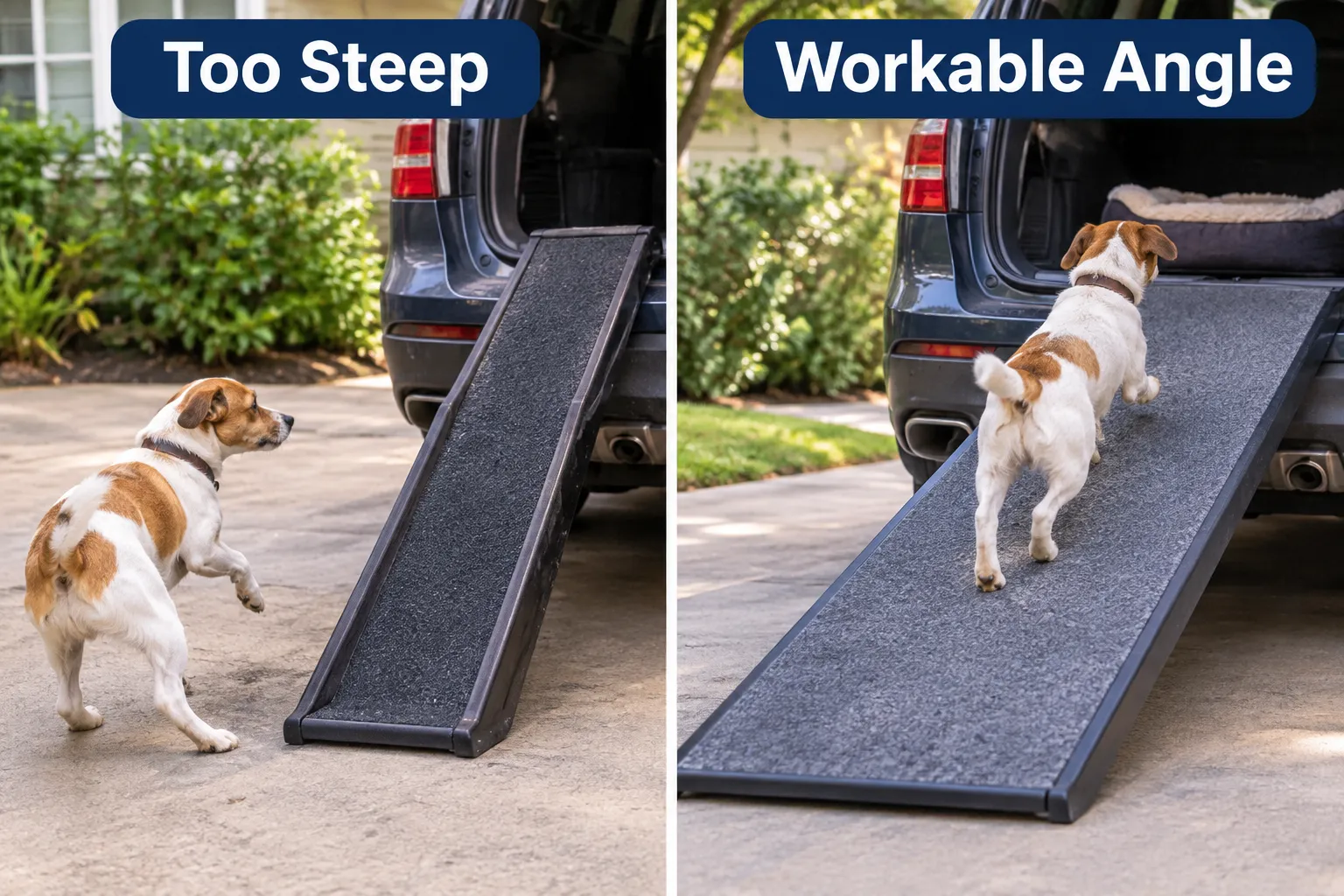
- Slipping at the ground end: check for rubber or textured feet at the base. A ramp resting on a smooth driveway or garage floor without grippy feet can slide forward when a dog’s weight lands on it.
- Slipping at the vehicle end: this is what Nissan’s current pet-travel guidance addresses by recommending a tether to the vehicle’s center D-ring, securing the top of the ramp so it cannot shift away from the bumper or tailgate mid-crossing.
- Slipping underfoot: a surface that has worn smooth after months of use needs either a replacement traction mat or a full ramp replacement, since re-texturing a worn fabric surface rarely holds up long term.
Do I actually need a dog car ramp
Not every dog needs a ramp. A healthy, agile dog with no joint issues who already jumps into a low trunk without hesitation generally does not need one, and adding a ramp in that case may create more hesitation than it solves, since some dogs find an unfamiliar moving surface more intimidating than a jump they already know how to make confidently.
Signs a the ramp use is worth adding:
- The dog hesitates, paces, or whines before jumping into the vehicle.
- The dog has a known or suspected joint condition, recent surgery, or is a breed prone to back or hip issues.
- The dog is a puppy under the age recommended for repeated jumping onto hard surfaces, or a senior showing reduced hind-limb strength.
- The vehicle in question has an unusually high sill height for a smaller or lighter dog.
Signs a ramp is probably unnecessary:
- The dog jumps in and out without any sign of discomfort, stiffness afterward, or avoidance behavior.
- The vehicle is low enough (a sedan trunk or hatchback, for example) that the jump distance is minor.
- The dog shows more stress around the ramp itself than around jumping, even after a fair training attempt.
Which Pick Fits Which Dog and Owner?
A household with a tall three-row SUV and a 90-pound dog needs length first. The Pawaboo’s 74-inch run gets closer to that 25-degree target at taller sill heights than a 60-inch ramp ever could, and the extra width gives a large dog room to plant all four paws without walking a tightrope.
A household juggling a sedan one week and a rented SUV the next benefits from a telescoping design. The PetSafe Happy Ride Telescoping Dog Ramp, Extra Long extends for the taller vehicle and retracts for the shorter one, which matters more than most spec sheets admit.
Budget pick: the The ramp Truck 63″ L × 17″ W fits owners with a mid-height SUV or truck bed and a dog under roughly 100 lb who don’t need the extra width or length of the pricier options. It is not the right the ramp use by a senior dog needing a gentle 18-degree climb, but for a healthy adult dog and a tight budget, it covers the basics.
Small dogs under 25 lb often do better with a narrower, lighter ramp they can be guided up on leash, while large and giant dogs need the width to feel stable and the length to avoid a steep pitch. Individual variation matters here. Two Labradors the same age can have very different comfort levels with an incline, and that’s worth watching rather than assuming from breed alone.
Things to Watch Out For
A ramp that advertises “fits all SUVs” is describing the ramp’s reach, not your vehicle’s actual geometry. Measure the sill yourself before buying. A ramp that looks sturdy in product photos can still flex in the middle under a 70-pound dog if the internal supports are thin aluminum rather than reinforced frame rails.
Check the lip at the top of the ramp, the part that rests against the bumper or tailgate edge. A lip that is too shallow can slip off a rounded bumper mid-crossing. A lip that is too tall can catch a dog’s back paws on the way up, which is a common and avoidable cause of a dog stumbling right at the top.
Wet grip and dry grip are not the same test. A texture that feels grippy to a dry human hand in a store aisle can turn slick within seconds of a rained-on paw. If a listing does not mention wet-weather performance, assume it was not tested for it, and plan to add a traction mat for rainy-season use.
Who Should Skip This
A small, agile dog with no joint issues who already hops into a low sedan trunk without hesitation does not need a the ramp trips. A set of pet stairs, or nothing at all, may serve that dog better, since ramps can actually be harder than stairs when the vehicle height forces a steep angle.
A dog with severe anxiety around moving or flexible surfaces may need stairs with solid, fixed steps rather than a ramp that gives slightly underfoot. And an owner whose only storage option is a trunk already packed with a stroller, crate, and cooler should measure folded length against real remaining space before buying any 70-plus inch ramp, telescoping or not.
Owners choosing a harness for the ride itself might also want to check the dachshund-safe harness guide if back-health concerns extend beyond the ramp into how the dog is secured in the vehicle. For general mobility and training basics, 5 essential commands every puppy should learn covers the foundational cues that make ramp training go faster.
Frequently Asked Questions
How steep is a folding dog ramp at your vehicle’s sill height? It depends on both numbers together. A 30-inch SUV floor with a 42-inch ramp creates roughly a 46-degree angle, while the same floor height with a 72-inch ramp drops to about 25 degrees. Measure your actual sill height and divide by the ramp’s full length to estimate the angle before buying, or use the calculator near the top of this guide.
What grip and width will a dog need to use the ramp? Width and slip resistance are two of the core features a safe ramp needs, alongside a gentle incline and a sturdy frame. Wider ramps, generally 17 inches or more, give large dogs room to walk without straddling the edges, and textured or rubberized surfaces perform better than smooth vinyl in wet conditions.
What is the best angle for a dog ramp? Orthopedic guidance treats 20 to 25 degrees as a workable target for many healthy adult dogs. Dogs with arthritis, recent surgery, or neurologic weakness do better closer to 18 degrees or less, which usually means choosing the longest ramp that still fits your storage space.
What size dog ramp do I need for my car? Measure your vehicle’s sill height from ground to trunk floor, then multiply by 2.5 to 3 for a healthy adult dog, or by 4 to 5 for a senior or recovering dog. A 30-inch SUV generally needs a 72 to 75 inch ramp to stay near 25 degrees.
How much do dog car ramps typically cost? Most fold out between $40 and $150, with telescoping or heavy-duty models reaching $150 to $250. Price tracks length, frame material, and weight capacity more closely than brand reputation.
Can senior dogs safely use a the ramp trips? Yes, but they generally need a lower angle, around 18 to 20 degrees or less, plus a wider and more stable platform than a younger, healthy dog requires. A vet check beforehand helps confirm the specific mobility issue driving the need.
My dog won’t use the ramp. What should I try first? Recheck the angle first, since many refusals trace back to a ramp that is simply too steep for the vehicle. If the angle checks out, test for wobble in the middle and add a traction mat before assuming the dog dislikes ramps in general.
Is a ramp or a set of stairs better for my dog? Ramps tend to work better for dogs with joint pain, weakness, or recent surgery, since they avoid repeated step-ups. Stairs tend to work better for tall vehicles where a storable ramp cannot reach a safe angle, or for small, agile dogs managing individual steps comfortably.
Do I actually need a dog ramp for my car? Not necessarily. A healthy dog that already jumps in and out without hesitation or stiffness afterward usually does not need one. Signs that a ramp helps include visible hesitation before jumping, a known joint condition, or an unusually tall vehicle for the dog’s size.