
Quick Answer
A this detangler spray is a leave-in conditioning mist that reduces friction between hair strands so a comb or slicker brush can move through light knots without pulling skin. It works well on loose tangles with space between the knot and the body, but it will not dissolve a mat that is already fused tight to the skin. For that kind of mat, a groomer or clippers are the safer route.
Key Takeaways
- Chewy’s grooming guidance recommends letting detangler sit about one to two minutes before combing, not spraying and pulling through right away.
- A light tangle is workable at home when there’s ample space between the knot and the skin, according to grooming guidance from Artero.
- Betterpet warns against cutting mats out with scissors, since skin can get caught in the knot along with the fur.
- TropiClean This detangler spray Dematting, 16oz, runs $15 to $20 and works as a leave-in conditioner for routine brushing between baths.
- Chris Christensen Ice on Ice, 16oz, runs $20 to $30 and is built as a no-residue finishing spray for show coats and polished pet coats.
- BioSilk Silk Therapy Dog Detangler, 8oz, is the budget pick at under $15, aimed at everyday light-tangle maintenance.
- Furry Critter’s grooming reference recommends line brushing, working in small sections close to the skin, since tangles can tighten further once the coat gets wet.
- The American Kennel Club’s grooming guide notes that regular brushing between full grooming sessions is what actually prevents mats from forming in the first place.

Affiliate disclosure
This post contains affiliate links. If you buy through one we may earn a commission at no extra cost to you. As an Amazon Associate I earn from qualifying purchases.
What is dog detangler spray and how does it work?
A this detangler spray is a light, leave-in liquid, usually built around silicone or botanical conditioning agents, that gets misted onto a dry or slightly damp coat before brushing. The slip agents coat each hair strand so they slide against each other instead of catching, which lets a comb or slicker brush pass through loose knots with less pulling.
That’s the entire function. A this detangler spray does not dissolve keratin bonds in a mat, it does not clean the coat the way a shampoo does, and it won’t shrink a mat that’s already compacted against the skin. What it does is cut friction enough that a light, loose tangle separates instead of tightening further as you brush.
The AKC’s guide to grooming challenges points out that mats most often form in high-friction spots: behind the ears, in the armpits, around the collar line, and at the base of the tail. These are the same zones where a this detangler spray earns its keep on maintenance days, because catching a knot early in one of these spots is a two-minute job, not a twenty-minute one.
The FDA’s guidance on animal grooming products draws a useful line: products meant only to cleanse or beautify a coat are generally treated as cosmetics, not drugs, while anything that claims to treat a skin condition falls into a different regulatory category. In plain terms, a this detangler spray is a grooming tool. If a bottle promises to cure dermatitis or stop itching, that’s a different kind of product, and the claim deserves a second look before you buy.
Best dog detangler spray for thick matted hair
For thick, dense coats that mat often (think Great Pyrenees, Old English Sheepdog, or a doodle with a dense undercoat), a leave-in dematting formula with higher slip, like TropiClean’s Detangling & Dematting Tangle Remover, is the better starting point than a light finishing spray. It is not a mat remover in the sense of dissolving a tight knot, but it adds enough slip to work through moderate, loose tangles across a dense undercoat before they compact further.
For dogs whose coats mat weekly regardless of brushing frequency, a few practical notes help:
- Apply the spray section by section rather than all over at once. A thick coat dries out before you finish brushing if you spray the whole body up front.
- Use a slicker brush or wide-tooth metal comb, not a plastic comb, which tends to skip over denser fur without separating it.
- If a section is still resistant after two spray-and-comb attempts, stop. That’s usually a sign the tangle has moved from “light” to “needs a groomer.”
- Products marketed specifically for dematting, like the CHI Detangling Finishing Dog Spray, often include more conditioning oils than a basic finishing mist, which helps on denser coats but also means more buildup if overused.
Edge case: double-coated breeds (Huskies, Shepherds) rarely form true mats the way curly or wavy coats do, but they can develop dense “tangled” undercoat clumps during shedding season. A this detangler spray combined with an undercoat rake works better here than brushing alone.

Can you use human detangler spray on dogs?
Human hair detangler spray is not recommended for dogs because of pH differences and fragrance or alcohol content that can irritate canine skin. Dog skin sits at a different pH than human skin, generally more neutral to slightly alkaline, and repeated use of human hair products can dry it out or trigger irritation over time.
Beyond pH, many human detanglers contain fragrance concentrations and preservatives that are fine for a scalp but not formulated with a dog’s more sensitive skin barrier in mind. If a dog ingests residue while licking its coat, which is common, some of those additives (certain essential oils, for example) can cause stomach upset.
The safer rule: use a product labeled specifically as a this detangler spray, even if it costs a few dollars more than a bottle already sitting in the bathroom. Brands built for dogs, including DOUXO’s Skin & Coat SPA Detangling Spray, are formulated around a dog’s skin pH and tend to skip the fragrance load found in human products.
Dog detangler spray vs conditioner: which is better?
A this detangler spray is built for quick, on-the-spot slip before brushing, while a conditioner is a rinse-out product applied during a bath to soften the whole coat. They solve different problems and work well together rather than as substitutes for each other.
Here’s the practical difference:
- Conditioner rinses out, meaning it conditions the coat during the bath but leaves nothing behind for brushing dry fur three days later.
- This detangler spray stays on the coat (it’s a leave-in), meaning you can use it between baths, right before a brushing session, on dry or lightly misted fur.
- Dogs with coats that mat often typically need both: a good rinse-out conditioner at bath time, plus a leave-in this detangler spray for the days in between.
Decision rule: choose a conditioner if your main goal is overall coat softness and shine after a bath. Choose a this detangler spray if your main goal is getting through a dry brush-out three or four days after the last bath without snagging knots. For dogs with coats that tangle fast, like many doodles, running both routines is standard practice among groomers, not overkill.
How to use dog detangler spray properly
The correct method is to spray the affected section, let it sit for roughly one to two minutes, then comb from the base of the knot outward in small strokes, working closer to the skin as the tangle loosens. Skipping the wait time is the single most common reason people think their spray “isn’t working.”
Step by step:
- Check the coat dry, before a bath, so you know where the knots are before water tightens them further.
- Section the coat with your fingers, working on one small area (about the size of your palm) at a time.
- Spray the this detangler spray directly onto the section, covering the knot and a little surrounding fur.
- Wait one to two minutes. Chewy’s grooming guidance specifically calls out this dwell time as the difference between a spray that works and one that seems to do nothing.
- Hold the base of the knot near the skin with one hand (this protects the skin from pulling) and comb from the tip of the hair downward with a wide-tooth comb or slicker brush.
- If the knot loosens, switch to finer brushing strokes. If it doesn’t move after two gentle attempts, stop and reassess rather than forcing it.
- Move to the next section. Furry Critter’s line brushing method is worth following here, working close to the skin in layers rather than brushing the surface only.
Common mistake: spraying once, over the whole body, and brushing immediately. That approach skips the dwell time and treats a this detangler spray like a leave-in shine mist instead of a working product.
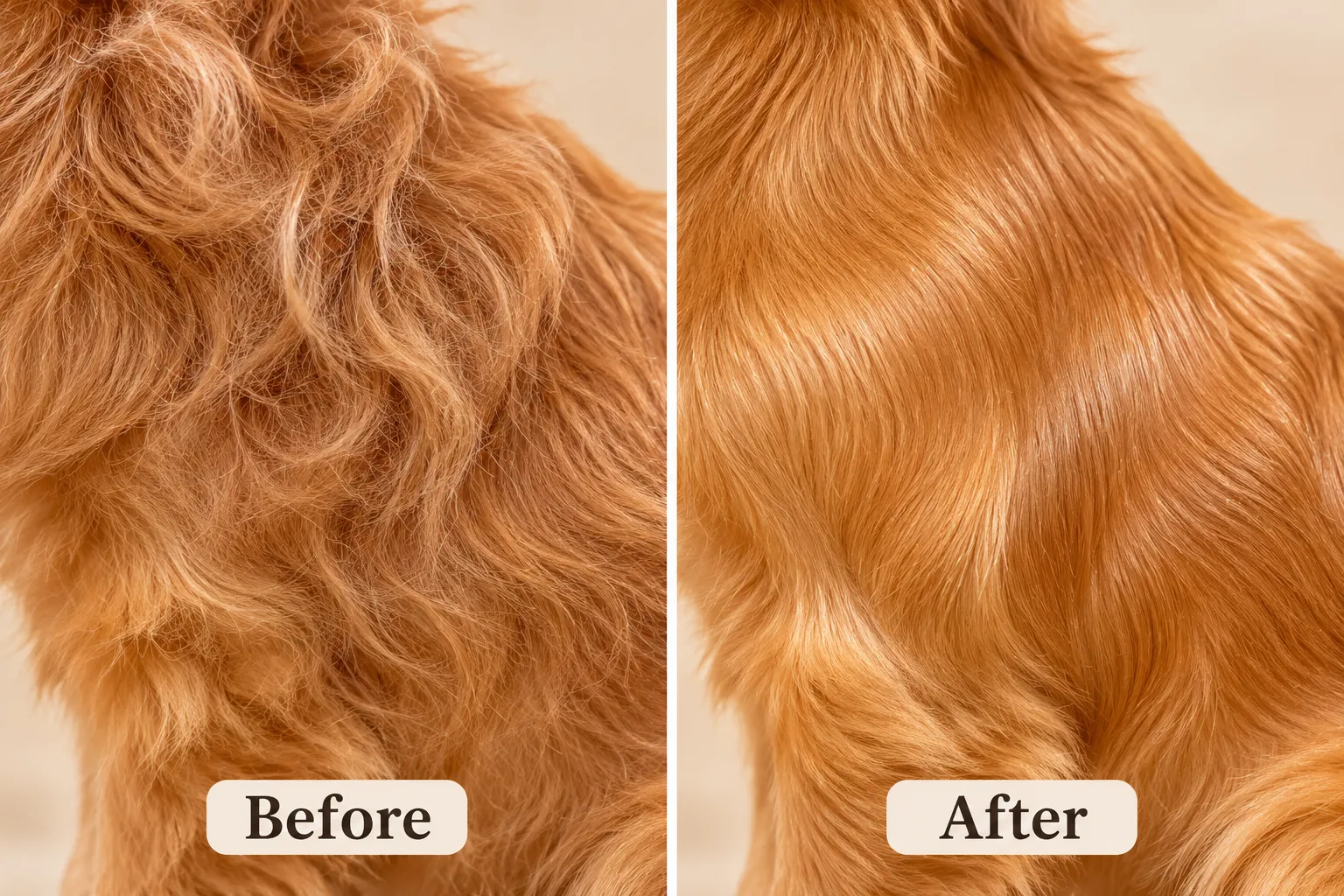
Does dog detangler spray actually work on mats?
A this detangler spray works on loose, light tangles but does not work on mats that are already matted tight to the skin. The product adds slip, not solvent power, so a knot that has compacted into a dense, felted clump simply will not separate no matter how much spray or how long you wait.
The practical test, per Artero’s grooming guidance, is space: if you can slide a finger or the end of a comb between the knot and the skin, it likely qualifies as a light tangle that a this detangler spray can help with. If the mat sits flush against the skin with no visible gap, spraying it and brushing is more likely to pull skin than to loosen hair.
Example: a dime-sized knot behind the ear that’s a day or two old, with visible space underneath, is a reasonable spray-and-comb candidate. A golf-ball-sized mat in the armpit that’s been there two weeks and sits flush to the skin is not. That one needs a groomer, and possibly clippers, not a spray bottle.
Doggy Rank IQ Tool
Dog Mat Triage Tool

Detangler works on light tangles. Describe the mat and get an honest call before you hurt the dog.
Options for Light Tangles
For light tangles, the realistic shortlist is small: a conditioning leave-in spray, a slicker brush or wide-tooth comb, and a few minutes of patience per section.
Three products cover most light-tangle needs for home groomers. TropiClean This detangler spray Dematting{:rel=”sponsored nofollow”} is built as a leave-in conditioner meant for routine brush-outs on wavy or curly coats. Chris Christensen Ice on Ice Detangler and Finishing Spray{:rel=”sponsored nofollow”} is a no-residue finishing product, the kind used after a bath to help the brush glide without leaving the coat greasy. BioSilk Silk Therapy Dog Detangler{:rel=”sponsored nofollow”} is a lighter-duty everyday spray, useful for quick touch-ups between full grooming sessions.
The decision rule: pick a leave-in dematting formula if you’re brushing a doodle-type coat several times a week, pick a no-residue finishing spray if you bathe the dog first and want shine without buildup, and pick a lighter everyday spray if your dog’s coat rarely tangles and you just need occasional help.
A common mistake is treating any of these three as a mat remover. A tangle only qualifies for home detangling when there’s ample room between the knot and the skin. If the knot pulls at the skin when you lift it, spray won’t fix that, no matter how good the formula is.
Top 5 Features That Decide the Purchase
The five features that actually matter are slip, residue, scent strength, leave-in safety, and bottle size for your coat length.
- Slip (how easily a comb glides through wet or dry fur): TropiClean’s dematting formula is built specifically around this, which matters most for doodle coats that knot daily.
- No residue after drying: Chris Christensen Ice on Ice markets itself on leaving zero film behind, a real consideration if your dog’s coat gets oily or dull-looking after other sprays.
- Scent strength: BioSilk’s Silk Therapy line is lighter on fragrance, a reasonable pick if your dog reacts to strong perfume during grooming.
- Leave-in safety: all three named products are formulated to stay on the coat rather than rinse out, which matters because a rinse-out product won’t help with dry brushing between baths.
- Price per ounce for coat length: a long-haired collie or doodle burns through spray faster than a short-coated dog, so bottle size changes the real cost over a year.
Comparison table
| Product | Price Band | Best For | Key Trait |
|---|---|---|---|
| BioSilk Silk Therapy Dog Detangler | Under $15 (8 fl oz) | Occasional light tangles | Light scent, budget pick |
| Chris Christensen Ice on Ice | $20 to $30 (16 oz) | Post-bath finishing, all coat types | No residue, made in USA |
| TropiClean This detangler spray Dematting | $15 to $20 (16 oz) | Doodle and curly coats, daily brushing | Leave-in conditioner formula |
Dog detangler spray price and where to buy
A this detangler spray typically costs between $6 and $30 depending on formula and bottle size, with most mid-range options sitting between $12 and $20 for a 12 to 16 ounce bottle. Everyday sprays sit at the low end, premium finishing sprays sit at the top, and the middle covers most leave-in dematting formulas.
Where to buy: Chewy and Amazon carry the widest selection with regular subscription discounts, and most pet retail chains stock at least one or two options in store. Specialty formulas aimed at sensitive skin, like DOUXO’s Skin & Coat SPA Detangling Spray, are more commonly found through veterinary retailers or online pharmacies rather than big-box pet stores. Professional-grade dematting tools, such as the Heiniger ProGroom Easy Comb Detangler, are usually sold through grooming supply sites rather than general pet retailers, since they’re built around clipper-adjacent dematting work rather than home spray-and-comb routines.
Decision rule: buy the smaller 8oz bottle if you’re testing a new formula on a dog with sensitive skin, and buy the 16oz size if you already know the formula works and you brush multiple times a week.
Dog detangler spray for sensitive skin dogs
For dogs with sensitive skin, allergies, or a history of reacting to scented grooming products, choose a fragrance-free or lightly scented this detangler spray and patch test it on a small area before full use. Alcohol-based sprays and heavily perfumed formulas are the most common triggers for irritation.
Practical steps for sensitive-skin dogs:
- Check the ingredient list for alcohol near the top, which can dry out already-irritated skin.
- Look for probiotic or oatmeal-based formulas, such as Skout’s Honor Probiotic Dog of the Woods Dog Detangler, which are built with skin barrier support in mind rather than just slip and shine.
- Apply a small test spray behind one ear and wait 24 hours before using it across the whole coat.
- If redness, scratching, or hives appear after a new spray, stop using it and consult a veterinarian, since the reaction may point to a broader allergy rather than just the detangler.
Edge case: dogs already on a prescribed medicated shampoo for skin conditions should run any new this detangler spray by their vet first, since combining products can sometimes counteract the medicated formula’s intended effect.
Best dog detangler spray on Amazon
Among Amazon’s best-selling options, TropiClean This detangler spray Dematting, Chris Christensen Ice on Ice, and BioSilk Silk Therapy Dog Detangler consistently rank among the most purchased and reviewed in the category, each serving a different budget and coat type. Shoppers browsing Amazon’s pet grooming category will also see smaller, lesser-known brands with fewer reviews, which is worth noting since review count affects how much you can trust the listed performance claims.
When comparing listings on Amazon, check three things before buying: the bottle size relative to price (some listings quote per-unit price in a multi-pack, which skews the sticker price), the ingredient list for alcohol or heavy fragrance if your dog has sensitive skin, and whether the listing specifies “leave-in” versus “rinse-out,” since some detangling conditioners are mislabeled in search results.
Is dog detangler spray safe for puppies?
Most this detangler spray formulas are safe for puppies over 8 to 12 weeks old, but it’s worth checking the product label since some formulas are only labeled for adult dogs. Puppy skin is thinner and more reactive than adult dog skin, so a gentler, fragrance-light formula is the safer starting choice.
Practical guidance for puppies:
- Choose a product specifically labeled safe for puppies, or one with a short, simple ingredient list free of heavy fragrance and alcohol.
- Spray a small test patch first, the same way you would for a sensitive-skin adult dog, and watch for redness over the next day.
- Puppies rarely develop true mats unless they have a longer-coated breed background (Shih Tzu, Maltese, Yorkie puppies can mat early), so a light everyday spray like BioSilk is usually enough rather than a heavy-duty dematting formula.
- If you’re introducing grooming routines early, pairing a this detangler spray with calm, short brushing sessions helps puppies build a positive association with grooming tools before adult coat changes bring more tangling.
Things to Watch Out For
The biggest risk with any this detangler spray is using it as a substitute for actually checking the mat before you spray.
- Spraying over a tight mat and brushing anyway can pull the skin along with the knot, which is exactly the injury Betterpet warns against.
- A detangler spray that “isn’t working” is often a sign the tangle has moved past light-tangle territory, not a bad bottle.
- Fragrance-heavy formulas can irritate dogs with sensitive skin or known allergies, so check the ingredient list if your dog reacts to scented shampoos.
- Letting the spray sit before combing matters. Chewy’s grooming guidance suggests roughly one to two minutes of dwell time before working the coat, not an instant brush-through.
- Wet tangles can tighten further during bathing, according to Furry Critter’s grooming reference, so check for knots before the bath, not just after.
Dog detangler spray common mistakes to avoid
The most common mistake is spraying a knot once and immediately yanking a comb through it, which tightens the mat and pulls skin instead of loosening the tangle. A few others show up consistently in home grooming:
- Overspraying the whole coat at once. This wastes product and lets the spray dry out on sections you haven’t reached yet, losing most of its slip effect.
- Using a fine-tooth comb on a thick, matted area. A wide-tooth comb or slicker brush is built for working through resistance; a fine comb just gets stuck and frustrates both the dog and the owner.
- Skipping the pre-bath check. Water tightens existing tangles, so a knot that was manageable dry can become a genuine mat after a bath.
- Brushing only the top layer of the coat. Surface brushing looks clean but leaves mats forming closer to the skin undetected until they’re large.
- Relying on spray alone for a dog that mats weekly. If this describes your dog, the actual fix is a more frequent brushing schedule, not a stronger spray formula.
How often should you use dog detangler spray?
Most dogs with coats prone to tangling benefit from a this detangler spray applied before each brushing session, typically 2 to 4 times per week for curly or wavy coats and once a week or less for short, straight coats. Over-application beyond what’s needed for brushing can leave a slight residue buildup over time, especially with heavier conditioning formulas.
Guidelines by coat type:
- Doodle, Poodle, or curly-coated breeds: 3 to 4 times weekly, aligned with a regular brushing schedule, since these coats tangle fastest.
- Long, straight coats (Collies, Shih Tzus): 1 to 2 times weekly, focused on known problem spots like behind the ears and the tail base.
- Short-coated breeds: occasional use only, mostly after a bath or during seasonal shedding when loose fur tends to tangle with new growth.
- Double-coated breeds during shedding season: increase frequency temporarily, since loose undercoat tends to mat into the top coat more during heavy shed periods.
Who Should Skip This
Skip a this detangler spray, at least as a standalone fix, if the tangle is already tight to the skin, inflamed, or older than a couple of weeks.
- Dogs with mats pulling at the skin: a tangle tightly attached to the skin isn’t a home detangling job, according to standard grooming guidance.
- Dogs with redness, wounds, dampness, or suspected parasites under the coat: that calls for a professional or veterinary look, not a spray bottle.
- Owners hoping a spray will replace regular brushing: no formula substitutes for a weekly brush-out on a doodle or long-coated breed. For a general refresher on routine coat care, see this beginner’s guide to dog grooming.
- Dogs with known sensitivities to fragrance or alcohol-based sprays: check labels and consider an unscented formula, or test on a small patch first.
Drawback worth stating plainly: all three named products here are conditioners, not mat-dissolving treatments. None will cut your grooming time on a dog that’s already matted. If your dog’s coat is a tangle minefield every week, the real fix is more frequent brushing, not a stronger spray.
Alternatives to dog detangler spray for matted fur
For mats that a this detangler spray can’t handle, the realistic alternatives are a mat-splitting comb, clippers for severe mats, or a professional groomer visit. Each fits a different severity level.
- Mat splitter or dematting comb: tools like the Heiniger ProGroom Easy Comb Detangler are built with blades that section through a mat gradually, useful for moderate mats that spray alone can’t loosen but that aren’t severe enough for clippers.
- Clippers: for mats fused tight to the skin, a groomer will typically clip the mat out entirely rather than risk pulling skin with a comb. This is standard practice and not a failure on the owner’s part, it’s simply the safer option once a mat passes a certain density.
- Professional groomer visit: for dogs with multiple mats, mats near sensitive areas (groin, armpits, between toes), or any mat accompanied by skin irritation, a groomer visit is the safer and often faster route compared to hours of at-home work.
- Preventive alternative: for dogs that mat weekly despite spray use, switching to a shorter trim (common for doodles) reduces how often serious mats form in the first place, which is often more cost-effective long term than repeated detangling sessions.
For owners weighing a shorter cut against continued detangling work, the AKC’s spring grooming guide is a useful reference point on seasonal coat management.
Dog detangler spray making hair worse: what to do
If a this detangler spray seems to be making the tangle worse, stop combing immediately and reassess the mat rather than applying more product or brushing harder. In most cases, this happens for one of a few reasons:
- The tangle was never a light tangle. If there’s no gap between the knot and the skin, spray will not loosen it, and continued brushing just works the knot tighter.
- Too much product was applied. Oversaturating a mat with spray can actually make hair clump together more as it dries, especially with thicker conditioning formulas.
- The coat was brushed in the wrong direction. Combing from the skin outward on a tight knot pulls the mat closer to the skin instead of working it loose from the tip inward.
- The dwell time wasn’t enough, or was too long. Letting spray sit for more than a few minutes on some formulas can cause it to dry before brushing, undoing the slip effect entirely.
If none of these explain the issue and the tangle genuinely seems to be worsening, it’s a sign to stop home treatment and move to a groomer. Continuing to work at a resistant mat risks a condition called “pelting,” where the entire coat starts matting into a single connected layer, which is far more serious and time-consuming to fix than a few isolated knots.
FAQ
What is the best detangler spray for dogs?
There’s no single best option across every coat type. For routine doodle maintenance, TropiClean’s leave-in dematting spray is a solid starting point. For finishing touches after a bath, Chris Christensen Ice on Ice is built for that, and for occasional light tangles on a budget, BioSilk Silk Therapy covers the basics.
How do you detangle a matted doodle coat at home?
Work in small sections about palm-sized, spray the this detangler spray directly onto the knot, wait one to two minutes, hold the base of the knot near the skin, and comb from the tip of the hair downward with a wide-tooth comb. If a section doesn’t loosen after two gentle attempts, move on and plan a groomer visit for that spot rather than forcing it.
Can I make my own dog detangler spray at home?
A simple homemade version combines water with a small amount of leave-in dog conditioner, but it won’t match the slip or shelf stability of a purpose-built product. For occasional light tangles this can work as a stopgap, but for regular use, a labeled this detangler spray is more reliable and tested for canine skin pH.
Does dog detangler spray expire?
Most bottles last 2 to 3 years unopened and about a year once opened, similar to other leave-in conditioning products. Check the label for a batch code or expiration date, and discard any spray that smells off or has separated, since the conditioning agents can break down over time.
Is it safe to use dog detangler spray every day?
Daily use is generally safe for dogs with coats that tangle fast, like doodles, as long as the formula doesn’t contain heavy alcohol or fragrance. For dogs with short or straight coats that rarely mat, daily use is unnecessary and may lead to minor product buildup over time.
What’s the difference between a detangler and a dematting spray?
A detangler is usually meant for light, loose knots and everyday maintenance, while a dematting spray is formulated with extra slip agents specifically for coats that mat more frequently, like curly or dense double coats. Products labeled as dematting, such as TropiClean’s, tend to work slightly harder on moderate tangles than lighter everyday detanglers.
Can dog detangler spray cause skin irritation?
Yes, particularly formulas with high alcohol content or strong fragrance, which can dry out or irritate sensitive skin. Patch testing a new spray on a small area and watching for redness over 24 hours is the simplest way to catch a reaction before using it across the whole coat.
How much should I expect to spend on dog detangler spray per year?
For a doodle or curly-coated dog brushed several times weekly, expect to go through roughly two to three 16oz bottles per year at $15 to $25 each, putting annual cost in the $30 to $75 range. Short-coated dogs using spray occasionally will spend far less, often under $15 a year.