
This post contains affiliate links. If you buy through one we may earn a commission at no extra cost to you. As an Amazon Associate I earn from qualifying purchases.
Quick Answer
The best dog ear cleaner for routine care is a plain, pH-balanced liquid flush or wipe used on a calm, non-infected ear, not a treatment for pain, swelling, or dark discharge. Liquids clear wax from the deeper canal and suit floppy-eared or water-loving dogs, while wipes handle quick outer-ear touch-ups for erect-eared breeds or light maintenance between full cleanings. If an ear is red, smelly, or painful, skip the cleaner and call a vet before anything goes in that canal.
Key Takeaways
- Virbac’s Epi-Otic Advanced was named a top routine pick by PetMD veterinarian Veronica Higgs, DVM, listed at $21.99 on Chewy in PetMD’s ear cleaner guide.
- Vetnique Labs OticBliss Wipes run about $18.99 and clean the outer ear but cannot reach the deeper horizontal canal the way a liquid flush can.
- Veterinary Formula Clinical Care Ear Therapy costs roughly $1.50 per ounce by independent price comparisons, making it a workable budget pick for fragrance-sensitive dogs.
- TrizULTRA + Keto Flush ($23.18) and prescription T8 Keto Flush ($29.84) are built for recurrent yeast problems, not everyday maintenance.
- VCA Animal Hospitals and Cornell’s Riney Canine Health Center both describe routine ear cleaning as a maintenance habit, separate from treating an active infection.
- Price bands for routine liquids run roughly $14 to $22 for mainstream veterinary brands and $9 to $14 for lower-cost options.
- The American Kennel Club recommends checking ears weekly even if you’re not cleaning them every time.
Affiliate disclosure
Some links in this article are affiliate links. If you buy through them, this site may earn a commission at no extra cost to you. Picks are chosen by fit for routine home care, not by commission size.

Best dog ear cleaner
The best dog ear cleaner for most households doing routine grooming at home is a gentle, alcohol-light liquid flush or a wipe product labeled for maintenance, not a product marketed to fix infection, odor, or itching. Those are different categories, and mixing them up is the single most common mistake owners make at the shelf.
A plain cleaner’s job is simple: loosen wax, carry off dirt and moisture, and leave the canal slightly dry. Ingredients like salicylic acid and docusate sodium show up across routine formulas because they soften debris without doing much else. That is the whole point. A healthy ear does not need an antifungal, an antibiotic, or a prescription strength anything.
The trap is using a plain cleaner on an ear that is not healthy. An ear that’s red, hot, swollen, foul-smelling, or painful to touch has moved past routine maintenance and into “see a vet.” Pouring liquid into that ear weekly does not fix the underlying problem and can make the dog dread the whole process. VCA Animal Hospitals and Cornell’s veterinary school both frame ear cleaning as a maintenance task performed on a comfortable ear, with a professional exam recommended when pain, odor, or discharge appear. The best dog ear cleaner on the market cannot substitute for that exam. No bottle does.
So the real first question is not “which brand.” It’s “is this ear actually fine.”
What is a dog ear cleaner and how does it work
A best dog ear cleaner is a liquid or wipe formula designed to loosen wax, dissolve debris, and dry out moisture in the ear canal without medicating the tissue underneath. Most routine formulas rely on a cerumenolytic agent (something that breaks down wax) paired with a drying agent, and nothing stronger.
Here’s the mechanism in plain terms:
- Cerumenolytic ingredients like docusate sodium or salicylic acid soften hardened wax so it can be flushed or wiped away instead of scraped out.
- Drying agents such as isopropyl alcohol or boric acid evaporate quickly, leaving the canal less hospitable to the yeast and bacteria that thrive in moisture.
- pH-balancing keeps the formula close to the ear’s natural chemistry so it does not sting healthy tissue.
None of this treats infection. A medicated otic product contains an antifungal (like miconazole), an antibiotic, or a steroid, and those require a vet’s direction because using the wrong one on the wrong organism can make things worse. MSD’s veterinary manual notes that otitis externa treatment depends on identifying whether bacteria, yeast, mites, or a foreign body are driving the problem, which is why guesswork at home with a medicated product rarely works out.
Doggy Rank IQ Tool
Ear Check Before Any Cleaner

Cleaner is for healthy ears. Answer what you see and we tell you whether to pour anything in today.
Liquids and Wipes for Routine Care
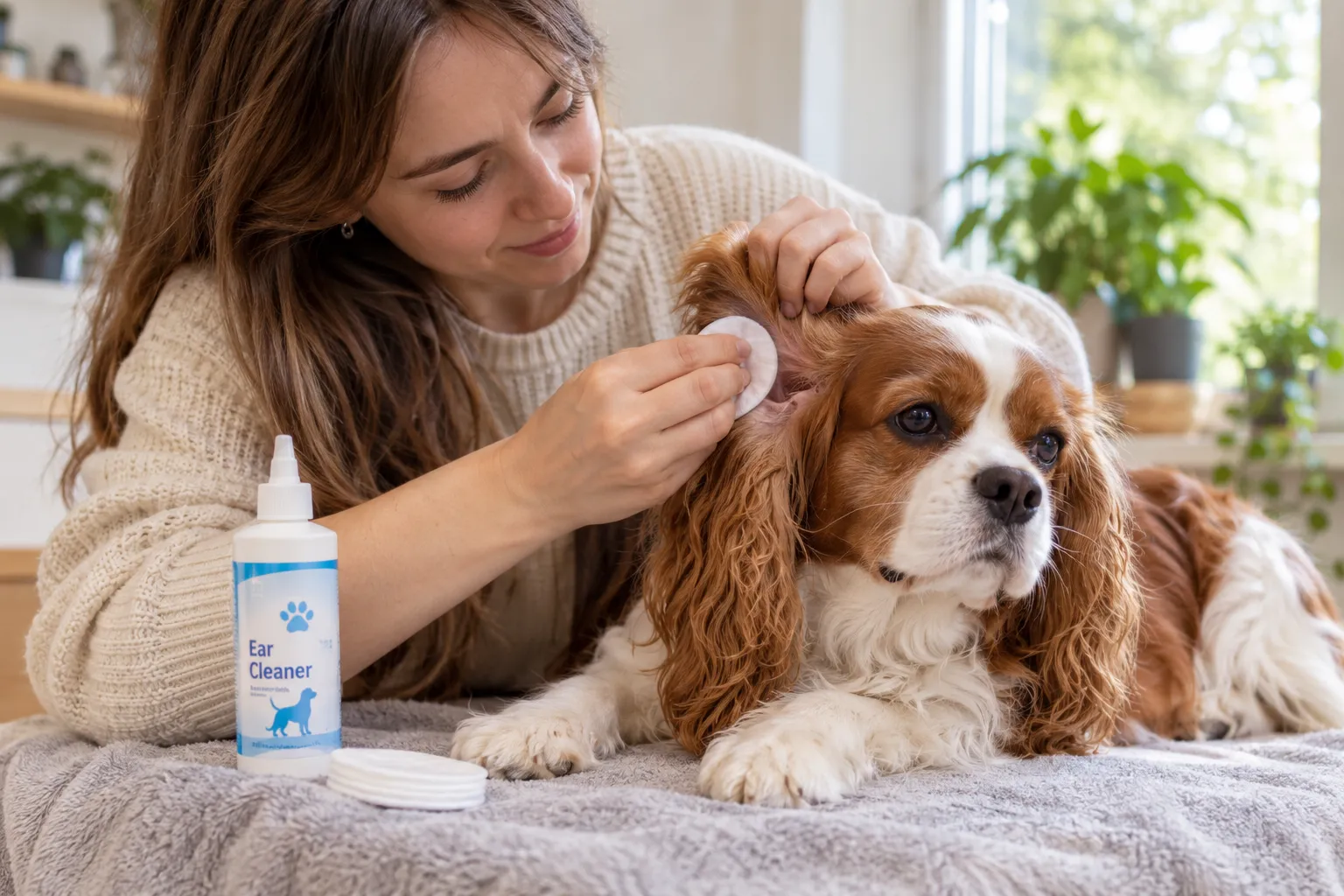
Liquids and wipes solve different problems, and knowing which one your dog needs saves money and frustration. A liquid flush reaches into the horizontal canal; a wipe cleans what you can see and reach with a finger.
Liquids work by gravity and massage. You fill the canal, massage the base of the ear until you hear a squelch, then let the dog shake and wipe the loosened debris from the outer ear. Vetoquinol Ear Cleansing Solution, at $16.98, pairs well with dogs who swim or bathe often, since its aloe and salicylic acid combination helps dry the canal after water exposure. The denatured alcohol in that formula is a point against it for inflamed or very sensitive ears, so check the label if your dog has a history of flare-ups.
Wipes are the grab-and-go option. Vetnique Labs OticBliss Wipes ($18.99) and HICC Pet Ear Relief Finger Wipes ($14.98 for 50, about $0.30 per wipe) both target the visible flap and canal opening. HICC’s five-inch finger format was noted for being easier to grip than small circular pads, which matters more than it sounds like once you’re wrestling a squirmy terrier. Neither wipe replaces a liquid flush for a dog with deep wax buildup; they’re a maintenance tool between fuller cleanings, not a substitute for one.
Dog ear cleaning wipes earn their keep for quick touch-ups after a muddy walk or a grooming session, while a dog ear cleaning solution does the heavier lifting for dogs prone to wax or moisture. If you’re setting up a full home grooming routine, our beginner’s guide to dog grooming covers how ear care fits alongside nail trims and brushing.
Dog ear cleaner vs ear wipes: which works better
Liquid cleaners work better for actual wax removal and moisture control in the canal; wipes work better for speed, portability, and light maintenance on the outer ear. Neither one is universally “better,” since they’re built for different jobs.

Choose a liquid if:
- Your dog has floppy ears that trap moisture.
- You can see or smell wax buildup.
- Your dog swims, bathes frequently, or lives somewhere humid.
Choose a wipe if:
- You’re doing a quick check after a walk or grooming session.
- Your dog tolerates a damp cloth far better than liquid poured into the ear.
- The ear looks clean and you just want to confirm it, not deep-clean it.
A common middle ground: use a liquid flush every one to two weeks for maintenance, and wipes in between for spot checks. That combination covers both the deep canal and the visible flap without over-handling the ear daily.
Top 5 Features That Decide the Purchase
The label tells you more than the marketing copy does. Here’s what actually matters when comparing bottles on a shelf or a product page.
- pH balance and alcohol content. Alcohol dries fast but can sting an irritated ear. Virbac’s Epi-Otic Advanced is alcohol-free and hydrogen-peroxide-free, which is part of why PetMD veterinarian Veronica Higgs listed it as her top routine pick.
- Active cerumenolytic ingredient. Docusate sodium and salicylic acid both show up repeatedly because they loosen wax without medicating the ear.
- Fragrance and dye. Independent testing flagged Epi-Otic Advanced for containing fragrance and blue dye, a detail worth knowing if your dog reacts to scented products. Veterinary Formula Clinical Care Ear Therapy is fragrance- and dye-free by comparison.
- Bottle and nozzle design. A long, narrow nozzle reaches the canal without forcing you to get your fingers in there. This sounds minor until you’re trying to aim liquid into a moving target.
- Format fit for the ear type. Wipes suit light maintenance and small dogs; liquids suit floppy-eared or water-loving dogs that build up wax faster.
Each of these shows up differently across named products, which is why the comparison table below separates them by format rather than brand loyalty.
Best dog ear cleaner brands compared
Among the mainstream brands sold through vets, Chewy, and Amazon, a handful show up consistently for routine care: Virbac (Epi-Otic line), Zymox, Vetoquinol, Vetnique Labs, and Veterinary Formula Clinical Care. Each targets a slightly different need.
- Virbac Epi-Otic Advanced is the vet-recommended standard for routine wax control, alcohol-free, priced around $20 to $25.
- Zymox Ear Cleanser uses an enzymatic formula without steroids or antibiotics, priced around $12 to $16, and is a solid everyday option for dogs without chronic ear issues.
- Vetoquinol leans on aloe and salicylic acid, good for water-exposed ears but contains denatured alcohol, so it’s less ideal for sensitive ears.
- Vetnique Labs OticBliss focuses on wipes rather than liquid, convenient but limited to outer-ear cleaning.
- Veterinary Formula Clinical Care is the budget, fragrance-free pick, often the cheapest per ounce among name brands.
None of these are interchangeable with medicated flushes like TrizULTRA + Keto or T8 Keto Flush, which are built for yeast-driven ear problems under a vet’s direction, not daily hygiene.
Comparison table: cleaner formats
| Product | Format | Price band | Key spec |
|---|---|---|---|
| EpiOtic Advanced Ear Cleanser | Liquid flush | around $20 to $25 | Alcohol-free, salicylic acid, docusate sodium |
| Pet MD Dog Ear Cleaning Wipes | Wipes, 100 ct | around $15 to $20 | Outer ear only, good for touch-ups |
| Zymox Ear Cleanser Solution | Liquid flush, 4oz | around $12 to $16 | Gentle enzymatic formula, no steroids or antibiotics |
None of these three are medicated flushes. They’re built for the ear that’s already healthy, which circles back to the sorter above: check the dimensions of the problem before checking the price of the bottle.
How much should dog ear cleaner cost
Routine best dog ear cleaner typically costs between $9 and $22 per bottle, with name-brand veterinary formulas sitting near the top of that range and generic or store brands near the bottom. Wipes usually run $15 to $20 for a 50 to 100 count pack, which works out to roughly $0.20 to $0.40 per wipe.
Medicated or prescription flushes cost more, often $23 to $30 per bottle, because they contain active antifungal or antimicrobial ingredients and are meant for a specific diagnosed problem rather than ongoing hygiene. If a product in that price range is being sold as a general-purpose cleaner, check the label for steroids or antibiotics before buying it for routine use.
For most households cleaning ears every one to two weeks, a single bottle of liquid cleaner lasts two to four months depending on dog size and ear shape, which puts the real monthly cost closer to $5 to $8.
Which pick fits which dog and owner?
The right best dog ear cleaner depends on your dog’s ear shape, water exposure, and sensitivity, not on which bottle has the flashiest label.

- Floppy-eared dogs (basset hounds, cocker spaniels, retrievers) trap moisture more easily and generally need a liquid flush weekly to every other week. EpiOtic Advanced fits this routine well given its gentle, alcohol-free profile.
- Dogs who swim or bathe often benefit from a drying-focused formula like Vetoquinol’s, though owners with sensitive-eared dogs should watch for irritation from its alcohol content.
- Erect-eared dogs (German shepherds, huskies) usually need monthly cleaning at most, and wipes like Pet MD’s can handle that lighter load without a full flush.
- Budget-focused owners grooming at home to save on salon trips should look at Zymox Ear Cleanser, priced around $12 to $16, as a straightforward option without steroid or antibiotic additives, suitable for ongoing maintenance rather than active infection.
- Fragrance-sensitive dogs do better with dye-free, unscented formulas; Veterinary Formula Clinical Care Ear Therapy is built for this at roughly $1.50 per ounce.
Choose the liquid if your dog has visible wax or regular water exposure. Choose the wipe if you’re doing quick maintenance between full cleanings or your dog genuinely cannot tolerate liquid in the ear. If you’re building a broader grooming station at home, our guide on how to clean dog teeth without brushing covers a similar at-home maintenance approach for another often-skipped routine.
Best dog ear cleaner for floppy eared dogs
The best dog ear cleaner for floppy-eared dogs is a liquid flush with drying properties, used weekly to every other week, because floppy ears trap heat and moisture against the canal in a way erect ears do not. Breeds like cocker spaniels, basset hounds, and retrievers are overrepresented in ear infection cases for exactly this reason.
For these dogs:
- Pick a formula with a drying agent (alcohol or boric acid) if the dog swims or bathes often, but check for irritation if the ear has a history of flare-ups.
- Pick an alcohol-free formula like EpiOtic Advanced if the ear tends toward sensitivity or redness after cleaning.
- Dry the outer flap thoroughly after any bath or swim, even on days you are not doing a full cleaning.
- Check weekly even if you clean less often, since floppy ears hide early signs of trouble under the flap.
A common mistake with floppy-eared breeds is cleaning only after a problem starts. By the time odor or discharge shows up, the infection is often already established, so the AKC’s recommendation of a weekly visual check matters more for this group than for erect-eared dogs.
My dog hates ear cleaning, how do I make it easier
Start slower than feels necessary: handle the ears without cleaning them first, reward calm behavior, and only introduce the actual cleaner once the dog accepts touch without flinching. Rushing the process is the single biggest reason ear cleaning turns into a wrestling match.
Practical steps that help:
- Desensitize first. Touch and gently lift the ear flap during calm moments (after a walk, before meals) with no cleaner involved, just treats and praise.
- Warm the liquid slightly. Cold liquid straight from the fridge or a cold garage shelf can startle a dog more than the process itself. Room temperature is fine.
- Use a towel wrap for small or squirmy dogs. A light towel burrito keeps paws out of the way without restraining the head tightly.
- Do one ear per session if needed. Two ears in one sitting is not a requirement. Splitting the task reduces stress for dogs who struggle.
- Stop before frustration builds, on both ends of the leash. A short, calm partial session beats a long, forced full one.
If a dog remains extremely fearful despite consistent, patient handling over several weeks, a groomer or vet tech can often make faster progress with proper restraint technique and may also check whether an underlying ear problem is the real source of the resistance.
Natural or homemade dog ear cleaner options
Diluted apple cider vinegar and water (roughly a 50/50 mix) is the most commonly mentioned homemade option, but it is not appropriate for every ear and should never be used on broken or inflamed skin. Homemade solutions also lack the pH balancing and consistency of commercial formulas, so results vary more.
What to know before trying a homemade approach:
- Never use on red, irritated, or broken skin. Vinegar stings on compromised tissue and can worsen irritation.
- Skip essential oils entirely. Tea tree oil and similar oils are toxic to dogs in concentrations that seem mild to humans.
- Witch hazel diluted with water is sometimes used as a gentler alternative to vinegar, though it still lacks the cerumenolytic action of commercial cleaners.
- Homemade options work best for light maintenance, not for dogs with chronic wax buildup or a history of infections.
For most owners, a $12 to $16 commercial liquid like Zymox offers more consistency and safety margin than mixing a solution at home, especially for dogs prone to ear issues. Dogster’s veterinary column on home remedies covers additional home approaches and where their limits are.
Can I use human ear cleaner on my dog
No. Human ear drops and cleaning products are formulated for human ear pH and anatomy, and some contain ingredients that are unsafe for dogs or simply ineffective because a dog’s ear canal is L-shaped and deeper than a human’s. Using a human product on a dog can also mask symptoms without addressing the actual cause, delaying a necessary vet visit.
Dog ear canals have a vertical and horizontal section, unlike the human ear’s straighter, shorter canal. A formula designed to flush a human ear canal with a small bulb syringe is not built to reach or clear debris from that deeper horizontal section. Stick to products labeled specifically for dogs, and if cost is the concern, the budget options in this guide (Zymox at $12 to $16, Veterinary Formula Clinical Care around $1.50 per ounce) are priced comparably to many human ear products anyway.
Dog ear cleaner for yeast infections or ear mites
Plain routine cleaners do not treat yeast infections or ear mites, and using one as a substitute for diagnosis and treatment usually delays recovery. Yeast overgrowth needs an antifungal ingredient (commonly miconazole or ketoconazole), and ear mites need a parasiticide, both of which require a vet’s involvement to confirm the actual cause first.
Here’s why self-treating is risky: a dark, coffee-ground-like discharge can be mites, yeast, or a bacterial infection, and they look similar enough that guessing wrong wastes time and money. MSD’s veterinary manual notes that proper treatment depends on identifying the underlying organism through an exam, sometimes including a swab checked under a microscope.
Products like TrizULTRA + Keto Flush ($23.18) or prescription T8 Keto Flush ($29.84) are designed for recurrent yeast problems but work best as part of a vet-directed plan, often alongside a prescribed medicated drop, not as a standalone fix bought off the shelf.
How often should I clean my dog’s ears
Most dogs with floppy ears benefit from cleaning every one to two weeks, while dogs with erect ears and low wax production often only need monthly cleaning. The right frequency depends more on ear shape, allergies, and water exposure than on a fixed calendar rule.
General guidelines:
- Floppy-eared, allergy-prone, or frequently swimming dogs: weekly to every other week.
- Erect-eared dogs with no history of ear issues: monthly, with a weekly visual check.
- Dogs recovering from a recent infection: follow the vet’s specific schedule, which is often more frequent for a limited period, then taper back to routine maintenance.
Over-cleaning is a real problem too. Cornell’s guidance treats ear cleaning as tied to actual exposure and wax production, not a daily ritual, since too much handling can irritate healthy skin and disrupt the ear’s natural balance.
Is dog ear cleaner safe for puppies
Yes, most routine liquid cleaners and wipes are safe for puppies once they’re a few weeks old, but introduce the process gradually and use a gentle, alcohol-light formula rather than a stronger drying product meant for adult dogs with heavy wax buildup. Puppy ears generally need less frequent cleaning since wax production is lower at a young age.
Practical notes for puppy owners:
- Start handling ears early, even before full cleaning is needed, so the puppy associates ear touch with calm, positive moments.
- Use a small amount of a gentle formula, and avoid cotton swabs entirely given how narrow and delicate a puppy’s canal is.
- Check with a vet before cleaning if the puppy has had any ear symptoms since birth or adoption, since congenital narrow canals occasionally need different handling.
- Monthly checks are usually enough for a healthy puppy with no discharge or odor.
Dog ear cleaner not working, what should I do instead
If odor, discharge, redness, or head shaking persists after a week or two of consistent routine cleaning, stop cleaning and schedule a vet visit rather than switching to a stronger over-the-counter product. Persistent symptoms despite cleaning usually mean the underlying cause (yeast, bacteria, mites, allergies, or a foreign body) needs diagnosis, not more cleaner.
Steps to take:
- Stop home cleaning once you notice the cleaner isn’t resolving symptoms within a few days to a week.
- Document what you’re seeing: color, smell, frequency of head shaking, and how long it’s been going on. This speeds up the vet visit.
- Avoid switching to a medicated flush on your own. TrizULTRA + Keto and similar products work best under a vet’s direction once the cause is confirmed.
- Ask about underlying allergies. Chronic or recurring ear issues in dogs are frequently tied to food or environmental allergies, and a vet can test for this rather than treating the ear in isolation repeatedly.
Things to Watch Out For
A few mistakes come up often enough to name directly.
- Using a medicated flush as a daily habit. TrizULTRA + Keto Flush and prescription T8 Keto Flush are formulated for recurrent yeast problems, not everyday hygiene. Using them when the ear is healthy is overkill and can throw off the ear’s normal balance.
- Ignoring the smell. A sudden yeasty or sour odor is one of the clearest early signs something has shifted from routine to infection. Don’t clean through it. Call the vet.
- Over-cleaning. More cleaning is not automatically better. Cornell’s veterinary guidance treats ear cleaning as a maintenance task tied to the dog’s actual exposure (water, allergies, wax production), not a daily ritual.
- Using cotton swabs inside the canal. This pushes debris deeper rather than removing it, and can injure the eardrum. Stick to cotton balls or gauze for the visible, reachable area.
- Skipping the drying step. Wet ears left unaddressed are a setup for yeast growth, especially in floppy-eared breeds.
What not to use when cleaning dog ears
Avoid hydrogen peroxide, rubbing alcohol in full strength, essential oils, cotton swabs, and any human ear product, since each one carries a real risk of irritation, toxicity, or injury rather than cleaning benefit. Hydrogen peroxide in particular can damage healthy tissue and cause a burning sensation on already irritated skin, which is why most veterinary-formulated cleaners avoid it.
Items to keep out of the ear cleaning routine:
- Hydrogen peroxide (too harsh for routine use)
- Full-strength rubbing alcohol (drying but irritating, especially on sensitive skin)
- Essential oils, including tea tree oil (toxic risk)
- Cotton swabs or Q-tips (push debris deeper, risk of injury)
- Human ear drops (wrong pH and anatomy fit)
- Any medicated product without a vet’s direction
Who Should Skip This
Routine cleaning with a plain liquid or wipe is not for every dog, and that’s worth saying plainly.
- Dogs with an active or suspected infection should see a vet before any cleaner touches the ear. Masking the smell or discharge with a cleaner delays real treatment.
- Dogs with ruptured or damaged eardrums (diagnosed or suspected) need a vet’s guidance on which products, if any, are safe to use.
- Dogs who are already extremely fearful of ear handling may need a vet or groomer’s help building tolerance before home cleaning becomes realistic; forcing it can make the fear worse.
- EpiOtic Advanced specifically isn’t ideal for dogs sensitive to fragrance or dye, given its scented, blue-tinted formula.
- OticBliss Wipes alone aren’t enough for a dog with deep wax buildup in the horizontal canal; a liquid flush does that job better.
If your dog falls into any of these groups, the honest answer is a phone call to the vet before a trip to the cart. For more on general home health routines, see our best dog food choices recommended by veterinarians and our broader dog grooming basics guide.
| Product | Format | Price band | Key spec |
|---|---|---|---|
| EpiOtic Advanced Ear Cleanser | Liquid flush | around $20 to $25 | Alcohol-free, salicylic acid, docusate sodium |
| Pet MD Dog Ear Cleaning Wipes | Wipes, 100 ct | around $15 to $20 | Outer ear only, good for touch-ups |
| Zymox Ear Cleanser Solution | Liquid flush, 4oz | around $12 to $16 | Gentle enzymatic formula, no steroids or antibiotics |
FAQ
What is the best dog ear cleaner for routine home care? A plain, pH-balanced liquid flush such as Virbac’s Epi-Otic Advanced or Zymox Ear Cleanser works well for most dogs doing routine maintenance, priced between $12 and $25. The best dog ear cleaner for your specific dog depends on ear shape, sensitivity to fragrance, and how often the dog gets wet.
How often should I clean my dog’s ears with a liquid or wipe? Floppy-eared dogs typically need cleaning every one to two weeks, while erect-eared dogs with low wax production often only need monthly cleaning with weekly visual checks in between.
Can I use the same best dog ear cleaner on a puppy as an adult dog? Most gentle, alcohol-light formulas are safe for puppies a few weeks old and older, but use a smaller amount and go slower to build comfort with handling before relying on a full cleaning routine.
Is it normal for my dog to shake its head after ear cleaning? Yes, a single shake right after cleaning is normal and helps clear leftover liquid. Repeated, ongoing head shaking over the following hours or days is not normal and suggests irritation or an underlying problem worth a vet check.
Why does my dog’s ear smell bad even after cleaning? Persistent odor after cleaning usually means an active yeast or bacterial infection rather than simple dirt, since routine cleaners are not designed to treat infection. A vet exam, sometimes with a swab test, identifies the actual cause.
Are ear wipes as effective as liquid cleaners? Wipes clean the visible outer ear and canal opening well but cannot reach the deeper horizontal canal the way a liquid flush does. They work best as a supplement to, not a replacement for, periodic liquid cleaning.
What ingredients should I avoid in a best dog ear cleaner? Avoid hydrogen peroxide, essential oils like tea tree oil, and any formula containing steroids or antibiotics unless a vet has prescribed it for a diagnosed problem. These either irritate healthy tissue or treat conditions that haven’t been confirmed.
How much should I expect to spend on routine ear cleaner per month? A single $12 to $22 bottle used every one to two weeks typically lasts two to four months, which works out to roughly $5 to $8 per month for most households.