
Quick Answer
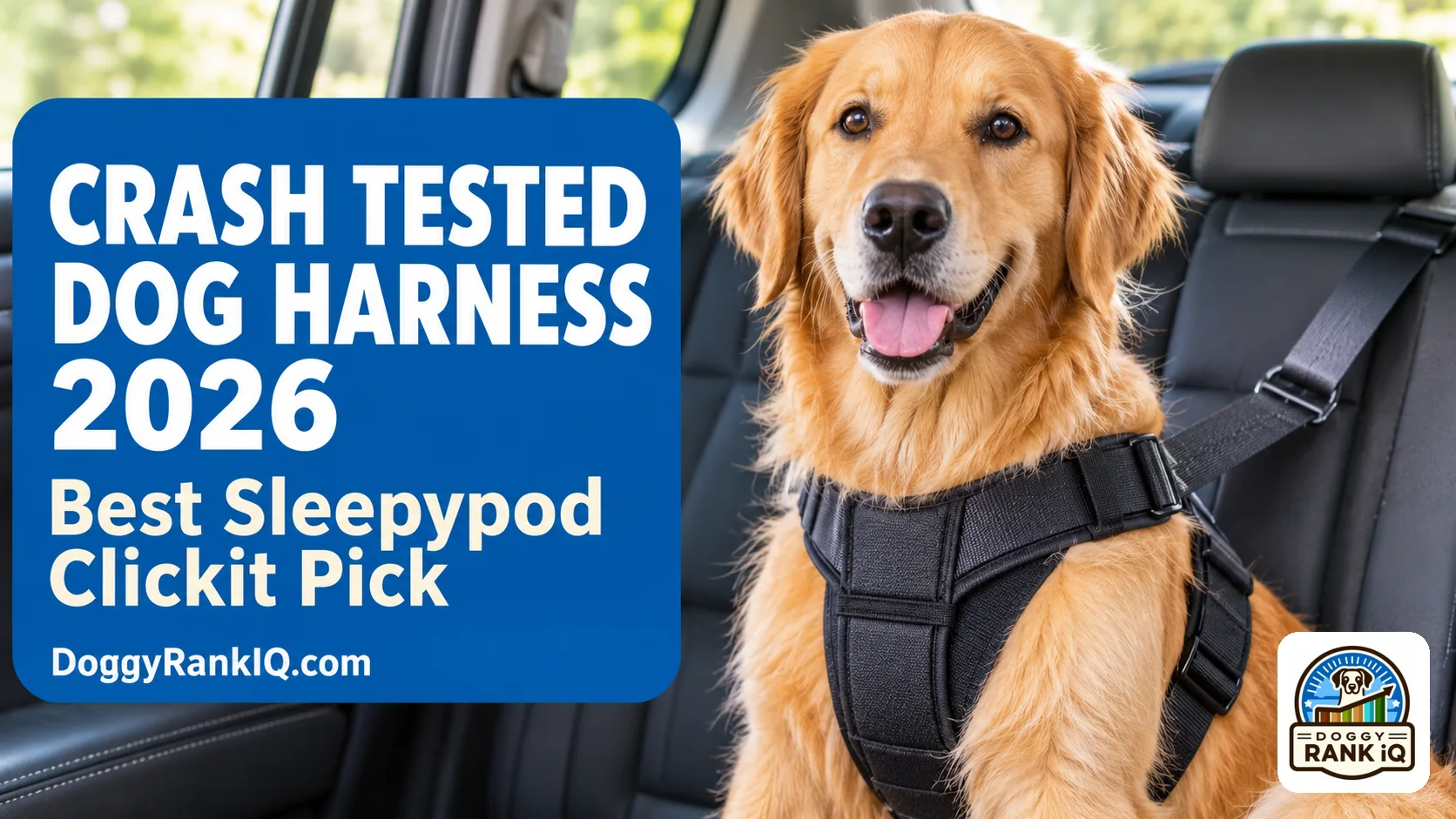
A crash tested dog harness is a vehicle restraint that has gone through independent sled testing rather than just a manufacturer’s marketing claim. The Center for Pet Safety (CPS) runs the most recognized independent program in the United States, and right now the Sleepypod Clickit Sport and the newer Sleepypod Clickit Range both carry five-star CPS ratings at specific sizes and weights, according to CPS’s certified products list. The Clickit Terrain earned a five-star rating in 2020 but no longer appears on the current CPS certified list, so it’s worth checking the active roster before you buy. For most owners asking about a crash tested dog harness, the Clickit Sport remains the best-documented, widely available pick, with the Range as the upgrade for dogs over 90 pounds.
Key Takeaways: crash tested dog harness
- A crash tested dog harness passes an independent sled test, not just an internal company claim. CPS is the primary U.S. certifier.
- The Sleepypod Clickit Sport holds a five-star CPS rating from July 2014 testing, protocol CPS-001-014.01, across Small (to 25 lbs), Medium (45-90 lbs), Large (75-90 lbs), and X-Large (to 90 lbs), per CPS’s Clickit Sport page.
- The Sleepypod Clickit Range is newer, CPS-tested in November 2024 with a 110-pound test dog, also earning five stars, documented on CPS’s Clickit Range page.
- The Clickit Terrain was five-star rated in 2020 but is not on CPS’s current certified list, so treat “historically tested” and “currently certified” as two different claims.
- No federal law requires crash testing for dog harnesses. CPS certification is voluntary, and that gap matters when you compare brands.
- Fit, not the label alone, determines whether a crash tested dog harness actually protects your dog. The same harness in the wrong size behaves differently in a real stop.
- The AVMA and AAHA both recommend restraining pets in vehicles but do not name one single product as universally safest.
- Other brands, including Kurgo and Ruffwear, publish their own crash testing methodology, which is worth reading even though it isn’t the same as CPS certification.
How does your dog ride?
Tap an option to see the answer.
What crash tested means, and who does the testing
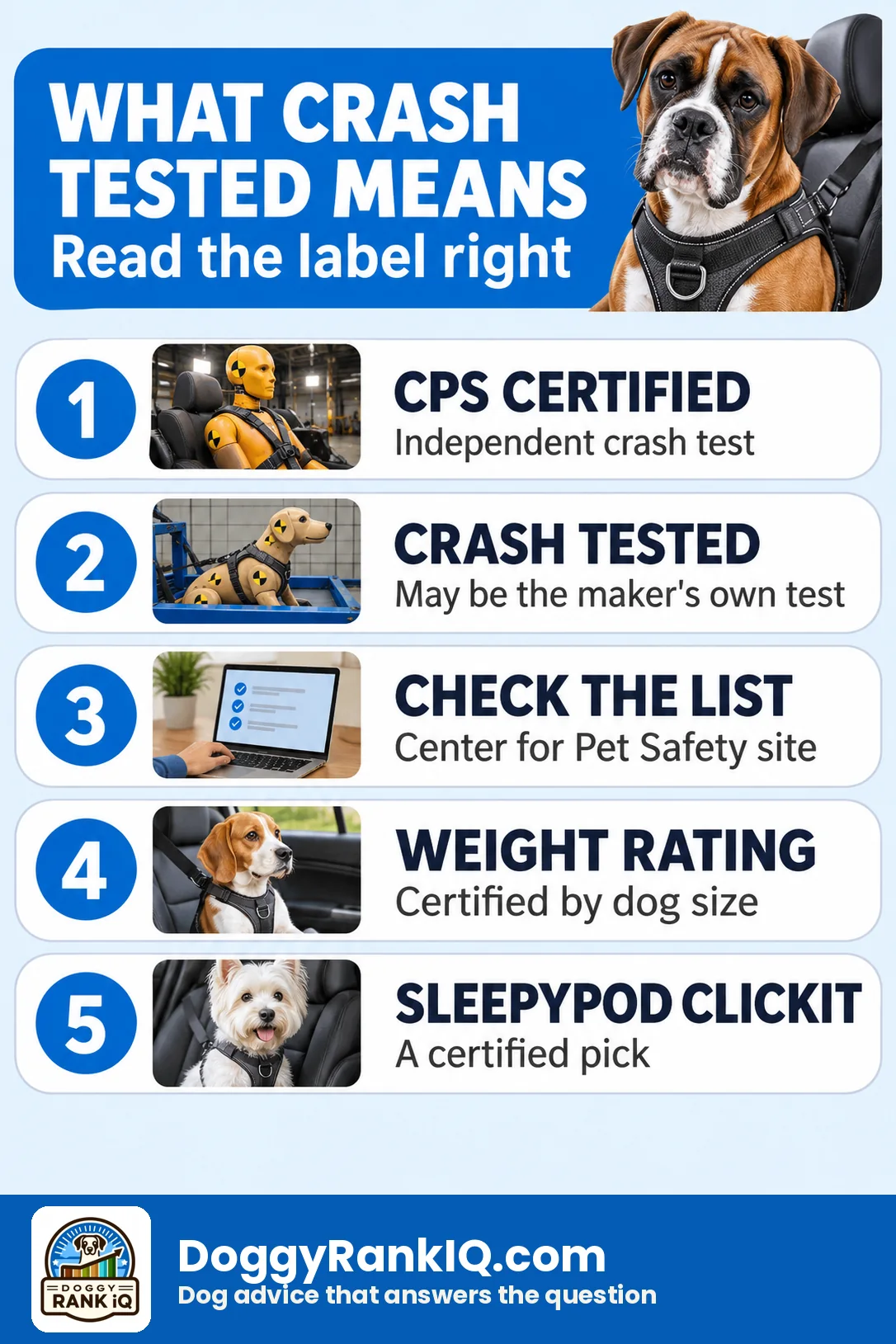
“Crash tested” means a harness has been strapped to a weighted dummy dog, mounted on a sled, and subjected to a simulated frontal impact while engineers measure excursion, webbing failure, and hardware integrity. It does not mean every size and color of that harness has been tested. Certification is often specific to a particular size and weight range, which is why a “Large” tag and a “crash tested” sticker on the box don’t automatically mean the same thing.
The Center for Pet Safety is the main independent group doing this work in the U.S. Its protocol, CPS-001-014.01, evaluates more than whether the harness stays attached to the dog. It tracks how far the dog travels after impact (excursion), whether the webbing or buckles deform or break, and whether the restraint keeps the dog in a position that limits injury on the second and third impacts that often follow a crash, according to CPS’s certified products list. A company claiming its own harness was “crash tested” in-house is not the same as a CPS-certified result. Kurgo, for example, publishes its own crash testing methodology on its site, and Ruffwear describes its testing and design process for the Load Up harness as well. Both are useful reading, but neither replaces an independent, third-party lab result the way CPS certification does.
There is no federal regulation requiring this testing. Pet restraint manufacturers participate in CPS testing voluntarily, the same way car seat buyers once relied on voluntary crash-test programs before federal standards caught up for human occupants. That means the harness market still runs on reputation, independent labs, and owner research rather than a government-mandated minimum.
Decision rule: if a listing says “crash tested” but doesn’t name CPS, a specific protocol number, or a test date, treat that claim as unverified marketing language rather than documented evidence.
Are crash tested dog harnesses actually safe?
A crash tested dog harness that carries an active CPS five-star rating has been shown, in a controlled sled test, to limit excursion and keep hardware intact during a simulated frontal crash at a specific weight class. That is meaningfully different from “safe in every real-world crash,” since no lab test can replicate every possible collision angle, speed, or vehicle type.
What the rating does tell you:
- The harness held together under forces similar to a frontal impact at highway speed, using the protocol CPS applies to all tested products.
- The dog-shaped test dummy stayed within a measured range of forward movement, which matters because unrestrained dogs (or badly fitted ones) can become projectiles in a crash.
- The webbing, buckles, and stitching didn’t fail at the tested weight.
What it does not guarantee: a side-impact or rollover crash wasn’t part of the standard frontal test protocol, and a harness fitted incorrectly or sized wrong for your dog won’t behave like the tested unit. A crash tested dog harness is a documented improvement over an unrestrained dog or an untested product, not a guarantee against injury in every scenario.
 Clickit Sport vs Clickit Terrain
 Clickit Sport vs Clickit Terrain
The short version: the Clickit Sport has the longer certification record and broader size range, while the Terrain’s CPS status has lapsed on the current list, even though it was five-star rated in 2020.
The Sport’s materials story matters here: CPS specifically notes that the Medium, Large, and X-Large Sport harnesses use identical webbing, stitching, and hardware. A dog that needs a Medium or Large gets the same construction quality as the X-Large, as long as the fit is correct. That’s a useful detail because it means sizing up for comfort doesn’t mean sizing down on protection.
Choose the Sport if your dog weighs between 18 and 90 pounds and you want the longest-standing CPS record. Choose the Range if your dog is a large or long-bodied breed over 90 pounds, since it was specifically built to address the Sport’s fit limits at the top end. Skip the Terrain unless you’ve confirmed its current certification status directly with CPS, since current listings don’t include it.
Crash tested harness vs regular harness: which is better?
A crash tested dog harness is built and tested specifically to limit forward movement and keep structural integrity during a simulated vehicle impact, while a regular walking harness is designed for leash control on sidewalks and trails, not for seat belt attachment. Using a walking harness for car travel is one of the most common mistakes owners make, since the leash ring on a daily harness isn’t rated to handle crash forces.
Differences that matter:
- A crash tested dog harness has a reinforced loop or Infinity Loop style connector meant to thread the vehicle seat belt directly through it.
- A regular walking harness usually has a lighter D-ring meant for a leash clip, not a seat belt.
- Crash tested models go through sled testing at a named lab; most walking harnesses never see this kind of evaluation because it isn’t their intended use.
Common mistake: clipping a dog’s everyday walking harness to the seat belt because it “feels secure.” It may hold during normal driving but hasn’t been tested for a sudden stop or collision. If you’re shopping for everyday wear instead, our guide to no-pull harnesses covers that separate use case.
How much does a crash tested dog harness cost?
A crash tested dog harness from Sleepypod typically runs somewhere between $120 and $175 depending on size and model, based on current Amazon pricing checked in 2026. The Clickit Sport Large lists at $120.74, while the Clickit Terrain Small lists at $171.68, so price doesn’t always track with size, and it’s worth comparing the specific listing rather than assuming the model name tells you the cost.
Other considerations that affect price:
- Larger sizes and the newer Clickit Range often cost more because of added material and a bigger connector loop.
- Sale pricing on Amazon fluctuates, so the price you see today may differ from the price checked for this article.
- Cheaper harnesses marketed as “crash tested” without a named lab or protocol may be priced lower because they skipped the certification process entirely, not because they’re a better deal.
Decision rule: if two harnesses are priced similarly but only one names CPS and a protocol number, the documented one is the safer buy even if it costs slightly more.
Best crash tested dog harness brands
Sleepypod currently holds the most visible CPS five-star certifications among widely sold car harnesses, with the Clickit Sport and Clickit Range both appearing on the active list. Other brands publish their own crash testing programs, which can still be worth considering if you understand they aren’t independently verified in the same way.
- Sleepypod: CPS five-star certified Clickit Sport and Clickit Range, the most documented options for most owners.
- Kurgo: sells the Impact Dog Car Harness and publishes its own crash testing approach, though this is a manufacturer-run program rather than CPS-independent.
- Ruffwear: the Load Up harness has a published testing and design process, again run internally rather than through CPS.
Choose Sleepypod if you want the longest independent certification record. Consider Kurgo or Ruffwear if your dog’s size, build, or fit needs don’t match what Sleepypod currently offers, but read the manufacturer’s own testing page closely so you know what was and wasn’t measured.
Where to buy a crash tested dog harness
The Sleepypod Clickit Sport and Clickit Terrain are both available through Amazon, linked above, while the newer Clickit Range is sold directly through Sleepypod’s website. Buying from the manufacturer site or an authorized retailer matters because counterfeit or off-brand “lookalike” harnesses sometimes use similar names without carrying any actual CPS certification.
Tips for buying safely:
- Check that the listing photos match the current product generation, since older Terrain listings sometimes still show the 2020 certification without noting its current status.
- Buy from Sleepypod directly or from Amazon listings that clearly state the model name and size, not a generic “universal” car harness with a vague crash tested label.
- If comparing retailers, confirm the return policy in case the fit doesn’t match your dog’s measurements once it arrives.
How to fit a dog car safety harness
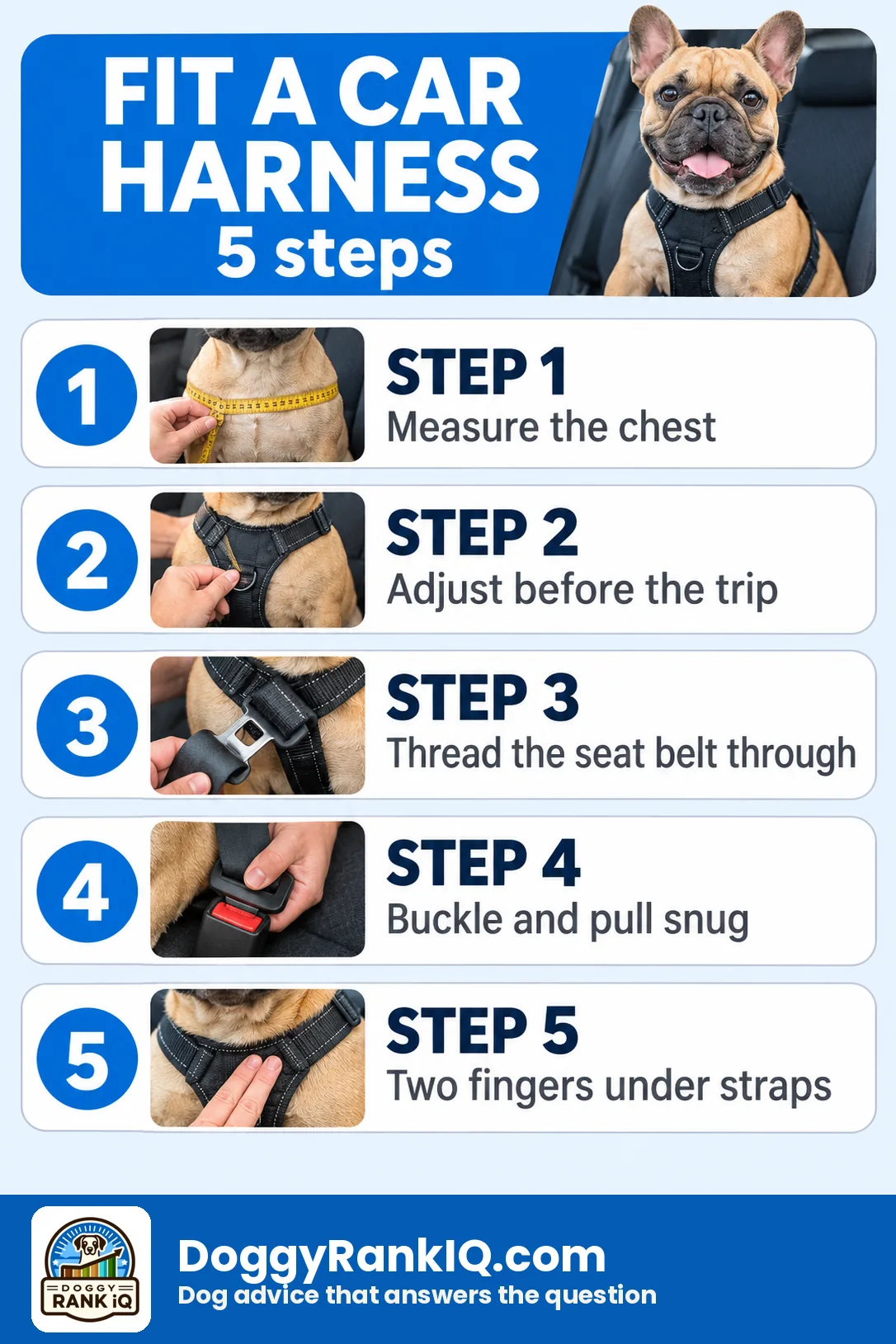
A crash tested dog harness only performs like its test results when the fit matches the manufacturer’s sizing chart exactly, not just “close enough.” Loose webbing adds excursion distance during impact, and an overly tight fit can restrict breathing or chafe during normal rides.
Steps to check fit:
- Measure your dog’s girth (widest part of the rib cage) and weight, then compare both numbers to the specific size chart, not just the weight range printed on the box.
- Fasten the harness and run two fingers flat between the strap and your dog’s body. Snug, not pinching.
- Clip the vehicle seat belt directly through the harness’s reinforced loop (never through a regular walking harness’s leash ring).
- Check that the dog can sit, lie down, and stand without the harness sliding forward over the shoulders.
- Recheck fit after the first few rides, since webbing can loosen slightly as it breaks in.
Common mistake: buying based on breed name instead of measured girth. A “Medium” harness fits by chest measurement, not by what size tag usually fits that breed. For walking harnesses specifically, our guide to fitting a dog harness covers the same girth-measuring method, though a car harness and a walking harness are not interchangeable products. Trip Jaunt’s breakdown of common car harness mistakes walks through several fit errors owners make without realizing it.
What size crash tested harness fits my dog?
The right size depends on measured girth and weight compared directly against the manufacturer’s chart, not the weight range printed broadly on packaging. A dog at 88 pounds and a dog at 92 pounds may need different Clickit Sport sizes even though both numbers round to “around 90 pounds.”
- Small dogs (under 25 lbs): typically fit the Clickit Sport Small or a crash tested carrier.
- Medium dogs (25-75 lbs): usually land in the Clickit Sport Medium or Large range.
- Large dogs (75-90 lbs): fit the Clickit Sport X-Large, right at the edge of its tested range.
- Giant or long-bodied dogs (90-110+ lbs): the Clickit Range, tested with a 110-pound dummy, is the better documented fit.
Edge case: if your dog sits right at a weight boundary, like 88 or 92 pounds, go with the model and size rated for the heavier range. CPS testing uses a specific test-dog weight for each class, and a dog near the top of a range benefits from the next size up rather than the edge of a lower one.
How do I put on a crash tested dog harness correctly?
Putting on a crash tested harness correctly means following the manufacturer’s step-by-step fitting instructions every time, not just the first time out of the box. Most Sleepypod models use a vest-style design that slips over the head and secures with chest and belly straps before the seat belt loop is threaded through.
- Slip the vest portion over the dog’s head, checking the chest plate sits centered, not twisted.
- Secure the belly strap snugly, using the two-finger test to confirm it isn’t too tight.
- Adjust shoulder straps so the harness doesn’t ride up toward the neck when the dog pulls forward.
- Thread the vehicle seat belt through the reinforced loop, not a walking leash ring, and buckle it in the back seat.
- Give a gentle tug test before driving to confirm the dog can’t easily slip free.
Common mistake: rushing the fitting on the first ride and skipping the tug test, then discovering mid-drive that a strap has loosened.
Is a crash tested harness worth the money?
For most owners, yes: a CPS-certified crash tested harness like the Clickit Sport or Clickit Range offers documented sled-test performance that an uncertified harness simply doesn’t have, and the price difference (often $20 to $60) is modest compared to the potential outcome difference in a real collision. The exception is for owners who primarily use a secured crate in a cargo area behind a barrier, where a harness may be a secondary rather than primary restraint.
- Worth it if you regularly drive with your dog loose in the back seat or front passenger area.
- Less critical if your dog already travels in a crash tested crate secured properly in the cargo hold.
- Still useful even then for the walk to and from the car, or for shorter trips where a crate isn’t practical.
Do all dogs need a crash tested harness?
Not every dog needs the same restraint, but the AVMA and AAHA both recommend some form of secured restraint, whether that’s a harness, crate, or carrier, rather than letting a dog ride loose in a moving vehicle. Puppies still building leash manners, senior dogs with mobility issues, and anxious dogs that pace in the car can all benefit from a properly fitted restraint, though the best type varies by size and temperament.
- Small, calm dogs: often do fine in a secured carrier instead of a harness.
- Active or anxious dogs: benefit more from a harness that limits movement and reduces pacing.
- Multi-dog households: may need a mix, a crate for one dog and a harness for another, depending on each dog’s size and behavior.
Crash tested harness for small dogs or only big dogs?
Crash tested harness options exist across the size spectrum, from small dogs under 25 pounds up through giant breeds over 100 pounds, so size alone doesn’t rule a dog in or out of using one. The Clickit Sport’s Small size is rated to 25 pounds, while the Clickit Range extends coverage up to roughly 110 pounds for larger dogs.
Small dog owners sometimes assume crash testing is only relevant for big, heavy dogs that could become dangerous projectiles, but a small dog moving at highway speed during a sudden stop still travels with significant force relative to its size. PetsRadar’s roundup of car harnesses in 2026 includes small-breed options alongside large-dog picks, which reflects how the market treats this as a size-inclusive category rather than a large-dog-only concern.
Which sizes appear on the certified list
Only specific sizes of specific models carry active CPS certification, and that list changes as manufacturers submit new products for testing. As of the most recent CPS records, the Sleepypod Clickit Sport and Sleepypod Clickit Range both appear with documented test dates and weight classes.
- Clickit Sport: Small (to 25 lbs), Medium (45-90 lbs), Large (75-90 lbs), X-Large (to 90 lbs), tested July 2014.
- Clickit Range: tested November 2024 with a 110-pound dummy dog, five stars, sold in Regular and Long configurations.
- Clickit Terrain: does not currently appear on CPS’s certified product list, despite a 2020 five-star result reported at the time.
Edge case: if your dog sits right at a weight boundary, like 88 or 92 pounds, go with the model and size rated for the heavier range. CPS testing uses a specific test-dog weight for each class, and a dog near the top of a range benefits from the next size up rather than the edge of a lower one.
Check the current CPS certified-product directory directly before buying, since it is updated as new models are tested and older ones are retired from the active list.
⭐ Top 5 Features We Love
- Documented CPS test dates and protocol numbers. Both the Sport and the Range list a specific test date and protocol (CPS-001-014.01), which is more verifiable than a generic “crash tested” label.
- Shared materials across Sport sizes. CPS notes the Medium, Large, and X-Large Sport harnesses use the same webbing, stitching, and hardware, so sizing for your dog doesn’t mean sizing down on build quality.
- Three-point restraint design. Sleepypod’s Infinity Loop webbing and padded vest are built to spread crash force across the chest and shoulders instead of concentrating it at the neck.
- A dedicated large-dog option. The Clickit Range was built specifically to address fit limits at the top of the weight range, giving owners of big or long-bodied dogs a tested option instead of forcing them into an ill-fitting Sport.
- Independent third-party testing. CPS testing isn’t run by the manufacturer, which matters when you’re choosing between products whose only other evidence is their own marketing copy.
⚠️ Things to Look Out For
- Terrain’s certification status has shifted. A 2020 rating doesn’t mean current certification; buyers relying on older reviews may assume the Terrain is still on the active CPS list when it isn’t.
- No federal crash-test standard exists yet. CPS testing is voluntary, so some competing brands on the market haven’t been through any independent test at all.
- Size-specific certification, not blanket coverage. A five-star rating on one size doesn’t automatically apply to every size variant of the same product line.
- Fit still depends on the owner. Even a certified harness won’t perform to its test results if it’s loose, twisted, or clipped incorrectly to the vehicle belt.
- Price varies by retailer and size. The Clickit Sport Large runs $120.74 and the Clickit Terrain Small runs $171.68, price checked 2026, so compare the exact size and listing before assuming one model is cheaper overall.
Common mistakes people make with crash tested harnesses
The most frequent mistake is treating a crash tested harness like a regular walking harness, clipping the leash ring to the seat belt instead of the dedicated reinforced loop built for that purpose. Other common errors show up during fitting and daily use rather than at purchase.
- Buying by breed stereotype instead of measured girth and weight.
- Skipping the recheck after the first few rides, missing webbing that has loosened.
- Leaving slack in the seat belt itself, which adds excursion distance even with a correctly fitted harness.
- Assuming a harness that’s crash tested in one size is automatically certified in every size the brand sells.
- Using an old listing’s certification claim (like the Terrain’s 2020 rating) without checking the current CPS list.
Harness, crate or carrier: the safest setup by dog size
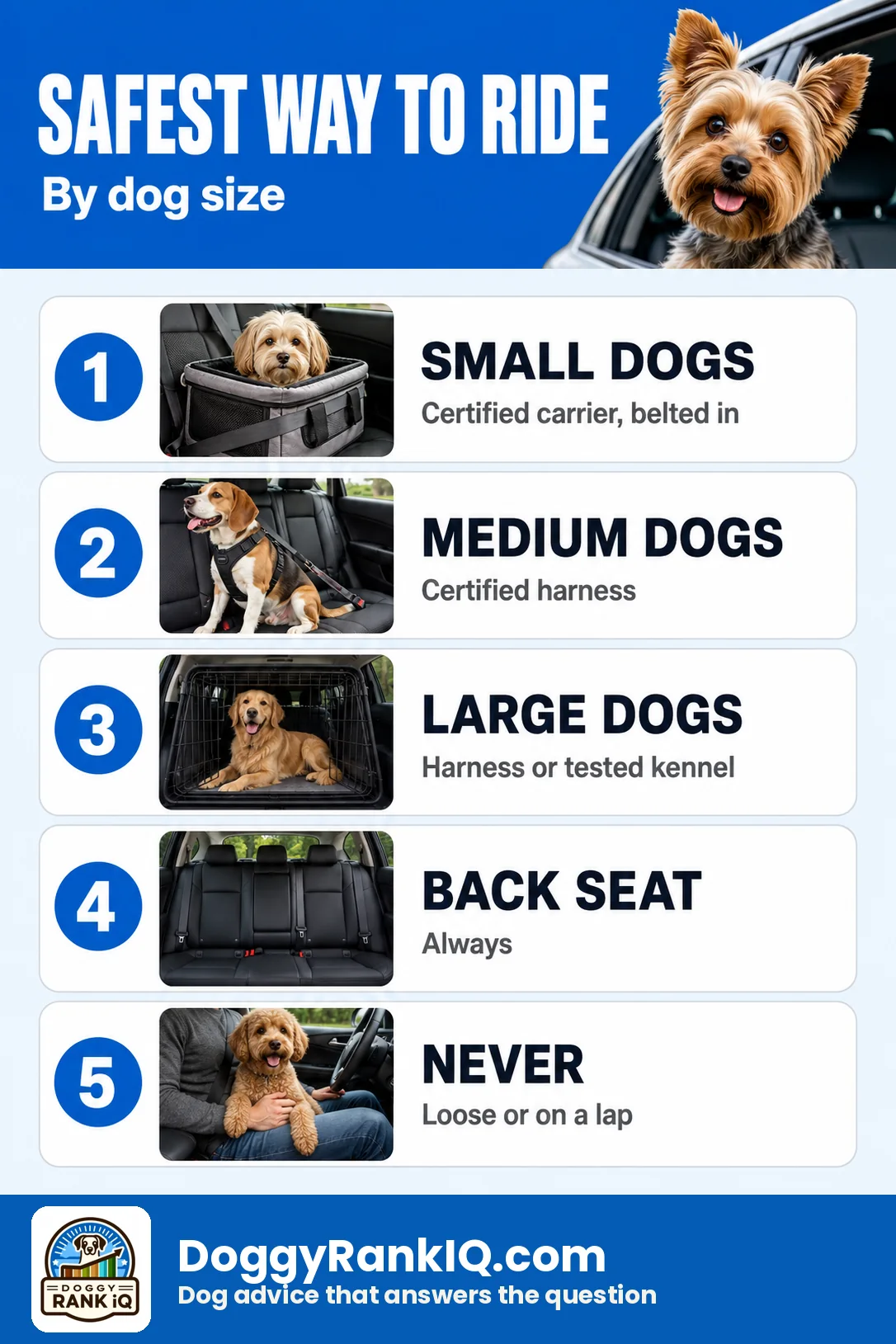
The right restraint depends more on your dog’s size and your vehicle setup than on a single “best” product. The AVMA recommends an appropriate crash-tested harness, crate, or carrier, and specifically notes that a car harness is a different product from a walking harness. The AAHA echoes this, naming secure carriers, pet seat belts, and vehicle barriers as valid options depending on the dog and vehicle.
- Small dogs (under 25 lbs): a crash tested carrier secured by the vehicle belt, or a Small Clickit Sport, both keep the dog contained in a smaller footprint. For travel beyond the car, our airline-approved carrier guide covers a related but distinct use case.
- Medium dogs (25-75 lbs): a properly fitted Clickit Sport in the correct size class is the most documented mid-range option.
- Large and giant dogs (75-110+ lbs): the Clickit Range was specifically built for this group, or a crash tested crate secured in the cargo area for dogs that travel better loose inside an enclosed space. Compare that against our notes on an elevated dog bed setup for home rest after long travel days.
- Dogs who ride in SUVs with cargo barriers: a secured crate behind a barrier can work alongside, not instead of, a harness for the ride to and from the vehicle.
If your dog already rides on a bench seat, pairing a harness with a dog car seat cover keeps the upholstery and the belt anchor points cleaner between trips. For dogs who do better elevated in a booster-style setup for shorter rides, compare that against a full harness system before deciding, since booster seats and harnesses solve different problems.
Decision rule: if your dog pulls, climbs, or paces in the car, choose a harness or crate that physically limits movement, not just one that theoretically restrains the dog during a crash. Day-to-day control matters as much as the worst-case scenario.
FAQ
The bottom line
A crash tested harness is worth the extra research time because the label alone tells you almost nothing. CPS certification, a named test date, and a specific protocol number are the details that separate documented performance from a marketing sticker. The Sleepypod Clickit Sport remains the best-supported pick for dogs between 18 and 90 pounds, the Clickit Range covers the larger end up to roughly 110 pounds, and the Clickit Terrain needs a direct check against CPS’s current list before you trust its older rating.
Measure your dog, compare the options against the certified list, and fit the harness the same way every single ride. That’s the part no test result can do for you.
Doggy Rank IQ is reader supported. As an Amazon Associate we earn from qualifying purchases, at no extra cost to you.