Quick Answer
A dog harness fits correctly when two fingers slide under every strap with light resistance, not into a loose gap. Learning how to fit a dog harness means checking all the contact points, not just the top of the back: the neck opening, the front strap across the breastbone, the girth strap behind the elbows, and any belly adjustment. Measure the chest girth first, adjust the neck second, and finish with an escape test by gently pulling the leash forward while your dog stands still. Guidance checked October 2026.
Key Takeaways: How to Fit a Dog Harness
- Two fingers, with resistance. The target is two fingers squeezed under each strap, not two fingers rattling around in daylight. The American Kennel Club’s veterinary adviser describes fingers that need slight compression to fit, which is tighter than most owners expect.
- Three fingers means too loose. Less than one means too tight. One fitting guide puts the boundaries at noticeable but not painful resistance.
- Girth is the sizing number that matters. Measure around the widest part of the rib cage, just behind the front legs, then use that brand’s chart.
- Sizes are not standardized. A medium in one brand can be a small or a large in another, so weight alone is a poor guide.
- Keep the girth strap off the armpits. Roughly a hand’s width behind the front legs is the working target for most adult dogs.
- The front strap belongs on the breastbone, not the soft throat.
- A loose harness is not the safe option. It slips, chafes, and lets dogs back out mid walk.
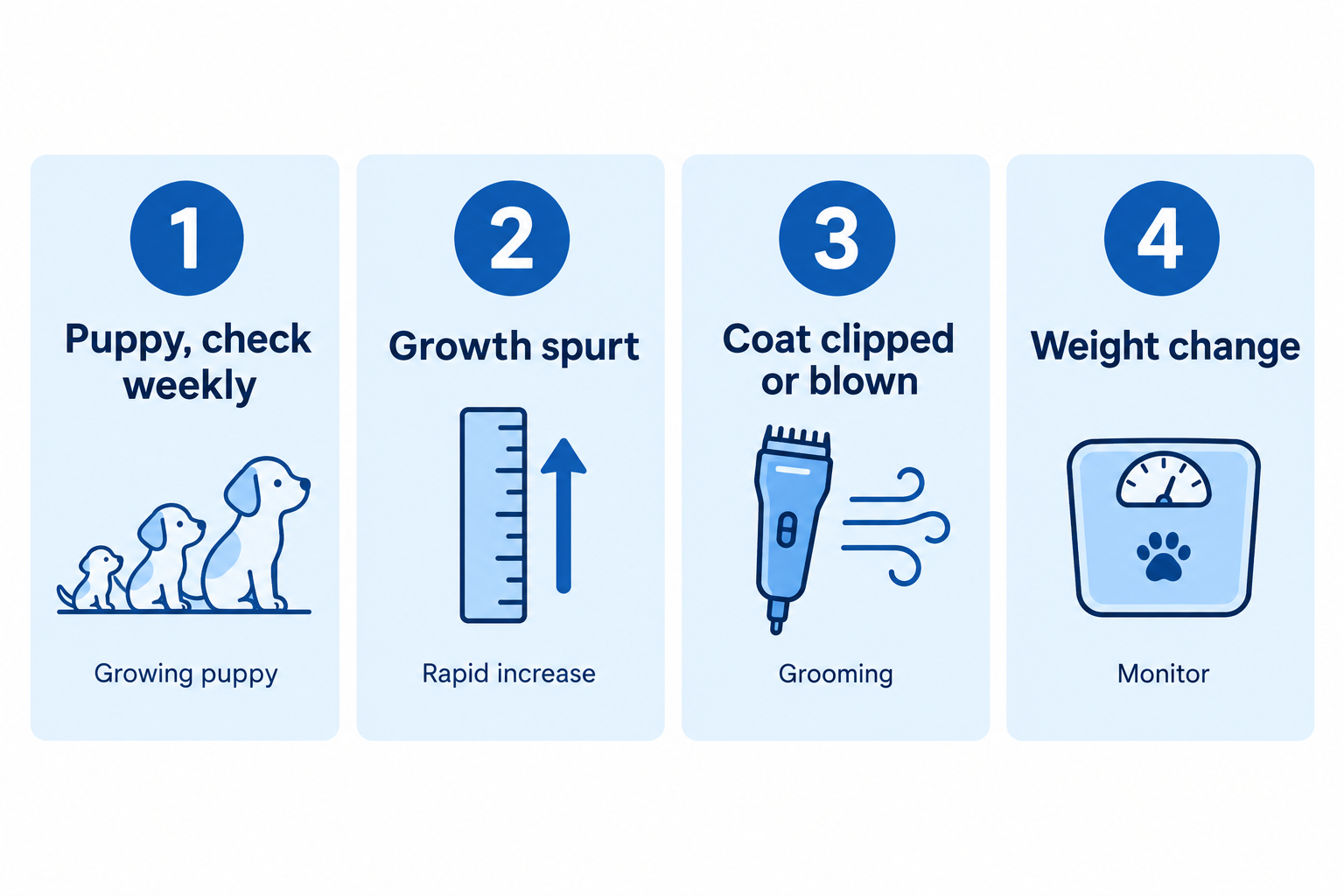
- Re-check often. Weekly for puppies, after grooming or a seasonal coat drop, and any time your dog gains or loses noticeable weight.
- No single design wins for every dog. A 2025 research synthesis found no universally superior restraint device across the studies it examined.
How should a dog harness fit? (the 2-finger rule explained)
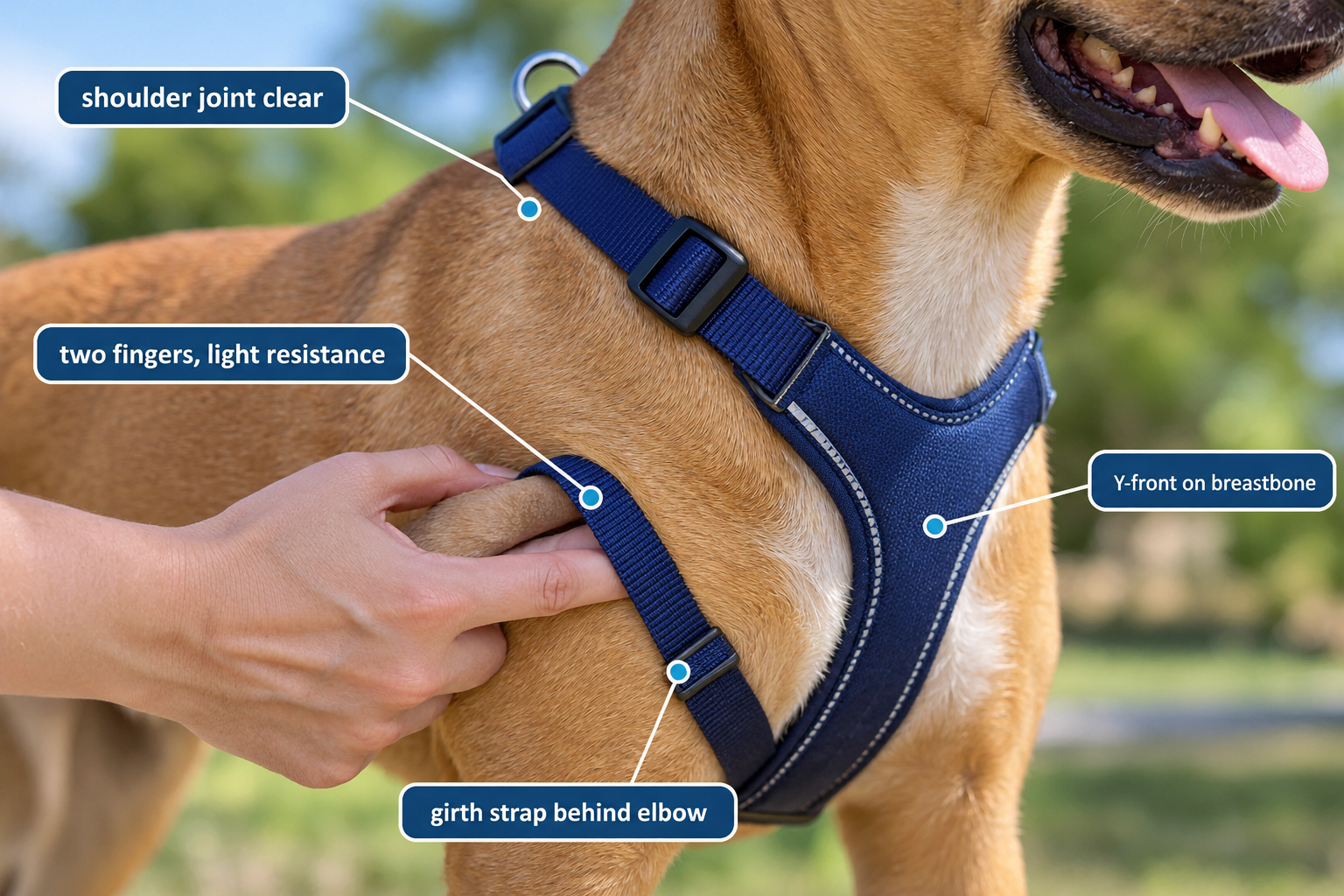
A harness should sit snug enough that two fingers slide under every strap with light pressure, and loose enough that your dog can walk, trot, and lie down without the straps digging in. That is the whole two-finger rule. The part people skip is the word “every.”
)
The rule exists because a harness touches a surprising amount of a dog. A 2026 veterinary review in Frontiers in Veterinary Science on the health implications of dog-worn equipment notes that harnesses can contact the neck, the thorax, the forelimbs, the shoulder joint, and shoulder muscles that sit close to the surface. The review’s practical conclusion is not that harnesses are bad. It is that fit and design need assessing for the individual dog in front of you.
So check the two-finger clearance in five places:
- The neck opening, at the side of the neck rather than the top.
- The front or sternum strap, where it crosses the breastbone.
- The girth strap, under the chest behind the elbows.
- The side straps, where they run along the ribs.
- Any belly or secondary adjustment on a no-pull or multi-point design.
A harness can pass the test on the dog’s back while being painfully tight in one armpit. That is the single most common fitting failure.
The resistance part matters. Manufacturer fitting guidance from Kurgo describes two fingers, and only two, fitting beneath the straps at any point. The AKC’s veterinary expert, Dr. Alexandra Attas, goes slightly further: the fingers should have to be pressed underneath rather than sliding in freely. A literal two-finger gap can already be a little loose.
If your fingers drop under the strap with no effort at all, you have not found the fit. You have found a gap your dog can work with.
Decision rule: if you can comfortably fit three fingers under any strap, tighten that strap. If you cannot get one finger under, loosen it and then re-measure, because the harness may be a size too small rather than badly adjusted.
How to measure your dog for a harness
Measure chest girth first, neck second, and ignore the weight number on the box until both measurements are written down. Ruffwear’s own fitting guidance tells owners to measure around the widest part of the rib cage, generally just behind the front legs, then match that figure to the published chart. In one of its harness ranges the girth bands run from roughly 9 to 13 inches at the smallest end up to 36 to 42 inches at the largest, which shows how wide a single product line has to stretch.
What to measure, in order:
- Girth: a soft tape around the deepest part of the rib cage, just behind the front legs, snug against the coat.
- Neck base: around the lower neck where a harness neck strap would actually sit, not up near the ears.
- Chest to shoulder distance: useful for Y-front models, because it tells you whether the front strap can reach the breastbone without riding up.
- Current weight: a cross-check, nothing more.
Write all three numbers in your phone. You will use them again, because the next harness you buy will almost certainly size differently.
Edge case: fluffy dogs measure wider than they are. If your dog has a thick double coat, measure with the tape flat against the coat rather than squeezed to skin, then plan to re-check the fit after a clip or a seasonal shed. Our beginner’s guide to dog grooming covers how much coat can come off in one session, which is often enough to change a harness setting.
How to fit a dog harness in 5 steps
Here is the sequence that works for most walking harnesses, including two-clip designs. The whole thing takes about five minutes on a calm dog, longer on a dog who treats a new harness as a chew toy.
Step 1: Measure the girth and neck, then pick the size from that brand’s chart.
If your dog falls between two sizes, choose the size where their girth sits in the middle of the range rather than at the very top or bottom. Middle of the range leaves adjustment room in both directions.
Step 2: Put it on loosely and adjust the neck first.
Step-in and over-the-head styles both benefit from this order. Chewy’s step-by-step guidance on how to put on a dog harness walks through the common variants, including the two-clip and step-in types. Set the neck so two fingers press under the strap at the side of the neck. Too loose here is the reason dogs reverse out.
Step 3: Adjust the chest and girth strap.
Slide the girth strap back so it sits roughly a hand’s width behind the front legs, then tighten to the two-finger standard. On a Y-front harness, set the front strap so it rests across the bony part of the breastbone. Blue-9’s fitting guidance for its Balance Harness puts the front attachment near that bony chest area, and warns that a strap riding too high can cause coughing when a dog pulls, while a girth strap sitting too far forward can rub the armpits.
Step 4: Check behind the elbows while your dog moves.
Lift one front leg and move it forward through a full stride. The strap should not trap skin or press into the armpit crease. Then walk your dog ten steps and watch the straps. Anything that creeps forward needs tightening at the side, not the top.
Step 5: Test the escape.
Hold the leash and apply gentle, steady backward pressure while your dog stands still, then try a slow forward pull as if they were braking. A well fitted harness rotates slightly and stays on. A loose one slides over the shoulders and off. Do this on a lead, indoors, before you need it at a kerbside.
What are the 4 most common harness fitting mistakes?
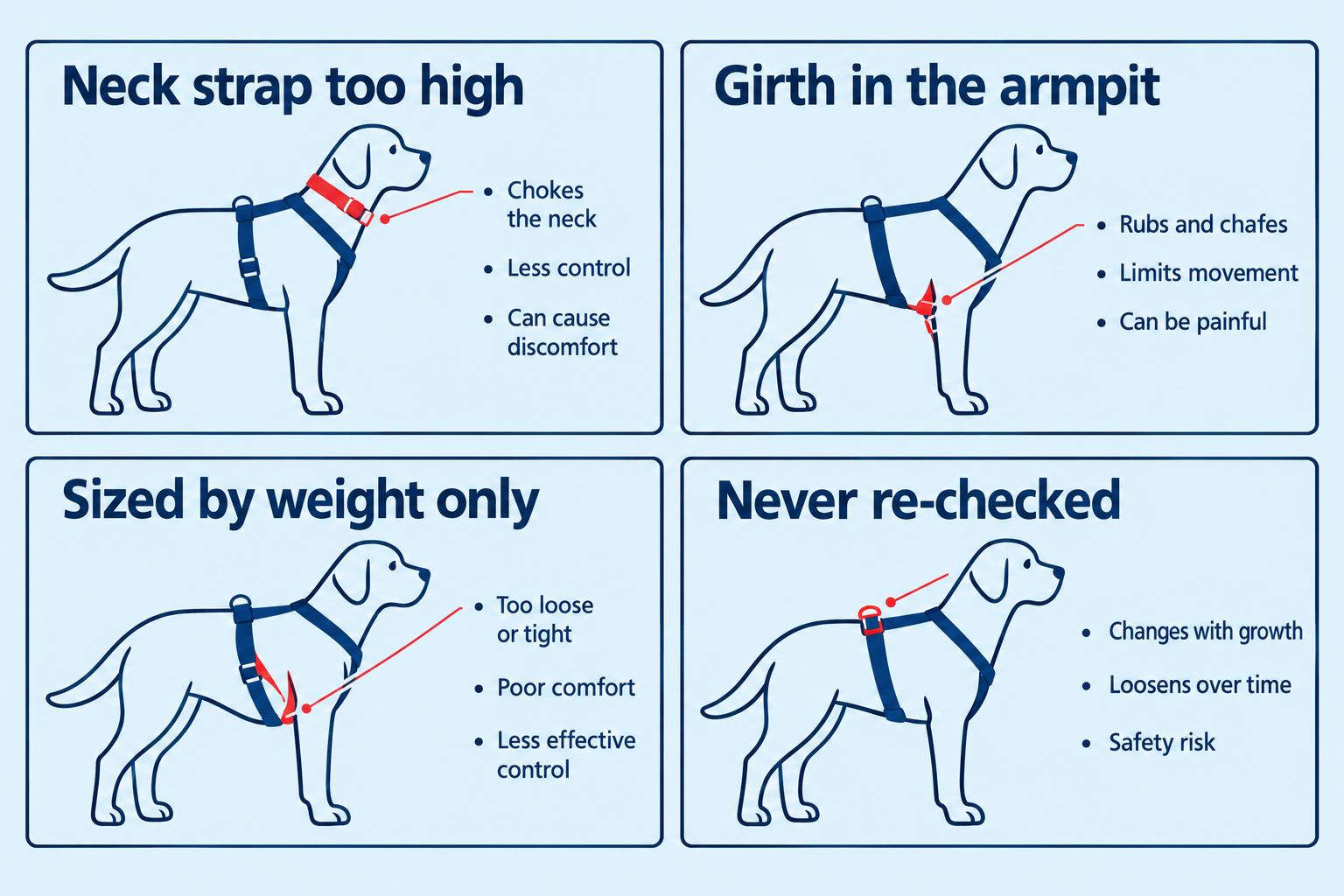
The four that show up again and again: a neck strap set too high, a girth strap parked in the armpit, sizing by weight instead of girth, and never checking the fit again after the first walk.
)
Mistake 1: the neck strap rides up onto the throat.
A high neck strap puts load on soft tissue instead of the chest. Blue-9’s fitting guidance links a front strap that sits too high with coughing during pulling. Fix it by lowering the strap onto the breastbone and taking up the slack at the side adjusters, not the top.
Mistake 2: the girth strap sits in the armpit.
This one causes most harness rubbing. You will see it before you feel it: hair parted or thinned in a line behind the elbow. Slide the strap back toward the rib cage, roughly a hand’s width behind the leg.
Mistake 3: sizing by weight.
Two 40-pound dogs can need different sizes, because one is a deep-chested running build and the other is a short-legged barrel. If your dog sits near a size boundary, our breakdown of dog size categories from small to giant is useful context, but the tape measure still wins.
Mistake 4: fitting it once and never again.
Straps slip. Buckles creep. Dogs change shape. A harness adjusted in April can be noticeably loose by June on a dog who has lost a winter coat.
Harness styles compared: which fit checks matter most
| Style | Shoulder movement | Escape risk if loose | Best suited to |
|---|---|---|---|
| Y-front (e.g. Blue-9 Balance, Ruffwear Front Range) | Front strap sits on the breastbone, leaving the shoulder joint uncovered | Low to moderate, mainly at the neck opening | Most everyday walkers, long walks, hiking |
| Strap-across-chest (horizontal front band) | Band crosses in front of the shoulders, so placement needs careful checking | Moderate | Short, slow walks and dogs who tolerate little handling |
| Step-in | Usually a fixed geometry with limited shoulder clearance | Higher, because adjustment is often limited to one or two points | Small dogs who dislike anything over the head |
| No-pull front clip | Leash tension pulls across the chest, so strap height matters most | Moderate, and rotation is common when loose | Strong pullers, paired with training rather than used alone |
A front clip changes where the leash load goes, not whether your dog has learned to walk on a loose leash. Pair it with practice from our training hub and reviews of no-pull harness options rather than expecting hardware to do the teaching.
Is it better for a dog harness to be tight or loose?
Snug beats loose. Not tight, snug. A loose harness is the one that chafes, rotates, and lets a startled dog reverse out on a busy pavement, which is why fitting guides treat looseness as the bigger everyday risk for most walking harnesses.
Signs a harness is too tight:
- You cannot slide one finger under a strap.
- Skin bunches or puckers at the edge of the webbing.
- Hair is worn, parted, or thinning along a strap line.
- Red or raw skin in the armpit after a walk.
- Breathing changes, coughing, or reluctance to move while wearing it.
- Your dog sits down and refuses to walk in it, having walked fine in it last month.
Persistent rubbing or any skin break needs a vet’s eyes, not a tighter buckle. A harness is not a treatment plan.
Signs a harness is too loose:
- Three or more fingers fit easily under a strap.
- The whole thing rotates so the back clip ends up over a hip.
- The girth strap drifts forward into the armpit while walking.
- Your dog can get one leg over the chest strap.
- A gentle forward pull on the leash lifts the neck opening over the shoulders.
Can a loose harness hurt my dog? Yes, in two ways. Friction, because moving webbing abrades skin and coat. And escape, because a dog who backs out of a loose harness is suddenly off leash. The 2026 Frontiers review’s point about equipment contacting the shoulder region applies to sloppy fit as much as tight fit: a strap that slides around the shoulder is still a strap pressing where it should not.
Note that walking-harness fit tells you nothing about crash safety. Vehicle restraints are a separate product category with separate testing, and a harness that fits beautifully on a footpath has not been shown to perform in a car.
What the sources actually say
A 2025 synthesis of restraint equipment found no universally superior device, and advised choosing by anatomy, behavior, pulling tendency, and use case.
Neck, thorax, forelimbs, shoulder joint, and shoulder muscles, per the 2026 review of dog-worn equipment in Frontiers in Veterinary Science.
Two fingers with noticeable but not painful resistance is the target; three sliding in easily means too loose.
Blue-9 lists six adjustment points on its Balance Harness; Ruffwear markets models with four. Both cite differing neck, chest, and ribcage proportions as the reason.
What’s the best dog harness for different body types?
There is no single best harness for every build, which is exactly what the 2025 review concluded. Match the design to the shape in front of you.
)
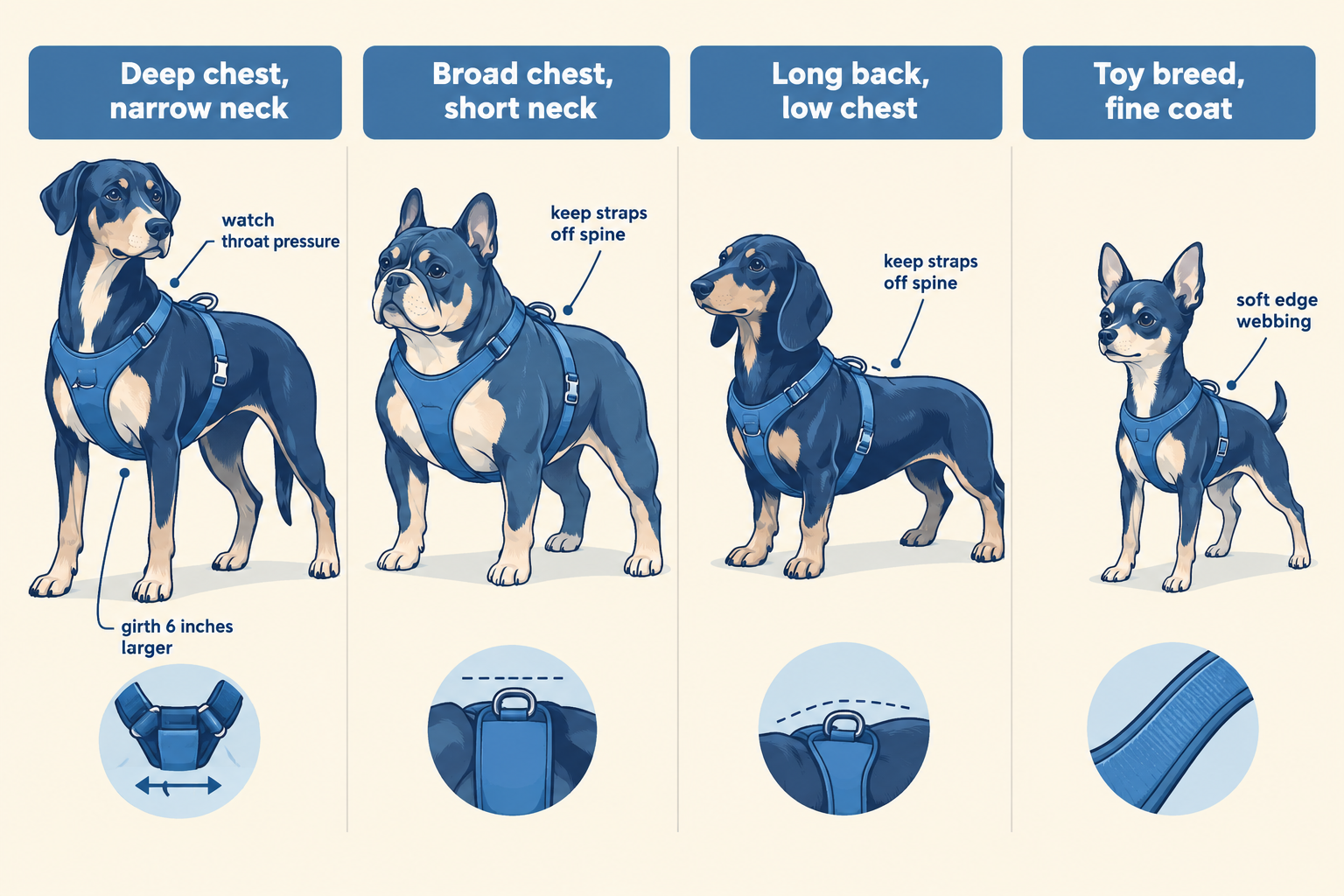
- Deep-chested, narrow-necked dogs (greyhound and whippet types, many sighthounds): the neck is often slimmer than the head, so an over-the-head harness with a fixed neck loop is an escape waiting to happen. Look for independent neck and girth adjustment, and check the neck setting every single walk.
- Broad-chested, short-necked dogs (bulldog types, including the much-debated French Bulldog): girth and neck measurements sit close together, so sizing charts based on weight fail badly. A Y-front that keeps webbing off the throat is usually easier to set correctly. Watch breathing, not just the strap gap.
- Long-backed, low-slung dogs (dachshund and corgi types): shorter chest panels and generous girth adjustment matter more than back length. Avoid anything that bridges a long span of spine with tight webbing.
- Toy and small breeds: fine coats mark quickly, so soft edged webbing and small buckle hardware help. On a 6-pound dog, a half inch of slack is a lot of slack.
- Giant breeds: check the maximum girth on the chart before anything else. Our large versus giant breed weight chart helps if you are not sure which category you are shopping in, and local stockists listed in our pet shop roundup let you try the size before buying.
Adjustable vs fixed harnesses: which is better?
Adjustable wins for most dogs, and the market agrees. Multi-point designs exist because neck, chest, shoulder, and ribcage proportions vary independently of each other. Fixed-geometry harnesses, including many step-in styles, suit a dog whose measurements happen to land in the middle of a size band and who is not a determined escaper.
Choose adjustable if: your dog is growing, between sizes, unusually proportioned, or has ever backed out of a harness.
Fixed is fine if: your dog is a stable adult weight, sits comfortably mid-chart, walks calmly, and finds over-the-head designs stressful.
Why do harness sizes differ so much between brands?
Because there is no industry standard. One brand’s medium can be another’s small. Girth ranges, strap lengths, and panel shapes are set per product line, which is why Ruffwear publishes different charts for different harness ranges. Measure your dog, read the specific chart, then apply the two-finger check. Never buy a size on the strength of the label your last harness carried.
Why does my dog slip out of their harness?
Nearly always because the neck opening is set too loose, the harness is a size too large, or the design has no independent neck adjustment. Dogs escape by reversing: they plant their feet, drop the shoulders, and let the harness slide forward over the head.
Fix it in this order:
- Tighten the neck opening to the two-finger standard, measured at the side of the neck.
- Tighten the girth to the same standard, then re-test with a slow forward pull.
- If the harness still lifts over the shoulders, you have a size or design problem rather than an adjustment problem.
- For a persistent escaper, look for a model with more adjustment points or a third strap behind the ribs.
Edge case: a dog who escapes only when frightened is giving you behavior information, not just gear information. Fit the harness properly, then work on the trigger with humane training. Equipment buys you time. It does not change how your dog feels about the bin lorry.
How do you fix a harness that doesn’t fit right?
Work through the adjusters in a fixed order before you spend money: neck, chest, girth, then re-test. Most “wrong size” harnesses are actually unadjusted harnesses.
| Problem | First thing to try | When to replace instead |
|---|---|---|
| Rides up onto the throat | Lower the front strap, tighten the side adjusters | Front panel cannot reach the breastbone on the smallest setting |
| Rubs the armpit | Slide the girth strap back, loosen one notch | Girth strap has no fore-and-aft movement |
| Rotates during walks | Tighten girth and neck evenly | Only one adjuster exists |
| Dog backs out | Tighten the neck opening first | Neck loop is fixed and still slides over the head |
| Two fingers will not fit | Loosen fully, then re-measure girth | Dog’s girth exceeds the top of the size range |
Two more practical notes. Replace webbing that is frayed, and replace buckles that no longer hold their setting, because a slipping buckle undoes a good fit halfway through a walk. And if your dog’s measurements sit outside every setting on the harness, stop adjusting. That is a sizing answer, not a tightening answer. Step-by-step harness fitting guides are worth reading alongside your specific brand’s instructions, since adjuster layouts differ.
How often should you re-check the fit? (puppies, coat changes, weight)
Check adult dogs monthly and before any long walk. Check puppies weekly. Check any dog within a week of grooming, a seasonal coat drop, or a noticeable weight change.
)
Puppies versus adult dogs. A growing puppy can outgrow a setting inside a fortnight, and a harness that fit at 12 weeks may be pressing on a shoulder by 16. Buy adjustable, buy for the size the puppy is now rather than the size they will be, and re-measure the girth every few weeks. Adults need less frequent checks but still need them, because buckles creep and bodies change.
Coat changes. A double-coated dog who drops a winter coat can lose enough bulk to turn a snug fit into a sloppy one. Clipping has the same effect, faster.
Weight changes. Diet shifts, recovery from illness, and winter inactivity all move the girth number. If you have changed food or portions, re-check the harness at the same time you re-check the waist. Our guides on feeding portions, timing and water cover the feeding side of that.
Quick monthly routine: two fingers under every strap, a glance at the armpits for parted hair, a tug test on the leash, and a look at the buckles. Ninety seconds, standing in the hallway, before the walk you were about to take anyway.
FAQ
What is the 2-finger rule for dog harness fitting?
Two fingers should fit under every strap with light resistance, pressed rather than slid into place. Three fingers fitting easily means the strap is too loose; not being able to fit one finger means it is too tight.
How tight should a dog harness be?
Snug enough that it does not rotate or slide over the shoulders, loose enough that your dog can walk, trot and lie down without the webbing digging in. Snug, not tight, at every contact point.
How do I know if my dog’s harness fits correctly?
Confirm five things: two fingers under every strap, the girth strap about a hand’s width behind the front legs, the front strap on the breastbone rather than the throat, no rubbing or parted hair at the armpits after a walk, and no escape when you pull the leash gently forward.
Should I use my dog’s weight or chest measurement to pick a size?
Chest girth, measured at the widest part of the rib cage just behind the front legs. Weight is only a cross-check, because sizes are not standardized between brands.
Can a loose harness hurt my dog?
Yes. Loose webbing rubs skin and coat, and a loose harness lets a dog back out of it mid walk. Looseness is the more common everyday problem, not the safer option.
How do you fit a step-in harness on a small dog?
Lay it flat, place both front feet into the loops, lift the sides and clip over the back, then adjust so two fingers fit under the chest and side straps. Step-in designs often have fewer adjusters, so verify the escape test carefully on a small dog with a narrow head.
Does a no-pull harness stop pulling on its own?
No. A front attachment changes the direction of leash tension, which can make handling easier, but loose-leash walking comes from training. Judge the harness on fit and comfort, and do the teaching separately.
How often should I re-check how to fit a dog harness on a growing puppy?
Weekly, and after every growth spurt. Puppies can outgrow a setting in two weeks, so re-measure the girth and reset the adjusters rather than assuming last month’s fit still holds.
Conclusion
Learning how to fit a dog harness comes down to a tape measure, five contact points, and a willingness to re-check. Measure the chest girth, use that brand’s chart instead of the weight on the box, adjust the neck before the girth, keep the strap a hand’s width behind the front legs, and finish with a gentle escape test indoors before you rely on it outside.
What the evidence supports is individual fitting. The 2026 Frontiers review found that harnesses contact the neck, thorax, forelimbs and shoulder region, so the dog’s own shape governs the answer, and the 2025 synthesis found no single best device across the studies it reviewed. Where the facts end: no fitting routine has been shown to prevent injury, and no walking harness fit tells you anything about crash performance in a car.
Next step: tonight, measure your dog’s chest girth and neck base, write both numbers in your phone, then run the five checks in the Harness Fit Check above. If two or more come back unticked, adjust before the next walk rather than after it.