
Quick Answer
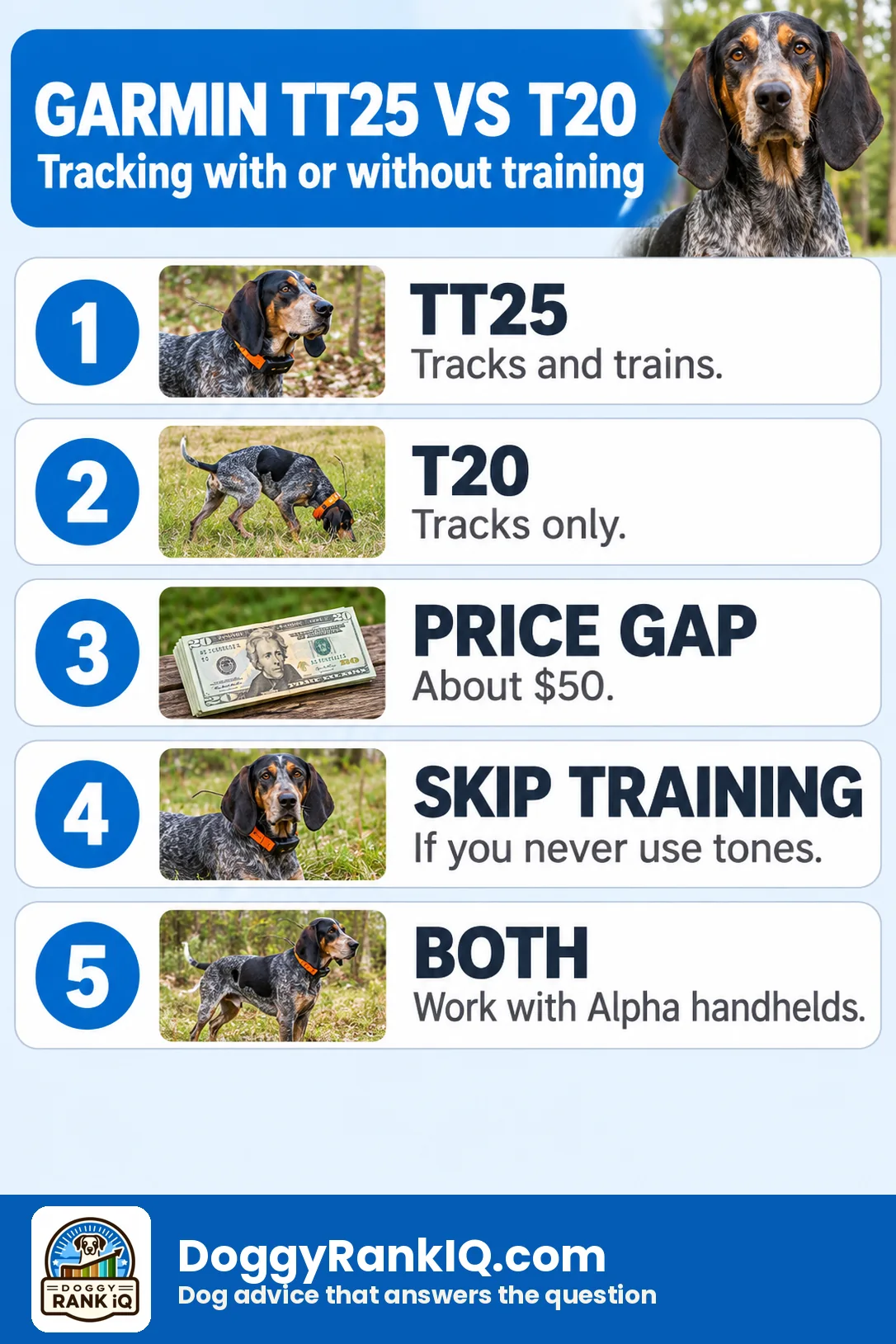
The Garmin TT25 and T20 run the same GPS tracking platform and pair with the same Alpha handhelds. The only functional difference is that the TT25 adds remote stimulation, tone, and vibration for training, while the T20 only tracks location. If your dog already listens off leash and you just want to know where it went, the T20 saves you about $50. If you need to correct behavior at a distance, the garmin tt25 earns its premium.
Key Takeaways: garmin tt25
- The TT25 and T20 share identical GPS tracking hardware and software updates.
- The real price gap is roughly $50, and it buys 18 stimulation levels, tone, and vibration.
- Both collars require a separate Garmin Alpha handheld (10, 200, 200i, 300, or 300i); neither works alone with a phone app.
- Garmin’s official listing shows the T20 at $299.99 and the TT25 at $349.99, before sale pricing according to Garmin’s product page.
- Current Amazon pricing seen in 2026 runs about $249.99 for the T20 and $299.99 for the TT25.
- Field testing from Wag & Wander notes reliable VHF-style tracking range even in terrain where cellular collars lose signal.
- If you never plan to use remote training, the TT25’s extra electronics add cost without benefit.
- No federal ban on e-collars exists in the U.S. as of the 2026 legal review, though local rules vary by city and county.

Do you use training tones?
Tap an option to see the answer.
 Garmin TT25 vs T20: the one real difference
 Garmin TT25 vs T20: the one real difference
Both collars track a dog’s location through the same Garmin radio system, display the same way on a compatible handheld, and update at the same dynamic rate. The TT25 adds a training function. The T20 does not. That’s the entire split, and it’s worth repeating because it’s easy to assume a $50 difference buys better GPS. It doesn’t.
Garmin’s own device specifications page lists the two collars with matching tracking specs. The only column that changes between them is the training feature set. Nobody buys the TT25 for better tracking. They buy it because at some point, probably mid-field, with a dog nose-deep in something that used to be alive, a tracking-only collar can tell you where your dog is but can’t do a thing about it.
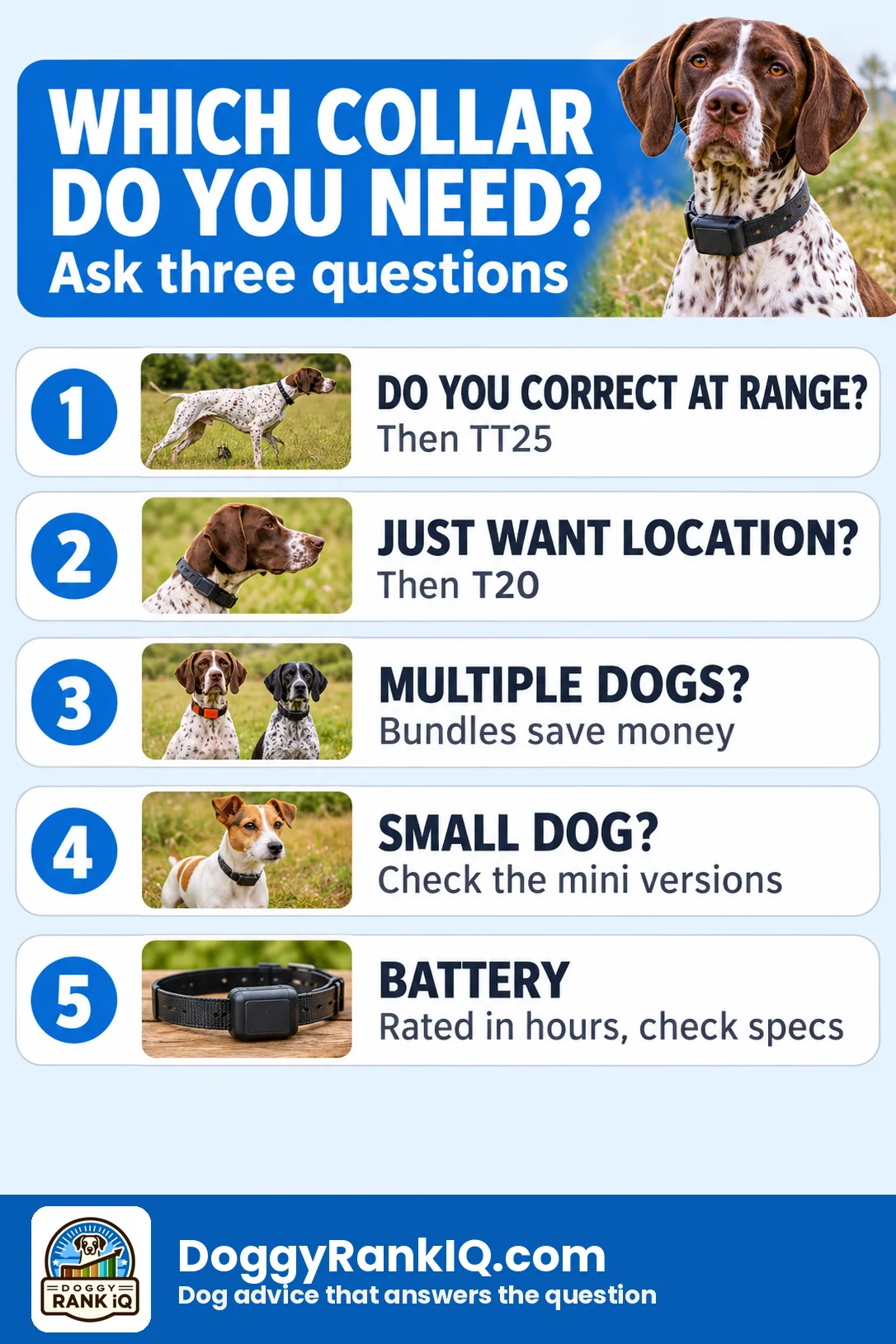
Decision rule: if your dog has solid recall and you mainly need a location fix during off-leash work, the T20 does that job completely. If your dog chases, flushes early, or ignores whistle commands at range, the TT25 gives you a tool the T20 physically cannot.
One common mistake: owners assume the TT25’s stimulation settings require daily use to justify the price. They don’t. Many hunters use the tone or vibration mode as the primary correction and reserve stimulation for rare situations. That’s a training choice, not a collar limitation. If you’re building out a training routine from scratch, pairing either collar with basic obedience work before you ever reach for the stimulation button tends to produce a calmer, more predictable dog in the field.
What is the garmin tt25 used for
The TT25 is used for GPS tracking and remote training of hunting and working dogs, combining real-time location data with the ability to correct behavior at a distance using stimulation, tone, or vibration. It’s built for owners who need both functions in one collar rather than carrying separate tracking and training devices.
Typical use cases include:
- Upland bird hunting, where a dog ranges wide and needs a correction before flushing birds too early.
- Hound work, where a dog’s drive to chase can override voice commands at distance.
- Multi-dog households running several collars off one Alpha handheld.
- Working dogs in open country where visual contact breaks often and a quick stimulation or tone cue keeps the dog oriented.
Garmin’s getting started guide for the TT25 walks through pairing the collar with a handheld and running the first training session, which is worth reading before the first time you clip it on a dog that’s never worn an e-collar.
How much does the garmin tt25 cost
The TT25 costs $349.99 at Garmin’s official list price, though retailers commonly sell it closer to $299.99, and bundle pricing with a handheld can bring the effective cost down further. Garmin’s product listing shows the manufacturer price, while Amazon pricing checked in 2026 runs about $299.99 for the standalone collar.
Bundle pricing changes the math:
- A collar-only purchase gets you the TT25 at full retail unless there’s a sale running.
- A handheld-plus-collar bundle, like the Alpha 300i TT25 bundle, often beats buying each piece separately.
- Multi-dog households running two collars off one handheld should look at the Alpha TT25 2-collar bundle at $729.95, since buying two TT25 units separately plus a handheld usually costs more.
Check the current price: Alpha TT25 2-collar bundle
Specs side by side
| Feature | Garmin T20 | TT25 |
|---|---|---|
| GPS tracking | Yes, up to 9 miles range with compatible handheld | Yes, same range reported with Alpha 300i |
| Remote training | None | 18 stimulation levels, tone, vibration |
| Wi-Fi updates | Supported, 2.4 GHz only | Supported, 2.4 GHz only |
| Handheld required | Alpha 10, 200, 200i, 300, 300i | Alpha 10, 200, 200i, 300, 300i |
| Garmin list price | $299.99 | $349.99 |
| Amazon price, checked 2026 | $249.99 | $299.99 |
Price checked 2026. Prices move with promotions, so confirm on the product page before buying. Garmin’s own battery comparison page breaks down expected runtime for both collars under different usage patterns, which is useful if you’re planning multi-day trips.
What’s the difference between TT15 and TT25?
The TT15 was Garmin’s earlier training collar, and the TT25 replaced it with revised documentation, updated training methods, and current collar specifications, according to Garmin’s 2026 manual revision. Functionally, both sit in the same training-collar tier above the tracking-only T-series.
For most buyers in 2026, this comparison is mostly academic. Garmin’s current lineup and retail listings center on the T20 and TT25, and the TT15 has largely aged out of new-unit availability. If you’re shopping secondhand and see a TT15 listed cheap, check whether it still receives software updates before assuming it matches TT25 performance. A collar that can’t update its firmware is a collar quietly falling behind on range and reliability, even if the price looks tempting.
Decision rule: if you’re choosing between new units today, compare T20 against TT25, not TT15. The TT15 question mainly matters for owners weighing a used unit against a new T20.
Which handhelds pair with each collar
Both the T20 and TT25 pair with the same family of Garmin handhelds: Alpha 10, Alpha 200 and 200i, and Alpha 300 and 300i. Neither collar connects directly to a smartphone app the way some cellular trackers do.
That shared compatibility is actually the headline feature for anyone already invested in a Garmin Alpha 300 system. You can run a T20 on one dog and a TT25 on another, off the same handheld, which is how a lot of multi-dog households justify buying one collar at a time instead of a matched pair.
- Alpha 10: budget handheld, simpler screen, still full tracking.
- Alpha 200/200i: adds mapping detail, the 200i layers in inReach satellite communication.
- Alpha 300/300i: current flagship, pairs with both T20 and TT25, and the TT25 can also combine with Garmin’s beeper and LTE accessories.
For buyers who want a phone-based alternative instead of a dedicated handheld, Garmin’s Alpha LTE uses cellular service and can pair with a smartphone, though it depends on carrier coverage and a monthly plan running about $4.99. That’s a real tradeoff: no handheld to carry, but a subscription and a signal dependency the radio-based T20/TT25 system doesn’t have.
If you’re still deciding on the handheld itself, a guide on sizing a system to your hunting terrain is worth a read before you commit to either collar, especially if you’re also training a younger dog and want the essential commands solid before adding stimulation into the mix.
Bundles are often the better buy here. Garmin and retailers package the T20 or TT25 with a handheld directly: the Alpha 300i TT25 bundle and Alpha 10 T20 bundle both run cheaper than buying each piece separately.
How to set up the garmin tt25 for the first time
Setting up the TT25 for the first time involves charging the collar fully, pairing it with a compatible Alpha handheld, fitting it correctly on the dog, and running a low-level training session before any real fieldwork. Garmin’s startup guide covers the pairing process step by step.
A practical setup sequence looks like this:
- Charge the collar and handheld fully before the first use; a partial charge on day one is a common reason new owners report pairing trouble.
- Power on the Alpha handheld and add the TT25 as a new device through the dog management menu.
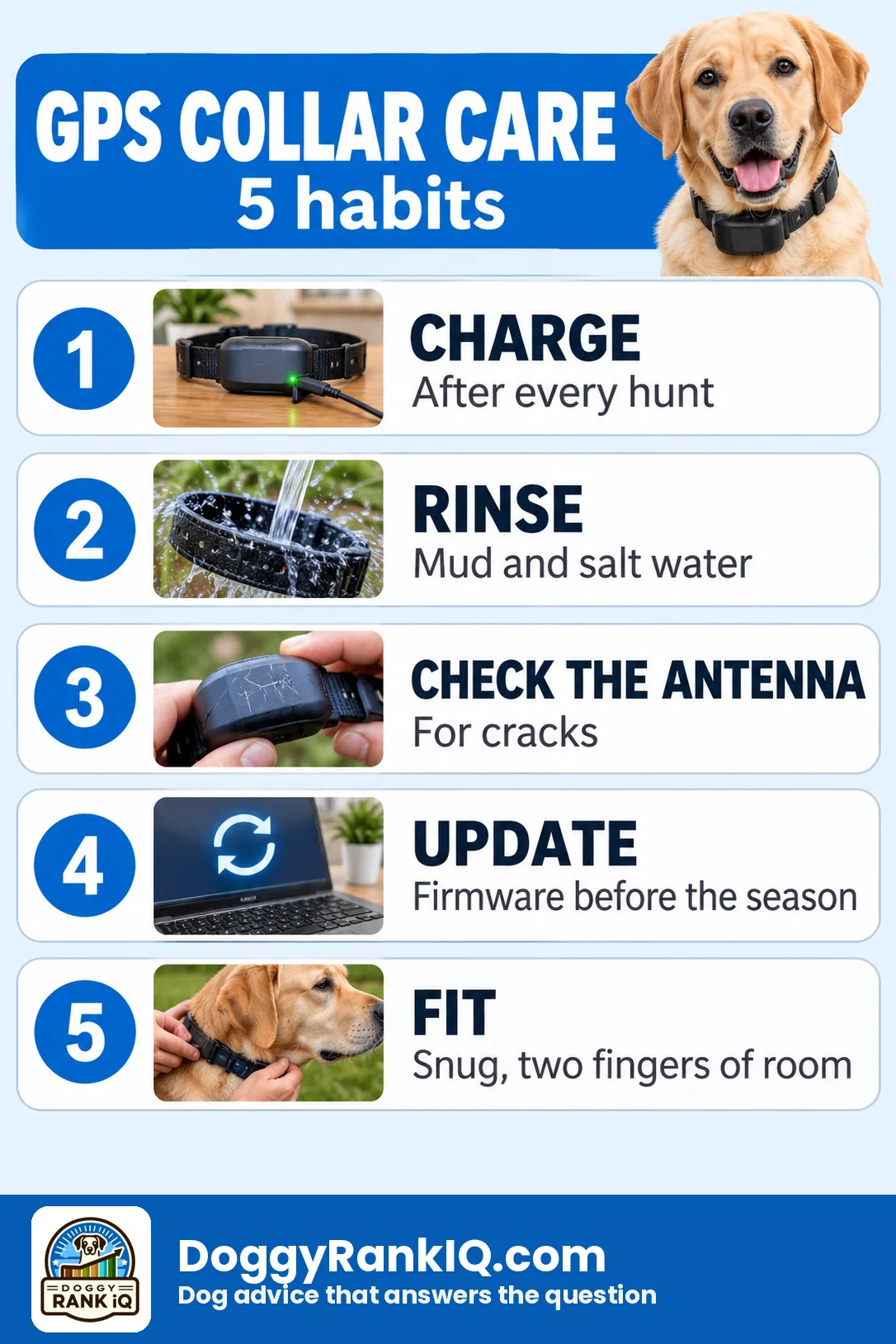
- Fit the collar so two fingers slide comfortably between the strap and the dog’s neck. Garmin publishes fitting guidance for small dogs if the standard strap runs long.
- Test tone and vibration before ever using stimulation, so the dog associates the collar with a sound or buzz first.
- Start stimulation, if needed, at the lowest of the 18 levels and only raise it if the dog shows no response.
- Run a short test walk in a fenced or familiar area to confirm the handheld shows accurate location before heading into open terrain.
Common mistake: skipping the fenced test walk and heading straight to the field. If the pairing dropped or the fit is loose, you won’t find out until the dog is already out of sight.
Is the garmin tt25 good for beginners
The TT25 can work for beginners, but it’s better suited to owners willing to learn proper stimulation technique rather than someone who has never handled a training collar. The tracking side is simple to use out of the box; the training side has a learning curve.
For a first-time e-collar owner:
- Start with tone and vibration only for the first few weeks.
- Read Garmin’s owner’s manual section on stimulation levels before using them.
- Consider pairing the collar with a trainer’s guidance if the dog shows fear or confusion at any setting.
- If recall is already shaky, build it with basic command training before leaning on stimulation to fix it.
Edge case: a beginner with a dog that already has strong obedience foundations may never need to move past tone and vibration, which makes the TT25 nearly as simple to use as the T20.
Garmin tt25 battery life: how long does it last
Garmin’s battery comparison for the T20 and TT25 shows runtime varies by usage pattern, with lighter tracking-only use extending battery life and frequent stimulation or tone use shortening it. Check the official battery comparison page for current runtime figures by mode, since Garmin updates these numbers as firmware changes.
Practical battery tips:
- Charge both the collar and handheld the night before a hunt, not the morning of.
- Heavy stimulation use during training sessions drains the battery faster than tracking alone.
- Cold weather reduces runtime on most lithium battery devices, the TT25 included.
- Carry a backup charger or power bank on multi-day trips, since there’s no swappable battery pack on either collar.
Garmin tt25 not connecting to phone: troubleshooting
The TT25 does not connect directly to a phone at all; it connects to a Garmin Alpha handheld, and the handheld is what may sync to a phone app for certain features. If a collar seems unresponsive, the fix usually involves the handheld pairing, not a phone connection.
Troubleshooting steps:
- Confirm the collar is fully charged; a low battery can cause intermittent pairing.
- Check that the handheld is updated to the latest firmware through Garmin Express.
- Re-pair the collar from the handheld’s device menu if it drops mid-session.
- Confirm Wi-Fi updates are running on a 2.4 GHz network, since neither collar supports 5 GHz, according to Garmin’s software update support page.
- Restart both devices if a firmware update appears stuck partway through.
Common mistake: assuming a dual-band router automatically works. Many routers default new devices to the 5 GHz band, which silently blocks the collar’s update process.
Garmin tt25 waterproof: can I use it in rain
The TT25 is built for field and hunting conditions and is rated for water exposure consistent with Garmin’s outdoor dog collar line, though it’s not meant for prolonged submersion like diving equipment. It handles rain, creek crossings, and wet grass without issue.
Practical guidance:
- Rinse the collar with fresh water after exposure to saltwater or muddy conditions.
- Dry contact points before charging to avoid corrosion over time.
- Avoid leaving the collar submerged for extended periods even if it survives a quick dunk.
- Check Garmin’s device specifications for the exact water rating before heavy water work like duck hunting.
Does the garmin tt25 work with all bikes, and garmin tt25 vs edge 530: which is better
The TT25 is a dog tracking and training collar, not a cycling computer, so it has no connection to bikes and isn’t comparable to the Garmin Edge 530, which is a bike GPS device for cyclists. These two products serve completely different purposes and shouldn’t be cross-shopped.
If you landed here looking for a bike computer, the Edge 530 is the relevant product, not the TT25. If you’re outfitting a hunting dog or working dog with GPS tracking and training, the TT25 and T20 are the correct comparison, as covered throughout this guide.
Garmin tt25 screen cracked: how to fix
The TT25 collar itself does not have a screen; the display lives on the paired Alpha handheld, so a cracked screen issue applies to the handheld, not the collar. If the handheld’s screen cracks, the collar continues transmitting location data normally, but viewing it requires a functional handheld display.
Options if the handheld screen cracks:
- Contact Garmin support for repair or replacement options under warranty.
- Check third-party repair shops that service outdoor GPS devices.
- If the handheld is older (like an early Alpha 100 or 10), replacement may cost less than repair.
- In the meantime, the collar keeps recording and transmitting, so no tracking data is lost while the handheld is out of service.
Garmin tt25 GPS accuracy issues
GPS accuracy issues with the TT25 are uncommon in open terrain but can occur under heavy tree canopy, in deep canyons, or when the handheld and collar lose line of sight for extended periods. Testing from Wag & Wander found the radio-based system generally more reliable than cellular trackers in remote areas, though no GPS system is perfect everywhere.
Common causes and fixes:
- Dense tree cover: signal can lag or jump; moving to higher ground often restores accuracy.
- Low battery on either device: both the collar and handheld need adequate charge for consistent updates.
- Outdated firmware: check for updates regularly through Garmin Express.
- Extreme distance: staying within the rated 9-mile range keeps tracking reliable; pushing past it causes dropouts.
Decision rule: if accuracy issues happen consistently in the same type of terrain, it’s usually environmental (canopy, canyon walls) rather than a defect, and repositioning the handheld higher often solves it.
Is the TT25 worth the money
The TT25 is worth the money for owners who need remote training in addition to tracking, since the roughly $50 premium over the T20 buys 18 stimulation levels, tone, and vibration that the T20 cannot offer at any price. For owners who only need location tracking, the extra cost doesn’t deliver value.
Worth it if:
- The dog chases game, livestock, or other animals.
- Recall breaks down under distraction or at distance.
- You’re training a younger dog and expect to need correction tools as it develops.
Not worth it if:
- The dog already has reliable recall and works mainly in open terrain.
- You don’t plan to ever use stimulation, tone, or vibration.
- Budget is tight and tracking alone solves the actual problem.
Best alternatives to the TT25
The main alternative to the TT25 within Garmin’s own lineup is the T20, which drops the training hardware and costs about $50 less. Outside Garmin, cellular pet trackers like Tractive-style devices offer activity and health tracking but lack the training features and backcountry reliability of Garmin’s radio-based system.
Alternatives worth comparing:
- Garmin T20: same tracking, no training, lower price. Covered in detail in the specs table above.
- Garmin Alpha LTE collar: pairs with a smartphone over cellular instead of a dedicated handheld, but depends on carrier coverage and a monthly fee.
- Cellular pet trackers: better for everyday activity tracking in neighborhoods and parks, weaker in remote terrain without cell service.
- Older TT15 units (used): only worth considering if they still receive firmware updates; otherwise they fall behind on reliability.
TT25 where to buy online
The TT25 can be purchased directly from Garmin, through outdoor retailers like L.L.Bean and L.C. Supply, and through Amazon, with prices varying by retailer and seasonal promotions.
Check the current price: Alpha TT25 2-collar bundle
Bundled options with a handheld, like the Alpha 300i TT25 bundle, frequently save more than buying collar and handheld separately, especially during hunting season promotions.
⭐ Top 5 Features We Love
- Shared tracking backbone. The TT25 and T20 use identical radio tracking, so you’re never sacrificing location accuracy by choosing the cheaper collar.
- 18 stimulation levels on the TT25. Granular enough to start low and only raise intensity if a dog genuinely ignores tone or vibration.
- Backcountry reliability. Field testing across desert routes, high-elevation trails, and multi-month trips from Wag & Wander found the system held up where cellular trackers dropped out.
- Beacon lights for low visibility. Testers have flagged the TT25’s lights as genuinely useful at dawn and dusk hunts.
- Flexible handheld pairing. Five compatible handhelds mean you can scale a system up or down instead of starting from scratch each time you add a dog.
⚠️ Things to Look Out For
- No handheld, no tracking. Neither collar works as a standalone tracker without an Alpha unit, which adds real cost on top of the collar price.
- No 5 GHz Wi-Fi support. Updates only run over 2.4 GHz networks, so a dual-band router set to 5 GHz by default can silently block firmware updates, per Garmin’s software update support page.
- No health or activity tracking. Unlike cellular pet trackers, neither collar tracks steps, sleep, or general activity the way a Tractive-style device does.
- Local law variation. There’s no federal e-collar ban in the U.S., but some municipalities restrict stimulation collars, so check local ordinances before using TT25’s training mode.
- Bulk and system cost add up fast. A collar plus a handheld plus any bundle accessories can run well past the sticker price of either unit alone.
- A struggling dog isn’t a training failure, it’s a signal. If a dog shows fear or confusion with stimulation settings, that’s a reason to drop intensity and consult a trainer, not push through.
Who should buy the T20 and save the money
Buy the T20 if your dog already has reliable recall and the only thing you’re missing is a location fix when it ranges out of sight. The TT25 premium runs roughly $50, which isn’t a small number, but it’s also not the number that should decide this. The question is whether you’ll ever need the training function, not whether you can afford it.
Here’s the honest math. Is the garmin t20 enough dog for your situation? If your dog:
- Already responds to whistle and voice commands at distance
- Works mainly in open terrain where visual contact rarely breaks
- Doesn’t chase game, livestock, or other dogs
- Has no history of ignoring recall under high distraction
…then stimulation and tone are features you’re paying for and not using. That’s the TT25 trap: buying training capability for a dog that never needed training in the first place.
But if any of those bullets describe a dog you’re hoping will eventually behave that way, rather than one that already does, the math flips. Paying the TT25 premium up front can be cheaper than buying a tracking-only collar now and a training collar later, since you’d be paying for two collars instead of one.
Check the current price: Garmin Alpha T 20 tracking collar
For households running two dogs, the Alpha TT25 2-collar bundle at $729.95 often beats buying two collars separately, especially if both dogs are in active training.
Check the current price: Alpha TT25 2-collar bundle
FAQ
The bottom line
The TT25 and T20 are the same tracking collar wearing two different price tags. One tracks. One tracks and trains. If your dog already does what you ask off leash, the T20 at $249.99 (price checked 2026) gets the job done for $50 less. If there’s any chance you’ll need to correct a chase, a flush, or a dog that’s decided your voice is optional at 200 yards, the TT25 at $299.99 (price checked 2026) buys you that option before you need it, not after.
Compare the options against your actual dog, not the dog you wish you had on day one. Check the dimensions of your existing Alpha handheld’s compatibility list, confirm your Wi-Fi band supports updates, and if remote stimulation is new territory, pair it with basic training guidance rather than the collar alone.
Doggy Rank IQ is reader supported. As an Amazon Associate we earn from qualifying purchases, at no extra cost to you.