
Quick Answer
FortiFlora for dogs is a single-strain probiotic (Enterococcus faecium SF68) that runs about $1.03 per day for the powder sachet at current pricing, while Proviable-DC is a multi-strain capsule that runs closer to $0.50 to $0.56 per day depending on which size you buy. Both have manufacturer and third-party evidence behind them, and Cornell’s veterinary school names both as products with actual studies, not just formulation claims theveterinariansbag.com. Neither is a guaranteed fix for diarrhea, and a 2024 evidence review found only a modest benefit from probiotics generally in acute cases pubmed.ncbi.nlm.nih.gov. Ask a veterinarian before starting either one, especially for a puppy, a senior dog, or a dog on antibiotics.
Key Takeaways: fortiflora for dogs
- FortiFlora for dogs contains one studied strain, SF68, at a fixed dose per sachet or tablet.
- Proviable packs seven bacterial strains plus a prebiotic into each capsule.
- Cost per day favors the Proviable capsules; FortiFlora powder sits in the middle; FortiFlora tablets land somewhere between the two depending on bottle size.
- Evidence supports both products in specific contexts, but no study proves either one beats the other head to head.
- A 2024 review of acute diarrhea trials found an average benefit of less than a day shaved off symptoms, not a cure ebvminpractice.org.
- FortiFlora Response is a different product entirely, dosed every 8 hours for 72 hours, not comparable dollar-for-dollar with the daily maintenance products newscenter.purina.com.
- Dogs on antibiotics, dogs with chronic loose stool, and dogs recommended a probiotic by a vet are the main candidates for either product.
- Always check with a veterinarian before starting a supplement, particularly for puppies, seniors, or dogs with existing health conditions.

What does your dog accept?
Tap an option to see the answer.
 What is fortiflora for dogs and how does it work?
 What is fortiflora for dogs and how does it work?
FortiFlora for dogs is a veterinary probiotic supplement built around one bacterial strain, Enterococcus faecium SF68, delivered at 1 x 10^8 CFU per gram sachet and mixed into food once daily Purina. It’s sold as a Pro Plan Veterinary Supplement, meaning it’s positioned closer to a clinical product than a general pet-store add-on, though it’s still available without a prescription.
The mechanism is fairly straightforward on paper. SF68 is meant to help establish a more balanced population of bacteria in the gut, which in theory supports firmer stool and steadier digestion during periods of stress, such as a food switch, travel, boarding, or a course of antibiotics. It isn’t a digestive enzyme and it isn’t a dewormer. It’s a live microorganism supplement, and its job is narrow: support the gut microbiome, not treat an underlying disease.
SF68 is one of the more studied probiotic strains in veterinary medicine, which is part of why Cornell’s Riney Canine Health Center lists FortiFlora among products backed by actual trials rather than marketing copy alone vet.cornell.edu. A shelter study combining SF68 with metronidazole found 65.6% of treated dogs had normal stool days compared with 46.9% on metronidazole alone. A separate study giving SF68 alone to 182 shelter dogs did not find a statistically significant difference supplegut.com.
That split result matters. FortiFlora’s best documented performance shows up alongside other treatment, not necessarily as a standalone fix. Choose FortiFlora for dogs if your dog is already on a vet-prescribed treatment plan and the probiotic is meant to support recovery, not replace it.
Bobby’s Fact: Cornell’s general probiotic benchmark for dogs is 1 to 10 billion CFU per day. FortiFlora’s sachet comes in at 100 million CFU, below that range, while Proviable-DC’s 5 billion CFU lands inside it. CFU count alone doesn’t decide which product works better for a given dog, since strain identity and trial data matter just as much vet.cornell.edu.
When should I give my dog fortiflora?
FortiFlora for dogs is typically given when a dog is starting antibiotics, recovering from a stomach upset, going through a stressful transition like boarding or a move, or switching foods. It’s also commonly recommended by vets as a general digestive support supplement for dogs with a history of loose stool.
Common situations where owners reach for it:
- A dog is prescribed metronidazole or another antibiotic and the vet wants gut support alongside it.
- A puppy or adult dog is being transitioned to a new diet over 5 to 7 days.
- A dog is heading into a kennel stay, a long car ride, or a move, all of which can trigger stress-related loose stool.
- A dog has chronic, mild digestive sensitivity without a diagnosed disease.
Edge case: if a dog has diarrhea lasting more than 24 to 48 hours, that’s not a “start FortiFlora and wait” situation. That’s a call to the vet, since persistent diarrhea can point to parasites, infection, or something a probiotic alone won’t resolve VCA Animal Hospitals.
How much fortiflora should I give my dog?
FortiFlora’s label directs one 1-gram sachet mixed into food once daily for adult dogs, regardless of size, according to the current Purina product page shop.purina.com. That flat dosing is part of what makes the powder simple to use. One sachet, one meal, done, no weighing the dog or doing math on body weight.
The tablet version follows its own label directions and should not be assumed identical to the powder’s dosing, since chewable formats sometimes carry different per-unit CFU counts proplanvetdirect.com. Always read the specific product’s label rather than assuming the powder’s instructions transfer over.
FortiFlora Response is a separate animal entirely. Its current label calls for dosing every 8 hours for up to 72 hours, with amounts that can increase based on body weight, followed by a switch to daily FortiFlora sachets for ongoing support Purina label PDF. That’s an acute-care dosing schedule, not a daily maintenance one, and the cost math discussed below does not apply to it.
Decision rule: if your dog needs ongoing daily support, the standard sachet or tablet is the right product. If a vet is managing an acute flare of diarrhea, ask specifically whether Response or a different formulation fits that situation better.
Confirm any dosing plan with your veterinarian, particularly if your dog has a chronic condition or is on other medication.
How does FortiFlora work in dogs?
FortiFlora for dogs delivers one bacterial strain, Enterococcus faecium SF68, at 1 x 10^8 CFU per gram sachet, mixed into food once daily shop.purina.com. The idea is that this specific strain supports a more balanced gut environment, which may help firm up stool and settle digestion during stressful periods like a diet change or antibiotic course.
SF68 has also shown up in research beyond routine diarrhea support. A recent study looked at supplementing dogs with chronic kidney disease using Enterococcus lactis (a reclassification tied to the SF68 lineage), suggesting researchers continue to explore uses for this strain outside the basic “upset stomach” niche pubmed.ncbi.nlm.nih.gov. That doesn’t mean FortiFlora treats kidney disease, but it shows the strain is still actively studied, which is more than can be said for many supplement strains on pet store shelves.
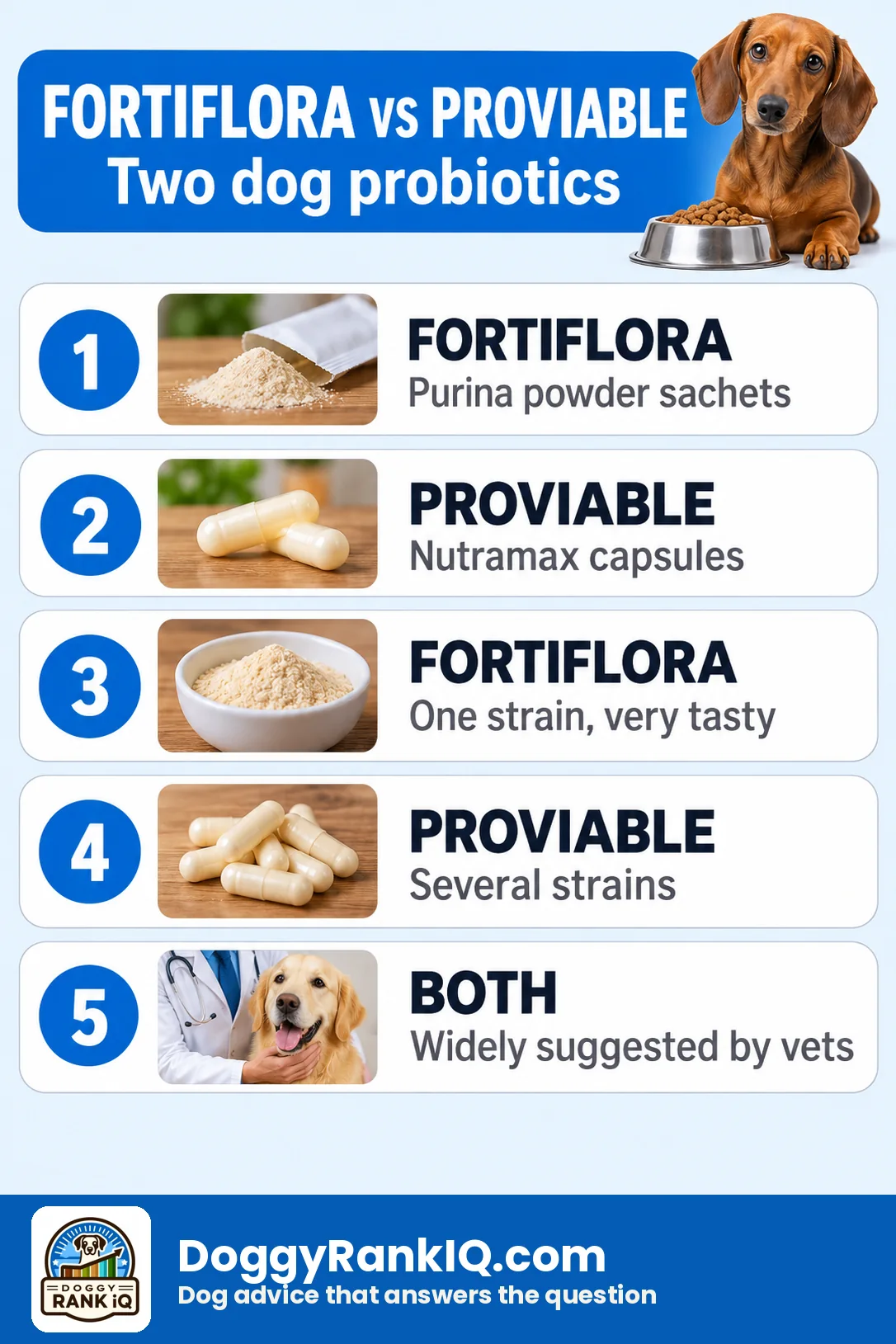
FortiFlora vs Proviable: strains, format and directions
 FortiFlora vs Proviable: strains, format and directions
A side-by-side look at the label details tells you more than either brand’s marketing page.
Source: manufacturer labels, Purina and Proviable.
Purina has also expanded its lineup. FortiFlora Plus adds bovine colostrum, FortiFlora PRO adds psyllium, and FortiFlora Response contains kaolin and pectin for acute situations, dosed every 8 hours for up to 72 hours before switching to daily sachets shop.purina.com. None of those variants are priced the same as the standard daily sachet, so don’t compare their cost per day against the basic product without checking the specific label.
Fortiflora vs other dog probiotics: which is better?
There’s no single winner between FortiFlora for dogs, Proviable, and other probiotic options, because “better” depends on what you’re treating for and how long you plan to use it. FortiFlora wins on simplicity and documented strain-specific research; Proviable wins on strain diversity and lower daily cost at larger bottle sizes.
A few decision points worth weighing:
- Choose FortiFlora if a vet has prescribed antibiotics and wants a probiotic with trial data supporting that specific combination.
- Choose Proviable if you want a broader multi-strain approach plus a prebiotic, and you’re planning on months of daily use where cost per day adds up.
- Choose neither, and ask your vet about alternatives, if your dog has a diagnosed GI disease, an immune condition, or a known sensitivity to inactive ingredients like yeast.
- Consider a general food-based approach first for mild cases. VCA Animal Hospitals notes that probiotics are supportive tools, not cures, for most digestive issues VCA Animal Hospitals.
Price checked at the time of this comparison showed FortiFlora powder, 30 sachets at $30.99, running about $1.03 per day. Check the current price{rel=”sponsored”} before buying since probiotic pricing shifts often.
Does fortiflora actually work for dogs?
The honest answer is: sometimes, and mostly when paired with other treatment. FortiFlora’s own clinical history shows a clear benefit when combined with metronidazole in shelter dogs, but a standalone trial in 182 shelter dogs did not find a statistically significant difference versus placebo supplegut.com.
A broader 2024 review of acute canine diarrhea treatments, covering several probiotic and nutraceutical options, found an average reduction in diarrhea duration of under one day across the trials examined pubmed.ncbi.nlm.nih.gov. That’s a real but modest effect, not a dramatic turnaround. Owners expecting a probiotic to resolve diarrhea within hours are likely to be disappointed; owners expecting a modest supportive nudge alongside proper veterinary treatment have more realistic expectations.
Common mistake: giving FortiFlora as the sole response to diarrhea that’s lasted more than a day or two, instead of calling the vet. A probiotic is a support tool, not a diagnostic one, and it won’t reveal whether a dog has parasites, a dietary indiscretion, or something more serious.
Fortiflora for dogs with diarrhea: does it help?
FortiFlora for dogs can offer mild, supportive benefit for diarrhea, particularly when used alongside antibiotics prescribed by a vet, but it is not a standalone cure. The shelter study pairing SF68 with metronidazole found meaningfully more dogs with normal stool days (65.6%) compared with metronidazole alone (46.9%), which is the strongest evidence behind this specific use case supplegut.com.
For acute diarrhea specifically, Purina also sells FortiFlora Response, formulated with kaolin and pectin and dosed every 8 hours for up to 72 hours, designed as a short-term response product rather than a daily maintenance supplement newscenter.purina.com. This is a different product, with different dosing and different cost math than the standard sachet discussed throughout this comparison.
Example: a dog with mild stress colitis after a kennel stay might see firmer stool within a few days on standard FortiFlora sachets. A dog with sudden, watery diarrhea and lethargy needs a vet visit first, with a probiotic only added if the vet recommends it as part of the plan.
Cost per day compared
Here is the actual math, using prices checked 2026.
| Product | Count | Days supply | Cost per day | Price |
|---|---|---|---|---|
| FortiFlora powder, 30 sachets | 30 | 30 | $1.03/day | $30.99 |
| FortiFlora tablets, 90 ct | 90 | 90 (1/day) | $0.90/day | $80.99 |
| Proviable-DC, 40 capsules | 40 | 40 | $0.50/day | $19.97 |
| Proviable-DC, 80 capsules | 80 | 80 | $0.56/day | $44.99 |
The math is simple division: price divided by days of supply, assuming one dose daily for a single average-size dog. Multi-dog households or large breeds needing a higher per-dose amount will change these numbers, since larger dogs sometimes need more than one capsule or sachet daily per the label.
The 40-capsule Proviable-DC bottle (check the current price{rel=”sponsored”}) comes out cheapest per day in this comparison, with the 80-capsule size (check the current price{rel=”sponsored”}) a close second. FortiFlora tablets (check the current price{rel=”sponsored”}) cost more per day than the powder (check the current price{rel=”sponsored”}), mostly because the tablet format carries a premium for convenience and palatability.
How much does fortiflora cost?
FortiFlora for dogs costs roughly $0.90 to $1.03 per day depending on format, with the 30-sachet powder box at $30.99 working out to about $1.03 per day and the 90-count tablet bottle at $80.99 working out to about $0.90 per day. Those numbers assume one dose daily for an average adult dog and will shift with retailer pricing changes.
Choose the cheapest option only if your dog’s needs are otherwise identical. A dog with a documented strain sensitivity or one already thriving on a particular product shouldn’t be switched purely to save fifty cents a day. For owners managing multiple pets or a tight supplement budget across several products, it can help to compare pricing the same way you would when researching the best dog food choices recommended by veterinarians, checking cost per serving rather than sticker price alone.
Is fortiflora safe for all dogs?
FortiFlora is not automatically safe for every dog, and most owners should check with a vet before starting it on puppies, seniors, pregnant dogs, or dogs with existing health conditions. For healthy adult dogs without known sensitivities, it’s generally considered low risk, but “low risk” is not the same as “risk free.”
FortiFlora’s inactive ingredients include liver flavor and yeast, which matters directly for dogs with known sensitivities to either ingredient shop.purina.com. A small number of dogs may also experience mild gas, temporarily softer stool, or appetite changes while adjusting to a new probiotic, regardless of brand.
FortiFlora for dogs side effects and who should ask a vet first
FortiFlora is generally considered low risk, and most owners report no noticeable issues, but a small number of dogs may experience mild gas, softer stool initially, or appetite changes during the adjustment period. The inactive ingredients include liver flavor and yeast, which matters for dogs with known sensitivities to either shop.purina.com.
Who should talk to a vet before starting:
- Puppies under veterinary care for other conditions, confirm the probiotic doesn’t interact with existing treatment.
- Dogs with yeast or liver-flavor sensitivities, check the inactive ingredient list first.
- Dogs already on another probiotic or supplement, avoid doubling up without guidance.
- Dogs with a compromised immune system, introducing live bacteria strains deserves professional input.
- Any dog with diarrhea lasting more than 24 to 48 hours, that’s a call to the vet regardless of which probiotic you’re considering, since persistent diarrhea can signal something a supplement alone won’t fix VCA Animal Hospitals.
Proviable’s seven-strain formula carries a similar general safety profile, though more ingredients mean more label items to check against known sensitivities. Neither product should be treated as a substitute for veterinary care when a dog shows signs of real illness, like lethargy, vomiting, or blood in the stool. For more on recognizing symptoms that need urgent attention, see our guide on bloat in dogs symptoms, which covers a different but equally time-sensitive digestive emergency.
Can puppies take fortiflora?
Puppies can sometimes be given FortiFlora for dogs, but it’s best confirmed with a vet first, especially for very young puppies or those with unresolved health issues. FortiFlora’s label does not restrict use strictly to adult dogs, but the flat one-sachet dosing was described on the product page in the context of adult dogs, so smaller or younger animals may need a different approach shop.purina.com.
A vet visit matters more here because puppies are more vulnerable to rapid dehydration from diarrhea than adult dogs, and a probiotic alone should never delay diagnosis of a puppy with persistent loose stool, vomiting, or lethargy.
Can senior dogs take fortiflora safely?
Senior dogs can generally take FortiFlora, but age alone isn’t the deciding factor, underlying health conditions are. A senior dog on multiple medications, with kidney disease, or with a compromised immune system needs a vet’s input before adding any new supplement, probiotic or otherwise.
Interestingly, a related strain to SF68 has been studied specifically in dogs with chronic kidney disease, which suggests researchers are paying attention to how this probiotic lineage behaves in older, more medically complex dogs pubmed.ncbi.nlm.nih.gov. That’s not an endorsement to self-prescribe FortiFlora for a senior dog with kidney issues, it’s a reason to bring the product up directly with the treating vet.
Are there alternatives to fortiflora for dogs?
Yes. Proviable-DC is the most direct multi-strain alternative covered in this comparison, but other options exist, including plain unflavored probiotic powders, prebiotic-only supplements, and diet-based approaches using gut-friendly whole foods. VCA Animal Hospitals notes that probiotic selection should generally be guided by the specific digestive issue and a vet’s recommendation rather than brand familiarity alone VCA Animal Hospitals.
For owners interested in supporting digestion through diet rather than, or alongside, a supplement, our guide on fruits and vegetables for dogs covers food-based options that are gentle on the gut. It’s also worth reviewing general feeding guidance in our beginner’s guide to choosing the best food for your dog before adding any supplement on top of an existing diet.
How long does it take for fortiflora to work?
Most owners report noticing changes in stool consistency within a few days to about a week of starting FortiFlora, though there’s no universal timeline since response depends on the underlying cause of the digestive upset. A dog with mild stress-related loose stool may firm up faster than a dog recovering from a more significant GI event.
The clinical trial pairing SF68 with metronidazole measured outcomes over the course of a treatment period rather than a single day, which supports the idea that this is a supportive product used over days, not something expected to resolve symptoms within hours supplegut.com. If there’s no improvement after a week of consistent daily use, that’s a reasonable point to check back in with a vet rather than continuing indefinitely without reassessment.

⭐ Top 5 Features We Love
- Single, well-studied strain in FortiFlora. SF68 has more trial history behind it than many boutique probiotic strains, which gives owners something concrete to point to.
- Proviable’s prebiotic inclusion. The fructooligosaccharide in Proviable-DC is meant to feed the beneficial bacteria already present, not just add new ones.
- FortiFlora’s flat dosing. One sachet, any adult dog size, no weight-based math required.
- Proviable’s cost efficiency at scale. The 80-capsule bottle brings cost per day down for owners managing a longer-term plan.
- Both products have veterinary-world recognition. Cornell names both as products with actual supporting research, which sets them apart from supplements that rely purely on marketing language theveterinariansbag.com.
⚠️ Things to Look Out For
- Neither product cures diarrhea on its own. The 2024 evidence review found only a 0.68-day average reduction in symptom duration across the trials studied, not a dramatic fix ebvminpractice.org.
- FortiFlora’s standalone evidence is mixed. The 182-dog shelter study found no significant difference when SF68 was given alone, without antibiotics supplegut.com.
- Proviable-DC lacks its own standalone placebo trial. The strongest related study tested a different formulation, Proviable-Forte combined with Saccharomyces boulardii, in just 22 dogs supplegut.com.
- Price per sachet or capsule varies by retailer. Always check the current listing before assuming the math above still holds exactly.
- FortiFlora Response is not a daily maintenance product. Confusing it with the standard sachet could mean overdosing or underdosing relative to the actual label directions.
Which one fits your dog
A dog recovering from antibiotics, with a vet already managing the case, is a reasonable candidate for FortiFlora, since its best documented results came alongside metronidazole treatment. A dog needing broader, longer-term digestive support, especially one an owner plans to keep on a probiotic for months, may fit better with Proviable-DC’s multi-strain approach and lower cost per day at the 80-capsule size.
Budget matters here, and it’s fine to let it. If cost per day is the deciding factor and your vet has no strong preference between the two, Proviable-DC’s 40-capsule bottle offers the lowest price point in this comparison. If your dog has already responded well to FortiFlora in the past, there’s no evidence requirement forcing a switch just to save money.
Dogs with sensitive stomachs that react poorly to new ingredients should start whichever product a vet recommends first, in the smallest available size, before committing to a larger bottle. For general digestive wellness beyond probiotics, our guide on fruits and vegetables for dogs covers additional ways to support gut health through diet, and our beginner’s guide to the best superfoods for dogs offers further food-based support ideas worth discussing alongside any probiotic plan.
This is not medical advice. Confirm with your veterinarian before starting FortiFlora, Proviable, or any other digestive supplement, particularly for puppies, seniors, pregnant dogs, or dogs managing an existing medical condition.

FAQ
The bottom line
FortiFlora and Proviable both have real evidence behind them, and neither one is a guaranteed fix for a dog’s digestive troubles. FortiFlora’s single, well-studied strain works best in the price range of $0.90 to $1.03 per day and shows its strongest results paired with other treatment. Proviable’s multi-strain capsule runs cheaper per day at larger sizes and adds a prebiotic, but it doesn’t have a standalone trial proving it beats FortiFlora directly.
The practical next step: if a vet already recommended one of these two, start there and watch for improvement over one to two weeks before switching anything. If you’re choosing without a specific recommendation, the cost-per-day math favors Proviable-DC, while FortiFlora’s simpler flat dosing may suit owners who want one less thing to calculate at dinner time. Either way, a short call to your veterinarian before you buy beats guessing from a label.
For related digestive and care topics, see our guides on why do dogs eat grass, why do dogs eat poop, and slow feeder for dogs if mealtime speed is contributing to stomach upset.
Doggy Rank IQ is reader supported. As an Amazon Associate we earn from qualifying purchases, at no extra cost to you.