
Why do dogs eat poop? Quick Answer
Dogs eat poop mostly out of ordinary instinct, curiosity, and food motivation, not nutrient deficiency, and a large owner survey found most dogs never do it at all. The largest dataset on this question, a UC Davis survey of over 1,500 owners, found that 76.9% of dogs had never been observed eating stool and only 16.0% did it frequently. So why do dogs eat poop when so few actually do? The answer lies in a mix of fresh-waste instinct, appetite, and in a smaller share of cases, an underlying medical issue worth a vet visit.
Key Takeaways
- A 2018 UC Davis survey of 1,552 dog owners found 76.9% of dogs had never been observed eating stool, and 16.0% were frequent eaters (six or more times) according to the UC Davis-linked findings reported by the American Kennel Club.
- A broader read of the same dataset puts “at least once” coprophagia around 23 to 24% of dogs, depending on the threshold used.
- About 80 to 85% of frequent stool-eaters preferred feces less than two days old, which supports an evolutionary “fresh waste” explanation over a nutritional one.
- Roughly half of stool-eating dogs were described by owners as “greedy eaters,” compared with under a third of non-eaters.
- Most veterinary sources, including VCA Animal Hospitals, list medical causes such as malabsorption, parasites, diabetes, and thyroid disease as possible but less common drivers.
- No prescription treatment for coprophagia has cleared regulatory review as of November 2026. The market still relies on taste-deterrent supplements, fiber additions, and digestive enzyme products.
- Puppies eat poop more often than adult dogs, and most grow out of it by around nine months to a year old.
Why do dogs eat poop? When to call the vet
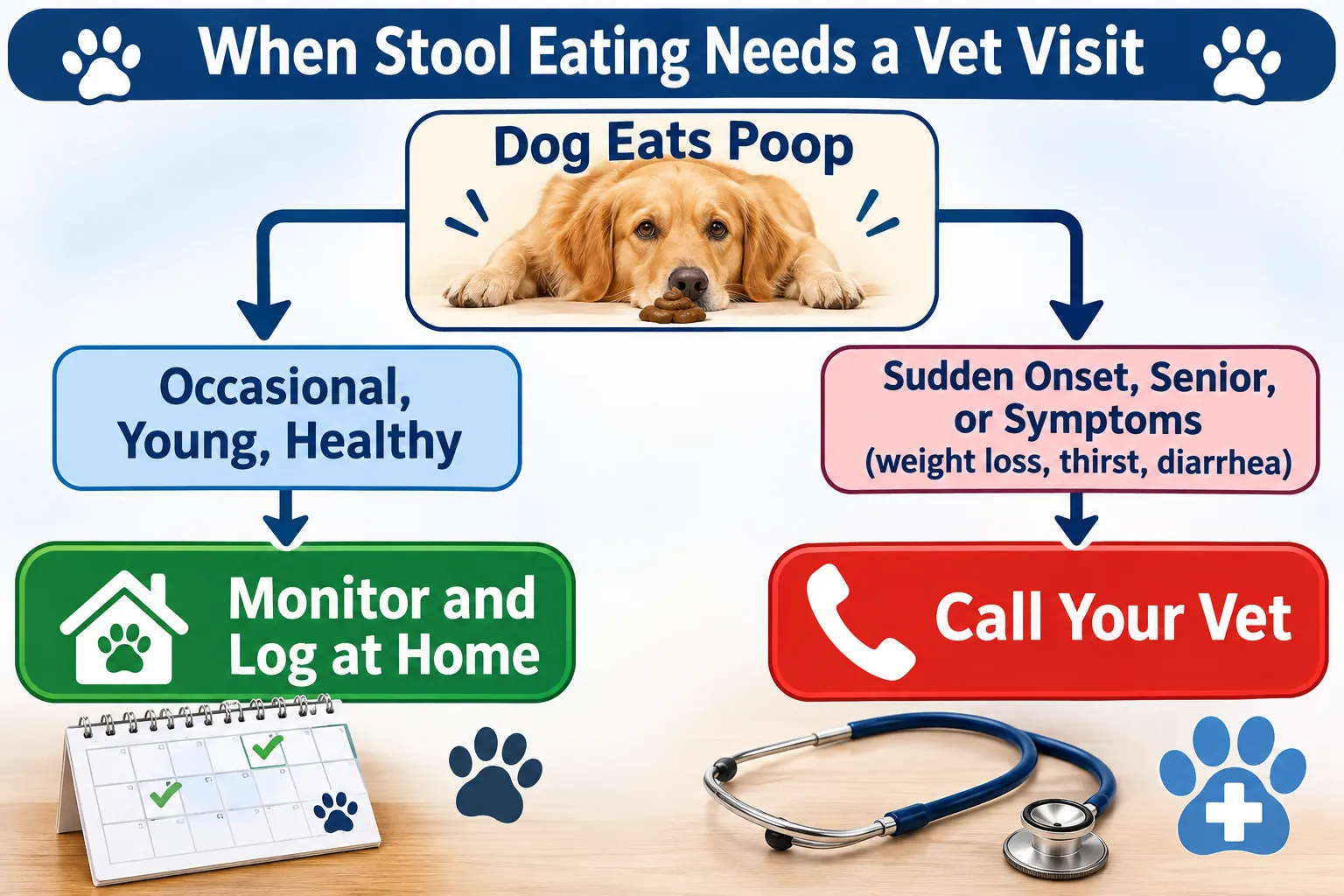
Call your vet if stool eating starts suddenly in an older dog, pairs with weight loss, increased thirst, diarrhea, or vomiting, or follows a recent medication change. These combinations point toward a medical cause rather than habit. A vet visit with a written log of dates and symptoms speeds up the diagnosis, and it rules out the more serious explanations before you spend money on supplements that won’t help.

Why do dogs eat poop
Why do dogs eat poop comes down to a mix of instinct, opportunity, and, in a minority of dogs, an underlying medical or behavioral driver. The UC Davis survey, led by veterinary behaviorist Benjamin Hart, remains the largest dataset on this question and reshaped how veterinarians talk about the behavior, as summarized by the American Kennel Club.
The leading theory is “den sanitation.” Ancestral canids may have benefited from removing fresh feces near a den site, reducing exposure to parasite eggs that become infectious after a couple of days in the environment. This explains a detail that otherwise looks contradictory: dogs generally avoid old, dried waste but will eat waste that is fresh. In the frequent-eater group, survey data showed a strong preference for stool under two days old in 80 to 85% of cases. That timing lines up closely with when certain parasite life cycles would still be non-infectious, which is why researchers lean on this theory more than a simple hunger story.
Food motivation also matters. Owners of frequent stool-eaters were roughly twice as likely to describe their dog as a “greedy eater” compared with owners of dogs who never did it. So why do dogs eat poop when their own food bowl is full? For many, it has less to do with nutrition and more to do with a dog that treats anything edible-adjacent as fair game, the same instinct that drives counter-surfing and trash raiding.
Medical causes are real but less common than search results suggest. VCA Animal Hospitals lists poor diet digestibility, malabsorption, enzyme deficiency, intestinal parasites, diabetes, Cushing’s disease, and thyroid disease as possible drivers of increased appetite or stool interest. Purina and Chewy both add that boredom and confinement raise the odds and recommend enrichment, including food-dispensing toys that make a dog work for meals instead of scanning the yard for something else to chew on.
Decision rule: if your dog is young, otherwise healthy, and the behavior is occasional, it is probably habit or curiosity. If it is new, frequent, or paired with other symptoms, treat it as a conversation starter with your vet, not a hot sauce problem.
For dogs that seem under-stimulated rather than under-fed, slower, more engaging mealtimes can help. Reviewing your dog’s basic training foundation also gives you a reliable “leave it” cue, which is one of the most useful tools for interrupting the behavior in real time.
Why do dogs eat poop? Is it normal for dogs to eat poop?
Occasional stool eating is common enough to be considered within the normal range of canine behavior, especially in puppies and young dogs, but it is not something every dog does. The UC Davis data makes this clear: three out of four dogs in the survey had never done it at all, so “normal” does not mean “universal.”
What counts as normal:
- A puppy mouthing or sampling stool during the exploratory stage of development.
- An adult dog eating another dog’s fresh stool once or twice during a walk.
- A dog eating stool shortly after it’s deposited, rather than seeking out old, dried waste.
What is less typical and worth watching:
- Daily or near-daily stool eating in an adult dog with no history of the habit.
- Eating stool alongside other unusual chewing or ingestion behavior, a pattern sometimes grouped under pica in dogs.
- Sudden onset in a dog over seven years old.
Why do dogs eat poop? Why do puppies eat poop more than adult dogs?
Puppies eat poop more often than adult dogs because they explore the world mouth-first and have not yet learned what is and isn’t food, and because mother dogs model stool cleanup behavior near the nest. Mother dogs routinely clean up after newborn puppies by consuming their waste, a normal maternal behavior that keeps the den area clean and free of parasite buildup, as noted by PDSA. Puppies raised around this behavior sometimes copy it before growing out of it.
Puppies are also simply less selective eaters. Everything from socks to sticks to stool gets sampled during the first year, and most of this falls away as a dog matures and food-seeking instincts normalize. Supervision and prompt yard cleanup matter most during this window, since puppies have the most opportunity and the least impulse control.
Why do dogs eat poop? At what age do puppies stop eating poop?
Most puppies stop eating poop somewhere between six months and one year old as mouthing behavior fades and their diet and routine stabilize. This is an estimate based on general puppy development patterns rather than a fixed rule, and some dogs carry the habit into adulthood regardless of age.
If a puppy is still eating stool past a year old, it is reasonable to start treating it the same way you would in an adult dog: rule out diet and medical causes, add supervision, and bring a log to your next vet visit rather than assuming it will resolve on its own.
Why do dogs eat poop? How do I stop my dog from eating poop?
Stopping the behavior starts with removing opportunity, since a dog cannot eat stool it cannot reach. Combine that with training, diet review, and enrichment, and most cases improve within a few weeks.
Practical steps:
- Clean the yard immediately after each potty break so fresh stool never sits long enough to be interesting.
- Walk on a leash and use a trained “leave it” cue the moment your dog shows interest in stool.
- Feed a consistent, complete diet and avoid sudden food switches, since digestive upset can change stool smell and texture in ways that increase interest.
- Add a food puzzle or slow feeder at mealtimes to address boredom-driven scavenging, a tip echoed by Chewy’s training guidance.
- Keep a 14-day log of incidents, diet, and any new symptoms before assuming the problem is purely behavioral.
Common mistake: punishing the dog after discovering the behavior rather than interrupting it in the moment. Dogs don’t connect delayed punishment with the act itself, and this approach can create house-training anxiety instead of solving anything.
Is it dangerous for dogs to eat their own poop?
Eating a dog’s own fresh stool carries low but real risk, mainly from re-ingesting intestinal parasites or bacteria the dog is already carrying. WebMD notes that the bigger danger usually comes from eating other animals’ waste, since that introduces unfamiliar parasites, toxins from rodenticide-poisoned rodents, or medication residue the dog was never exposed to directly.
Risk goes up when the stool source is:
- A dog with an active parasite infection or recent deworming treatment.
- A dog on medication, since drug residue can pass through waste.
- Wildlife or livestock, which may carry different parasite species.
- Compost or garden areas treated with chemicals.
For a healthy dog eating its own fresh waste occasionally, the risk is low. For a dog scavenging unknown stool on walks, the risk climbs, which is one more reason leash supervision matters.
What does it mean when a dog eats poop?
In most cases, it means a dog is acting on an old evolutionary instinct or simple opportunism, not sending a signal about a hidden illness. Why do dogs eat poop in a way that looks almost deliberate? Survey data suggests timing is the key clue: frequent eaters target fresh waste specifically, which points toward instinct rather than random scavenging.

That said, the behavior can mean different things depending on context:
- In puppies, it usually means normal exploration.
- In bored or under-exercised adults, it usually means a dog looking for stimulation.
- In a dog with sudden-onset symptoms, it can mean an underlying medical issue such as malabsorption or a hormonal condition.
- In a newly adopted or rescued dog, it can mean a stress response tied to past food scarcity.
Is eating poop a sign of a nutrient deficiency in dogs?
Nutrient deficiency is one of the least likely explanations for coprophagia in a dog eating a complete, commercial diet. Veterinary sources, including VCA Animal Hospitals, list malabsorption and enzyme insufficiency as possible contributing factors, but these are medical conditions that need diagnosis, not something you can assume from stool eating alone.
If you suspect diet is a factor, look at digestibility rather than deficiency. A diet that is poorly digested can leave more residual nutrients and smell in the stool, which may increase a dog’s interest in it. Reviewing how to choose the best food for your dog or checking whether your current food meets digestibility standards is a more useful step than adding random supplements on the assumption something is missing.
Can eating poop make my dog sick?
Yes, in specific circumstances. Eating stool can make a dog sick if the waste carries intestinal parasites, harmful bacteria, or toxins, or if the dog has a sensitive stomach that reacts poorly to any non-food item. Watch for vomiting, diarrhea, lethargy, or loss of appetite within 24 to 48 hours of a known incident, and call your vet if any of these appear.
The risk is generally low for an otherwise healthy dog eating its own fresh waste occasionally. It rises with unknown stool sources, especially from wildlife, other dogs with unknown parasite status, or areas treated with chemicals or rodenticide.
Why do some dogs eat poop and others don’t?
Individual differences in food drive, early development, and opportunity explain most of the gap between dogs that eat stool and dogs that never do. The UC Davis survey found that greedy eaters were roughly twice as likely to be frequent stool-eaters, which suggests general appetite drive plays a large role beyond any single trigger.
Breed, household routine, and early life experience also matter. A dog raised in a multi-dog household with less supervised cleanup has more opportunity than a single dog with an attentive owner. A dog that was food-insecure before adoption may carry a stronger scavenging instinct long after food security is no longer an issue. None of this means something is “wrong” with dogs that do it, since the behavior sits on a normal spectrum rather than a pass/fail test.
Does eating poop mean my dog has worms?
Not necessarily, but intestinal parasites are worth ruling out, especially in dogs with new or increased stool-eating alongside loose stool, weight loss, or a visibly dull coat. PDSA notes that parasites can both drive the behavior and be transmitted by it, since re-ingesting infected stool can re-introduce the same parasites a dog is trying to pass.
A simple fecal exam at your vet’s office answers this question directly instead of guessing. If your dog is on a regular deworming and parasite prevention schedule and has no other symptoms, worms are a less likely explanation, but it costs little to confirm rather than assume.
How to train a dog not to eat poop
Training works best when it combines a reliable interrupt cue with consistent cleanup and reward-based redirection, rather than punishment after the fact. Building obedience basics first makes this much easier. If your dog doesn’t reliably respond to essential commands like “leave it” and “come”, start there before tackling the stool-eating habit specifically.
A basic training sequence:
- Practice “leave it” with low-value items at home until the response is automatic.
- Take your dog on leash during potty breaks so you can intervene before the behavior starts.
- Reward your dog immediately after eliminating, before it has a chance to turn around and investigate.
- Clean up promptly so there’s nothing left to practice the unwanted behavior on.
- Reinforce with a food puzzle or enrichment activity right after the walk to redirect food-seeking energy elsewhere.
Edge case: dogs with severe anxiety-driven coprophagia may need a broader behavior plan from a certified trainer or veterinary behaviorist, since training alone won’t resolve a stress-based root cause.
Why do dogs eat cat poop specifically?
Dogs eat cat poop mainly because cat food is higher in protein and fat than most dog food, which makes cat waste smell and taste appealing to a dog’s food-driven nose. The Independent and several veterinary sources point to this protein content as the main draw, rather than any special nutrient a dog is missing.
The simplest fix is access control rather than training. Options include:
- Placing the litter box somewhere the dog physically cannot reach, such as behind a baby gate with a cat-sized opening.
- Using a covered litter box with a narrow entry.
- Scooping the litter box more frequently so there’s less fresh material available.
This is one of the more easily solved versions of the behavior, since it is almost entirely about access rather than psychology.
Can dietary supplements stop coprophagia in dogs?
Dietary supplements marketed for coprophagia, usually taste-deterrent products added to food that make stool unappealing, have mixed and largely anecdotal success, and no major controlled study has confirmed they work reliably across dogs. WebMD notes that these products work by making the dog’s own stool taste bad, which only helps if the dog is eating its own waste and not another animal’s.
Before trying a supplement:
- Rule out medical causes with your vet, since a supplement won’t fix malabsorption or a thyroid issue.
- Confirm your dog’s current diet is complete and appropriately digestible, since some superfoods and diet upgrades address digestion issues more directly than a deterrent additive.
- Treat supplements as one tool among several, not a standalone fix, and combine them with cleanup and training for the best odds of success.
Is poop eating a stress or anxiety behavior in dogs?
In some dogs, yes. Stress-related coprophagia shows up most often in dogs with a history of food scarcity, shelter stays, or harsh house-training methods, where the behavior overlaps with general anxiety rather than simple opportunism. Merck Veterinary Manual-style guidance commonly links confinement, under-exercise, and anxiety to a range of compulsive or scavenging behaviors, coprophagia included.
Signs that stress may be a factor:
- The behavior appeared after a major household change, such as a move, new pet, or long owner absence.
- The dog also shows other anxiety signs like pacing, destructive chewing, or excessive licking.
- Punishment after house-training accidents has been part of the dog’s history.
If stress looks like the driver, enrichment, consistent routine, and in some cases a veterinary behaviorist referral tend to help more than deterrent sprays or supplements alone.
Doggy Rank IQ Tool
Poop Eating Pattern Tracker
Pineapple and hot sauce skip the part that matters. Log what is happening and get the likely category plus a two week tracker.
What changes at home and what history should you discuss with a vet?
Bring a dated log, not just a description, because timing and triggers are what separate habit from a medical question. Owner-reported survey data is only as reliable as the owner’s memory, which is exactly why a written log beats a verbal summary at the vet’s office.
Discuss these points at your appointment:
- Onset age: did this start as a puppy, or suddenly in an adult or senior dog?
- Diet history: any recent food switch, new treats, or reduced portion size?
- Medication changes: steroids and some other drugs increase appetite and thirst.
- Household changes: new confinement, less exercise, a new pet, or a move.
- Other symptoms: weight change, increased thirst, loose stool, vomiting.
A sudden shift in an older dog deserves more attention than a lifelong habit in a young, healthy one. This is one place where why do dogs eat poop has two very different answers depending on the dog’s age and history.
Observation and cleanup checklist
Supervised walks and prompt cleanup reduce opportunity, which is often the simplest fix available. The table below gives a quick-scan version of the daily habits worth building when you’re trying to figure out why your own dog eats poop.
| Action | When | Why it helps |
|---|---|---|
| Leash supervision in yard | Every potty break | Removes opportunity before the behavior starts |
| Clean up immediately | Within minutes | Fresh stool is what frequent eaters prefer |
| Log date and dog involved | Each incident | Builds the 14-day pattern for your vet |
| Note diet or medication changes | Same day they happen | Links timing to possible triggers |
| Add a food puzzle at mealtime | Daily | Addresses boredom-driven scavenging |
Comparison table
| Scenario | Likely driver | Next step |
|---|---|---|
| Puppy, occasional, own stool | Normal exploration | Supervise and clean up; usually fades with age |
| Adult, frequent, other dogs’ stool | Opportunity or boredom | Leash walks, enrichment, cleanup routine |
| Dog eats cat poop from litter box | Attraction to protein-rich cat diet, not a deficiency | Block litter box access |
| Senior, sudden onset | Possible medical cause | Vet visit with symptom log |
| After a medication change | Drug-related appetite increase | Mention medication at the vet visit |
Things to watch out for
Pineapple, hot sauce, and meat tenderizer sprinkled on food are popular home remedies with no controlled evidence behind them for stopping coprophagia. Punishing a dog after the fact doesn’t address the root behavior and can create house-training anxiety instead, which several veterinary sources link back to coprophagia in the first place.
Don’t assume eating poop means a nutrient deficiency. Current veterinary consensus, including guidance from VCA Animal Hospitals, treats deficiency as a less likely explanation in dogs eating a complete commercial diet, which argues against a simple “my dog is missing something” story for most cases. Also don’t ignore new-onset eating in a senior dog just because it “seems normal for dogs.” Context changes the right response, and age is one of the biggest context clues you have.
Editor’s take
The honest answer to why do dogs eat poop is less dramatic than most forum threads suggest. Most dogs never do it. Among those that do, fresh stool preference and food motivation explain more than any missing vitamin ever could. That’s reassuring, but it isn’t permission to skip the vet conversation when the pattern changes suddenly or new symptoms show up alongside it.
Survey numbers depend entirely on what owners noticed and reported, so treat figures like 16% and 76.9% as estimates shaped by attention and memory, not a lab measurement. That’s exactly why your own 14-day log matters more than any national percentage when you’re trying to understand your own dog’s behavior.
FAQ
Why do dogs eat their own poop?
Mostly instinct and food motivation. Survey data shows frequent eaters favor fresh stool, which supports a den-cleaning instinct rather than a nutrient deficiency.
Why do dogs eat poop from other dogs?
Opportunity and smell drive this more than anything specific to the other dog. A fresh, unattended pile on a walk is simply available, and a food-motivated dog treats it the same way it treats a dropped crumb.
Is it normal for a puppy to eat poop?
Yes, occasional stool eating in puppies is considered normal exploratory behavior and usually fades by six months to a year old as mouthing instincts settle down.
Can eating poop make my dog sick?
It can, mainly if the stool carries parasites, bacteria, or toxins, or comes from an unknown or wild source. Watch for vomiting, diarrhea, or lethargy within a day or two and call your vet if symptoms appear.
Does eating poop mean my dog has worms?
Not necessarily, but it’s worth checking with a fecal exam, especially if loose stool, weight loss, or a dull coat come along with it.
Why does my dog eat cat poop?
Cat waste tends to smell appealing because cat food is higher in protein and fat than most dog food. Blocking litter box access solves most cases.
How do I stop my dog from eating poop?
Clean up promptly, supervise outdoor time on leash, train a reliable “leave it” cue, and add enrichment at mealtimes. Rule out medical causes with your vet if the behavior is new or frequent.
Can supplements fix coprophagia?
Taste-deterrent supplements help some dogs but have no strong controlled evidence behind them, and they only work if the dog is eating its own stool rather than another animal’s.
At what age do puppies usually stop eating poop?
Most stop somewhere between six months and a year old as their diet and exploratory instincts stabilize, though this varies by individual dog.
Is poop eating a sign of stress or anxiety?
It can be, particularly in dogs with a history of food scarcity, shelter stays, or harsh house-training. Other anxiety signs alongside the behavior support this explanation.