
Quick Answer
Hiking with dogs means more than clipping on a leash and heading for the trailhead. National parks typically require a leash no longer than 6 feet, and some trails ban dogs outright, including most trails inside Great Smoky Mountains National Park (nps.gov). The biggest mistakes owners make are assuming “dogs allowed” means off leash, skipping the water math, and pushing distance before the dog is ready. Checking the specific land manager’s rules, carrying enough water, and building mileage slowly fix most of what goes wrong on trail.
Key Takeaways: hiking with dogs
- A trail that allows dogs is not automatically a trail that allows dogs off leash. Those are two separate rules set by the land manager (home.nps.gov).
- Most national parks require a 6-foot leash, and some, like Great Smoky Mountains, permit dogs on only two trails total (nps.gov).
- Vets recommend roughly 1 ounce of water per pound of body weight per day, more in heat or on climbs.
- Heavy panting, bright red gums, and stumbling are heat-stress warning signs that call for an immediate stop (vth.vetmed.vt.edu).
- Hiking with dogs on hot pavement or rock can burn paw pads before a person even notices the heat.
- Leave No Trace asks hikers to pack out pet waste, not bury it or leave the bag trailside.
- Puppies, seniors, and flat-faced breeds need shorter, cooler outings than a fit adult dog.
- A dog pack should carry a modest share of body weight, and a vet should confirm how much before loading it up.
- Tick checks belong in the first five minutes after every hike, focused on ears, toes, and the collar area (vth.vetmed.vt.edu).

How far are you going?
Tap an option to see the answer.
The short answer: what hiking with dogs takes
Hiking with dogs takes three things: a leash setup that matches the land manager’s rules, enough water for both of you, and a distance plan based on the dog in front of you, not the dog on Instagram. Skip any one of those and the day usually goes sideways somewhere past mile two.
The American Kennel Club recommends dogs know basic commands, “come,” “sit,” and “stay,” before any trail outing, on or off leash (akc.org). A harness with sturdy leash control, fresh water, waste bags, and a small first-aid kit round out the baseline gear list recommended by veterinary sources (veg.com). None of this is complicated. Most of it just gets skipped because the trailhead photo looked so simple online.
9 trail rules owners get wrong
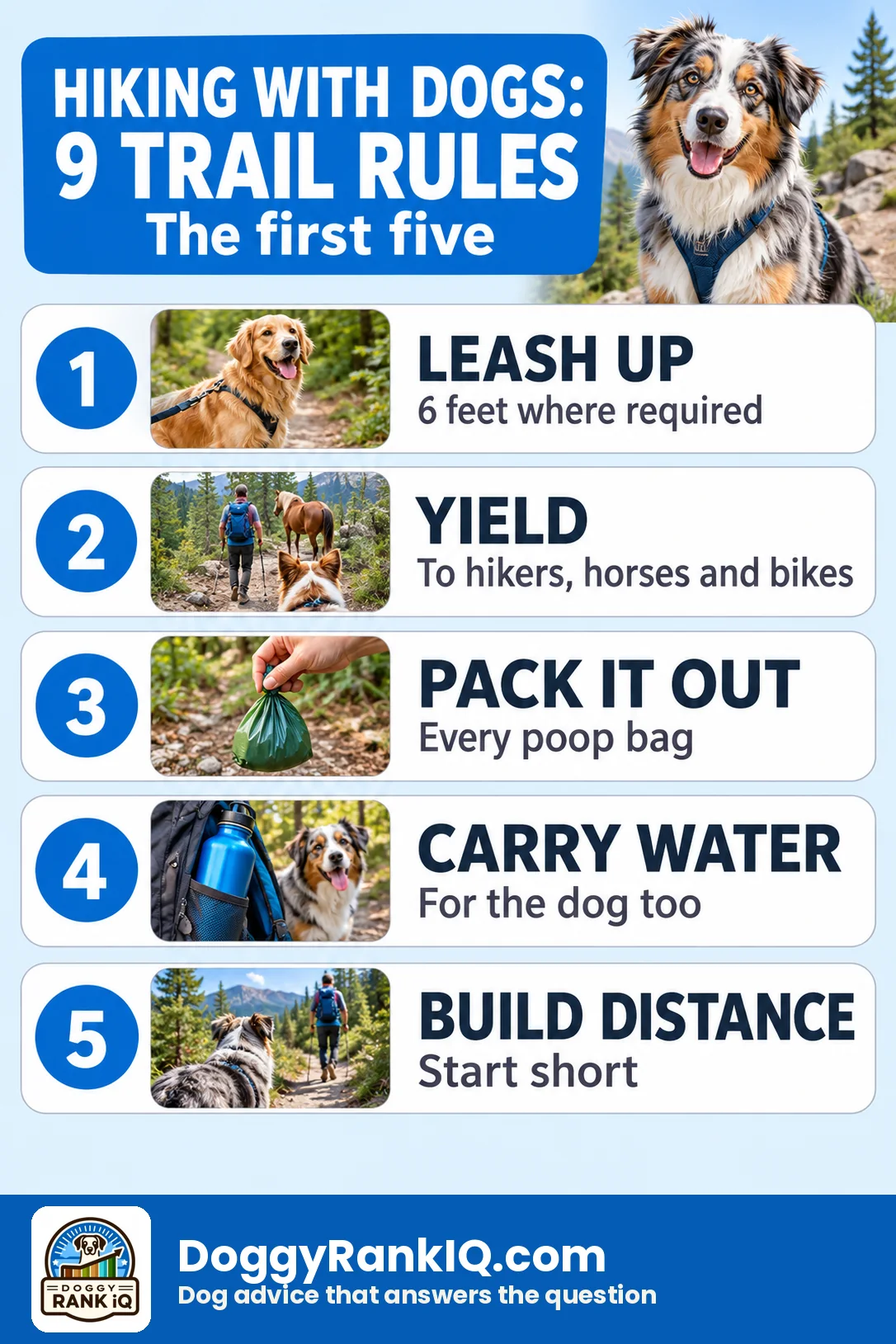
1Assuming a short leash is optional
The National Park Service generally recommends a leash no longer than 6 feet, and many parks enforce it as a hard rule rather than a suggestion (home.nps.gov). A retractable leash that extends to 20 feet does not meet that standard and gives a dog enough room to startle a hiker, a horse, or a cyclist coming around a blind bend.
2Not yielding to horses and bikes
Horses spook. Bikes move fast and quiet. The polite, and often required, move is to step off the trail, shorten the leash, and let other trail users pass before continuing.
3Leaving the poop bag by the trail
Leave No Trace guidance asks hikers to pack out pet waste completely, not tie it to a tree for later. “Later” rarely happens, and the bag sits there for the next hiker to see.
4Underestimating water needs
A commonly cited vet guideline is about 1 ounce of water per pound of body weight per day, with more needed in heat or on a steep climb. A 40-pound dog needs more water than most owners pack for a half-day loop.
5Jumping straight to a long hike
Veterinary and outdoor guidance both recommend gradual conditioning, particularly for puppies, seniors, overweight dogs, and brachycephalic breeds (home.nps.gov, chewy.com). A dog that walks fine around the block is not automatically ready for 8 miles of elevation gain.
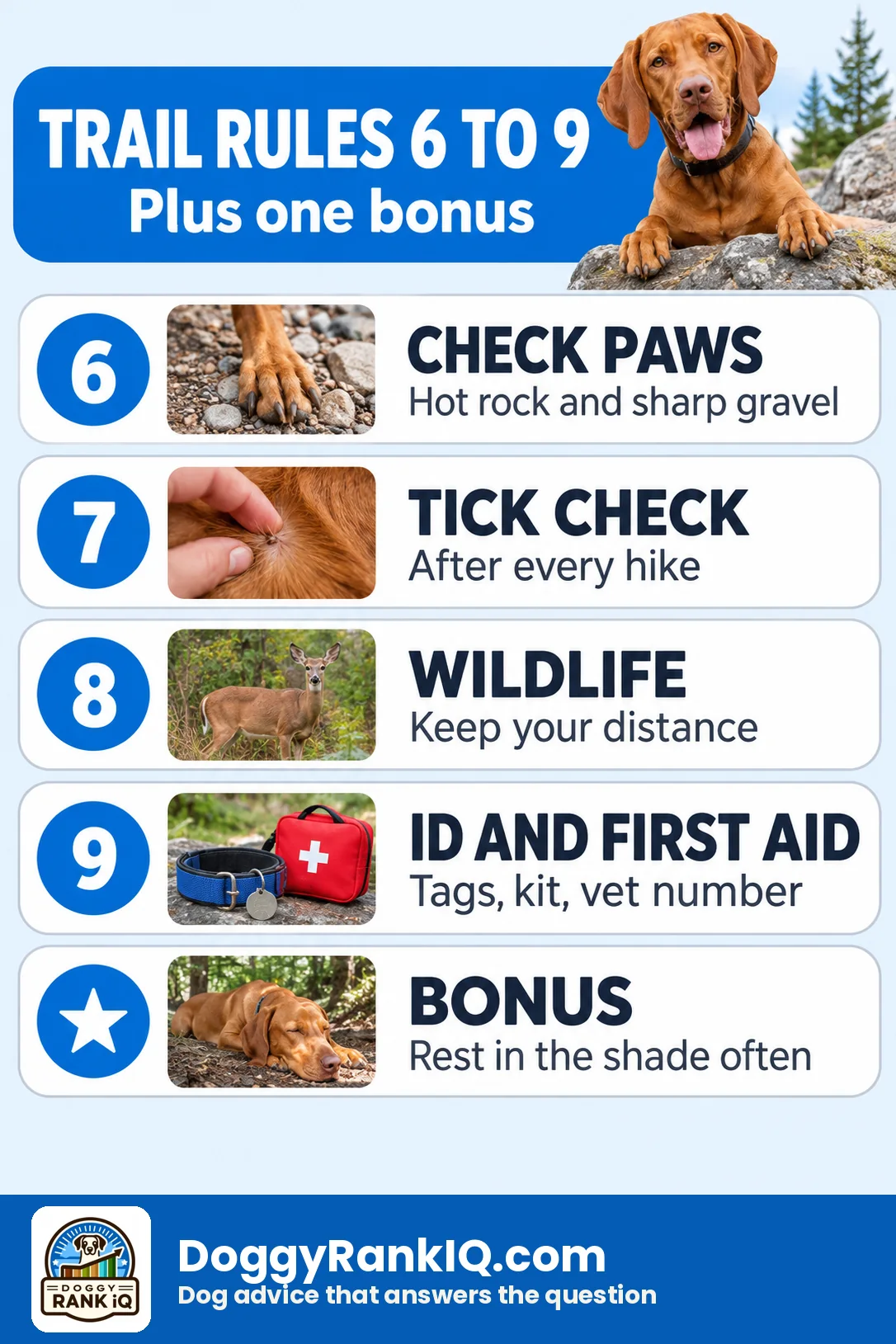
6Ignoring paw and surface heat
Pavement, exposed rock, and packed dirt in direct sun can injure paw pads well before the air temperature feels dangerous to a person standing upright.
7Skipping tick and flea prevention
Virginia Tech’s veterinary hospital specifically recommends checking ears, toe spaces, and the collar area after every hike, and the AKC recommends discussing vet-approved tick prevention before entering brushy terrain (vth.vetmed.vt.edu, akc.org). For the fuller picture on what these parasites can cause, see this guide to tick-borne diseases in dogs.
8Getting too close to wildlife
“My dog is friendly” is not a wildlife management plan. Keep distance from any wild animal the dog notices, and keep the leash short enough to redirect a sudden lunge.
9Hiking without ID or a plan for the nearest vet
A collar tag, a first-aid kit, and the address of the closest emergency vet clinic take five minutes to sort out before leaving the house and matter enormously if they’re needed on trail (veg.com).
Facts table: day hike pack list for a dog
This table sums up hiking with dogs at a glance.
How far can I hike with my dog? Building distance
There’s no single mileage number that fits every dog, but the safe approach is to add distance gradually and watch the dog’s recovery the next day, not just during the hike. A dog that’s sore or reluctant to move the morning after a hike went too far, too fast.
Veterinary and outdoor sources recommend starting short, assessing fitness with a vet first for puppies, seniors, and brachycephalic breeds, and building mileage over weeks rather than a single season (chewy.com). A good decision rule: if the dog hasn’t done 3 to 4 miles comfortably on flat ground, don’t attempt 8 miles with elevation gain. Watch for lagging behind, heavy panting that doesn’t ease at rest stops, or reluctance to continue, all signs to turn back before pushing further.
Best dog-friendly hikes: how to find trails near you and check the rules
The fastest way to find dog-friendly hikes near you is to check the specific land manager’s page before leaving home, not a general “best hikes” list. Rules vary wildly between a national park, a national forest, and a city greenway, and only the official page reflects the current year’s policy.
National parks often prohibit pets on hiking trails and boardwalks entirely, while national forests and BLM land tend to allow more flexibility (home.nps.gov). Crater Lake National Park, for example, limits pets to specific locations, with some trail access depending on snow conditions. The common mistake is assuming a park’s general “pet friendly” reputation applies to every trail inside it. It usually doesn’t. For paw protection on rockier terrain, this comparison of dog hiking boots for grip is worth a look before a rough trail day.
Off leash dog trails: where it is legal
Off-leash hiking is legal only in areas a land manager has specifically designated for it, and the dog still needs reliable recall and visual supervision even there. A trail simply allowing dogs does not grant off-leash privileges by default (home.nps.gov, akc.org).
The AKC’s position is that off-leash hiking should happen only where permitted and only with a dog that reliably comes when called, stays visible, and can be controlled around other hikers (akc.org). National forests and BLM land are more often the places this applies, but it still needs confirming on the specific ranger district’s page, not assumed from a general reputation. Dogs that bolt after squirrels or ignore recall around other dogs are not good off-leash candidates, no matter how friendly they are.
🥾 Trail hazards the pack list will not solve
Gear covers thirst and sore feet. A few trail problems need you to recognize them on sight.
Foxtails come first in the dry West from late spring through fall. The seed heads of these grasses are barbed, so they travel in one direction only: deeper. They lodge between toes, in ears, up noses and under eyelids, and they do not work themselves back out. After any walk through dry, seeded grass, spread each toe, look inside the ear flaps and run your hands through the armpits and groin. A dog who starts sneezing violently, shaking the head hard or licking one paw nonstop on the drive home needs a vet, usually the same day.
“Foxtails only move one way, and that way is in.”
Blue-green algae is the one that kills fast. Cyanobacteria bloom in warm, still, nutrient-rich water, mostly in summer and early fall, and some produce toxins that attack the liver or the nervous system. Dogs are exposed by drinking, swimming and then licking their coats. The water may look like spilled green paint, pea soup or a scummy mat along the shore, though it can also look ordinary. If a pond or slow river has a posted advisory or looks off, keep the dog out. A dog who swam in suspect water should be rinsed with clean water right away and taken to a vet if there is any vomiting, drooling, weakness or stumbling.
Clear mountain streams carry a slower risk. Giardia and other parasites spread through water contaminated by wildlife and other dogs, and the diarrhea shows up days later. Carrying water for the dog, as the rules above advise, is the fix. Dogs will still sneak a drink, so mention hiking with dogs to your vet when you drop off the yearly stool sample.
Then there is wildlife with defenses. Porcupine quills are barbed like foxtails and migrate inward. Do not cut them or pull them on the trail with your fingers. Keep the dog from pawing at the face and get to a vet, since sedation makes removal complete and far less painful. In rattlesnake country, stay on open trail, keep the leash short near rock piles and logs, and treat any bite as an emergency: carry the dog if you can, keep them calm, and drive to the nearest clinic that stocks antivenom. Call ahead from the trailhead to check.
🐾 Is your dog built for the trail you picked?
Puppies are the common mistake. Growth plates, the soft areas near the ends of young bones, stay open until roughly a year old in most dogs and longer in giant breeds. Long descents and repetitive pounding are hard on them. Short, soft-surface outings with plenty of sniffing are fine. Save the eight-mile summit for after your vet confirms the dog is done growing.
Flat-faced breeds overheat at temperatures a Labrador shrugs off, and short-legged dogs take three steps for each one of yours on rocky stairs. Seniors often do well on trails if you halve the distance you remember them doing and watch the day after. Stiffness the next morning means the hike was too long.
⭐ Top 5 Features We Love
- Shade-and-water stops built into the route. Trails with creek crossings or tree cover give a dog real recovery breaks, not just a pause to take photos.
- Reliable recall in open country. A dog that comes back on the first call turns a tense moment with wildlife into a non-event.
- A properly fitted harness. Even on a 6-foot leash, a harness distributes pressure better than a collar on steep sections (veg.com).
- A dog that settles when told. Calm behavior around other hikers, dogs, and horses keeps the whole group moving smoothly.
- A paw check routine. A quick look at pads and between toes mid-hike catches small cuts before they become a limp.
⚠️ Things to Look Out For
A few cautions on hiking with dogs:
Heat, ticks, wildlife, and bad water sources account for most hiking injuries that could have been prevented. Each has a clear warning sign worth memorizing before the trailhead.
- Heat stress: heavy panting, bright red or pale gums, stumbling, or refusing to walk. Stop immediately, find shade, offer water, and head to a vet if the dog doesn’t recover quickly (vth.vetmed.vt.edu).
- Ticks: check ears, between toes, and under the collar right after the hike, not days later. See tick-borne diseases in dogs for what untreated bites can lead to.
- Wildlife encounters: keep leash short, create distance, and never let a dog chase or approach.
- Contaminated water sources: streams, ponds, and puddles can carry bacteria and parasites, so carry fresh water instead of relying on natural sources (dovelewis.org).
After the hike: a 5-minute check
The short answer: run hands over the whole dog, check paws, ears, and the collar line for ticks, and offer water before anything else. This takes less time than untying boots.
Start at the paws and look for cuts, torn nails, or raw pads, a common issue worth knowing more about in this guide to paw pad injuries. Move to the ears and collar, the two spots vets most often find ticks after a hike (vth.vetmed.vt.edu). Offer water calmly rather than letting an overheated dog gulp a full bowl at once. If panting hasn’t eased within 10 to 15 minutes of rest and shade, or gums look pale or brick red, call the vet rather than waiting it out.
Helpful trail gear
A few pieces of gear solve most of the common hiking mistakes above. These are the items that come up again and again in veterinary and outdoor guidance, matched to real products available in 2026.
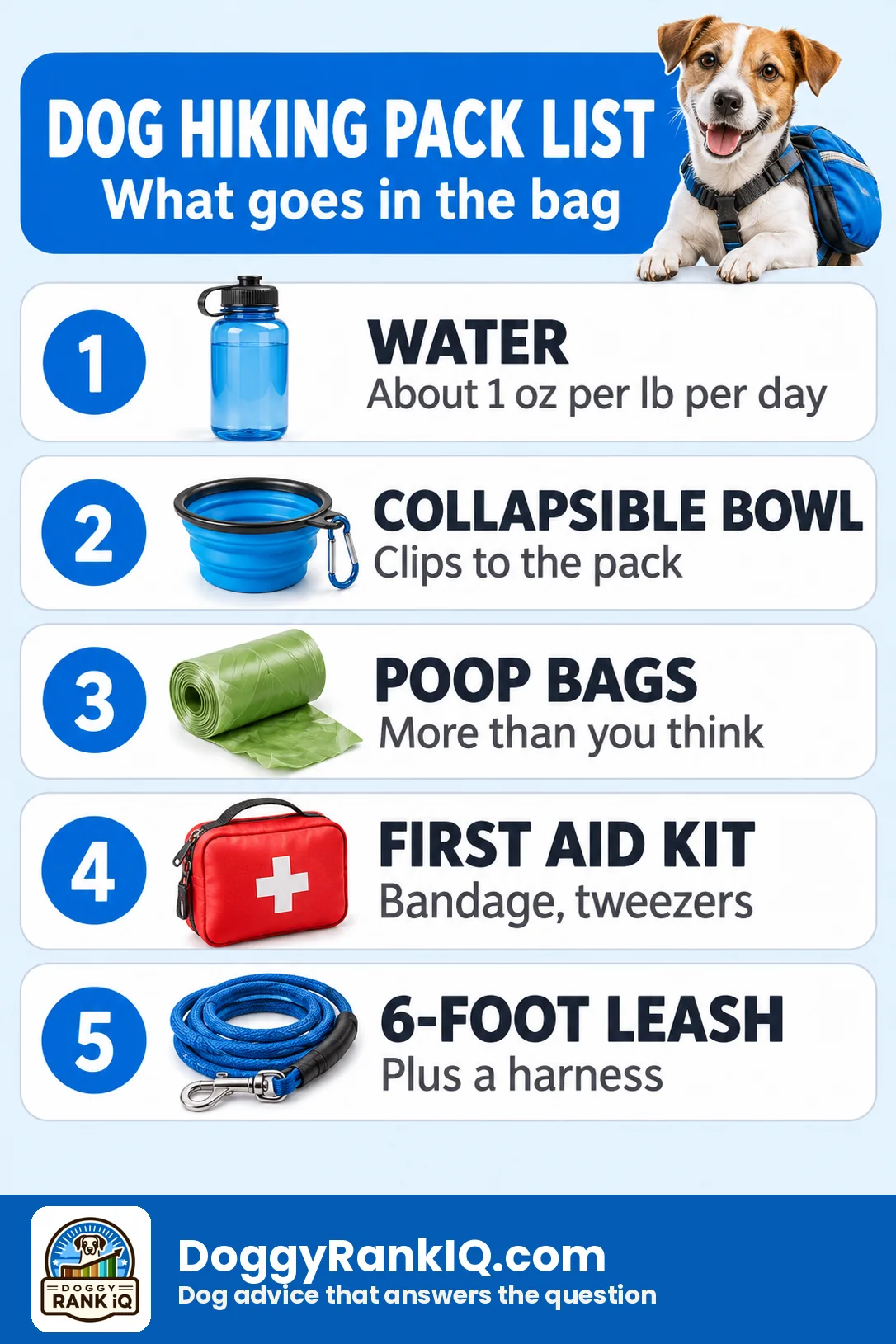
- Ruffwear Front Range Dog Harness, Medium ($59.99, price checked 2026): a padded harness built for leash control on climbs and uneven ground. Check the current price.
- Taglory 6 FT Rope Dog Leash with Padded Handle ($8.99, price checked 2026): matches the 6-foot leash length most national parks require (home.nps.gov). Check the current price.
- Kalimdor Portable Dog Water Bottle, 19 oz ($9.99, price checked 2026): built-in trough makes offering water quick at rest stops. Check the current price.
- Collapsible Dog Bowls, 2 Pack with Carabiners ($6.98, price checked 2026): clips to a pack strap, useful for both water and trail snacks. Check the current price.
- OneTigris Dog Backpack for Medium and Large Dogs ($39.99, price checked 2026): lets a fit adult dog carry its own water and waste bags. A vet should confirm the right weight limit before loading one up (chewy.com). Check the current price.
- Dog First Aid Kit, Vet-Approved ($34.95, price checked 2026): covers paw cuts, tick removal, and minor wounds on trail (veg.com). Check the current price.
For more on pack fit specifically, this comparison of Ruffwear dog backpacks breaks down capacity by dog size. Dogs prone to overheating on warmer trails may also benefit from reviewing dog cooling vest options before a summer hike.
FAQ: hiking with dogs
The bottom line: hiking with dogs
Hiking with dogs comes down to checking the actual trail rules, not assuming, carrying enough water for both hiker and dog, and building distance slowly instead of all at once. The leash length, the heat check, and the five-minute tick inspection after the hike aren’t glamorous, but they’re the parts that prevent an easy day from turning into an emergency vet visit. Check the dimensions of the next trail’s official page before lacing up boots, pack the basics from the gear list above, and let the dog’s fitness, not the trail map, set the pace.
For related reading on keeping dogs comfortable outdoors, see how cold is too cold for dogs and signs of arthritis in dogs for owners hiking with older dogs.
Doggy Rank IQ is a participant in the Amazon Services LLC Associates Program. We earn from qualifying purchases made through links on this page, at no extra cost to you.
Doggy Rank IQ is reader supported. As an Amazon Associate we earn from qualifying purchases, at no extra cost to you.