
Quick Answer
A dog cooling vest uses wet fabric and evaporation to pull heat off a dog’s body, similar to how sweat cools skin. The Ruffwear Swamp Cooler Vest covers more of the torso and works best for dry heat, while the newer Swamp Cooler Zip (the updated Jet Stream) is lighter, cheaper, and suits shorter, faster-paced activity. In high humidity, any evaporative dog cooling vest loses effectiveness because wet air cannot absorb much more moisture, so the vest just sits there, damp and increasingly useless. For most owners walking or hiking thick-coated or dark-coated dogs in dry heat, the standard Swamp Cooler is the better pick; for value and quick trips, the Swamp Cooler Zip wins.
Key Takeaways: dog cooling vest
- A dog cooling vest relies on evaporative cooling, which slows down when humidity climbs above roughly 60 to 70 percent.
- Ruffwear discontinued the original Jet Stream name; the current version is sold as the Swamp Cooler Zip, with updated fabric that holds more water (ruffwear.eu).
- The standard Ruffwear Swamp Cooler Vest costs $74.99 and covers more surface area than the Zip, which lists at $59.99 with sales sometimes dropping it to around $30 (price checked 2026) (ruffwear.eu).
- A 2022 military working dog study found evaporative vests reduced body temperature and pulse more effectively than phase-change vests during moderate heat work.
- Voluntary head dunking in cool water outperformed vests, towels, and ice packs for fast post-exercise cooling in a JAVMA study of 12 working dogs, but it only works on alert dogs that can cooperate.
- No cooling garment is a substitute for recognizing heatstroke signs or for emergency veterinary care.
- A rough screening rule: add the temperature in Fahrenheit to the relative humidity; above 150 combined is considered unsafe for most dogs’ sustained activity (businessinsider.com).
- Dark-coated and thick-coated dogs absorb more radiant heat and often get the most practical benefit from a dog cooling vest on sunny walks.

How does your dog exercise in the heat?
Tap an option to see the answer.
How does a dog cooling vest actually work
A dog cooling vest works by soaking fabric panels with water and letting that moisture evaporate off a dog’s skin and coat, pulling heat away in the process. It is the same mechanism behind human sweating, just engineered into a wearable garment instead of relying on skin glands.
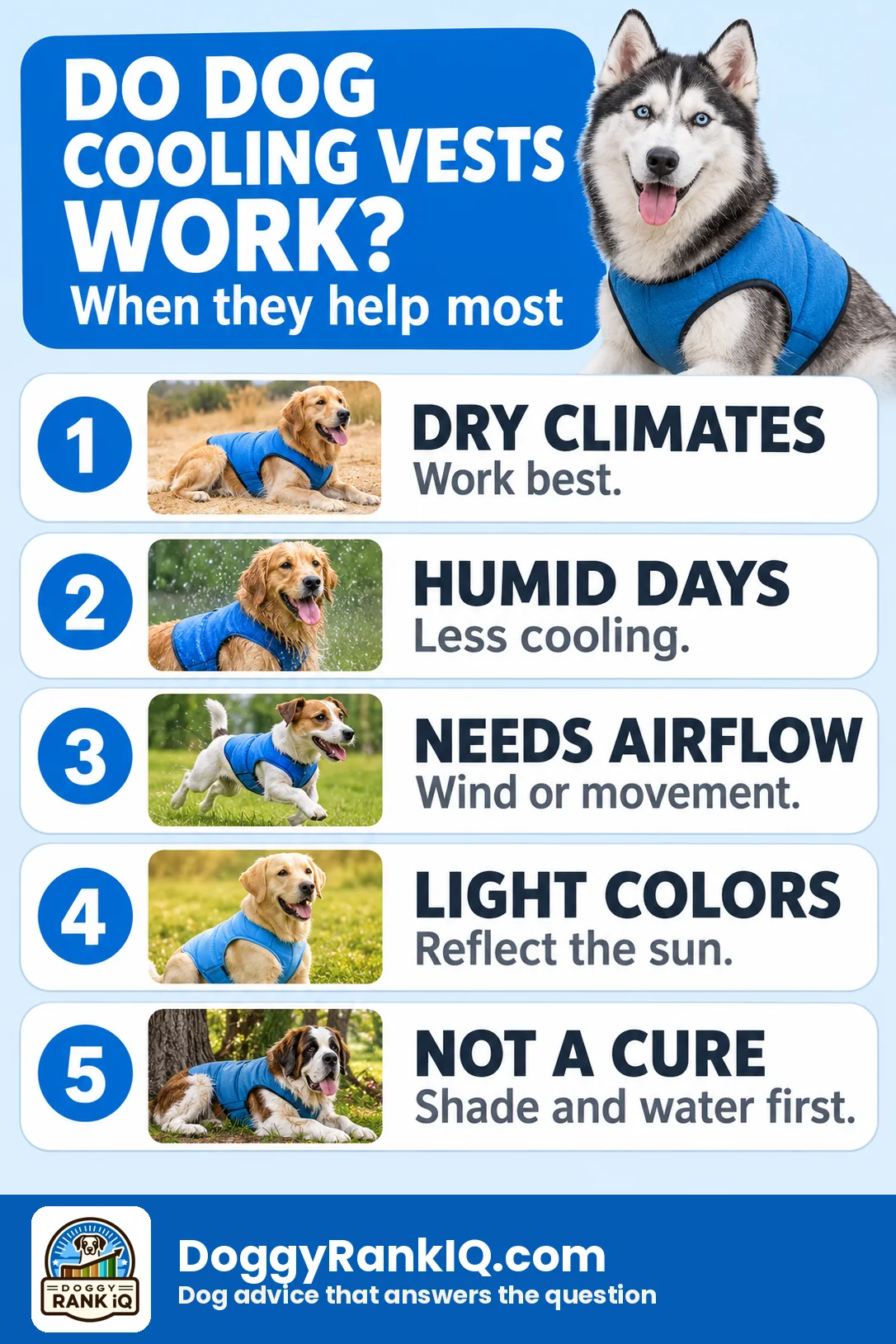
Airflow accelerates the process, which is why a dog cooling vest performs better during a walk or breezy hike than it does on a dog lying still in a parked car. As air moves across the wet fabric, water molecules leave the surface faster and carry heat with them. Without airflow, evaporation slows to a crawl and the cooling effect flattens out quickly.
The design only works as long as there’s a humidity gradient between the wet fabric and the surrounding air. Once the surrounding air is already saturated with moisture, as it is on muggy days, water has nowhere to go. The vest stays wet, but the cooling stalls. Pet Science Review breaks down this same evaporative principle and notes that humidity is the single biggest variable that determines whether a dog cooling vest actually earns its price tag on a given day.
Example: a dog cooling vest soaked and worn during a dry 85°F hike in Arizona will likely stay effective for 30 to 40 minutes before needing a re-soak. The same vest worn during an 85°F walk in coastal Florida with 85 percent humidity may lose most of its cooling power within 10 to 15 minutes.
Best dog cooling vests for summer heat
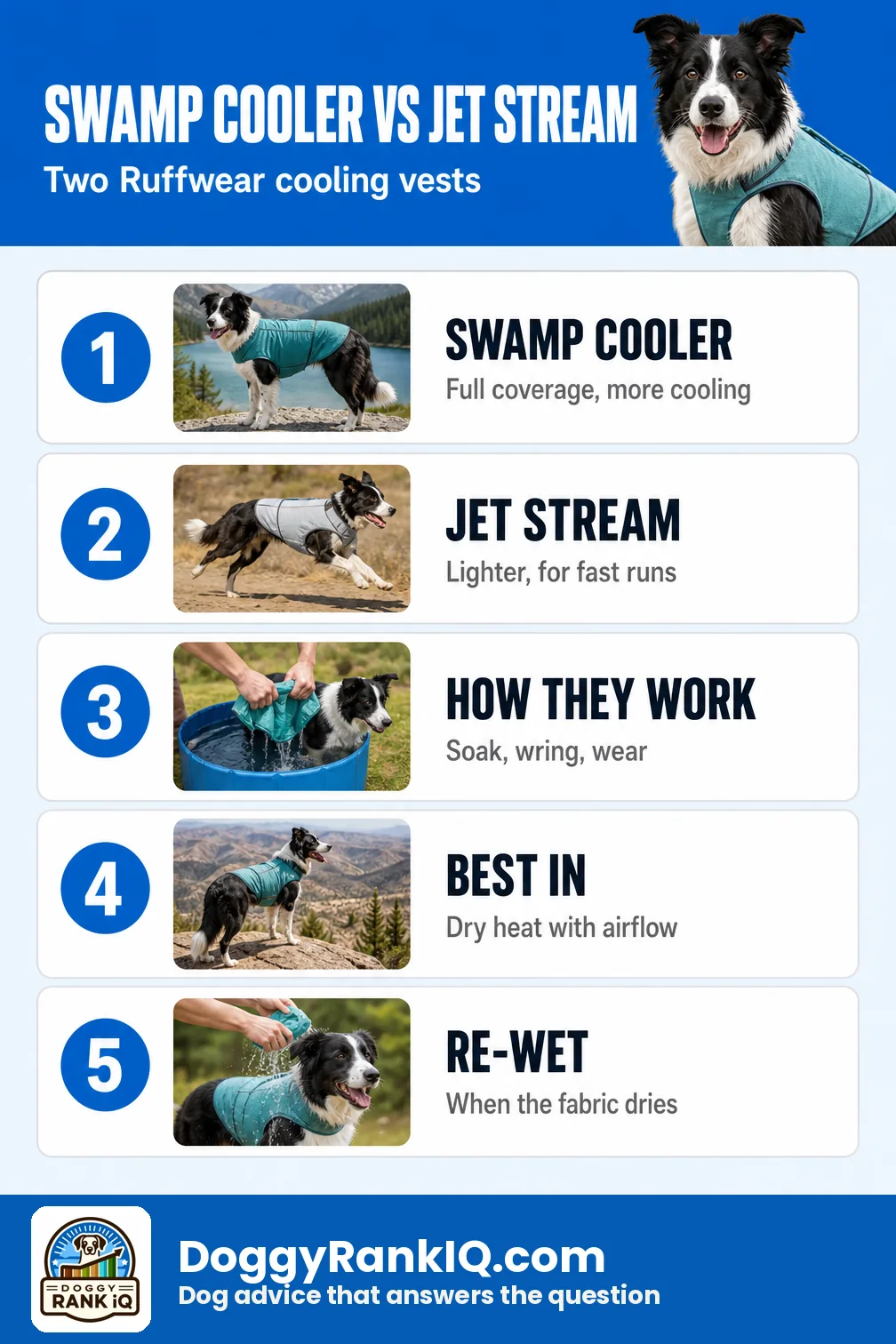
The best dog cooling vest for most owners in 2026 depends on climate and activity length, not just brand reputation. The Ruffwear Swamp Cooler Vest leads for dry-heat, longer outings because of its broader torso coverage, while the Swamp Cooler Zip suits shorter trips and budget-conscious buyers.
Independent gear reviewers back this general split. Treeline Review has repeatedly ranked Ruffwear’s evaporative line among the top picks for hiking dogs, citing fit and water retention as the deciding factors over flashier marketing claims. Wirecutter takes a more skeptical stance overall, noting that cooling gear for pets tends to produce modest, situational benefits rather than dramatic results, which lines up with the peer-reviewed data on evaporative vests.
Other names worth knowing in the category, according to Dog Gear Review and Packs and Paws, include various chill-mesh and bandana-style cooling wraps, though most reviewers agree the Ruffwear Swamp Cooler line remains the benchmark for fit and durability in 2026.
Decision rule: if hiking trips regularly run past an hour in dry conditions, the standard Swamp Cooler Vest is worth the extra cost. If outings are usually under 30 minutes or budget is tight, the Zip covers the basics for less.
Do dog cooling vests really help
Yes, within limits that matter more than most product pages admit. A peer-reviewed 2022 study on military working dogs found that dogs wearing evaporative cooling vests during training in moderately warm conditions had lower core temperatures and pulse rates than dogs with no vest, and the evaporative design outperformed a phase-change (gel-pack) vest in the same test.
The catch is scale. The study involved working dogs under controlled conditions, not a backyard beagle on a humid July afternoon. A 2026 synthesis citing similar research reported a modest benefit: dogs wearing an evaporative vest finished about 0.62°C cooler than unvested dogs, and about 0.77°C cooler 15 minutes after exercise, in a small, 13-dog, three-day study conducted around 28 to 31°C. TrustMyPets covers similar findings and cautions that lab-scale results don’t always scale cleanly to everyday backyard or trail conditions.
Decision rule: if your dog does moderate exercise in dry heat and you want a measurable edge, a dog cooling vest is reasonable. If your dog is already struggling with heat, collapsing, or showing heatstroke signs, a vest is not the tool for that moment. PETA’s guidance on cooling vests makes a similar point: gear is a supplement to good judgment about heat exposure, not a replacement for it.
How an evaporative dog cooling vest works, and where humidity beats it
An evaporative dog cooling vest works by soaking fabric in water, then letting that water evaporate off the dog’s skin and coat, which pulls heat away in the process, the same physics behind sweating. Airflow speeds up the evaporation, which is why these vests perform better while a dog is moving or in a breeze than while lying still in a stuffy car.
Humidity is the limiting factor nobody puts on the box. The air can only hold so much water vapor before it is saturated. When relative humidity climbs toward 70 or 80 percent, the vest’s water has nowhere to go. It stays wet. The dog stays warm. Business Insider’s veterinary sources specifically flag this: performance drops in high humidity, and owners may need to re-wet the vest more often just to get a partial effect.
A practical screening tool, cited by veterinary-oriented sources, adds the temperature in Fahrenheit to the relative humidity percentage. Below 130 combined is generally lower risk for ordinary activity. Between 130 and 149 calls for shorter outings and more breaks. Above 150, most dogs should skip strenuous activity altogether, vest or no vest. This is a screening aid, not a safety guarantee, and individual variation (age, coat, breed, fitness, health conditions) still matters.
Common mistake: owners wet the vest once before a two-hour hike and assume it keeps working the whole time. In dry conditions it might stretch 20 to 40 minutes before needing a re-soak. In humid conditions, the window is shorter and the payoff is smaller.
How much does a good dog cooling vest cost
A solid cooling vest in 2026 generally runs between $30 and $85, depending on brand, coverage, and whether it’s on sale. The Ruffwear Swamp Cooler Vest sits at the higher end at $74.99, while the Swamp Cooler Zip lists at $59.99 but has been seen on sale for around $30.
Budget options from lesser-known brands can cost less, but reviewers at The Consumers Guide note that cheaper vests often use thinner fabric that dries out faster and loses shape after repeated washing, which shortens the useful cooling window per soak. Spending more on a vest with denser, water-retentive fabric can mean fewer re-wets per outing, which matters on longer hikes.
Cost breakdown for 2026:
- Budget cooling bandanas or wraps: $15 to $25
- Mid-range evaporative vests (Swamp Cooler Zip tier): $30 to $60
- Full-coverage evaporative vests (Swamp Cooler Vest tier): $65 to $85
- Phase-change ice pack vests: often $40 to $90, with ongoing cost of freezer access
Swamp Cooler vs Jet Stream
Ruffwear has officially folded the Jet Stream line into the Swamp Cooler Zip, describing it as an updated version with fabric that holds more water and a longer cooling “charge” (ruffwear.eu). The standard Ruffwear Swamp Cooler Vest still sits as the brand’s full-coverage option.
Check the dimensions before ordering either one. Ruffwear’s size chart is based on girth, not weight alone, and a dog with a broad chest (think Lab mixes) may need a size up from what the weight chart suggests.
- Ruffwear Swamp Cooler Vest, Large, $74.99
- Ruffwear Swamp Cooler Vest, Medium, $74.99
- Ruffwear Swamp Cooler Zip at ruffwear.com
Check the current price: Swamp Cooler Vest, Large | Swamp Cooler Vest, Medium
How to properly fit a cooling vest on your dog
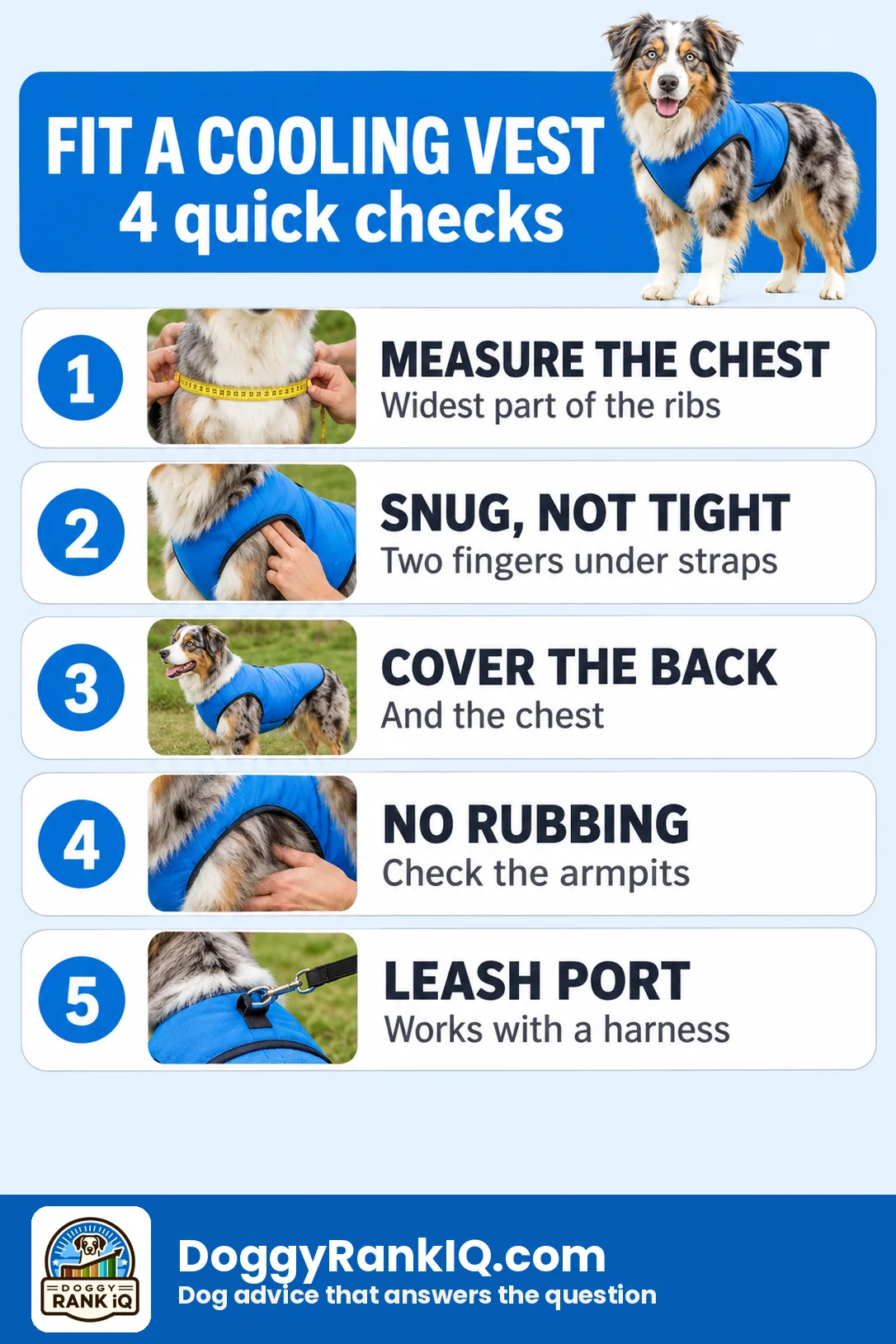
A cooling vest only works if it stays in contact with the skin along the back and chest, so fit matters as much as the fabric technology inside it. A vest that’s too loose flaps in the air instead of transferring heat, and a vest that’s too tight restricts shoulder movement or rubs at the armpits.
Steps for a proper fit:
- Measure girth (the widest point of the ribcage) rather than relying on weight alone, since weight charts miss broad-chested or barrel-shaped breeds.
- Soak the vest fully in cool water, then wring it until damp, not dripping.
- Slide or wrap the vest on so the wet fabric lies flat against the back and chest, avoiding bunching near the shoulders.
- Fasten the closure snug enough that two fingers fit comfortably between the vest and the dog’s body.
- Watch the dog’s gait for the first few minutes; any hitching or stiff-legged walking usually means the vest sits too tight across the shoulders.
Common mistake: buying by weight range alone. A 50-pound Lab mix and a 50-pound Greyhound have very different chest girths, and a vest sized by weight only may fit one and gap badly on the other.
Cooling vest vs cooling pad for dogs: which is better
A cooling vest and a cooling pad solve different problems and aren’t really interchangeable. A vest cools a moving dog outdoors through evaporation and airflow, while a cooling pad cools a resting dog indoors or in shade through direct contact conduction.
Cooling pads use gel or water-based inserts that absorb body heat when a dog lies on them, and they work regardless of humidity since there’s no evaporation involved. That makes a cooling pad a better fit for humid climates or for a dog resting after exercise, while a vest makes more sense for the active portion of a hot-weather walk or hike.
Choose a vest if: the dog is moving, exercising, or outdoors in dry heat.
Choose a pad if: the dog is resting, recovering, or lying in one spot indoors without strong air conditioning.
Owners managing multiple climate needs for dogs who sleep in a crate might also look at a dog crate pad built for airflow, separate from a dedicated cooling pad for peak summer afternoons.
Evaporative vest vs ice pack vest vs cooling collar
Evaporative vests, ice pack vests, and cooling collars solve different problems, and picking the wrong one is a common source of disappointment. Evaporative vests (like the Swamp Cooler line) need water and airflow and work best in dry heat. Ice pack or phase-change vests use gel inserts that stay cold for a fixed window regardless of humidity, but add weight and need a freezer between uses. Cooling collars target the neck and are lighter, but cover far less surface area.
A 2022 study comparing evaporative and phase-change designs found the evaporative vest reduced temperature and pulse more during active work, though the phase-change vest still helped compared to no vest at all. Independent 2026 coverage from Pupcovery frames the tradeoff clearly: evaporative products depend on evaporation and lose ground in humidity, while phase-change products sidestep that problem but introduce their own limits around duration and recharge time.
Choose evaporative if: your climate runs dry, your dog does longer outings, and you can re-wet the vest periodically.
Choose phase-change (ice pack) if: you’re in a humid region or need a short, intense cooling burst, like before a dog show ring or a brief car-to-building transition.
Choose a cooling collar if: your dog overheats easily but refuses to wear a full vest, or you need something lightweight for a short walk.
Should I get a cooling vest or cooling collar instead
Choose a cooling vest for broader coverage and more measurable temperature reduction during active exercise; choose a cooling collar if your dog resists wearing full garments or if the goal is just light, convenient relief on short outings.
A collar covers only the neck, which is a much smaller surface area for evaporation or contact cooling, so the overall temperature effect is smaller than a vest provides. However, collars are easier to put on anxious or fidgety dogs, dry faster, and are cheaper to replace. Shinee Pets recommends collars mainly as a secondary or backup option rather than a primary cooling tool for dogs doing real exercise in heat.
Edge case: dogs with skin sensitivities or mobility limits that make a full vest uncomfortable to put on may do better with a lightweight collar even if it offers less total cooling benefit.
Can dogs wear cooling vests all day long
No. A cooling vest is meant for active use during outdoor heat exposure, not as all-day wear. Leaving a wet vest on for hours, especially once it dries out or once the dog is back indoors in air conditioning, offers no benefit and can cause skin irritation or chafing from prolonged dampness.
Take the vest off once the dog is back in a cool, shaded, or air-conditioned space. A damp vest left on indoors can also trap moisture against the skin, which isn’t ideal for dogs prone to hot spots or skin infections.
Rule of thumb: wear the vest during the active, hot portion of an outing, then remove and dry it once the dog returns to a cooler environment.
Dog cooling vests for short haired or brachycephalic breeds
Short-haired and brachycephalic (flat-faced) breeds like French Bulldogs and Pugs face heat risk primarily through restricted airway cooling, not coat insulation, so a cooling vest helps less than it would for a thick-coated breed, but it isn’t useless either.
Since brachycephalic dogs can’t pant as efficiently to dissipate heat, any added body-surface cooling from a vest can take some pressure off their breathing. That said, a vest should never be treated as a primary safety measure for these breeds. Shade, air conditioning, and strictly limited outdoor time in heat matter far more.
Decision rule: for brachycephalic breeds, use a cooling vest only for brief outdoor stretches and treat any heavy, labored panting as a signal to stop immediately and move to a cool space, regardless of what the vest is doing.
Cooling vest for senior dogs with health issues
A cooling vest can help senior dogs manage heat during short outings, but added weight from wet fabric and heart or joint conditions common in older dogs mean extra caution is needed. A soaked vest adds noticeable weight, which can tire a senior dog with arthritis or reduced stamina faster than expected.
Dogs with heart or respiratory conditions should only wear a cooling vest with veterinary input, since any added physical load, however small, can matter more for a compromised cardiovascular system. Shinee Pets recommends shorter outings and more frequent breaks for senior dogs even when cooling gear is in use.
Common mistake: assuming a vest offsets the need to shorten walks for an older dog. The vest helps marginally; it doesn’t replace reduced exertion as the main strategy for senior heat safety.
How to choose the right size cooling vest for your dog
Choosing the right size cooling vest comes down to girth measurement, not weight alone, plus attention to chest shape and coat thickness. Brands like Ruffwear base their charts on girth because two dogs of the same weight can have very different chest circumferences.
Steps to choose correctly:
- Measure around the widest part of the ribcage with a soft tape measure.
- Compare to the brand’s girth-based size chart, not just the weight range.
- For broad-chested breeds (Labs, Pit Bull types, Boxers), consider sizing up if the dog falls between two sizes.
- For narrow, deep-chested breeds (Greyhounds, Whippets), a snugger fit within the recommended size usually works better than sizing up.
- Try the vest on dry first to check range of motion before committing to the wet fit.
Which one for dry heat, which for humid heat
For dry heat, the standard Swamp Cooler Vest’s larger coverage area gives evaporation more surface to work with, which matters when the air is actually capable of absorbing that moisture. For humid heat, no evaporative vest performs well, so the Swamp Cooler Zip’s lower price makes more sense since you’re not paying a premium for a cooling mechanism that humidity will blunt anyway.
In genuinely humid, high-risk conditions, independent veterinary sources suggest a different toolkit entirely: shade, air conditioning, timing walks for early morning or late evening, and direct water contact. A JAVMA-published study of 12 working dogs found that voluntary head dunking in roughly 22°C (70°F) water produced lower core temperatures than ice packs, wet towels, or wet axillary compresses, and it was the only method tested that stopped the initial post-exercise temperature spike. That technique only applies to alert, cooperative dogs who can pause panting on their own, and it is not a fix for a dog already showing signs of heatstroke.
Decision rule: combined temperature (°F) plus humidity (%) under 130 means a cooling vest can genuinely help. Above 150, skip the vest and skip the activity; move cooling efforts indoors or to direct water access instead (businessinsider.com).
How to wet, fit and re-wet the vest
Soak the vest in cool water for a few minutes before putting it on; a quick splash is not enough to saturate the fabric layers that do the actual cooling work. Wring out excess water so the vest is damp, not dripping, then fasten it snugly enough that it contacts the skin along the back and chest without restricting the shoulders.
Re-wetting depends on conditions. In dry heat with a breeze, 20 to 40 minutes is a reasonable window before the vest starts to dry out. In humid or still air, check it sooner, since evaporation slows and the fabric may feel damp but stop actively cooling much earlier than expected. Carry a small bottle of water on hikes specifically for re-wetting; a dog’s regular water bottle works, but a dedicated supply avoids running short on drinking water.
Freezing the vest before use is not recommended by Ruffwear and is not how the evaporative mechanism is designed to work; that approach fits phase-change vests, not the Swamp Cooler line. Cool water is enough.
For households managing multiple pieces of warm-weather gear, a dog raincoat for cooler, wetter months and a cooling vest for summer cover opposite ends of the same closet shelf.
⭐ Top 5 Features We Love
- Reflective trim on both Ruffwear vests. Visible in low light, a real safety plus for dawn or dusk walks.
- Girth-based sizing charts. More accurate fit than weight-only charts common on cheaper brands.
- Machine washable fabric. Both the Swamp Cooler Vest and Zip hold up to regular washing, which matters for a product that’s supposed to get soaked anyway.
- The Zip’s side-entry closure. Faster to put on a squirmy dog than a wrap-and-buckle system.
- The Swamp Cooler Harness option. For owners who want cooling and a built-in leash attachment and lift handle in one piece of gear, Ruffwear’s Swamp Cooler Harness (listed at $84.99, price checked 2026) combines evaporative panels with a three-point leash system and six adjustment points (treelinereview.com).
⚠️ Things to Look Out For
- Humidity kills the effect. In muggy climates, expect a noticeably smaller benefit, and budget time to re-wet the vest more often.
- A wet vest is heavier. Senior dogs or dogs with joint issues may notice the added weight on longer hikes.
- It is not a heatstroke treatment. A cooling vest will not reverse an overheating dog in crisis; that requires immediate cooling and a vet.
- Dark fabric over dark coats traps some heat anyway. Look for lighter vest colors if your dog already has a dark coat.
- Fit matters more than brand. A loose vest flaps and loses contact with skin, which cuts evaporative cooling, while a tight vest can restrict movement or rub.
FAQ
The bottom line
A cooling vest is a useful, modest tool for dry-heat activity, not a shield against every hot day. Choose the standard Swamp Cooler Vest for broader coverage on longer dry-heat hikes, or the Swamp Cooler Zip for a lighter, cheaper option on shorter outings. In humid climates, compare the options honestly: a phase-change vest, a cooling collar, or simply timing walks around the heat may serve your dog better than any evaporative design. Watch for heatstroke warning signs, heavy panting that doesn’t ease, bright red gums, stumbling, or collapse, and treat those as a reason to call a veterinarian immediately, not a reason to reach for a vest.
Always confirm any new gear or cooling approach with your veterinarian if your dog has a heart, respiratory, or mobility condition.
Doggy Rank IQ is reader supported. As an Amazon Associate we earn from qualifying purchases, at no extra cost to you.