
Quick answer: A dog backpack carrier is a wearable bag or framed pack that holds a dog against your chest or back, and the right one depends on your dog’s weight, back length, and the length of your outing, not weight alone. Compact slings run from under $25 and suit dogs up to about 18 pounds, while framed hiking packs cost up to roughly $260 and support dogs up to 50 pounds. Below, seven picks are grouped by weight band so you can match a carrier to your dog’s actual body shape instead of guessing.
A 20-pound dog on your back feels different than a 20-pound bag of flour. Flour doesn’t shift its weight when a squirrel crosses the trail. That’s the whole problem a dog backpack carrier has to solve, and most buyers only figure that out after the straps dig in on mile two.
A dog backpack carrier is a wearable bag or framed pack that holds a dog against your chest or back, usually for hikes, errands, vet trips, or any outing where walking isn’t an option or isn’t safe. Picking the right one is less about brand loyalty and more about matching weight limit, back length, and your dog’s actual body shape to the product’s stated specs. This guide groups seven real picks by weight band, flags what owners report after regular use, and explains what manufacturers actually document versus what marketing photos imply.
Key Takeaways: dog backpack carrier
- A dog backpack carrier should match both your dog’s weight and back length, not weight alone, since body shape changes how well a given carrier fits, according to vet-reviewed carrier guidance.
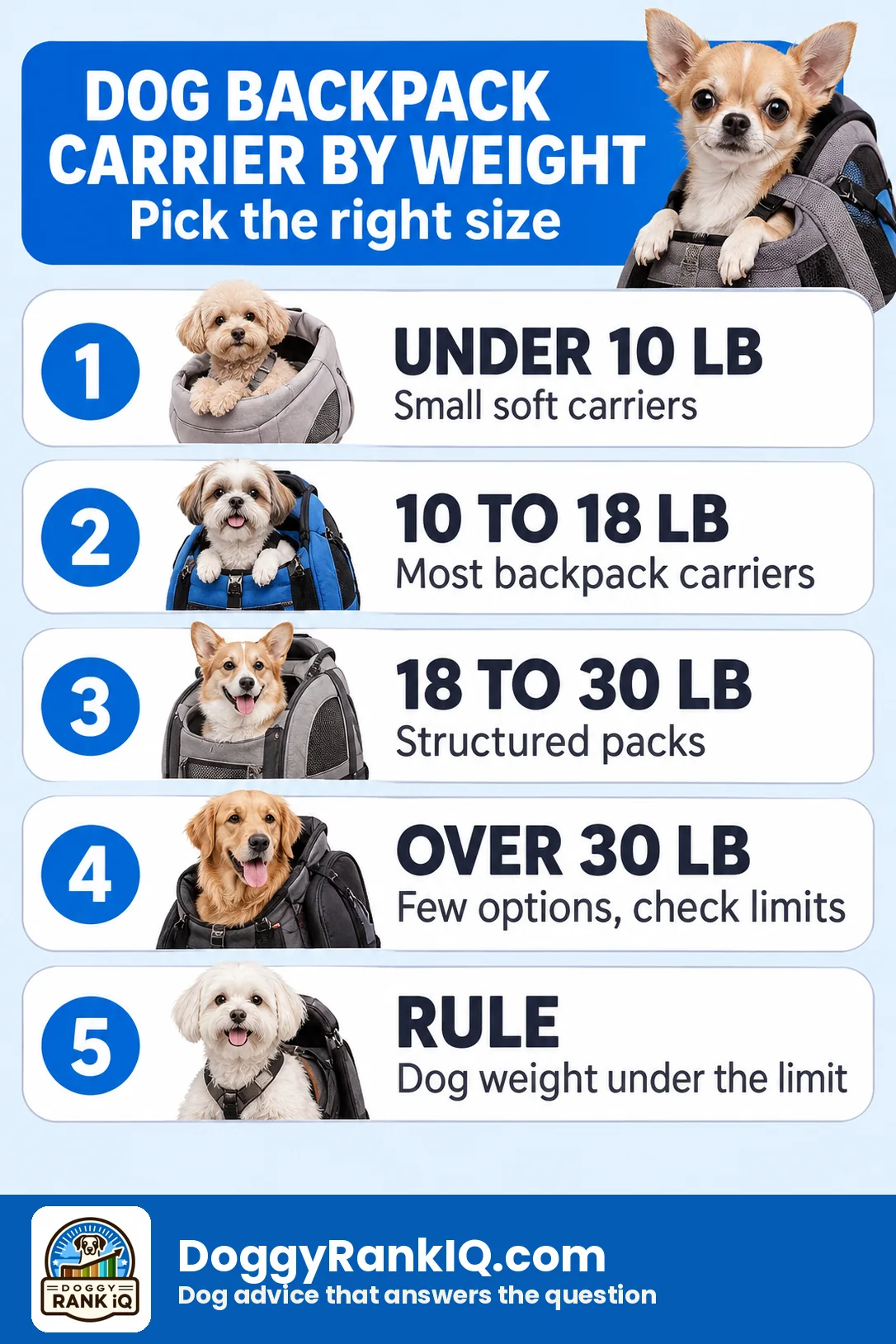
- Weight limits on a dog backpack carrier range from around 15 pounds in compact styles to 50 pounds in framed, internal-support designs.
- Front-facing carriers tend to suit smaller dogs and shorter trips, while back-mounted framed packs suit larger dogs and longer hikes.
- No major U.S. safety standard currently certifies crash performance or impact ratings for this product category.
- Price checked 2026, ranging from under $25 for basic slings to nearly $260 for framed hiking packs.
- Girth plus back length, not weight alone, is how brands like Ruffwear and K9 Sport Sack size their products.
- A dog backpack carrier is not a substitute for veterinary clearance if your dog has a joint, breathing, or anxiety condition.

How much does your dog weigh?
Check the current price
Check the current price
Tap an option to see the answer.
What is a dog backpack carrier and how does it work?
A dog backpack carrier is a structured bag worn on the chest or back that lets an owner carry a dog hands-free, usually secured with shoulder straps, a sternum strap, and sometimes a hip belt. It works by distributing the dog’s weight across the wearer’s torso instead of one arm or a leash, similar to how a baby carrier works for a toddler who can’t walk a whole route.
Most models fall into two broad types:
- Front-facing carriers hold the dog against the chest, often with legs-out openings so the dog can see and move slightly. These suit small dogs and short trips because the weight sits close to your center of gravity but still pulls on your shoulders and lower back as the dog gets heavier.
- Back-mounted packs hold the dog behind the wearer, sometimes with an internal frame and hip belt that shifts weight onto the hips instead of the shoulders, the same principle used in hiking backpacks for people.
A backpack carrier is not the same as a dog stroller or a soft-sided travel bag. It’s built for mobility over uneven ground, not for rolling down a sidewalk or fitting under an airline seat, though some smaller models double as both.
Are backpack carriers good for dogs?
For the right dog, yes. A backpack carrier can get a senior dog, a recovering surgery patient, a tiny breed, or a dog with sore joints through outings they’d otherwise miss entirely. It also matters for owners managing a dog that tires mid-hike or can’t handle pavement heat on paws.
It is not automatically good for every dog. A carrier that’s too small compresses the ribcage. One that’s too loose lets a nervous dog shift and lose balance, which can make the experience worse, not better. Guidance from Webvet’s carrier review points out that the decision depends on weight, body shape, and the length of the trip, not a single number on a box. A short-nosed breed with breathing sensitivity, a dog with anxiety around tight spaces, or a dog recovering from a joint injury all need a different conversation with your vet before you buy anything. If your dog has an existing medical condition, confirm with your veterinarian before using a backpack carrier for extended periods.
How to measure: weight and back length
Weight is the easy number. Back length is the one people skip, and it’s usually the reason a carrier that “should fit” doesn’t.
Back length is measured from the base of the neck to the base of the tail, following the spine. Brands like Ruffwear and K9 Sport Sack size their products by this measurement because two dogs can weigh the same 25 pounds and have completely different torso lengths. A long, low dog and a compact, square dog don’t belong in the same bag just because a scale agrees.
Measure your dog standing, not sitting. Add the girth measurement too (the widest part of the ribcage) since several manufacturers use girth plus back length together, not weight in isolation. Check the dimensions on the specific product page before ordering, because specifications changed materially in 2026. SPOTS rechecked its recommendations in late 2026 and found that Petsfit’s stated limit had been corrected from 22 pounds down to 18 pounds, and that K9 Sport Sack Air moved away from a flat 30-pound claim toward sizing by 9 to 22-inch back length instead. Trust the current product listing over anything printed in an old review, including this one.
Quick how-to for measuring a dog for any backpack carrier:
- Stand the dog on a flat surface in a natural posture.
- Run a soft tape from the base of the neck to the base of the tail along the spine for back length.
- Wrap the tape around the widest part of the ribcage for girth.
- Weigh the dog on a standard scale, or step on a scale holding the dog and subtract your own weight.
- Compare all three numbers against the specific product listing, not a general weight class.
The 7 picks at a glance
| Carrier | Weight Limit | Style | Price |
|---|---|---|---|
| K9 Sport Sack Urban 3 Large | 20 to 22 inch back length | Back-mounted, legs-out | $99.95 |
| Ruffwear Hitch Hiker Small | up to 40 lb | Back-mounted, framed | $99.99 |
| Maxine One Backpack carrier | medium dogs | Back-mounted | $125.00 |
| Texsens Traveler Bubble Backpack | small dogs | Back-mounted, bubble window | $25.64 |
| Dog Carrier Backpack 3-entrance | up to 18 lb | Back-mounted, 3 openings | $23.74 |
| Pet Front Dog Carrier | small to medium | Front-facing, legs-out | $39.99 |
| Pawaboo Pet Front Carrier | small dogs | Front-facing | $19.99 |
Price checked 2026.
1 K9 Sport Sack Urban 3 Large
 K9 Sport Sack Urban 3 Large
The K9 Sport Sack name shows up in nearly every backpack carrier comparison, and the Urban 3 Large is sized by back length (20 to 22 inches) rather than a flat weight number, which lines up with how the brand’s whole catalog is now measured. Owners researching a backpack carrier large option often land here because it’s built for dogs who are long-bodied, not just heavy.
Who it suits: medium to larger dogs whose back length falls in the stated range, for errands, air travel style carrying, or a dog who tires partway through a walk.
Drawback: the K9 Sport Sack Air sibling model was rated only 7.1 out of 10 by SPOTS testers, who noted a soft fabric bottom, limited storage, and an upright legs-out position that reviewers felt could add strain to a dog’s back and hips during longer carries. That critique applies to the Air version specifically, so check which K9 Sport Sack model you’re ordering before assuming the same design applies.
2Ruffwear Hitch Hiker Dog Backpack Carrier Small
 Ruffwear Hitch Hiker Dog Backpack Carrier Small
The Ruffwear Hitch Hiker ranks as a top overall pick for dogs under roughly 40 pounds in several 2026 roundups, and the reasoning is refreshingly unglamorous: Ruffwear actually publishes its materials. The shell is 150D polyester ripstop and the back panel is 160D nylon mono mesh, with sizing determined by girth and maximum back length rather than a single weight figure, per Travel + Leisure’s testing notes.
Who it suits: small to medium dogs up to the stated 40-pound limit, especially owners who want documented materials instead of vague marketing copy.
Drawback: the sizing system (girth plus back length) takes more measuring effort upfront than a simple weight cutoff, so it’s not the fastest impulse buy on this list.
Ruffwear Hitch Hiker Backpack carrier Small / Check the current price
3Maxine One Dog Backpack Carrier for Medium Dogs
The Maxine is built specifically around the medium-dog middle ground, the size range that gets ignored by both tiny front-carriers and oversized hiking frames. It’s a back-mounted design meant for dogs who are too big for a sling but not yet candidates for a full internal-frame pack.
Who it suits: medium dogs who need a dedicated carrier rather than a scaled-up small-dog bag or a scaled-down large-dog frame.
Drawback: without an internal frame, a fully loaded Maxine will rely more on the wearer’s own posture to stay comfortable on longer outings, which matters more the farther you plan to walk.
4Texsens Traveler Bubble Backpack
This one looks like a novelty item with its clear bubble window, but it solves a real problem: dogs who get anxious when they can’t see out, and owners who want to glance back and actually check on their dog mid-walk.
Who it suits: small dogs and especially curious or visually anxious dogs who do better with a clear sightline than a mesh panel.
Drawback: bubble-style carriers trade some ventilation for visibility, so heat management on warm days deserves extra attention, and the carrier is sized for small dogs only, not a flexible option as a dog grows.
Texsens Traveler Bubble Backpack / Check the current price
5Dog Carrier Backpack with 3 Entrances, up to 18 lbs
Three entry points sounds like a gimmick until you’ve tried to wrestle a reluctant dog through a single zippered opening. This budget pick is explicitly rated for a backpack carrier 20 lbs style weight class, though its actual stated limit sits at 18 pounds, so check the listing rather than rounding up.
Who it suits: small dogs, owners managing a squirmy or nervous dog who needs an easier way in and out, and anyone shopping on a tighter budget.
Drawback: at this price point, construction is lighter duty than framed hiking packs, so it suits short errands and vet trips better than all-day hikes.
6Pet Front Dog Carrier, legs-out
Front carriers keep a dog against your chest rather than your back, which some dogs find calming since they stay close to your face and heartbeat. This legs-out style lets a dog’s legs dangle through openings, which several owners report helps smaller dogs feel less confined than a fully enclosed bag.
Who it suits: small to medium dogs, short trips, dogs who do better facing their owner than facing forward on a back-mounted pack.
Drawback: front-worn weight puts more strain on your lower back and shoulders than a back-mounted pack with a hip belt, which matters once a dog crosses into the double digits.
Pet Front Dog Carrier legs-out / Check the current price
7Pawaboo Pet Front Carrier
The lowest price on this list, and a reasonable entry point for owners who aren’t sure yet whether their dog will even tolerate a carrier. It’s a basic front-facing design without the hip belts or internal structure of pricier models.
Who it suits: small dogs, first-time carrier owners testing the concept before investing more, short errands rather than hikes.
Drawback: minimal padding and no frame means comfort drops quickly on anything longer than a quick trip, and it isn’t built for a dog who needs back support.
Pawaboo Pet Front Carrier / Check the current price
Picks by weight: up to 20 lbs, up to 40 lbs, large dogs
For dogs up to 20 lbs, the Dog Carrier Backpack with 3 Entrances, the Texsens Traveler Bubble Backpack, and the Pawaboo Pet Front Carrier are the realistic fits. This range also covers SPOTS’ top-tested small-dog pick, the Petsfit Soft Pet Backpack Carrier, which scored 9.2 out of 10 in testing covering more than 15 products, praised for its stable bottom, padded straps, chest strap, hip belt, four mesh windows, and attached harness leash. Note that Petsfit’s capacity was corrected in late 2026 from a claimed 22 pounds down to 18 pounds, so measure before assuming a dog at the upper edge of this range qualifies.
For dogs approaching a backpack carrier 40 lbs style limit, the Ruffwear Hitch Hiker Small is the strongest documented option on this list, and the Maxine One Backpack carrier fits the medium-dog middle range just below it. Kurgo’s G-Train is another option worth knowing about for hiking-focused owners, recommended by Dogster’s hiking carrier guide for trail days up to 25 pounds with fiberglass support rods, ventilated mesh panels, an interior tether, hip belt, sternum strap, and a waterproof base, listed around $144.95 in late 2026.
Best dog backpack carrier for large dogs
Large dogs over 40 pounds need an internal frame, not a soft bag with straps. A soft sling that works fine for a 15-pound dog will sag and twist under 45 pounds, shifting the dog’s center of gravity with every step and straining your shoulders within minutes.
Hound & Field’s carrier comparisons point to the K9 Sport Sack Knavigate for dogs between 40 and 50 pounds specifically because of its internal frame, padded hip belt, and back-length sizing that runs from 9 to 25 inches. Choose a framed pack like this if your dog is a large breed, a senior with reduced mobility, or recovering from surgery and needs to be carried for more than a short walk. If your dog is flying with you rather than hiking, confirm cabin dimensions separately. The airline approved dog carrier guide breaks down the exact under-seat measurements airlines actually enforce, which differ from hiking-pack sizing entirely, a distinction also noted by VCA Animal Hospitals’ airplane travel guidance.
Front facing or on your back: which is easier on you and the dog
Front-facing carriers put weight against your chest and are easier on a nervous dog who wants eye contact with you, but harder on your own lower back once the dog weighs more than about 15 pounds. Back-mounted framed packs with a hip belt shift weight onto your hips instead of your shoulders, which is the better choice for any dog over 20 pounds or any outing longer than a quick errand.
Choose a front-facing carrier if your dog is small, anxious in enclosed spaces, or you’re running a five-minute errand. Choose a back-mounted framed pack if your dog is larger, the outing is a real hike, or you need your hands and arms free for trekking poles or a leash on a second dog.
Dog backpack carrier vs pet stroller: which is better?
A backpack carrier works better for uneven trails, stairs, and crowded spaces where a stroller can’t roll, while a pet stroller works better for flat paved routes, longer outings where you want to carry gear, and dogs who dislike being strapped against a body.
- Choose a carrier if: you’re hiking, visiting a vet clinic with stairs, handling a crowded market, or your dog is small enough to ride comfortably against you.
- Choose a stroller if: your dog is recovering from surgery and needs to lie flat, you’re walking long flat distances, or your dog is too heavy to carry comfortably for more than a few minutes.
- Common mistake: assuming a stroller is always gentler on a dog’s joints. A stroller that bounces over curbs and cracks can jostle a recovering dog more than a well-fitted carrier worn close to the body.
How much does a dog backpack carrier cost?
A backpack carrier typically costs between $20 and $260 depending on size, materials, and whether it includes an internal frame. Basic front-facing slings for small dogs sit at the low end, while framed hiking packs built for dogs up to 50 pounds sit at the high end.
- Budget tier ($20 to $40): Pawaboo Pet Front Carrier ($19.99), Dog Carrier Backpack 3-entrance ($23.74), Texsens Traveler Bubble Backpack ($25.64), Pet Front Dog Carrier ($39.99).
- Mid tier ($90 to $130): K9 Sport Sack Urban 3 Large ($99.95), Ruffwear Hitch Hiker Small ($99.99), Maxine One Backpack carrier ($125.00).
- Premium framed packs: can run close to $260 for large-dog hiking models with internal support rods, according to pricing noted in Dogster’s hiking carrier roundup.
Price checked 2026. Spend more if your dog weighs over 30 pounds or you plan regular multi-mile hikes, since cheaper soft bags lack the frame and hip belt needed to keep that much weight stable.
My dog won’t stay still in backpack carrier, what now?
A dog that squirms or tries to climb out of a backpack carrier usually needs gradual introduction rather than a different product. Most dogs treat a new carrier the way they’d treat any new piece of equipment: with suspicion until it’s proven safe.
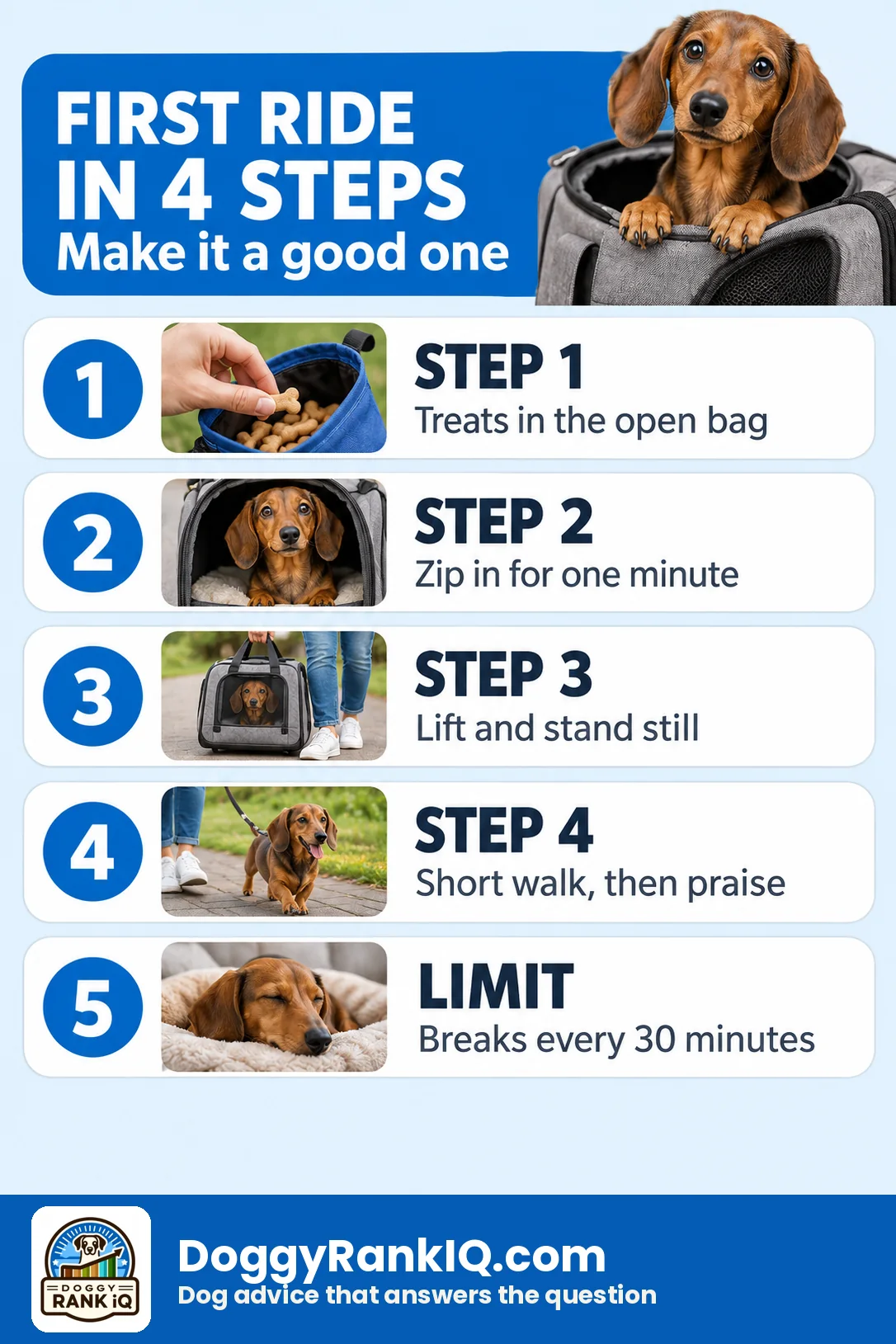
- Let the dog sniff and explore the empty, unzipped carrier at home for several days before the first short carry.
- Place treats inside the carrier so the dog associates it with something good, not confinement.
- Start with carries of two to three minutes around the house or yard before attempting a real outing.
- Use the carrier’s chest strap and sternum strap snug enough that the dog can’t lunge forward and fall, but not so tight it restricts breathing.
- If a dog still panics after a week of short sessions, stop and consult your veterinarian, since anxiety around confinement sometimes points to a condition unrelated to the carrier itself.
⭐ Top 5 Features We Love
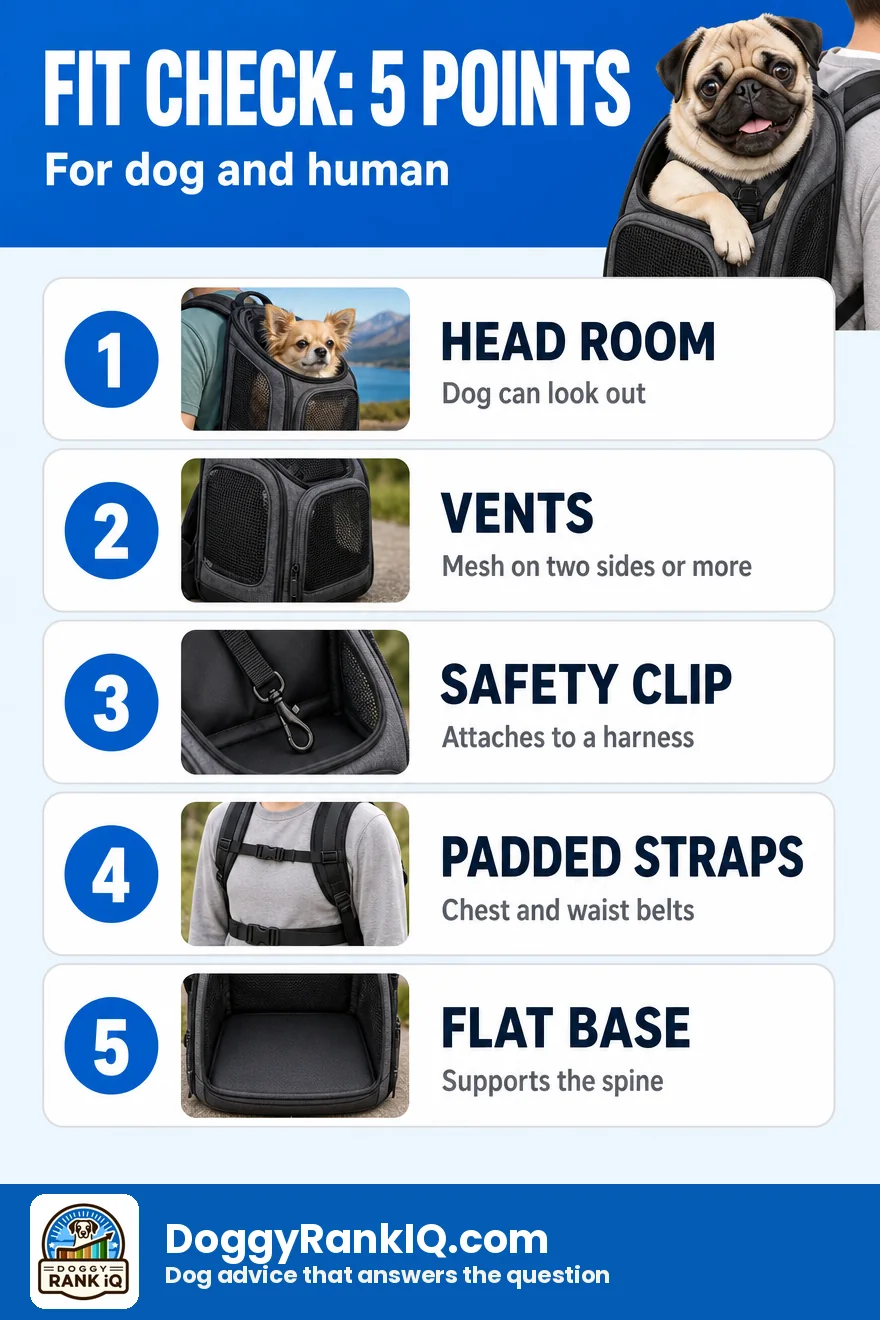
- Back-length sizing instead of weight-only sizing. Ruffwear and K9 Sport Sack both measure by back length and girth, which catches the mismatch between a long dog and a compact dog of the same weight.
- A hip belt that actually transfers weight off your shoulders. The Kurgo G-Train’s hip belt and sternum strap combination is built for multi-mile days, not just a trip to the mailbox.
- Multiple entry points. The 3-entrance budget carrier makes loading a reluctant dog noticeably less of a wrestling match.
- A stable, structured bottom panel. The Petsfit’s 9.2 out of 10 score from Spots.com testing came down partly to a bottom that doesn’t sag under a dog’s full weight. (spots.com)
- Mesh ventilation panels placed away from direct sun exposure. Several higher-rated packs use mesh positioned on the sides rather than the top, which keeps airflow moving without turning the carrier into a sunroof.
⚠️ Things to Look Out For
No major U.S. safety standard currently certifies crash performance or impact ratings for dog backpack carriers. Hound & Field’s comparison found that none of the carriers it reviewed publish crash testing or speed limits, and clarified that the Center for Pet Safety’s certification program covers vehicle restraints, not backpack-style carriers. (houndandfield.com) That means “safety rated” marketing language on a backpack listing isn’t backed by an independent crash standard the way a car seat claim would be.
Watch for soft-bottomed bags on bigger or older dogs. A soft fabric bottom that flexes under weight, like the critique Spots.com gave the K9 Sport Sack Air, can let a heavier dog sag into an uncomfortable curled position over a long carry. (spots.com) Also watch pricing. Costs moved noticeably in 2026: Petsfit dropped from $65.99 to a range of $56.35 to $57.95, Snoozer rose from $135.95 to $142.95 to $153.95, and K9 Sport Sack Air rose from $72.99 to $99.95. (spots.com) Check the listing price against what you remember from a past search before assuming last year’s number still applies.
How long a dog can ride, and signs to take a break
There’s no single documented time limit that applies to every dog in a carrier, and no source in this research set offers one. What matters more is reading the dog, not the clock. A dog that starts shifting weight constantly, panting heavily without heat as the obvious cause, or going unusually still and quiet may be uncomfortable rather than calm. Stop, set the dog down, let them stretch their legs and walk a stretch if that’s safe, and check the straps for pinching before continuing.
Short trial sessions work better than a surprise all-day hike. Start with ten or fifteen minutes around the house, then a short walk, before attempting a longer trail day. If your dog has a joint condition, respiratory sensitivity, or recent surgery, confirm an appropriate carry time with your veterinarian before planning a long outing.
FAQ
The bottom line
A backpack carrier earns its keep when the weight limit, back length, and your dog’s actual temperament all line up with the same product, not when you pick whichever bag looked cutest in a photo. Measure first, check the current listing for weight limits since several brands revised their numbers in 2026, and watch your dog’s body language on a short trial run before committing to a long hike. If your dog also travels by air, check our airline approved dog carrier guide for the cabin dimensions that actually get enforced at the gate, and pair any new gear with a properly fitted no pull dog harness for the walking portions of your trip.
Doggy Rank IQ is reader supported. As an Amazon Associate we earn from qualifying purchases, at no extra cost to you.