
Quick Answer
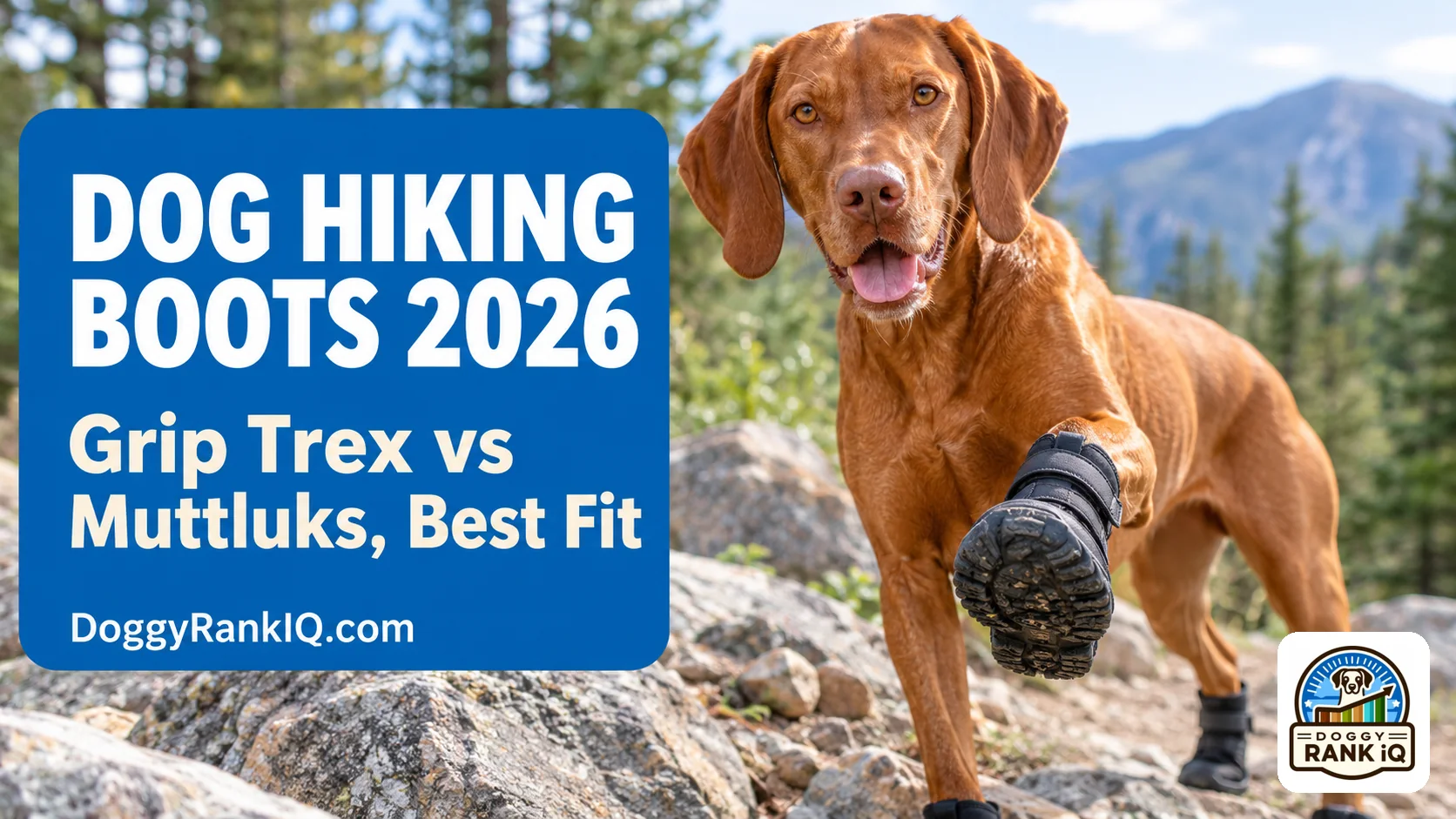
Dog hiking boots protect paws from hot rock, sharp scree, ice, and road salt, and the two names that come up most in 2026 are Ruffwear Grip Trex and Muttluks All Weather. Grip Trex wins on traction and long-distance durability thanks to its Vibram outsole, while Muttluks wins on puncture protection and flexibility. Neither boot is magic against retention problems; fit, measuring paw width correctly, and a proper break-in period matter more than the brand name. Dog hiking boots that stay on come down to one thing: a snug width match, not a snug length match.
Key Takeaways: dog hiking boots
- Dog hiking boots are protective gear for specific conditions (heat, ice, scree, chemical de-icers), not a year-round requirement for every dog.
- Grip Trex ($49.99 per pair) uses a Vibram sole and tested best for traction on rock and packed snow.
- Muttluks All Weather ($66 for four boots) uses a flexible leather sole and tested best for puncture resistance.
- Measure paw width, not length, and use each maker’s own method since the two brands size differently.
- Grip Trex is sold in pairs because front and back paws are often different widths; buy two pairs if your dog needs two sizes.
- Boots that fly off are almost always a width problem, not a brand problem.
- Break dogs into boots gradually over several short sessions before a real hike.
- No published standard sets a safe “hot pavement temperature” just because a dog is wearing boots.
- Senior dogs with arthritis often do better in lighter, more flexible boots than in stiff, heavily built ones.

What is the trail like?
Tap an option to see the answer.
What are dog hiking boots and why do dogs need them?
Dog hiking boots are protective footwear built to shield paw pads from surfaces and conditions a dog’s natural pads can’t always handle, including hot asphalt, jagged scree, ice, and chemical de-icers. They typically combine a durable sole (rubber, Vibram, or treated leather) with a fabric or leather upper and some form of strap or cuff closure to keep the boot seated on the paw.
Dogs need boots in the same way hikers need footwear: not for every step, but for the terrain that actually causes damage. A dog’s pads are tough, but they’re not immune to thermal burns from pavement, lacerations from volcanic rock, or chemical irritation from road salt. The Virginia Tech Veterinary Teaching Hospital lists paw protection as one of several core hiking safety considerations alongside hydration and tick prevention, which tells you boots sit in the same category as a good leash or collar: situational gear, not a fashion accessory.
A practical example: a dog crossing a mile of sun-baked rock in August faces a different risk than the same dog walking on shaded dirt trail in October. The first scenario calls for dog hiking boots. The second usually doesn’t.
Do all dogs need hiking boots or just certain breeds?
Not all dogs need hiking boots, and breed alone isn’t the deciding factor; coat type, pad toughness, age, and the specific trail conditions matter more. A husky with thick, weathered pads built for snow travel handles different terrain than a short-haired senior dog with thin, sensitive pads.
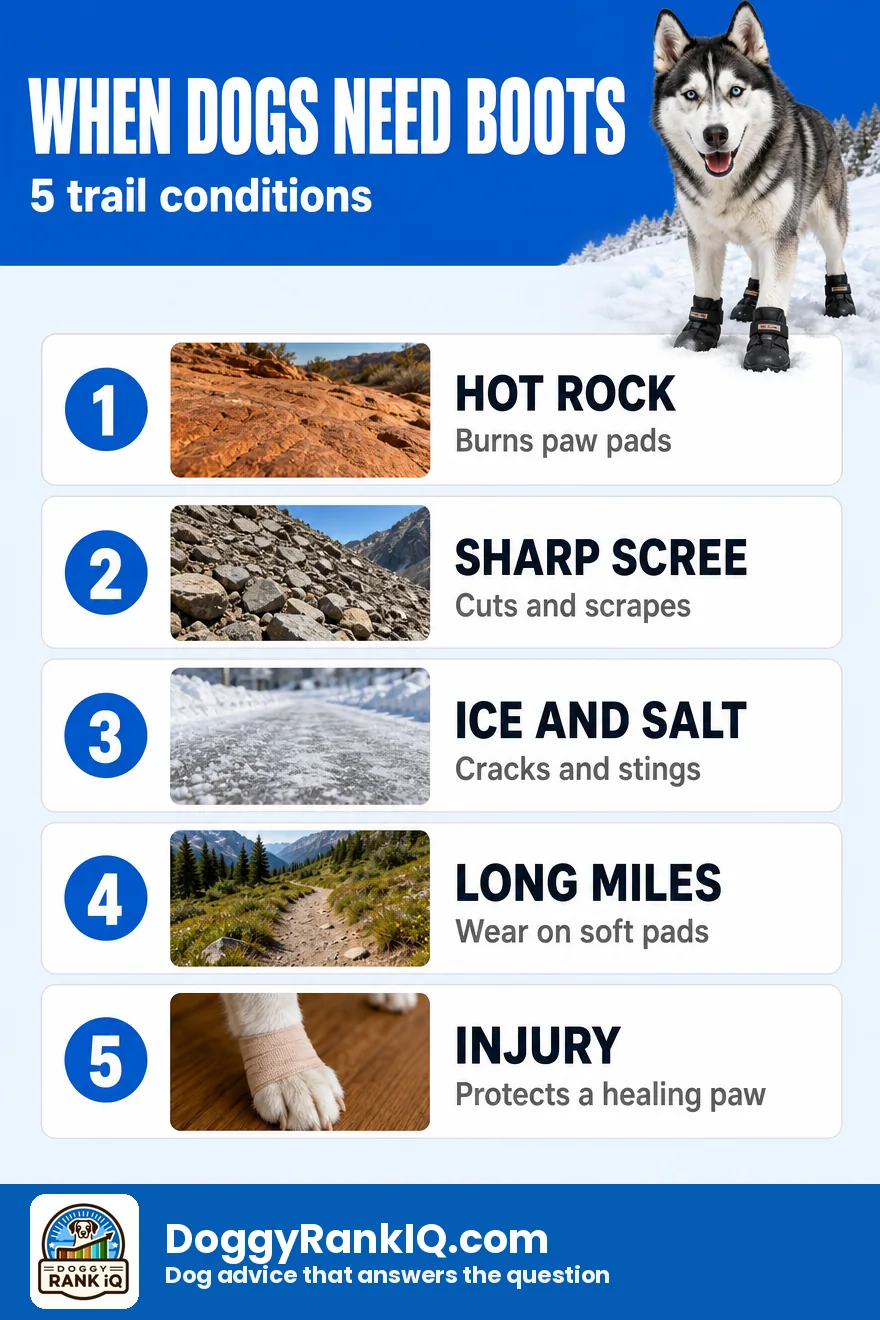
Dogs who benefit most from dog hiking boots:
- Breeds with naturally thinner or softer pads (many toy and some short-haired breeds)
- Senior dogs with arthritis who need extra cushioning and stability
- Dogs recovering from a paw injury or surgery who need a barrier while healing
- Working and sled-type breeds crossing ice, packed snow, or salted roads regularly
- Any dog hiking volcanic rock, scree fields, or desert terrain in summer
Dogs who usually don’t need them:
- Healthy adult dogs on short, shaded grass or dirt walks
- Dogs with pads already conditioned to rough terrain through regular outdoor activity
- Dogs on mild, temperate trails with no ice, chemical treatment, or sharp debris
Veterinarian Jo Myers told Weather.com that temperature alone doesn’t determine whether a dog needs boots; ice, de-icing chemicals, sharp terrain, paw sensitivity, age, and breed all factor in together, not individually.
Should dogs wear boots on hikes?
Dogs should wear hiking boots when the trail surface poses a specific risk: hot rock, sharp scree, crusted snow, ice, or chemical de-icer, not simply because the calendar says “winter” or “summer.” A husky with thick, weathered pads crossing packed snow is a different case than a short-haired senior crossing a salted sidewalk.
Choose boots if your dog is hiking scree fields, lava rock, hot pavement, or salted winter trails, or if they’re recovering from a paw injury and need a barrier while it heals. Skip boots for a quick grassy walk around the block. A common mistake is assuming a boot’s tough sole means a dog can handle any amount of heat exposure; a resistant sole doesn’t establish a safe whole-body heat limit. Wearing boots does not change how fast a dog’s core temperature rises in extreme heat, so hiking schedules still need to account for midday sun and humidity even when paws are covered.
 Grip Trex vs Muttluks All Weather
 Grip Trex vs Muttluks All Weather
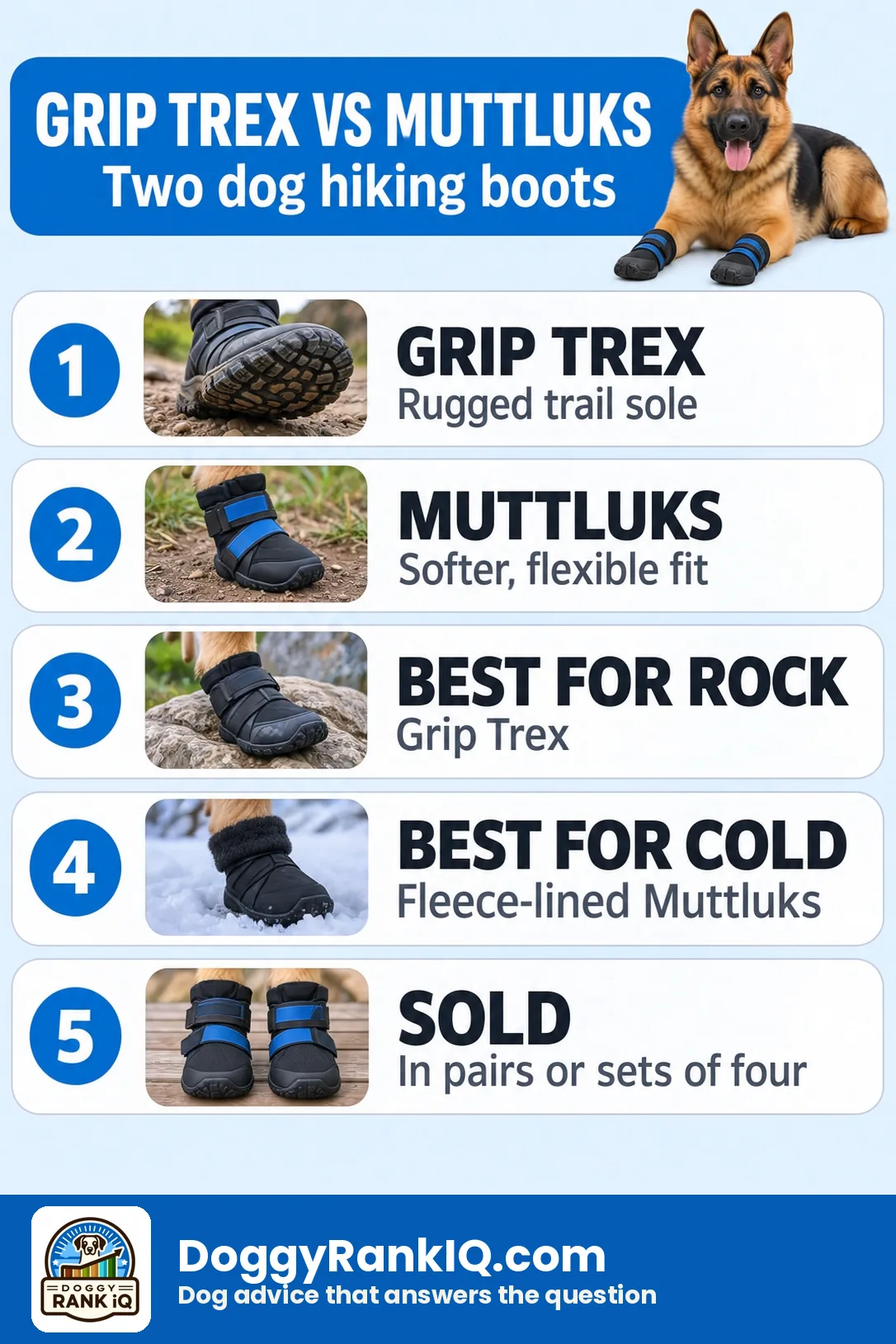
Grip Trex and Muttluks All Weather solve different problems well. Grip Trex grips better; Muttluks resists punctures better. The table below lays out the mechanical differences that actually change which one fits your trail.
| Feature | Ruffwear Grip Trex | Muttluks All Weather |
|---|---|---|
| Sole | Vibram, lugged tread | Flexible treated leather |
| Closure | Single hook-and-loop cinch | Self-tightening strap, adjustable leg cuff |
| Sizing range | 1.50 to 3.25 inch widths, 8 sizes | Varies by model, measured in paw width |
| Best result in independent testing | Traction on rock and snow | Puncture and abrasion resistance |
| Price | $49.99 per pair (price checked 2026) | $66 for four boots (price checked 2026) |
CleverHiker’s 2026 testing scored both boots nearly identically overall, 4.4 out of 5.0, but for different reasons: Grip Trex earned “Best Hiking-Specific Dog Boot” and Muttluks All Weather earned “Best Boot for Foot Protection.” Grip Trex and Kurgo Blaze were named the top traction performers on a specialized traction-testing device. Muttluks, tested with keys, razors, and sewing needles, showed no punctures or visible damage. Grip Trex also carries the stronger long-distance record, with an estimated service life of 200 to 300 miles on multi-day hikes, and the toe fabric above the rubber tends to wear first. Muttluks, in the tested small size, was lighter at 0.6 ounces versus Grip Trex’s 1.6 ounces, though weight scales with boot size and shouldn’t be compared across different dogs.
Choose Grip Trex if your dog hikes rocky, technical terrain where traction and rubber toughness matter most. Choose Muttluks if your dog’s paws need protection from sharp debris and you want a lighter, more flexible boot for everyday wear alongside occasional trail use.
The Ruffwear Grip Trex, set of 2, 2.00 inch and Ruffwear Grip Trex, set of 2, 2.75 inch are both listed at $49.99 (price checked 2026). Muttluks sells direct; see the Muttluks dog boot catalog for current sizes and the Original All-Weather model at $66 for four boots.
Best dog hiking boots for different terrains and weather
The right dog hiking boots depend on the ground your dog actually crosses, not a single “best overall” pick. Rocky alpine trails, muddy forest paths, and salted winter sidewalks each call for a different sole and upper material.
- Hot, dry rock and desert hiking: breathable mesh uppers with a grippy rubber sole, like Grip Trex, let heat escape while resisting abrasion from loose rock.
- Muddy or wet forest trails: treated leather soles, like Muttluks, shed water better and resist the slow saturation that softens fabric boots.
- Snow and ice: look for lugged tread and a snug cuff that keeps snow from packing inside; both Grip Trex and Muttluks’ Snow Mushers line get used in winter, according to Treeline Review’s testing roundup.
- Volcanic rock or scree fields: prioritize sole toughness and toe protection over flexibility, since sharp edges wear through soft materials quickly.
- Everyday neighborhood walks on salted sidewalks: a lighter, easy-on boot like Muttluks All Weather often suffices without the bulk of a full hiking-specific design.
A common mistake is buying one pair of dog hiking boots and expecting it to perform equally well on ice, hot pavement, and sharp scree. Most owners who hike varied terrain year-round end up owning two boot types: one rugged pair for technical trail and one lighter pair for everyday protection.
How to measure paw width so boots stay on
Measuring width, not length, is the single biggest factor in whether dog hiking boots stay on. Each brand uses its own method, so a size that fits in Grip Trex won’t automatically match a Muttluks size chart.
Here’s the general process:
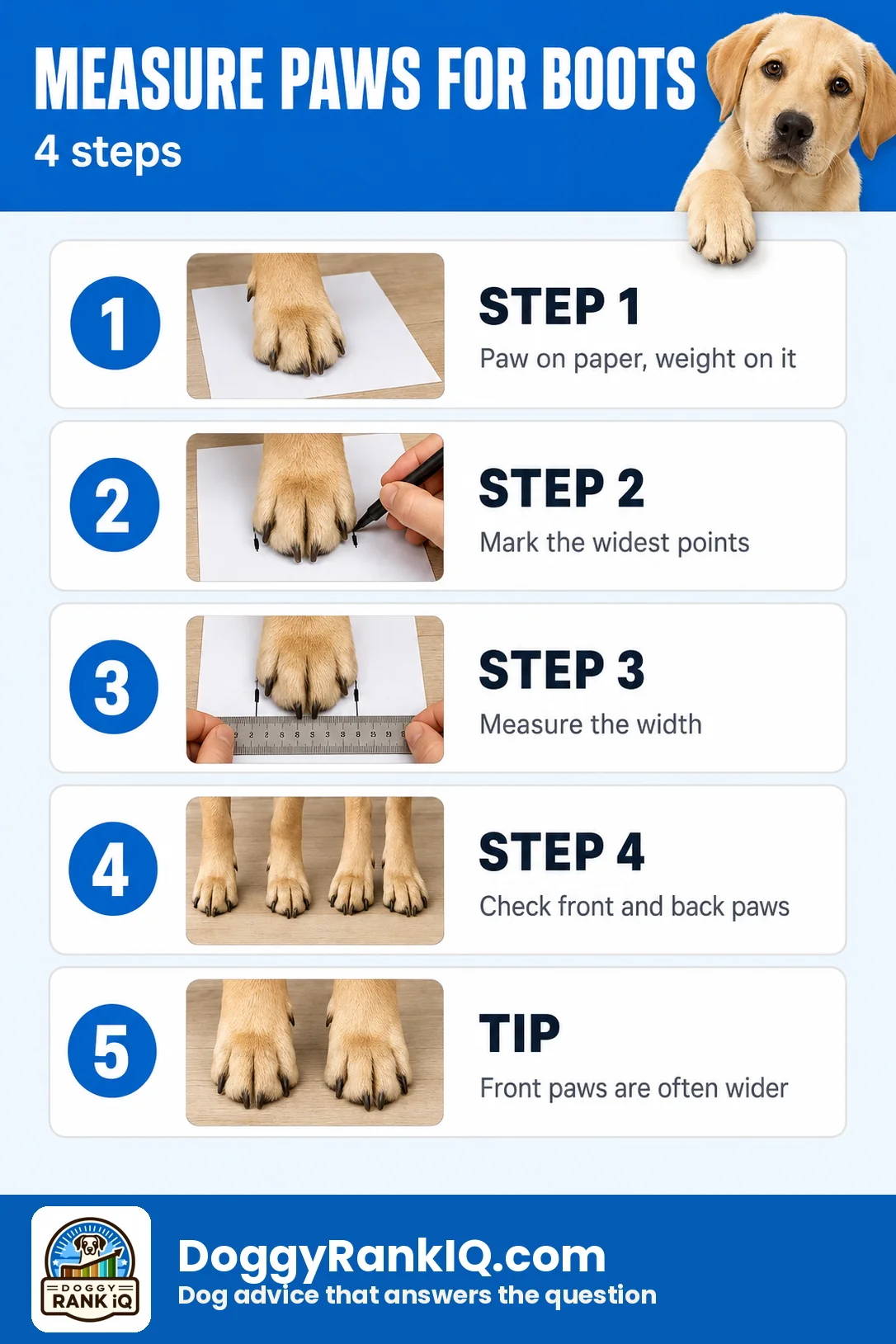
- Have your dog stand on a flat surface with weight evenly distributed on the paw.
- Trace the widest point of the paw, usually across the base where the toes spread.
- Measure that width in inches, not the length from heel to toenail tip.
- Check each front paw and each back paw separately; many dogs have wider front paws than back paws.
- Compare your measurement against the specific brand’s width chart before ordering.
Grip Trex is sold in pairs partly because front and back paw width often differs enough to need two sizes. According to Ruffwear’s Grip Trex product page, the boot comes in eight widths from 1.50 to 3.25 inches, giving enough range to size front and back paws separately. A common mistake: measuring once, buying four boots in one size, and wondering why the back boots keep slipping. Measure all four paws, every time, even for a dog you’ve already fitted once. Paw width can shift slightly with weight change or age.
How to get my dog used to wearing hiking boots
Getting a dog comfortable in dog hiking boots takes repetition, not a single long session. Most dogs need a week or more of short, positive exposures before boots feel normal on a real trail.
See the full break-in schedule below, but the short version: let the dog investigate the boots first, introduce short wear times indoors with treats, then move to the yard before attempting a trail. Ruffwear’s own break-in guidance recommends gradual introduction rather than forcing a dog into boots for a full hike on the first attempt, and recommends checking the fit about 15 minutes into any activity since straps can loosen.
Why does my dog hate wearing boots and keep trying to take them off?
Dogs who resist boots are usually reacting to an unfamiliar sensation on their paws, not rejecting the product itself; this is a near-universal first response, not a sign something is wrong. The stiff-legged, high-stepping “frozen statue” shuffle is the most common reaction and almost always fades with repeated short exposures.
Reasons a dog keeps trying to remove boots:
- Unfamiliar sensation: paws are packed with nerve endings, so any covering feels strange at first.
- Poor width fit: a boot that’s too loose shifts with every step, which irritates a dog more than a snug one.
- Skipped break-in: dogs introduced to boots for the first time on a long hike are far more likely to fight them than dogs eased in gradually.
- Closure discomfort: a cuff cinched too tight can pinch; a two-finger gap under the cuff is the target.
A common mistake is giving up after one failed walk and concluding the dog simply “won’t wear boots.” Most dogs stop fighting boots within a week of short, positive sessions, especially when treats or a meal are paired with the early fittings. A puzzle toy or slow feeder used as a distraction during indoor fitting sessions can shorten that adjustment period.
Dog hiking boots vs other paw protection like booties and waxes
Hiking boots, lightweight booties, and paw waxes all protect pads, but they’re built for different levels of risk and different budgets. Boots offer the most physical protection; wax offers the least barrier but the most convenience.
- Hiking boots (Grip Trex, Muttluks All Weather): full coverage with a hard or semi-hard sole, best for hot rock, ice, scree, and chemical exposure.
- Lightweight booties (often disposable or thin fabric): useful for brief exposure to salted sidewalks or light snow, but they lack the sole toughness for rocky or long-distance trail use.
- Paw wax or balm: adds a protective layer against salt and dryness without changing how the paw feels or grips, but offers no defense against punctures or sharp rock. A dog paw balm works well as a supplement to boots, applied around the edges where fur meets pad, rather than as a replacement for them.
Choose boots if your dog faces sharp terrain, ice, or extreme heat. Choose wax or light booties if the exposure is brief and the surface is only mildly abrasive, like a short walk on a salted driveway.
Are hiking boots necessary for dogs or just optional?
Hiking boots are optional for most everyday walking and necessary only in specific conditions that pose a real risk to paw pads. There’s no rule requiring boots for every outdoor dog, and plenty of healthy dogs hike regularly without them.
Necessary scenarios include hot pavement that would burn bare skin, ice and chemical de-icer exposure, sharp volcanic rock or scree, and recovery from a paw injury. Optional or unnecessary scenarios include short walks on grass or soft dirt, cool weather on unsalted paths, and dogs with pads already well-conditioned to the terrain they’re walking on. The decision comes down to surface temperature, sharpness, and chemical exposure, not a blanket rule tied to season.
Best dog boots that stay on: the fit checks that matter
The best dog boots that stay on share three fit traits: a snug width match, a secure but adjustable closure, and a check-in routine during the hike. Ruffwear specifically recommends checking and re-adjusting the closure about 15 minutes into activity and periodically after that, since straps can loosen as a dog moves.
Fit checks worth running before any hike:
- The two-finger test: you should be able to slide one or two fingers under the top cuff, not more.
- The heel-lift check: lift the dog’s leg slightly; the boot shouldn’t slide down toward the toes.
- The first-ten-steps watch: most boots that are going to come off do it in the first few minutes, not miles in.
- The gait check: a dog high-stepping or shaking a paw repeatedly usually has a width problem, not a “dogs hate boots” problem.
Grip Trex’s single cinch closure is fast to put on but offers less fine-tuning than boots with multiple straps, a drawback CleverHiker specifically flagged. Muttluks’ self-tightening strap and stretchy leg cuff adjust more passively as the dog moves. Choose the multi-point adjustment option if your dog has an unusual paw shape or has slipped boots before; choose the single-cinch option if speed of putting boots on four paws matters more to you than fine-tuning.
Waterproof or breathable: which terrain needs which
Waterproof hiking boots matter for wet, muddy, or snowy trails; breathable mesh boots matter for dry, warm trails where overheating the paw is the bigger risk. Grip Trex uses breathable mesh with reflective trim, built for varied warm-weather trail use rather than deep water crossings. Muttluks’ treated leather sole and weather-resistant construction lean toward wet and winter conditions.
- Muddy, wet trails: a leather or treated sole that sheds water, like Muttluks’ All Weather or Mud Monsters line, holds up better over a soggy afternoon.
- Hot, dry rock: breathable mesh uppers, like Grip Trex, let heat escape rather than trapping it against the pad.
- Snow and ice: Muttluks’ Snow Mushers model and Grip Trex’s lugged tread both get used in winter conditions, but neither is a substitute for checking ice and salt exposure directly.
A frequent misunderstanding: assuming “waterproof” means “warm.” A fully waterproof boot can trap moisture from sweat or snowmelt inside just as easily as it keeps rain out, so drying paws after a wet hike still matters regardless of boot choice. For cold-weather walks where coverage matters as much as footwear, a dog winter coat with good leash access rounds out the kit, and a dog raincoat pairs well with waterproof boots on soggy trail days.
⭐ Top 5 Features We Love
- Vibram outsole on Grip Trex. A rubber compound built for human hiking boots, applied to a dog boot, giving Grip Trex its traction edge on rock and packed snow.
- Self-tightening strap on Muttluks. The strap tightens somewhat as the dog moves, reducing the constant re-cinching that frustrates owners on long walks.
- Reflective trim on both brands. Useful for early-morning or dusk hikes when visibility matters as much as paw protection.
- Sold-in-pairs sizing logic. Buying Grip Trex as a pair, rather than a set of four identical boots, acknowledges that front and back paws aren’t the same width.
- Stretchy adjustable leg cuff on Muttluks. Accommodates different leg shapes without needing a separate size chart for the cuff itself.
⚠️ Things to Look Out For
- Limited adjustment on Grip Trex. The single cinch closure is quick but doesn’t fine-tune the way a two-strap system can, a specific drawback noted in independent testing.
- Inventory gaps. Ruffwear’s own product page has shown certain Grip Trex colors and sizes out of stock as of 2026; check availability before planning a trip around a specific pair.
- No universal heat-safety standard. A tough sole doesn’t establish a safe temperature limit for the whole hike; 2026 guidance treats boots as protection, not authorization to push through dangerous heat.
- Toe wear on Grip Trex. The fabric above the rubber toe cap tends to wear first on long-distance use, around the 200 to 300 mile mark.
- Price range confusion on Muttluks. The brand sells several distinct models (Original All-Weather, Mud Monsters, Snow Mushers, Deluxe) at different prices, roughly $23 to $100, so it’s worth confirming which specific model you’re comparing to Grip Trex.
Best dog hiking boots brands and where to buy them
Ruffwear and Muttluks lead the hiking boots category in 2026, with Kurgo, FidoHikes-reviewed snow booties, and several smaller brands rounding out options for specific conditions. FidoHikes’ winter booties guide and Packs & Paws’ boot roundup both treat Ruffwear and Muttluks as reference points when comparing newer entrants.
- Ruffwear Grip Trex: sold through Ruffwear’s own site and major retailers; see the Ruffwear Grip Trex, set of 2, 2.00 inch and Ruffwear Grip Trex, set of 2, 2.75 inch listings for specific widths.
- Muttluks: sold direct through the Muttluks dog boot catalog, which lists sizing for each model separately since they don’t share a single chart.
- Kurgo: named alongside Grip Trex as a top traction performer in CleverHiker’s testing, worth comparing if Grip Trex is out of stock in your size.
- Wirecutter’s dog boot coverage: the Wirecutter review of dog boots offers an independent, consumer-focused comparison worth reading alongside manufacturer specs.
Buying direct from the brand site usually gives access to the full size range and current stock, while marketplace listings can be faster to ship but limited to popular sizes.
Breaking boots in before the trail
Dogs rarely accept boots on the first try, and that’s normal, not a sign the product is wrong. A short, repeated introduction period works better than forcing a dog to wear boots for an entire hike on day one.
A practical break-in approach:
- Day 1 to 2: Let the dog sniff and investigate the boots indoors. No wearing yet.
- Day 3 to 4: Put boots on for five minutes at a time indoors, pairing it with treats or a meal.
- Day 5 to 7: Short walks around the yard or block in boots, watching gait and checking fit.
- Week 2: A short trail walk, re-checking the closure about 15 minutes in, as Ruffwear recommends for Grip Trex specifically.
If your dog refuses to walk and does the stiff-legged “frozen statue” shuffle, that’s a near-universal first reaction and usually resolves with repetition, not a different boot. A common mistake is giving up after one failed walk and assuming the dog simply “won’t wear boots.” Most dogs adjust within a week of short, positive sessions. For dogs who need extra motivation during training sessions, a puzzle toy or slow feeder used as a distraction during the indoor fitting stage can help.
FAQ
The bottom line
Hiking boots solve a specific problem: protecting paws from a specific hazard on a specific trail, not from general weather. Grip Trex earns its reputation through traction and rubber durability; Muttluks earns its reputation through puncture resistance and a more forgiving, flexible fit. Neither wins across the board, which is exactly why “best overall” is the wrong question. The better question is what your dog’s next trail actually demands.
Measure all four paws by width, not length. Compare the options using each brand’s own chart since Grip Trex and Muttluks don’t size the same way. Break boots in gradually before a real hike, and recheck the fit about 15 minutes into activity, just as Ruffwear recommends. If a boot keeps coming off, the fix is almost always a width adjustment, not a brand switch.
For related gear decisions, see our guides on no-pull harnesses sorted by chest shape, dog raincoats with proper belly coverage, paw balm compared by wax type, and winter coats with good leash access. If your dog is still getting used to gear in general, our puppy training guide covers the same short-session approach used for boot break-in.
Doggy Rank IQ is reader supported. As an Amazon Associate we earn from qualifying purchases, at no extra cost to you.