
This post contains affiliate links. If you buy through one we may earn a commission at no extra cost to you. As an Amazon Associate I earn from qualifying purchases.
Quick Answer
The best dog paw balm depends on the job you need done. For protection before a salted winter walk, choose a harder wax like Musher’s Secret. For repairing pads that are already dry or cracked, choose a softer balm like Natural Dog Company’s Paw Soother. Sticks are just either formula packaged for clean, fast application. Most households end up needing both a wax and a balm, not one product that tries to do everything.
Key Takeaways
- Wax sits on top of the pad and protects against salt, snow, and hot pavement. Balm absorbs in and repairs skin that’s already damaged.
- The best dog paw balm for a salted sidewalk is not the same product as the best option for a pad that’s already cracked.
- Sticks are a format choice, not a formula choice. You can get wax or balm in stick form.
- Reapply wax before each cold-weather walk. Reapply balm two to three times a week once pads look normal.
- Persistent licking focused on one paw, or pads that keep getting worse despite regular balm use, is a reason to call a vet, not a reason to try another product.
- Dog boots solve the salt and hot pavement problem more completely than any balm, especially for dogs who won’t tolerate contact at all.
- Budget options like Bag Balm work fine for basic conditioning in multi-dog households, even though the texture is heavier and greasier than specialty sticks.
- Hyperkeratosis (thickened, crusty pads) is a medical condition that balm manages but does not cure, according to the American Kennel Club.
A dog’s paw pad is tougher than human skin in some ways and more vulnerable in others. It has almost no sweat glands, it touches road salt and hot asphalt directly, and it cracks quietly over a few weeks before suddenly looking raw. That’s the entire case for the best dog paw balm: not a luxury item, but a buffer between your dog’s feet and whatever the sidewalk is doing that day.
Doggy Rank IQ Tool
Dog Paw Balm Picker

The right product depends on what the pad looks like and when you walk.
What Is Dog Paw Balm and Why Do Dogs Need It?
Best dog paw balm is a topical product, usually made from waxes, plant oils, or butters, applied to the pad to either block contact with harsh surfaces or restore moisture to dry, cracked skin. Dogs need it because their pads lack the oil-producing structures that keep human skin supple, and daily walking exposes them to salt, ice melt, hot concrete, and abrasive gravel that wears pads down faster than they can repair on their own.

Unlike a human palm, a dog’s paw pad gets direct, repeated contact with the ground at body weight with every step. Over a winter season, that adds up to thousands of contact points with rock salt crystals and chemical de-icers. Over a summer, it means direct contact with pavement that can reach well above safe temperatures within minutes, according to NBC Select. Balm and wax products exist to reduce that exposure or to help the skin recover once damage has already started.
Decision rule: if your dog walks daily on treated sidewalks, hot pavement, or rough trails, some form of paw protection is worth building into the routine. If your dog is mostly on grass and carpet, balm is optional upkeep rather than a necessity.
Best Dog Paw Balm for Cracked and Dry Paws
For pads that are already rough, flaking, or lightly cracked, a softer, oil-rich balm works better than a hard wax because it absorbs into the skin instead of sitting on top of it. Natural Dog Company’s Paw Soother Stick is built specifically for this job, with coconut oil, cocoa butter, mango butter, jojoba oil, and calendula doing the repair work rather than acting as a shield.
Palmer’s for Pets Cocoa Butter Paw Pad and Nose Balm is a reasonable second option here, especially if you also want something for a dry nose. Its texture leans soft and absorbent rather than protective, which makes it a daily conditioning product rather than a pre-walk shield.
Common mistake: owners reach for a hard wax when pads are already cracked, expecting it to “seal” the damage. A wax barrier on top of broken skin can trap irritants against the crack instead of letting it heal. Switch to balm first, let the pad recover, then go back to wax for prevention once it looks normal.
Dog Paw Balm vs Dog Boots: Which Is Better?
Boots physically block contact between the pad and the ground, which makes them more reliable than any balm for severe cold, deep snow, or scorching pavement. Balm is lighter, cheaper, and better tolerated by dogs who refuse to wear footwear, but it offers partial protection at best against extreme conditions.
- Choose boots if your dog needs to cross heavily salted roads for more than a few minutes, or if summer pavement temperatures are a real hazard in your area.
- Choose balm if your dog tolerates short exposure to cold or salt and you mainly want to reduce drying and cracking over a season.
- Many owners run both: boots for the worst stretches of sidewalk, balm for general conditioning and for the paw once boots come off.
Grooming routines matter here too. A dog whose nails and pads are checked regularly during basic grooming is easier to catch early cracking on, before it becomes a boots-only situation.
Is Dog Paw Balm Safe If My Dog Licks It?
Most paw balms and waxes made from food-grade ingredients like beeswax, coconut oil, and shea butter are safe in small amounts if licked, but heavy or repeated ingestion of any topical product can cause mild stomach upset. The bigger safety concern is not the balm itself, it’s whatever the balm picked up off the sidewalk, including salt and de-icer residue.
Dogs lick balm off almost immediately after application because many formulas smell and taste appealing, especially ones built around coconut oil or cocoa butter. That’s not a flaw in the product, it’s just dog behavior. Wax-heavy formulas tend to get licked less aggressively than oil-rich balms, which is one more reason to reserve wax for pre-walk protection and balm for overnight repair when a dog is less likely to be chewing at its own feet.
Edge case: if licking is constant, focused on one specific paw, and continues long after a normal grooming session would end, that’s worth a vet visit rather than a product swap. Persistent single-paw licking can signal an injury, an infection, or an allergy that no amount of the best dog paw balm will resolve on its own.
Best Dog Paw Balm for Winter Salt and Snow
For salted sidewalks and packed snow, a hard wax applied before the walk is the right call, not a soft balm. Musher’s Secret Paw Wax remains the reference point in this category, built from beeswax, carnauba wax, candelilla wax, vegetable oils, and vitamin E, with the manufacturer specifically noting the absence of lanolin, petroleum, tea tree oil, nut oils, soy, and flax oils.

A dog-trainer-led review from Dogster picked Musher’s Secret as a standout in a field that included sticks, jars, and softer balms, citing protection against salt and snow without leaving pads greasy enough to track across carpet. PawZ MAXWAX is a firmer alternative built on beeswax, mineral jelly, lanolin, vitamin E, and soft wax, sold in 60-gram and 200-gram sizes, and testing from Pet Science Review noted it holds up well against cold pavement and salt, though heavy application can leave a residue that needs wiping off.
Price bands for winter wax products generally run from budget to mid-range:
- Small tins (60g) and single sticks: low price band, good for one dog and occasional walks.
- Mid-size tins (200g): mid price band, suited to daily winter walkers.
- Large tins (450g+): higher price band but lower cost per use, better for multi-dog households.
Choose wax if: your dog’s pads look healthy now and you’re trying to prevent damage from an upcoming cold snap. Choose balm instead if: the pads are already showing cracks, since wax won’t repair existing damage, it will just sit on top of it.
How Often Should I Apply Paw Balm to My Dog?
Wax used for protection can go on daily before a walk during an active winter stretch, since it’s meant to wear off by the time you get home. Balm used for repair works best at two to three applications a week once pads look normal again, since daily use on already-healthy skin doesn’t speed up anything, it just burns through the tin faster.
Watch the pad, not the calendar. If rough patches from the previous week have smoothed out and the pad looks supple, scale back the frequency. If a pad keeps looking worse despite consistent use over a week or two, that’s a signal to stop guessing and get a vet to look at it, since continued application to a pad that needs medical attention can mask a problem rather than fix it.
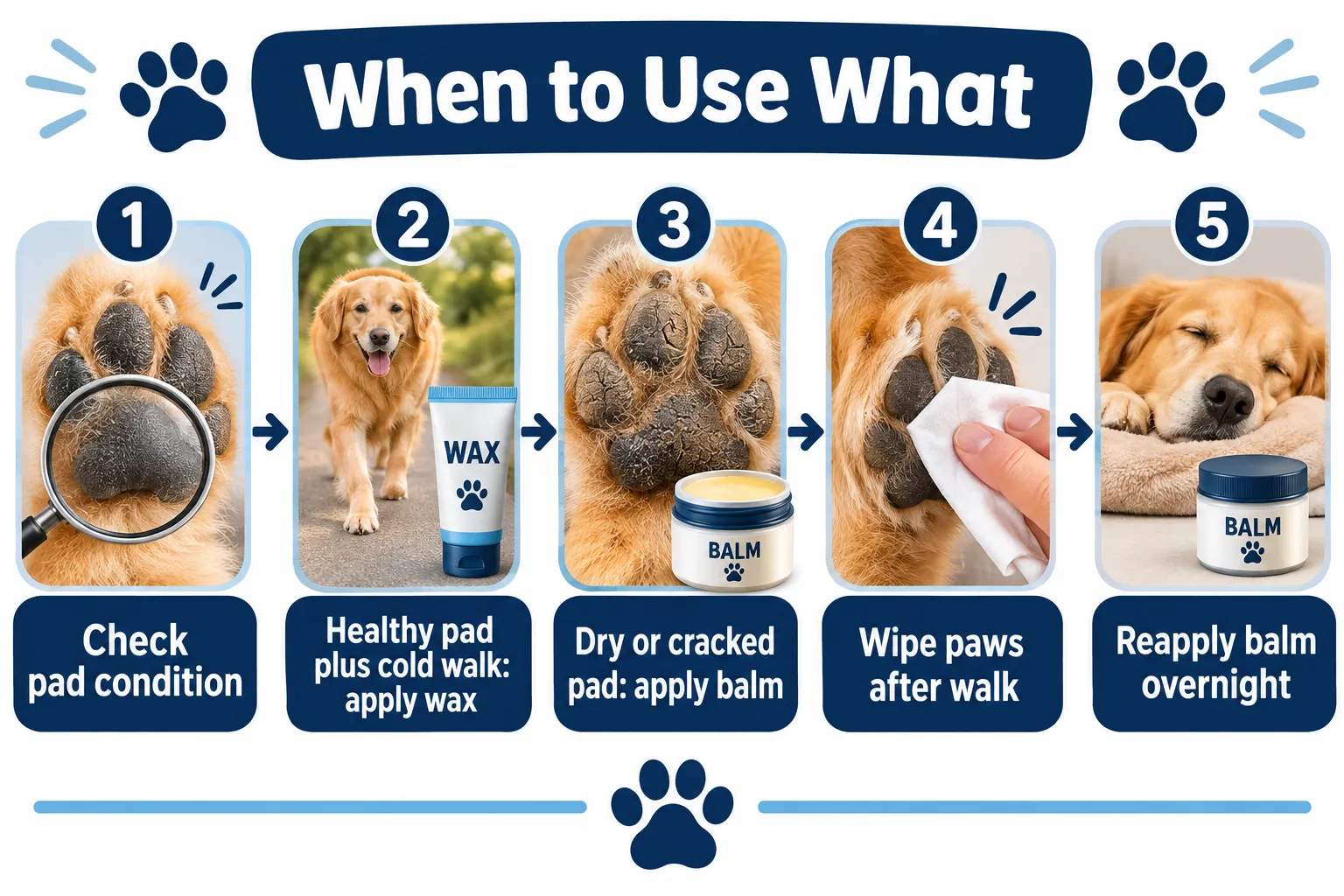
A simple rotation that works for most households:
- Check paw pads before a walk for cracks, redness, or swelling.
- If pads look healthy and conditions are harsh (salt, snow, hot pavement), apply wax before leaving.
- After the walk, wipe paws clean with a damp cloth to remove salt or debris.
- If pads look dry or slightly rough, apply a softer balm overnight.
- Recheck in a week. Scale back balm use once pads look normal, or escalate to a vet visit if they don’t improve.
Dog Paw Balm for Sensitive Paws and Allergies
Dogs with known food or skin sensitivities need a shorter, more recognizable ingredient list, and checking for specific allergens matters more than checking star ratings. Lanolin shows up in both Bag Balm and PawZ MAXWAX, so dogs with a known wool or lanolin sensitivity should avoid those two. Musher’s Secret specifically advertises the absence of lanolin, nut oils, tea tree oil, soy, and flax, which makes it a reasonable default for dogs with food-related skin issues.
Puppies have thinner, less calloused pads than adult dogs and deserve the same caution you’d give any new topical product on young or sensitive skin. A small test patch on one paw, followed by a short watch period before full application, catches a reaction before it spreads to all four feet.
Common mistake: assuming “natural” or “pet safe” on a label guarantees hypoallergenic. Natural ingredients like coconut oil or beeswax can still trigger reactions in individual dogs. Read the actual ingredient list every time, not just the front-of-package claims.
Best Dog Paw Balm for Hot Pavement and Burns
No balm makes hot pavement safe to walk on, and that distinction matters more than any product marketing suggests. A wax barrier can reduce some direct heat transfer for brief contact, but it does not replace the basic rule of testing pavement with the back of your hand for five seconds before letting a dog walk on it, a guideline echoed by NBC Select.
If a pad already shows blistering, peeling, or raw tissue from heat exposure, that is a burn injury, not a dryness problem, and no amount of the best dog paw balm on the market substitutes for a vet visit. Balm belongs in the prevention conversation for hot pavement (shorter walks during peak heat, grass routes, early morning timing), not in the treatment conversation once a burn has happened.
Edge case: summer paw care is a separate problem from winter paw care even though people reach for the same tin. A wax built for salt resistance isn’t doing much against heat, and a cooling balm isn’t doing much against ice. Match the product to the season, not just the category label.
Dog Paw Balm for Hyperkeratosis and Thickened Pads
Hyperkeratosis is a medical condition where paw pads grow excess keratin, producing thick, crusty, sometimes hair-like growths, and balm can soften the texture but does not cure the underlying condition, according to the American Kennel Club. Some cases are genetic, others develop with age or from an underlying health issue, so a vet diagnosis matters before assuming a tin of balm will fix it.

Owners sometimes mistake ordinary dryness for hyperkeratosis or vice versa, and the distinction matters for treatment. Ordinary dry pads respond well to a consistent balm routine over a couple of weeks. Hyperkeratosis tends to persist or worsen regardless of how much balm gets applied, and the texture often looks more like a callus or a small horn than simple flaking.
Decision rule: if balm applied consistently for two to three weeks makes no visible difference, or the texture looks more like a growth than dry skin, stop self-treating and get a vet exam. This is one of the clearest cases where continuing to apply product to a pad that needs medical attention does more harm than good, since it delays an actual diagnosis.
How Much Does Quality Dog Paw Balm Cost?
Most dog paw balms and waxes fall into three rough price bands based on size and formulation, and spending more doesn’t always mean better protection for your specific use case.
- Small tins, sticks, and budget tubes (around 2 oz or 60 grams): generally the lowest price band, suitable for single-dog households or occasional use.
- Mid-size tins (around 3.5 oz to 200 grams): mid price band, good for daily seasonal use.
- Large tins (450 grams and up) or bundled sets: higher upfront cost but lower cost per application, which makes sense for multi-dog households or year-round use.
Budget options exist and work fine for basic conditioning. Bag Balm’s pet version, built on petrolatum and lanolin, sells at a noticeably lower price point than specialty paw brands while still delivering strong moisture lock-in, according to listings reviewed by Treeline Review. The tradeoff is a heavier, greasier texture compared to refined paw sticks.
Quick example: a household with one dog doing occasional winter walks can reasonably spend on the low end of the price range with a small wax stick. A household running three dogs through a full snowy season will save money per application by buying a larger tin, even though the upfront cost looks higher.
Alternatives to Paw Balm for Protecting Dog Paws
Balm is not the only tool for paw protection, and for some dogs and conditions it isn’t even the best one. Dog boots, paw pad toughening through controlled exposure to varied surfaces, and simply adjusting walk routes and timing all reduce the same risks that balm addresses.
- Dog boots: best for extreme cold, deep snow, or hot pavement where any direct contact is risky. Downsides include fit issues and dogs who refuse to walk in them.
- Route and timing changes: walking on grass instead of salted sidewalks, or shifting summer walks to early morning, reduces exposure without any product at all.
- Gradual pad conditioning: regular walking on varied natural surfaces over time toughens pads similarly to how calluses form on human feet, though this takes months and isn’t a fast fix for an already sensitive dog.
- A mix of boots for the worst conditions and balm for everyday upkeep covers more ground than relying on one method alone.
Owners who are also working through basic obedience and leash habits might find it useful to pair paw care routines with broader training groundwork, like the steps covered in essential commands every puppy should learn, since a dog that sits calmly for a boot fitting or a balm application saves a lot of frustration on a cold morning.
Can I Use Human Lotion on My Dog’s Paws?
Most human hand lotions and creams are not a good substitute for dog-specific balm because they often contain fragrances, alcohols, or ingredients like xylitol-adjacent sweeteners in flavored products that can irritate a dog’s skin or cause problems if licked and ingested in quantity. Plain, unscented products like pure shea butter or coconut oil in small amounts are generally tolerated, but a dog-formulated product removes the guesswork.
The core issue isn’t that human skin and dog paw pads are wildly different in structure, since both benefit from similar moisturizing ingredients. The issue is that human products are formulated for a human who isn’t going to lick the product off within sixty seconds of application. A dog-specific balm skips the fragrance and essential oil additives (like tea tree oil) that cause problems for dogs even in amounts that are harmless to people, a point echoed in homemade balm guidance from the American Kennel Club.
Common mistake: grabbing a scented hand cream from the bathroom counter because it’s convenient. If nothing dog-specific is on hand, plain petroleum jelly or plain coconut oil in a thin layer is a safer short-term substitute than a fragranced lotion.
Best Dog Paw Balm for Puppies and Senior Dogs
Puppies need gentler, shorter ingredient lists because their pads are thinner and less calloused than an adult dog’s, while senior dogs often need more frequent conditioning because pad skin loses elasticity with age the same way human skin does. A small test patch before full application is the right first step for both age groups.
For puppies, a mild balm like Palmer’s Cocoa Butter or a diluted application of a product like Paw Soother works better than a heavy wax barrier, since young dogs are less likely to be doing long salted-sidewalk walks and more likely to benefit from basic conditioning. For senior dogs, especially those with reduced mobility or arthritis, a balm applied after shorter, more frequent walks helps manage pads that dry out faster and heal more slowly than they did at two years old.
Edge case: a senior dog with diabetes or circulation issues can have slower wound healing on the pads, which makes any crack or sore a bigger deal than it would be in a younger, healthier dog. That’s a situation for a vet check alongside, not instead of, regular balm use.
Does Dog Paw Balm Actually Work? What the Reviews Say
Independent reviews generally confirm that best dog paw balm reduces visible dryness, cracking, and irritation from salt and cold exposure, though results vary by formula and by how consistently it’s applied. Roundups from The Spruce Pets and Parade Pets both point to wax-forward products performing better specifically against salt and snow, while oil-rich balms score higher for softening already-rough pads.
The honest caveat across most testing: best dog paw balm is a maintenance tool, not a cure for an injury. A 2026 field comparison from Pet Science Review found that wax-based products held up better through a full twenty-minute walk on salted sidewalk than softer balms, which tended to wear off faster under the same conditions. That lines up with the general pattern across this category: pick the product for the job, not the brand reputation alone.
Where to Check Current Prices
Prices move during Black Friday week, so we link to the live listing instead of quoting a number that will be wrong by Friday. Confirm the exact model and size before you buy.
- Check current availability for Musher's Secret paw wax
- Check current availability for the second paw balm pick (soft balm)
- Check current availability for the stick-format paw balm pick
Top 5 Features That Decide the Purchase
These are the five things that actually determine whether a best dog paw balm or wax works for a given dog, each tied to a specific product mentioned in this guide.
- Hardness at room temperature. Musher’s Secret stays firm enough to resist salt and snow for a full walk without melting off in the first five minutes.
- Absorption speed. Natural Dog Company’s Paw Soother Stick is built to soak into dry skin overnight rather than sit on the surface, which is exactly what a cracked pad needs.
- Dual-purpose formulation. Palmer’s Cocoa Butter Paw Pad and Nose Balm covers two problem areas with one jar, which matters for owners managing both dry pads and a cracked nose in the same season.
- Cost per use. Bag Balm’s lower price point and petrolatum-lanolin base make it the practical choice for multi-dog households going through balm quickly.
- Barrier firmness without heavy residue. PawZ MAXWAX aims for a firm, non-greasy barrier, though heavy application can still need wiping off, a tradeoff worth knowing before buying the larger tin.
Things to Watch Out For
Marketing copy rarely tells you where a product’s job ends, so a few honest limits are worth knowing before buying any best dog paw balm or wax.
- No balm neutralizes de-icer chemicals on a sidewalk. “Pet safe” ice melt labeling has no uniform legal standard, meaning the phrase on a bag doesn’t guarantee a genuinely safer formula, and some de-icers still cause stomach upset if licked off paws in quantity.
- A wax barrier applied to an already-cracked pad can trap irritants against the wound rather than protecting it. Switch to a repair-focused balm until the crack heals, then go back to wax for prevention.
- Heavy or constant licking at a single paw, especially if it continues for more than a day or two despite a change in balm, usually points to an injury, infection, or allergy that needs a vet exam, not a different tin of balm.
- Balm and wax do not replace the five-second pavement test for summer heat safety, and no amount of product makes it safe to walk a dog on pavement hot enough to blister a bare hand.
- Thickened, crusty pad texture that doesn’t improve after two to three weeks of consistent balm use may be hyperkeratosis, a medical condition that balm manages but doesn’t cure.
- Lanolin-based products like Bag Balm and PawZ MAXWAX aren’t a safe default for dogs with a known wool sensitivity, regardless of how well they perform for other dogs.
| Product | Format | Best For | Key Ingredients |
|---|---|---|---|
| Musher’s Secret | Tin (wax) | Salt, snow, pre-walk barrier | Beeswax, carnauba, candelilla, vitamin E |
| Paw Soother Stick | Stick (balm) | Dry, rough or cracked pads | Coconut oil, mango butter, calendula |
| Palmer’s Cocoa Butter | Jar (balm) | Daily paw and nose upkeep | Cocoa butter |
| Bag Balm | Tin (ointment) | Budget, multi-dog households | Petrolatum, lanolin |
| PawZ MAXWAX | Tin (wax) | Firm barrier, non-greasy feel | Beeswax, mineral jelly, lanolin |
FAQ
What’s the difference between paw wax and paw balm? Wax is a harder, more occlusive product meant to sit on top of the pad as a barrier before a walk. Balm is softer and oilier, meant to absorb into the skin and repair dryness or cracking after exposure.
Can I use the same product for prevention and repair? Some products try to do both, but dedicated formulas tend to outperform all-in-one options for their specific job. A rotation of wax before walks and balm overnight covers more ground than one product alone.
How do I know if my dog needs a vet instead of more balm? If a pad keeps looking worse despite two to three weeks of consistent balm use, or if licking is focused and persistent on one paw, stop self-treating and get a vet exam.
Is it safe if my dog licks paw balm off? Small amounts of most food-grade balm ingredients are low risk if licked, but heavy ingestion can cause mild stomach upset, and the bigger concern is often salt or de-icer residue mixed into the balm from the sidewalk.
Do I need dog boots if I already use paw wax? Boots offer more complete protection for extreme cold, deep snow, or very hot pavement. Wax is a reasonable middle option for shorter exposure but doesn’t fully replace boots in severe conditions.
How often should I reapply paw balm? Wax for protection can go on daily before winter walks. Balm for repair works well at two to three times a week once pads look normal, since more frequent use on healthy skin doesn’t speed up results.
Can puppies use the same paw balm as adult dogs? Many formulas are fine for puppies, but thinner puppy pads call for a small test patch and a short watch period before full application, the same caution you’d use with any new topical product on a young animal.
What ingredients should sensitive dogs avoid in paw balm? Dogs with lanolin or wool sensitivities should avoid products containing lanolin, and dogs with food-related skin issues should check for nut oils, tea tree oil, soy, and flax, all of which show up in some paw products.