
This post contains affiliate links. If you buy through one we may earn a commission at no extra cost to you. As an Amazon Associate I earn from qualifying purchases.
Quick Answer
The best dog best dog best dog winter coats fit three measurements, not a breed guess: neck, chest girth, and back length from collar to tail base. For wind and short walks, a water-resistant shell with fleece lining works fine. For wet snow or rain, you need a true waterproof shell with taped seams. Whatever you buy, check that the coat has a clear opening for your harness or leash before you pay for it, because a coat that fights your leash every walk gets left in the closet by January.
Key Takeaways
- Measure chest girth, neck, and back length before shopping. Breed size charts are a starting point, not an answer.
- Leash access comes in four forms: collar opening, dedicated harness portal, two-way zipper, or built-in harness. They are not interchangeable.
- Waterproof shells (taped seams, high water-column rating) handle rain and wet snow. Fleece-lined shells handle wind and dry cold.
- Short-haired, small, senior, or underweight dogs benefit most from a coat. Thick double-coated breeds often do not need one.
- A coat should cover roughly 70% of the body without pinching behind the front legs or sliding off the shoulders.
- Budget coats under $30 can work fine for mild climates; technical shells with taped seams cost more because the materials do more.
- Dogs that hate coats usually hate the process, not the garment. Short, repeated, treat-paired introductions fix most refusals.
- No coat should stay on indefinitely. Check underneath for dampness, matting, or overheating after active walks.
Doggy Rank IQ Tool
Dog Winter Coat Size Finder

Breed size charts are a guess. Three measurements get it right.
Quick Answer and the main fit decision
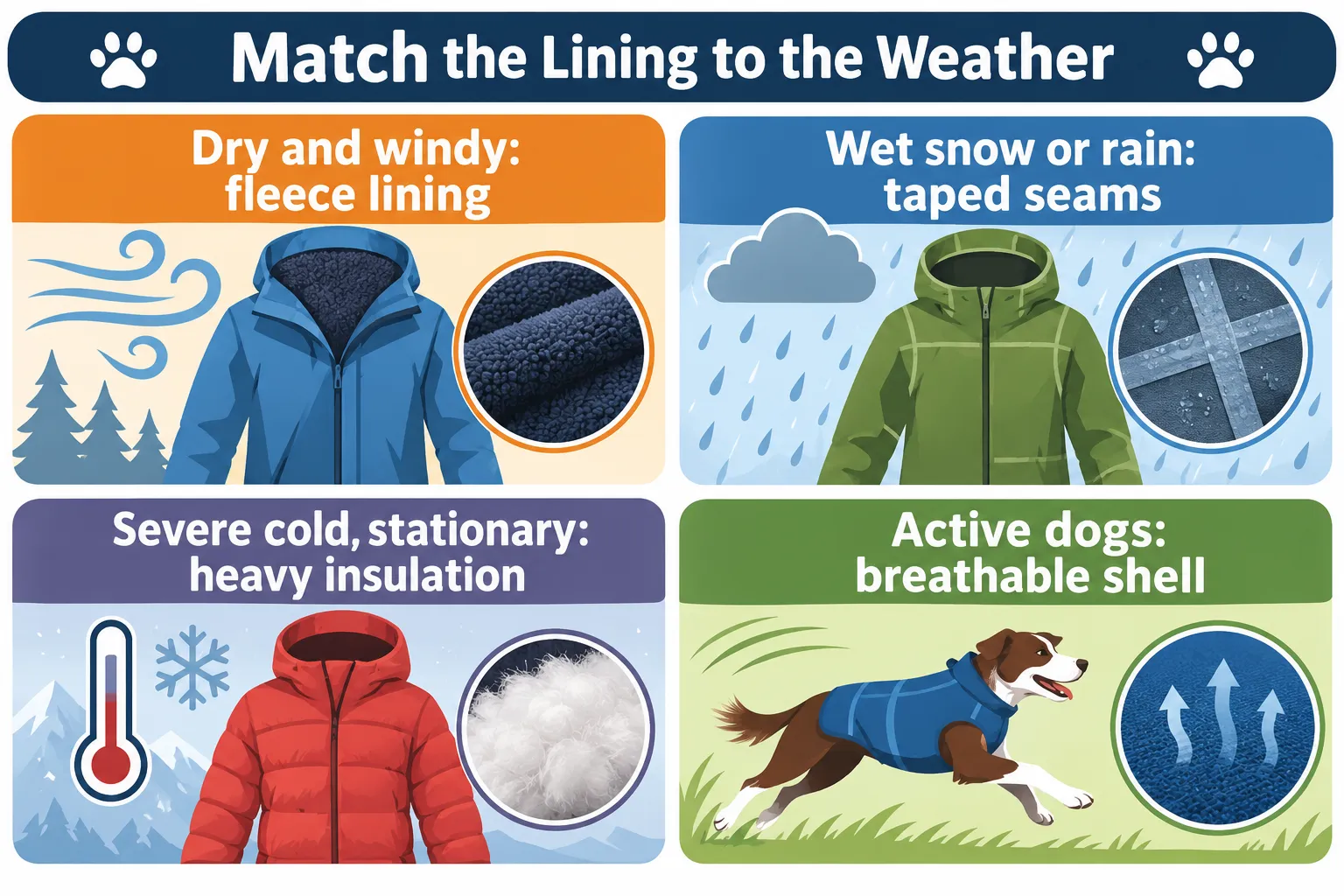
Choosing among the best dog best dog best dog winter coats starts with matching the lining to the weather, not the calendar. A fleece-lined shell handles a dry, windy 20-minute walk. A taped-seam waterproof shell handles rain, slush, and wet snow, where a soaked lining turns cold fast and stops insulating.
The decision tree is simpler than most product pages make it look:
- Dry and windy: fleece or quilted lining, water-resistant (not waterproof) shell.
- Wet snow or rain: taped seams, a water-column rating above 5,000mm, and a shell that sheds rather than absorbs.
- Severe cold, stationary time (camping, tailgating): heavier insulation like Hurtta’s Extreme Warmer III, built for temperatures down toward 20°F to minus 20°F with a high waterproof rating, according to Whole Dog Journal’s winter coat testing.
- Active dogs in variable weather: a breathable, high-mobility shell such as the Non-stop Dogwear Glacier Jacket 3.0, rated near 20,000mm waterproof with high breathability, so sweat and body heat escape instead of soaking the lining, as noted in Treeline Review’s active dog coat coverage.
Choose a thicker insulated coat if your dog stands around more than it moves. Choose a breathable shell if your dog runs, pulls, or covers real mileage, because overheating under a bulky coat during exercise is a genuine risk for active breeds.
What size dog winter coat do I need
Your dog needs the coat size that matches its chest girth measurement first, back length second, and neck circumference third. Weight-based sizing on a package is a rough starting point at best, and it fails most often on narrow-chested or long-backed breeds.

A coat that fits correctly:
- Covers roughly 70% of the body length without bunching behind the front legs
- Sits flush at the neck with two fingers of room, not gaping or choking
- Allows a full stride without the front leg openings rubbing or restricting movement
- Does not require force to get the zipper or Velcro closed
Decision rule: if your dog falls between two sizes on a chart, size up for a thick-coated or stocky breed and size down, or look for a slim-fit cut, for a narrow-chested breed like a Greyhound or Whippet.
How to measure my dog for a winter coat
Measure three numbers with a soft tape while your dog stands normally: neck circumference, chest girth at the widest point behind the front legs, and back length from the base of the neck to the base of the tail. Round up rather than down if your dog falls between sizes.
- Neck: wrap loosely where a collar sits. Two fingers should fit underneath.
- Chest girth: this is the number that actually determines fit. Measure at the widest point of the ribcage, not the narrower belly.
- Back length: stop at the base of the tail, not partway down the back. A coat that’s too short leaves the lower back exposed; one that’s too long drags in slush.
Our guide to the best harness for dachshund backs covers a similar sizing problem for long-backed dogs if your dog’s proportions don’t match a standard chart.
Dog winter coat sizing chart
Most brands publish a sizing chart that lines up chest girth ranges with letter or number sizes, but charts vary enough between brands that a “medium” from one company can fit like a “large” from another. Always measure your dog first, then cross-check against the specific brand’s chart rather than assuming sizes are universal.
A simplified version of how most charts are structured:
| Size | Chest girth (approx.) | Back length (approx.) | Typical breed examples |
|---|---|---|---|
| XS/S | 12 to 18 inches | 8 to 12 inches | Chihuahua, Yorkie |
| M | 18 to 24 inches | 12 to 16 inches | Beagle, French Bulldog |
| L | 24 to 30 inches | 16 to 20 inches | Labrador, Border Collie |
| XL | 30 to 36 inches | 20 to 24 inches | German Shepherd, Boxer |
Table caption: Use this as a general reference while shopping for the best dog winter coats, then confirm against the exact brand’s own measurement chart before ordering.
Common mistake: ordering by breed name alone. A “Beagle size” label assumes an average Beagle build, but individual dogs within a breed can differ by several inches in chest girth.
Do all dogs need winter coats or just small breeds
No. Coats make the most sense for small, senior, underweight, short-haired, or recently groomed dogs, not every dog in cold weather. Risk depends on wind chill, precipitation, duration outside, activity level, breed, size, coat type, and overall health, not a single temperature number.
PDSA and several veterinary sources name Greyhounds, Whippets, puppies, senior dogs, and dogs with health conditions as more likely to need extra warmth. A Siberian Husky with a full double coat is usually fine without one. A twelve-year-old Chihuahua standing on cold concrete is a different story.
Edge case: dogs recently shaved for surgery or grooming lose their natural insulation temporarily and may need a coat even if they normally wouldn’t. Check our beginner’s guide to dog grooming for how shaving affects a coat’s natural insulation.
Do small dogs really need winter coats
Small dogs lose heat faster than large dogs because they have a higher surface-area-to-body-mass ratio, which means a small dog standing on cold pavement cools down noticeably quicker than a large dog in the same conditions. That’s why small-breed owners shopping for the best dog winter coats often see faster payoff than owners of large, heavily coated breeds.

- Choose a coat if: your small dog is short-haired, underweight, senior, or shivers within a few minutes outside.
- Skip the coat if: your small dog has a thick double coat and tolerates cold well, though this is less common in toy breeds than in larger ones.
What’s the difference between a dog coat and a dog sweater
A coat is built for outdoor exposure with a water-resistant or waterproof outer shell. A sweater is an indoor or mild-weather layer, usually knit, with no weather protection at all. Choosing between them depends entirely on where the dog will actually be wearing it.
| Feature | Dog coat | Dog sweater |
|---|---|---|
| Outer shell | Water-resistant or waterproof | None, absorbs water |
| Best for | Walks in wind, rain, snow | Indoor chill, layering under a coat |
| Leash access | Usually built in | Rarely included |
| Insulation | Fleece, synthetic fill, or quilting | Knit fibers only |
A sweater soaked by rain gets heavier and colder, which is the opposite of what you want on a walk. If you’re layering for a very cold day, a sweater under a waterproof coat works better than either item alone.
Best dog winter coats with leash access
Leash access matters because a coat that blocks your leash or harness gets left at home. The three common designs are a plain collar slit, a dedicated harness portal with a reinforced opening, and a two-way zipper that opens from either end, according to product breakdowns from Chewy’s winter coat roundup.
- Kuoser Waterproof Dog Coat, Warm Reversible Dog Jacket with Leash Hole (check price on Amazon) is built with a leash hole cut into the back panel, a simple fix for owners who clip a leash directly to a collar rather than a harness.
- Hurtta Expedition Parka II has a harness opening on sizes 28 to 80 and a leash loop on the smaller 23 to 25 sizes, which matters if your dog is on the small end of the chart and still wears a harness. The coat is listed from roughly $125, climbing to about $190 for larger sizes and colors, as checked November 5 to 6, 2026.
- Spark Paws Dog Winter Coat Jacket (check price on Amazon) is worth checking in person against your dog’s harness, since fit around a chest strap varies by brand.
Common mistake: buying a coat with a harness portal and then discovering the portal sits an inch off from where your actual harness strap crosses the dog’s back. Test the full setup, leash clipped, indoors before the first real walk.
For owners juggling two dogs and two leashes at once, a tangle-resistant setup matters as much as the coat itself. See our breakdown of the double dog leash no tangle options if that’s a regular walk problem.
Best dog winter coats for wet weather
The best waterproof best dog winter coats combine taped seams with a water-column rating well above 5,000mm, since untaped seams let water seep through even on a technically “waterproof” fabric. This rating tells you how much water pressure the fabric can resist before it leaks.
- Hurtta’s Expedition Parka II carries a 10,000mm rating, per Wirecutter’s dog coat testing.
- The Non-stop Dogwear Glacier Jacket 3.0 goes further at roughly 20,000mm, paired with high breathability so the dog doesn’t end up damp from sweat instead of rain.
- Hurtta’s Extreme Warmer III pairs heavy insulation with a waterproof rating above 10,000mm for dogs that stand still outdoors in severe cold.
Choose waterproof if: your routine includes wet grass, slush, or regular rain. Choose fleece-lined instead if: your winters are cold but mostly dry, and the coat’s main job is cutting wind rather than shedding water.
Best dog winter coats by brand
Among the brands most frequently tested for the best dog winter coats, Hurtta, Non-stop Dogwear, and Kuoser each serve a different budget and use case, based on reviews from Rebarkable and PawBench.
- Hurtta focuses on technical outdoor performance, taped seams, and harness compatibility, priced in the $100 to $200 range.
- Non-stop Dogwear leans toward high breathability and mobility for working or active dogs, also in a premium price bracket.
- Kuoser sits in the budget to mid-range tier, with reversible designs and leash holes built in at a lower price point.
- Chewy’s own private-label and marketplace options vary widely in quality, so check the specific water-column rating and lining material rather than trusting the category label alone.
Decision rule: choose Hurtta or Non-stop Dogwear if you walk daily in real rain or genuine cold and want a multi-season investment. Choose Kuoser or a similar budget brand if you want a reliable backup coat or your climate is mild.
How much should I spend on a dog winter coat
Budget $20 to $40 for a basic water-resistant coat suited to mild, mostly dry climates, and $100 to $200 for a technical waterproof shell with taped seams and a rated breathability figure. The price difference reflects the materials, not just the brand name.
- Under $40: water-resistant (not waterproof) shell, basic fleece lining, Velcro closures, fine for short walks in light precipitation.
- $40 to $100: improved waterproofing, reinforced leash openings, better closures, suited to regular winter walking.
- $100 to $200: taped seams, rated water-column figures above 10,000mm, breathable technical fabric, built for daily use in real winter conditions.
Quick example: a $25 coat and a $150 coat can look nearly identical in photos, but the cheaper one usually lacks taped seams, which means water gets in at the stitch lines even if the main fabric panel sheds rain.
How do I know if my dog is cold enough for a coat
Watch for shivering, lifting paws off cold ground, reluctance to walk, tucking the tail, or wanting to turn back early. Any of these signs during a normal winter walk suggests the dog needs a coat, a shorter walk, or both.
- Shivering within the first five minutes outside
- Repeatedly lifting one or more paws off snow or cold pavement
- Slowing down, stopping, or trying to head home earlier than usual
- Seeking out sunny patches or your legs for warmth during the walk
Edge case: dogs with thick double coats rarely show these signs even in genuinely cold weather, which is part of why breed and coat type matter more than the thermometer reading alone.
Can dogs overheat in winter coats
Yes. A coat that’s too heavy for the activity level, left on too long indoors, or worn during a fast-paced run can cause overheating even in cold outdoor temperatures. This risk is highest with thick insulated coats on active or high-energy dogs.
Signs of overheating under a coat:
- Excessive panting that doesn’t slow down after a rest
- Damp or matted fur underneath the coat after removal
- A dog that tries to pull the coat off or lies down mid-walk
Decision rule: choose a lightweight, breathable shell for active dogs and remove any coat promptly once you’re back indoors or once the dog stops moving for an extended period.
Best dog winter coats for sensitive skin
Dogs with sensitive skin do best in coats with a soft fleece or cotton-blend lining, flat seams, and no rough synthetic fill touching bare skin. Velcro closures placed away from the belly and inner legs also reduce irritation.

- Look for a lining labeled soft-brushed fleece rather than a scratchy quilted synthetic.
- Avoid coats with exposed seam edges across the chest or belly, where skin contact is constant.
- Check for a liner that can be removed and washed separately, since buildup of salt, dirt, and moisture against sensitive skin causes more irritation than the fabric itself.
Common mistake: choosing a coat based on outer shell toughness alone and ignoring what touches the dog’s skin directly underneath. The outer shell protects against weather; the lining is what actually touches sensitive skin all walk long.
Best dog winter coats for active dogs
Active dogs need a breathable, high-mobility shell over a bulky insulated one, because heavy insulation combined with real exercise raises overheating risk. Treeline Review named the Non-stop Dogwear Glacier Jacket 3.0 its 2026 Best Overall pick, citing warmth, weather resistance, range of motion, and fit for active winter use.
Specs worth knowing: the Glacier Jacket 3.0 is rated near 20,000mm waterproof with roughly 20,000 g/m²/24-hour breathability, a combination that lets body heat and sweat escape during exercise instead of trapping moisture against the skin. For dogs that pull hard or run off-leash in open areas, a secure fit around the shoulders matters as much as the fabric rating, since a loose coat shifts and restricts the front legs mid-stride.
Choose this category if: your dog hikes, runs, or does real daily mileage in cold weather. Skip it if: your dog’s main winter activity is a short bathroom walk, where a basic fleece-lined coat does the job for less money.
Best budget friendly dog winter coats
A budget coat can work fine for mild, mostly dry climates, but it typically trades away taped seams and a rated water-column for a lower price. The Kuoser Waterproof Dog Coat, Warm Reversible Dog Jacket with Leash Hole (check current price) sits in this category: reversible, a leash hole already cut in, priced well under technical shells from Hurtta or Non-stop Dogwear.
New low-cost listings in this space change often. A similar reversible waterproof-style Kuoser coat became newly available on Amazon in October 2026, per The Pet Times’ 2026 coat roundup, a reminder to check current specifications and reviews before buying, since marketplace listings get revised without notice.
Decision rule: choose a budget coat if your walks are short, your climate is mild, and you want a backup or trial coat before committing to a technical shell among the best dog winter coats on the market. Choose the technical shell if you’re walking daily in real rain or genuine cold.
My dog won’t wear a winter coat what do I do
Most dogs that fight a coat are reacting to the process, not the garment itself. A cold, unfamiliar fabric pulled quickly over the head or legs feels like a mild ambush, even if the coat itself fits fine.
Fixes that actually work:
- Let the dog sniff the coat first, treat nearby, no pressure.
- Drape it loosely for a few seconds, treat, remove it. Repeat over several short sessions.
- Fasten one closure at a time instead of all at once.
- Walk immediately after putting it on, so the coat gets associated with something the dog already wants.
If a dog goes stiff, freezes, or won’t move at all with the coat on, that’s a fit or texture problem, not stubbornness. Check the chest clearance first. For general training reinforcement, our guide to essential commands every puppy should learn covers the same reward-based approach used for coat training.
Are winter coats too tight on my dog
A coat is too tight if you can’t fit two flat fingers under the chest strap, if the fabric bunches behind the front legs, or if your dog’s gait changes when walking in it. Watch for rubbing after a 10-minute test walk indoors.
Signs of a coat that’s too tight:
- Red or flattened fur lines after removal
- A dog that sits down and refuses to walk
- Visible pulling or stretching across the shoulders when the leash is clipped
Signs of a coat that’s too loose:
- Sliding sideways or rotating around the body
- Gaping at the chest that lets wind or rain in anyway
- A leash portal that no longer lines up with the harness clip
Quick example: a coat rated for a 20 to 25 pound dog by weight alone can still gape at the chest on a narrow-chested breed of that same weight. Chest girth, not body weight, is the number that predicts fit.
Common mistakes when buying dog winter coats
The most common mistake is sizing by weight or breed name instead of chest girth, which leads to returns and refused coats. A close second is ignoring leash or harness compatibility until after the coat already arrives.
- Sizing by weight alone instead of measuring chest girth directly.
- Buying a coat with no harness portal for a dog that only ever wears a harness.
- Choosing fleece lining for a dog that walks through wet snow or slush regularly.
- Leaving a coat on indoors for hours, which can trap heat and moisture against the skin.
- Assuming all brands use the same size chart, when a “medium” varies significantly between companies.
Dog winter coat alternatives for dogs that hate wearing them
If a dog consistently refuses any coat despite gradual introduction, shorter outdoor exposure time and a dry-off routine at the door can substitute for some of a coat’s job, though this doesn’t replace actual insulation for cold-sensitive dogs.
Alternatives worth trying:
- A snug, lightweight vest instead of a full-sleeve coat (less fabric, less resistance)
- A fleece-lined harness cover for dogs that tolerate a harness but not a coat
- Shortened, more frequent walks during the coldest part of the day instead of one long walk
This article covers shopping for the best dog winter coats specifically. For guidance on cold tolerance thresholds, walk length limits, and when to head home early, that’s a related topic worth checking separately before deciding a coat is optional for your dog.
FAQ
What size dog winter coat do I need? Measure chest girth, back length, and neck circumference, then match those numbers to the brand’s specific size chart rather than relying on breed name or weight alone.
How do I measure my dog for a winter coat? Use a soft tape to measure neck circumference, chest girth at the widest ribcage point, and back length from the base of the neck to the base of the tail, with the dog standing normally.
What are the best waterproof best dog winter coats? Coats with taped seams and a water-column rating above 10,000mm, such as Hurtta’s Expedition Parka II or the Non-stop Dogwear Glacier Jacket 3.0, handle rain and wet snow reliably.
How much should I spend on a dog winter coat? Budget coats run $20 to $40 and suit mild, dry climates. Technical waterproof shells with taped seams run $100 to $200 and suit daily winter walking in real cold or rain.
Do small dogs really need best dog winter coats? Many small dogs benefit from a coat because they lose body heat faster than larger dogs, especially if they’re short-haired, senior, or underweight.
Is a dog coat or sweater better for winter? A coat is better outdoors because it has a water-resistant or waterproof shell. A sweater works only as an indoor layer or as added warmth under a waterproof coat.
My dog won’t wear a winter coat, what do I do? Introduce it gradually with treats, fasten one closure at a time, and walk immediately after putting it on so the dog associates the coat with something rewarding.
Can dogs overheat in winter coats? Yes, especially active dogs in heavy insulated coats. Watch for excessive panting, damp fur underneath, or a dog trying to remove the coat, and take it off promptly once indoors.