
Quick Answer
Five infections account for most canine cases in the United States: Lyme disease, anaplasmosis, ehrlichiosis, Rocky Mountain spotted fever, and babesiosis. The early signs of tick borne diseases in dogs overlap heavily, which is the frustrating part: fever, low energy, appetite loss, and lameness that moves from one leg to another. Many infected dogs never look sick at all, so a dog can carry antibodies without needing treatment. If your dog had a tick and then develops a fever, limping, or sudden fatigue within the next few weeks, call your vet and mention the tick.
Key Takeaways: Tick Borne Diseases in Dogs
- Five infections dominate the picture: Lyme disease, anaplasmosis, ehrlichiosis, Rocky Mountain spotted fever, and babesiosis. Each has a different tick, a different geography, and a different blood picture.
- Shifting lameness is the signature early Lyme sign. Dogs do not get the bull’s-eye rash people get.
- Timing varies enormously. Anaplasmosis signs often appear within one to two weeks; Lyme signs are commonly reported two to five months after infection, according to the American Kennel Club’s guidance on Lyme disease in dogs.
- A positive antibody test is not a diagnosis. A 2026 veterinary screening algorithm recommends adding clinical assessment, a complete blood count, and a blood-film review before reaching for antibiotics.
- Doxycycline is the standard drug for Lyme, anaplasmosis, ehrlichiosis, and Rocky Mountain spotted fever. Babesiosis is a protozoan infection and needs different medication.
- Most dogs recover well with early treatment, though “cured” is a word vets use carefully, especially with ehrlichiosis and babesiosis.
- Prevention beats treatment, and the current trend is year-round, not seasonal.
- Your dog cannot give you Lyme disease directly, but it can carry an unattached tick into your house.
What are the 5 main tick borne diseases in dogs?
The five most common tick borne diseases in dogs in the United States are Lyme disease (Borrelia burgdorferi), anaplasmosis (Anaplasma phagocytophilum or A. platys), ehrlichiosis (Ehrlichia canis and related species), Rocky Mountain spotted fever (Rickettsia rickettsii), and babesiosis (Babesia species). Each is carried by a specific tick, and your dog’s risk depends mostly on which ticks live where you walk.
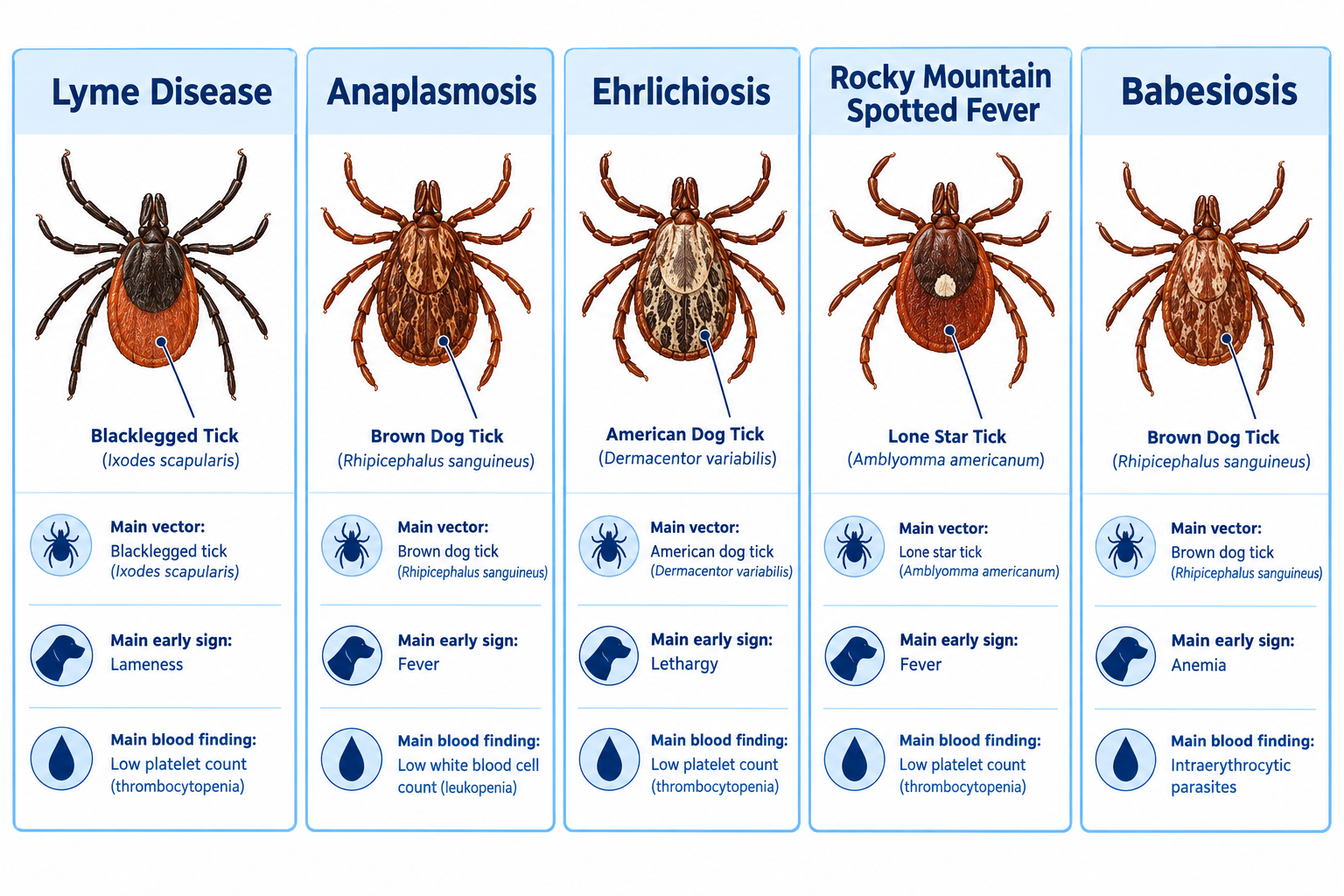
Lyme disease
Carried by blacklegged ticks, Lyme is the one most owners have heard of and the one most likely to hide. The Merck Veterinary Manual reports that many infected dogs never become visibly ill. When they do, the pattern is intermittent lameness that shifts between legs, fever, swollen lymph nodes, and painful joints. The serious complication is kidney involvement, which is why vets check urine protein in antibody-positive dogs.
The Companion Animal Parasite Council’s 2026 parasite forecast flags growing Lyme risk in eastern Ohio, Kentucky, Tennessee, Virginia, and North Carolina, with increases reported across parts of Indiana, Illinois, Michigan, and West Virginia. CAPC forecasts predict expected positivity among dogs tested in veterinary clinics, not infection rates across the whole dog population. That distinction matters when you read a map.
Anaplasmosis
Same tick, different organism, very similar misery. Cornell’s Riney Canine Health Center lists fever, lethargy, appetite loss, joint pain, lameness, and dehydration as the usual findings, with vomiting, diarrhea, respiratory signs, or neurologic changes in some dogs. VCA’s overview of anaplasmosis in dogs notes the same cluster. Blood work often shows moderately low platelets, which is a useful clue.
Ehrlichiosis
Ehrlichiosis comes mainly from the brown dog tick, a species that happily lives indoors, and from the lone star tick in the southeast. Acute illness brings fever, weight loss, low energy, and bleeding tendencies such as nosebleeds or pinpoint bruising. Dogs that are not treated can slide into a chronic phase with bone marrow suppression, and that version is much harder to treat. A veterinary overview of Lyme, anaplasmosis and ehrlichiosis in dogs describes the acute phase beginning roughly one to three weeks after the bite.
Rocky Mountain spotted fever
The fast one. Spread by American dog ticks, Rocky Mountain wood ticks, and brown dog ticks, this rickettsial infection damages blood vessels. The CDC describes signs in dogs appearing within days to about two weeks of a bite: sudden fever, swelling of the face or limbs, bruising, joint pain, and lethargy. Severe cases can be fatal, so it is treated as an emergency rather than a wait-and-see.
Babesiosis
Babesia are protozoan parasites that destroy red blood cells, producing pale gums, weakness, dark urine, and sometimes jaundice. Greyhounds and American Pit Bull Terriers show up more often in reports of specific Babesia species, partly because of transmission routes beyond ticks. Doxycycline does not fix it. Treatment uses antiprotozoal drugs, and some dogs remain carriers after recovery.
| Disease | Main tick | Higher-risk US regions | Typical early signs | Usual test | First-line treatment |
|---|---|---|---|---|---|
| Lyme disease | Blacklegged tick | Northeast, upper Midwest, Pacific coast, now expanding into Appalachia and the eastern Midwest | Shifting lameness, fever, swollen joints and lymph nodes | Antibody screen plus quantitative antibody test and urine protein | Doxycycline, with kidney monitoring |
| Anaplasmosis | Blacklegged tick; brown dog tick | Overlaps Lyme territory closely | Fever, lethargy, joint pain, low platelets | Antibody screen, CBC, blood film, PCR if acute | Doxycycline, at least two weeks |
| Ehrlichiosis | Brown dog tick; lone star tick | Southeast, south-central, southwest | Fever, bruising or nosebleeds, weight loss, eye inflammation | Antibody screen, CBC, PCR | Doxycycline, longer course if chronic |
| Rocky Mountain spotted fever | American dog tick, Rocky Mountain wood tick | Southeast, central and western states | Sudden high fever, facial or limb swelling, bruising | Paired antibody titers, PCR | Doxycycline started immediately |
| Babesiosis | Brown dog tick and other ixodid ticks | Southern states, plus kennel and fighting-dog histories | Pale gums, weakness, dark urine, jaundice | Blood smear, PCR, antibody testing | Antiprotozoal drugs, not doxycycline alone |
Which tick borne diseases are most dangerous for dogs?
Rocky Mountain spotted fever and babesiosis tend to cause the most abrupt, life-threatening illness, because one attacks blood vessels and the other destroys red blood cells. Chronic ehrlichiosis is dangerous in a slower way, suppressing the bone marrow until the dog cannot replace its own blood cells. Lyme disease is rarely sudden, though protein-losing kidney disease is its worst outcome and is difficult to reverse.
What is the difference between Lyme disease and ehrlichiosis in dogs?
Lyme disease is a bacterial spirochete infection from blacklegged ticks that mainly produces joint and kidney problems, often months after the bite. Ehrlichiosis is a rickettsial infection from brown dog and lone star ticks that targets white blood cells and platelets, producing fever, bruising, and bleeding within weeks. Lyme shows up in the legs. Ehrlichia shows up in the blood count.
How is anaplasmosis different from babesiosis in dogs?
Anaplasmosis is a bacterial infection of white blood cells that usually responds to doxycycline, often with visible improvement in a day or two. Babesiosis is a protozoan infection of red blood cells that causes anemia, needs antiprotozoal drugs, and can leave a dog as a long-term carrier. Both can lower platelet counts, so blood work alone will not separate them. The blood smear and PCR do.
How do I know if my dog has a tick borne disease?
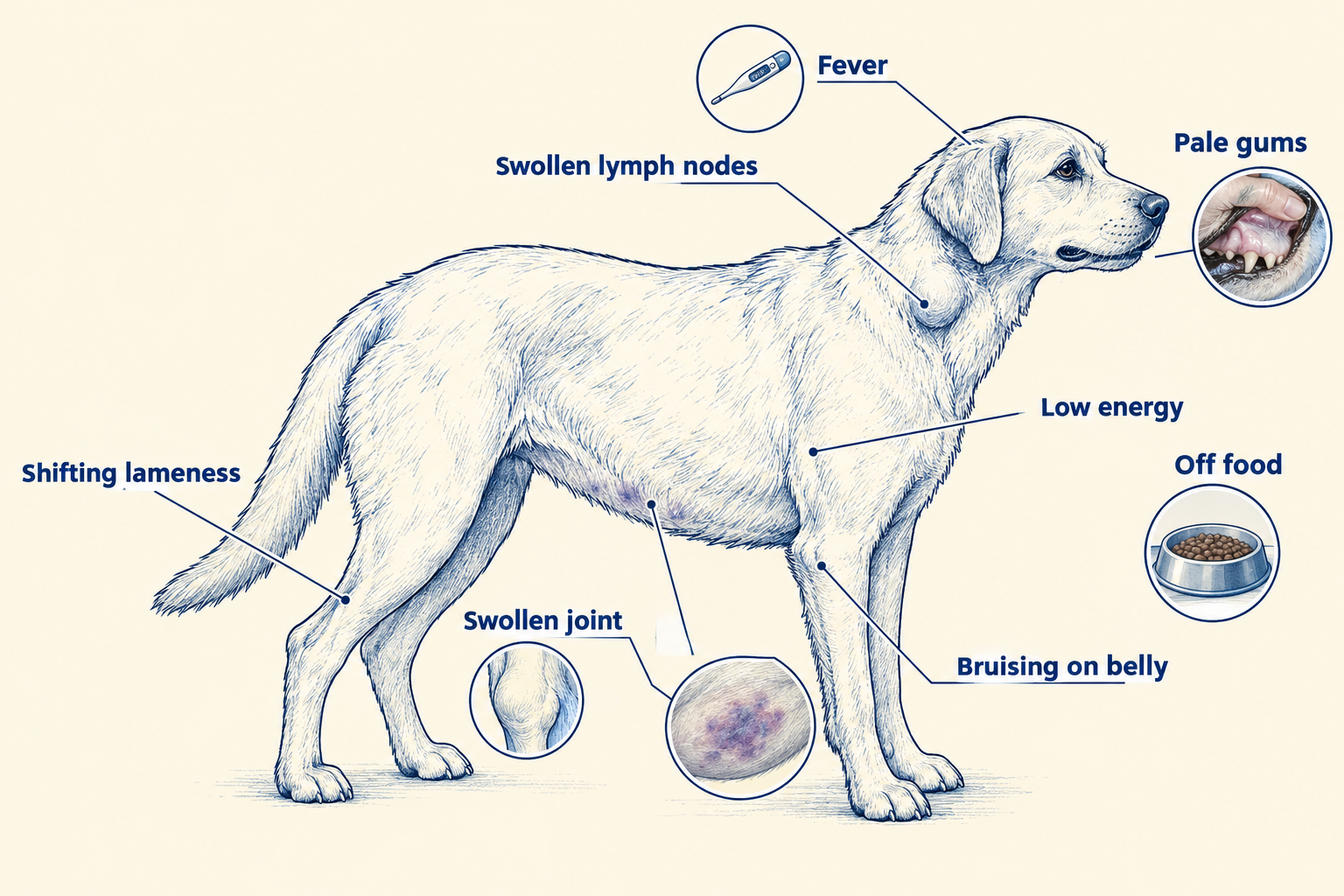
You often cannot tell by looking, which is the honest answer. The early signs are nonspecific: fever, low energy, reluctance to jump or climb stairs, appetite loss, and lameness that appears in one leg and then another a few days later. A dog with a known tick exposure plus any of those signs needs an exam, not a wait-and-see week.
Signs worth a same-week vet call:
- Shifting or intermittent lameness with no injury to explain it
- Fever, often noticed as warm ears, shivering, or unwillingness to move
- Sudden flatness. Dogs sleep a lot normally, and research on canine sleep patterns shows a wide normal range, so the signal is a change from your dog’s own baseline
- Swollen lymph nodes under the jaw or behind the knees
- Pinpoint bruising, nosebleeds, or pale gums
- Dark or cola-colored urine, which points at red cell destruction
Appetite loss during illness and recovery is common, and owners often ask what to add to the bowl. Keep it simple while a dog is on medication, and ask your vet before changing food. If you want background reading for later, our guide to what to add to kibble and what to skip covers the general evidence limits.
A dog who is sore in a different leg this week than last week is describing something specific. Write down which leg and which day. Your vet will use it.
How soon after a tick bite do symptoms show?
It depends entirely on the organism. Anaplasmosis signs typically appear about one to two weeks after the bite. Ehrlichiosis acute illness commonly starts around one to three weeks. Rocky Mountain spotted fever moves fastest, within days to roughly two weeks. Lyme disease is the outlier: the AKC notes that signs may not appear until two to five months after infection.
So a normal dog two weeks after a tick bite is reassuring for some diseases and meaningless for Lyme. That is why vets usually recommend a tick-borne screening panel at the next annual visit rather than a rushed test three days after a bite. Antibodies take weeks to become detectable.
One edge case worth knowing: a dog can be bitten many times in a season without you ever seeing a tick. Fine-coated dogs are easier to check than a double-coated Newfoundland. The absence of a found tick is not the absence of exposure.
How do vets test for tick borne diseases in dogs?
Most clinics start with an in-house antibody screen, commonly the IDEXX SNAP 4Dx Plus test, which checks for heartworm antigen plus antibodies to Borrelia burgdorferi, Anaplasma, and Ehrlichia species from a few drops of blood. A positive result means exposure, not automatic illness. From there, vets add a complete blood count, a blood-film review, chemistry, urinalysis, and sometimes PCR.
The 2026 tick screening algorithm published in Today’s Veterinary Practice recommends exactly this layered approach instead of treating every antibody-positive dog. Clinically normal seropositive dogs generally do not need antimicrobials. Cornell makes the same point for anaplasmosis: a positive antibody test with no clinical signs and normal blood work usually does not call for antibiotics.
When to use which test:
- Antibody screening is best for exposure surveillance, annual wellness panels, and dogs in CAPC-flagged areas
- PCR is more useful when a dog is acutely ill, because antibodies may not have developed yet
- Blood smear is how Babesia is often spotted inside red blood cells
- Paired titers weeks apart help confirm Rocky Mountain spotted fever
Can tick borne diseases in dogs be cured, and what does treatment cost?
Most dogs treated early for Lyme disease, anaplasmosis, ehrlichiosis, or Rocky Mountain spotted fever improve quickly and go on to live normal lives. Doxycycline is the standard antibiotic for all four, and CAPC lists a commonly used regimen of 10 mg/kg for 28 days for Ehrlichia and Anaplasma infections. Dosing comes from your vet, not from a web page.
Where the facts end: “cure” is not guaranteed in every case. Antibodies can stay positive for months or years after successful treatment, so a repeat positive test does not mean failure. Chronic ehrlichiosis may not clear. Babesia can persist after clinical recovery. Lyme-related kidney damage is managed rather than reversed.
On cost, there is no credible national average figure worth quoting here, and inventing one would not help you. What you can do is ask for an itemized estimate covering:
- Exam fee for a sick visit
- In-clinic tick-borne screening panel
- Complete blood count, chemistry, and urinalysis
- PCR or a send-out quantitative antibody test, if indicated
- The doxycycline course, priced by your dog’s weight
- Recheck visit and follow-up blood or urine work
- Hospitalization, fluids, or transfusion for severe cases
Weight drives drug cost more than anything, so a Chihuahua and a Great Dane are not in the same financial conversation. Our breakdown of small, medium, large and giant dog size categories is a useful reference for why weight-banded products and prescriptions differ so much.
How do you remove a tick from a dog safely?
Grip the tick as close to the skin as possible with fine-point tweezers or a purpose-made hook such as a Tick Key or TickEase remover, then pull straight out with steady, even pressure. Do not twist, do not apply heat, do not smother it in oil or petroleum jelly. Irritating a tick can increase what it puts back into the bite.
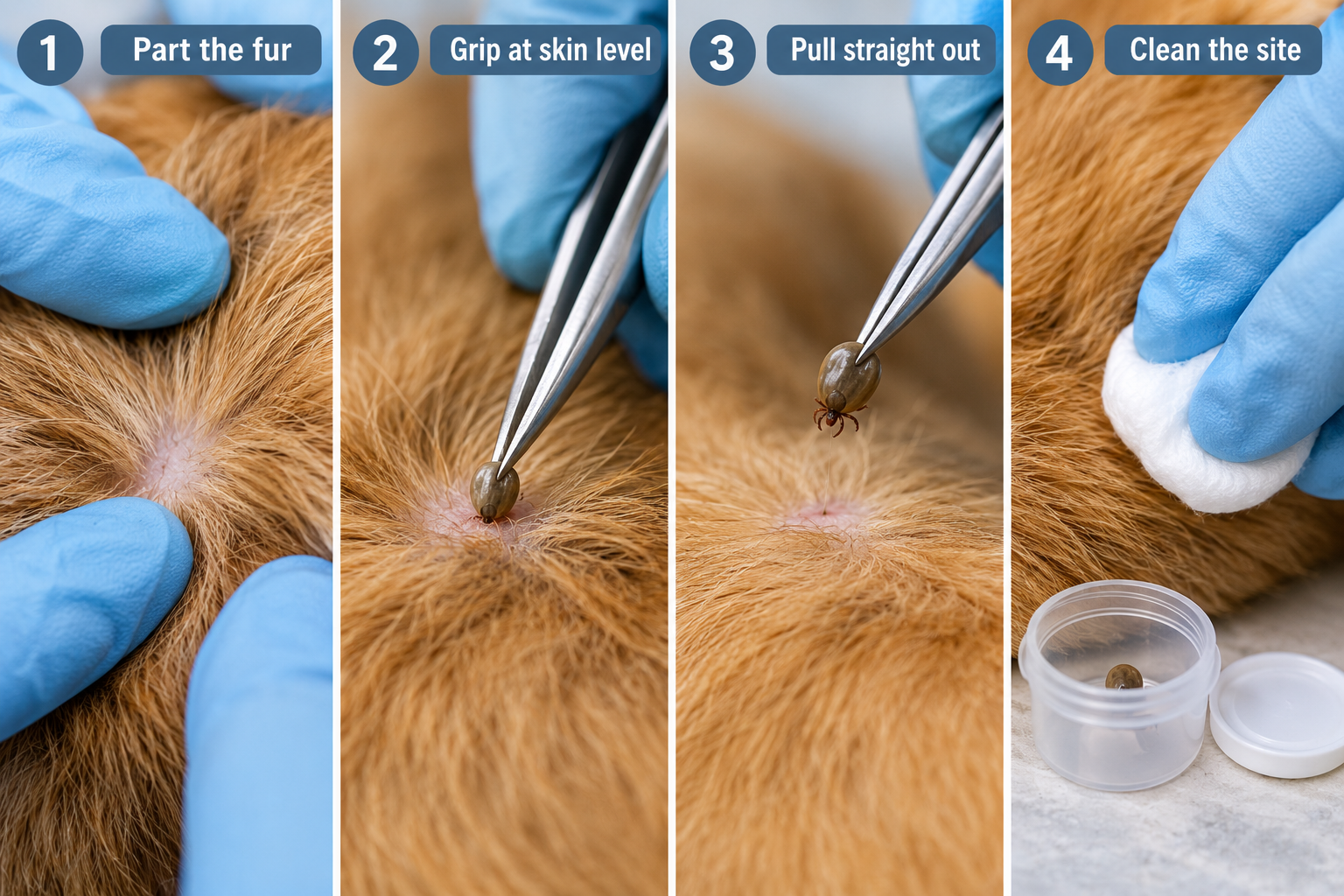
After removal:
- Clean the bite site and the tool, then wash your hands
- Log it. Date, body location, and if you can tell, tick type. A photo on your phone takes three seconds
- Watch for the next several weeks for fever, limping, flatness, or appetite change
- Expect a small bump. A firm red lump at the bite site for a few days is a common local reaction
If mouthparts stay behind, leave them. Digging at the skin causes more inflammation than the fragment does. Call your vet if the site becomes hot, swollen, oozing, or painful, or if your dog is a puppy, immune-suppressed, or recovering from illness.
Tick bite on a dog: when to worry. Worry when the dog changes, not when the tick is alarming. A fever, a limp that moves, pale gums, dark urine, bruising, or a dog who will not get up all deserve a call. Those are the signs worth interrupting your day for.
What prevents tick borne diseases in dogs?
Year-round tick prevention, daily tick checks after walks in grass or woods, prompt removal, and the Lyme vaccine where risk justifies it. CAPC’s Lyme disease guidelines recommend continuous use of a product active against Ixodes ticks, daily checks, and vaccination for appropriate dogs. The seasonal approach is being retired because tick activity and geographic risk no longer line up with a tidy spring-to-fall window.
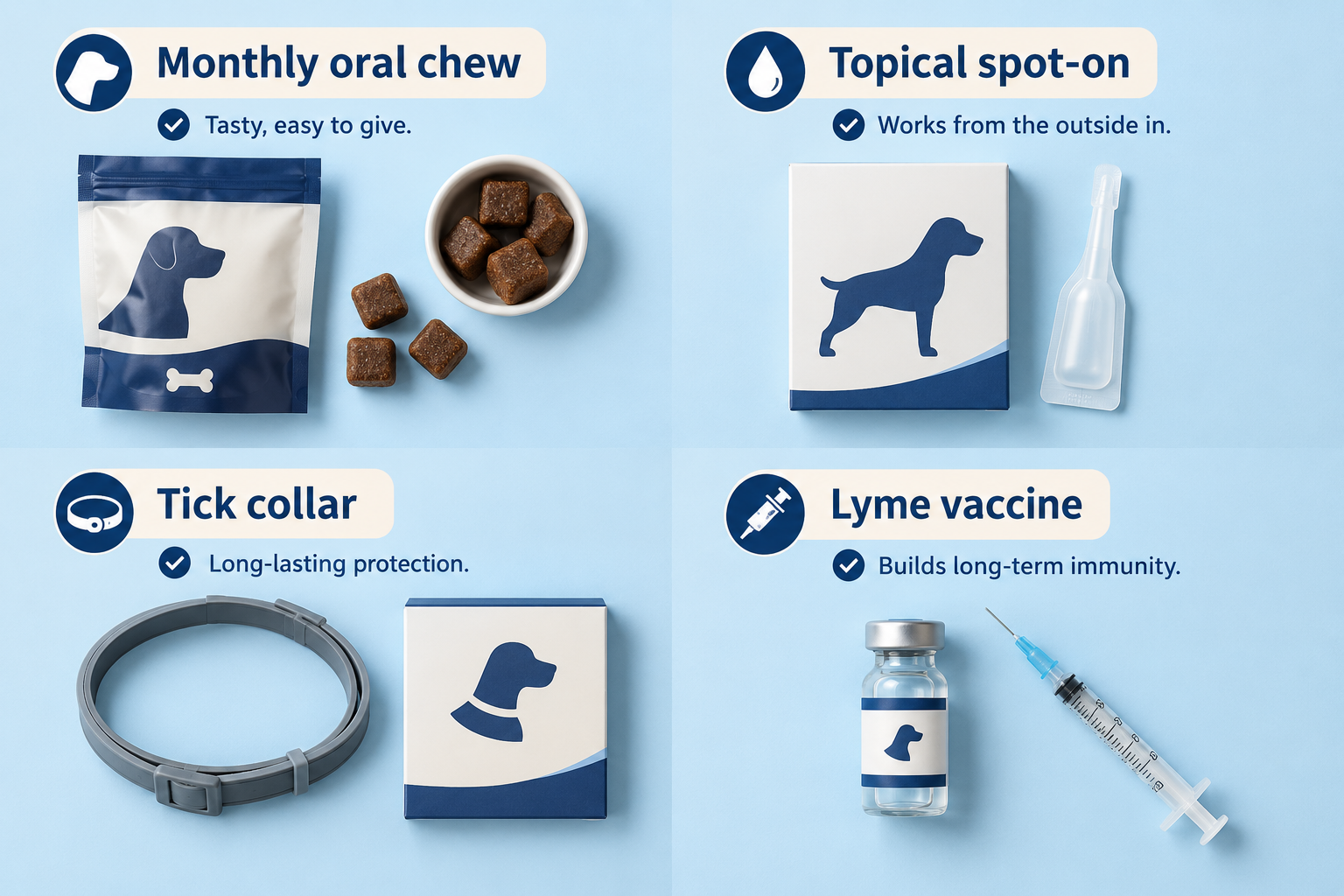
Compare the options
- Monthly oral chews: NexGard PLUS, Simparica Trio, and Credelio sit in this group. Convenient, weight-banded, and not affected by swimming or bathing. They kill ticks after attachment rather than repelling them.
- Extended-duration injectables: Bravecto’s product family includes a veterinarian-administered extended-release fluralaner injection. An FDA supplement dated March 16, 2026 added treatment and control of Asian longhorned ticks and Gulf Coast ticks for 12 months in dogs at least six months old. Useful for owners who forget monthly doses, and it is a vet-clinic product by design.
- Topical spot-ons: Applied along the back, with activity varying by product. Needs drying time and care around small children and cats.
- Collars: The Seresto collar releases active ingredients over an extended period. It suits dogs who refuse oral medication, and it needs correct fit and supervision for dogs who chew gear.
- Lyme vaccines: Nobivac Lyme and Vanguard crLyme are the commonly used canine options. They address Lyme only, not anaplasmosis, ehrlichiosis, Rocky Mountain spotted fever, or babesiosis, and they do not replace a tick product.
- Yard care: Keep grass short, clear leaf litter, and create a mulch or gravel border between lawn and woodland edge. Ticks prefer humidity and shade.
The AKC’s roundup of flea and tick prevention options for dogs is a reasonable starting point for comparing formats, and your vet knows which ticks are active locally. Individual variation matters here: some dogs react to a topical, some refuse a chew, some lose collars in the first week.
What is the best tick prevention for a dog with a history of tick borne disease?
For a previously infected dog, most vets move to year-round, non-negotiable coverage plus annual screening, and add the Lyme vaccine if the dog lives in an Ixodes area and has no contraindication. There is no anaplasmosis vaccine, so product compliance does the work. Set a phone reminder on the same date each month, and keep a written record of doses given.
New owners building a care routine from scratch often underestimate this one. If you are still at the research stage, our guide to choosing a breed as a first-time owner includes the kind of ongoing health admin worth budgeting for, and prevention is high on that list.
Can humans get tick borne diseases from dogs, and are some breeds more susceptible?
Your dog cannot transmit Lyme disease, anaplasmosis, or ehrlichiosis to you directly. The shared risk is the tick itself: a dog can carry an unattached or partially fed tick indoors, where it can find a person. A dog testing positive is also a signal that infected ticks are active where your family walks.
The CDC treats positive dogs as a useful indicator of local human risk for exactly that reason. Check yourself and your kids after the same walks you check the dog after.
On breeds, no dog breed is immune, and susceptibility claims deserve care. Labrador Retrievers and Golden Retrievers show a documented predisposition to Lyme-associated protein-losing kidney disease, which is about disease outcome rather than infection risk. Greyhounds and American Pit Bull Terriers appear more often in Babesia reports, partly for transmission reasons unrelated to genetics. Coat type affects detection, not vulnerability: thick double coats hide ticks, so owners simply find fewer of them.
FAQ
How long must a tick be attached to transmit disease?
Risk rises the longer a tick stays attached, which is why Cornell lists daily checks and prompt removal among the main preventive measures. Removing a tick the same day is better than removing it tomorrow, so check your dog after every walk through grass or woods.
Does a positive test mean my dog needs antibiotics?
Not by itself. The 2026 veterinary screening algorithm and Cornell both advise that a clinically normal dog with a positive antibody test and normal blood work generally does not need antimicrobial treatment. Your vet will add a blood count, a blood-film review, and a urine protein check before deciding.
Can a dog get a tick borne disease twice?
Yes. Previous infection does not give reliable protection, and reinfection is possible in the same season. Lyme antibodies can also stay positive long after treatment, so a second positive result needs clinical context, not automatic retreatment.
Is the Lyme vaccine enough on its own?
No. The Lyme vaccine covers one organism and leaves anaplasmosis, ehrlichiosis, Rocky Mountain spotted fever, and babesiosis untouched. CAPC recommends vaccination where appropriate alongside year-round tick products and daily checks, not instead of them.
Do tick preventives stop ticks from biting?
Most oral products kill ticks after they attach rather than repelling them, so finding a dead or dying tick on a treated dog is expected rather than a product failure. Some topicals and collars have repellent activity. Ask your vet which local tick species the product covers.
What should I do if I find a tick on my dog but my dog seems fine?
Remove it promptly, clean the site, note the date and location, and carry on with normal life. Watch for fever, shifting lameness, low energy, or appetite loss over the following weeks, and remember that Lyme signs can appear two to five months later. Mention the bite at your dog’s next appointment.
Can tick borne diseases in dogs be prevented with yard treatment alone?
No. Yard management lowers tick numbers near the house, and it does nothing about the trail, the park, or your neighbor’s hedge. Treat the yard as a supporting measure behind year-round preventives and daily checks.
Is seasonal prevention still acceptable?
Current guidance from CAPC and veterinary clinical sources points to year-round use, because tick activity and risk geography are shifting and no longer match a short season. If you stop in November, ask your vet specifically about local winter Ixodes activity before you do.
Conclusion
Here is the one next step: book a tick-borne screening panel at your dog’s next wellness visit, and ask the vet which tick species are active in your county and which prevention format fits your dog’s size, temperament, and your own memory for monthly doses. Bring your tick log if you have one. Two dates and a body location beat a vague “sometime in spring.”
Tick borne diseases in dogs are mostly treatable when caught early and mostly preventable with consistent products and daily checks. What the evidence supports is unglamorous: the same routine, every month, all year, plus a hand run over your dog’s ears, neck, armpits, and groin after walks. That is the part that actually changes outcomes, and it takes about ninety seconds.
Guidance in this article was checked in October 2026. Dosing, vaccination decisions, and test interpretation belong to your veterinarian, who knows your dog and your county.