

Quick Answer
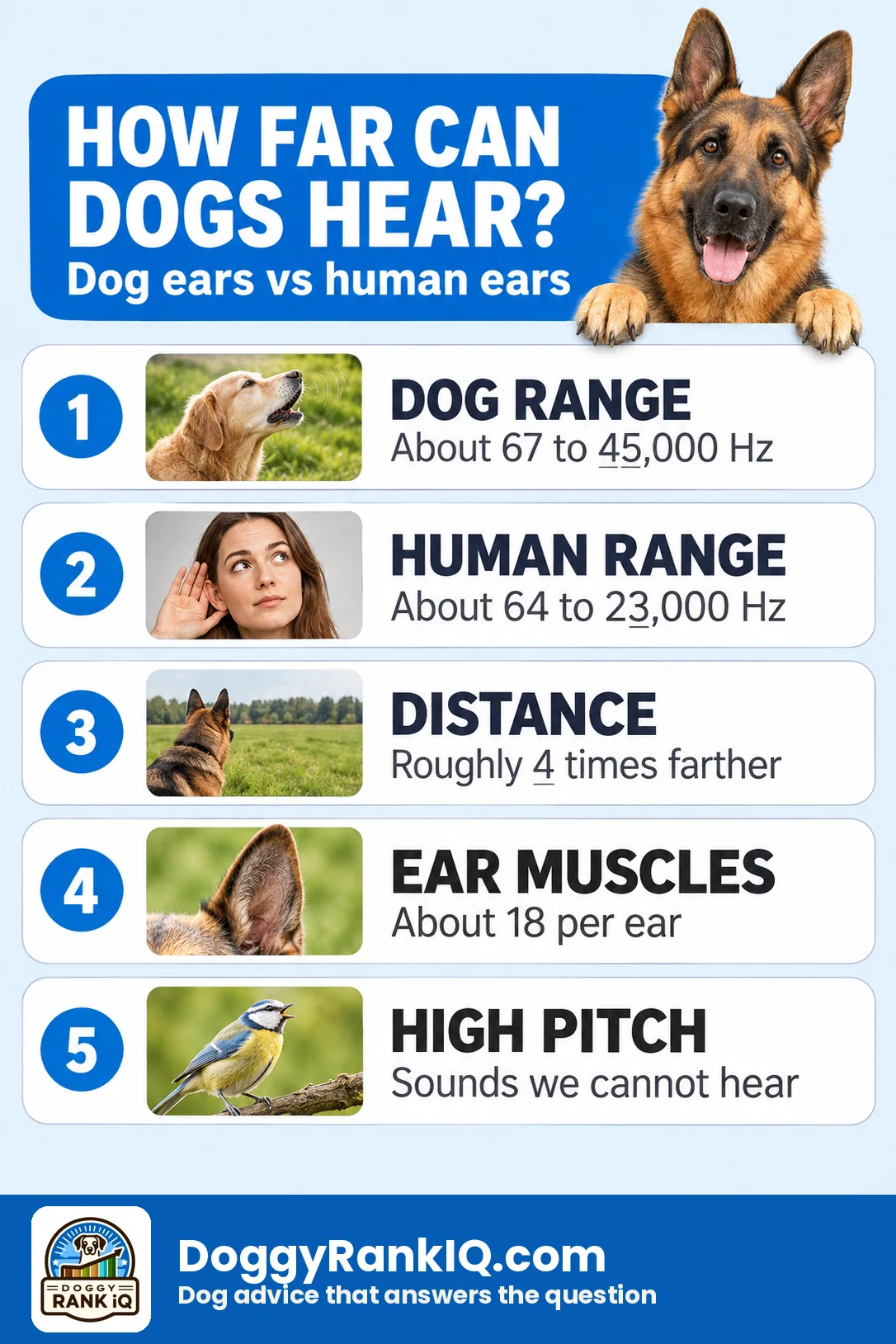
How far can dogs hear compared to people? Dogs detect some sounds up to four times quieter than humans at the same distance, which can translate into a longer detection range outdoors, though the exact number depends on pitch, wind, and background noise (npsa.gov.uk). The commonly cited frequency range for dogs is about 67 Hz to 45,000 Hz, against roughly 20 Hz to 20,000 Hz for people (lsu.edu). There is no single distance figure that applies to every dog, every sound, and every yard. The sections below give ranges instead of one number, plus a table you can actually use.
Key Takeaways: how far can dogs hear
- The question of how far can dogs hear has no single answer. It depends on pitch, loudness, wind, and surroundings.
- Dogs hear higher frequencies than people, up to roughly 45,000 Hz in commonly cited ranges, versus about 20,000 Hz for an adult human (lsu.edu, akc.org).
- The “four times the distance” rule of thumb from the NPSA describes a sound-quietness advantage, not a guaranteed range multiplier (npsa.gov.uk).
- Dogs have about 18 muscles per ear, letting them swivel and locate a sound source fast (caninejournal.com).
- Low-frequency hearing is similar between dogs and humans, so the big gap shows up at the high end, not the bass end (npsa.gov.uk).
- Hearing fades with age in dogs the same way it does in people, and a BAER test can measure how much.
- Loud, sudden noise like fireworks or close gunfire can frighten dogs and, at close range, damage their hearing.
- A 2024 University of Padova study measured dog hearing thresholds directly using behavioral testing, not just brainstem responses (pmc.ncbi.nlm.nih.gov).

What do you want to know?
Tap an option to see the answer.
The short answer: how far can dogs hear?
There is a popular claim that dogs hear sounds about four times farther away than people. That number comes from a real relationship, not a guess, but it is a rule of thumb, not a fixed measurement you can apply to every situation.
The United Kingdom’s National Protective Security Authority explains the mechanism: dogs can detect some sounds at intensities roughly four times quieter than what a human ear can pick up (npsa.gov.uk). Sound intensity drops by about 6 decibels every time distance doubles. Put those two facts together and a quieter detection threshold can stretch into a meaningfully longer detection distance, under comparable outdoor conditions.
But the NPSA is careful not to promise four times the distance in every case (npsa.gov.uk). The advantage is strongest for quieter, higher-pitched sounds. At low frequencies, dogs and humans hear in a similar range, so the car-door-slam your dog “hears from three houses away” might be more about attention and ear shape than raw range.
Decision rule: if the sound is high-pitched and quiet (a dog whistle, a mouse, a distant electronic beep), expect a dog’s advantage to be real and sometimes dramatic. If the sound is low-pitched and loud (thunder, a passing truck), the distance advantage shrinks.
The real range: pitch vs distance
How far a dog hears a given sound depends more on its pitch than on any single “dog superpower” number. Higher frequencies carry dog-specific sensitivity advantages. Lower frequencies do not.
Louisiana State University’s veterinary hearing data, compiled from researcher Heffner’s behavioral work, puts the canine range at roughly 67 Hz to 45,000 Hz, against about 64 Hz to 23,000 Hz for people (lsu.edu). Other current sources describe a wider canine ceiling. The American Kennel Club’s 2026 review cites approximately 47,000 to 65,000 Hz as the upper range some dogs reach, compared with about 20,000 Hz for the average adult human (akc.org).
These numbers do not fully agree with each other, and that is expected, not a mistake. LSU’s own hearing range page notes that differences in breed, individual dog, test method, sound intensity, and where researchers draw the line for “audible” all shift the reported ceiling (lsu.edu). There is no single biological limit stamped on every dog’s ears.
A 2024 peer-reviewed study out of the University of Padova, led by Cécile Guérineau and colleagues, measured hearing thresholds in nine dogs using a behavioral staircase method rather than relying only on electrical brainstem response testing (pmc.ncbi.nlm.nih.gov). The average threshold was 19.5 dB SPL at 0.5 kHz, 14.5 dB SPL at 4 kHz, and 8.5 dB SPL at 20 kHz, meaning the dogs were actually more sensitive at 20 kHz than at 4 kHz on average (pmc.ncbi.nlm.nih.gov). One dog skewed that average heavily, so the researchers called for larger samples before treating the result as settled (pmc.ncbi.nlm.nih.gov).
Older behavioral research by H. E. Heffner tested four dogs and found a detectable range near 63 Hz to 47 kHz at higher sound intensities, with peak sensitivity, meaning tones detectable below 10 dB SPL, sitting around 4 to 16 kHz and centering near 8 kHz (pmc.ncbi.nlm.nih.gov). That 8 kHz peak shows up again and again in dog hearing research, and it roughly matches the pitch of a squeaky toy or a rodent’s distress call.
Common mistake: assuming one frequency number applies to “how far” a dog hears everything. Pitch and loudness both matter, and they interact differently for every sound.
Facts table: dog vs human hearing
This table answers “how far can dogs hear” at a glance.
How far can dogs hear in the house, at night, thunder and your heartbeat?
Inside a house, dogs hear through walls and closed doors fairly well, because the low-frequency rumble of footsteps, engines, and voices travels through structures more easily than high-pitched sound. A dog curled up two rooms away often reacts to a garage door or a car in the driveway before a person does, not because the dog has magic ears for distance but because it is listening constantly and reacting to the lowest-effort cue.
At night, background noise drops, which effectively extends how far a sound travels before it disappears into ambient hum. A quiet house plus a dog’s lower detection threshold means normal nighttime sounds, a floorboard, a neighbor’s car, can seem to trigger alert barking “from nowhere.” It is usually not a new sound. It is the same sound with less competition.
Thunder sits mostly at low frequency, where dogs and humans hear similarly, but thunder is loud and unpredictable, and many dogs react with fear rather than curiosity. That is a behavior and sound-aversion issue more than a hearing-range one. Readers managing a thunder-reactive dog may find our guide on why dogs howl useful for understanding vocal stress responses.
The claim that a dog can hear a human heartbeat at a specific distance is popular online, but there is no verified study in the sources reviewed here that puts a number on that distance. Dogs likely can pick up a heartbeat at very close range, where their sensitive hearing and proximity both help, but any specific footage range circulating online should be treated as unconfirmed rather than established science.
Dogs’ hearing range compared to humans
Dogs and humans overlap heavily at low and mid frequencies, and the gap opens wide at the high end. That is the clearest way to compare the two.
Human hearing centers on speech frequencies, roughly 128 to 4,000 Hz for easiest detection, which is no accident given how people evolved to communicate (npsa.gov.uk). Dogs are especially sensitive across a broader band, roughly 200 to 15,000 Hz according to the NPSA’s practical sensitivity description, with their frequency ceiling extending well past anything a person can register (npsa.gov.uk).
This is why a dog whistle (often in the 23,000 to 54,000 Hz range depending on the model) works on dogs and is silent to people. It is also why electronics with a high-pitched whine, like an old CRT television or a failing appliance, can bother a dog long before anyone else in the house notices anything.
Example: a rodent’s distress squeak often lands near 20 to 50 kHz, squarely inside dog territory and mostly or fully outside human hearing (akc.org). That is one reason a dog can “hear” a mouse in the wall that a person cannot hear at all, independent of distance.
How far can dogs smell vs hear?
Smell and hearing are different senses with different physics, so comparing their “range” directly is a stretch, but dogs outperform humans substantially in both. A dog’s nose relies on scent particles carried by air currents, which can travel and linger over long distances depending on wind and humidity, while hearing relies on sound waves that fade predictably with distance. For a full breakdown of how scent detection works and where its real limits are, see our guide on dog sense of smell.
The practical difference for owners: a dog’s nose often picks up something before the ears do, especially outdoors, because scent trails persist after the source has moved on. Hearing tends to be the faster real-time alert system, especially for sudden or high-pitched sounds.
👂 Why some dogs hear less: coat color, age and the Dalmatian numbers
Range charts describe a dog with two working ears. A fair number of dogs do not have that.
Inherited deafness in dogs is tied to the genes behind white and merle coats. The pigment cells that color the coat also keep part of the inner ear alive, and when they are missing there, the hearing cells die off in the first weeks of life. George Strain’s long-running data set at Louisiana State University puts Dalmatians at the top: roughly 30 percent are deaf in one or both ears, and most of those are deaf on one side only. Bull Terriers, Australian Cattle Dogs, English Setters and double-merle Australian Shepherds also show up often in his numbers.
A dog who is deaf in one ear acts almost normal at home. The giveaway is direction. Call from another room and the dog looks the wrong way first, because locating a sound takes two ears. How far can dogs hear with one ear? About as far, with trouble telling where the sound came from.
Age takes hearing more slowly. High pitches go first, usually in the last third of a dog’s life, which is why an old dog may still hear a low voice and a dropped pan but sleep through the doorbell. Owners often read this as stubbornness. Stamp a foot on the floor or flick a light before touching a sleeping senior, and teach a hand signal for “come” while the dog can still hear the word that goes with it.
“High notes go first. The doorbell disappears years before your voice does.”
The silent dog whistle belongs here too. Francis Galton built the first one in 1876 to test the upper limit of hearing in people and animals, and found that small dogs and cats reacted to notes he could not hear himself. A modern whistle works on the same principle. It only reaches a dog whose high-frequency hearing is intact, so an older dog who ignores it may not be ignoring you.

⭐ Top 5 Features We Love
- Mobility. About 18 muscles per ear let a dog swivel toward a sound almost instantly, pinpointing direction without turning the whole head (caninejournal.com).
- High-frequency range. The ability to hear up to roughly 45,000 to 65,000 Hz opens up a world of sound, rodents, electronics, other dogs, that people simply cannot access (lsu.edu, akc.org).
- Peak sensitivity near 8 kHz. This matches many everyday cues dogs care about, including squeaky toys and certain alert tones (pmc.ncbi.nlm.nih.gov).
- Breed-shaped ear design. Upright ears in breeds like German Shepherds can funnel sound more directly, though floppy-eared breeds are not necessarily worse at low-frequency hearing, just differently shaped for sound collection.
- Fast behavioral response. Dogs orient toward sound faster than most people, useful for everything from recall training to simply noticing a delivery truck two minutes before the doorbell rings.
⚠️ Things to Look Out For
A few cautions for anyone asking “how far can dogs hear”:
- Sudden loud noise. Fireworks, gunfire, and close thunder can frighten dogs and, at close range or repeated exposure, contribute to hearing damage.
- Age-related decline. Hearing fades with age in dogs much as it does in people. A veterinarian can run a BAER test (brainstem auditory evoked response) to measure actual hearing loss rather than guessing from behavior alone.
- Chronic ear problems. Infections and wax buildup can reduce hearing sensitivity long before true deafness sets in. Routine ear care matters; see our guide on how to clean dog ears for a safe approach.
- Overestimating distance claims. Viral claims about dogs hearing specific heartbeats or sounds from exact mile distances are not supported by the sources reviewed here. Treat specific unsourced numbers with skepticism.
- Confusing fear with aggression. A dog that reacts badly to a loud sound is often scared, not defiant. Always confirm any suspected hearing or behavior change with your veterinarian rather than guessing at home.
How to protect your dog’s hearing
Protecting a dog’s hearing starts with reducing unnecessary close-range exposure to loud, sudden sound and giving a frightened dog somewhere quiet to go. This matters most during fireworks season, thunderstorms, and any event involving sustained loud noise like concerts or construction near the home.
Practical steps:
- Create a quiet, enclosed space (a covered crate or interior room) during fireworks or storms.
- Avoid close-range exposure to gunfire, firework launches, or heavy machinery whenever possible.
- Watch for signs of noise fear: pacing, panting, hiding, or trying to escape a yard during loud events. Our guide on separation anxiety in dogs covers some overlapping stress behaviors worth recognizing.
- Ask your veterinarian about noise-fear management options if a dog consistently struggles, since repeated panic responses can be addressed with a real plan rather than just waiting it out.
- If you suspect hearing loss rather than fear, a veterinary BAER test is the only reliable way to confirm it. Please confirm any hearing or health concern with your veterinarian before assuming the cause.
Helpful ear protection and training tools
A few owner-reported tools come up often for noise-sensitive dogs and recall training built around a dog’s strong high-frequency hearing.
The Happy Hoodie Calming Band for Dogs is a stretchy wrap some owners use during grooming, storms, or stressful events to apply gentle, consistent pressure around the ears and head. Price checked 2026: $12.99. Check the current price.
For recall training that takes advantage of a dog’s sensitivity to high pitches, the Adjustable Ultrasonic Dog Whistle for Recall Training lets owners tune the frequency to a range dogs hear clearly and most humans cannot. Our guide on how to teach a dog recall covers training steps alongside tool choice. Price checked 2026: $8.99. Check the current price.
The Calming Anxiety Vest for Dogs, Small applies gentle pressure across the torso and is reported by some owners to help with general noise-related anxiety during storms or fireworks. Price checked 2026: $38.99. Check the current price.
For readers who want to go deeper into the science of canine senses, the book Inside of a Dog by cognitive scientist Alexandra Horowitz is a widely recommended read on how dogs experience the world through smell, hearing, and perception. Price checked 2026: $11.21. Check the current price.
For a deeper comparison of ear protection options specifically, our article on dog ear protection, Happy Hoodie vs Rex Specs breaks down fit and use case. Confirm any product choice fits your dog’s size and sensitivities, and check with your veterinarian if your dog has an existing ear condition.

FAQ: how far can dogs hear
The bottom line: how far can dogs hear?
How far can dogs hear is not a one-number question, and any article that gives you a single distance is skipping the details that actually matter: pitch, loudness, wind, and the sound’s surroundings. Dogs reliably beat humans at high frequencies and quieter sounds, hold a similar range at low frequencies, and use fast, mobile ears to locate a source quickly. If your dog struggles with loud noise, start with a quiet space and a conversation with your veterinarian rather than guessing at the cause.
Doggy Rank IQ is reader supported. As an Amazon Associate we earn from qualifying purchases, at no extra cost to you.