
Quick Answer
A gunner kennel earns its reputation from one documented crash test, not a vague marketing claim: the G1 Intermediate passed Center for Pet Safety testing in June 2015 with a 75-pound test dog and held together, kept its door shut, and retained the dog. Lucky Duck matches that story for bigger dogs: its Large kennel is CPS-certified for a 110-pound test dog, a size Gunner’s G1 line does not currently cover. The real gap between these brands isn’t marketing copy, it’s which specific size and tie-down setup actually carries a certification, and for which dog.
Key Takeaways: gunner kennel
- A Gunner is CPS-certified in Small, Medium, and Intermediate only. There is no CPS-certified Large G1 on the current register, according to the CPS Certified Products list.
- Lucky Duck’s Lucky Kennel is certified in Medium, Intermediate, and Large, with the Large rated for a 110-pound test dog.
- The Gunner G1 Intermediate test used a 75-pound dog, protocol CPS-002-016.01, test number V15572, back in June 2015.
- Certification covers the whole tested setup (straps included), not every accessory. Lucky Duck’s metal door option was not part of its certified configuration.
- A Gunner costs roughly the same as a comparable Lucky Duck model; price is not the deciding factor here.
- If the dog weighs more than 75 pounds, Lucky Duck’s certified Large currently has documentation that Gunner’s lineup does not match.
- Both brands require the specific certified tie-down method to claim the tested protection; swapping straps voids the comparison.

Where does the kennel ride?
Check the current price
Tap an option to see the answer.
 What is a gunner kennel?
 What is a gunner kennel?
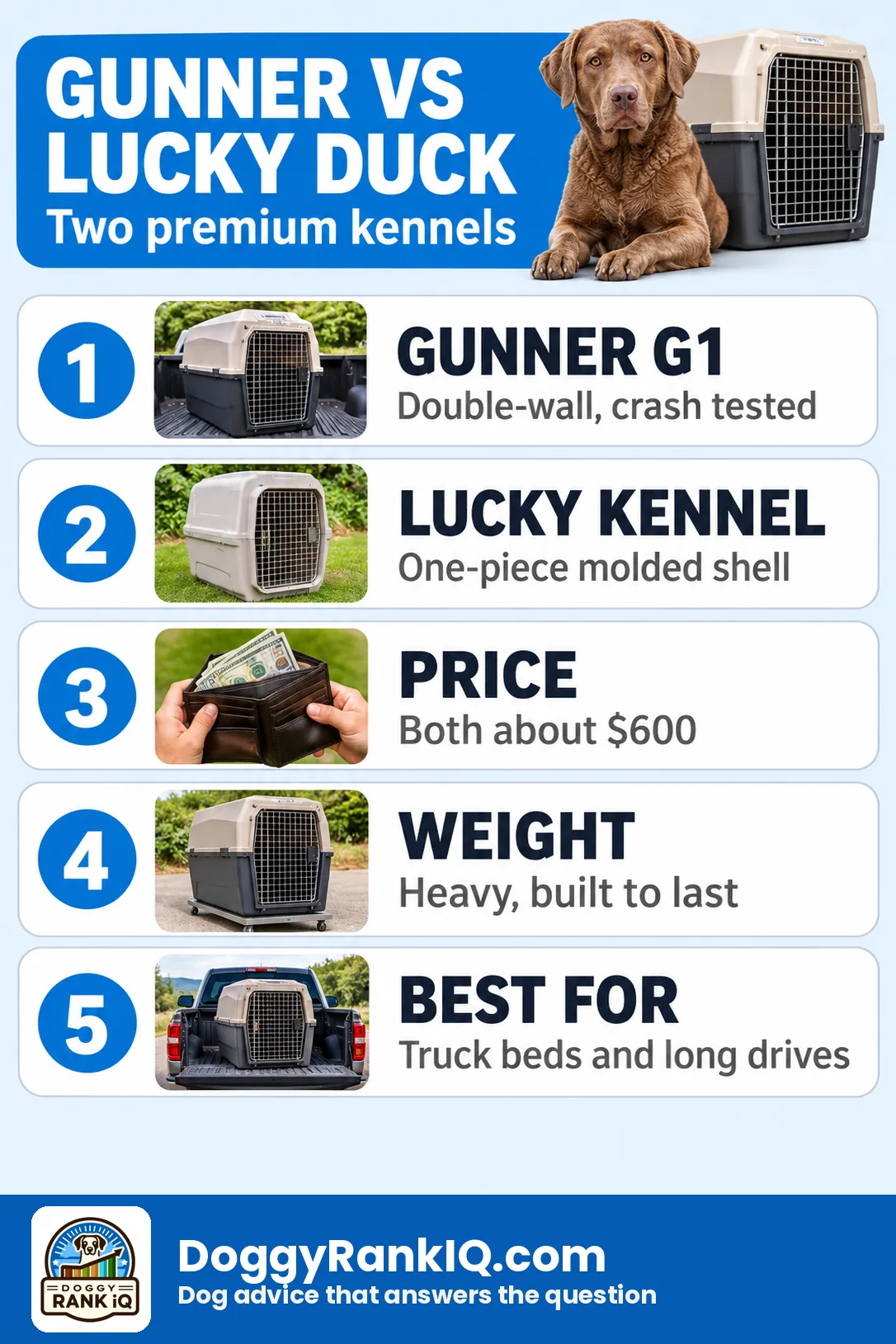
A Gunner is a double-wall rotomolded plastic dog crate built for vehicle and truck bed travel, with at least three of its sizes independently crash tested by the Center for Pet Safety. It’s not a soft carrier or a wire cage. It’s closer in concept to a hard-sided cooler, with an inner shell and outer shell separated by an air gap that absorbs impact.
The company markets the G1 line as its flagship crate, built for hunters, truck owners, and anyone who regularly drives with a dog loose enough in the vehicle that a crash could turn the crate into a projectile. Gunner’s own safety page leans heavily on the CPS results rather than in-house claims, which is part of why the brand has a reputation that outpaces most competitors in this niche.
A Gunner is not sold as a breed-specific product. It’s sized by dog weight and crate dimensions, not by breed, so a Labrador, a pit mix, and a mutt of similar size and weight can all use the same model as long as the measurements line up.
Is a Gunner Kennel worth it?
For a dog under 75 pounds riding in a vehicle with anchor points for the specified straps, a Gunner is one of the few crates with an independent crash test behind it, and that documentation is worth the price for anyone who drives with a dog regularly.
The crate itself is built from double-wall rotomolded plastic, a manufacturing process that creates an air gap between an inner and outer shell. That’s not decoration. It’s the same basic idea behind a hard-sided cooler, and it’s why the kennel shrugs off impacts that would crack a single-wall plastic crate from a big-box store.
Here’s where the “worth it” math gets specific instead of hand-wavy:
- Choose a Gunner if the dog weighs under 75 pounds, the vehicle has real anchor points (floor rings, cargo tie-downs, or a truck bed rail system), and the dog rides along often enough that a crash scenario is a real, non-trivial risk.
- Skip it if the dog only travels a few times a year for short local trips, or the dog’s weight puts it outside every size Gunner currently has certified.
Owners who hunt, who haul a truck bed kennel daily, or who make long highway drives tend to report the crate holding up through years of loading and unloading, not just a lab test, a pattern echoed in Field & Stream’s hunting kennel roundup. That kind of repeated real-world stress is arguably a better predictor of long-term value than the crash test alone, though the crash test is still the only independently verified data point either brand has.
A quick example: a hunter who drives a truck 45 minutes each way to a lease several times a season, with the dog riding in the bed in a mounted crate, is squarely in the group that benefits most from a Gunner. A household that drives the dog to the vet twice a year in a sedan back seat is a much weaker case for spending $600.
Gunner kennel dog breeds available
A Gunner is not sold by breed, it’s sold by crate size matched to dog weight and measurements, so there’s no “breeds available” list the way there would be from a breeder. Buyers choose Small, Medium, Intermediate, or Large based on the individual dog’s build, not its breed name.
That said, in practice certain breeds show up more often with specific sizes:
- Small (certified for a 30-pound test dog): smaller spaniels, terriers, and mixed breeds in that weight class.
- Medium: mid-size retrievers-in-training, border collies, and similar builds.
- Intermediate (certified for 75 pounds): Labrador retrievers, pointers, and other mid-to-large hunting breeds, which is why this size shows up constantly in hunting dog gear reviews like CNN Underscored’s crash-tested crate guide.
- Large (not currently CPS-certified): bigger dogs such as German shorthaired pointers on the heavier end, Labradors over 75 pounds, or larger mixed breeds, though buyers in this category should know they’re relying on general construction claims rather than a crash test.
Why are GUNNER crates so expensive?
A Gunner costs $600 for a Small because the price reflects rotomolded double-wall construction, a documented crash test, and a company that absorbs the cost of CPS testing instead of skipping it.
Rotomolding is slower and more expensive than injection molding, the process used for most budget plastic crates. The mold is filled with plastic powder, then rotated inside an oven so the material coats the inside evenly and forms two bonded walls around an air pocket. That process is partly why a basic wire crate costs $40 and a rotomolded double-wall kennel costs well over $500.
Independent crash testing through the Center for Pet Safety is voluntary and not cheap, and CPS states it does not accept funding from the manufacturers whose products it certifies, according to its own certified products page. That arrangement is part of why the certification carries weight: it isn’t a manufacturer-run press release dressed up as a lab result.
A few things the price is not paying for:
- A certification for every size. The G1 Large is not on the CPS certified list, so buying that size does not come with the same documented protection as the Small, Medium, or Intermediate.
- A blanket cold-weather guarantee. CPS notes the Gunner Small’s certification does not extend to the cold-weather door accessory.
- Automatic protection with any strap. The certified setup uses Gunner’s specified anchor straps, detailed on the brand’s own G1 Kennel product page. A different ratchet strap from a hardware store is an unknown variable, not a tested one.
Manufacturer figures like “4,000 pounds of force” or a drop test from height circulate in marketing material, but those numbers describe different test conditions, not the CPS vehicle-crash protocol, and shouldn’t be read as interchangeable with certification.
How much does a gunner kennel cost?
A Gunner starts around $600 for the Small size, with Medium, Intermediate, and Large models priced higher depending on the retailer, and pricing stays close between Gunner and Lucky Duck for comparable sizes. There’s no budget tier in this category: both brands sit in the premium bracket because of the rotomolding process and the cost of independent crash testing.
Buyers should expect:
- Small: roughly $600, based on current Amazon listings.
- Intermediate and larger sizes: prices vary by retailer and often run higher than Small, since more material and larger molds are involved.
- Accessories (cold-weather doors, metal door upgrades, mounting hardware): sold separately and, as noted above, often excluded from the CPS certification.
Because the Small and Intermediate sizes sit in a similar price band to Lucky Duck’s comparable models, cost shouldn’t be the deciding factor. Fit, dog weight, and which size actually carries a current certification matter more.
Gunner kennel hunting dogs reviews
Owner feedback and outdoor publications consistently describe the Gunner as a favorite among hunters who load dogs into a truck bed on rough roads and need a crate that survives years of that abuse, not just a single lab test. Field & Stream’s 2026 roundup of hunting dog kennels repeatedly points to rotomolded double-wall crates, including Gunner’s, as the standard for dogs that ride in truck beds across hunting seasons.
Common themes in hunting-focused reviews:
- Durability through repeated loading and unloading matters as much as the crash test itself for this buyer group.
- Insulation from the double wall helps in both summer heat and winter cold during long days in the field.
- Weight is a recurring complaint: an empty Intermediate or Large crate is heavy enough that loading it into a truck bed alone is awkward, a point echoed in several owner reports. (centerforpetsafety.org)
Gunner kennel vs other bird dog breeders
This heading phrase doesn’t apply to the Gunner Kennels crate brand, since Gunner is a gear manufacturer, not a breeder of bird dogs or any other breed. Buyers searching for bird dog breeders should look at kennel clubs or breed-specific training programs rather than this product line; Gunner’s business is crash-tested transport crates, not puppies.
If the search intent is actually about equipment for bird dogs, the more useful comparison is the one this article already covers: Gunner’s G1 line against Lucky Duck’s Lucky Kennel, sized to the individual hunting dog’s weight.
Gunner kennel training programs, what’s included
Gunner Kennels does not run dog training programs; the company sells crates, mounting hardware, and related travel accessories, not obedience or hunting training services. Anyone searching for training programs attached to the name “Gunner” is likely thinking of a different business, possibly a breeder or training kennel with a similar name.
For actual training resources, owners starting with a new dog may find more value in a guide like 5 essential commands every puppy should learn, which covers foundational obedience work separate from any crate purchase.
How to buy a puppy from Gunner Kennel
Gunner Kennels does not sell puppies. The company is a crate and gear manufacturer, so there is no puppy purchase process, litter list, or breeding program associated with the brand covered in this comparison. Searches combining “Gunner” with puppy buying are most likely confusing the crate brand with an unrelated breeder of the same or similar name.
Anyone looking to buy a crash-tested crate for an existing dog should instead follow the sizing steps later in this article, matching the dog’s measured weight to a CPS-certified model from either Gunner or Lucky Duck.
Are gunner kennel dogs good family pets or hunting only?
This question doesn’t apply to the Gunner Kennels crate brand, since “Gunner dogs” implies a breeding operation rather than a gear company. The Gunner crate itself is built for both hunting use and ordinary family transport; it’s not restricted to one or the other.
In practice, the crate shows up in two main use cases:
- Hunting and working dogs: truck bed mounting, daily loading, exposure to weather and rough terrain.
- Family travel: SUV or car cargo area use for road trips, vet visits, or regular commuting with a dog, where crash protection matters even without a hunting context.
Gunner kennel health guarantee and return policy
Gunner Kennels’ return and warranty terms apply to the crate as a manufactured product, not a health guarantee, since the company does not sell live animals. Buyers should check the retailer’s own return window (Amazon listings carry standard Amazon return policies) and Gunner’s own warranty terms on its site rather than expecting a pet health guarantee, which is a different category of policy entirely associated with breeders.
Gunner kennel location and can you visit?
Gunner Kennels operates as a gear brand selling through its own site and retailers like Amazon rather than a physical kennel facility open for visits in the way a breeding kennel might be. There is no puppy viewing location associated with this brand, since it manufactures crates rather than breeding dogs.
Gunner kennel puppies available now
Gunner Kennels does not have puppies available, now or at any other time, because the company does not breed or sell dogs. This search phrase is almost certainly intended for an unrelated breeder. For dog owners who already have a puppy and are shopping for travel gear, a crash-tested crate sized correctly for the puppy’s expected adult weight, or a properly sized airline-approved dog carrier for flights, is the more relevant next step.
Common issues with gunner kennel dogs
Since Gunner Kennels is a crate manufacturer, there are no “Gunner dogs” in the breeding sense, so there’s no health issue list tied to a bloodline. The common issues reported actually relate to the product:
- Crates in the Intermediate and Large sizes are heavy enough that loading them solo into a truck bed is difficult.
- Accessory doors (cold-weather or metal upgrades) can fall outside the CPS-certified configuration, so owners who want the tested protection should stick with the standard door unless they’ve confirmed accessory compatibility.
- Strap substitution is a frequent and preventable mistake: using a different brand of tie-down strap means the setup no longer matches the tested configuration.
Gunner kennel alternatives, similar breeders
Since Gunner Kennels isn’t a breeder, the relevant “alternatives” are competing crate brands, and Lucky Duck is the clearest comparison point in this category, particularly for dogs over 75 pounds where Gunner’s current lineup has no CPS certification. Other owners researching this space often also compare general crate durability and sizing guidance found in resources like a best dog crate pad guide for adding comfort inside a hard-sided crate, or a dog car seat cover guide for protecting upholstery around the crate.
Gunner vs Lucky Duck by size and certification
The short version: Gunner wins on documentation age and consistency across its mid-size range, Lucky Duck wins on large-dog certification, and pricing between the two brands is close enough that size fit should decide the purchase, not cost.
| Model | CPS Certified Sizes | Test Dog Weight | Year Tested | Price (2026) |
|---|---|---|---|---|
| Gunner G1 Small | Small | 30 lb | 2017 | $600.00 |
| Gunner G1 Intermediate | Intermediate | 75 lb | 2015 | varies by retailer |
| Gunner G1 Large | Not certified | n/a | n/a | varies by retailer |
| Lucky Duck Lucky Kennel Medium | Medium | 50 lb | 2024 | varies by retailer |
| Lucky Duck Lucky Kennel Intermediate | Intermediate | not specified in CPS record | varies | $599.99 |
| Lucky Duck Lucky Kennel Large | Large | 110 lb | 2021, recertified 2022 | varies by retailer |
The Gunner G1 Small Kennel and the Lucky Duck Lucky Kennel Intermediate are the two models with current Amazon listings at the prices above, checked 2026.
Check the current price on the Gunner G1 Small. Check the current price on the Lucky Duck Lucky Kennel Intermediate.
What the Center for Pet Safety record covers, size by size
Each certification applies only to the exact size and tie-down setup CPS tested, so a buyer needs to match the dog’s weight to the specific certified model, not the brand name in general.
Here’s what the current CPS register actually documents:
- Gunner G1 Small: passed in June 2017 with a 30-pound test dog, 5-star rating, dual certification in both crate and carrier categories, per the Gunner G1 Small CPS record. The cold-weather door accessory is excluded from that certification.
- Gunner G1 Intermediate: passed in June 2015 with a 75-pound test dog, protocol CPS-002-016.01, test number V15572. CPS reported the anchor straps held, the crate didn’t strike the seatback, there was no structural failure, the locked door stayed shut and still opened easily afterward, and the test dog was retained, according to the Gunner G1 Kennel Intermediate test record.
- Gunner G1 Medium: listed as certified on the current CPS register, filling the size gap between Small and Intermediate.
- Gunner G1 Large: not on the certified list, so buying this size means relying on the brand’s general construction and marketing claims, not an independent crash record. This matches what appears on Gunner’s own G1 Kennel product listings, which do not reference CPS data for the Large.
- Lucky Duck Medium: certified in January 2024 with a 50-pound test dog, test number V24019, 5-star rating under the same CPS-002-016.01 protocol.
- Lucky Duck Intermediate: also listed as certified, sitting between the Medium and Large.
- Lucky Duck Large: certified for a 110-pound test dog, originally in April 2021 and recertified in November 2022. CPS specifically flags that the metal door accessory was not part of the tested configuration. The certified setup used the standard injection-molded door, according to the Lucky Kennel Large CPS record.
A common mistake: assuming a certification for one size applies to every size in that product line. It doesn’t. CPS tests and certifies size by size, strap setup by strap setup.
Measuring the dog and the vehicle
A kennel that’s certified on paper only protects the dog if the size actually fits the dog and the vehicle, so measure before ordering rather than after.
Start with the dog standing naturally, not stretched:
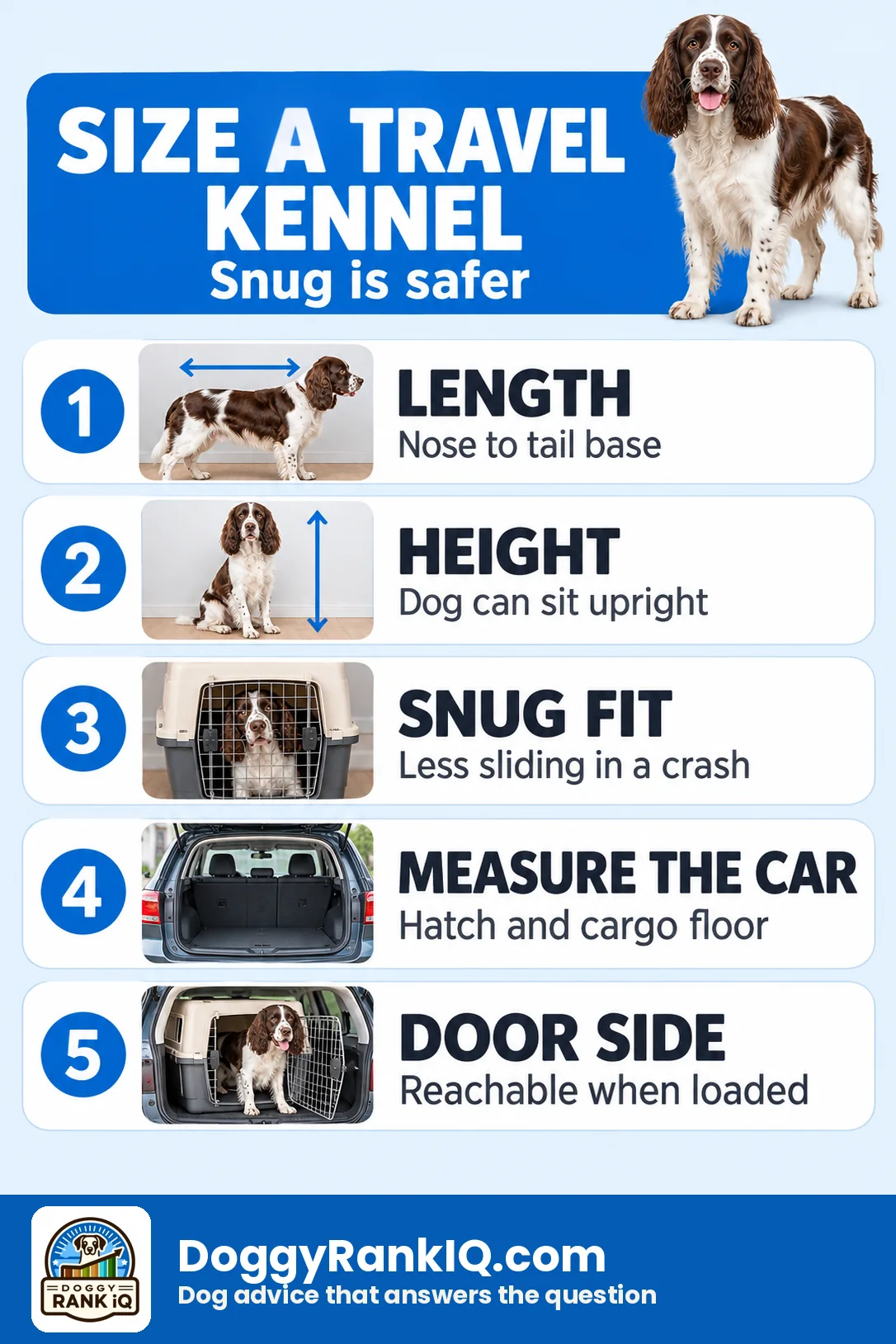
- Length: nose to base of tail, then add 2 to 4 inches for a crate the dog can turn around in comfortably.
- Height: floor to the top of the head or ears, whichever is taller, plus a few inches of headroom.
- Weight: compare to the CPS test dog weight for the size being considered, not just the manufacturer’s generic weight range.
Then check the dimensions of the vehicle:
- Measure the cargo area or truck bed opening, including any wheel wells that narrow the usable space.
- Confirm the anchor points line up with the straps that came with the kennel; a crate without a matched tie-down setup isn’t tested the way CPS tested it.
- For SUVs, check that the kennel clears the hatch when it closes, not just when it’s open.
A real example: a 65-pound Labrador fits the certified 75-pound Gunner Intermediate with room to spare, but the same dog would be undersized for the Lucky Duck Large, built and tested around a 110-pound dog. Bigger isn’t automatically safer. It’s a different test condition entirely.
⭐ Top 5 Features We Love
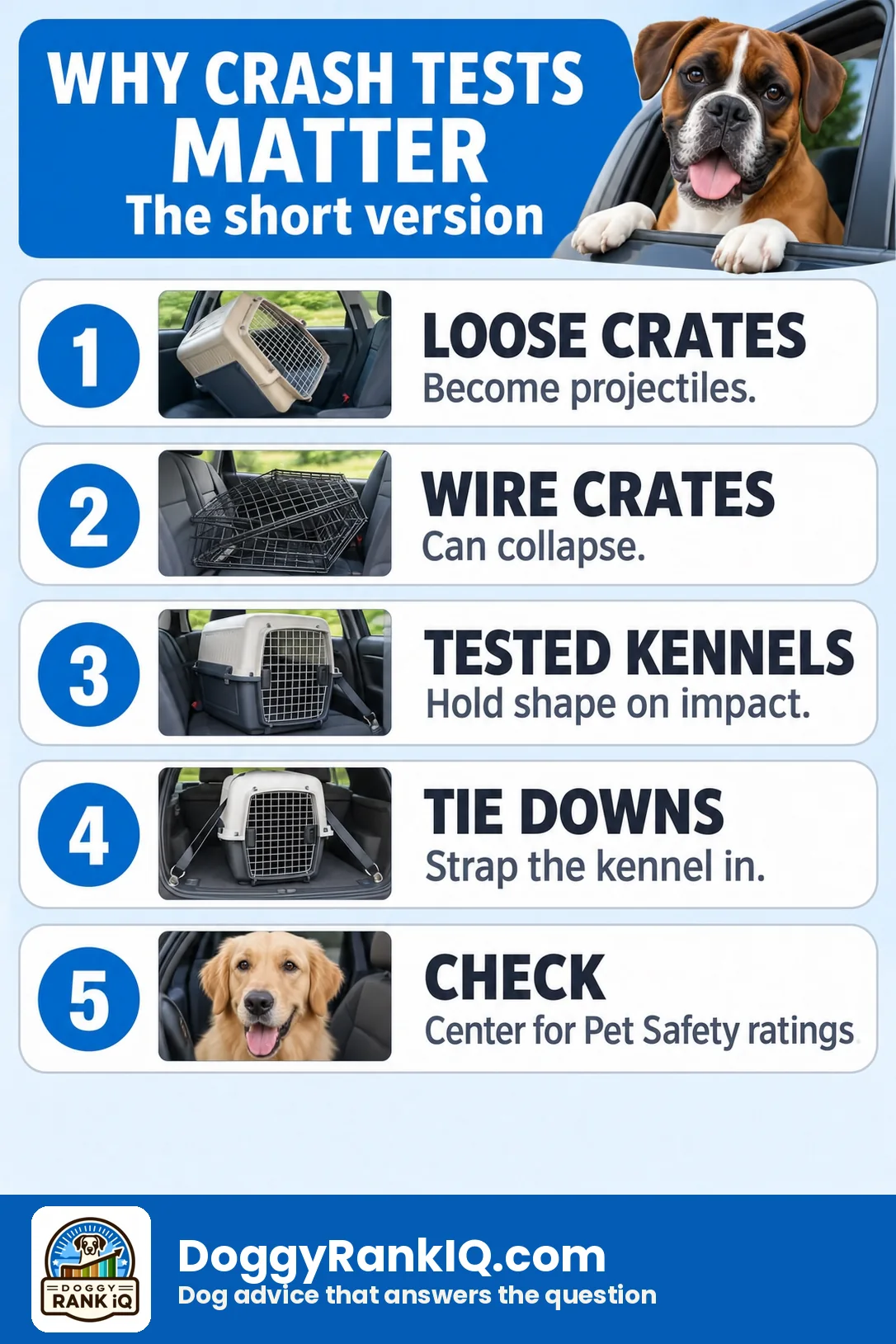
- Documented crash data, not just a durability claim. Both brands can point to an actual CPS test number and date, which is more than most dog crates on the market can say.
- Double-wall rotomolded construction. The air gap between walls absorbs impact in a way single-wall plastic crates can’t match.
- Size-specific certification transparency. CPS publishes exactly which size, strap setup, and test dog weight applies, so buyers aren’t guessing.
- Truck bed compatibility. Both the Gunner line and Lucky Duck’s Lucky Kennel are built with hunters and truck owners in mind, with mounting options detailed in Gunner’s own 2026 Flyway Series page.
- Large-dog coverage from Lucky Duck. A 110-pound certified test dog covers breeds that Gunner’s current lineup simply doesn’t reach.
⚠️ Things to Look Out For
- No certified Gunner Large. Anyone with a dog over roughly 75 pounds should not assume the Large G1 carries the same tested protection as the Small, Medium, or Intermediate.
- Accessory doors can fall outside the certification. Lucky Duck’s metal door option and Gunner’s cold-weather door were both excluded from their respective tested setups.
- Strap substitution breaks the test conditions. Swapping in a different ratchet strap means the installation no longer matches what CPS actually certified.
- Weight is heavy to lift alone. Owner reports describe both brands as a two-person job to load into a truck bed, especially in Intermediate and Large sizes.
- Price doesn’t scale down much by size. A Small Gunner and a Large Lucky Duck sit in a similar price range despite the size difference, so budget by need, not by assuming smaller means cheaper.
Who should buy which, and who can skip both
Choose a Gunner if the dog weighs under 75 pounds and the vehicle has anchor points that match Gunner’s specified straps; choose Lucky Duck’s Large if the dog is closer to 100 to 110 pounds, since that’s the size range with documented CPS testing on Gunner’s side missing entirely.
Owners who should consider skipping both for now:
- A household with a dog under 20 pounds that rides occasionally in a well-secured carrier already appropriate for that size.
- Someone whose vehicle lacks real anchor points for straps, since neither crate’s certification applies without the tested tie-down method.
- An owner who needs a crate mainly for home use, where crash protection isn’t the relevant feature; a standard wire crate, a best orthopedic dog bed, or a guide to easing puppy crying in the crate at night may be more useful than a $600 purchase.
Long road-trip owners and hunters moving a dog in a truck bed daily are the clearest fit for either brand, since repeated loading, temperature swings, and highway miles are exactly the stress both crates are designed to absorb over years of use, not just a single test day at a lab.
FAQ
The bottom line
A Gunner earns its price through one thing competitors mostly skip: an actual, size-specific crash test with a public record. That record is strongest for dogs under 75 pounds. Above that weight, Lucky Duck’s certified Large, tested with a 110-pound dog, currently has the documentation Gunner’s lineup lacks. Before buying either, measure the dog, measure the vehicle, confirm the exact size against the CPS record, and use the straps that came with the kennel. The certification only means what it was tested to mean, nothing more.
If the dog also deals with car-related stress or whining on the road, a look at how talking to your dog affects behavior or the signs of separation anxiety might help before the next long drive.
Doggy Rank IQ is reader supported. As an Amazon Associate we earn from qualifying purchases, at no extra cost to you.